ABSTRACT
KELLEY, CHRISOPHER MICHAEL. Moving Beyond the Verbal Learning Domain: An Empirical Investigation of the Effectiveness of Feedback Parameters on Learning. (Under the direction of Dr. Anne Collins McLaughlin).
Moving Beyond the Verbal Learning Domain: An Empirical Investigation of the Effectiveness of Feedback Parameters on Learning
by
Christopher M Kelley
A dissertation submitted to the Graduate Faculty of North Carolina State University
in partial fulfillment of the requirements for the degree of
Doctor of Philosophy
Psychology
Raleigh, North Carolina 2014
APPROVED BY:
_______________________________ ______________________________ Dr. Anne Collins McLaughlin Dr. Douglas J. Gillan
Committee Chair
Dedication
Biography
Christopher M. Kelley was born in San Diego, CA. He graduated from Appalachian State University in 2005 with a Bachelor of Science in Business Administration – Computer Information Systems.
Acknowledgements
This dissertation would not have been possible without the support, encouragement and understanding of those around me. First, I would like to thank my wife, Steph. I could not have done this without your love, support and encouragement. You were always there with whatever I needed. We did this together.
I would like to thank my advisor, Dr. Anne McLaughlin. Her guidance and support were instrumental throughout this journey. I couldn’t have asked for a better advisor.
I also thank my committee members, Dr. Doug Gillan, Dr. Chris Mayhorn and Dr. Eric Wiebe. They provided invaluable comments and suggestions that contributed not only to the completion of this dissertation, but my Ph.D. as well.
Table of Contents
List of Tables ... vii
List of Figures ... viii
Summary ... 1
Critical Issues ... 1
Research Question... 3
Contributions to Theory & Application ... 5
Introduction ... 7
Feedback Parameters... 7
Learning Theories ... 8
Prior Research ... 12
Interim Summary ... 16
Overview of the Study ... 17
Method ... 19
Participants ... 19
Procedure ... 34
Design ... 35
Results ... 35
Acquisition and Retention... 36
Differences in Feedback Use ... 43
Transfer ... 46
Acquisition and Retention... 49
Transfer ... 55
Discussion ... 58
Potential Limitations ... 62
Future Research... 63
Practical Application ... 63
References ... 65
Appendices ... 70
Appendix A: Participant Materials ... 72
Informed Consent... 73
Participant Instructions ... 75
Debriefing ... 76
Demographics ... 77
Computer-Expert Screening Questions and Internet Experience ... 78
List of Tables
Table 1. Sample of Research Exami ning Feedback Effects on Learning ... 13
Table 2. Participant characteristics ... 19
Table 3. Participants’ Internet Experience ... 21
Table 4. MANOVA Summary for Participant Ability Tests ... 24
Table 5. MANOVA Summary for Participant Internet Experience ... 25
Table 6. Frequencies for the Number of Links within Experimental Stimuli... 29
Table 7. Mean Acquisition and Retention Results by Content and Timing ... 36
Table 8. Mixed-Model MANOVA Summary for Acquisition and Retention by Content and Timing ... 37
Table 9. ANOVA Summary for Time Spent Looking at Feedback by Content and Timing. ... 46
Table 10. Mean Transfer Results by Content and Timing ... 47
Table 11. MANOVA Summary for Transfer Results by Content and Timing ... 47
Table 12. Mean Sensitivity and Criterion Levels divided by Feedback Content and Timing ... 50
Table 13. Mixed-model MANOVA Summary for Sensitivity and Criterion ... 50
List of Figures
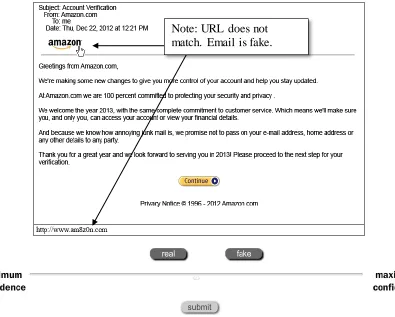
Figure 1. Example question where learning requires understanding rules that determine email authenticity. Each email was viewed individually for a trial, so no direct comparison could be made between correct and incorrect emails. Call -outs point out the comparison between URLs participants were required to make
and were not present in the task ...30
Figure 2. Example stimuli where participant had to hover the mouse cursor over ‘Amazon’ to display the destination of the link. ...32
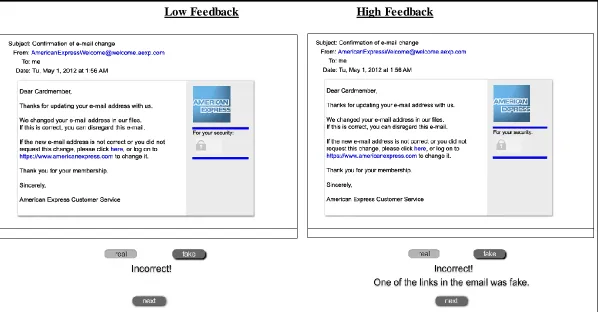
Figure 3. Example of feedback content where low (left) specified answer correctness only while high (right) provided answer correctness as well as the reason why ...33
Figure 4. Effects of Timing and Learning Stage on Accuracy (top) and Response Time (bottom)...39
Figure 5. Effects of Content and Learning Stage on Accuracy (top) and Response Time (bottom) ...40
Figure 6. Effects of Feedback Content and Timing on Accuracy. ...42
Figure 7. Effects of Feedback Content and Timing on Response Time ...42
Figure 8. Mean Time Spent Looking at Feedback. ...45
Figure 9. Effects of Content and Learning Stage on Sensitivity Levels. ...52
Figure 10. Effects of Feedback Timing and Learning Stage on Phishing Identification ...53
Figure 11. Effects of Feedback on Transfer Sensitivity. ...56
Summary
Critical Issues
The amount of instructional support required for learning remains unclear. Some advocate more support, such as immediate knowledge of results or providing worked examples, is necessary for learning as it frees the cognitive resources required to learn (Sweller, 1988); others, however, argue less support such as delayed feedback adds “desirable difficulties” that force the learner to practice the retrieval processes necessary when support is removed, such as on retention tests (see Salmoni, Schmidt, & Walter, 1984; Schmidt & Bjork, 1992), for reviews). Despite the lack of a unifying theory for feedback requirements, an examination of the literature revealed some general patterns regarding the parameters of feedback timing and content.
Feedback content is seen as more supportive when it provides information or explanation germane to the task. Content manipulations have included knowledge of response (KR; e.g., Gilman, 1969), knowledge of correct response (KCR; e.g., Kelley & McLaughlin, 2012), and elaborative feedback (Rosa & Leow, 2004). More supportive feedback content has most often improved learning for tasks that required learning concepts, relationships, or similar higher -order knowledge (e.g., Kelley & McLaughlin, 2012; Pridemore & Klein, 1995; Vollmeyer & Rheinberg, 2005; Waldrop et al., 1986). Few studies have found benefits for less supportive feedback content; however, those that did either included participants with prior knowledge of the task, added irrelevant information to the “more” feedback condition, or used a variable other than learning (i.e., strategy use) to show detrimental effects of feedback content (Goodman, Wood, & Hendrickx, 2004; Phye, Gugliemella, & Sola, 1976; Phye, 1989) Clariana, Ross, & Morrison, 1991; Phye et al., 1976). These findings are in congruence with prior research on cognitive load theory (CLT) that suggests any irrelevant information presented by instructional support imposes an extraneous load on a learners cognitive resources resulting in decreased levels of learning (Renkl, & Atkinson, 2003; Sweller, 1988). Accordingly, it appears feedback content is most effective when it encourages a learner to focus attention on the relationships within a task needed for performance.
solving, and the use of cognitive strategies offers a rich source for researchers to explore” (p.777).
Research Question
The goal of the current research was to identify empirically based feedback principles that maximize learning in a higher-order learning task. In addition, technological advancements have made distance learning and computer-based training increasingly common and as a result it is necessary to identify factors that may affect learning in non-traditional and autonomous environments. The experiment investigated the hypothesis that the type of information being learned affects the feedback parameters that maximizes learning with the following specific aims:
1. To investigate the effects of feedback content and timing in a higher-order learning task a. To test the hypothesis that content effects will be greater than timing effects when
learning requires the application of concepts, or understanding, to novel situations 2. Evaluate the effects of feedback delivered in an online, autonomous learning
environment
Historically, SDT has been used to explain perceptual experiments in which subjects had to distinguish a visual or auditory signal from noise (Green & Sweats, 1966; Macmillan & Creelman, 2007). Fundamentally, however, it is a theory about how choices are made, and moreover, how choices are made in the face of uncertainty (McNicol, 1972). In the current study, SDT was used to gain insight into whether results were the result of learning to identify phishing emails, or due to changes in behavior from an increased awareness in the likelihood of encountering a phishing email (Sheng et al., 2007).
Results were expected to show the connection between the information being learned and effective feedback. In general, the literature suggests feedback timing affects learning more than content when task performance is primarily determined by memory strength as measured by a recognition test (e.g., facts, word lists). However, it was expected the effects of feedback would be different when learning required constructing a mental model, or understanding (e.g., the application of rules and concepts, higher-order learning tasks), as measured by the ability to apply the information learned to novel situations (i.e., transfer test). Specifically, the effects of feedback content were predicted to be greater than the effects of timing on overall accuracy and the identification of phishing emails in particular. This pattern of results would be consistent with prior research that utilized complex learning tasks.
Therefore, the reasoning required for successful task performance may determine the effectiveness of feedback parameters.
Contributions to Theory & Application
This study offers multiple contributions to the scientific community. The design of this study was based on limitations of prior research identified from the literature. Past feedback research has generally focused on comparing “more” or “less” feedback and given little attention to the information being learned. As a result, feedback theories are largely based on studies from the verbal learning paradigm. The question of how the content and timing of feedback may affect learning different types of knowledge is an important one. As a result, the current study investigated feedback effects while learning concepts related to cybersecurity in a web-based environment.
Additionally, few studies, have utilized a factorial design to study the effects of content and timing. Thus, the present study employed a factorial design to allow for a comparison of content and timing effects. SDT was also used to provide a more complete picture by providing measures beyond accuracy or response time. This analysis helped clarify whether performance differences between feedback groups was from actually learning to identify phishing emails, or from a change in response bias due to an increased awareness in the likelihood of encountering a phishing email (Sheng et al., 2007).
Introduction
“Behavior is complex. People learn to play chess, write computer programs, organize governments, and create soufflés. Learning theorists' strategy is to break down complex behavior into simple units, study these units, then put the behavior back together again. They believe that in this way complex behavior can eventually be understood.”
- Miller, 1993, p. 200
Feedback Parameters
The complexity of learning was well stated by Miller (1993). As such, it may come as little surprise that a century’s worth of research has been unable to identify the amount of feedback required for learning. Feedback is information given to a learner about performance (e.g., Kluger & Denisi, 1996) and most would agree feedback is an essential part of the learning process.
Historically, studies have compared extremes of “more” or “less” support from feedback using the variables of content and timing. In feedback content studies, the information within feedback itself is manipulated. Examples include the amount of information, the type of information, or the presentation of the information contained in the feedback. However, simply increasing the number of words contained within the feedback does not necessarily provide more support to a learner. That is, more support provides more specific informati on about why an error occurred and results in higher performance. For the remainder of this article more or less feedback will refer to providing more or less support.
feedback increases support because the context in which the error was made is still available to the learner (Bolton, 2007; Corbett, Koedinger, & Anderson, 1997).
Learning Theories
Increased amounts of information contained within feedback content generally leads to higher performance during training; however, those given less feedback frequently outperform those given more once training effects have dissipated (e.g., tests of retention; see Salmoni et al., 1984; Schmidt & Bjork, 1992; van Merriënboer & Sweller, 2005). Indeed, Schmidt and Bjork (1992) stated training performance was an imperfect predictor of learning. Research results are split into two categories; those who contend more feedback facilitates learning while others in favor of less feedback (cf. Schmidt & Bjork, 1992; Sweller, 1988). In the section that follows, theories supporting each view will be discussed.
Cognitive load theory. CLT argues that more specific feedback reduces the demand, or intrinsic cognitive load, placed on a learner’s cognitive resources and results in increased learning (Sweller, 1988); however, this is only true for tasks that require a high amount of cognitive resources. That is, a task must be sufficiently complex so that the available cognitive resources of the learner are depleted. In general, CLT does not focus on feedback, but rather the use of instructional support to free the cognitive resources needed to learn (Sweller, 1988), such as through worked examples that allow a learner to devote cognitive resources to understanding important features and relationships of the task as opposed to searching for
acquisition (e.g., worked-examples or feedback), performance increases in retention (Kelley & McLaughlin, 2012; McLaughlin, 2007; Tuovinen & Sweller, 1999; Vollmeyer & Rheinberg, 2005). However, there are circumstances in which more support is detrimental to learning (see Renkl, & Atkinson, 2003).
Extraneous cognitive load can also be imposed by instructional support (Sweller, 2010). In this view, overall cognitive load is not only determined by the task, but the instructional support provided to learners. That is, a learner must devote cognitive resources to learning and the processing of instructional materials. For example, the redundancy effect often occurs when learners are presented with unnecessary or redundant information. Consider a task in which learners are required to memorize a list or words. Feedback that includes information beyond the correct answer contributes little, if any, to the encoding of information. Indeed, a study conducted by Phye et al. (1976) showed feedback comprised of the correct answer only was superior to feedback that added the original question and choices, or the correct answer with three new distractors. Taken together, these results imply feedback that imposes extraneous load by including irrelevant or distracting information can negatively influence learning (Mory, 2004).
the old adage says “practice makes perfect,” as Anderson et al., (1995), note “if one is practicing the wrong competences, one might say “practice makes imperfect (p. 15).”
Temporal contiguity. Temporal contiguity proposes that information regarding the accuracy of one’s decision should occur in close proximity to when the decision was made (Bolton, 2008; Corbett, Koedinger, & Anderson, 1997; Guthrie, 1935). In other words, for feedback to be meaningful a learner must be able to establish the context in which the decision was made. Indeed, Gibson (2000) reported delayed feedback in a dynamic decision task was detrimental to learning and therefore immediate feedback should be provided.
over immediate feedback as measured by a retention test (Butler et al., 2007; Pashler et al., 2007; Smith & Kimball, 2010). For example, Smith and Kimball (2010) compared immediate and delayed feedback in the cued recall of trivia facts. Results showed benefits of delayed feedback compared to immediate. A conditional boot-strapping analysis was also used to suggest the benefits of delayed feedback were from an increase in the probability of remembering a correct answer.
The bifurcation model. Recent feedback research has used models of memory to explain the effects of feedback timing (Kornell, Bjork, & Garcia, 2011). The bifurcation model was originally developed to explain testing-effects (Kornell et al., 2011; Roediger & Karpicke, 2006). Studies investigating testing-effects generally compare learning between a testing condition and a restudy condition (Butler et al., 2007; Pashler et al., 2007; Smith & Kimball, 2010). Participants in the restudy condition study material once, and then restudy after a predetermined delay. Participants in the testing condition, however, study material once, but are tested on the material (as opposed to restudying) after the same delay as the restudy condition. A “testing-effect” occurs when a restudy condition outperforms a testing condition on immediate retention tests while the testing condition outperforms the restudy condition on a delayed retention test.
immediate tests of retention because the memory strength of all items was enhanced from restudying. However, on delayed tests of retention, the test condition has more items above recall threshold because the magnitude of the increase in memory strength for the items recalled previously resulted in fewer items falling below the threshold needed for recall.
The bifurcation model suggests feedback is most effective when provided after an incorrect response as feedback is similar to a restudy opportunity that increases the memory strength for the unrecalled response. In contrast, the increase in memory strength that occurs from the act of recall itself exceeds the increase provided by feedback resulting in minimal feedback effects.
Interim Summary
In sum, several theories were used to explain the effects of feedback on learning (Butler et al., 2007; Kornell et al., 2011; Smith & Kimball, 2010; Sweller, 1988). The bifurcation model and spacing hypothesis suggest feedback timing effects will be largest when learning primarily relies on memory strength (e.g., vocabulary, trivia facts). CLT and ACT-R, however, suggest the effects of feedback content may be greatest when learning requires comprehension and the understanding of relationships or interacting task elements.
Prior Research
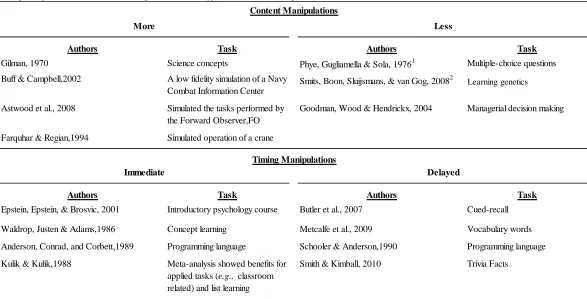
Table 1.
Sample of Research Examining Feedback Effects on Learning
Note: 1"More" feedback content consisted of information not relevant to the answer (e.g., re-presentation of the question and all answer choices); 2Result only applied to learners with high prior knowledge of the task.
Authors Task Authors Task
Gilman, 1970 Science concepts Phye, Gugliamella & Sola, 19761 Multiple-choice questions Buff & Campbell,2002 A low fidelity simulation of a Navy
Combat Information Center
Smits, Boon, Sluijsmans, & van Gog, 20082
Astwood et al., 2008 Simulated the tasks performed by the Forward Observer,FO
Goodman, Wood & Hendrickx, 2004 Managerial decision making
Farquhar & Regian,1994 Simulated operation of a crane
Authors Task Authors Task
Epstein, Epstein, & Brosvic, 2001 Introductory psychology course Butler et al., 2007 Cued-recall
Waldrop, Justen & Adams,1986 Concept learning Metcalfe et al., 2009 Vocabulary words
Anderson, Conrad, and Corbett,1989 Programming language Schooler & Anderson,1990 Programming language
Kulik & Kulik,1988 Meta-analysis showed benefits for applied tasks (e.g., classroom related) and list learning
Smith & Kimball, 2010 Trivia Facts
Immediate Delayed
Content Manipulations
More Less
Timing Manipulations
only (e.g., associative or verbal learning tasks), studies often found minimal, if any, effects of content (Kulhavy, White, Topp, Chan, & Adams, 1985; Lee, 1985; Schimmel, 1983).
Benefits of delayed feedback have been found in studies in which learning is demonstrated by memory strength alone (e.g., Butler et al., 2007; Metcalfe, Kornell, & Finn, 2009). Example tasks include the learning of lists, facts, categories, or similar memorization tasks (Mory, 2004; Smith & Ragan, 1993). The spacing hypothesis (Butler et al., 2007; Pashler et al., 2007; Smith & Kimball, 2010) and the bifurcation model (Kornell et al., 2011) discussed previously suggest the efficacy of feedback timing is determined by the cause of an error. Specifically, the bifurcation model predicts immediate feedback is effective when errors are the result of a weak memory trace (Kornell et al., 2011). Similiarly, the spacing hypothesis proposes delayed feedback is most effective when it acts as an additional (spaced) encoding opportunity (c.f., Butler et al., 2007; Smith & Kimball, 2010).
The learning of multiple, or causal, relationships (for reviews see Bangert-Drowns, Kulik, Kulik, & Morgan, 1991; Kulik & Kulik, 1988) have shown benefits of immediate feedback. Mory (2004) acknowledged “in most learning situations delayed feedback appears to function to hinder the acquisition of needed information” (p. 756) with Dempsey, Driscoll, and Swindell (1993) suggesting delaying feedback was analogous to withholding information a learner can use. A meta-analysis on feedback timing effects revealed immediate feedback typically resulted in more learning compared to delayed (Bangert-Drowns et al., 1991; Kulik & Kulik, 1988) with Kulik and Kulik (1988) concluding,
When experiments deviate from this paradigm, they show results similar to those in applied studies. In such experiments, immediate feedback produces a better effect than delayed feedback does (p. 94).”
Interim Summary
In review, not all learning is equal. Some information may be learned through memorization, yet others require understanding complex or interacting relationships. Therefore, it seems feedback effects may differ depending on the type of tasks. Specifically, the effects of feedback timing should be greatest when learning primarily relies on memory, while the effects of feedback content should be largest for tasks that require an understanding of casual relationships or element interactivity (e.g., mental model; Sweller, 1988).
Cybersecurity Education
The majority of modern complex systems are used by people. As a result, users need to be knowledgeable of security threats and practices (Furman, Theofanos, Yee-Yin, & Stanton, 2012; Kwon, Jacobs, Cullinane, Ipsen, & Foley, 2012). To achieve such goals requires effective training programs based on psychological learning theories and sound pedagogical principles. In addition, technological advancements have made distance learning and computer-based training increasingly common and as a result it is necessary to identify factors that may affect learning in non-traditional and autonomous environments.
Research on training users to spot phishing attempts has largely adopted an embedded training methodology (Kumaraguru, et al., 2007). Embedded training occurs in the real-world and is integrated in routine day-to-day tasks. Kumaraguru et al., (2007) sent fake emails to participants and provided training only if they fell for a phishing attempt. That is, participants were only given feedback when an error occurred. While this approach was in line with traditional research that viewed feedback as an error correction mechanism (e.g., Thorndike, 1911), recent research has shown the benefits of delayed feedback for the maintenance of correct responses (e.g., Butler, Karpicke, & Roediger, 2008). Additionally, although a meta-analysis of feedback effects in computer based instruction showed benefits of immediate feedback over delayed, it lacks empirical guidance on the design of feedback content (see Azevedo & Bernard, 1995; Mason & Bruning, 2001). Further, while studies have manipulated both the content and timing of feedback delivery in a web-based learning environment, to-date no study could be found that did so using a factorial design or investigated this question in the cybersecurity domain.
Overview of the Study
which feedback parameter is most effective. Knowing how the how feedback parameters affect learning conceptual information would allow feedback recommendations based on the information being learned and help disambiguate previous mixed results.
Method
Participants
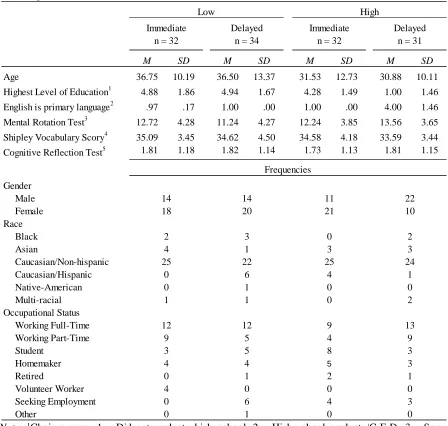
One-hundred twenty-nine participants were recruited from Amazon’s mechanical Turk (mTurk), an online marketplace where participants sign-up to complete jobs. The mTurk subject pool is largely more diverse than samples obtained from American university psychology classes (Buhrmester, Kwang, & Gosling, 2011) allowing increased generalizability across a larger range of ages and abilities (Pashler, Cepeda, Wixted, & Rohrer, 2005). Recruitment was limited to individuals over the age of eighteen with internet-protocol (IP) addresses within the United States. Participant demographics and characteristics are provided in Tables 2 & 3.
Ability tests. Participants completed the following ability tests: vocabulary (Shipley Institute of Living Scale; Shipley 1986), spatial ability (Mental Rotation Test; Vandenberg & Kuse, 1978; Peters et al., 1995) and the cognitive reflection test (Frederick, 2005; see Table 2 for descriptives).
Table 2.
Participant characteristics
Note: 1Choices were: 1 = Did not graduate high school, 2 = High school graduate/G.E.D, 3 = Some
college, 4 = Associate's degree, 5 = Bachelor's degree, 6 = Some graduate school, 7 = Master's degree, 8 = M.D, Ph.D., or some other advanced degree; 2Choices were: 0 = No, 1 = Yes; 3Mental
rotation Test; 4Shipley, 1986; 5Frederick, 2005.
M SD M SD M SD M SD
Age 36.75 10.19 36.50 13.37 31.53 12.73 30.88 10.11
Highest Level of Education1 4.88 1.86 4.94 1.67 4.28 1.49 1.00 1.46 English is primary language2 .97 .17 1.00 .00 1.00 .00 4.00 1.46 Mental Rotation Test3 12.72 4.28 11.24 4.27 12.24 3.85 13.56 3.65 Shipley Vocabulary Scory4 35.09 3.45 34.62 4.50 34.58 4.18 33.59 3.44 Cognitive Reflection Test5 1.81 1.18 1.82 1.14 1.73 1.13 1.81 1.15
Gender Male Female Race Black Asian Caucasian/Non-hispanic Caucasian/Hispanic Native-American Multi-racial Occupational Status Working Full-Time Working Part-Time Student Homemaker Retired Volunteer Worker Seeking Employment Other 1 2 1 0 3 5 4 4 13 9 12 12 0 0 1 0 3 4 6 0 0 0 0 4 3 8 5 3 9 4 5 9 2 0 1 1 0 0 1 0 Frequencies 14 18 14 20 11 21 22 10
2 3 0 2
4 High Low 1 25 22 1 4 6 0 24 25 3 3
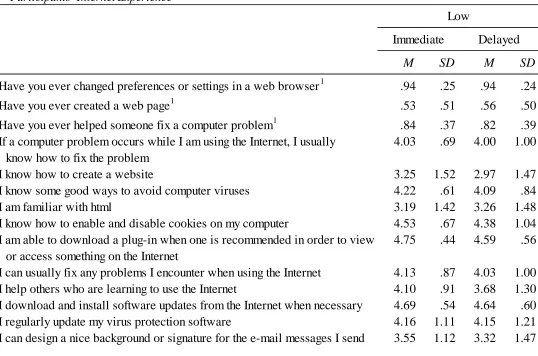
Table 3.
Participants’ Internet Experience
M SD M SD
Have you ever changed preferences or settings in a web browser1 .94 .25 .94 .24
Have you ever created a web page1 .53 .51 .56 .50
Have you ever helped someone fix a computer problem1 .84 .37 .82 .39
If a computer problem occurs while I am using the Internet, I usually 4.03 .69 4.00 1.00 know how to fix the problem
I know how to create a website 3.25 1.52 2.97 1.47
I know some good ways to avoid computer viruses 4.22 .61 4.09 .84
I am familiar with html 3.19 1.42 3.26 1.48
I know how to enable and disable cookies on my computer 4.53 .67 4.38 1.04
I am able to download a plug-in when one is recommended in order to view 4.75 .44 4.59 .56 or access something on the Internet
I can usually fix any problems I encounter when using the Internet 4.13 .87 4.03 1.00
I help others who are learning to use the Internet 4.10 .91 3.68 1.30
I download and install software updates from the Internet when necessary 4.69 .54 4.64 .60
I regularly update my virus protection software 4.16 1.11 4.15 1.21
I can design a nice background or signature for the e-mail messages I send 3.55 1.12 3.32 1.47 Low
Table 3 (continued)
Note:1Answers were no (0) and yes (1); answers for all other items were 1 = strongly disagree, 2 = somewhat disagree,
M SD M SD
Have you ever changed preferences or settings in a web browser1 .94 .25 .97 .18
Have you ever created a web page1 .50 .51 .42 .50
Have you ever helped someone fix a computer problem1 .84 .37 .84 .37
If a computer problem occurs while I am using the Internet, I usually 3.88 .98 4.13 .72 know how to fix the problem
I know how to create a website 3.22 1.36 2.77 1.48
I know some good ways to avoid computer viruses 4.19 .93 4.16 .69
I am familiar with html 3.30 1.32 2.93 1.28
I know how to enable and disable cookies on my computer 4.59 .67 4.53 .57
I am able to download a plug-in when one is recommended in order to view 4.59 .76 4.55 .68 or access something on the Internet
I can usually fix any problems I encounter when using the Internet 4.09 .93 4.19 .60
I help others who are learning to use the Internet 3.97 1.11 3.83 .93
I download and install software updates from the Internet when necessary 4.44 .67 4.29 1.04
I regularly update my virus protection software 4.20 1.03 4.19 1.08
I can design a nice background or signature for the e-mail messages I send 3.69 1.33 3.40 1.19 Delayed High
Questionnaires. All questionnaires can be found in Appendix A. Questionnaires included participant demographics and a survey to assess internet experience (Potosky, 2007).
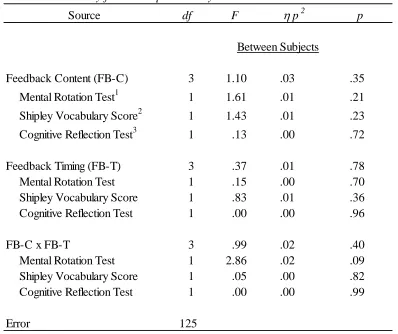
Table 4.
MANOVA Summary for Participant Ability Tests
Note: 1Mental rotation Test; 2Shipley, 1986; 3Frederick, 2005.
Source df F hp2 p
Feedback Content (FB-C) 3 1.10 .03 .35
Mental Rotation Test1 1 1.61 .01 .21
Shipley Vocabulary Score2 1 1.43 .01 .23
Cognitive Reflection Test3 1 .13 .00 .72
Feedback Timing (FB-T) 3 .37 .01 .78
Mental Rotation Test 1 .15 .00 .70
Shipley Vocabulary Score 1 .83 .01 .36 Cognitive Reflection Test 1 .00 .00 .96
FB-C x FB-T 3 .99 .02 .40
Mental Rotation Test 1 2.86 .02 .09
Shipley Vocabulary Score 1 .05 .00 .82 Cognitive Reflection Test 1 .00 .00 .99
Error 125
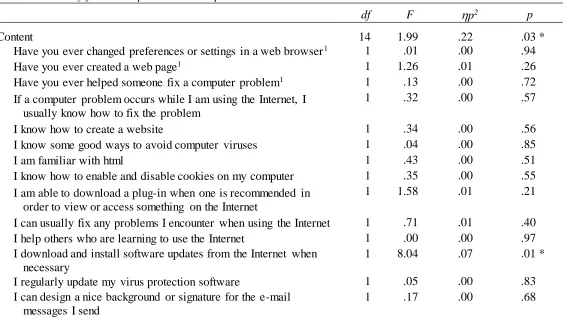
Table 5.
MANOVA Summary for Participant Internet Experience
df F hp2 p
Content 14 1.99 .22 .03 *
Have you ever changed preferences or settings in a web browser1 1 .01 .00 .94
Have you ever created a web page1 1 1.26 .01 .26
Have you ever helped someone fix a computer problem1 1 .13 .00 .72
If a computer problem occurs while I am using the Internet, I usually know how to fix the problem
1 .32 .00 .57
I know how to create a website 1 .34 .00 .56
I know some good ways to avoid computer viruses 1 .04 .00 .85
I am familiar with html 1 .43 .00 .51
I know how to enable and disable cookies on my computer 1 .35 .00 .55 I am able to download a plug-in when one is recommended in
order to view or access something on the Internet
1 1.58 .01 .21 I can usually fix any problems I encounter when using the Internet 1 .71 .01 .40 I help others who are learning to use the Internet 1 .00 .00 .97 I download and install software updates from the Internet when
necessary
1 8.04 .07 .01 * I regularly update my virus protection software 1 .05 .00 .83 I can design a nice background or signature for the e-mail
messages I send
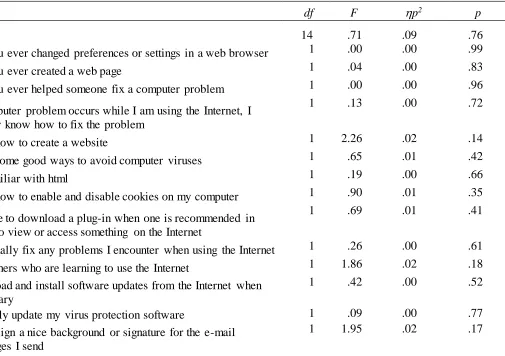
Table 5 (continued)
df F hp2 p
Timing 14 .71 .09 .76
Have you ever changed preferences or settings in a web browser 1 .00 .00 .99
Have you ever created a web page 1 .04 .00 .83
Have you ever helped someone fix a computer problem 1 .00 .00 .96 If a computer problem occurs while I am using the Internet, I
usually know how to fix the problem
1 .13 .00 .72
I know how to create a website 1 2.26 .02 .14
I know some good ways to avoid computer viruses 1 .65 .01 .42
I am familiar with html 1 .19 .00 .66
I know how to enable and disable cookies on my computer 1 .90 .01 .35 I am able to download a plug-in when one is recommended in
order to view or access something on the Internet
1 .69 .01 .41
I can usually fix any problems I encounter when using the Internet 1 .26 .00 .61 I help others who are learning to use the Internet 1 1.86 .02 .18 I download and install software updates from the Internet when
necessary
1 .42 .00 .52 I regularly update my virus protection software 1 .09 .00 .77 I can design a nice background or signature for the e-mail
messages I send
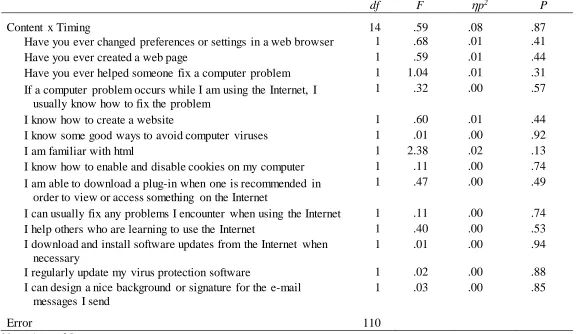
Table 5 (continued)
df F hp2 P
Content x Timing 14 .59 .08 .87
Have you ever changed preferences or settings in a web browser 1 .68 .01 .41
Have you ever created a web page 1 .59 .01 .44
Have you ever helped someone fix a computer problem 1 1.04 .01 .31 If a computer problem occurs while I am using the Internet, I
usually know how to fix the problem
1 .32 .00 .57
I know how to create a website 1 .60 .01 .44
I know some good ways to avoid computer viruses 1 .01 .00 .92
I am familiar with html 1 2.38 .02 .13
I know how to enable and disable cookies on my computer 1 .11 .00 .74 I am able to download a plug-in when one is recommended in
order to view or access something on the Internet
1 .47 .00 .49 I can usually fix any problems I encounter when using the Internet 1 .11 .00 .74 I help others who are learning to use the Internet 1 .40 .00 .53 I download and install software updates from the Internet when
necessary
1 .01 .00 .94 I regularly update my virus protection software 1 .02 .00 .88 I can design a nice background or signature for the e-mail
messages I send
1 .03 .00 .85
Error 110
proactive about computer security. While it’s possible this difference between content groups influenced results, it is unlikely given high content resulted in better performance than low content. Thus, it does not appear this difference had any impact on the results obtained in the present study.
Instructions. Participants received onscreen instructions describing the task and learning objectives (Appendix A).
Experimental task. A web-based computer program was developed for the current study. It presented acquisition trials, feedback, retention/transfer tests, all ability tests and questionnaires, and debriefing.
Images. Two different sets of 20 email images were created (Appendix): the first set was used in acquisition/retention only while the second was used in the transfer test. The topics and number of links within each email varied from image to image (Table 6). Topics were drawn from a variety of domains, but generally focused on topics participants would likely encounter in phishing attempts such as online banking, order confirmation, and password reset confirmation.
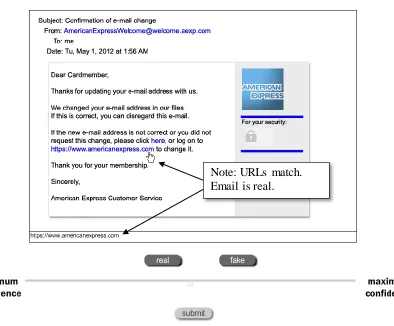
Participants were to learn rules that allowed them to decide whether a given email was ‘real’ or ‘fake’ by hovering-over and visually inspecting a URL (Figure 1). Correct answers were based on identifying three methods used in phishing attacks: the @ exploit, use of an internet-protocol (IP) address, and a random web address.
http://myusername:[email protected]. However, if a website does not require a username and password, everything before the @ symbol is ignored and the browser automatically redirects to site.com. A fake link using the @ symbol will generally take the following form: http://[email protected].
Table 6.
Frequencies for the Number of Links within Experimental Stimuli
2 3 4 5 9
Figure 1. Example question where learning requires understanding rules that determine email authenticity. Each email was viewed individually for a trial, so no direct comparison could be made between correct and incorrect emails. Call-outs point out the comparison between URLs participants were required to make and were not present in the task.
IP address. Another method participants learned was the linking to an IP address instead of the actual domain name of a given website. For example, to visit Google’s website one would usually enter www.google.com into the address bar of their web browser. Alternatively, however, 74.125.139.138 could be entered into the address bar with the same result. A fake link exemplifying this method will show an IP address instead of the domain name of a given site (e.g., http://15.76.6.3/mybank/).
Random web address. The final method was the use of a random website. This involves linking to a website not associated with the assumed sender of the email. For example, an email claiming to be from Microsoft may contain a link to http://www.getcashnow.com instead of http://www.microsoft.com. The current experiment will use the same manner when demonstrating a fake link with this method.
Figure 2. Example stimuli where participant had to hover the mouse cursor over ‘Amazon’ to display the destination of the link.
Feedback conditions. Feedback was operationally defined as being low or high on the parameters of content and timing. A total of four feedback conditions were created by manipulating the variables of content and timing with each variable containing a less supportive and more supportive condition (see Figure 3 for example content).
Low Feedback High Feedback
Immediate low. This condition consisted of low feedback content delivered immediately after each response was submitted. Low content feedback indicated answer correctness only. That is, participants were required to determine why their answer was correct or incorrect.
Immediate high. This condition contained high feedback content delivered immediately after each trial. High content feedback indicated answer correctness as well as the reason for correctness.
Delayed low. This condition contained the same feedback content described in the low condition; however, there were a five second delay between the submission of a response and the presentation of feedback.
Delayed high. This condition contained the same feedback content described in the high condition; however, there was a five second delay between response submission and feedback presentation.
Procedure
Acquisition. Participants followed a link via mTurk and were randomly assigned to one of four feedback conditions. After providing informed consent, they provided demographics, completed the Shipley Institute of Living Scale (Shipley, 1986) followed by five practice trials during which participants became acquainted with the actions necessary to perform the task. The acquisition phase followed immediately where participants were told their goal was to learn how to recognize a phishing email.
1978; Peters et al., 1995). Then five practice trials were completed followed by the cued-recall retention test.
Transfer. Immediately following retention, a twenty item transfer test with no feedback was used to assess learning with novel stimuli. Debriefing was provided once the transfer test was finished and participants were compensated within forty-eight hours.
Design
The design used was similar to other feedback studies conducted online (Pashler et al., 2005). Feedback content and timing were manipulated as between-subjects factors and learning stage a within-subjects factor.
Performance accuracy, confidence, trial response time and time on task were measured during an acquisition session with feedback present, a retention session with feedback removed, and a transfer task with no feedback. Accuracy was the primary dependent variable of interest and defined as the average number of correct responses.
Results
Acquisition and Retention
Table 7.
Mean Acquisition and Retention Results by Content and Timing
Note: 1Anchors were minimum confidence (-350) and maximum confidence (350).
M SD M SD M SD
Content Timing
Low Immediate .55 .16 23.90 10.82 98.95 84.05 Delayed .53 .13 21.63 11.91 115.98 95.08
High Immediate .64 .19 23.32 11.11 103.08 121.99 Delayed .71 .18 19.31 11.42 139.99 110.70
Low Immediate .68 .20 17.86 7.58 140.16 115.64 Delayed .67 .19 23.54 14.44 112.10 108.52
High Immediate .64 .20 17.43 8.43 127.02 107.64 Delayed .76 .22 18.52 7.92 136.42 118.49
Acquisition
Retention
Table 8.
Mixed-Model MANOVA Summary for Acquisition and Retention by Content and Timing
Source df F hp2 p
Between Subjects
Feedback Content (FB-C) 3 8.17 .16 .00 **
Accuracy 1 16.42 .11 .00 **
Reaction time 1 2.25 .02 .02 *
Confidence 1 .63 .01 .43
Feedback Timing (FB-T) 3 1.48 .03 .22
Accuracy 1 4.18 .03 .04 *
Reaction time 1 .01 .01 .20
Confidence 1 .51 .00 .83
FB-C x FB-T 3 3.96 .09 .01 *
Accuracy 1 7.54 .06 .01 *
Reaction time 1 1.30 .01 .26
Confidence 1 1.35 .01 .25
Error 129
Learning Stage (LS) 3 7.05 .14 .00 **
Accuracy 1 9.84 .07 .00 **
Reaction time 1 4.80 .04 .03 *
Confidence 1 1.03 .01 .31
LS x FB-C 3 2.22 .05 .09 *
Accuracy 1 5.21 .04 .02 *
Reaction time 1 .27 .00 .60
Confidence 1 .09 .00 .77
LS x FB-T 3 3.56 .08 .02 *
Accuracy 1 .28 .00 .60
Reaction time 1 7.01 .05 .01 *
Confidence 1 1.63 .01 .20
LS x FB-C x FB-T 3 .25 .01 .86
Accuracy 1 .10 .00 .66
Reaction time 1 .36 .00 .56
Confidence 1 .10 .00 .76
Error 129
Within subjects
Learning stage effects. All groups learned, as evident by a significant multivariate effect of learning stage. Univariate results showed when collapsed across all feedback conditions, retention performance was better than acquisition with higher accuracy and faster response times. All effects on confidence were non-significant.
Content effects. There was a multivariate effect of content where high content yielded better accuracy and faster response times than low. There were no interactions of content, timing and learning stage, or content and learning stage; however, planned comparisons showed for the low content group, retention accuracy was higher than acquisition accuracy (p < .001). On the other hand, when collapsed across timing groups, high content resulted in better acquisition accuracy than low (p < .01).
Timing effects. There was a significant multivariate interaction of timing and learning
Planned comparisons also showed delayed feedback led to higher overall accuracy than immediate (p < .05). Additionally, accuracy improved significantly between learning stages when feedback was delayed (p < .05), but not when immediate (p < .05). There were no significant effects on confidence.
Content and timing interaction. Performance also differed across content and timing groups (Figures 5 & 6) demonstrated by a significant multivariate interaction of content and timing. Univariate analysis indicated the content and timing of feedback differentially affected accuracy. Simple effects analysis showed accuracy was higher with high content when feedback was delayed compared to immediate (p < .05). Similarly, when feedback was delayed, accuracy was higher when content was high compared to low (p < .001).
Figure 6. Effects of Feedback Content and Timing on Accuracy.
Interim Summary
The goal of the analysis presented in the previous section was to investigate the effects of feedback content and timing while learning a concept based higher-order learning task. Cognitive load theory and ACT-R predicted increased content would maximize learning. On the other hand, the spacing hypothesis and bifurcation model suggest delayed feedback would provide an additional encoding opportunity resulting in more learning.
Results showed benefits of high content compared to low on accuracy. Low content led to a significant increase in accuracy from acquisition to retention; however, acquisition accur acy was significantly higher with high content compared to low content. Thus, it appears the improvement in accuracy between learning stages for those given low content was primarily due to initial accuracy being so low.
Results also showed retention accuracy was higher for participants given high content compared to low when feedback was delayed; however, for participants given high content, delayed feedback resulted in higher retention accuracy then immediate feedback. This result, and the lack of any significant difference in accuracy between timing groups when content was low, suggests accuracy differences between timing groups is the result of high content.
Differences in Feedback Use
conducted on the total time participants spent looking at feedback. The total time participants spent looking at feedback was computed using the following equation:
𝑡𝑜𝑡𝑎𝑙 𝑡𝑖𝑚𝑒 𝑙𝑜𝑜𝑘𝑖𝑛𝑔 𝑎𝑡 𝑓𝑒𝑒𝑑𝑏𝑎𝑐𝑘 =
([𝑡𝑖𝑚𝑒 𝑜𝑛 𝑡𝑎𝑠𝑘 − (𝑅𝑇𝑡1+ 𝑅𝑇𝑡2+ 𝑅𝑇𝑡3+ . . . + 𝑅𝑇𝑡20)] − [𝐷𝑡1+ 𝐷𝑡2+ 𝐷𝑡3 + . . . + 𝐷𝑡20])
Time on task was collected by the program and referred to the total amount of time participants spent on the entire experimental task. The parameter RT denoted response times for each trial (t), indicating the time spent looking at the stimuli and clicking to indicate if the email was a phishing email. RTs were summed across trials and then subtracted from time on task. The parameter D represented the delay for each trial (t). While there was a five-second delay between a response and feedback presentation for the delayed group, the immediate group had a 5-second delay before beginning the next trial. Thus, the delay across all trials was removed from time on task leaving the total amount of time spent looking at feedback. Group means are given in Figure 8 and inferential statistics in Table 9.
Timing effects. Results showed a main effect of timing. Specifically, delayed feedback was looked at longer than immediate feedback whether it contained low (p < .01) or high (p < .001) content. There was no effect of content or interaction of content and delay on feedback use (p’s > .05).
Interim Summary
complexity, and the level of confidence one has in the correctness of their response (see Mory, 2004). Surprisingly, results of the current study appear to contradict the claim that feedback complexity affects feedback use. Specifically, results showed delayed feedback was looked at longer than immediate, whether it contained high or low content. While the spacing hypothesis suggests delayed feedback enhances performance through an additional encoding opportunity, no claims are regarding how feedbacks use are made. Thus, as suggested by Shute, (2008) it appears other mediating factors are involved in the use of feedback.
Table 9.
ANOVA Summary for Time Spent Looking at Feedback by Content and Timing
Transfer
A transfer test occurred immediately following completion of the retention test and included twenty additional trials with novel stimuli (10 real and 10 fake). No feedback was given during the transfer test. Results were analyzed using a 2 (Feedback Content: Low and High) x 2 (Feedback Timing: Immediate and Delayed) MANOVA with dependent variables of accuracy, response time, and confidence. A Bonferroni correction was applied to all tests of simple main effects and planned comparisons. Descriptive statistics are provided in Table 10 and inferential statistics in Table 11.
Source
df
F
h
p
2Feedback Content (FB-C)
1
.09
.00
.77
Feedback Timing (FB-T)
1
25.41
.17
.01 *
FB-C x FB-T
1
1.29
.01
.26
Error
127
Note: * p
< .01
Table 10.
Mean Transfer Results by Content and Timing
Note: 1Question anchors were minimum confidence (-350) and maximum
confidence (350).
Table 11.
MANOVA Summary for Transfer Results by Content and Timing
M SD M SD M SD
Content Timing
Low Immediate .67 .17 23.33 13.81 130.51 108.22 Delayed .65 .19 28.51 16.25 99.64 96.84
Content effects. A significant multivariate effect was found for content. Univariate results
showed when collapsed across timing groups, response times were faster on the transfer test for those given high content in acquisition compared to low.
Timing effects. Although the multivariate effect of timing was not significant, planned
comparisons revealed response time was faster on the transfer test for those who received immediate feedback compared to delayed (p < .05).
Content and timing interaction. The multivariate interaction of content and timing was not significant; however, planned comparisons revealed when feedback contained high content, transfer accuracy was higher and response times lower for those who had received delayed rather than immediate feedback in acquisition (p’s < .05). Response times were faster with high content compared to low when feedback was immediate (p < .05) as well.
Interim Summary
A transfer test was used to assess feedback effects on the application of knowledge to novel stimuli. Results showed high content led to faster response time than low content. In addition, delayed feedback increased accuracy and reduced response times compared to immediate when feedback contained high content. That is, high content feedback given after a delay increased the transfer of knowledge demonstrated by higher accuracy and faster response times.
as predicted by the spacing hypothesis are, to some extent, influenced by the contents of feedback.
Application of Signal Detection Theory
Signal detection theory (SDT) was used to further investigate the effects of feedback on learning to identify a phishing email. The measures used were the same utilized by Sheng et al. (2007) to explore the effects of different anti-phishing training: sensitivity (d’) and criterion (C). Sensitivity refers to the ability to distinguish a signal (a phishing email) from noise (a real email). Sensitivity increases as the ability to distinguish a signal from noise increases. In the current study, higher values of sensitivity indicate a better ability to detect phishing emails.
Criterion, or response bias, reflects the degree to which one response (i.e., signal present) dominates over another (i.e., signal absent). Applied to the present study, criterion values represented the propensity to respond either signal present (fake email) or signal absent (real email). That is, criterion values also characterize response bias. A positive criterion indicated a tendency to respond “real email” while a negative criterion indicated the tendency to respond “fake email.”
Sensitivity and criterion values were calculated for each participant and subjected to a 2 (Learning Stage: Acquisition and Retention) x 2 (Feedback Content: Low and High) x 2 (Feedback Timing: Immediate and Delayed) mixed-model MANOVA. Bonferroni corrections were applied to all tests of simple main effects and planned contrasts. Means and inferential statistics are provided in Tables 12 and 13 respectively.
Table 12.
Mean Sensitivity and Criterion Levels divided by Feedback Content and Timing
Learning stage effects. There was a multivariate effect of learning stage, where sensitivity increased from acquisition to retention. Additionally, planned comparisons showed response bias decreased between learning stages. That is, although the ability to detect phasing emails increased between learning stages; participants were more likely to indicate an email was fake in retention than acquisition. Planned comparisons also showed delayed feedback led to higher sensitivity than immediate (p < .05).
Content effects. Results showed a multivariate effect of content, where sensitivity was higher with high content (M = 1.18, SD = .74) than low content (M = .66, SD = .79). Criterion values were also lower with high content (M = .10, SD = .25) than low content (M = .23, SD = .31) indicating participants given high content were more likely to indicate an email was fake.
Table 13.
M SD M SD M SD M SD
Content Timing
Low Immediate .28 .95 1.13 1.30 .21 .46 .26 .49
Delay .21 .77 1.02 1.21 .34 .42 .12 .35
High Immediate .84 1.13 .84 1.24 .17 .36 - .04 .40
Delay 1.35 1.11 1.68 1.43 .26 .31 .01 .36
d' C
Source df F hp2 p Between Subjects
Feedback Content (FB-C) 2 10.70 .15 .00 **
Sensitivity 1 16.05 .11 .01 *
Criterion 1 7.03 .05 .01 *
Feedback Timing (FB-T) 2 2.94 .05 .06
Sensitivity 1 5.65 .04 .02 *
Criterion 1 .42 .00 .53
FB-C x FB-T 2 4.78 .07 .01 *
Sensitivity 1 8.68 .07 .00 **
Criterion 1 .55 .00 .46
Error 127
Within Subjects
Learning Stage (LS) 2 8.93 .13 .00 **
Sensitivity 1 10.07 .08 .00 **
Criterion 1 9.90 .07 .00 **
LS x FB-C 2 3.56 .06 .03 *
Sensitivity 1 4.42 .03 .04 *
Criterion 1 2.06 .02 .15
LS x FB-T 2 1.34 .02 .26
Sensitivity 1 .20 .00 .65
Criterion 1 2.63 .02 .11
LS x FB-C x FB-T 2 .94 .02 .39
Sensitivity 1 .34 .00 .56
Criterion 1 1.38 .01 .24
Error 127
Figure 9. Effects of Content and Learning Stage on Sensitivity Levels.
As shown in Figure 9, there was a multivariate interaction of learning stage and content on sensitivity indicating feedback content differentially affected the detection of phishing emails at different learning stages. Simple main effects analysis revealed acquisition sensitivity was higher with high content compared to low (p < .001), and for both the immediate (p < .05) and delayed (p < .001) groups given high content. At retention, however, the difference between content groups dissipated (p > .05) as sensitivity increased significantly from acquisition to retention for those given low content (p < .001).
Timing effects. While neither the multivariate interaction of content, timing and learning stage or timing and learning stage were significant, planned comparisons revealed sensitivity was higher (p < .05) when feedback was delayed (M = 1.05, SD = .83) compared to immediate (M = .77, SD = .76). As shown in Figure 10, there was a significant increase in the ability to detect phishing emails (sensitivity) from acquisition to retention for participants given delayed feedback (p < .05) and a marginal increase (p = .06) for those given immediate feedback.
Figure 10. Effects of Feedback Timing and Learning Stage on Phishing Identification.
content (M = 1.52, SD = .66) compared to low (M = .62, SD = .74). Planned comparisons also showed when content was high, delayed feedback increased the ability to identify phishing emails in retention more than immediate (p < .05). Additionally, criterion values were lower with high content (M = .07, SD = .27) compared to low (M = .24, SD = .36) when feedback was immediate (p < .001).
Interim Summary
A Signal Detection Theory analysis was conducted on sensitivity and bias measures to investigate the role of feedback while learning concepts related to cybersecurity. Cognitive load theory and ACT-R suggested high content would maximize learning. The spacing hypothesis predicted benefits of delayed feedback due to an additional encoding opportunity.
As predicted by CLT and ACT-R, high content increased the ability to detect phishing emails more than low content. Predications made from the spacing hypothesis appeared to be supported as well: delayed feedback also increased discrimination between real and fake emails and led to a significant increase in phishing detection between lear ning stages. However, when the effects of content are taken into consideration, the benefits of delayed feedback become less clear.
Participants given high content were also more likely to indicate an email was fake. That is, high content led to more cautious behavior overall and at retention. Despite more cautious behavior, it could be argues the response bias for participants given high content more readily approached the ‘ideal’ value. This interpretation and further implications of these findings are addressed in the Discussion.
Transfer
Sensitivity and criterion values were calculated for transfer and examined with a 2 (Feedback Content: Low and High) x 2 (Feedback Timing: Immediate and Delayed) MANOVA. Bonferroni corrections were applied to all tests of simple main effects and planned comparisons. Inferential statistics are provided in Table 14 and means in Figures 11 and 12.
Table 14.
MANOVA Summary for Transfer Sensitivity and Criterion
Figure 11. Effects of Feedback on Transfer Sensitivity.
Source df F
h
p2 pContent 2 2.62 .04 .08
Sensitivity 1 2.38 .02 .13
Criterion 1 3.62 .03 .06
Timing 2 1.84 .03 .16
Sensitivity 1 1.72 .01 .19
Criterion 1 2.52 .02 .12
Content x Timing 2 4.71 .07 .01 *
Sensitivity 1 3.32 .03 .07
Criterion 1 4.84 .04 .03 *
Error 127
Figure 12. Effects of Feedback on Transfer Criterion.
Results also indicated sensitivity differences between content groups when feedback was delayed (p < .05). Specifically, identification of phishing emails was enhanced when delayed feedback contained high content compared to low content. Similarly, when feedback contained high content, delayed feedback led to better detection of phishing emails than when feedback was immediate (p < .05). Finally, high content led to a marginal increase over low content (p = .06) in the discernibility of phishing emails.
Interim Summary
did not show a significant differences in phishing identification between low and high content groups. These results suggest delayed feedback may foster the transfer of knowledge to novel situations.
Discussion
A century’s worth of research has yet to determine the feedback required for learning. A review of the literature revealed differences in studies finding benefits of increased feedback content versus those that showed benefits of delayed feedback. These differences were generally in the type of information being learned. Studies that found benefits of delayed feedback were generally associative or verbal learning tasks that required participants to memorize only. On the other hand, studies that showed advantages of increased feedback content tended to include more complex higher order learning tasks that required the understanding of concepts or relationships.
Overall, results demonstrate the effectiveness of feedback as participants in all groups improved from acquisition to retention; however, accuracy was higher for those given high content compared to those given low. A SDT analysis also showed participants given high content were better at detecting phishing emails. One possible explanation supported by cognitive load theory is high content reduced intrinsic cognitive load allowing learners to focus on understanding the relationships required for performance (Renkl & Atkinson, 2003; Sweller, 1988; Sweller, 2010). High content specified answer correctness as well as the reason why. Thus, it provided information regarding cause and effect relationships that contributed to successful task performance supporting the claim that feedback should provide information about cause and effect relationships (Jonassen & Ionas, 2008).
Another explanation provided by the ACT-R framework is high content allowed learners to experience more correct responses resulting in performance that more closely resembled that of ‘experts’ (Anderson, 1993, 1996). As a result, it’s possible the benefits of high content were due to more time practicing the skills needed for successful performance.
The bifurcation model also provides an explanation for the benefits of high content (Kornell et al, 2011). As discussed previously, the bifurcation model suggests successful retrieval increases the storage strength for a given item. Given the finding in the present study that high content led to higher acquisition accuracy, the implied result is it also led to more successful retrieval attempts. Thus, benefits of high content may result from increased encoding strength due to a higher number of successful retrieval attemps in acquisition.
found for tasks in which performance is primarily governed by memory strength. The results obtained here would seem to contradict this account of feedback timing effects. However, when one considers the information required for task performance, this interpretation of feedback timing effects appears to be supported.
If timing effects were independent of content, similar results would be expected whether content was high or low. Yet, this was not the case: when feedback contained low content, there were no instances in which delayed feedback resulted in better performance than immediate. Conversely, there were numerous findings in which high content resulted in better performance whether it was delayed or immediate. These results suggest the conditions under which the spacing hypothesis apply need further qualification (Butler et al., 2007; Smith, & Kimball, 2010). Specifically, aaccording to ACT-R, the act of encoding is only beneficial when the correct information is encoded (Anderson, 1993, 1996). Thus, its likely high content provided the information needed for participants to take advantage of the additional encoding opportunities.
provide an additional encoding opportunity that results in more adaptable knowledge. This, however, would need to be studied further.
Finally, findings from the current study also suggested feedback affects response bias. Specifically, high content was associated with more cautious behavior where participants were more likely to indicate an email was fake when collapsed across learning stage and in retention. Additionally, high content resulted in significantly more cautious behavior in retention than acquisition. In similar research, Sheng et al. (2007) interpreted a non-significant change in criterion as an indication of learning. They further suggested,
“when presented with the training, a user may shift the decision criterion (C) to the left, to be more cautious. This might lead to fewer false negatives at the expense of false positives. Alternatively a user may learn to distinguish the phishing websites better, in which case there will be an increase in d’.”
Given the effects of content on response bias in present study, one might argue the benefits of high content were the result of more cautious behavior. However, this is not likely because the ability to discriminate between phishing emails and real emails (d’) was enhanced with high content. If participants were simply behaving more cautiously, the false alarm rate would increase leading to decreased sensitivity. Yet, sensitivity was highest for participants given high content.