WHITE, AUSTINA ULANDA. Stakeholder Perceptions on the Most Important Knowledge and Skills to Gain Through a Graduate Program in Training and Development: A q-study. (Under the direction of Dr. James Bartlett).
Public and private organizations throughout the world utilize training and development professionals to ensure that their staff have the skills and knowledge necessary to effectively carry out the tasks of their jobs. These professionals come from a variety of backgrounds and unfortunately, there is little existing research on how individuals are prepared for these roles. Graduate programs in training and development serve as one way for learning professionals to increase their skillset for these roles, along with various certification programs and training courses available through groups such as the Association of Talent Development. For these graduate programs to have curriculum that meet the expectations of the training and development professionals, and the future organizations that will be hiring them, it is essential to understand the needs of the programs’ stakeholders.
In this study, with Stakeholder theory as its foundation, Q-methodology was utilized to gain insights on the perspectives of stakeholders of graduate programs in training and
development. Specifically, the study aimed to understand what faculty members, current students enrolled in these programs, and learning leaders and managers view as the most important
knowledge and skills to gain through a quality graduate program in training and development. The study also aimed to answer how the views of these different stakeholder groups may differ.
important). After the sort, participants were asked to share feedback on why they selected their top and lowest ranked items, demographic information such as their age, gender, and current job title, and what items they thought should have not been included in the study.
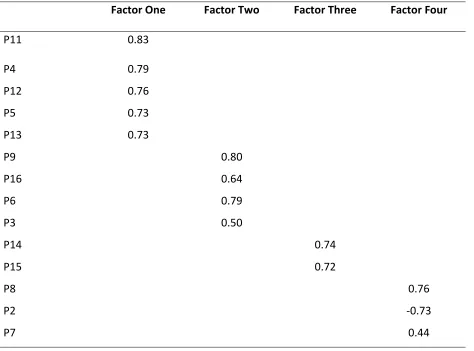
With sorts submitted by sixteen participants, R statistical software was then used to conduct a factor analysis of the provided data. A four-factor solution was chosen as the best representation of the varying perspectives of the participants. The solution loaded fourteen of the sixteen participants into groups including Factor Group A, The Foundationalist, who see a quality graduate program as one that prepares someone with the foundational knowledge of adult learning and instructional design, Factor Group B, The Impactors, which view skills around aligning training to business goals and demonstrating values as most import to learn, Factor Group C, The Generalists, who had a mix of topics and skills that they felt were important to learn, and Group D, The Future Leaders, who placed a strong emphasis on technology and management related tasks being taught in graduate programs.
Graduate Program in Training and Development: A Q-study
by
Austina Ulanda White
A dissertation submitted to the Graduate Faculty of North Carolina State University
in partial fulfillment of the requirements for the degree of
Doctor of Education
Adult and Community College Education
Raleigh, North Carolina 2019
APPROVED BY:
_______________________________ _______________________________ Dr. James Bartlett Dr. Michelle Bartlett
Committee Chair
ii DEDICATION
iii BIOGRAPHY
A native of North Carolina, Austina White attended East Carolina University (ECU) under the NC Teaching Fellows Scholarship, studying Business and Marketing Education. During her time at ECU, she was an active member of the campus, working for the college in the Office of Student Rights and Responsibilities and in the Office of Equity, Diversity, and
Community Relations, and participating in various organizations including leading the campus’ chapter of the North Carolina Association of Educators (NCAE) and serving as State President for the college division.
After completing her bachelor’s degree, Austina moved to Raleigh to study in North
Carolina State University’s master’s program in Instructional Technology. During this time, she worked in a variety of positions including serving as a teaching assistant for the department, as a graduate assistant for Duke University’s Office of Assessment and Professional Development, an eLearning content developer, and as a Career and Technical Education middle school teacher.
In 2014 Austina transitioned to working in the training and development field full-time as a product trainer for a local software company. A believer in lifelong learning, Austina decided in 2016 to continue her education as a member of NC State’s Charlotte Cohort for the Adult and
Community College Education program. With a mixed background in K-12, higher education, and corporate training work experience, she aimed to deepen her understanding of how
individuals could be prepared for the workforce through education.
iv ACKNOWLEDGMENTS
While these few paragraphs could never fully summarize my gratitude, I would like to thank those who helped me along this journey as I pursued my doctoral degree:
• To my peers in the 2016 Charlotte Cohort, thank you for your support as we went through the program and during the dissertation process.
• To my dissertation chair, the members of the committee, and the faculty and staff of NC State, thank you for your assistance, guidance, and inspiration over the past four years. • To my colleagues at work, thank you for the flexibility provided so I could finish the
program and for checking in and asking about my progress. For my team, I appreciate the understanding you had as I learned how to balance work and school.
• To my family and friends, thank you for your support and understanding throughout this process as I missed birthdays, holidays, events, and family functions to do school work. Thank you for checking in to see how things were going and reminding me when I needed that quitting was not an option.
v TABLE OF CONTENTS
LIST OF TABLES ... vii
LIST OF FIGURES ... ix
CHAPTER ONE: INTRODUCTION ... 1
Problem Statement ... 2
Significance of the Study ... 3
Theoretical Framework ... 5
Purpose Statement ... 7
Research Questions ... 7
Definition of Terms... 8
Delimitations and Bias ... 8
Summary ... 9
CHAPTER TWO: LITERATURE REVIEW ... 11
History of Training and Development ... 11
Roles in Training and Development ... 15
About Graduate Education ... 17
Stakeholders of Graduate Programs ... 19
Graduate Program Quality ... 20
Curriculum Development in Higher Education ... 22
Stakeholder Involvement in Curriculum Development ... 23
Graduate Programs in Training and Development ... 24
vi
CHAPTER THREE: METHODOLOGY ... 26
Introduction ... 26
History of Q Methodology ... 28
Q-Methodology Terms... 29
Concourse Development ... 30
The Q-Set ... 30
The P-Set ... 31
Q-Sort Process and Instrumentation ... 33
Data Analysis ... 35
CHAPTER FOUR: FINDINGS ... 37
Introduction ... 37
Data Collection ... 38
P-Set ... 39
Data Analysis Overview ... 41
Factor Correlation Matrix ... 43
Factor Loadings ... 49
Z-Scores ... 46
Factor Array ... 48
Consensus Statements ... 52
Distinguishing Statements ... 52
Factor One: The Foundationalists ... 54
Factor Two: The Impactors ... 58
vii
Factor Four: The Future Leaders ... 63
Common Themes and Post-Sort Feedback ... 65
Summary ... 68
CHAPTER FIVE: IMPLICATIONS AND DISCUSSIONS ... 70
Introduction ... 70
Overview of Research Process... 70
Overview of Findings ... 71
Conclusions ... 73
Limitations ... 73
Implications for Program Leaders ... 73
Implications for Potential Program Students ... 74
Implications for Learning Leaders ... 74
Recommendations for Future Research ... 75
Recommendations for Future Studies Utilizing Q-Methodology ... 75
Summary ... 76
References ... 78
Appendices ... 97
Appendix A: Q-set Statements... 96
Appendix B: Letter to Program Directors ... 102
Appendix C: Letter to Potential Participants ... 104
viii LIST OF TABLES
Table 1 Post-sort Questionnaire ... 38
Table 2 P-set Demographics ... 41
Table 3 Comparison of Factor Solutions ... 43
Table 4 Factor Characteristics Eigenvalues for 4-Factor Solution ... 43
Table 5 Correlation Matrix ... 44
Table 6 Factor Loadings ... 44
Table 7 Flagged Factor Loadings ... 45
Table 8 Factor Loadings Displayed by Factor Group ... 46
Table 9 Z-scores ... 47
Table 10 Factor Array ... 49
Table 11 Factor Consensus Statements ... 52
Table 12 Factor Distinguishing Statements ... 52
Table 13 Group One Demographics ... 55
Table 14 Group One Highest and Lowest Items ... 56
Table 15 Group Two Demographics ... 59
Table 16 Group Two Highest and Lowest Items ... 60
Table 17 Group Three Demographics ... 62
Table 18 Group Three Highest and Lowest Items ... 63
Table 19 Group Four Demographics ... 64
ix LIST OF FIGURES
Figure 1 Steps of Q-Methodology Research ... 27
Figure 2 Online Pre-Sort Instructions ... 34
Figure 3 Example Q-Sort Distribution Chart ... 35
Figure 4 Factor Array for Factor One ... 58
Figure 5 Factor Array for Factor Two ... 61
Figure 6 Factor Array for Factor Three ... 63
1 CHAPTER 1: INTRODUCTION
Introduction
Throughout the world, organizations both private and public invest in the ongoing development of their workforce. In 2014, over 80% of organizations reported offering
opportunities for professional growth to their staff (Society of Human Resource Development [SHRD], 2014). These initiatives, often carried out by training and development professionals, can include traditional classroom training, interactive eLearning, mentoring and coaching programs (Bureau of Labor Statistics [BLS], 2019a), and now, with the advancement of technology, virtual and augmented reality experiences. While training is necessary to develop and maintain a skilled workforce, these investments in human capital come with a great cost. In 2012, it was estimated that over 160 billion was being spent by organizations on training and development activities (SHRD, 2014), including costs for training and development staff.
There are currently over 250,000 people working in the training and development field in the United States and it is projected that these types of roles would continue to grow faster than other careers over the coming years (BLS, 2019a).The success of these professionals in their roles is important for not only the organizations they serve, but also the larger global economy that they contribute to. Because of this, it is vital to have clarity of how these professionals are prepared for their roles, including the quality of the education they have received. Specifically, it is important to know if the educational programs they participate in equip them with the
knowledge and skills they need to succeed.
Most training and development professionals enter the field with a bachelor’s degree
2 required (BLS, 2019b). However, even with this education, learning leaders are still reporting lack of skills as being one of the main challenges they face (Little, 2019). This concern around lack of skills brings to question the type and quality of education provided to training and development professionals as they enter to and continue in their careers. What are the skills and knowledge that are required for their roles and are current education programs providing these future professionals with what they need to succeed? In this study, stakeholders of graduate programs in training and development will be asked to share their perspectives on the most important learning objectives to meet through the curriculum of graduate programs in training and development. The aim in doing the study is to start a conversation on a topic which currently has little prior research, the alignment of skills and knowledge of training professionals with the needs of the organizations they serve.
Problem Statement
Each year, organizations invest money into the ongoing training and development of their employees with the hope of seeing improved performance and engagement. In 2006, it was reported that companies in the United States spent over 100 billion dollars towards these efforts (HR Magazine, 2008) and by 2012, reports estimate this number to be over 160 billion (SHRD, 2014). Learning efforts are typically led in organizations by training and development
3 rate of turnover (Berta, 2006) or, if done well, can increase job satisfaction if offered (SHRD, 2014).
Because of this, it is essential that training professionals meet the needs of their
organizations. With one in four training teams reporting that they are unaware of how their teams are gaining ongoing professional development, lack of skills being reported as a key challenge for these teams, and only three out of ten reporting that they see improvements in productivity and engagements based on their work (Little, 2016), one can question if the people serving in these capacities have all the knowledge and skills they need to be successful.
Professionals often seek to gain the necessary knowledge and skills for their roles through educational programs at colleges and universities. Having alignment between the skills they will need in the profession and the skills they learn in these programs potentially impacts their career success. This alignment is also important for the higher education institutions offering these programs as the competition between graduate schools and the need to effectively prepare learning professionals for their roles represents two of the key challenges faced by universities offering graduate programs in training and development. Being able to meet these challenges is going to be essential for survival.
Significance of the Study
The success of organizations directly impacts the organization’s stakeholders (Nadeem,
Abbas, & Javed, 2015). Information gathered in the study will be beneficial for the various stakeholder groups of higher education institutions that offer graduate programs in training and development, including the programs’ faculty and staff, students enrolled in those programs, and
4 With the new information gathered in the study, institutions will be able to further assess if their current program offerings align to the expectations of program stakeholders, an approach recommended in prior higher education research (Eberle, Milan, and Dorion, 2015). With students as a key stakeholder (Nadeem et al, 2015), often called the customers of their programs (Pealu, 2015), being able to meet their expectations and the expectations of business partners is important to being able to maintain relevance and competitiveness. Like with other services, students have the option to evaluate and chose other institutions offering similar academic programs (Moogan, Baron, Harris, 1999), and with the growth of online graduate programs, student choice and competition will only continue to increase.
Aiming to invest in their professional growth, students spend both their money and time completing their graduate programs. As reflected in human capital theory, increasing knowledge can increase the ability to reach new economic levels (Becker, 1962) and students often expect that the completion of their programs will lead to increased job opportunities (Tan & Nakata, 2018). This study provides an opportunity for students in a graduate program to share their feedback on their expectations for the graduate programs that they have invested in and opens the conversation on how current programs may or may not be providing their graduates will the skills and knowledge they would need to later to be successful in the workforce.
Lastly, for the business sector, training and development has shown to affect productivity and business success (Bartel, 1999; Danvila del Valle, Castillo, Rodriguez-Duarte, 2008).
5 increasingly important for business leaders to have training leaders that can successfully design and deliver training programs that impact performance. This study will allow industry
stakeholders to share their perspectives on the most important knowledge for training
professionals to gain through their graduate programs. With this information, and future potential research on the alignment of these perspectives with current graduate programs, higher education institutions and the business industry can work together to ensure that training and development professionals have the skills they need to be successful in their roles.
Theoretical Framework
For this research study, stakeholder theory will serve as the central theoretical
framework. For each organization, there are entities that are directly affected by whether or not the organization succeeds. These individuals and groups are the stakeholders of the organization (Freeman, 2010).The idea of stakeholders was first introduced in the 1960s as part of a memo at the Stanford Research Institute (Freeman, 2010) and has gone on to be the topic of countless research studies and books, particularly in the business field. Through the introduction of the stakeholder model, corporations began shifting their focus, moving from viewing only
6 or stakeholder management, was developed (Freeman, 2010). As part of stakeholder
management, practices such as stakeholder audits have been developed to help organizations align their focus to the groups they impact. The audits include four steps: defining the mission of the organization, listing the stakeholders, evaluating how well the organization is currently meeting stakeholder needs, and adjusting as needed to meet those needs (Freeman, 2010).
In the private sector, having knowledge of the stakeholders and their needs are considered important because the increased availability of goods and services continues to make competition more prevalent (Freeman, 2010). It is also believed that companies can create value with their stakeholders (Plewa, Galan-Muros, & Davey, 2014).Similarly, for higher education institutions, as the availability of online programs increases, competition between the institutions will also continue to grow and stakeholder management strategies will continue to rise in importance.
Students, including potential students, current students, and former students, represent one of the key stakeholder groups for higher education institutions. Other stakeholders include businesses, government agencies, trustees, parents, faculty and staff, and various academic and social organizations (Chapleo & Simms, 2010). While stakeholders of higher education
institutions have been identified in prior research, research on how to manage these relationships is not as prevalent as with the corporate sector (Stankeviciene & Viciukeviciute, 2016).
For this study, q-methodology will be used to gain insight on the views of the
stakeholders of graduate programs in training and development including faculty and staff of the programs, students, and potential employers (learning and development leaders and managers within businesses). This is a subset of the full list of stakeholders for a training and development academic program. Additional stakeholders would include the program’s graduate school
7 Specifically, this study will aim to understand how each of these groups would prioritize the various possible learning objectives in training and development curriculum.
Prior research has looked at the involvement of stakeholders in curriculum decisions. The amount of involvement varies institution-to-institution. Bovil and Bulley describe the various levels of possible participation through a ladder of engagement with little student involvement at the bottom (2011). For students, traditional involvement has been through the completion of post-course surveys (Coates, 2005) and in some cases, students are involved throughout the curriculum design process (Casey, 2013).
Purpose Statement
The purpose of this study is to determine the viewpoints of stakeholders of graduate programs in training and development, specifically to determine what knowledge and skills they consider most important for students to gain through master’s level programs in this area of
study. The viewpoints will provide an understanding of their perspectives, including the distinguishing characteristics that separate the views of each stakeholder group. Additionally, the study will provide an understanding of the items that are viewed similarly across the viewpoints. This will be achieved by utilizing q-methodology to capture the perspectives of faculty, student, and employer stakeholders. Afterwards, a post sort-questionnaire will be facilitated, and a factor analysis will be conducted.
Research Question
• What are the perspectives of students, faculty members, and employers toward a quality master’s program in training and development that prepares graduates for employment
8 • How are the perspectives of students, faculty members, and employers similar or
different toward a quality master’s program in training and development that prepares
graduates for employment?
Definition of Terms
Accreditation: The process by which colleges and university are reviewed by independent groups to ensure that high quality standards are being met (US Department of Education, 2019).
Advisory Board: A group of individuals, outside of the university, that collaborate with the members of the college’s or university’s faculty to share feedback on curriculum and to provide insight on trends in their respective industries (Tapis & Delany, 2017; Mello, 2019; Olsen, 2008; Hicks, Hancher-Rauch, Vansickle, & Statterblom).
Stakeholder(s): An individual or group that may be impacted or that is impacted by the level of success obtained by an organization (Nadeem, Abbas, & Javed, 2015).
Stakeholder Theory: Introduced by R. Edward Freeman, a theory based on the notion that an organization is best able to provide value by focusing on the needs of its stakeholders (Nadeem, Abbas, & Javed, 2015)
Training and Development: Activities such as classroom and online instruction,
assessments, and experiences organized within an organization to improve performance through the upskilling of individuals (Swanson & Holton, 2001).
Delimitations and Bias
Delimitations
9 (learning leaders and managers), and current faculty and staff members of these
programs. Additional program stakeholders such as university leaders, educational
organizations, and professional associations will not be included in the scope of this research due to time limitations.
Post-Sort Questionnaire: To gather additional information after the q-sort, participants will be asked to complete an online questionnaire. Unlike doing a post-sort interview, this may limit the amount of qualitative information that can be gathered due to the lack of interaction between the researcher and the participant during the feedback process.
Bias
Q-Set Development: The concourse that will be used for this study was developed through the review of online resources related to the skills and knowledge needed by training professionals. From these sources, a q-set was drafted through the reduction of repeated statements and removal of statements that did not appear from multiple sources. To reduce the potential risk of bias, professionals were asked to review these statements. The feedback collected was used to edit and finalize the Q-set before the sorting process began. Summary
Professionals in the training and development field are focused on ensuring that the employees have the “knowledge, skills, and attitudes” they need to successfully do their jobs
(Gordon, Petrini, & Campagna, 1996). Most professionals in the field enter it after earning a bachelor’s degree (BLS, 2019a), and some go on to pursue masters level degrees to better
10 Because of this, it is important that there are quality higher education programs preparing
individuals for these roles. This study will aim to understand how stakeholders view the curriculum of these programs. With this information, we can begin to look at if there is
11 CHAPTER 2: LITERATURE REVIEW
Introduction
To gain insight on prior studies that have been conducted on the topics addressed in the research questions, a review of the literature was conducted. Due to the limited amount of research specifically on graduate programs in training and development, information on related areas have been gathered and organized into two main sections – understanding the training and development field and understanding the landscape of graduate education in the United States, including the history of graduate education, how program quality has been measured in the past, designing program curriculum, and identifying current graduate programs offered in training and development.
History of Training and Development
There are many definitions of training and development but, it can be summarized as the effort to improve performance within an organization through upskilling the knowledge and skills of individuals (Swanson & Holton, 2001). Training and development professionals aim is to ensure that staff members within their organizations can successfully do the tasks their organizations assign (Gordon et al., 1996). Training includes activities that are organized to facilitate learning and development, including traditional in-person instruction along with any additional formal education, assessments, experiences that can help employees prepare for future roles (“Introduction to Employee Training and Development”). This type of support is offered to the employees of organizations as a way of ensuring that the workforce can effectively help the company reach its goals and is often seen by employees as a company benefit.
12 employees how to use the tools of the company (Spleight, 1993). Laws on apprenticeships have been discovered in the Hammurabi code, requiring craftsmen to share their knowledge with future workers. Later, in the 13th century, craft guilds were formed in Europe, also encouraging knowledge sharing from skilled workers to new craftsmen (Encyclopedia Britannica,
Apprenticeships). One of benefits to this type of instruction was that it allowed knowledge to be transferred without requiring the employee to be able to write or read (Spleight, 1993).
Later, as education became more formalized, the idea of placing classroom into factories was introduced (Spleight, 1993; Kopp, 2018). Evidence of these schools date back to the 1870s (Kopp, 2018). These schools offered several benefits to employers including the ability to train workers without the distractions they may find on the production floor and the ability to train multiple employees at the same time (Spleight, 1993). In 1913, as company schools continued to become more popular, the National Association of Corporation Schools was formed. Today it is known as the American Management Association (American Management Association). The members of the organization included businesses such as Cadillac Motor Car Company, General Electric Company, Thomas A. Edison Inc, and Carnegie Steel Company. Together, they focused on the training and development of a diverse set of professionals from locomotive workers to salesmen. Emphasizing the connection between schooling and business, their goal was to help training units within corporations learn from each other, creating a forum for sharing
13 With the start of the world wars, there was an increased need for systematic training. During this time, several methods were created for effectively and consistently training
individuals (Spleight, 1993). After the wars, with countless soldiers returning home, partnerships were developed to prepare them for new careers and the GI Bill, signed in 1944, was used to fund job training programs (Torraco, 2016). This led to a burst in the number of on-the-job training programs offered by companies and, as training and development teams become more prominent in organizations, the need for leadership of this function also increased (Swanson & Holton, 2001).
In the 1940s, the American Society for Training Directors was formed. Later, its name was changed to the American Society of Training and Development and most recently, the name was changed to the Association of Talent Development (ATD, 2018; ATD, “Our History”). Now, with over 30,000 members in over 100 countries, the association promotes the
development of training and development professionals through conferences, research, and books (ATD, “Our History”; ATD, “About Us”). The association also employees a team of researchers to help track learning and development trends and to conduct research that can be applied by professionals in the field (ATD, 2018).
14 Computer-based training, although more expensive to develop than traditional classroom
training, opened the door for training teams to begin creating a more personalized learning experience (Kruse & Keil, 2000). In 1960 Donald Blizer of the University of Illinois at Urbana-Champaign, created the Programmed Logic for Automatic Teaching Operations, PLATO, one of the first forms of networked computer-based instruction (Jones). These technological advances are considered to be the building blocks of what we know of today as eLearning (Spleight, 1993).
Now, the use of traditional in-classroom training continues but, eLearning and online self-paced learning has continued to increase over the years (Association of Talent Development, 2018). With technology learners are able to gain new knowledge and skills from any location (Cantoni & Mangia, 2019). Recently, the idea of informal learning has started to become more popular (Swanson and Holton, 2001) as companies began to acknowledge that a large amount of information that is learned about jobs happens outside of a formal training setting. New focuses in training and development also include personalized learning, the use of augmented reality and VR in training and development, and content curation.
15 organization have shown to be powerful, with some reports showing that organizations with training and development programs having better financial success (SHRD, 2014).
Roles in Training and Development
Training and development roles can be found in a diverse set of organizations including companies and nonprofits in the health care, government, and technical services fields (BLS, 2019a). Often associated with human resources, the placement of training and development professionals differs by organization, with some working as part of the human resources department, some as their own divisions, and some as part of organization development teams (Cunningham, 2008). Companies which have all training staff in the same department or
organizational unit are considered to have centralized learning organizations (Training Industry, 2019a). Decentralized learning organizations have training professionals spread out amongst various departments or business units within the company (Training Industry, 2019b).
While there are several different roles within the training and development field, one key element that they all have in common is the focus around helping organizations to perform well. Depending on the primary responsibilities of the individual, those in the field can have titles such as training specialist, training coordinator, instructional designer, content developer, or various other titles (BLS, 2019a; National Center for O*Net Development, 2019).While these specialties do exist, there is becoming an increasing need for people in the profession to have knowledge in several areas (Introduction to Employee Training and Development), requiring them to serve more as a generalist than as a specialist.Training and development professionals are often tasked with determining the learning needs of the organization for which they work, and then
16 simulations (BLS, 2019a; National Center for O*Net Development, 2019). Once the training is complete, specialists are also typically required to evaluate the impact and effectiveness of instruction (BLS, 2019a). Other day-to-day activities of those working in training roles includes training coordination, budgeting, graphic design, data analysis, and for those serving in
leadership roles: management (Gordon et al., 1996; National Center for O*Net Development, 2019). Leaders of training departments serve as the primary strategist for the company’s learning and an overall partner for the business (“Introduction to Employee Training and Development”).
As the roles of training and development professionals become more complex, the needed skill set is also evolving. Professionals in the field are now expected to have knowledge for a wide range of topics including adult learning, personalized learning, preparing learning for global audiences, technology skills, and creativity (Meyer & Marsick, 2003; Valentini & Woods, 2011). The Association of Talent and Development organizes the skills needed for the field into a ten-area competency model, with competencies including change management, performance improvement, knowledge management, instructional design, coaching, training delivery,
17 field is even longer, including skills in business, critical thinking, decision making, collaboration (BLS, 2018b).
While other professions such as law and medicine require graduate level education to enter the field (Harde & Hackett, 2015), most people enter the training and development field with a bachelor’s degree. However this degree is not a formal requirement for all roles in the
field (BLS, 2019a: National Center for O*Net Development, 2019). Research has found that many individuals serving in training and development roles do not have any formal education in training or adult learning, often transitioning from other human resources or k-12 education roles (Gordon et al. 1997). Professional certifications are available as an alternative education option for those in the field, with certifications available from organizations such as the International Society for Performance Improvement and the Association of Talent Development (BLS, 2019). For those wishing to advance their knowledge of the field, several universities throughout the United States also offer graduate programs in training and development (Association of Talent Development, “L&D Degree”). For management roles in the field, this level of education is
sometimes required for the position (BLS, 2018b). About Graduate Education
Introduced in the United States in the late 1800s, after several failed attempts from other universities, graduate education has been available since John Hopkins started their first masters level program (Berelson, 1960). Graduate programs, often managed separately from
undergraduate programs (CGS, 2015; Sanford, 1978), were introduced to address the need for “advanced, specialized training” (Bereleson, 1960), and includes master’s level degrees,
18 to the 1970s, the master's degree was primarily considered part of the journey to going towards the doctoral degree but over time there started to be more alignment with business needs (Glazer-Raymo, 2005). Now hundreds of thousands of master’s degrees are conferred each year
(National Center for Education Statistics).
Graduate programs can be divided into two categories: professional graduate degrees, (such as MBAs and Law Degrees), and research degrees. As part of professional graduate programs, students are often required to complete work in the field through activities such as internships (Grand Valley State University) as the goal of these programs is to prepare students to use their new specialized knowledge within the industry (Marano, Pedersen, Seshiyer, & Slimowitz, 2003; Northeastern University, 2019, US Department of Education, 2008).
Professional graduate programs can last between one to five years and are required to enter some professions such as law and medicine (Northeastern University, 2019). Research degrees
however are designed to prepare students for doing research in their field of study and to potentially continue to a doctoral program (Grand Valley State University). Instead of
curriculum centered around the application of information in an industry setting, research degree programs have a curriculum mixed with courses, seminars, comprehensive exams and research work such as a thesis (US Department of Education, 2008).
In 2013, it was reported that over 400,000 students were enrolled in graduate study (Council of Graduate Schools, 2014), an example of the explosive growth at has happened in this area of higher education. Enrollment increased by 199% between 1980 and 2010 (Stevenson, 2016), growing even as enrollment in bachelor’s degree begins to flattene out (New England
19 completing their programs online (New England Board of Higher Education, 2014). A 2012 report from the National Center for Education Statistics found that 30% of students were taking an online course as part of their graduate program and over 20% of them were enrolled in programs that were offered completely online (2014).
Previous research on graduate school choice, often looked at human capital theory as the basis for reviewing why students decided to pursue further education (English & Umback, 2016). Human capital theory centers around the idea in investing in humans, increasing their value, as you would other resources (Cornacchione & Daugherty, 2013). For many individuals deciding on whether or not they should attend a masters or doctoral program, they are deciding if they want to invest in their personal growth, with the aim of being of higher value in the job market. But with the potential benefits of having a graduate degree, there is also a cost to pursuing additional education. Loans have shifted into one of the primary finance methods for this additional coursework (English & Umback, 2016) and in addition to the monetary costs
associated with participating in a graduate program, learners also spend time (Harde & Hackett, 2013) away from family and friends to attend class sessions and complete assignments. With students investing both time and money, providing a quality education to students is key for them to be able to get a return on their invest through future career advancement.
Stakeholders of Graduate Programs
20 around the idea of being able to provide value by focusing on the needs of stakeholders (Naeem, Abbas, & Javed, 2015). With graduate programs having a diverse set of stakeholders, including students, faculty, staff, and business leaders, it has been encouraged in previous research to look at graduate program quality from each of their perspectives (Eberle, Milan, Dorion, 2015). Like other graduate programs, the stakeholders of graduate programs in training and development would include faculty, staff, students, and the business industry. Businesses invest large amounts of money and employee time each year on the training of their staff (SHRD, 2014), so the skills of professionals in the training and development field are of interest for this group, as they are hired to help the organization achieve its business objectives.
Graduate Program Quality
There are various ways to measure the quality of academic programs. The oldest recorded method for measuring the quality of graduate programs is through reputation ratings. Dating back to the 1920s, reputation was used as the primary way to assess the quality of graduate academic programs. These types of studies were later expanded to include other factors such as “multiple measures, scholarly publications, and correlations between reputation and
publications” (DiBiasio, 1981). Later, an adaptation of the SERVQUAL method, HedPerf, was
21 individual online courses within their programs. Student satisfaction of these learning
experiences have been evaluated by reviewing the quality of the support provided, learning design, instruction, and the technology used to facilitate the course (Lee, 2010).
Through the accreditation process, colleges and universities are also reviewed by outside parties to ensure that high levels of quality are being met. This accreditation can be awarded at either the program or institution level after the college or university is able to demonstrate that they are meeting the standards of the accrediting body. There are several accrediting bodies including the Middle States Commission on Higher Education, the New England Commission on Higher Education, the Northwest Commission on Colleges and Universities, the Southern
Association of Colleges and Schools, and the WASC Senior Colleges and University
Commission (US Department of Education, 2019; Southern Association of Colleges and Schools – Commission on Colleges [SACS-COC], “About”). While the U.S. government is not directly
involved in this review, accrediting organizations are approved by the Department of Education and government funded financial aid can only be awarded to students attending accredited institutions (US Department of Education, 2019). As part of the review process, applying
institutions will aim to demonstrate that they have an appropriate academic mission and that they can meet that mission through the programs and services they offer and the resources they have (SACS-COC, 2017). They will also try to demonstrate their commitment to ongoing
22 Curriculum Development in Higher Education
The process for developing the curriculum of academic programs is different for each college and university but, key elements of this process includes determining the objectives that will be covered, the materials and teaching methods that will be used, and how learners will be assessed (Khan & Law, 2014; Cooper & Westlake, 1998). Changes to the curriculum can be triggered by things such as new faculty within the department and changes within the field of study (Bright & Richards, 2001). Cooper and Westlake describe two different approaches to curriculum planning: the content approach in which decisions are primarily made based on the expertise of these instructors and secondly, a process approach in which there is a high focus on the needs of students, including what they will need to know and do after graduation (1998). The level of involvement from students and other outside influences varies depending on the program and university.
For the curriculum development process, Cooper & Westlake describe using backwards design - starting by asking what students need to be able to know and do before graduating. Afterwards, decisions on course content and assessments are made with the goal of aligning them to the objectives (1998). The process of deciding on any curriculum additions and changes is often considered the responsibility of the university’s faculty but, academic deans are
responsible for the overall programs within their departments. While these decisions are made by those working for the university, curriculum is often influenced by outside forces such as the needs of industry, the funding that is available, and politics (Cooper & Westlake,
1998). Students, stakeholders of these programs, are recommended participants of this process. As new programs are created, and existing programs are modified, review processes are
23 Stakeholder Involvement in Curriculum Development
When and how much stakeholders are involved in the curriculum development process varies depending on the university, department, and program. For institutions that do not involve external stakeholders, it brings to question the alignment of the content with needs of the
industry (Bennis & O’Toole, 2005). For universities that chose to engage students in the process, many follow the common practice of having students involved by collecting their feedback on individual courses upon completion (Coates, 2005), however there can be a higher level of student engagement during this process. In a case study written by Philip Casey, he highlights a university in which students were involved throughout the curriculum development process. One of the key items noted from the case study was that students needed an understanding of the terminology being used by those also be involved in the curriculum development process (2013), such as professors, to ensure mutual understanding and clarity.
The level and type of involvement varies for industry stakeholders, as well. In a study conducted by Khoon Koh, feedback from industry stakeholders for tourism management programs was collected through a Delphi study. The researcher considered this a “marketing approach” to designing the curriculum because it took into the account of stakeholders (1995).
Feedback from industry stakeholders has also been collected through the use of surveys and by ranking courses within a curriculum list (Ellen & Pilling, 2002; Enz, Renaghan, Geller,
1993). Feedback and advice on curriculum from industry stakeholders can also come from advisory boards (Hicks, Hancher-Rauch, Vansickle, & Statterblom; Shaeffer & Rouse, 2014; Tapis & Delaney, 2017).
24 board provide recommendations to the institution, but because they are not a part of the
governing body controlling the college or university, they cannot force changes (Mello, 2019; Olsen, 2008). Their recommendations can be collected through exercises such as brainstorming sessions and surveys (Hammond & Moser, 2009; Tapis & Delaney, 2017). In addition to
academic guidance, they can also provide information on trends in the industry (Hicks, Hancher-Rauch, Vansickle, & Statterblom).
Graduate Programs in Training and Development
As the interest in developing training competencies grew in the 1970s and 1980s, academic programs related to training and development began to emerge at colleges and universities (Gordon et al., 1996). Within business, education, and psychology departments, individual courses in training and development can often be found (“Introduction to Employee Training and Development”) and now there are full degree programs dedicated to the field (ATD, “L&D Degree”). Until the introduction of these formal programs, many entered the
profession by either studying associated fields such as HR or K-12 education, or was introduced to the field through a rotation working in the department through their organization (Gordon et al., 1996). On their website, The Association of Talent Development lists graduate programs related to the learning and development field including masters level degrees in instructional design, training and development, human resources, organizational development, and
instructional technology (ATD, “L&D Degree”). Graduate programs in Instructional Design has been noted as a way of taking a more ‘technical approach’ to entering the training and
25 2017). While there has been strides to ensure that programs are aligned to the skills needed by training professionals, such as with Roosevelt University’s program, authors of an article titled “HRD Degrees and Who Needs Them”, found that interviewees often felt that graduate programs in their field were “too based on theory and not enough on practical development” (Kaeter,1995),
like previous feedback that has been gathered on graduate programs in business (Bennis & O’Toole, 2005).
In addition to learning about the training and development field, a study conducted by Larson found that learning professionals also expect to learn about the specific business environments they would be serving (2007). It has been recommended that graduate programs focused in training and development provide opportunities for learners to experience working in different types of business environments (Larson & Lockee, 2007). An example of this being done is the College of St. Frances which integrates business topics into their required coursework for students participating in their Masters program in Continuing Education and Training
Management (Gordon et al., 1996). Summary
26 CHAPTER 3: METHODOLOGY
Introduction
For this study, q-methodology was selected as the method to gather information from stakeholders of graduate programs in training and development. They were asked to share their perspectives on the most important knowledge and skills that students should gain through a quality graduate program in training and development.
Q-methodology, introduced by Williams Stephenson, is a multi-phase research method that includes both qualitative and quantitative components to assess participants’ subjectivity on
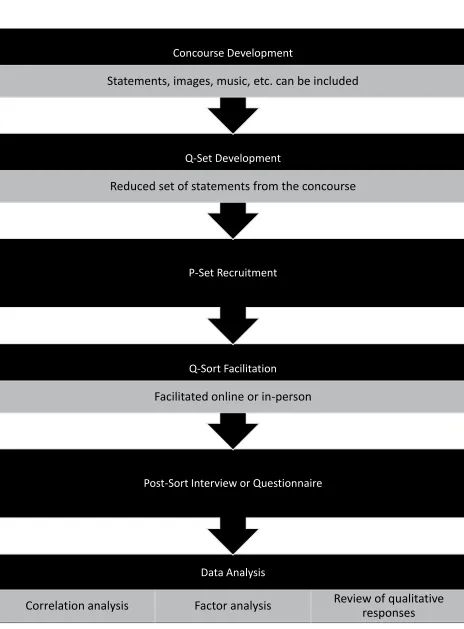
a topic (Ramlo, 2016; Newman & Ramlo, 2010; Simons, 2013). An overview of the steps involved in Q-methodology can be found in Figure 1.
The process begins with the development of a concourse, or collection of thoughts, around the selected topic (Simons, 2013). Afterwards, a representative subset of these statements are presented to participants to sort using a distribution chart (Watts & Stenner, 2014). For this study, over five-hundred statements were narrowed down to a set of forty-two for participants to rank on a scale of least important (-5) to most important (5).
27 Figure 1: Steps of q-methodology research.
Data Analysis
Correlation analysis Factor analysis Review of qualitative responses Post-Sort Interview or Questionnaire
Q-Sort Facilitation
Facilitated online or in-person P-Set Recruitment Q-Set Development
Reduced set of statements from the concourse Concourse Development
28 History of Q Methodology
William Stephenson, a psychologist, first introduced Q-methodology through a letter in a journal called Nature in 1935 (Ramlo, 2016; Brown, 1993; Simons, 2013) and later provided more information in a publication titled “Correlating Persons Instead of Tests (Brown, 1993).
Considered to have evolved from factor analysis theory (Cross, 2005), Q-methodology allows for researchers to study the subjectivity of research participants (Brown, 1993). Through
q-methodology, participants are able to share their perceptions on a topic by arranging statements on a scale provided by the researcher (Newman & Ramlo, 2010; Ramlo, 2016). It is believed that having the forced arrangement encourages participants to consider their decisions more carefully (Cross, 2015). It is also believed to discourage participants form defaulting to extreme views (Kampen & Tamas, 2013).
Since its introduction, there have been critiques of Q methodology including thoughts from researchers that the methodology lacks the validity and reliability found in more traditional research methods (Ramlo, 2016). In Q-methodology, it cannot be assumed that conducting the same study on the same participants will produce the same results and promoters of the
methodology do not express an intent to have results show the same over time (Cross 2004; Watts & Stenner, 2005) There has also been concern expressed around how factor analysis is used in Q methodology (Simons, 2013). However, with these concerns, it continues to be used as a viable option for collecting information on participant perceptions. Q-methodology has been used in a variety of studies as views on its ability to measure subjectivity with a small group of participants become more positively viewed (Kampen & Tamas, 2013).
29 promotion strategy was the publication of Operant Subjectivity: The International Journal of Q Methodology. The launch of this organization came right before what some consider to be a mixed-method research movement (Ramlo, 2016). Introduced over 70 years ago, Q-studies have been conducted in the areas of political science, health science, education, behavioral science, and communication (Cross, 2004). And now, software tools such as Q-method, have also been developed to help facilitate Q-sorts electronically (Simons, 2013).
Q-Methodology Terms
Concourse: A group of statements, images, or other media collected by the researcher(s) to reflect the comprehensive views of the research study’s topic (Cross, 2005; Simons, 2013).
Consensus Statement: Statement from the q-set in which participants had similar views (Krueger, 2001).
Contention Statement: Also known as a distinguishing a statement, an item ranked by a factor group that reflect the greatest difference in their rankings (perspective) (Krueger, 2001).
P-Set: In Q-methodology, the group of participants which complete the q-sort (Simons, 2013).
Q-Methodology: Introduced by William Stephenson, a research methodology used to study the perceptions of study participants by arranging (sorting) topical statements on a pre-determined scale and conducting a factor analysis to analyze the results of the participant rankings (Ramlo, 2016; Brown, 1993; Simons, 2013).
Q-Set: A reduced number of statements from the concourse, allowing the study
30 Concourse Development
The first step in preparing the q-study was developing the concourse. The concourse is a collection of thoughts on the topic being researched (Simons, 2013) including statements, images, or other forms of media (Cross, 2005). There are various methods that can be used to develop the concourse of a q-study, but interviews have shown to be the most frequently used method (Brown, 1993; Simons, 2013). Other options include reviewing literature, pulling from personal experience, and gathering media (Cross, 2004). The researcher selects the appropriate method for collecting the items, based on the research questions being asked in the study (Cross, 2004).
For this study, the concourse was drafted through a review of online references on the topic of skills and knowledge needed by training and development professionals, the aim being to identify what students in graduate programs should ideally know as they transition to careers in the field. Reviewed materials included blog posts, competency models from professional certifications, articles from organizations focused on the field, and job postings seeking professionals in the field. From the over sixty references reviewed, five hundred and nine statements on the skills and knowledge needed by professionals in training and development were identified. These statements included a variety of requirements ranging from knowledge of adult learning, to data analysis and technology skills, to business acumen.
The Q-Set
31 Brown, the development of the q-set is “more of an art than a science” (Brown, 1980) but,
Fisher’s Experimental Design Principles have been previously noted as a guiding method used in
prior research to finalize the list of items (Brown, 1970). The number of items in a q-set often ranges between 40 to 50 statements (Ramlo, 2016), with some researchers suggesting a range between 40 to 60 statements. There have also been prior research studies that have used over 100 statements (Simons, 2013).
For this study, the original statements collected through my review of online research was narrowed down to a q-set of forty-two statements. These statements can be found in Appendix A. The final list of statements in the q-set were determined by first grouping duplicate statements and noting how often each statement appeared. Duplicate statements were then synthesized into single statements. Lastly, statements that did not in more than one reference was removed. To finalize the drafted q-set, the statements were reviewed with a few professionals in the training and development field prior to beginning the sorts with participants. The set was reviewed to ensure that there was clarity in the statements and to reduce any chance of bias.
The P-Set
The participants in a Q-study are known as the P-set (Simons, 2013). It has been
recommended to have between 40 to 60 participants complete the Q-sort (Simons, 2013). Unlike other research methods, a large population size of research participants is not needed (Brown, 1980) but these participants should represent a mix of possible opinions on the topic being studied (Simons, 2013).
For this study, the P-set included participants that represent the stakeholders of graduate programs in training and development including:
32 • Students currently enrolled in graduate programs in training and development
• Training and development leaders and managers, representing the potential employers of student graduating from the program
Faculty and student participants were recruited by directly emailing program directors and faculty members of graduate programs in training and development. A list of graduate programs in training and development was obtain through the degree listing on the Association of Talent Development website. It is important to note that only programs which specifically included training and/or development in the programs title was included in the recruitment list and only programs in the United States. Contacts, including program directors and faculty members, from eleven programs were reached out to via email. Representatives from two of the institutions responded noting that they would forward information on the study to faculty members and students within their graduate programs. A copy of the recruitment letter that was sent can be found in Appendix B.
Ninety-nine learning and development leaders and managers were identified through the online professional network, LinkedIn. Through messaging in training and development
professional groups, and direct messages using LinkedIn’s InMail feature, potential participants
were sent information on the study. An example of the recruitment letter sent these potential participants can be found in Appendix C.
The recruitment goal was to have representatives from each of the three groups in the P-set. Recruitment occurred from August to October of 2019, resulting in sixteen people
33 reiterated on the first screen of the online q-sort, reminding participants that by beginning the study they were providing consent to the researcher.
Q-sort Process and Instrumentation
With the set finalized and participants recruited, the main component of the Q-methodology could be completed: the sort. In the sorting process, participants are asked to sort the statements within the q-set on a distribution chart provided by the researcher (Newman and Ramlo, 2010). As this is done, participants will often interpret the statements with their own meanings (Ramlo, 2016; Cross, 2005)In doing this, there is no right or wrong answer (Ramlo, S. 2016),the goal is to collect the opinion of the participant, so it can later be analyzed against other people who have completed the study.
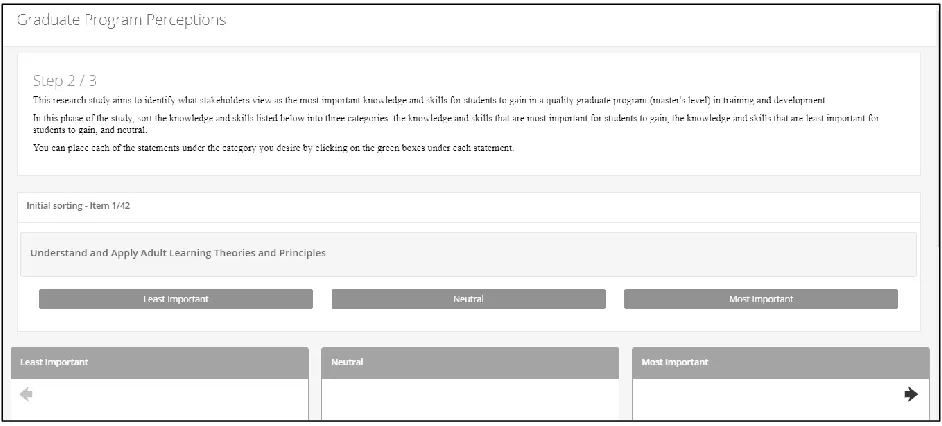
Traditionally Q-sorts have most often been facilitated using an in-person, physical sorting of cards. However, for this study, the q-sort was facilitated through an online software program, Q-sorTouch created by Dr. Alessio Pruneddu (Pruneddu).
In the instructions for the sort, as shown in Figure 2, participants were first asked to divide up the statements into three groups based on the topic including:
34 Figure 2: Online pre-sort instructions.
Once in these groupings, participants were transitioned from completing this preliminary sort to the final sort of the statements. During this phase, participants are typically asked to read through the statements again (Brown, 1980) and to rank the statements against each other using a provided distribution chart (Watts and Stenner, 2014). For this study, participants were asked to rank the statements on a scale from least important (-5) to most important (5), as Q-sort
35 Figure 3: Example q-sort distribution chart.
As recommended by the literature on Q-methodology, participants were then asked follow-up questions to gain additional information on their perspectives. Specifically, the participants in this study were asked why they chose the statements they rated as the most important item and the statement chosen as the least important item. They were also asked demographic questions such as their gender, age range, and current job title. Lastly, they were asked if there were any cards they would have not included in the study and if they had any additional information they wanted to share. These questions were asked using the Q-sorTouch software as the third step in the study. A copy of the questions can be found in Appendix C. Data Analysis
37 CHAPTER 4: FINDINGS
Introduction
Using Q-methodology, the study aimed to gain insight on what stakeholders of graduate programs in training and development view as the key knowledge and skills to learn through these types of programs. Specifically, the study aimed to answer:
• What are the perspectives of students, faculty members, and employers toward a quality master’s program in training and development that prepares graduates for employment
and why?
• How are the perspectives of students, faculty members, and employers similar or different toward a quality master’s program in training and development that prepares
graduates for employment?
Invitations to participate in the study were sent to directors and faculty members of graduate programs in training and development and leaders in the training and development field. Students were recruited with the assistance of the graduate program directors, by
forwarding the recruitment letter to those currently enrolled in the programs. Sixteen participants completed the q-sort, arranging forty-two statements of skills and knowledge on a scale of least important to most important. The sorting process, conducted online, was facilitated with Q-sorTouch. Post-sort questionnaires were also submitted through the site. The data from these sorts were then extracted and analyzed by conducting a factor analysis in R using the Qmethod package.
38 Data Collection
The Q-sort process was facilitated through Q-sorTouch, an online tool created to conduct q-methodology studies. Each participant was provided with a direct link to the study in the tool. Upon entering the site, each user was prompted with a consent agreement followed by the initial sort, the final sort, and the post-sort questionnaire.
In the initial sort participants were asked to place the provided statements into one of three groups: least important, neutral, or most important. Afterwards, the same statements were presented to the participant again for the final sort, in which they were asked to place the statements on a scale of -5 (least important) to 5 (most important). For the statements that were ranked as being of lowest importance and most important, they were asked to share why the statement was given the ranking. It is important to note that the sort enforced a specific distribution of the statements, only allowing a certain number of statements to be assigned to each ranking.
To gain additional insights on the background of the participants and why they chose their rankings of the statements, each person was also asked to complete eight demographic and qualitative questions after the sort. The questions can be found in Table 1 below. These questions were asked directly in the Q-sorTouch software.
Table 1: Post-sort questionnaire questions.
No. Question
1 Age
2 Gender
3 Through which of the following categories do you qualify as a participant?
39 Table 1 (continued).
5 If yes, what is your current title?
6 Have you previously graduated from a graduate program in training and
development?
7 Are there any cards that you would have not included? Why?
8 Is there any additional information that you would like to share?
P-Set
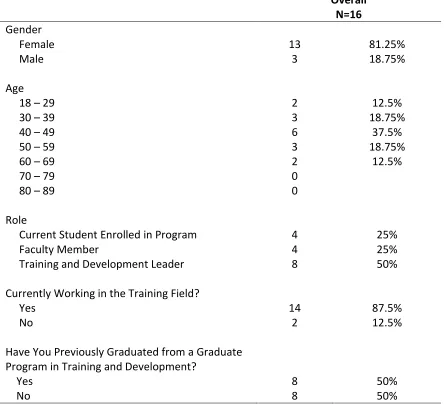
Sixteen participants completed the sort between August 2019 and October 2019. An overview of the demographics of the participants can be found in Table 2. Most participants, 81.25%, were female. Age ranges were also collected from the participants. 37.5% of
participants were between the ages of 40-49. 12.5% reported being in the 18-29 age range, 18.75% reported being in the 30-39 range, 18.25% were in the 50-59 age range, and 12.5% were in the 60-69 age range.
In the third post-sort question, participants were asked to self-identify which stakeholder group they belonged in. This stakeholder group was used to collect information on how their current role qualified them for the study. For this question participants were presented with three options:
• Current student in a graduate program in training and development • Faculty member in a graduate program in training and development • Learning and development leader/ manager
40 and development graduate program, and 50% of participants identified as being a learning and development leader/manager. In addition to those who reported being in the third category, several of the students and faculty members also noted they are currently working in the training and development field. Of the sixteen participants in the study overall, fourteen (87.5%), said they are currently working in the field. Their job titles included a mix of roles such as Associate Professor, Consultant, Senior Regional Training Director, Instructional Designer, Training Coordinator, Director of Organization and Executive Development, and Director of Technical Training.
Information was also collected on if the participant had previously completed a graduate program in training and development, as having prior experience as a student in a program could potentially influence the statement rankings. Eight people, 50% participants, have previously graduated from a graduate program related to the training and development field. These eight participants include all four of the faculty participants and four of the eight learning
leader/manager participants.
In addition to these demographic questions, participants were also asked two open-ended questions: if they would have not included any of the statements provided in the q-sort and if there was any additional information they wanted to share. Both of these questions were
41 Table 2: P-set demographics.
Overall N=16 Gender
Female 13 81.25%
Male 3 18.75%
Age
18 – 29 2 12.5%
30 – 39 3 18.75%
40 – 49 6 37.5%
50 – 59 3 18.75%
60 – 69 2 12.5%
70 – 79 0
80 – 89 0
Role
Current Student Enrolled in Program 4 25%
Faculty Member 4 25%
Training and Development Leader 8 50%
Currently Working in the Training Field?
Yes 14 87.5%
No 2 12.5%
Have You Previously Graduated from a Graduate Program in Training and Development?
Yes 8 50%
No 8 50%
Data Analysis Overview
42 groupings of the participants. Several possible factor solutions were reviewed to determine which would be best to comprehensively reflect the views of the participants. With the software a 2-factor, 3-factor, 4-factor, and 5-factor rotation was identified. A comparison of the factor solutions can be found in Table 3.
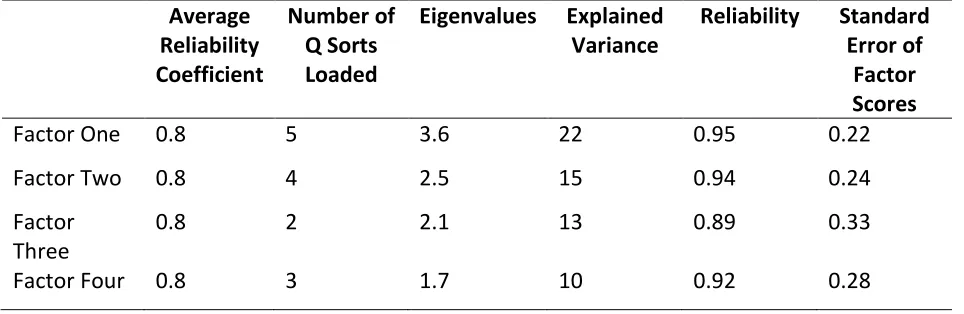
When deciding on a factor solution, it is recommended for the researcher to review the eigenvalues, the percentage of variance explained, scree tests, and any potential suggestions on the number of factors from prior research or theory (Hair et al., 2014). As described by Watts and Stenner, the basis of factor analysis is to be able to explain as much of the variance in the groupings as possible (2005). Based on the results of the factor rotation, the four-factor solution was chosen as the best option for this study. The four-factor solution resulted in 14 of the 16 sorts loading into a single factor. Participants one and ten, both learning and development professionals, did not significantly load into a single factor and are therefore not represented in any further analysis of the data. Of the remaining participants, five individuals load into factor one, four participants load into factor two, two participants into factor three, and three
43 Table 3: Comparison of factor solutions.
Factors Rotated Explained Variance Participants Loaded Decision
2 44% 16 Declined: All participants are loaded to a
factor, but only 44% of variance is explained.
3 54% 16 Declined: All participants are loaded to a
factor, but solution only explains 54% of the variance.
4 60% 14 Accepted: Two of the participants are not
included but the solution explains a high % of the variance with at least two people in each factor.
5 67% 14 Declined: Solution removed two of the
sixteen participants and one of the factors has only one participant included.
Table 4: Factor characteristics eigenvalues for 4-factor Solution.
Average Reliability Coefficient Number of Q Sorts Loaded
Eigenvalues Explained Variance
Reliability Standard Error of
Factor Scores
Factor One 0.8 5 3.6 22 0.95 0.22
Factor Two 0.8 4 2.5 15 0.94 0.24
Factor Three
0.8 2 2.1 13 0.89 0.33
Factor Four 0.8 3 1.7 10 0.92 0.28
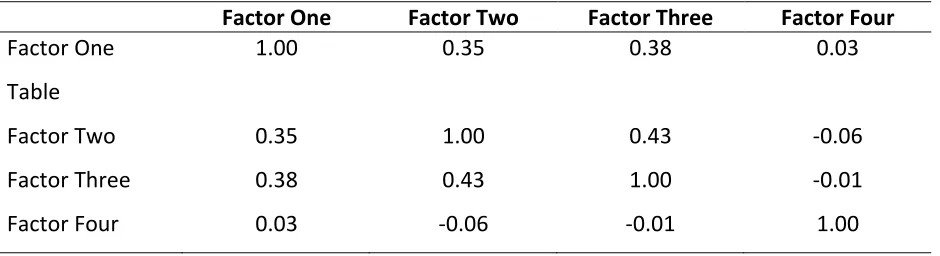
Factor Correlation Matrix