Advanced Content Based Image Retrieval
Using Multiple Feature Extraction
Charmi Katira1, Nikunj Vora2, Krisha Wali3, Abhinav Medhekar4
B.E, Dept. of Electronics and Telecommunication, Sardar Patel Institute of Technology, Mumbai, India1
B.E, Dept. of Electronics and Telecommunication, Sardar Patel Institute of Technology, Mumbai, India2
B.E, Dept. of Electronics and Telecommunication, Sardar Patel Institute of Technology, Mumbai, India3
B.E, Dept. of Electronics and Telecommunication, Sardar Patel Institute of Technology, Mumbai, India4
ABSTRACT:Due to the enormous increase inimage database sizes, as well as its vast deployment in various applications, many Content Based Image Retrieval (CBIR) systems have been developed. The challenge, however, is in designing a system with the ability to retrieve best matches in case of having all kind of images as query. The power of such system highly depends on the features it employs to perform the matching process. In this project a CBIR system has been designed and developed. Firstly, this report outlines a description of some primitive features of image, which have been utilized in the presented system. These features are extracted and used as the basis for a similarity check between images. The algorithms used to calculate the similarity between extracted features, are then explained. Final result was a MATLAB built software application, with an image database, that utilized different feature of the images in the database as the basis of comparison and retrieval. The structure of the final software application is illustrated. Furthermore, the results of its performance are illustrated.
KEYWORDS: Color, Content Based Image Retrieval, Edge, Gabor Filter, Tamura, Texture, Wavelet Transform
I. INTRODUCTION
The field of image retrieval has been an active research area for several decades and has been paid more attention in recent years as a result of the dramatic and fast increase in the volume of digital images. One approach for indexing and retrieving images is using manual text annotations. The annotation is then used to search images indirectly. There are several problemswith this approach. First, it is very difficult to describe the contents of an image using only a few keywords. Second, the manual annotation process is subjective. These problems have created great demands for automatic and effective techniques for Content Based Image Retrieval (CBIR) systems.
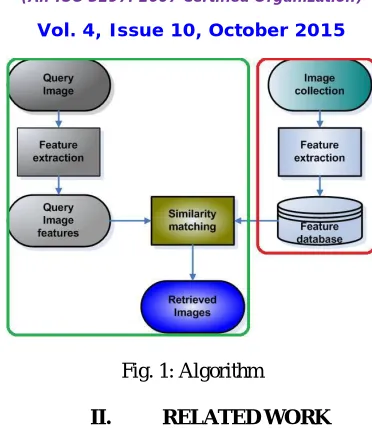
Image features such as color, texture, shape, edge etc. are used for image indexing and retrieval. We have used Query By Example (QBE) technique for image retrieval.[3] Here, the database is searched by giving an image input. The features of the images in the database are extracted and stored. On giving a query image, the features of the query image are extracted and are compared with the stored features of the database images and the similarity between the query image and the database images is calculated by different distance metrics. Finally the image that has best matching with the query image is ranked first followed by other image, based on the distance metric.
Fig. 1: Algorithm
II. RELATED WORK
Different approaches have been used to retrieve image using various feature extraction techniques.
2.1 Edge Detection using different operators:
a) Gradient based Edge Detection:
The gradient method detects the edges by looking for the maximum and minimum in the first derivative of the image.
b) Laplacian based Edge Detection:
The Laplacian method searches for zero crossings in the second derivative of the image to find edges. An edge has the one-dimensional shape of a ramp and calculating the derivative of the image can highlight its location.
2.2 Signature-based Color-Spatial Retrieval:
First,the color-spatial information has to be extracted and represented. The retrieval process requires a measure to compute the similarity between two images (in terms of their color-spatial representation). It includes approach which incorporates the concept of perceptually similar colors and weightage of colors. Finally, to speed up the retrieval process, filtering mechanism is also proposed.
2.3 Image Hashing Technique:
Image hashing is one of the techniques used to generate hash value for each image in the database. These hash values generated for images are used for content based image retrieval, image database indexing, image authentication, avoiding and mitigating the tampering of digital images.
III. PROPOSED SYSTEM
Our proposed CBIR system is divided in to three main parts:
a) Feature extraction
b) Similarity matching
c) Retrieved images.
3.1 Feature extraction:
3.2 Similarity matching:
To retrieve desired images, user has to provide a query image. The system then performs certain feature extraction procedures on it and represents it in the form of feature vectors. The similarity distances (metrics) between the feature vectors of the query image and those of the images in the database are then calculated. Distance metrics are used to calculate the distance or metric (i.e. error) between the various features. The lower the distance value, closer is the match. One such distance metric is squared Euclidean distance.
3.3 Retrieved images:
The database images are sorted in ascending order of the metrics and displayed. Thus, the database image with least metric value will be displayed first followed by images with increasing metric values.
IV. STATISTICAL METHOD
Moments of an image are the statistical values calculated for the image. These values give a probabilistic approach to
similarity matching. The first order moment is known as Mean or Expected value. It gives an average value of allpixel
values in the image.The second order moment is known as Variance.It measures howfar a set of pixels is spread out. A
small variance indicates that the pixel value tends to be very close to the meanpixel value (expected value),while a
high variance indicates that pixel valuesare very spread out from the mean pixel value and from each other.[6]
As variance is a central moment (moment about the mean), it provides clearer information about the distribution of the
pixel values. Hence theprecision in comparison of images based on the second order moment would increase over first
order moment.Similarly, as the order of the moment increases, the accuracy of similarity matching between the images increases.
V. EDGE HISTOGRAM DESCRIPTOR
The edge histogram descriptor resembles the color layout descriptor (CLD) in its principle of capturing the spatial distribution of edges which is useful in image matching even if the texture itself is not homogeneous.[7] An image is partitioned into 4×4 = 16 sub-images, and 5-bin local edge histograms are computed for these sub-images, each histogram representing five broad categories of vertical, horizontal, 45o-diagonal, 135o-diagonal, and isotropic (non-orientation specific) edges. The resulting scale-invariant descriptor is of size 240 bits, i.e. 16×5 = 80 bins and supports both rotation-sensitive and rotation-invariant matching.
The edge histograms are computed by subdividing each of the 16 sub-images into a fixed number of blocks. The size of these blocks depends on the image size and is assumed to bea power of 2. To have the constant number of blocks per sub-image, their sizes are scaled in accord with the original image dimensions. Each block is then treated as 2×2 pixel image (by averaging each of the 2×2 partitions), and a simple edge detector is applied to these average values. The detector consists of four directional filters and one isotropic filter.
Five edge strengths, one for each of the five filters, are computed for each image block. If the maximum of these strengths exceeds a certain preset threshold, the corresponding image block is an edge block contributing to the edge histogram bins. The bin values are normalized to the range [0.0, 1.0].
VI. COLOR HISTOGRAM
A color histogram describes the distribution of colors within a whole image or within a specified region. As a pixel-wise characteristic, the histogram is invariant to rotation, translation, and scaling of an object. At the same time, the histogram does not capture semantic information, and two images with similar color histograms can possess totally different contents. A quantized HSI (or RGB) color space is typically used to represent the color in order to make the search partially invariant to irrelevant constraints such as illumination and object viewpoints.[1]
A color histogram is a K-dimensional vector such that each component represents the relative number of pixels of color
Ck in the image, that is, the fraction of pixels that are most similar tothe corresponding representative color. [8]To build
the dissimilarity of image colors is now measured by the weighted sum of the individual color dissimilarities between the corresponding regions.[4]
VII. TEXTURE
Texture is that innate property of all surfaces that describes visual patterns, each having properties of homogeneity. An image texture is a set of metrics calculated in image processing designed to quantify the perceived texture of an image[8]. Image Texture gives us information about the spatial arrangement of color or intensities in an image or selected region of an image.Texture properties include Coarseness, Contrast,Directionality,Line-likeness,Regularity, Roughness.[6]
A. Gabor Filter:
Gabor filters are band pass filters which are used in image processing for feature extraction and texture analysis. Frequency and orientation representations of Gabor filter are similar to those of the human visual system, and they have been found to be particularly appropriate for texture representation and discrimination. In thespatial domain, a 2D
Gabor filter is a Gaussian kernel function modulated by a sinusoidal plane wave. Its impulse response is defined by a
sinusoidal wave (a plane wave for 2D Gabor filters) multiplied by a Gaussian function. Gabor filters are able to generate consistent measurements in low and medium frequencies but generate inconsistent measurements for higher frequencies. The higher the frequency of a Gabor filter, the more sensitive the filter is to the point noise. This is due to the higher frequency filters having larger spatial-frequency bandwidth which covers relatively more energy of the impulsive noise that is evenly distributed in the spatial-frequency domain.
B. Wavelet Transform:
Discrete wavelet transformation (DWT) is used to transform an image from spatial domain intofrequency domain. Wavelet transforms extract information from signal at different scales by passing the signal through low pass and high pass filters. Wavelets are robust with respect to color intensity shifts and can capture both texture and shape information efficiently. The wavelet transforms can be computed linearly with time and thus allowing for very fast algorithms.The wavelet transform computation of a two-dimensional applies recursive filtering and sub-sampling. At each level (scale), the image is decomposed into four frequency sub-bands, LL,LH, HL, and HH where L denotes low frequency and H denotes high frequency.
C. Tamura:
Tamura features are six texture features corresponding to human visual perception: coarseness, contrast, directionality, line-likeness, regularity and roughness. Amongst these, the first three features are very important.Coarseness gives information about the size of the texture elements. The higher the coarseness value is, the rougher is the texture. The essence of calculating the coarseness value is to use operators of various sizes.Contrast stands for picture quality. More detailed, contrast can be considered to be influenced by the following four factors: dynamic range of gray-levels, polarization of the distribution of black and white on the gray-level histogram, sharpness of edges and period of repeating patterns.Not the orientation itself but presence of orientation in the texture is relevant in CBIR. That is, two textures differing only in the orientation are considered to have the same directionality.
VIII. PERFORMANCE EVALUTION
The performance of retrieval of the system can be measured in terms of its performance parameters. CBIR defines two parameters viz. recall and precision. Recall measures the ability of the system to retrieve all the images that are relevant, while precision measures the ability of the system to retrieve only the images that are relevant.
No. relevant documents retrieved
Precision value = ________________________________
No. relevant documents retrieved
Recall value = _______________________________________
Total No. relevant documents in the collection
IX. SIMULATIONS AND RESULTS
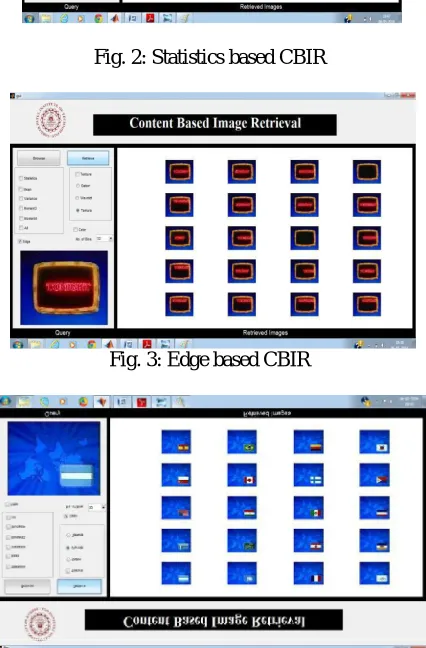
We have created a simulation system which is a search engine to evaluate and compare the accuracy of our results based on the multiple features explained above. The results from the simulations are shown in the following figures. Figure 2 describes the results of simulation for Statistics based CBIR. Figure 3 shows results of simulation for Edge based CBIR. Results for simulations for Color based CBIR are shown in figure 4.
Fig. 2: Statistics based CBIR
Fig. 3: Edge based CBIR
Simulation results for Texture based CBIR using various methods are described in the following images.
Figure 5-a shows Texture based CBIR using Tamura filter. Figure 5-b shows Texture based CBIR using Wavelet transform. Figure 5-c shows Texture based CBIR using Gabor filter.
Fig. 5-a : Texture based CBIR using Gabor filter
Fig. 5-b : Texture based CBIR using wavelet transform
Fig. 5-c : Texture based CBIR using Tamura
X. APPLICATIONS
A. Medical diagnosis
patient, there is increasing interest in the use of CBIR techniques to aid diagnosis by identifying similar past cases.[5]
B. Crime Prevention
The Law enforcement agencies typically maintain large archives of visual evidence, including past suspects’ facial photographs(generally known as mug shots), fingerprints, weapons and shoeprints. Whenever a serious crime is committed, they can compare evidence from the scene of the crime for its similarity to records in their archives. Thus, the systems designed for this purpose are capable of searching an entire database to find the closest matching records to track the criminal.
C. Military
Military applications of CBIR are recognition of enemy aircraft from radar screens, identification of targets from satellite photographs etc. Many of the techniques used in crime prevention could also be relevant to the military field.
D. Intellectual Property
Can be used in trademark image registration, where a new candidate mark is compared with existing marks toensure no risk of confusing property ownership.
E. Fashion and Interior Design
A combination of color and texture based CBIR can be used for fabric recognition.
F. Cultural Heritage
Museums and art galleries deal in inherently visual objects. The ability to identify objects sharing some aspect of visual similarity can be used by researchers, archaeologists as well as art lovers for study and research of cultural heritage.
G. Journalism and Advertising
This application area is one of the prime users of CBIR technology. Newspapers and stock shot agencies maintain archives of still photographs to illustrate articles. Using CBIR in this field provides automatic assistance in retrieving such photographs.
XI. CONCLUSION
The dramatic rise in the sizes of images databases has stirred the development of effective and efficient retrieval systems. The application performs a simple color-based search in an image database for an input query image, using color, texture and shape to give the images which are similar to the input image as the output. The number of search results may vary depending on the number of similar images in the database.
CBIR is a developing science. As digital image processing has become more developed in recent years, CBIR maintains a steady pace of development in the research field. In our system, we provide the functionality to the user to select the features as per his requirement. This development promises an immense range of future applications using CBIR.
XII. FUTURE SCOPE
The existing interface can be developed into feedback-based user interface. This dwells onthe fact that the relevance of output images and hence the evaluation of precision and recallrates is a subjective phenomenon. In thisscenario, a feedback based user interface would empower the user to mark the relevant output images and consequently evaluate the precision and recall rates. When trained with a suitable Neural Network, it can strive to achieve higher values of precision and recall rates, thereby promising improved efficiency and better results.
[2]Dr.H.B.Kekre, Sudeep Thepade, Priyadarshini Mukherjee, Miti Kakaiya, Shobhit Wadhwa and Satyajit Singh,“Image Retrieval with Shape Features Extracted using Gradient Operators and Slope MagnitudeTechnique with BTC”,International Journal ofComputer Applications (0975 – 8887) Volume 6– No.8, September 2010
[3]Colin C. Venteres and Dr. Matthew Cooper, “A Review of Content-Based Image RetrievalSystems”
[4]Shengjiu Wang, “A Robust CBIR Approach Using Local Color Histograms,” Department ofComputer Science, University of Alberta, Edmonton, Alberta, Canada, Tech. Rep. TR 01-13, October 2001
[5]Sh. Akbarpour,“A review on cbir used in medical images”,IJTPE/IJTPE-2013/IJTPE-Issue15-Vol 5-No2-Jun2013
[6]S. Mangijao Singh , K. Hemachandran,“Content Based Image Retrieval using ColorMoment and Gabor Based Image Retrieval using Color Moment and Gabor”, IJCSI International Journal of Computer Science Issues, Vol. 9, Issue 5, No 1, September 2012
[7]Wenjing Jia, Huaifeng Zhang, Xiangjian He, and Qiang Wu,”A Comparison on Histogram Based Image Matching Methods”, Proceedingsof the IEEE International Conference on Video and Signal Based Surveillance,2006