:
SIMULATION-EXTRAPOLATION:
THE MEASUREMENT ERROR JACKKNIFE
by
L. A. Stefanski and
J.
R. Cook
Institute of Statistics Mimeograph Series No. 2259
November 1993
/
,
.
L.A.Stefanski & J.R.Cook MIMEO SIMULATION-EXTRAPOLATION
W~~$~S J*g~r~EMENT
ERRORI NAME
DATE
I
!
I(
SIMULATION-EXTRAPOLATION:
THE
MEASUREMENT ERROR JACKKNIFE
1. A. Stefanski
Department of Statistics
North Carolina State University Raleigh, NC 27695
J. R. Cook Merck Research Laboratories Division of Merck & Co., Inc. West Point, PA 19422
..
ABSTRACT
This paper provides theoretical support for the simulation- based estimation procedure, SIMEX,
introduced by Cook and Stefanski (1992) for measurement error models. We do so by establishing
a strong relationship between SIMEX estimation and jackknife estimation. A resultant of our
investigations is the identification of a variance estimation method for SIMEX that parallels
jackknife variance estimation. It is shown that the variance estimator is asymptotically valid in simple linear regression measurement error models. Data from the Framingham Heart Study
are used to illustrate the variance estimation procedure in logistic regression measurement error
models.
Keywords: Bias Reduction; Components of Variance; Extrapolation; Linear Regression; Logistic
Regression; Simulation; UMVUE; Variance Estimation .
Note: This paper uses data supplied by the National Heart, Lung, and Blood Institute, NIH, and
DHHS from the Framingham Heart Study. The views expressed in this paper are those of the
authors and do not necessarily reflect the views of the National Heart, Lung, and Blood Institute,
•
1. INTRODUCTION
Cook and Stefanski (1992) introduced a simulation-based method of estimation for measurement
error models, called SIMEX, wherein a simulation step is followed by a modelling and extrapolation
step. Exact computations for linear models and simulation studies for nonlinear models were
presented showing that SIMEX is competitive with other more conventional methods of analyzing
data contaminated with measurement errors.
By establishing a close relationship between SIMEX and jackknife estimation, this paper provides
further theoretical justification for SIMEX and identifies a complementary method of variance
estimation. The relationship is such that SIMEX can be viewed as a specialized adaptation of the.
jackknife to measurement error models.
The problem with ignoring measurement errors in data is that parameter estimates so obtained
are generally biased whenever the estimates are nonlinear functions of the variates measured with
error. The jackknife (Quenouille, 1956) is a technique that was developed for the purpose of reducing
bias in nonlinear estimators. Despite the apparent connection between these problems, there has
been relatively little mention of the jackknife in the literature on measurement error methods.
In Sections 2 and 3 we review jackknife and SIMEX estimation, using for illustration a
common example that is amenable to both methods. Section 4 digresses somewhat to address
the extrapolation component of SIMEX estimation. Section 5 establishes the formal connection
between SIMEX and the jackknife and studies the performance of SIMEX estimation in a class
of problems that have typically been handled by the jackknife. Also in this section we describe a
variance estimation method for SIMEX that parallels jackknife variance estimation.
Section 6 describes the implementation of the variance estimation method to measurement error
models. We prove its validity for the simple, but representative, components-of-variance model,
and also for the more complicated linear regression measurement error model. Section 6 ends with
an application to a logistic regression measurement error model. Concluding remarks are given in
Section 7.
Throughout the paper we assume the simple, additive measurement error model, often with
known measurement error variance. The utility of this simple model for both applications and
theoretical study is evident by the attention it has received in linear measurement error models,
Fuller (1987).
2. JACKKNIFE EXTRAPOLATION
In order to present Quenouille's jackknife (Quenouille, 1956) as an extrapolation technique,
•
distributed data, {Xj}l, from a Gaussian population with mean J1. and known variance u2 • We
take f(J1.) = exp(J1.) in this section, generalizing later to more general functions. This particular
example was chosen primarily for its analytic tractibility. The results in this section do not depend
on knowingu2, but results in later sections do.
It is well known that the maximum likelihood estimator, iJ exp(X), has expectation
E(iJ)
=
8exp{u2/(2n)}, and thus is positively biased by the amount [exp{u2/(2n)} -1]8. The biasis of order n-l, and, to terms of order n-3, the bias is 8{n-l(u2/2)
+
n-2(u4/8)+
n-3(u6/48)}.The reduced-bias jackknife estimator is niJ - (n -
1)8
(n-l),(.) where8
(n-l),(.) is the average ofthe nleave-I-out estimators iJ(n-I),(kjl k = 1, ... ,n, based on samples of size n - 1.
Later we will make use of the notation iJ (n-j),(.), to denote the average of the nCj leave-j-out
estimators B(n-n,(k)' k
=
1, ... , nCj, based on samples of size n - j. This notation is further extended to denote both the maximum likelihood estimator,B
(n),(.), and the jackknife estimator,B
(=),(.). The maximum likelihood estimator is a leave-O-out estimator, and the jackknife estimatorcan be thought of, for reasons that will become evident in following sections, as a leave-(-00)-out
estimator, hence the notation.
The jackknife estimator of ()
=
exp(J1.) has a negative bias of order n-2, and to terms of ordern-3 is -(){n-2(u4/8)
+
n-3(u4/8+
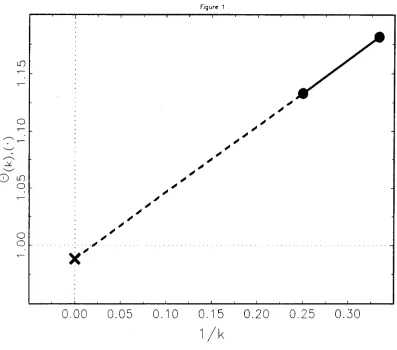
u6/24)}.Figure 1 illustrates the nature of the extrapolation involved. For this figure a pseudo-random,
standard normal sample of size 4, {Xl = -0.20544, X2 = 0.33879, X3 = 1.39088, X4 = -1.02414},
was generated subject to certain constraints explained in Section 3.2. For these data J1.
=
0 andthus 8 = 1. Plotted are the points
(8
(k),(.jll/k)
fork
= 3 (the average of the 4 leave-l-outestimates), k
=
4 (the maximum likelihood estimate), and k=
00 (the jackknife estimate). It isevident that the jackknife estimate is a simple linear extrapolation (the dashed line) of the line
determined by the maximum likelihood estimate and the average of the leave-I-out estimates on an
inverse sample size scale. Since 8 = 1, Figure 1 illustrates both the positive bias of the maximum
likelihood estimator and the negative bias of the jackknife estimator. Our Figure 1 is similar to a
figure in Efron (1982, Ch. 2, p. 7).
3. SIMULATION EXTRAPOLATION
3.1. Simulation Extrapolation Estimation
SIMEX estimation is a computational and graphical method-of-moments-like inference procedure
for assessing and reducing measurement error-induced bias. The method starts with the observed
data and the so-called naive estimator, i.e., the estimator computed from the observed data without
pseudo-random measurement errors to the data in a resampling-like stage and recalculating the naive
estimator again from the contaminated data. These estimators are used to establish a trend of
measurement error-induced bias versus the variance of the added measurement error. This trend is
then extrapolated back to the case of no measurement error, producing estimators with less bias,
and in some cases no bias, at least asymptotically. Details of the method and example applications
are presented in Cook and Stefanski (1992).
We adopt notation consistent with Cook and Stefanski (1992). We use U to denote the true
variate subject to measurement error (U is for unobserved), X to denote the measurement of U,
and Y and V to denote response and covariable variates respectively, should the latter be present
in the data. We assume initially that Xj
=
Uj+
(JZj, j=
1, ... ,n, where {Uj}f is a sequenceof unknown constants and {Zj}f is a sequence of independent standard normal random variables,
i.e., a functional measurement error model with additive independent normal error.
The estimator that would be calculated in the absence of measurement error IS denoted
8TRUE = T ( {Yj , Vj , Uj}n, where T represents the function applied to the data, e.g., for linear
regression T would commonly represent least-squares estimation. The so-called naive estimator,
i.e., the estimator calculated if measurement error is ignored, is obtained by replacing Uj with Xj
above, and is denoted 8NAIVE = T({Yj,Vj,Xj}f).
The pseudo data constructed by adding random errors to{Xj}} are denoted
j=l, ...
,n,
b=l, ... ,B,where the added pseudo errors, {{Zb,j
Yi=df=l
are mutually independent, independent of the data{Yj , Vj,Xj}I, and identically distributed, standard normal random variables.
The pseudo data are used to calculate
which in turn are used to estimate, by averaging,
b=l, ... ,B, (3.1)
(3.2)
The expectation in (3.2) is with respect to the distribution of {Zb,j
}j=1
only.Note that 8(0) =
8
b(0) = 8NAIVE' Although analytic determination of 8(A) for A>
0 issometimes possible, it can always be estimated with arbitrarily small variance by generating a
estimator
th(A)
for each b= 1, ... ,B, and estimatingO(A)
by the sample mean of{Ob(A)}f.
Thisis the simulation component of SIMEX.
The extrapolation step of SIMEX entails modelling
O(
A) as a function of A for A ~ 0 and extrapolating the model back to A=
-1. This results in the simulation-extrapolation estimatordenoted 8SIMEX. The procedure is illustrated in the next section.
3.2. Estimating 0= exp(J.L) via Simulation Extrapolation
SIMEX estimation applies to the problem studied in Section 2under the interpretation that Xj
is a measurement ofJ.L with measurement error variance (12. Adding additional measurement error
with variance A(12 to
X}, ... , X
n , results in the estimator8b(A)
= exp(X+
(1V):
Zb)
where(1y).Zb
is the mean of the added pseudo errors. Doing this for b= 1, ... ,B, averaging the estimators, and letting B -+ 00 conceptually, results in
B
8(A) = lim B1
~
exp(X+
(1V):
Zb)
=E{8b(A)
I
X} = exp(X+
A(12/(2n)),
B-+oo ~
b=l
where the limit is justified by an appeal to the Strong Law of Large Numbers, and the expectation
can be found using moment generating function-like identities.
The functional form of
O(
A) is known in this example only because the required expectations canbe obtained analytically. The measurement error analyst will always have available
((O(A),
A) :A
>
O}, but will seldom know its functional form. Thus for this example we proceed under thecontrived assumption of ignorance of the functional form of 8( A).
SIMEX next calls for plotting 8(A) versus A for A
>
0, fitting a model to this curve andextrapolating the curve back to A= -1, thereby obtaining 8SIMEX. Upon examining the plot of
B(A) versus A or by looking at residuals from the fit of a linear model, most data analysts would
arrive at the realization that log(iJ(A)) is exactlylinear in Aand hence determine the exact functional
form. Thus for this example SIMEX results in the estimator iJSIMEX = iJ(-1) = exp(X_(12
/(2n)).
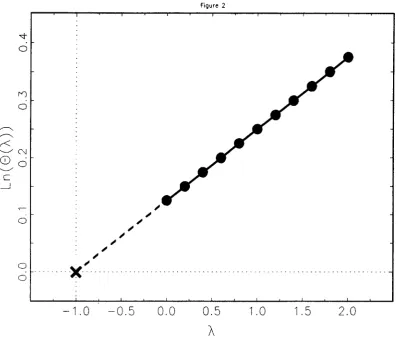
Figure 2 contains a plot of In(B('x)) versus A for 0
:S
,X:S
2 (solid line), and the extrapolationto ,X
=
-1 (dashed line), for the four-point data set set used in Section 2. The plotted points are for an equally-spaced grid of eleven ,X values spanning [0,2],
and In(8SIMEX) at A=
-l.There is nothing special about the number or range of A values employed in this example, except
that both are large enough to provide convincing evidence of linearity. It transpires that for these
data BS1MEX = 1, i.e., exactly equal to O. Thus Figure 2illustrates both the positive bias of the maximum likelihood estimate, iJ(O), and the apparent unbiasedness of the SIMEX estimator.
that both
°
(n),(.) and°
(n-l)'(-j, equal their expectations. Thus Figures 1 and 2 depict exactexpectedbehaviour of the maximum likelihood, jackknife and SIMEX estimators.
Indeed, a simple calculation shows that 0SIMEX is an unbiased estimator of 8 in this problem.
In fact, for what it's worth, 0SIMEX is the uniform minimum variance unbiased estimator of 8.
This is not a coincidence. If the naive estimator is a function of a sufficient statistic, then so too
will be the SIMEX estimator. Ifthe latter is unbiased, then it is necessarily uniform minimum
variance unbiased.
Lest we be accused of painting too rosey a picture of SIMEX with this example, we emphasize
that the unbiasedness of 0SIMEX depends crucially on knowing (72, being able to determine the
functional form of 9(A) exactly, and normality of the data. For simple problems O(A) often has
a simple functional form, and a little exploratory data analysis will often reveal it. However, the
strength of SIMEX does not depend on knowing the functional form of O(A). Our experience
indicates that even for complicated problems9(A) is well approximated by one or more of a handful
of simple functional forms (see Cook and Stefanski (1992) and Section 4 of this paper), and that
the approximations are generally more than adequate for applied work.
However, in most applications (72 is not known, and an estimate is used in its place. The
effect of this can be analyzed in the simple example described above. When (72 is replaced by s~,
0SIMEX = exp(X - s~j(2n )). Routine calculations involving normal and chi-squared moment generating functions show that this estimator has expectation anexp(J.l) where
2 [ 2 ](1-n)/2
an = exp((7 j(2n)) 1
+
(7 j{n(n - I)} .A little analysis shows that an
2:
1 for all n and that n3(an - 1) -+ (74j4 as n-+ 00. In other words
the SIMEX bias,
E(OSIMEX) -
8, is positive and of order n-3 for the case when (72 is estimatedby s~.
With regards to normality, SIMEX has no particular advantages or disadvantages relative to
other nonlinear estimators. Many non quadratic estimators that are unbiased under an assumption
of normality, fail to remain unbiased under non normality in general. In the particular example of
this section, it should be noted that normality of the data is important only to the extent that
it guarantees the independence of
X
and s~X", and that expectations of certain functions of these statistics are the same as those obtained from the appropriate normal and chi-squared distributions.4. EXTRAPOLANT CHARACTERISTICS AND EDA
4.1 Exploratory Data Analysis and Quadratic Extrapolants
estimates, 9(oX), oX
>
O. The curves are necessarily smooth ifB is large enough and in some caseshave simple functional forms that are easily identified using exploratory data analysis techniques.
However, in most problems the curves will not have simple functional forms although there will
usually be some simple form that fits well. Th~ problem is finding it. Since not all exploratory
data analysts are created equal, it is difficult to present an objective description of a procedure
that relies on an exploratory modelling step.
In the simulations and examples that follow we fit simple quadratic extrapolants in each case.
Thus we avoid the problem of biasing the reported results by having prior knowledge of the
appropriate, or best extrapolant function. In doing so, we provide a lower bound on the performance
of SIMEX in the sense that statisticians are more competent curve fitters than our straw analyst
who fits only quadratic functions. However, it will be evident that our straw analyst does quite
well. The reason is that for many problems extrapolant curvature is slight and is well modeled by
a quadratic.
4.2 The Range ofoX
The simulation step can generate 9( oX) for all oX
>
O. There remains the problem of choosing arange ofoX, say [0, AJ, over which to fit the extrapolant model.
Having developed SIMEX as an exploratory method for analyzing and describing the effects of
measurement error, we were led to consider initially A= 2. The plot of9(oX) for 0 ::; oX ::; 2, yields
immediate responses to queries about the effect of measurement error at levels two (oX = 1) and three (A
=
2) times as large as the nominal level (72 (oX=
0). Note that if the naive estimate isderived from measurements that are the means of replicate or triplicate measurements, then such
queries translate directly into questions about the adequacy of a single measurement.
Subsequent simulation studies designed to investigate the choice of A have been generally
inconclusive. This is good, since it suggests that SIMEX is relatively robust to choice of A. In
addition, some useful conclusions are possible for the problem of estimating regression coefficients
in large samples, under the assumption that B is large enough to ignore simulation variation.
Our observations are based on experience estimating regression parameters, suggesting that
extrapolant functions are often monotone, concave or convex, and have decreasing curvature as
A increases. In such cases if a quadratic extrapolant is employed, then there is a tendency to
undercorrect for the effects of measurement error. The reason is that the constant-curvature
quadratic will diverge from the increasing-curvature true extrapolant as A -+ -1. The larger
the value of A, the greater the undercorrection. However, a little undercorrection is desirable if
associated with the choice of A when quadratic extrapolants are fit.
5. SIMEX COMPLEMENTS TO JACKKNIFE THEORY 5.1 The Jackknife in SIMEX Clothing
The connection between SIMEX and the jackknife suggests an alternative formulation of the
latter. Let {) (n-j),(-) denote the average of thenCjleave-j-out estimators8(n-j),(k)' k
=
1, ... , nCj,based on samples of size n - j. For some fixed positive integer jmax ::; n - 1 and for Aj = j /(n - j), j = 0,1, ...,jmax, (0 ::; Aj ::; A= jmax/( n - jmax)), calculate
9(
Aj) =8
(n/(Aj+l»,(.) •Next plot 8(Aj) versus Aj, examine this plot, and fit a model extrapolating the curve to A
=
-1.The extrapolant at A= -1 is the modified, reduced-bias jackknife estimate.
The mapping between Aj and j (the number of points left out) is best understood in the context of estimating ()
=
f(p.) via f(X) with normally distributed, N(p.,u2), data. In this case X(n-j),(k)and X
+
UAZb are identically distributed when Aj=
j/(n - j). It follows that f(X(n-j),(k») and f(X+
UAZb) are identically distributed and thus possess the same moments, inparticularthe same bias and variance. This is the key property relating SIMEX to the jackknife. Note that
j
= -
00 corresponds to Aj=
-1; this correspondence is part of the explanation for our definitionof jackknife estimator as a leave-(-00)-out estimator.
Others have studied the use of higher-order jackknife modifications (Gray et
at.,
1972, 1975;Schucany et
at.,
1971). Thus there is little new here except the proposal to examine the plot ofO(
A) versus A and use exploratory methods to suggest an appropriate extrapolant function.The idea is intriguing. The usual two-point jackknife is a function of only two summary statistics,
-
-O(n),(.), and 8(n-l),(-). Thus there is an inherent loss of information relative to the proposed
modification which is a function ofn summary statistics when A= n - 1.
Despite this advantage of the proposal, we doubt that it will supplant the usual jackknife. The reasons are twofold. First there is the inescapable bias-variance compromise. Reducing
bias increases variability and thus there is always a point beyond which further bias reduction
is counterproductive. For many real problems the usual jackknife seems to be near this optimal
point. Second is the matter of knowing how to use the additional information in the modified
proced ure. The discussion in Section 4 makes clear that knowing
8(
A) for large A is useful only if the exact extrapolant function is known. When an approximate extrapolant is employed attentionshould be focused on A in a neighborhood of O. Applying the rule-of-thumb region, 0 ::; A ::; 2,
sugested by our experience with SIMEX to the proposed modified jackknife bounds j via the
inequality 22 Aj
=
j /(n - j), i.e., j ::; 2n/3.•
simulation employed the model of Section 3.2 with n = 5. Seven estimators were studied: the
maximum likelihood estimate (MLE); the two-point linear jackknife estimator (LJ); three-, four-,
and five-point quadratic modified jackknife estimators, i.e., the modification suggested above using
a quadratic extrapolant (QJ3-QJ5); the SIMEX estimator with s~ in place of u2 (SIMEX1); and
the SIMEX estimator with known u2 (SIMEX2). One-hundred thousand data sets were generated and analyzed.
The bias-corrected estimators do a good job of eliminating bias. Reductions ranged from 94% for
LJ, to 100% for SIMEX2. All of the pairwise t-tests comparing MSEs are statistically significant,
except the test comparing QJ3 and SIMEXl. However, except for SIMEX2, there is little practical
difference between the estimators.
Of the three quadratic-extrapolant estimators the worst performing was QJ5 corresponding to
A= 4 which is much greater than the rule-of-thumb cutoff of 2. In contrast QJ3 and QJ4, with
A= 2/3 and 3/2 respectively, performed better.
5.2 Jackknifing a Sample of Size One
In this section we use the term jackknife to denote both the specific techniques associated with
the name, and the broader notion of a generally useful tool for reducing bias.
The connection between SIMEX and the jackknife makes clear that the essential role played
by multiple observations in the latter is to provide a measure of variability. Jackknifing should
be possible, in principle, with a sample of size one provided an external estimate of variability is
available. One such manifestation of the jackknife under these conditions is SIMEX estimation.
The example in Section 3.2 makes this clear. Reexamination shows that, given either the raw
data
{X
j}l,orX
and either knowledge of u 2 or an independent estimate of it, say &2, it is possible to construct the SIMEX estimator. In the case that onlyX
is given, the simulation step of SIMEX differs only in that the pseudo errors are generated from a N(O, &2/n ) distribution and added toX,
where &2 is either the known or estimated value ofu2•Thus we now consider bias reduction in the estimator 0NAIVE = f(X) of f(J.L), assuming that
X is normally distributed with mean J.L and known variance u2• We know how SIMEX is to be
applied. Simulation is used to estimate O(A) = E{f(X
+
U..;'>:Zb)I
X} for 0 ~ A ~ 2, the plotofO(A) vs Ais examined, and a model is fit to the curve. Extrapolation of the model to A = -1
results in the reduced-bias SIMEX estimator.
Note that for the simple models studied in this section, O(A) can be calculated by numerical
integration more easily and efficiently than by simulation. However, the simple models are studied
..
numerical integration is not feasible and thus we maintain the simulation component.
We now show that if the true extrapolant is employed, then for a general class of functions
f,
the SIMEX estimator is unbiased. The results that follow hold for smooth functionsf,
although the smoothness requirements are much greater than the common regularity conditions (one or twocontinuous derivatives) usually encountered in mathematical statistics. A minimum requirement is
that
f
be analytic, i.e.,has a convergent power series expansion, and furthermore that expectation and summation can be interchanged in the power series expansion off.
The necessary smoothness conditions have been studied elsewhere (Stefanski, 1989) and will not be examined here. In thefollowing i =
yCl.
LEMMA 1. IfZ1 and Z2 are independent and identically distributed standard normal variates, then E{(Zl+iZ2)n} =0, n=1,2, ....
PROOF. The result can be verified by binomial expansion and direct calculation. Alternatively,
consider that Zl+~Z2 has a N(O, l+A)distribution and thus E{(Zl+~Z2)n}is proportional to (1
+
A)n/2. Let A-+ -1 to establish the result. This proof actually uses the result of Lemma 2,although in an easily justified case.
••
LEMMA 2. If f is sufficiently smooth and Zl and Z2 are independent and identically distributed standard normal variates, then
(5.1)
PROOF. Under the assumptions on
f,
and upon appeal to Lemma 1,00 f(n)(p)crn
>'~~1
E{I(p+
crZ1+
Vf"
crZ2)} =>'~~1
E{I(p)+
L
n! (Zl+
Vf"
Z 2)n} n=l00 f(n)(p)crn
=
E{I(p)+
L
,
(Zl+
iZ2)n}n.
n=l
00 f(n)( ) n
= f(p)
+
L
~
cr E{(Z1+
iZ2t}
= f(p), (5.2) n.n=l
completing the proof. ••
Henceforth, we define a sufficiently smooth function
f
to be one for which the result of Lemma 2 holds.The exact SIMEX extrapolant is just
tip)
=E{I( X
+
..;>:
cr Zb)I
X}
and the correspondingthe latter equality following from Lemma 2. That is, the exact SIMEX estimator is unbiased.
Lemma 2 and the unbiasedness of the exact SIMEX estimator have an interesting (and amusing)
intuitive explanation. Estimator bias generally results from the fact that for a nonlinear function,
g, and random variate X, E {g( X)} =Fg( E {X}) in general. In fact the latter is true in general only ifX is degenerate, i.e., Var(X)=O, in which case E{xn} = (E{X}t for all n.
In the following we define Var{W} = E{W2} - (E{W})2 for complex-valued random variables
W. Also if WI and W2are two complex~valued random variables we define their covariance as
Cov{WI ,W2} = E{WI W2} - E{WdE{Wd. It will become evident that this is a useful departure
from convention. The reader is warned that these definitions give rise to some unusual looking
results.
It follows from Lemma 2 that the complex variate W = J.l
+
(1ZI+
i(1Z2, where ZI and Z2are independent standard normal variates, has mean E{W} = J.l, and variance Var{W} = O. In
fact Lemma 2 shows that E{wn} = J.ln = (E{w})n for all n ~ 1. Thus W behaves very much
like a degenerate N(J.l, 0) random variate with respect to expectation, in the sense that for any
smooth g, E {g(W)} = g( E{W}). Since adding i(1Z2 to (1ZI annihilates (1ZI in an expected value
sense, we refer to i(1Z2 as the anti-measurement error of (1ZI. We now have the amusing, yet
fairly descriptive paraphrasing of Lemma 2, "measurement error-induced bias is annihilated by the
addition of anti-measurement error."
A simple example illustrates these ideas. Consider the problem of estimating f(J.l) = J.l2. The
estimatorf(X) = X 2is biased because of the measurement error X -J.l = (1Z. Let X* = X +i(1Zb.
A candidate estimator is X; = X2 - (12Z;
+
2iX(1Zb. This has expectation E{ X;} = J.l2 and isthus unbiased. We have annihilated the measurement error in an expected value sense. However,
the new estimator has certain deficiencies, namely it is a complex variate and it depends on the
arbitrary, generated pseudo error, Zb. These deficiencies are remedied by taking the real part of
the estimator, and then taking expectations conditional on X; or simply by taking expectations
conditional on X, since the imaginary part vanishes upon conditional expectation. We are left with
the unbiased estimator 0SIMEX = X2- (12.
Although the previous paragraph dealt with f(J.l) = J.l2 the main points apply to any smooth
function f: a) E{f(X
+
i(1Zb)} = f(J.l); b) the imaginary part off(X+
i(1Zb) has zero conditional(on X) mean; and c) E{f(X
+
i(1Zb)I
X} is an unbiased estimator off(J.l).5.3 Variance Estimation
The jackkknife is used at least as often for variance estimation as it is for bias reduction (Tukey,
1958; Efron, 1982). We now examine SIMEX in regards to variance estimation.
The basic building blocks of a jackknife variance estimate are the n differences
~k
= O(n-I),(k) -0
(n-I),(.)' k = 1, ...,n.
The jackknife estimate of variance is n-I(n - 1)~~=I ~l.In the SIMEX version of the jackknife with sample size = 1, corresponding quantities are
). >
O.We use the problem of estimating exp(ll) to illustrate the manner in which these differences
are employed in variance estimation. The SIMEX estimator is 0SIMEX
=
exp(X - (72/2). It has expectation exp(ll) and its variance is easily calculated and shown to be {exp((72) - I}exp(21l).For this problem,
The variance of this difference is easily calculated and found to be,
Note that since O()') = E{Ob().)
I
X},Var{~().)}= E{Var{~().)
I
X}}
= E{Var{~().)I
X, O().)}}.
(5.3)The variance of 0SIMEX' which we have already calculated directly, can also be obtained by
taking the limit as). ---+ -1 ofVar{~().)},viz.,
Var{OSIMEX} = - lim Var{~(>.)}.
A-+-I (5.4)
It is easily verified that taking the indicated limit results in the correct variance. The formula is also easily checked for the case !(Il) = 1l2
• Note that ~(O)= 0and thus Var{~(O)}= O. Since for
>.
>
0, Var{~(>.)}>
0, it is to be expected that as this curve is extrapolated to ).<
0, Var{~().)} takes on negative values. This seemingly preposterous result is due to our definition of variance forcomplex-valued random variates, e.g., Var{i(7Zb}
=
_(72. SinceOs
1MEX is itself a limit as>. ---+ -1,the previous formula is naturally expressed as
Var { lim
O().)}
= - limVar{~(>.)}.
Before demonstrating the correctness of the formula in general we describe its relevance in practice.
Inproblems that defy analytic treatment, the variance of the SIMEX estimator can be estimated
by: 1) calculating S~(A), the sample variance of the (h(A), b
=
1, ... ,B, for each A, therebyobtaining an unbiased estimator of Var{6.(A)
I
X}, which by (5.3) is also unbiased for Var{6.(A)};2) plotting s~(A) versus A; and 3) modelling the curve and extrapolating back to A= -1. The
result is an estimator, albeit an approximate one when an approximate extrapolant is used, of
-Var{8S IMEX}·
LEMMA 3. If
f
is sufficiently smooth, then (5.5) holds.PROOF. The derivation of the variance formula depends on a simple but subtle point that is best attended to initially. Lemma 2 shows that when f is smooth, 8b(A) = f(X
+
';>:(7Zb) hasexpectation E{(h(A)} -+ f(J.l) as A-+ -1. When f is smooth
P
is also smooth, and thus Lemma2 also shows that E{8~(A)} -+ f2 (J.l) as A-+ -1. It follows that
(5.6)
Now since 8(A) = E{Ob(A)
I
X}, it follows that Cov{fh(A), 8(A)} = Var{8(A)}. Thus, via the usual variance decomposition,Var{8b(A) - 8(A)} = Var{8b(A)}
+
Var{8(A)} - 2Cov{8b(A), 8(A)}=
Var{8b(A)} - Var{8(A)}.In light of (5.6) it is seen that
lim Var{8b(A) - 8(A)}
= -
lim Var{8(A)}=
-Var{8(-1)}=
-Var{8SIMEX}',\--1 ),-+-1
completing the proof.
••
SIMEX is now a complete package for the problem of estimating f(J.l) from X '" N(J.l, (72)
with (72 known or independently estimated, say be &2. Pseudo errors are generated to obtain
8b(A)
=
f(X+
&';>:Zb), b=
1, ... ,B. The sample mean, 8(A), and variance, S~(A),of{8b(A)}fare then calculated for several A. These are plotted as functions of A, modelled and extrapolated
back to A= -1. The extrapolated mean function yields the estimator 8SIMEX; the extrapolated
variance function, multiplied by -1, yields an estimator of Var{ 8SIMEX}. The method is exact,
in the sense of producing unbiased estimators, when (72 is known, i.e., &2 = (72, and the exact
For the problem of estimating J(Jl) = exp(Jl), it is readily verified that as B -+ 00,
81
(A) -+V(X,A), where V(X,A)
=
Var{th(A)I
X}=
{exp(2(12 A) - exp((12 A)}exp(2X) is the exactextrapolant function for variance estimation. Thus if the exact extrapolant is employed, the
SIMEX estimator of Var{OSIMEX} is -v(X,-1). Under the assumed normality, -v(X,-1) is
the uniform minimum variance unbiased estimator ofVar{OSIMEX}' It is tempting to debunk this optimality in light of the small likelihood of identifying the exact variance extrapolant function in
this case without prior knowledge its the functional form. However, the important point is that
the approximate SIMEX variance estimator, approximates an estimator that makes efficient use of
the data.
Cook and Stefanski (1992) suggested the use of pseudo errors contstrained to have certain
population moments, as a means of reducing variability in the Monte Carlo estimate of 8(A) and
decreasing computation time. However, they did not consider SIMEX variance estimation. In
order for the variance estimator suggested herein to be valid in general, the pseudo errors must be
independent and identically distributed.
5.3.1 Variance Estimation Simulation
We now illustrate this procedure with an example and study its performance via simulation. We
take f(Jl) = Jl/(1
+
exp(-Jl)). This function is not analytic and thus Lemma 2 does not apply. Wechose this function for two reasons. First, to demonstrate the utility of the method even when the
mathematical theory does not apply and an approximate extrapolant, a quadratic, is necessarily
employed.
Second, is the relevance of this function to understanding measurement error in logistic
regres-sion. The normal equations for simple logistic regression are L:j=dYj - G(o:
+
,BUj)}(l, Ujf = (0, O)T where G is the logistic distribution function. IfUj is replaced by a measurement X h then the normal equations lose the essential feature of Fisher consistency sinceE {{Yj - G(o:
+
,BXj)}(I, Xj?} =G(o:+
,BUj)(I, Uj)T_E {G(o:
+
,BXj)(I, Xj?}:f:
(0, O?Nonlinearity of the functions G(t) and tG(t) is responsible for the lack of Fisher consistency. The
latter is just the function f(t) = t/(1
+
exp(-t)) chosen for our simulation.For the simulation study Jl = 1 was fixed. The measurement error variance (12 had levels
0.25, 0.50, 0.75 and 1.00. Two independent N(Jl, 2(12) measurements ofJl were generated as well
as a second independent sample of size d
+
1 of N(Jl, (12) measurements. The first sample of sizeconstruct an estimate of(72 based on d degrees of freedom. This was done for d= 1, 16, 256 and
00, i.e., (72 known.
This design allowed us to control both the measurement error variance and the precision of the
independent estimate, 172, of(72 required by SIMEX, while also allowing for the calculation of the
standard, linear-extrapolated jackknife estimator from the initial sample of two measurements.
The study compared three estimatorjvariance estimator pairs: the maximum likelihood
estima-tor 0NAIVE = f(X), with ~-method variance estimator {f'(X)p 172; the SIMEX estimator and
corresponding variance estimator employing quadratic extrapolants for each; and the jackknife
es-timator and corresponding variance eses-timator based on the sample of size 2. The SIMEX eses-timator
was calculated with B
=
1000 and 4000. We report on only the results for B=
4000. The smallervalue of B was studied as a check on the adequacy of B = 4000. The results for B = 1000 and
B = 4000 were similar. For each combination of(72 and d, 25,000 replications were performed.
The intent of the study is to show that even with the use of simple quadratic extrapolants, and
for a case where the exact theory does not hold, and when(72 is replaced by172,that SIMEX reduces
bias as well as the jackknife, and that the proposed variance estimation method is comparable to the
jackknife variance estimator as an estimator of the variance of the reduced-bias jackknife estimator.
Relevant results of the study are displayed in in Figures 3a-3d and 4a-4d.
With 25,000 replications, visually detect ably differences and statistically significant differences
are roughly the same. In order to preserve clarity in the figures we elected not to display standard
errors. However, some feeling for the simulation variability can be inferred from the plots upon
realizing that the jackknife procedure made no use of the data used to generate the independent
estimate of(72. Thus the four dashed lines in Figures 3a-3d and in Figures 4a-4d are independent
replicates.
Figures 3a-3d contain plots of relative bias as functions of(72 for each d. The SIMEX estimator
displayed uniformly smallest bias across levels of(72 and d, with the jackknife a close second.
Figures 4a-4d display plots of the (mean of the variance estimator)j(true estimator variance)
as functions of(72 for each d. In all cases the SIMEX procedure came closest to the ideal value of
unity, i.e., unbiased variance estimation. The true variances of the SIMEX and jackknife estimators
were virtually identical over all factor level combinations in the experiment. Thus the differences
in Figures 4a-4d are due almost exclusively to differences in the means of the estimated variances.
Both procedures underestimate variability, the jackknife more than SIMEX.
These results are not in conflict with the well-known conservativeness of the jackknife variance
estimator as an estimator of the variance of the initial estimator, the maximum likelihood estimator
in this case, and not as an estimator of the variance of the reduced-bias jackknife estimator.
Figures 5a and 5b display an example of the quadratic mean and variance extrapolations used
in the SIMEX procedure. Figures 5a and 5b were constructed from a data set generated as in
the simulation with cr2 = 0.5 and d = 256, and employed B=1000 replications in the simulation
step. The unusually poor fit of the extrapolant in Figure 5a suggested that B was not large
enough for this particular sample, i.e., an unusually variable sequence of pseudo errors had been
generated. We reanalyzed the data set taking B = 16,000 resulting in the quadratic mean and
variance extrapolants plotted in Figures 5c and 5d. Comparison between Figures 5a and 5c suggests
that even though our simulations failed to reveal noteworthy differences between B = 1000 and
B
=
4000, that differences might be detected at even larger values ofB.5.3.2. Jackknife Variance Estimation Revisited
The SIMEX description of the jackknife presented in Section 5.1 and Lemma 3 suggest an
alternative method of deriving a jackknife variance estimator. Suppose that A
=
l/(n - 1) sothat the usual linear jackknife is obtained. Lemma 3 then suggests fitting a line to the two points
(Aj, Vj), j = 1,2 where Al = 0 and VI = 0, and A2 = l/(n - 1) and V2 = n-1 L~ ~~, the population variance of the n differences ~k = (}(n-l),(k) - (} (n-l),(.); then extrapolating the line
back to A = -1, resulting in - V2/ A2. Upon multiplication by -1 we arrive at the new variance
estimator, n-1(n - 1)L~=l ~L that is, the usual jackknife variance estimator. In other words, the
ususal jackknife variance estimator is an extrapolation of the form (5.5), but with an approximate
(linear) extrapolant.
Itmay appear that this result was fudged by use ofthe divisornin the definition ofV2 • However, for SIMEX variance estimation, S~(A)is an unbiased estimator of the variance of
8
b(A) about itsconditional mean (}(A). Likewise V2 should be an unbiased estimator of the variance of8(n-l),(k)
about (} (n-l),(-)' In the special case that
iJ
is the sample mean, then either exactly for finitesamples and normally distributed data, or approximately for large samples upon appeal to the
Central Limit Theorem, the conditional distribution of8(n-l),(k) given (} (n-l),(.) is normal with
mean
8
(n-l),( .). Itfollows that the divisor n in V2 yields an unbiased estimator of the appropriateconditional variance. The same argument applys asymptotically for non-sample mean statistics
after linearization.
6. JACKKNIFE COMPLEMENTS TO SIMEX THEORY
In this section we extend the jackknife-like variance estimation procedure for SIMEX estimators
Cook and Stefanski (1992).
In Section' 3.1 we introduced the function T to denote the estimator under study. We now
introduce a second function, TYar to denote an associated variance estimator. That is, with
6TRUE = T( {Yj, Vj, Uj}f), TYar({Yj,ltj,Uj}f) is an estimator of Yar{6TRUE}' We allow T to be p-dimensional, in which case TYar is pXp-matrix valued, and variance refers to the
variance-covariance matrix. We use r2 to denote the parameter Yar{6TRUE}' TTRUE to denote the
estimator TYar({Yj, Vj,Uj}f), f&AIYE to denote the naive estimator TVar({Yj, Vj,Xj}f), and
so on.
6.1 Multivariate Anti-Measurement Error
We start this section with a generalization of Lemma 2 to multivariate normal random variates.
LEM MA 4. If
f
is a sufficiently smooth function from RP to Rq, P, E RP, and Zl and Z2 are independent and identically distributed p-dimensional N(O, n) random vectors, then(6.1)
PROOF. The assumed smoothness allows us to represent the qcomponents of
f
as multivariatepower series and to exchange expectation and series summation. First assume that
n
is the identitymatrix. In this case the key step in the proof entails showing that
when at least one of the nonnegative interger powers Tj
>
0, where Zl,j and Z2,j, j=
1, ...,parethe components of Zl and Z2 respectively. The truth of this assertion follows from independence
and appeal to Lemma 1. It then follows that upon taking expectations in the series expansion of
f(p,
+
Zl+
iZ2)around p" that all terms vanish except the first, that is f(p,).For the case with general
n
define9 viag(t)=
f(p,+
n
1 / 2t) wheren
1/2is the symmetric squareroot of
n.
By the independence case just established, E{g(n-1/2Zl+
in-
1/2Z2)}=
g(O). Invokingthe relationship between
f
and 9 establishes the result.••
6.2 Exact SIMEX, Finite-Sample Theory
In this section we assume that 6TRUE = T( {Yj ,ltj,Uj}f) is an unbiased estimator of(Jand that
TYar({Yj 'Vj,Uj}l) is an unbiased estimator of Yar{6TRUE}' Furthermore we assume that both
T and TYar are smooth functions of the arguments Uh . . . ,Un'
that
lim E{8(An = E{8(-In = 8,
A-+-l
and
Further appeal to smoothness, Lemma 4, and upon invoking our definition of variance in the
case of complex-valued p-dimensional variates, show that
Var{OSIMEX}
=
Var{O(-In=
lim Var{O(AnA-+-l
=
lim Var{Ob(An - lim Var{Ob(A) - O(A)}A-+-l A-+-l
= Var{8b(-In - lim Var{Ob(A) - O(An. (6.2)
A-+-l
But the fact that TTT is smooth whenever T is smooth, and further appeal to Lemma 4 show
that
A A AT A A T
Var{8b(-In = E{8b(-I)8b (-In - E{8b(-I)}(E{8b(-In)
A AT T
= E{E{8b( -I)8b (-1)
I
{Yj, Vj,Xj}fn - 88A AT T
= E{8TRUE8TRUE} - 88
= Var{OTRUE}
SIMEX estimation can be used to estimate (the components of) r2• That is, f;
(A)
=TVar({Yj 'Vj,Xb,jpnf) is calculated for b = I, ... ,B, and upon averaging and letting B -- 00,
results in f 2(A), and so on. Furthermore, the sample variance matrix of {ih(Anr=l' call it
S1(A),
isan unbiased estimator ofVar{8b(A)-O(A)
I
{Yj , Vj,Xj}f} for all B>
1 and converges in probabilityto its expectation as B -- 00. It follows that E{si(An = Var{Ob(A) - O(An.
The plots of (the components of)
si
(A) versus A>
0, extrapolated back to A= -1 provide an estimator ofThe estimator is unbiased if the exact extrapolant is used. In light of (6.2) the difference,
f§IMEX - si( -1), is an unbiased estimator of Var{OSIMEX}'
SIMEX estimation is now a complete package for the special case of this section. The simulation
unbiased estimator of 8, and extrapolation of (the components of) the difference, f2(A) - Si(A) to
A
= -1 provides an unbiased estimator of Var{OSIMEX}'6.2.1. Components-of-Variance Estimation
The components-of-variance problem provides a simple yet informative illustration of these ideas.
Suppose that U1, ... , Un are independent and identically distributed N({lu, 8). Thus 0TRUE
=
sh
and 0NAIVE=
s~. Cook and Stefanski (1992) show that for this problem O(A)=
s~+
A0'2 andthus 0SIMEX = s~_0'2. The normality ofU1, ... , Un is significant only to the extent that it allows
us to easily identify an unbiased variance estimator, ftRUE' of 0TRUE'
Itis readily verified that r 2
=
282/(n - 1), ftRUE=
2st/(n+
1),A2( ') _ _2_ {( 2 '2)2 2A20'4
+
4A0'2s~}
r A - Sx
+
AO'+
1 'n+1
n-and
2 (A) _ 2A20'4
+
40'2AS~sa - n - 1 .
The difference, f2(A) - Si(A)
=
2si/(n+
1), is constant in Aand thus extrapolation to A=
-1is trivial. It is equally trivial to show that the constant difference, 2s1 / (n
+
1), is an unbiasedestimator of Var{OSIMEX}'
6.3 Exact SIMEX, Large-Sample Theory
In many problems, even in the absence of measurement error, the functions T and TVar do not
yield unbiased estimators, but do so only asymptotically, i.e., they yield consistent estimators as
the sample size, n -'> 00. We now argue heuristically that the SIMEX variance estimator works
asymptotically in general for such problems.
Our intent is explain how SIMEX works in large samples and not to provide rigorous conditions
under which the asymptotic results are valid. These are best handled on a case-by-case basis. We
begin the heuristics by replacing the finite sample estimators with their large sample linearizations,
that are assumed to exist.
Thus we let
_ 1 n
(}TRUE = (}
+ -
L
IC(Yj, Vj, Uj , (}),n.
;=1
Related quantities required in SIMEX estimation are
. 1 n
theA) = 8(A)
+;;
LIC(Yj, Vj,Xb,j(A),8(A)), j=lf;(A) =
:2
t
IC(Yj, Vj, Xb,j(A), 8(A))ICT(Yj , Vj, Xb,j(A), 8(A)), j=land
f2(,X) = :2
t
E{IC(Yj, Vj, X b,j(A),8(A))ICT(Yj, Vj ,Xb,j(A),8(A))I
Yj , Vj,Xj}. j=lItis now a simple exercise to verify that all of the results from the previous section hold under the assumption that IC is a smooth function ofUj. Thus for SIMEX and SIMEX variation estimation
to work in large samples, smoothness of the functions T and TVar is not important per se, but
rather it is smoothness of the influence curve that is relevant.
These large-sample heuristics are useful for they indicate the key components involved analyzing
SIMEX in large samples, namely linearization and smoothness of the linearized form, but they hide
the fact that a rigorous demonstration is quite involved. We illustrate this with a detailed analysis
of simple linear regression in the presence of measurement error.
6.3.1. SIMEX Variance Estimation in Simple Linear Regression
The regression model under investigation is Yj
=
Q+
{3Uj+
Ej, j=
1, ... , n, where it is assumedthat the equation errors
{E
j}I are identically distributed with E{Ed
=0
and Var{Ed
=(1;,
mutually independent, and are independent of the measurement errors. Furthermore we assume
the functional version of this model,
i.e.,
thatUl, ... , Un
are nonrandom constants. We add theregularity condition that the sample variance of{Uj}I converges to
(1&
>
0, as n -- 00. This isstronger than is necessary, but simplifies the presentation.
We will not address asymptotic normality per se, since this follows from the easily established
asymptotic equivalence of the SIMEX estimator and the much-studied method-of-moments
estima-tor (Fuller, 1987, pp 15-17); see also Lombard et
at.
(1993). Our focus is on variance estimation.Define SyU
=
n-1L(Yj - Y)(Uj - (;) and Suu=
n-1L(Uj - (;)2, etc. We proceed under theminimal assumptions that: 1) Syy
=
{32(1fJ+
(1;
+
op(l); 2) vn(SyX - Suu{3)=
Op(l); and 3)vn(Sxx - Suu - (n - 1)(12In)
=
Op(l). Note that 3) implies that Sxx=
(1fJ+
(12+
op(l).We consider estimating8= {3. Thus
• SYU
where O";,TRUE IS the
true-The estimator 0TRUE is unbiased in finite samples. However, the results of Section 6.2 do not
apply since the estimator is not a sufficiently smooth function of U1 , ••• ,Un' Indeed, if we view
0TRUE as a function ofU1alone, then it has the form g(Ud whereg(U1) = (dU1 +e )J(aui +bU1 +c)
for suitably defined real constants a, .. . , e. The quadratic in the denominator has either one real root or two complex roots, since Suu ~ O. In either case the function g(w) of the complex variable
w has at least one singularity in the complex plane and this violates the assumed smoothness (Stefanski, 1989).
D fi 2 2/( S ) d -2 (S )-1A2
e ne T = (1E n uu an TTRUE = n UU (1E,TRUE'
regression mean squared error. For this problem
(6.3)
where
A 1~ - I >
Nb(>') = :;; L)Yj - Y)(Xj
+
(1V>.
Zb,j)j=l
Db(>') =
~
t
{(Xj -X)
+
(1v'>:(Zb,j - Zb)}2.n . 1
J=
Define
N(>') = E{Nb(>.)
I
{Yj,Xj }} = SyX,N(>')
=
E{Syx}=
Suuf3,- A
(n-l)
2D(>.)
=
E{Db(>.)I
{Yj,X j }}=
Sxx+
-n- >'(1,(n-l)
2(n-l)
2D(>')
=
E{Sxx+
-n- >,(1}=
Suu+
-n-(>.
+
1)(1 .The Cauchy-Schwartz inequality is used to show that
(6.4)
Conditioned on {Yj, X
j}l,
the right hand side of (6.4) is proportional to the reciprocal of anoncentral Chi-squared random variable with n - 1 degrees of freedom and thus has its first k
Define
o
(A)=
N(A) Nb(A) - N(A)Db(A)jD(A)b D(A)
+
D(A) .Then Ob(A)
=
Ob(A)+
Rb(A) wherewhere
O(A)
=
N(A) N(A) - N(A)D(A)j D(A)D(A)
+
D(A) .In the Appendix it is shown that the remainder terms, Rb(A) and R(A), can be ignored
asymptotically. Thus upon employing the linearizations Ob(A) and O(A) it follows that
Si(A)
=
Var{(h(A) - O(A)I
{Yj,Xj}n~ Var{Ob(A) - O(A)
I
{Yj,Xj}r}A0'2 { N 2 ( A ) 2 N(A)Sy x}
= nD2(A) Syy
+
D2(A) (4Sxx+
2AO' ) - 4 D(A) .For the linear regression model
and it is readily seen that
Of course nr2(A) also has the same limit asymptotically.
Assuming that the exact extrapolant function is employed, the validity of SIMEX variance
estimator depends on
The indicated limit coincides with the asymptotic variance reported in Fuller(1987, pp 15-17).
The function, n{r';(A) - Si(A)}, that must be extrapolated to obtain the SIMEX variance
over a useful range of conditions. We will not provide evidence of this claim electing instead to
address this issue in a more complicated problem in the next section.
6.3.2. SIMEX Variance Estimation in Simple Logistic Regression
Logistic regression provides an example for which SIMEX theory is exact in neither finite samples
or asymptotically, yet has been shown by Cook and Stefanski (1992) to be competitive with
estimation methods that are optimal asymptotically. We now present an example demonstrating
the SIMEX variance estimator based on a quadratic extrapolant in a nontrivial application.
We make use of data from the Framingham Heart Study. The model we study relates Y =CHD,
an indicator of coronary heart disease over an eight-year period following enrollment, to systolic
blood pressure (SBP).
The data contain blood pressure measurements at two-year intervals during the study. We make
use of the first two such measurements and work under the assumption that on a logarithmic scale
these are replicate measurements; see Carroll and Stefanski (1993) for a discussion of the replicate
measurements assumption. Thus with Xl and X 2denoting the logarithms of the two blood pressure
measurements, our working assumptions are that Xl = U
+
V2(1Z1 and X 2= U+
V2(1Z2 where Zl and Z2 are independent measurement errors. Thus the best measurement, X = (Xl+
X 2)/2,has mean U and variance (12. Implied by our assumptions is the definition of U as the long-term
average In(SBP).
We have subsetted the data, selecting data on males only, and eliminating cases with missing
information. The resulting sample size is 1615. Since it is unlikely that data are missing at random,
we view our analysis as illustrative only.
A components-of-variance analysis results in the estimate 0-2 = 3.15X 10⁻³ corresponding to an
estimated linear model correction-for-attenuation (the inverse of the reliability ratio) of1.21.
Table 2 displays the results of three estimator/variance estimator combinations along with bootstrap variance estimates. The NAIVE procedure refers to ordinary logistic regression of Y
on X (= the average of the two measurements). Standard errors were obtained from the usual large-sample, inverse-information variance matrix estimate.
The SUFFICIENCY procedure refers to the method based on sufficient statistics as described
in Stefanski and Carroll (1985, 1987). This is a conditional likelihood-based procedure and is
known to be asymptotically optimal under certain conditions. Itprovides a benchmark with which to compare the SIMEX procedure. Standard errors were obtained as for the NAIVE procedure
employing the inverse, conditional-information matrix.
described in Section 6.2, with
T
andTVAR
the usual,i.e.,
non-measurement error, maximumlikelihood estimator and inverse information matrix respectively, and with B
=
1000.In both the SUFFICIENCY and SIMEX procedures, the estimate
;,2
was employed as if it werethe known. This is not unreasonable in light of the sample size.
Five hundred bootstrap samples were drawn and analyzed for the purpose of obtaining bootstrap
standard errors for each of the three procedure.
Table 2 shows that the two measurement-error procedures result in nearly identical analyses
that differ predictably from the NAIVE procedure. The almost-constant differences between the
bootstrap standard errors and the procedure-based standard errors, and the relative magnitudes
of these differences suggest two conclusions. First is that the SIMEX standard error estimates are
comparably to the conditional likelihood-based estimates. Second is that all ofthe procedure-based
standard error estimates do an adequate job of estimating variability.
7. SUMMARY
The close relationship between SIMEX and the jackknife established in this paper adds much
credibility to the former. The SIMEX simulation step, corresponds to the jackknife leave-j-out
step, and the extrapolation steps in both procedures are conceptually identical.
In addition to providing· theoretical justification for SIMEX estimation, the investigation of
SIMEX as a variant of the jackknife made obvious the variance estimation procedure described in
Section 6. Except for the fact that the theory assumes (1"2 to be known, SIMEX provides a widely
applicable method for statistical inference in the presence of measurement error.
In situations where (1"2 is estimated and the estimation variation is not negligible, it alsways
possible to jackknife, or bootstrap, the combined estimation procedure,
i.e.,
estimation of (1"2followed by SIMEX estimation. Alternatively, the large-sample distribution theory developed by
Lombard et al. (1993) yields asymptotically valid standard errors for a large class of SIMEX
estimators with estimated (1"2.
8. REFERENCES
Cook, J. R. and Stefanski, 1. A. (1992). Simulation Extrapolation Estimation in Parametric Measurement Error Models, Journal of the American Statistical Association, in review.
Efron, B. and Stein, C. (1981). The Jackknife Estimate of Variance, Annals of Statistics, 9, 586-96.
Efron, B. (1982). The Jackknife, the Bootstrap and Other Resampling Plans, SIAM, Philadelphia.
Fuller, W. A. (1987). Measurement Error Models. Wiley, New York.
Relation to en-transformations, Annals of Mathematical Statistics, 43, 1-30.
Gray, H., Schucany, W. and Watkins, T. (1975). On the Generalized jackknife and Its Relation to Statistical Differentials, Biometrika, 62, 637-42.
Lombard, F., Carroll, R. J. and Stefanski, L. A.(1993). Asymptotics for the SIMEX Estimator in Structural Measurement Error Models, in review.
Quenouille, M. (1956). Notes on Bias and estimation, Biometrika, 43, 353-60.
Stefanski, L. A. and Carroll, R. J. (1985). Covariate Measurement Error in Logistic Regression,
The Annals of Statistics, 13, 1335-1351.
Stefanski, L. A. and Carroll,
R.
J. (1987). Conditional Scores and Optimal Scores for Generalized Linear Measurement-Error Models. Biometrika, 74, 703-716.Stefanski, 1. A. (1989). Unbiased Estimation of a Nonlinear Function of a Normal Mean
with Application to Measurement Error Models, Communications in Statistics, Theory and Methods, 18, 4335-4358.
Tukey, J. (1958). Bias and Confidence in Not Quite Large Samples, Annals of Mathematical Statistics, 29, 614.
9. APPENDIX
We now show that the remainder terms, Rb(>") and R(>..), encountered in Section 6.3.1 can
be ignored asymptotically. Note that it is not sufficient to show that these are op(n-1/2). The
variance estimation method depends on the convergence in probability of the scaled conditional
variance, ns~(>..)
=
nVar{8b(>") - 8(>..)I
{Yj,Xj}l}, >..>
O. Thus it must be shown thatE{n[Rb(>..) - R(>..)F
I
{Yj,Xj}I}=
op(l). However, since E{n[Rb(>..) - R(>..)FI
{Yj,Xj}I} =E{nR~(>")
I
{Yj , X j }I}-nR2(>..) and nR2(>..) ~ E{nR~(>")I
{Yj,Xj}I} almost surely, it is sufficientto show that E{nR&(>..)
I
{Yj,Xj}f} = op(1).For the remainder of this section let E {.} denote conditional expectation E{·
I
{Yj , Xj}f}, andlet all equalities and inequalities be interpreted in an almost sure sense.
The Cauchy-Schwartz inequality and the inequality (a
+
b)4S
8(a4+
b4) are used to show thatThus it is sufficient to show that
E{(.jn[Nb(A) - N(A)])4}
=
Op(l);E{( .jn[Db(A) - D(A)])4} = Op(l);
E {(Db(A) - D(A))4}
=
op(l).Db(A)
Now conditioned on {Yj,Xj}l, yIn[Nb(A) - N(A)] is normally distributed with mean Me = yIn(Sy x - Suu(3) and variance Ve
=
A0'2 Syy. Its fourth (conditional) moment is thus boundedby 8(Mi:
+
3V~) which is Op(l) provided yIn(SyX - Suu(3) and Syy are Op(l).Define Tn
=
nSxx/(2A0'2). Then conditioned on {Yj,Xj}l, yIn[Db(A) - D(A)] is equal indistribution to
where xln-l) (Tn) denotes a noncentral Chi-squared random variable with noncentralityTn.
The inequality (a
+
b)4 ::s; 8(a4+
b4),and evaluation of the fourth central moment of a noncentralChi-squared distribution are used to show that E{(y'1iTDb(A) - D(A)])4}::s; 8(Bn
+
Cn) where0'8A4
Bn= - 2{48(8Tn
+
n - 1)+
3[8Tn+
2(n - 1W},n
Cn
=
(.jn[Sxx - Suu - (n -1)0'2 /n)])4.Thus E{(yIn[ih(A) - D(A)])4} = Op(l) provided Cn and Tn/n are Op(l).
Note that
and thus to show that
E {(Db(A) - D(A))4} = 0 (1)
Db(A) p
it is sufficient to show that E{[D(A)/ Db(A)]i} = 1
+
op(l) for j = 1, ... ,4. We present the proof for j = 4 only. Let Tn and X[n_lj(Tn)be defined as above. We must show thatWhen n
>
9 the indicated expectation exists. Furthermore,{
-4}
00 ( ) j 1E 4 2 ( ) 4 exp - Tn Tn
Let ak be the coefficient oft4- k in the expansion of (1 - t)3/48, k = 1, ... ,4. Then
4
' " ak 1
~ n
+
2j - 2k - 1 - (n+
2j - 3)x ... x
(n+
2j - 9) . For 0 $ s $ 1 define the generating functionNote that 9n(1) = E
{n
4[Xln-l)(Tn)]
-4}.
The derivative of9n(S) with respect tos,
9~(S),
exists (almost surely) and furthermore00 2 . 4
' ( ) 4 n-lO ' " exp(-Tn)(TnS )J ' " (2)4-k
9n S
=
n S L..t ., L..tak Sj=l J. k=l
n4S n-lO(1 _ S2)3
= eXp(Tn(S2 - 1)).
48
Integrating, making the change-of-variables y = -Tn(s2 - 1), and appealling to the Lebesgue
Dominated Convergence Theorem using the fact that Tn/n - (ab
+(
2)/(2a2>..) in probability, wefind that
- [ab
+
a2(>..+
1)]4·The ' - ' in the preceeding set of equations denotes convergence in probability. In light of (9.1) it
TABLE 1. COMPARISON OF SIMEX AND JACKKNIFE ESTIMATORS
Results from the simulation described in Section 5.1. MLE, maximum likelihood estimator; LJ,
linear jackknife; QJ3-QJ5, quadratic jackknife base on 3-5 points; SIMEX1, SIMEX with estimated
variance; SIMEX2, SIMEX with known variance.
MLE LJ QJ3 QJ4 QJ5 SIMEXI SIMEX2
Mean
Variance
Mean Squared Error
1.105 0.275 0.286 0.994 0.231 0.231 1.001 0.233 0.233 1.002 0.233 0.233 1.004 0.235 0.235 1.003 0.233 0.233 1.000 0.225 0.225
TABLE 2. LOGISTIC REGRESSION VARIANCE ESTIMATION
Variance estimation example from Section 6.3.2. NAIVE, naive procedure; SUFFICIENCY,
sufficiency procedure; SIMEX, SIMEX procedure; Information, inverse information-based standard
errors; Bootstrap, bootstrap standard errors based on 500 resampled data sets.
NAIVE SUFFICIENCY SIMEX
Intercept Slope Intercept Slope Intercept Slope
Figure 1
L()
0
~
'---/
-~
..Y
'---/
CD L()
0
o
o0.00 0.05 0.10 0.15 0.20
11k
0.25 0.30
FIGURE 1. JACKKNIFE EXTRAPOLATION
The solid line determined by the plot of
e
(k),(') versus 11k (circles) for k=
4 (the maximumlikelihood estimate) and k
=
3 (the average of the 4 leave-I-out estimates) is extrapolated (dashedFigure 2
-1.0
-0.5
0.00.5
A
1.0
1.5 2.0•
FIGURE 2. SIMEX EXTRAPOLATION
The solid line determined by the plot of In(9(A)) versus A (circles) for eleven, equally-spaced