OPERATION MANUAL
FACSIMILE
UX-340L
1. Installation
2. Setting Up and Using OpenLCR 3. Sending Documents
4. Receiving Documents 5. Making Copies
6. Making Telephone Calls 7. Answering Machine Hookup 8. Special Functions
9. Printing Lists 10. Maintenance 11. Troubleshooting
FACSIMILE
open
not expressly approved by the manufacturer could void the user’s authority to operate this equipment.
Note: This equipment has been tested and found to comply with the limits for a Class B digital device, pursuant to Part 15 of the FCC Rules.
These limits are designed to provide reasonable protection against harmful interference in a residential installation.
This equipment generates, uses and can radiate radio frequency energy and, if not installed and used in accordance with the instructions, may cause harmful interference to radio communications. However, there is no guarantee that interference will not occur in a particular installation. If this equipment does cause harmful interference to radio or television reception, which can be determined by turning the equipment off and on, the user is encouraged to try to correct the interference by one or more of the following measures:
- Reorient or relocate the receiving antenna.
- Increase the separation between the equipment and the receiver.
- Connect the equipment into an outlet on a circuit different from that to which the receiver is connected.
- Consult the dealer or an experienced radio/TV technician for help.
ABOUT THE TELEPHONE CONSUMER PROTECTION ACT OF 1991
"The Telephone Consumer Protection Act of 1991 makes it unlawful for any person to use a computer or other electronic device to send any message via a telephone facsimile machine unless such message clearly contains in a margin at the top or bottom of each transmitted page or on the first page of the transmission the following information:
(1) The date and time of transmission.
(2) Identification of either the business, business entity or individual sending the message. (3) Telephone number of either the sending machine, business, business entity or individual. In order to program this information into your facsimile machine, please refer to the appropriate instructions in the operation manual."
As an ENERGY STAR partner, SHARP has deter-mined that this product meets the ENERGY STAR guidelines for energy efficiency.
FOR YOUR RECORDS
Please record the model number and serial number below, for easy reference, in case of loss or theft. These numbers are located on the rear side of the unit.Space is also provided for other relevant
information.
Note: This fascismile machine is Year 2000 compliant.
*Based on ITU-T Test Chart #1 at standard resolution in Sharp special mode, excluding time for protocol signals (i.e., ITU-T phase C time only).
Automatic dialing Rapid Key Dialing: 4 numbers
Speed Dialing: 40 numbers
Imaging film Initial starter roll (included with machine):
32 ft. (10 m) (approx. 30 letter-size pages)
Replacement roll:
UX-3CR 98 ft. (30 m) (two rolls in
package, one roll yields approx. 100 letter-size pages)
Memory size* 476 KB (approx. 27 average pages)
Modem speed 9600 bps with automatic fallback to lower
speeds.
Transmission time* Approx. 15 seconds
Resolution Horizontal: 203 pels/inch (8 pels/mm)
Vertical:
Standard: 98 lines/inch (3.85 lines/mm) Fine /Halftone:
196 lines/inch (7.7 lines/mm) Super fine:
391 lines/inch (15.4 lines/mm)
Automatic document feeder
10 pages max. (20 lb paper)
Recording system Thermal transfer recording
Halftone (grayscale) 64 levels
Display 16-digit LCD display
Paper tray capacity (16- to 20-lb. paper)
Letter: 60 sheets Legal: 30 sheets
Compression scheme MR, MH, Sharp (H2)
Applicable telephone line Public switched telephone network
Compatibility ITU-T (CCITT) G3 mode
Input document size Automatic feeding:
Width: 5.8 to 8.5" (148 to 216 mm) Length: 5.5 to 11" (140 to 279 mm)
Manual feeding:
Width: 5.8 to 8.5" (148 to 216 mm) Length: 5.5 to 23.6" (140 to 600 mm)
Effective scanning width 8.3" (210 mm) max.
Effective printing width 8.3" (210 mm) max.
Contrast control Automatic/Dark selectable
Reception modes TEL/FAX/A.M. (Note: A.M. mode is for
connecting an answering machine)
Copy function Single/Multi/Sort (99 copies/page)
Telephone function Yes (cannot be used if power fails)
Power requirements 120 V AC, 60 Hz
Operating temperature 41 - 95°F (5 - 35°C)
Humidity Maximum: 85% RH
Power consumption Standby: 4.2 W
As a part of our policy of continuous improvement, SHARP reserves the right to make design and specification changes for product improvement without prior notice. The performance specification figures indicated are nominal values of production units. There may be some deviations from these values in individual units.
Dimensions Width: 13.5" (343 mm)
Depth: 10.1" (256 mm) Height: 7.2" (182 mm)
Weight Approx. 7.3 lbs. (3.3 kg)
Important safety information
• Do not disassemble this machine or attempt any procedures not described in this manual. Refer all servicing to qualified service personnel.
• Do not install or use the machine near water, or when you are wet. For example, do not use the machine near a bath tub, wash bowl, kitchen sink or laundry tub, in a wet basement, or near a swimming pool. Take care not to spill any liquids on the machine.
• Unplug the machine from the power outlet and telephone jack and consult a qualified service representative if any of the following sit-uations occur:
- Liquid has been spilled into the machine or the machine has been exposed to rain or water.
- The machine produces odors, smoke, or unusual noises. - The power cord is frayed or damaged.
- The machine has been dropped or the housing damaged.
• Do not allow anything to rest on the power cord, and do not install the machine where people may walk on the power cord.
dam-• Never insert objects of any kind into slots or openings on the machine. This could create a risk of fire or electric shock. If an object falls into the machine that you cannot remove, unplug the machine and consult a qualified service representative.
• Do not place this machine on an unstable cart, stand or table. The machine could be seriously damaged if it falls.
• Never install telephone wiring during a lightning storm.
• Never install telephone jacks in wet locations unless the jack is spe-cifically designed for wet locations.
• Never touch bare telephone wires or terminals unless the telephone line has been disconnected at the network interface.
• Use caution when installing or modifying telephone lines.
• Avoid using a telephone (other than a cordless type) during an elec-trical storm. There may be a remote risk of electric shock from lightning.
• Do not use a telephone to report a gas leak in the vicinity of the leak.
• The power outlet must be installed near the equipment and must be easily accessible.
Important:
• This facsimile machine is not designed for use on a line which has call waiting, call forwarding, or certain other special services offered by your telephone company. If you attempt to use the fax machine in conjunction with any of these services, you may experi-ence errors during transmission and reception of facsimile mes-sages.
Introduction
1
Important safety information . . . 3
Table of Contents
5
A Look at the Operation Panel
7
1. Installation
9
Unpacking Checklist . . . 9Connections . . . 10
Loading the Imaging Film . . . 16
Loading Printing Paper . . . 22
Entering Your Name and Fax Number . . . 25
Setting the Date and Time . . . 29
Setting the Reception Mode . . . 32
Volume Adjustment . . . 33
2. Setting Up and Using OpenLCR
35
3. Sending Documents
50
Transmittable Documents. . . 50Loading the Document . . . 52
Adjusting the Resolution and Contrast . . . 55
Sending a Fax by Normal Dialing . . . 58
Sending a Fax by Automatic Dialing. . . 60
4. Receiving Documents
71
Using FAX Mode . . . 71Using TEL Reception Mode . . . 73
5. Making Copies
80
6. Making Telephone Calls
84
7. Answering Machine Hookup
87
Connecting an Answering Machine . . . 87
Optional A.M. Mode Settings . . . 90
8. Special Functions
92
Caller ID (Requires Subscription to Service) . . . 92Distinctive Ring (Requires Subscription to Service) . . . 98
Broadcasting . . . 100
Cover Sheet . . . 102
Batch Page Numbering . . . 105
Blocking Reception of Unwanted Faxes . . . 107
Sending Documents From Memory . . . 109
Polling (Requesting a Fax Transmission) . . . 111
Timer Operations . . . 115
9. Printing Lists
118
10. Maintenance
125
11. Troubleshooting
129
Problems and Solutions . . . 129Messages and Signals . . . 134
Clearing Paper Jams . . . 137
Ordering Parts. . . 140
FCC Regulatory Information . . . 141
Quick Reference Guide
142
Guía de referencia rápida
144
SPEED DIAL key
Press this key to dial a fax or voice number using an abbreviated 2-digit Speed Dial number.
REDIAL key
Press this key to automatically redial the last number dialed. Display
This displays messages and prompts during operation and programming.
RECEPTION MODE key
Press this key to select the reception mode. An arrow in the display will point to the currently selected reception mode.
RESOLUTION key
Press this key to adjust the resolution for faxing or copying. VOLUME key
Press this key to adjust the volume of the speaker when the
SPEAKER key has been pressed, the volume of the handset when the
1
2
3
3
4
5
5
JKL SPEED DIAL REDIAL SPEAKER HOLD/ SEARCH STOP COPY/HELP START/MEMORY VOLUME DOWN UP RECEPTIONMODE
RESOLUTION FUNCTION TEL FAX
A.M. ABC 2 1 DEF 3 WXYZ 9 GHI 4 5 MNO 6 PQRS 7 TUV 8 0 OpenLCR 04/POLL 03 02 01
1 2 3 4 5 6 7 8
9 10 11 12 14 15 16
FUNCTION key
Press this key to select various special functions. Panel release
Grasp this finger hold and pull toward you to open the operation panel.
Number keys
Use these keys to dial numbers, and enter numbers and letters when storing auto-dial numbers.
HOLD/SEARCH key
Press this key to search for an auto-dial number, or, during a phone conversation, press this key to put the other party on hold.
SPEAKER key
Press this key to listen to the line and fax tones through the speaker when faxing a document.
Note: This is not a speakerphone. You must pick up the handset to talk with the other party.
Rapid Dial Keys
Press one of these keys to dial a fax number automatically. OpenLCR key
Press this key to register for OpenLCR service and receive carrier rate data to your fax.
STOP key
Press this key to cancel an operation before it is completed. START /MEMORY key
Press this key to begin transmission when using Speed Dialing, Direct Keypad Dialing, or Normal Dialing.
COPY/HELP key
When a document is in the feeder, press this key to make a copy of a document. At any other time, press this key to print out the Help List, a quick reference guide to the operation of your fax machine.
7
8
8
9
9
10
13 12 11
14
15
1. Ins
Unpacking Checklist
If any are missing, contact your dealer or retailer.
Before setting up, make sure you have all of the following items.
Original document support
Handset
Handset cord
Gears (4)
Imaging film (initial starter roll)
Paper tray extension
Rapid key labels
Operation manual
Telephone line cord
Connections
Points to keep in mind when setting up
Do not place the machine in direct sunlight.
Do not place the machine near heaters or air conditioners.
Keep dust away from the machine.
Keep the area around the machine clear.
About condensation
1. Ins
Connecting the Handset
Connect the handset as shown and place it on the handset rest.
♦The ends of the handset cord are identical, so they will go into either jack.
Use the handset to make ordinary phone calls, or to transmit and receive faxes manually. Make sure the handset
Connecting the power cord
Plug the power cord into a 120 V, 60 Hz, grounded AC (3-prong) outlet.
Caution!
Do not plug the power cord into any other kind of outlet. This will damage the machine and is not covered under the warranty.
Note: If your area experiences a high incidence of lightning or power
surges, we recommend that you install surge protectors for the power and telephone lines. Surge protectors can be purchased at most telephone spe-cialty stores.
1. Ins
Connecting the telephone line cord
Insert one end of the line cord into the jack on the back of the machine marked TEL. LINE. Insert the other end into a standard (RJ11C) single-line wall telephone jack.
Note: The fax machine is set for tone dialing. If you are on a pulse dial line, you must set the fax machine for pulse dialing. Press the keys on the operation panel as follows:
1
Press these keys: The display will show:4
DIAL MODE
2
Press 1 to select tone dialing, or 2 to select pulse dialing.1
or2
TONE PULSE
3
Press the STOP key to return to theFUNCTION
STOP
Be sure to insert the line into the
TEL. LINE jack.
Do not insert it into
the TEL. SET jack.
TE L. SET TEL.
Attaching the tray extension and document support
Attach the paper tray extension.
♦Pull the paper release plate forward. Insert the paper tray extension horizontally into the notches in the paper tray. Rotate the paper tray extension up until it snaps into place.
Attach the original document support.
1. Ins
Extension phone (optional)
If desired, you can connect an extension phone to the TEL. SET jack on the fax.
♦To connect an answering machine to your fax, see Chapter 7,
Answering Machine Hookup (page 87).
2
Connect the extension phone line to the TEL. SET jack.1
Remove the seal covering the TEL. SET jack.TE L. SE
TTEL.
Loading the Imaging Film
Your fax uses a roll of imaging film to create printed text and images. The print head in the fax applies heat to the imaging film to transfer ink to the paper. Follow the steps below to load or replace the film..
Note: If there is paper in the paper tray, pull the paper release plate
for-ward and remove the paper before loading the imaging film.
When replacing the film, use a roll of Sharp UX-3CR imaging film. One roll can print about 100 letter-size pages.
The initial starter roll of imaging film included with your fax can print about 30 letter-size pages.
1
Open the operation panel by grasping the finger hold and pulling up.1. Ins
4
Remove the used film from the cartridge.5
Remove the four green gears from the used film. DO NOT DISCARD THE FOUR GREEN GEARS!3
Remove the imaging film cartridge from the print compartment (grasp the handle at the front of the cartridge) and turn it over.7
Insert the large gear into the green end of the empty spool. Make sure the two protrusions on the large gear fit firmly into the slots in the end of the spool. Insert the remaining three gears into the spools, making sure the protrusion on each gear fits firmly into one of the slots in the end of each spool.• If needed, pull the spools apart slightly to allow the gears to fit (the band will stretch).
6
Remove the new roll of imaging film from its packaging.• Do not yet remove the band that holds the rolls together.
Slot Protrusion
1. Ins
10
Turn the cartridge over, grasp the handle, and insert the cartridge into the print compartment.8
Insert the large gear into the large holder on the imaging film cartridge (make sure it clicks into place), and then insert the small gear on the other end of the spool into its holder.11
Rotate the large gear toward you until the film is taut.12
Close the print compartment cover (press down on both sides to make sure it clicks into place), and then close the operation panel.13
Load paper in the paper tray and then press the following keys to initialize the film.Note: Paper must be loaded before the film can be initialized. To load
paper, see Loading the Printing Paper on page 22.
6
Display shows:
INITIALIZE FILM
START/MEMORY FUNCTION
1. Ins
When to replace the imaging film
Replace the imaging film when the display shows:
FILM END
Use the following imaging film, which is available from your dealer or retailer:
Loading Printing Paper
You can load letter or legal size paper in the paper tray. The maximum number of sheets depends on the weight and size of the paper you are loading.
♦Paper from 16 to 20 lbs. (60 to 75 g/m2): Letter size: 60 sheets Legal size: 30 sheets
♦Paper from 20 to 24 lbs. (75 to 90 g/m2): Letter size: 50 sheets Legal size: 25 sheets
1
Fan the paper, and then tap the edge against a flat surface to even the stack.3
Insert the stack of paper into the tray, print side down.• If paper remains in the tray, take it out and combine it into a single stack with the new paper before adding the new paper.
2
Pull the paper release plate toward you.Important:
1. Ins
Note: When receiving faxes or copying documents, do not allow a large
number of pages to accumulate in the output tray. This may obstruct the outlet and cause paper jams.
5
The fax has been set at the factory to scale the size of received faxes to letter size paper. If you have loaded legal paper, you must change the paper size setting to legal. Press these keys:The display will show:
4
Push the paper release plate back down.• If the paper release plate is not pushed down, paper feed errors will result.
FUNCTION
6
PAPER SIZE SET
Press 1 to select LETTER or 2 to select LEGAL.
The display will show:
Press the STOP key to return to the date and time display.
1
or2
LETTER LEGALCOPY CUT-OFF
6
Your fax has been set at the factory to print at normal contrast. Depending on the type of paper you have loaded, you may find that you obtain better print quality by changing the setting to LIGHT. Press these keys:The display will show:
Press 1 to select NORMAL or 2 to select LIGHT.
The display will show:
Press the STOP key to return to the date and time display.
FUNCTION
6
PRINT CONTRAST
1
or2
NORMAL LIGHTPAPER SIZE SET
1. Ins
Entering Your Name and Fax Number
Once you enter this information, it will automatically appear at the top of each fax page you send.
3 key
Before you can begin using your fax, you must enter your name and fax (telephone) number. You also need to set the date and time.
# key
FUNCTION key
STOP key
START/MEMORY key
2
1 3
9 4 5 6 7 8
0
www.OpenLCR.com open
LCR
Important!
The law requires that your name, telephone/fax number, and the date and time appear on each fax message you send. Enter your name and fax number here and set the date and time as explained in the following section to have the fax machine include this information automatically at the top of your fax messages.
4
Enter your fax number by pressing the number keys (max. of 20 digits).• To insert a space between digits, press the # key.
• If you make a mistake, press the SPEED DIAL key to backspace and clear the mistake.
3
Press the START /MEMORY key. The display will show:2
Press the # key twice. The display will show:(Example)
3
1
2
4
4
1
1
OWN NUMBER SET
ENTER FAX #
4
4
2
1
Press these keys: The display will show:ENTRY MODE
3
FUNCTION
START/MEMORY
5
Press the START /MEMORY key to enter the fax number in memory. The display will show:ENTER YOUR NAME
1. Ins
6
Enter your name by pressing numberkeys for each letter as shown in the chart below. Up to 24 characters can be entered.
Example: SHARP = 77777 444 22 7777 77
♦ To enter two letters in succession that require the same key, press the SPEAKER key after entering the first letter.
(The SPEAKER key moves the cursor forward, and the HOLD/ SEARCH key moves the cursor backward.)
♦ To clear a mistake, press the SPEED DIAL key.
♦ To change case, press the REDIAL key.
♦ To enter one of the following symbols, press the # key or the * key repeatedly:
. / ! " # $ % & ’ ( ) * + , - : ; < = > ? @ [ ¥ ] ^ _ ' { | } → ←
A =
B =
C =
D =
E =
F =
G =
H =
I =
J =
K =
L =
M =
N =
O =
P =
Q =
R =
S =
T =
U =
V =
W =
X =
Y =
Z = SPACE =
SPEAKER
7
Press the START /MEMORY key. The display will show:SECURITY SELECT
8
Press the STOP key to return to the date and time display.START/MEMORY
1. Ins
Setting the Date and Time
1
Press these keys: The display will show:Set the date and time by pressing the keys on the operation panel as shown below.
The date and time appear in the display and are printed at the top of every page you fax.
3 key
* key
FUNCTION key
STOP key
START/MEMORY key
3
FUNCTION
2
1 3
9 4 5 6 7 8
0
www.OpenLCR.com open
LCR
Note: The imaging film and printing paper must be loaded before the date and time can be set.
7
Enter a two-digit number for the hour (“01” to “12”) and a two-digit number for the minute (“00” to “59”).Example: 9:25
4
Enter a two-digit number for themonth (“01” for January, “02” for February, “12” for December, etc.).
• To correct a mistake, press the SPEED DIAL key to move the cursor back to the mistake and then enter the correct number.
5
Enter a two-digit number for the day (“01” to “31”).Example: January
Example: the 5th
6
Enter the year (four digits).Example: 2000
3
Press the START /MEMORY key.• The currently set date will appear in the display.
0
1
0
5
9
0
2
5
START/MEMORY
0
2
0
0
2
Press these keys: The display will show:1. Ins
Daylight Saving Time
If desired, you can set the clock to move forward and backward automatically at the beginning and end of Daylight Saving Time. To turn on this function, press the panel keys as follows:
1
Press these keys: The display will show:2
Press 1 to turn on the Daylight SavingTime function, or 2 to turn it off. or
YES NO
3
Press the STOP key to return to the9
Press the START /MEMORY key to start the clock.The display will show:
10
Press the STOP key to return to the date and time display.DAY LIGHT SAVING
3
1
2
DAY LIGHT SAVING
START/MEMORY
STOP
FUNCTION
STOP
8
Press the * key to select A.M. or the# key to select P.M. or
Setting the Reception Mode
Your fax has three modes for receiving incoming calls and faxes: TEL mode:
Select this mode when you want to receive both phone calls and faxes on the line connected to the fax machine. All calls, including faxes, must be answered by picking up the fax machine's handset or an extension phone connected to the same line.
FAX mode:
Select this mode when you only want to receive faxes on your line. The fax machine will automatically answer all calls on four rings and receive incoming faxes.
A.M. mode:
Use this mode only if you have connected an answering machine to the fax (see Chapter 7). Select this mode when you go out to receive voice messages in your answering machine and faxes on your fax machine.
Setting the reception mode
Press the RECEPTION MODE key until the arrow in the display points to the desired mode.
RECEPTION MODE key
For more information on receiving faxes in TEL and FAX modes, see Chapter 4, Receiving Documents (page 71). For more information on using A.M. mode, see Chapter 7, Answering Machine Hookup (page 87).
2
1 3
9 4 5 6
7 8 0 www.OpenLCR.com open LCR FAX TEL A.M. FAX TEL A.M. FAX TEL A.M. FEB 1 10:30
FEB 1 10:30
FEB 1 10:30 RECEPTION
1. Ins
Volume Adjustment
You can adjust the volume of the speaker and ringer using the UP and DOWN keys.
2
Press the UP or DOWN key.3
When the display shows the desired volume level, press the SPEAKER key to turn off the speaker.SPEAKER: HIGH Display:
SPEAKER: MIDDLE
SPEAKER: LOW
or
Handset
1
Lift the handset.Speaker
1
Press the SPEAKER key.DOWN key UP key
SPEAKER
SPEAKER DOWN UP
2
1 3
9 4 5 6
7 8
Ringer
1
Press the UP or DOWN key. (Make sure the SPEAKER key has not been pressed and the handset is not lifted.)Display:
RINGER: HIGH
RINGER: MIDDLE
RINGER: LOW
RINGER OFF: OK?
2
If you selected RINGER OFF: OK?, press the START /MEMORY key.The ringer will ring once at the selected level, then the date and time will reappear in the display.
2
Press the UP or DOWN key.RECEIVER: HIGH Display:
RECEIVER: MIDDLE
3
When the display shows the desired volume level, replace the handset.START/MEMORY
or
DOWN UP or
Your fax machine features OpenLCR technology, which helps you save money on long distance and international phone calls (both fax and voice) by automatically routing each call for the best available rate.
♦OpenLCR service is free of charge. The only cost to you is that of a periodic call (usually once every three months) to OpenLCR to receive the latest rate data. (Once you have registered with OpenLCR, your fax machine automatically makes this call.)
♦All calls routed by OpenLCR are consolidated on your monthly phone bill.
You can register with OpenLCR by fax, phone, or through OpenLCR’s Web site (www.OpenLCR.com).
♦Before registering, be sure to read the information on the Fax Transmission Test and OpenLCR Line Activation Form and Terms of Service sheet included with your fax machine. If you have any questions, call OpenLCR at 970-206-1207.
♦OpenLCR uses Caller ID to identify your fax number when you call. If you have requested your phone company to withhold your caller information when you place calls, you will not be able to register with OpenLCR.
♦It is possible to register for and use OpenLCR if you do not subscribe to a Caller ID service; however, in some instances where rate data must be changed on an emergency basis, your fax may not
Registering by fax
To register by fax, fill in the Fax Transmission Test and OpenLCR Line Activation Form, and then fax the form as follows:
1
Place the form with the side you wrote on face down, and push it gently into the document feeder of the fax machine.The display will show:
READY TO SEND
2
Press the OpenLCR key, the 5 key, and then the START /MEMORY key.• Your fax automatically calls OpenLCR and sends the form. After the form is sent, your fax will automatically receive the rate data. This lasts one or two minutes. When downloading is completed, the display will briefly show DOWNLOAD OK!! and then revert to the date and time. Your fax will print out the registration form to confirm that it was received.
• OpenLCR will also program the date and time and your fax number in your fax machine.
OpenLCR START/MEMORY
5
fax that it must receive new rate data, and old, incorrect data will continue to be used.
2. S
e
tting Up
O
penLCR
Registering by phone
To register by phone, follow these steps:
1
Pick up the handset on the fax machine.1
2
Press the OpenLCR key and then the1 key.
3
If the display shows the alternating messages at right, press the number keys to enter your fax/phone number, including the area code (the number must be 10 digits long). When finished, press the START / MEMORY key.(If the message at right doesn’t appear, this step is not necessary.)
SET OWN NUMBER
10 DIGITS
3
1
2
4
4
2
4
4
1
1
(Example)
START/MEMORY OpenLCR
Important!
4
Follow the instructions you hear.♦Note: If you are on a pulse dial line, press the * key before pressing the number keys to respond.
(This makes your fax temporarily issue tone signals when you press the number keys.)
♦When registration is completed, your fax machine will receive the rate data from OpenLCR. This will last one or two minutes. When downloading is completed, the display will briefly show
DOWNLOAD OK!! and then revert to the date and time.
♦OpenLCR will also program the date and time and your fax number in your fax machine.
Registering through OpenLCR’s Web site
You can also register at OpenLCR’s Web site, www.OpenLCR.com. After registering you will need to receive the rate data manually (service is not activated until your fax receives the rate data). See
Downloading (receiving) the rate data manually on the following page.
If you move, you must re-register!
The rate data that you receive is based on the address you provide when registering with OpenLCR. If you move, the rate data will not be correct for your new location. In this case, repeat the registration procedure to give OpenLCR your new address.
Note: If you wish to connect more than one OpenLCR-enabled device to
2. S
e
tting Up
O
penLCR
Downloading (receiving) the rate data manually
Your fax machine will automatically call OpenLCR and download updated rate data about once every three months. Normally you will not need to download the rate data manually.
♦If you register through OpenLCR’s Web site, you must manually download the rate data to activate service.
♦If the fax machine is unplugged or some other interruption occurs in the power, you will need to manually download the rate data. Press these keys to call OpenLCR and initiate downloading:
2
Downloading lasts one or two minutes. During this time the display will show:
LCR DOWNLOADING
When downloading is completed, the display will briefly show DOWNLOAD OK!! and then revert to the date and time. OpenLCR will also program the date and time and your fax number in your fax machine.
Note: OpenLCR cannot be used if your fax machine is connected to a
Private Branch Exchange (PBX).
READY TO SEND
Fax transmission test
Even if you are not ready to register for OpenLCR service, we recommend that you test your fax setup by filling out Section A of the Fax Transmission Test and OpenLCR Line Activation Form and faxing it to OpenLCR as shown below. The test is free of charge and does not place you under any obligation to register with OpenLCR.
♦If the test sheet is successfully transmitted, it will be faxed back to you on the same connection. This lets you confirm that your setup is okay.
♦After receiving the test sheet, the current date and time will automatically be programmed in your fax machine. This saves you the trouble of setting the date and time in the fax yourself.
1
Place the form with Section A face down, and push it gently into the document feeder of the fax machine. The display will show:2
Press the OpenLCR key, the 5 key, and then the START /MEMORY key.• Your fax machine will automatically call OpenLCR and send the form. The form will then be faxed back to you, and the current date and time programmed in your fax machine.
START/MEMORY
5
2. S
e
tting Up
O
penLCR
“C” indicates that OpenLCR is activated
Using OpenLCR
When you have registered with OpenLCR and downloaded the rate data to your fax machine, a highlighted “C” will appear in the date and time display to indicate that the OpenLCR feature is activated.
Each time you make a long distance phone or fax call, the fax machine will automatically route the call through the least expensive carrier based on the downloaded rate information.
Don’t unplug the fax, or the rate data will be lost!
Caution!
If you unplug the fax machine or an interruption occurs in your power supply, the rate data will be erased. If this happens, the highlighted “C” in the display will blink to alert you.
The fax machine will automatically call OpenLCR within the next 24 hours to receive new rate data; however, if you want to use OpenLCR service before that time, you should download the rate table manually as explained on page 39.
♦We recommend that you do not unplug the fax machine on a regular basis (for example at night or on the weekends), as this will result in a large number of calls to OpenLCR and a higher phone bill
FAX TEL
A.M.
The following table shows marks related to OpenLCR that may appear in the display.
Mark Meaning
OpenLCR has been activated and is ready for use.
(Blinking)
OpenLCR cannot be used because the rate data has been erased. Your fax will automatically call
OpenLCR within the next 24 hours to receive new data, or you can download the data manually if you need to use OpenLCR immediately. See
Downloading (receiving) the rate data manually on
page 39.
The rate data in the fax is no longer correct and the fax cannot connect to OpenLCR to obtain new data.
See What to do if “E” appears in the display on page
45.
OpenLCR has been temporarily turned off. See
Temporarily turning off OpenLCR below.
Rate data was not yet available when your fax called OpenLCR. Your fax will automatically call OpenLCR again when the rate data is available. Until that time, long distance calls will be routed through your primary carrier.
(Blinking)
Your fax will automatically call OpenLCR within the next 24 hours to learn when correct rate data will be available.
Temporarily turning off OpenLCR
If needed, you can temporarily turn off OpenLCR.
2. S
e
tting Up
O
penLCR
2
Press 2 (NO) to turn off OpenLCR. (Press 1 (YES) to turn it back on.)• When you turn off OpenLCR, the highlighted “C” in the display will change to “-”.
3
Press the STOP key to return to the date and time display.2
STOP
To stop using OpenLCR
Press the following sequence of keys if you want to stop using the Open LCR feature.
6
8
1
8
1
4
♦Calls will not be routed by OpenLCR and the fax machine will not call OpenLCR to update data.
To resume use of OpenLCR, press these keys:
OpenLCR
1
Press these keys: The display will show:LCR DIAL SELECT
7
Changing your user profile
To call OpenLCR to change your user profile, follow these steps:
1
Pick up the handset on the fax machine.2
Press the OpenLCR key and then the 3 key.3
If the display shows the alternating messages at right, press the number keys to enter your fax/phone number, including the area code (the number must be 10 digits long). When finished, press the START / MEMORY key.(Note: If the message at right doesn’t appear, this step is not necessary.)
SET OWN NUMBER
10 DIGITS
3
1
2
4
4
2
4
4
1
1
(Example) START/MEMORY
3
4
Follow the instructions you hear.♦Note: If you are on a pulse dial line, press the * key before pressing the number keys to respond.
(This makes your fax temporarily issue tone signals when you press the number keys.)
OpenLCR
Important!
2. S
e
tting Up
O
penLCR
“E” indicates that the rate data is out-of-date.
What to do if “E” appears in the display
A highlighted “E” will appear in the display in place of “C” if the rate data in the fax is out-of-date and the fax is unable to obtain new data. When this happens, OpenLCR routing will not take place.
This will only occur if the fax machine is unable for some reason to make its periodic call to OpenLCR to receive new rate data.
First try downloading the rate data manually by pressing the OpenLCR key and 2 key as explained in Downloading (receiving) the rate data manually on page 39. If this doesn’t work, proceed to the following section, What to do if you cannot connect to OpenLCR.
What to do if you cannot connect to OpenLCR
If you are unable to connect to OpenLCR when you use the OpenLCR key to register or manually download data, it is likely that the phone number that the fax machine dials when you press the OpenLCR key is no longer correct.
To obtain the correct phone number, call OpenLCR at 970-206-1207, and then program the number into the fax machine as explained on the following page.
♦Note: The number that you will obtain is the number for manually downloading rate data (dialed by pressing the OpenLCR key and 2). When you manually download the rate data, the new numbers for registering (dialed by pressing the OpenLCR key and 1, 3, or 5) will also be programmed in your fax machine.
FAX TEL
A.M.
3
Press the number keys to enter the new phone number.2
Press 1 (SET) to set the new phone number.• Note: If you want to restore the factory-set number, press 2 for CLEAR and then go to Step 4.
1
4
Press the START /MEMORY key to store the number.START/MEMORY
5
Press the STOP key to return to the date and time display.STOP
6
Press the OpenLCR key and 2 to download new rate data.• If you have not yet registered with OpenLCR, your fax will receive new phone numbers that will allow you to connect to OpenLCR. Register using one of the procedures described at the beginning of this chapter.
2
1
Press these keys:The display will show:
CENTER # MODE
7
FUNCTION
2. S
e
tting Up
O
penLCR
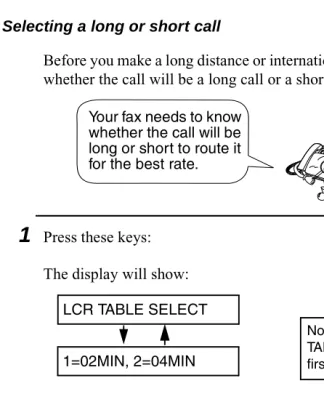
Selecting a long or short call
Before you make a long distance or international phone/fax call, select whether the call will be a long call or a short call.
Your fax needs to know whether the call will be long or short to route it for the best rate.
1
Press these keys: The display will show:LCR TABLE SELECT
1=02MIN, 2=04MIN
FUNCTION
2
Press 1 to select the SHORT TIME setting, or 2 to select the LONG TIME setting.• The initial SHORT TIME setting is 2 minutes, and the initial LONG TIME setting is 4 minutes. If desired, you can change these settings as explained on the following page.
• The short/long time selection will remain in effect for all calls until you
1
or2
SHORT LONG
Note: If the display shows TABLE NOT EXIST, you must first download the rate data.
Note: The following settings are not required as of the printing of this manual. OpenLCR will inform you through its Web site
(www.OpenLCR.com) if the settings become necessary in the future.
Changing the SHORT TIME and LONG TIME settings
The initial SHORT TIME setting is 2 minutes, and the initial LONG TIME setting is 4 minutes. If the typical durations of your short and long calls are different, you should change the time settings to ensure that OpenLCR routes your calls for the best rate.
♦For example, if your fax transmissions normally last about 3 minutes and your phone calls last about 5 minutes, set 03 for the SHORT TIME and 05 for the LONG TIME. Before sending a fax, select the SHORT TIME setting (03MIN) in the procedure on the preceding page. Before making a phone call, select the LONG TIME setting (05MIN).
♦When you change the SHORT TIME and/or LONG TIME setting, the fax machine will automatically call OpenLCR and receive rate data for the new times.
1
Press these keys: The display will show:LCR TIME SELECT
PRESS START KEY
7
FUNCTION
2
Press the START /MEMORY key.The display will show: START/MEMORY
SHORT TIME
ENTER (01-29) 02
2. S
e
tting Up
O
penLCR
3
Enter a 2-digit number (01 to 29) for the number of minutes of the SHORT TIME setting. (If the number is less than 10, enter a 0 before the number.) The display will show your selection and then show:0
3
Example: 3 minutes
4
Enter a 2-digit number for the number of minutes of the LONG TIME setting. (The number must be greater than the SHORT TIME setting and no more than 30.)The display will show your selection. If the settings were changed, it will then show:
0
Example: 5 minutes
5
START: DOWNLOAD
STOP: CANCEL
5
Press the START /MEMORY key to begin receiving the rate data for the new settings.• Your fax calls OpenLCR and receives the data. This lasts one or two
minutes.
• Note: If you do not press the START / MEMORY key to receive new data, the settings will revert to their
START/MEMORY
Note: If the display shows NO SERVICE, you must first download the rate data.
LONG TIME
3. Sendi ng Doc u ments 5.5" (140 mm) 5.8" (148 mm) 8.5" (216 mm) 23.6" (600 mm) 14 lbs.
(52 g/m² )
42 lbs. (157 g/m²) 11" (279 mm) 8.5" (216 mm) 21.5 lbs. (80 g/m²)
Transmittable Documents
Size and weight
The size and weight of documents that you can load in the document feeder depend on whether you load one page at a time or several pages at once.
Loading one page at a time:
Loading several pages at once: Minimum
size Maximumsize
Minimum weight
Maximum weight
Minimum
size Maximumsize
Minimum weight Maximum weight 5.5" (140 mm) 5.8" (148 mm) 14 lbs.
3. S
ending
Doc
u
ments
Note: Letters or graphics on the edges of a document will not be scanned.
Other restrictions
♦The scanner cannot recognize yellow, greenish yellow, or light blue ink.
♦Ink, glue, and correcting fluid on documents must be dry before they pass through the document feeder.
♦All clips, staples, and pins must be removed from documents before loading in the feeder. If these are not removed, they may damage the machine.
♦Documents which are patched, taped, torn, smaller than the mini-mum size, carbon backed, easily smudged, or have a slippery coated surface should be photocopied, and the copy loaded in the feeder.
0.16"(4 mm) 0.16"(4 mm)
0.2"(5 mm)
Loading the Document
Up to 10 pages can be placed in the feeder at one time. The pages will automatically feed into the machine starting from the bottom page.
♦If you need to send or copy more than 10 pages, place the additional pages gently and carefully in the feeder just before the last page is scanned. Do not try to force them in, as this may cause double-feed-ing or jammdouble-feed-ing.
♦If your document consists of several large or thick pages which must be loaded one at a time, insert each page into the feeder as the previous page is being scanned. Insert gently to prevent double-feeding.
1
Adjust the document guides to the width of your document.READY TO SEND
2
Place the document face down and push it gently into the document feeder. The top edge of the document should enter the machine first.3. S
ending
Doc
u
ments
3
Adjust the resolution and/or contrast settings (if desired) as explained inResolution and Contraston on page 55, then dial the receiving machine as explained in Sending a Fax by Normal Dialing on page 58.
Removing a document from the feeder
Important!
Do not try to remove a document without opening the operation panel. This may damage the feeder mechanism.
1
Grasp the finger hold and pull up to open the operation panel.If you need to remove a document from the feeder, open the operation panel.
3
Close the operation panel, making sure it clicks into place.3. S
ending
Doc
u
ments
Adjusting the Resolution and Contrast
If desired, you can adjust the resolution and contrast before sending a document.
Note: The resolution and contrast settings are only effective for sending a document. They are not effective for receiving a document.
Resolution settings
Contrast settings
STANDARD Use STANDARD for ordinary documents. This setting gives you the fastest and most economical transmission.
FINE Use FINE for documents containing small
letters or fine drawings.
SUPER FINE Use SUPER FINE for documents containing very small letters or very fine drawings.
HALF TONE Use HALF TONE for photographs and illustrations. The original will be reproduced in 64 shades of gray.
AUTO Use AUTO for normal documents.
DARK Use DARK for faint documents.
You must adjust the settings each time you don’t want to use the default settings. The default resolution
1
Load the document(s).• The document must be loaded before the resolution and contrast can be adjusted.
2
Press the RESOLUTION key one or more times until the desiredresolution and contrast settings appear in the display.
• The first time you move through the list of resolution settings, the contrast setting AUTO will appear next to each resolution setting. The second time you move through the list, the contrast setting DARK will appear.
STANDARD :AUTO
FINE :AUTO
SUPER FINE :AUTO
HALF TONE :AUTO
STANDARD :DARK
FINE :DARK
SUPER FINE :DARK
HALF TONE :DARK
Note: In order to transmit in SUPER FINE resolution, the receiving fax machine must also have that resolution. If it doesn’t, your machine will auto-matically step down to the next best available setting.
3. S
ending
Doc
u
ments
Changing the default resolution
If desired, you can change the default resolution for faxing documents to FINE. Follow the steps below.
1
Press these keys: The display will show:2
Press 1 (YES) to set the default resolution to FINE, or 2 (NO) to set it to STANDARD.3
Press the STOP key to return to the date and time display.4
1
orYES NO
FINE PRIORITY
FUNCTION
2
Pick up the handset or press the SPEAKER key. Listen for the dial tone.READY TO SEND
or
SPEAKER
• Set the resolution and/or contrast if
desired. RECEPTION
MODE
Sending a Fax by Normal Dialing
With Normal Dialing, you pick up the handset (or press the SPEAKER key) and dial by pressing the number keys.
♦If a person answers, you can talk with them through the handset before sending the fax. (If you pressed the SPEAKER key, you must pick up the handset to talk.)
♦Normal Dialing allows you to listen to the line and make sure the other fax machine is responding.
3. S
ending
Doc
u
ments
4
Wait for the connection. Depending on the setting of the receiving machine, you will either hear a facsimile reception tone or the other person will answer.• If the other party answers, ask them to press their Start key (if you pressed the SPEAKER key, pick up the handset to speak with them). This causes the receiving machine to issue a reception tone.
Using the REDIAL key
You can press the REDIAL key to redial the last number dialed. To send a document, press the START /MEMORY key when you hear the fax tone after the connection is established. Note that the speaker is automatically activated when you press the key.
5
When you hear the reception tone, press the START /MEMORY key. Replace the handset if you used it.• When transmission is completed, the fax will beep once.
Beep
START/MEMORY
3
Dial the number of the receiving machine by pressing the number keys.(Example)
3
Sending a Fax by Automatic Dialing
You can dial a fax or telephone number by simply pressing a Rapid Key, or by pressing the SPEED DIAL key and entering a two-digit number.
♦To use Automatic Dialing, you must first store the full fax or tele-phone number in your fax machine.
♦When you store a fax or telephone number, you select a two-digit Speed Dial number for it. Forty Speed Dial numbers are available.
Speed Dial numbers 01 through 04 are for Rapid Key (one-touch) Dialing.
01
Speed Dial numbers 05 through 44 are for dialing with the SPEED DIAL key.
Rapid Keys SPEED DIAL key
0 6
Attach the strip of Rapid Key labels above the Rapid Keys.
SPEED DIAL
START/MEMORY
2
1 3
9 4 5 6 7 8
0
www.OpenLCR.com
openLCR
3. S
ending
Doc
u
ments
Storing fax and telephone numbers for Automatic Dialing
1
Press these keys:The display will alternately show:
2
Press the 1 key to select SET. The display will alternately show:3
Enter a two-digit Speed Dial number by pressing the number keys (01 to 04 for Rapid Key Dialing, 05 to 44 for Speed Dialing).4
Enter the fax or voice number by pressing the number keys.(Note: A space cannot be entered.)
• To clear a mistake, press the SPEED DIAL key.
♦If a pause is required between any of the digits to access a special service or an outside line, press the REDIAL key (two seconds per pause). The pause will appear as a hyphen. Several pauses can be
3
FAX/TEL # MODE
1=SET,2=CLEAR
1
FAX/TEL # SET
ENTER SPEED #
0
1
(Example)
(Example)
3
2
2
4
5
6
7
SPEAKER
5
Press the START /MEMORY key.6
Enter the name of the party by pressing the number keys as shown below. (If you don’t want to enter a name, go directly to Step 7.)Example: SHARP = 77777 444 22 7777 77
♦To clear a mistake, press the SPEED DIAL key.
♦To enter two letters in succession that require the same key, press the SPEAKER key after entering the first letter.
A =
B =
C =
D =
E =
F =
G =
H =
I =
J =
K =
L =
M =
N =
O =
P =
Q =
R =
S =
T =
U =
V =
W =
X =
Y =
Z = SPACE =
7
Press the START /MEMORY key.START/MEMORY
3. S
ending
Doc
u
ments
8
Return to Step 3 to store another number, or press the STOP key to return to the date and time display.Chain Dialing for area and access codes
You can also store an area code or access code in a Rapid Key or Speed Dial number. To use this number to dial, see Chain Dialing on page 85.
Note: An area code or access code stored in a Rapid Key or Speed Dial
number can only be used if the handset is lifted or the SPEAKER key is
pressed before dialing.
2
Press 2 to select CLEAR.3
Enter the Speed Dial number that you want to clear by pressing the number keys.FAX/TEL # MODE
1=SET,2=CLEAR
2
0
1
(Example) Step 3 or
Clearing auto-dial numbers
1
Press these keys:The display will show:
3
STOP
4
Press the START /MEMORY key.5
Return to Step 3 to clear another number, or press the STOP key to return to the date and time display.Making changes
To make changes in a number previously stored, repeat the
programming procedure. Select the Rapid Key or Speed Dial number for which you want to make changes in Step 3, and then change the number and/or name when they appear in the display in Steps 4 and 6.
Step 3 or
Note: The fax machine uses a lithium battery to keep automatic dialing
numbers and other programmed data in memory when the power is turned off. Battery power is consumed primarily when the power is off. With the power kept continuously off, the life of the battery is about 5 years. If the battery dies, have your dealer or retailer replace it. Do not try to replace it yourself.
START/MEMORY
3. Sending Do
c
u
ments
2
Press the Rapid Key corresponding to the desired Speed Dial number.• The name of the receiving party will appear in the display. If no name was stored, the fax number will appear. (If the name or number is incorrect, press the STOP key.)
• The document will be
automatically transmitted once the connection is established.
Rapid Key Dialing
If the number you want to dial has been stored for Automatic Dialing as a Speed Dial number from 01 to 04, you can dial it by pressing the corresponding Rapid Key.
1
Load the document(s). The display will show:Example: To dial Speed Dial number 01, press Rapid Key 01.
READY TO SEND
• Set the resolution and/or contrast if desired.
01
Speed Dialing
Speed Dialing can be used to dial any number that has been stored for Automatic Dialing.
1
Load the document(s). The display will show:2
Press the SPEED DIAL key and then enter the Speed Dial number by pressing the numeric keys.• To enter numbers 1 through 9, first
enter 0 and then the number. (Example)
READY TO SEND
• Set the resolution and/or contrast if desired.
3
Check the display. If the name or number shown is correct, press the START /MEMORY key. (If not, press the STOP key and then repeat Step 2.)SPEED DIAL
0
9
3. Sending Do
c
u
ments
Direct Keypad Dialing
You can also enter a full number with the number keys and then press the START /MEMORY key to begin dialing. You can use this method to dial a full number when you don’t need to speak to the other party before faxing.
1
Load the document(s). The display will show:READY TO SEND
• Set the resolution and/or contrast if desired.
2
Enter the number of the receiving machine by pressing the numeric keys.• If a pause is required between any of the digits to access a special service or an outside line, press the REDIAL key (two seconds per pause). The pause will appear as a hyphen. Several pauses can be entered in a row.
3
2
2
4
5
6
7
3
Check the display. If the number of the receiving machine shown is correct, press the START / MEMORY key.• If it is not correct, press the STOP key to backspace and clear one
(Example)
RESOLUTION
Searching for an auto-dial number
If you don’t remember the Rapid Key or Speed Dial number in which you have programmed a particular fax number, you can search for the number by following the steps below. Once you have found the number, you can dial and transmit the loaded document by simply pressing the START /MEMORY key.
1
Load the document(s). The display will show:• Set the resolution and/or contrast if desired.
2
Press the HOLD/SEARCH key and then the 1 key.READY TO SEND
3
Enter the first letter of the stored name by pressing the appropriate number key (the key below the marked letter) one or more times until the letter appears in the display. If the name begins with a special character or number, press 1.♦If you don’t remember the first letter, go to Step 4 (you will scroll through the list from the beginning).
♦If a name wasn’t stored for the number, press 0. This will cause numbers, not names, to appear when you scroll.
HOLD/ SEARCH
1
RESOLUTION2
5
8
GHI JKL MNO
TUV WXYZ
PQRS
ABC DEF
1
4
7
3
6
3. Sending Do
c
u
ments
4
Press the # key or the * key to scroll through the names (numbers if you pressed 0). Stop when the desired name appears in the display.• If no names have been stored that begin with the entered letter, you will scroll from the next name, in alphabetical order, in the list. If no names/numbers have been stored at all, NO DATA will appear.
5
Press the START /MEMORY key. The document will be automatically transmitted once the connection is established.Automatic redialing
If you use automatic dialing (including Direct Keypad Dialing) and the line is busy, the fax machine will automatically redial the number. The fax machine will make up to two redialing attempts at an interval of five minutes.
♦To stop automatic redialing, press the STOP key.
Recall Interval for automatic redialing
If desired, you can change the interval at which the fax machine makes automatic redialing attempts.
1
Press these keys: The display will show:or
4
START/MEMORY
2
Enter a 2-digit number from 01 to 15 for the number of minutes in the interval.3
Press the STOP key to return to the date and time display.Example: 3 minutes
0
3
STOP
Recall times for automatic dialing
If desired, you can change the maximum number of automatic redialing attemps made when the line is busy.
♦Under certain conditions (for example if a person answers the call on a telephone), automatic redialing may stop before the set number of redialing attempts are made.
1
Press these keys: The display will show:2
Enter a 2-digit number from 00 to 10 for the maximum number of redial attempts.3
Press the STOP key to return to the date and time display.RECALL TIMES
4
Example: 5 attempts
0
STOP