Copyright to IJIRSET DOI: 10.15680/IJIRSET.2015.0405126 3721
Conventional Pump
[1]Maruti Talawar [2]Subbaiah.K.M [3]Prasad Raghuveer
[1]
Department of Industrial & Production Engineering, The National Institute of Engineering, Mysuru, India
[2]
Dept. of Quality Management & Methods, Bosch Ltd., Adugodi, Bengaluru, Karnataka, India
ABSTRACT-Pump is the principle segment in the engine. The major problem identified is, the required fuel delivery is not optimized at the different speeds and the fuel delivery variation was more at the constant speed. The experimentation is conducted in a leading automobile industry to optimize this parameter. Utilizing critical thinking methodology, the major fuel delivery variation at 1800 RPM was observed. The fundamental goal of this work to optimize the fuel delivery variation and reduce the spread. The root cause is carried out utilizing advanced Shainin Technique and Design of Experiments (DOE)
KEYWORDS:Engine,Fueldelivery,TimerGrooveDepth,Shainin,DOE
I. INTRODUCTION
Diesel engines are known for higher efficiency engines and as well as have become the most popular power packs for low duty vehicles and equipments such as three wheeler, tractors, passenger vehicles, and so forth as the diesel fuel is a standout amongst the most productive and vitality fuels accessible today. Engine running at lower RPM’s has numerous advantages. The obvious of these is reduced fuel consumption, since the engine can spend more time running within optimum efficiency range. Diesel Fuel Injection Pump (DFIP) System- the heart of the diesel engine is one such critical system.
The fuel-injection system is the most vital component in the working of CI engine. The engine performance (power output, efficiency) is greatly dependent on the effectiveness of the fuel injection system. It has the important duty of initiating and controlling the combustion process. Diesel fuel pump that delivers diesel to the engine cylinder in atomized form at moderate pressure. BPS is the pioneer in quality production by conveying propelled quality measures in its assembling courses of action and subsequently, fulfilling the customers. The root cause is observed through Shainin system and DOE.
TYPES OF DIESEL FUEL INJECTION PUMP 1.) Common Rail Fuel injection Pump
a. Normal Common Rail Fuel Injection Pump b. Electronic Common Rail Fuel Injection Pump 2.) Distributor Fuel Injection Pump
3.) In-Line Fuel Injection Pump 4.) PF Pumps
a. K-Type PF Pump b. Q-Type PF Pump c. Monotype Block Pump
Copyright to IJIRSET DOI: 10.15680/IJIRSET.2015.0405126 42
1.2 Root cause analysis technique:
Shainin: Shainin is a simplest problem solving tool used to optimize the problem. The classification of the issue done to pick the best powerful strategies, for example, component search, paired correlation. Shainin is done in three steps. 1) Measurement validation. 2) Process validation. 3) Product validation.
DOE: Design of experiments (DOE) is a systematic procedure for designing, conducting and evaluating experiments while minimizing the necessary resources. For each response there are a few variables and a few levels. In this case torque is the response. DOE is carried out using the ‘level to power of factors’.
1.3 Problem Definition:
Fig.1.3 Problem Definition
Experiments are carried out on single bench to nullify the bench variation.
Find and eliminate the RedX causing fuel delivery variation @1800 & @1100 rpm and optimize the variation. 1800 rpm variation is the priority task.
II. METHODOLOGY
2.1 Sample selection
Fig.2.1 Sample selection
Samples which are showing delivery above standard specification @1800 rpm is taken as Best of Best (BOB). Samples which are showing delivery below the standard specification @1800 rpm is taken as Worst of Worst (WOW).
Fuel Delivery Variation
@1100 rpm
Copyright to IJIRSET DOI: 10.15680/IJIRSET.2015.0405126 43
2.2 Approach and solution tree:
Fig.2.2 Approach and solution tree
2.3 Measurement validation
Fig.2.3 Measurement validation Green Y = Fuel Delivery Variation @
1800 rpm
∆P ∆M
Product(Pump )
Process
Element Other
components
Plunger Barrel
Copyright to IJIRSET DOI: 10.15680/IJIRSET.2015.0405126 44
Measurement not the cause: No swapping takes place.
2.4 Process validation:
Fig.2.4 Process validation
Process not the cause: No swapping takes place.
2.5 Product validation
Fig.2.4 Product validation
2.6 Setting Layout change: 2.6.1 Previous calibration layout
Table. 2.6.1 Previous calibration layout
CRP
(mm) RPM
Delivery Tolerance
(mm3/str)
9 1800 Setting 1
8 800
Over checking
5
9 1100 5
18 100 10
Copyright to IJIRSET DOI: 10.15680/IJIRSET.2015.0405126 45
2.6.2 Current calibration layout Table. 2.6.2 Current calibration layout
CRP
(mm) RPM
Delivery Tolerance
(mm3/str)
8 800 Setting 1
9 1800
Over checking
7
9 1100 7
18 100 12
According to current setting point @800 rpm, obtained 7 mm3/str of delivery tolerance @1800 rpm over checking point.
It is understood that calibration layout influences on variation phenomenon.
III. RESULTS AND DISCUSSIONS
Fig.3 Si Si
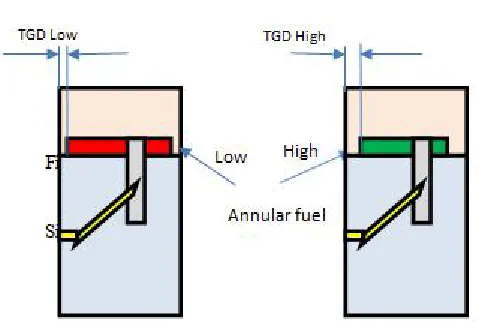
Significance of Timer Groove
If TGD is less, then proportionate delivery will not be achieved @1100 & 1800 rpm.
Whatsoever is TGD required delivery is achieved @800 rpm since it is adjusted by eccentric pin setting. But achieved delivery @800 rpm is not by the true behaviour of FIP!
True behaviour of the pump and TGD proportionately effect is evident @1100 & 1800 rpm since annular fuel plays dominant effect on fuel delivery.
Copyright to IJIRSET DOI: 10.15680/IJIRSET.2015.0405126 46
3.1 TG Optimization:
Fig.3.1 Timer Groove Optimization
3.2 Existing and proposed TGD
Table.3.2Comparison of Delivery @800 rpm before and after adjustment
Condition TG Depth
(mm)
Delivery @ 800 rpm before adjustment
(mm3/str)
Delivery @ 800 rpm after
adjustment (mm3/str)
Existing 0.05-0.01 22 11.5
Proposed 0.08-0.01 11.1 11.5
Major variations are contributed by extent of setting. Extent of setting attributed to TGD
Optimized TGD = 0.07 mm has given close value to required delivery and very less extent of setting. Till certain depth (about 40µm) the effect of TG is not dominant; because, depth is very less and cannot induce timing difference (annular
space is filled with fuel is as good as solid block) Higher the TGD, the annular fuel block decides surization starting according to rate of strokes(rpm) From experiments→50, 60, 70µm are the TGD which can induce
required proportional delivery at different RPM’s
IV. CONCLUSION
Purpose of timer groove is to impart the proportionate fuel delivery w.r.t rpm (rate of strokes) nevertheless having same CRP or Effective stroke.It is achieved through ‘Fuel Injection Timing Mechanics’.Theory of fuel injection in FIP’s with TG → TGD α 1/FM (@800 rpm).Optimum TGD gives better (less variation) proportional delivery @different
rpm’s
Myth: More the setting extent, more the variation.
Truth: Non-Optimum TGD, nom proportional delivery (high variation).Eccentric pin setting is not culprit, but it is the signal of inadequate TGD. But signal is neglected and abused by larger amount of setting.
REFERENCES
Copyright to IJIRSET DOI: 10.15680/IJIRSET.2015.0405126 47
2. Mohammad Javed, Prof. S.D. Ambekar, “Optimisation of Fuel Injection Pump Parameters of Tata 1613 & Tata 609 Engine Using Diesel & Biodiesel”, International Journal of Engineering Research and Applications (IJERA), Vol. 3, Issue 4, Jul-Aug 2013.
3. Dr. Arakerimath, R. Rachayya, “Parametric analysis and optimization of fuel delivered and Torque by FIP of Diesel Engine using Genetic Algorithm”, International Journal of Engineering Research and Applications (IJERA), Vol. 2, Issue 3, May-Jun 2012.
4. Bhaskara P, Raghuveer Prasad, “Root Cause Analysis of Control Rod Friction Problem in DFIP Using Shainin® Approach”, International Journal of Mechanical Engineering and Technology (IJMET), Volume 5, Issue 9, September (2014).