Copyright1998 by the Genetics Society of America
Detection of the Ongoing Sorting of Ancestrally Polymorphic SINEs Toward
Fixation or Loss in Populations of Two Species of Charr During Speciation
Mitsuhiro Hamada,* Nobuyoshi Takasaki,* James D. Reist,
†Alfred L. DeCicco,
‡Akira Goto
§and Norihiro Okada*
*Faculty of Bioscience and Biotechnology, Tokyo Institute of Technology, Midori-ku, Yokohama 226-8501, Japan,†Department of Fisheries
and Oceans Canada, Winnipeg, Manitoba R3T 2N6, Canada,‡Alaska Department of Fish and Game, Fairbanks, Alaska 98701 and §Laboratory of Embryology and Genetics, Faculty of Fisheries, Hokkaido University, Hakodate 041-8611, Japan
Manuscript received March 9, 1998 Accepted for publication April 30, 1998
ABSTRACT
The FokI family of short interspersed repetitive elements (SINEs) has been found only in the genomes of charr fishes (genus Salvelinus). In an analysis of the insertion of FokI SINEs using PCR, we characterized six loci at which FokI SINEs have been inserted into the genomes of Salvelinus alpinus (Arctic charr) and/ or S. malma (Dolly Varden). An analysis of one locus (Fok-223) suggested that a sister relationship exists between S. alpinus and S. malma and the SINE at this locus might have been inserted in a common ancestor of these two species, being fixed in all extant populations examined. By contrast, SINEs at two other loci (Fok-211 and Fok-206) were present specifically in the genome of S. alpinus, with polymorphism among populations of this species. Moreover, the presence or absence of the SINEs of the other three loci (Fok-214, Fok-217, and Fok-600) varied among populations of these two species. The most plausible interpretation of this result is that SINEs, which were ancestrally polymorphic in the genome of a common ancestor of these two species, are involved in an ongoing process of differential sorting and subsequent fixation in the various populations of each species.
A
retroposon is defined as a nucleotide sequence, quently excised precisely except in cases of gross dele-tions. Moreover, it is believed that the insertion sites of present initially as a cellular RNA transcript, thathas been reincorporated into the genome via a cDNA SINE units are almost random (Kidoet al. 1995). These
features allow SINEs to serve as excellent evolutionary intermediate. This process is called retroposition (
Rog-and phylogenetic markers (Okada1991b). Indeed, we ers1985;Weineret al. 1986). Short interspersed
repeti-propose that SINE insertion analysis is one of the best tive elements (SINEs;Singer1982) form one group of
methods for the determination of phylogenetic relation-retroposons, and they are often present at more than
ships among closely related species (Murataet al. 1993,
105 copies per genome (Okada 1991a,b; Okada and
1996;Shimamuraet al. 1997). Ohshima 1995).
SINE insertion analysis is also useful for the studies SINEs can be divided into two classes according to
of structures of populations of a species. In cases where their origins. One class of SINEs is derived from the
SINEs were retroposed recently on an evolutionary time 7SL RNA (Weiner1980;UlluandTschudi1984) in
scale, they have not yet been fixed in populations of the signal recognition particle (SRP) that is involved in
the species. For example, several Alu elements that were the secretion of polypeptides during protein
biosynthe-amplified recently have not yet been fixed within the sis (WalterandBlobel1982). The primate Alu family
human genome, and the distribution of these elements and the rodent type 1 (B1) family belong to this class
varies among geographically distinct groups of the (Schmid and Maraia 1992; Deininger and Batzer
world’s population (Batzer et al. 1991, 1994; Batzer
1993). Members of the other class of SINEs originated
andDeininger1991;Pernaet al. 1992;Hammer1994;
from specific tRNAs. All known SINEs, with the
excep-Kass et al. 1994). Batzer et al. (1994, 1996)
demon-tion of the primate Alu and rodent B1 SINEs, are
mem-strated the African origin of Homo sapiens by using these bers of the second class of SINEs (Okada 1991a,b;
elements as phylogenetic markers.
Okada andOhshima 1995).
In a previous study, we characterized three different It is generally accepted that, in contrast to DNA
trans-families of SINEs in the genomes of salmonid fishes posable elements, a single unit of a SINE is never
subse-(Kido et al. 1991). We designated these SINEs the
salmon SmaI family, the charr Fok I family and the salmo-nid HpaI family. The SmaI family of SINEs is restricted
Corresponding author: Norihiro Okada, Faculty of Bioscience and to the genomes of chum salmon (Oncorhynchus keta)
Biotechnology, Tokyo Institute of Technology, 4259 Nagatsuta-cho,
and pink salmon (O. gorbuscha). The charr Fok I family
Midori-ku, Yokohama 226-8501, Japan.
E-mail: [email protected] of SINEs is present only in species that belong to the
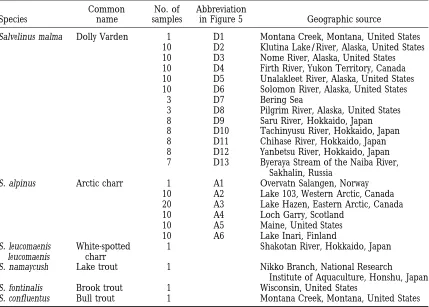
TABLE 1
Fish species analyzed
Common No. of Abbreviation
Species name samples in Figure 5 Geographic source
Salvelinus malma Dolly Varden 1 D1 Montana Creek, Montana, United States 10 D2 Klutina Lake/River, Alaska, United States 10 D3 Nome River, Alaska, United States 10 D4 Firth River, Yukon Territory, Canada 10 D5 Unalakleet River, Alaska, United States 10 D6 Solomon River, Alaska, United States
3 D7 Bering Sea
3 D8 Pilgrim River, Alaska, United States
8 D9 Saru River, Hokkaido, Japan
8 D10 Tachinyusu River, Hokkaido, Japan 8 D11 Chihase River, Hokkaido, Japan 8 D12 Yanbetsu River, Hokkaido, Japan 7 D13 Byeraya Stream of the Naiba River,
Sakhalin, Russia
S. alpinus Arctic charr 1 A1 Overvatn Salangen, Norway 10 A2 Lake 103, Western Arctic, Canada 20 A3 Lake Hazen, Eastern Arctic, Canada
10 A4 Loch Garry, Scotland
10 A5 Maine, United States
10 A6 Lake Inari, Finland
S. leucomaenis White-spotted 1 Shakotan River, Hokkaido, Japan leucomaenis charr
S. namaycush Lake trout 1 Nikko Branch, National Research
Institute of Aquaculture, Honshu, Japan S. fontinalis Brook trout 1 Wisconsin, United States
S. confluentus Bull trout 1 Montana Creek, Montana, United States
genus Salvelinus. The salmonid HpaI family of SINEs is Arctic, and S. malma occurs sympatrically with S. alpinus in the northern Pacific. A sister relationship between present in all species in the family Salmonidae but not
in other species (Matsumoto et al. 1986; Kido et al. S. alpinus and S. malma was confirmed in numerous
studies by reference to both morphological and bio-1991, 1994, 1995;KoishiandOkada1991;Murataet
al. 1993, 1996). Recently, we found another family of chemical markers (Phillipset al. 1992, 1995;Stearley
andSmith1993).
SINEs in coregonid fishes. This family of SINEs is almost
identical to the SmaI family and it was designated the S. alpinus and S. malma are recognized as distinct spe-cies (Behnke1972; Morrow1980; Reist et al. 1997).
SmaI-cor family (SmaI family in cor egonids;Hamadaet
al. 1997). Among these four different families of SINEs, However, the relationships among populations of S. alpi-nus and S. malma in the North Pacific, as well as the it seems likely that the SmaI family of SINEs was
ampli-fied relatively recently because of its restricted distribu- relationships between S. alpinus and S. malma in the North Pacific and the other Asian charrs, have been tion and the limited sequence divergence of members
of this family (Kido et al. 1991). The discovery that all the subject of controversy because of the variable
mor-phology and life histories of these fishes (Behnke1980,
the SmaI SINEs in the genome of chum salmon are
polymorphic and not fixed among populations of the 1984;Cavender1980;Savvaitova1995).Savvaitova
(1980) performed a morphological study, and claimed species supports this hypothesis (Takasakiet al. 1997).
Charr species have attracted the interest of many evo- that S. malma should be considered synonymous with S. alpinus. She also proposed that the designation “spe-lutionary biologists because of their highly variable
life-history strategies, phenotypic plasticity, and potential cies-complex” provides a more appropriate description of the complex structure of these two species, claiming for sympatric morphological divergence.Behnke(1980)
andCavender(1980) proposed that the genus Salveli- that all Arctic charr and Dolly Varden should be
in-cluded in one superspecies, namely, the S. alpinus com-nus includes six major morphologically distinct species,
namely, Salvelinus fontinalis (brook trout), S. namaycush plex (Savvaitova1995).
To elucidate the complex structure of populations of (lake trout), S. confluentus (bull trout), S. leucomaenis
(white-spotted charr), S. malma (Dolly Varden) and these two species, we attempted to analyze the insertions of FokI SINEs in S. alpinus and S. malma. As is the case S. alpinus (arctic charr). The continuous circumpolar
Figure 1.—Compilation of sequences of 10 members of the Fok I SINE family. A consensus sequence was de-duced from the alignment. Nucleotides identical to those in the consensus se-quence are indicated by dots and absent nucleotides are indicated by dashes. (SL) 101, (SL) 103, Fok-(SL) 106, and Fok-Fok-(SL) 110 were reported in a previous article (Kidoet al. 1991) as Fok-(SLL) 1, Fok-(SLL) 3, Fok-(SLL) 6, and Fok-(SLL) 10, respectively (where SLL stands for S. leucomaenis leu-comaenis). The remaining Fok I SINEs are newly iso-lated in this study. SA, S. al-pinus; SM, S. malma; SL, S. leucomaenis.
phage clones were isolated and their inserts were subcloned et al. 1997), Fok I SINEs were found to be highly
polymor-into pUC18 or pUC19. Then the inserts were sequenced with phic in the genomes of S. alpinus and S. malma, and to
primers that corresponded to or were complementary to the be useful for elucidation of the complex evolutionary consensus sequence for the FokI family.
history of these two species. The Fok I SINEs are the Amplification by PCR:When a unit of the FokI family ap-peared to have been integrated at a single locus within a second example to date of highly polymorphic SINEs.
genome, we synthesized 59 and 39 oligonucleotide primers (Oligo1000 DNA synthesizer; Beckman, Fullerton, CA). The sequences of primers are shown in Figure 2. The reaction MATERIALS AND METHODS
mixtures for amplification by PCR contained Tth buffer (TOY-OBO, Tokyo, Japan), 0.2 mmdNTPs (Pharmacia, Uppsala, DNA samples:Individuals from each of the six species of
Sweden), 100 ng of each primer, 1mg of genomic DNA, and charr from various locations were examined, as shown in Table
2 units of Tth DNA polymerase (TOYOBO) in a final volume 1. Total genomic DNA of each species was extracted as
de-of 100ml or 50ml. The thermal cycling involved 30 repeats scribed byBlinandStafford(1976) for large-scale
prepara-of denaturation at 938for 1 min, annealing at 558for 1 min, tion for the establishment of genomic libraries. For the analysis
and extension at 728 for 1 min. The products of PCR were of populations, DNA was extracted from samples of individual
analyzed by electophoresis in 2% (w/v) NuSieve GTG and 1% fish as follows. One-half gram of liver, muscle or a whole fry
(w/v) Seakem GTG agarose gels (FMC BioProducts, Rock-was homogenized on ice in TNE solution, which contained
land, ME). 10 mmTris-HCl (pH 8.0), 100 mm NaCl, and 1 mmEDTA.
Southern hybridization:Products of PCR were transferred Then lysis buffer, which contained 500mg/ml proteinase K,
from gels to GeneScreen Plus membranes (New England Nu-2% sodium dodecyl sulfate (SDS), 10 mmTris-HCl (pH 8.0),
clear Research Products, Boston) in 0.4mNaOH and 0.6m 150 mmNaCl, and 10 mmEDTA, was added to the solution,
NaCl and then dried. For detection of a SINE unit of the FokI with incubation at 508for 2 to 3 hr. DNA was extracted with
family, hybridization was performed with the Fok1 oligonucleo-phenol and chloroform, washed with chloroform and isoamyl
tide as the probe, as described above and under the same alcohol, and collected by ethanol precipitation.
conditions as those used for screening. For detection of or-Construction and screening of genomic libraries,
subclon-ing and sequencsubclon-ing:Total genomic DNA from S. alpinus and thologous loci of Fok-217, an end-labeled oligonucleotide that S. malma was separately digested with EcoRI for construction contained the flanking sequences of the SINE unit at that of a genomic library for each species. Digests were size-fraction- locus was used as a probe (Fok-217 flan: AGCCCTGCAGTTG ated by sucrose gradient (10 to 40%, w/v) centrifugation. CAGACGGTGCAGTTGCT). For subsequent rehybridization DNA fragments of 2 to 4 kb were ligated with lgt10 arms with a different probe, the first probe was removed by incuba-(Stratagene, La Jolla, CA) and then packaged in vitro. Screen- tion in 0.4mNaOH at 428for 30 min.
ing was performed with an end-labeled oligonucleotide, desig-nated FokI (see positions 20–40 in Figure 1), as the probe. Hybridization was allowed to proceed at 428 overnight in a
RESULTS solution of 63SSC (SSC is 0.15mNaCl, 0.015 mtrisodium
citrate, pH 7), 1% (w/v) SDS, 53Denhardt’s reagent [13 Characterization of Fok I SINEs in the genus Salveli-Denhardt’s reagent is 0.02% (w/v) Ficoll 400, 0.02% (w/v)
nus:Previous studies in our laboratory showed that the polyvinylpyrrolidone, and 0.02% (w/v) bovine serum
albu-charr Fok I family of SINEs appeared to be restricted min], and 100mg/ml herring sperm DNA. Washing was
Figure2.—Continued.
S. leucomaenis leucomaenis, S. leucomaenis pluvius, and mic DNA from S. alpinus, S. malma, S. leucomaenis, S. con-fluentus, S. namaycush, and S. fontinalis as templates. S. namaycush. This family of SINEs was presumed to have
been amplified at the time at which the genus Salvelinus As shown in Figure 3, a SINE at the Fok-206 and Fok-211 loci was found specifically in the genome of diverged from other genera (Kidoet al. 1991). To
con-firm this hypothesis, we performed a dot hybridization S. alpinus (Figure 3, A and B). We also found that a SINE at another locus, namely Fok-600, was specific to experiment using the FokI sequence as a probe,
includ-ing samples of DNA from other fishes in the genus S. malma (Figure 3F). SINEs at three other loci, namely, Fok-214, Fok-217, and Fok-223, were found in the ge-Salvelinus (S. fontinalis, S. confluentus, and S. alpinus).
DNAs from all fishes in the genus Salvelinus gave strong nomes of both S. alpinus and S. malma (Figure 3, C–E). In Figure 3, A–F, the upper DNA fragments (black ar-hybridization signals, confirming that they all contained
the Fok I family of SINEs (data not shown). rowheads) indicate the presence of a Fok I SINE, while the lower DNA fragments (white arrowheads) indicate We constructed genomic libraries for S. alpinus from
Overvatn Salangen and S. malma from Montana Creek the absence of such SINEs. To confirm that orthologous loci have been faithfully amplified in these cases, we and screened them for Fok I SINEs. Five clones that
contained the sequence of a Fok I SINE were isolated determined the sequences of the orthologous loci, which do not contain a SINE unit, of S. malma (Fok-206 from the genomic library of S. alpinus and they were
designated Fok-(SA) 206, Fok-(SA) 211, Fok-(SA) 214, Fok- and 211) and S. leucomaenis (214, 217, Fok-223, and Fok-600; Figure 2).
(SA) 217, and Fok-(SA) 223 (SA stands for S. alpinus).
One clone was isolated from the genomic library of To examine whether these species-specific insertions and the group-specific insertions of FokI SINEs were S. malma; it was designated Fok-(SM) 600 (SM stands for
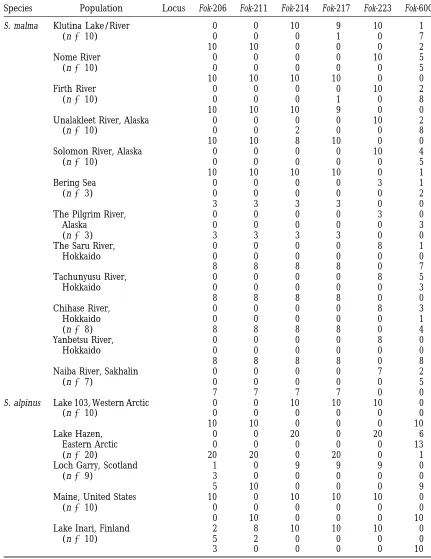
S. malma). An alignment of the SINE sequences of these fixed or dimorphic in other populations, we analyzed DNA from 59 specimens of S. alpinus from 5 regions clones, together with those obtained from a genomic
library of S. leucomaenis leucomaenis (Kidoet al. 1991), and 95 specimens of S. malma from 12 regions. The
results are summarized in Table 2. is shown in Figure 1. The ten sequences of FokI SINEs
were very similar, and we failed to find a distinct subfam- The Fok I SINEs specific to S. alpinus are dimorphic
among populations of this species:At the Fok-206 and
ily structure of the type reported for other SINE families
from salmonids (Kidoet al. 1994, 1995;Takasakiet al. Fok-211 loci, the FokI SINEs were not fixed among
popu-lations of S. alpinus (Table 2). For example, Figure 4 1994, 1997; Hamadaet al. 1997).
To estimate the times of insertion of the FokI SINEs, shows the results of PCR for the Fok-206 locus with speci-mens of S. alpinus from various populations. Individuals we performed an analysis by PCR. We determined the
59- and 39-flanking regions of each Fok I sequence and were scored as homozygous (1/1or2/2) or heterozy-gous (1/2) for the presence of the 400-bp fragment synthesized a set of primers that flanked each unit, as
been found to be commonly inserted into the genomes of S. alpinus and S. malma in the pilot experiment (Fok-214, Fok-217, and Fok-223; Figure 3) were fixed among populations of both species.
A SINE at the Fok-223 locus was fixed in every speci-men from 17 populations examined (Table 2). Al-though we cannot exclude the possibility that, in the other remaining populations of both species, the SINE at this locus is dimorphic, the present results favor the conclusion that the SINE at this locus is fixed in all individuals of both species. This locus provides the first evidence, from SINE insertion analysis, that S. alpinus and S. malma form a monophyletic group.
The Fok I SINEs common to S. alpinus and S. malma
are not fixed among populations of the two species:In
the case of Fok-217 (Figure 5), insertion of the SINE in S. malma was observed only in a few populations, namely, those of the Klutina River/Lake and the Firth River [Figure 5A(a)], whereas insertion of the SINE in S. alpinus was observed in every population except for that in Lake Hazen [Figure 5B(a)]. In the case of Fok-214, insertion of the SINE were fixed in all the popula-tions of S. alpinus examined and were presented in the population of S. malma in the Klutina Lake/River, but not presented in the populations of other S. malma (Table 2).
In the case of Fok-217, we confirmed the presence of the SINE in the upper fragment in Figure 5 and the validity of amplification by PCR of the orthologous locus by Southern hybridization with the Fok I sequence and Figure 3.—A unit of a FokI sequence is integrated (A and
the flanking sequence of the SINE, respectively, as B) in the genomes of S. alpinus species-specifically, (C, D and probes [Figure 5, A (b and c) and B (b and c)]. E) in the genomes of both S. alpinus and S. malma, and (F)
In the case of the Fok-600 locus, we demonstrated that in the genomes of S. malma species-specifically. Black and
insertion of Fok I units was dimorphic among popula-white arrowheads indicate positions of DNA with and without
a unit of the FokI SINE, respectively. M indicates a HincII tions of S. malma, with the exception of the population digest ofFx174 DNA, loaded as a source of size markers. from the Yanbetsu River (Table 2). Moreover, we also Lengths of DNA fragments are shown in base pairs. found insertion of a SINE at the Fok-600 locus in individ-uals from one population of S. alpinus, namely, the population from Lake Hazen. Thus, the insertion of a fixed in individuals from Maine in the United States,
FokI SINE at the Fok-600 locus was not specific to whereas, in the specimens from Loch Garry, Scotland,
S. malma but was common to S. malma and S. alpinus, one individual was homozygous (1/1), three
individu-and it was not fixed among the populations of the two als were heterozygous (1/2), and five individuals were
species. homozygous (2/2). Moreover, two specimens from
Our results indicated that several insertions of Fok I Lake Inari, Finland, were homozygous (1/1) and five
SINEs that were common to S. alpinus and S. malma were heterozygous (1/2). No insertions were observed
were not fixed among populations of the two species. We in the specimens from Lake 103 in the western Arctic
found that the insertions were not only intraspecifically of Canada and from Lake Hazen in the eastern Arctic
polymorphic but also interspecifically variable. Such in-of Canada.
traspecific polymorphism and interspecific variation of As summarized in Table 2, in the case of the Fok-211
insertions of SINEs might reflect complex processes of locus, insertion of a Fok I SINE was only detected, with
speciation in which two closely related (sub)species di-a heterozygous pdi-attern (1/2), in the genomes of
speci-verge by subdivision into genetically distinct populations mens of S. alpinus from Lake Inari, suggesting that the
to form the more-distinguishable species (see below). SINE was inserted very recently at this locus in an
indi-vidual in this population or a closely related population. All specimens of S. malma from all populations had no
DISCUSSION insertion at either locus.
SINEs can be used as efficient tools for the
determina-S. alpinus and determina-S. malma form a monophyletic group:
TABLE 2
Distribution of members of the Fok I family in S. alpinus and S. malma
Species Population Locus Fok-206 Fok-211 Fok-214 Fok-217 Fok-223 Fok-600
S. malma Klutina Lake/River 11 0 0 10 9 10 1
(n510) 12 0 0 0 1 0 7
22 10 10 0 0 0 2
Nome River 11 0 0 0 0 10 5
(n510) 12 0 0 0 0 0 5
22 10 10 10 10 0 0
Firth River 11 0 0 0 0 10 2
(n510) 12 0 0 0 1 0 8
22 10 10 10 9 0 0
Unalakleet River, Alaska 11 0 0 0 0 10 2
(n510) 12 0 0 2 0 0 8
22 10 10 8 10 0 0
Solomon River, Alaska 11 0 0 0 0 10 4
(n510) 12 0 0 0 0 0 5
22 10 10 10 10 0 1
Bering Sea 11 0 0 0 0 3 1
(n53) 12 0 0 0 0 0 2
22 3 3 3 3 0 0
The Pilgrim River, 11 0 0 0 0 3 0
Alaska 12 0 0 0 0 0 3
(n53) 22 3 3 3 3 0 0
The Saru River, 11 0 0 0 0 8 1
Hokkaido 12 0 0 0 0 0 0
22 8 8 8 8 0 7
Tachunyusu River, 11 0 0 0 0 8 5
Hokkaido 12 0 0 0 0 0 3
22 8 8 8 8 0 0
Chihase River, 11 0 0 0 0 8 3
Hokkaido 12 0 0 0 0 0 1
(n58) 22 8 8 8 8 0 4
Yanbetsu River, 11 0 0 0 0 8 0
Hokkaido 12 0 0 0 0 0 0
22 8 8 8 8 0 8
Naiba River, Sakhalin 11 0 0 0 0 7 2
(n57) 12 0 0 0 0 0 5
22 7 7 7 7 0 0
S. alpinus Lake 103, Western Arctic 11 0 0 10 10 10 0
(n510) 12 0 0 0 0 0 0
22 10 10 0 0 0 10
Lake Hazen, 11 0 0 20 0 20 6
Eastern Arctic 12 0 0 0 0 0 13
(n520) 22 20 20 0 20 0 1
Loch Garry, Scotland 11 1 0 9 9 9 0
(n59) 12 3 0 0 0 0 0
22 5 10 0 0 0 9
Maine, United States 11 10 0 10 10 10 0
(n510) 22 0 0 0 0 0 0
22 0 10 0 0 0 10
Lake Inari, Finland 11 2 8 10 10 10 0
(n510) 12 5 2 0 0 0 0
22 3 0 0 0 0 10
believed that a SINE is amplified in the germ cells of of the population must necessarily be polymorphic. However, among the many SINEs examined to date, one individual and then spreads within a population
through sexual reproduction and random genetic drift intraspecific polymorphism of SINEs is very rare. Most SINEs, including the HpaI SINEs in salmonids, have in the same manner as other changes in the DNA
(Kimura1983). As the frequency of the SINE increases been fixed in all populations of a given species ( Taka-saki et al. 1994, 1996). These results suggest that the
Figure 4.—The SINE unit in the Fok-206 locus that was specifically inserted in the genomes of S. alpinus appears to be polymorphic among populations of this species. Forty-nine specimens of S. alpinus were collected from Lake Hazen (lanes 1–10), Lake 103 (lanes 11–20), Loch Garry (lanes 21–29), Maine (lanes 30–39), and Lake Inari (lanes 40–49). Black and white arrowheads indicate positions of DNA with and without a unit of the FokI SINE, respectively.
period between the divergence of any two salmonid insertions of Fok I SINEs that we found do not necessarily reflect the actual phylogenetic relationships among the species and the present time has been long enough for
SINEs to become fixed in all populations of each species. populations of these species.
Ancestral polymorphism is the most plausible
expla-On the basis of this observation and the synapomorphic
character of SINEs, phylogenetic relationships among nation for variations in the presence or absence of a
SINE at a given locus: To date, only two examples of
species in the genus Oncorhynchus were determined
in our laboratory (Murata et al. 1993, 1996). In this intraspecific polymorphism of SINEs have been
re-ported, namely, Alu SINEs in human populations and study, the existence of the SINE at the Fok-223 locus in
S. malma and S. alpinus suggests a monophyletic relation- SmaI SINEs in populations of chum salmon, and each example has been shown to be useful for population ship among the two species of Salvelinus (Figure 6).
Are populations of S. alpinus or S. malma monophy- analysis (Batzeret al. 1994, 1996;Takasakiet al. 1997).
SINEs that are polymorphic among the populations of
letic?In this study, we found intraspecific polymorphism
and interspecific variation when we examined the inser- S. alpinus and S. malma provide a third example. In addition, these SINEs provide the first example of a tion of SINEs in a large number of populations of the
two charr species. It is possible that such patterns of useful tool for clarification of the processes of dispersion and sorting of ancestrally polymorphic SINEs among insertion directly reflect the phylogenetic relationships
among the populations. For example, can the results populations during speciation, as discussed below. In this study, we clearly showed that the presence or for Fok-214 be interpreted to indicate the monophyly
of the population of S. malma in Klutina Lake and of absence of insertions of FokI SINEs (Fok-214, Fok-217, and Fok-600) varied in populations of S. alpinus and all the populations of S. alpinus? Does the population
of S. malma in Klutina Lake need to be reclassified as S. malma. The most plausible explanation for these intra-specific and interintra-specific variations is that they are the S. alpinus? In general, species have been identified from
morphological characteristics, but it is well known that result of ancestral polymorphism.
Insertions of FokI SINE at the Fok-214, Fok-217, and morphological characteristics are plastic and can
re-spond to variations in the environment. Such pheno- Fok-600 loci might have occurred in a common ancestor of S. malma and S. alpinus. Before fixation of each SINE typic plasticity has caused many problems in the
taxo-nomic analysis of charr (for review, seeBehnke 1980, at these loci in the ancestral species, the speciation of
S. malma and S. alpinus must have occurred and the 1984;Cavender1980;Savvaitova1995;Phillipsand
Oakley1997). Thus, the possibility exists that the pres- polymorphic SINEs were inherited by and sorted to
populations of the two new species. After speciation, ent taxonomic status of several populations of the two
species might be incorrect. the SINEs at the Fok-214, Fok-217, and Fok-600 loci were fixed, lost, or became polymorphic as a result of random The interpretation, in terms of phylogeny, of the
re-sults for Fok-214 is, however, inconsistent with the inter- genetic drift in each population. There is a possibility of such a situation having occurred if the population pretation of the results for Fok-600, which indicated that
all populations of S. malma, with the exception of the size of the ancestral species was too large, or the period between the divergence of these two species and the populations in the Yanbetsu River, and S. alpinus from
Lake Hazen have a SINE insertion at this locus. In addi- present time was too short to be fixed in all populations of each species. Therefore, the present observations tion, the interpretation of the results for Fok-600 is
in-consistent with the interpretation of the results for Fok- might reflect the ongoing processes of sorting of ances-trally polymorphic SINEs toward fixation or loss in pop-217. Furthermore, it is very unlikely from a taxonomic
perspective that the population of S. malma in Klutina ulations of the two new species during speciation. The complete fixation of the SINE at the Fok-223 locus in Lake/River actually belongs to S. alpinus (Reist et al.
1997). S. malma and S. alpinus might indicate that the insertion
histocompatibility complex loci of the mouse and rat. Since SINEs described here appear to be neutral, the present analysis provides a more general scheme of how trans-species polymorphism behaves during the specia-tion of two closely related species.
Hybridization is another possibility:Hybridization
be-tween S. malma and S. alpinus, with successive introgres-sion of nuclear information from one species to the other, provides another explanation for these variations, although this explanation appears less likely.
There is no good evidence of intermediates formed by hybridization between S. malma and S. alpinus (McPhail
1961;Behnke1980). S. malma and S. alpinus are now
considered valid species in view of the identification of several lakes in which the two species live sympatrically with no signs of hybridization (DeLacy and Morton
1943;McPhail1961). However, there have been
sug-gestions of the existence of hybrids between S. malma and S. alpinus (Volobuyevet al. 1979), and some
evi-dence for gene flow from S. alpinus to S. malma has been presented (Gharrettet al. 1991). In the present
case, we cannot yet completely rule out the possibility of hybridization because we did not analyze sympatric populations of the two species. However, introgression seems less likely than ancestral polymorphism, at least in the case of the populations of S. alpinus in Lake Hazen. Lake Hazen, at the northern end of Ellesmere Island in the Canadian high Arctic, is the largest body of freshwater in the world that is located entirely north of the Arctic Circle (Johnson1990). Because the only
species of fish in this lake is S. alpinus (Reistet al. 1995),
it is unlikely that polymorphism of SINE insertions could be a result of hybridization between S. alpinus and S. malma. The addition of sympatric populations of the two species to our analysis will allow us to clarify and perhaps even eliminate the possibility of hybridization.
SINEs will be a useful tool for distinguishing one
population from another:In this study, we found that
the distribution of FokI SINEs at distinct loci varied among remote populations. As described above, such patterns of insertion do not necessarily reflect the phylo-genetic relationships among the populations. However, Figure 5.—The SINE unit in the Fok-217 locus that was
we can use them as genetic markers to distinguish ge-found to be commonly inserted in (A) S. malma and (B) netic variations. For example, at the Fok-600 locus, S. alpinus appears to exhibit polymorphism among
popula-among the populations of S. malma that we showed, tions of the two species. In A and B, the results of agarose gel
only the population from the Yanbetsu River had no electrophoresis of the products of PCR with the appropriate
primers are shown in a, the results of Southern hybridization insertion of a FokI SINE. The population of S. malma using a unit of the FokI sequence as the probe are shown in in Lake Shikaribetsu and its inlet stream, the Yanbetsu b, and rehybridization using the flanking region as the probe River, on Hokkaido Island, Japan, is thought to be a is shown in c. See Table 1 for corresponding names of
popula-subspecies of S. malma (S. malma miyabei). S. malma miya-tions.
bei has the most numerous gill-rakers, which range in number from 23 to 29 with a mode of 26, of all species of Salvelinus (Maekawa 1977). In addition, from an
divergence of the ancestral species of S. malma and
S. alpinus from other species of Salvelinus (Figure 6). analysis of isozymes, S. malma miyabei was found to differ markedly from other populations of S. malma (
Mitsu-The significance of trans-species polymorphism in
evolution was first indicated by Jan Klein and his col- boshiet al. 1992). The results for Fok-600, as well as the
Figure6.—Timing of the insertion of FokI SINEs in the lineage of S. alpinus and S. malma. Black arrows indi-cate the time of insertion of FokI SINEs. Square hatched brackets indicate the time required for a SINE to be fixed within a species. The length of square hatched brackets is arbitrary on con-dition that it is longer than the length between the time when S. malma and S. alpi-nus diverged and the pres-ent time, and that it is shorter than the length be-tween the time when an ancestral species of S. malma and S. alpinus diverged from another Salvelinus species and the time when S. malma and S. alpinus diverged. The phylogenetic tree shown here was deduced from an analysis of morphology (Stearley andSmith1993).
of high molecular weight DNA from eukaryotes. Nucleic Acids
chemical studies, also support the hypothesis that the
Res. 3: 2303–2308.
species in one distinct population of S. malma, which Cavender, T. M., 1980 Systematics of Salvelinus from the North
Pacific Basin, pp. 295–322 in Charrs: Salmonid Fishes of the Genus
became landlocked in Lake Shikaribetsu during the
re-Salvelinus, Vol. I, edited byE. K. Balon.Junk Publishers, The
cent Ice ages, might have adapted intrinsically to the
Hague.
environment in the lake (Maekawa1977, 1985). The
Deininger, P. L.,andM. A. Batzer,1993 Evolution of retroposons,
pp. 157–196 in Evolutionary Biology, Vol. 27, edited by M. K.
population size of the ancestral population of S. malma
Hecht, R. J. MacIntyreandM. T. Clegg. Plenum Press, New
miyabei may have been small enough to lose the SINE
York.
insertion in all individuals. DeLacy, A. C.,andW. M. Morton,1943 Taxonomy and habits of
the charrs, Salvelinus malma and Salvelinus alpinus, of the Karluk
Further screening of FokI SINE loci and analysis of
drainage system. Trans. Am. Fish. Soc. 72: 79–91.
more samples from various regions should allow us to
Figueroa, F., E. GuntherandJ. Klein,1988 MHC ploymorphism
clarify the structures of populations and the evolution- pre-dating speciation. Nature 335: 265–267.
Gharrett, A. J., A. GotoandF. Yamazaki,1991 A note on the
ary history of S. alpinus and S. malma.
genetic contrast of sympatric Dolly Varden (Salvelinus malma) The authors are grateful toT. Yoshikawa, T. Masuda, and M.
and Arctic charr (S. alpinus) in the Karluk river system, Alaska,
Tsujifor their help in isolation of SINE clones. We thankN. Davis pp. 37–48 in Reproductive Biology and Population Genetics of Dolly
(Bering Sea),F. Kircheis(Maine),J. Vuorinen(Finland), andM. Varden (Salmonidae), edited byF. Yamazaki.Report of overseas
work supported by Grant-in-Aid for Overseas Scientific Survey of
Saneyoshi(Japan) for providing those samples and Parks Canada
the Ministry of Education, Science and Culture of Japan, during for field assistance at Lake Hazen. North American field work was
1987–1990, Tokyo. supported by Fisheries and Oceans Canada and Alaska Department
Hamada, M., Y. Kido, M. Himberg, J. D. Reist, Y. Caoet al., 1997
of Fish and Game. This work was supported by a Grant-in-Aid for
A newly isolated family of short interspersed repetitive elements Specially Promoted Research from the Ministry of Education, Science,
(SINEs) in coregonid fishes (whitefish) with sequences that are
and Culture of Japan. almost identical to those of the SmaI family of repeats: possible
evidence for the horizontal transfer of SINEs. Genetics 146: 355– 367.
Hammer, M. F.,1994 A recent insertion of an Alu element on the
LITERATURE CITED
Y chromosome is a useful marker for human population studies. Mol. Biol. Evol. 11: 749–761.
Batzer, M. A.,andP. L. Deininger,1991 A human-specific
subfam-Johnson, L.,1990 Hazen Lake, pp. 1–9, in Data Book of World Lake
ily of Alu sequences. Genomics 9: 481–487.
Environments, edited by Lake Biwa Research Institute and
Interna-Batzer, M. A., V. A. Gudi, J. C. Mena, D. W. Foltz, R. J. Herrera
tional Lake Environment Committee. United Nations
Environ-et al., 1991 Amplification dynamics of human-specific (HS) alu
ment Programme, Otsu, Japan. family members. Nucleic Acids Res. 19: 3619–3623.
Kass, D. H., C. Aleman, M. A. BatzerandP. L. Deininger,1994
Batzer, M. A., M. Stoneking, M. Alegia-Hartman, H. Bazan, D. H.
Identification of a human specific Alu insertion in the Factor
Kasset al., 1994 African origin of human-specific polymorphic
XIIIB gene. Genetika 94: 1–8.
Alu insertions. Proc. Natl. Acad. Sci. USA 91: 12288–12292.
Kido, Y., M. Aono, T. Yamaki, K. Matsumoto, S. Murataet al., 1991
Batzer, M. A., S. S. Arcot, J. W.Phinney, M. Alegia-Hartman,
Shaping and reshaping of salmonid genomes by amplification of
D. H. Kasset al., 1996 Genetic variation of recent Alu insertions
tRNA-derived retroposons during evolution. Proc. Natl. Acad. in human populations. J. Mol. Evol. 42: 22–29.
Sci. USA 88: 2326–2330.
Behnke, R. J.,1972 The systematics of salmonid fishes of recently
Kido, Y., M. Himberg, N. TakasakiandN. Okada,1994
Amplifica-glaciated lakes. J. Fish. Res. Board Can. 29: 639–671.
tion of distinct subfamilies of short interspersed elements during
Behnke, R. J.,1980 A systematic review of the genus Salvelinus, pp.
evolution of the Salmonidae. J. Mol. Biol. 241: 633–644. 441–481 in Charrs: Salmonid Fishes of the Genus Salvelinus, Vol. I,
Kido, Y., M. Saito, S. Murata andN. Okada,1995 Evolution of
edited byE. K. Balon.Junk Publishers, The Hague.
the active sequences of the HpaI short interspersed elements. J.
Behnke, R. J.,1984 Organizing the diversity of the Arctic char
com-Mol. Evol. 41: 986–995. plex, pp. 2–21 in Biology of the Arctic Charr, edited byL. Johnson
Kimura, M., 1983 The Neutral Theory of Molecular Evolution.
Cam-andB. L. Burns. University of Manitoba Press, Winnipeg.
Klein, J.,1987 Origin of major histocompatibility polymorphism: Wissink,1995 Evidence for two morphotypes of Arctic char
(Salvelinus alpinus (L.)) from Lake Hazen, Ellesmere Island, the trans-species hypothesis. Hum. Immun. 19: 155–162.
Koishi, R.,andN. Okada,1991 Distribution of the salmonid Hpa Northwest Territories, Canada. Nordic J. Freshwater Res. 71: 396–
410. I family in salmonid species demonstrated by in vitro runoff
transcription assay of total genomic DNA: a procedure to estimate Reist, J. D., J. D. JohnsonandT. J. Carmichael,1997 Variation
and specific identity of char from Northwestern Arctic Canada repetitive frequency and sequence divergence of a certain
repeti-tive family with a few known sequences. J. Mol. Evol. 32: 43–52. and Alaska. Am. Fish. Soc. Sym. 19: 250–261.
Rogers, J. H.,1985 The origin and evolution of retroposons. Int.
Maekawa, K.,1977 Studies on the variability of the landlocked
Mi-yabe char, Salvelinus malma miMi-yabei I. Development and early life Rev. Cytol. 93: 187–279.
Savvaitova, K. A.,1980 Taxonomy and biogeography of charrs in
history (in Japanese). Jap. J. Ecol. 27: 91–102.
Maekawa, K., 1985 Life History Patterns of the Miyabe Charr in the Paleoarctic, pp. 281–294 in Charrs, Salmonid Fishes of the Genus
Salvelinus, edited byE. K. Balon.Junk Publishers, The Hague.
Shikaribetsu Lake, Japan, pp. 233–250 in Biology of Arctic Charr,
edited byL. JohnsonandB. Burns.University of Manitoba Press, Savvaitova, K. A.,1995 Patterns of diversity and processes of
specia-tion in Arctic char. Nordic J. Freshwater Res. 71: 81–91. Winnipeg.
Matsumoto, K., K. MurakamiandN. Okada,1986 Gene for lysine Schmid, C.,andR. Maraia,1992 Transcriptional regulation and
transpositional selection of active SINE sequences. Curr. Opin. tRNA1may be a progenitor of the highly repetitive and
transcriba-ble sequences present in the salmon genome. Proc. Natl. Acad. Genet. Dev. 2: 874–882.
Shimamura, M., H. Yasue, K. Ohshima, H. Abe, H. Katoet al., 1997
Sci. USA 83: 3156–3160.
McPhail, J. D., 1961 A systematic study of the Salvelinus alpinus Molecular evidence from retroposons that whales form a clade
within even-toed ungulates. Nature 388: 666–670. complex in North America. J. Fish. Res. Board Can. 18: 793–816.
Mitsuboshi, T., A. GotoandF. Yamazaki,1992 Genetic differentia- Singer, M. F.,1982 SINEs and LINEs: highly repeated short and
long interspersed sequences in mammalian genomes. Cell 28: tion of the Dolly Varden Salvelinus malma in Hokkaido, Japan.
Bull. Fac. Fish. Hokkaido Univer. 43: 153–161. 433–434.
Stearley, R. F.,andG. R. Smith,1993 Phylogeny of the Pacific
Morrow, J. E.,1980 Analysis of the dolly varden charr, Salvelinus
trouts and salmons (Oncorhynchus) and genera of the family
Sal-malma, of northwestern North America and northeastern Siberia,
monidae. Trans. Am. Fish. Soc. 122: 1–33. pp. 323–338 in Charrs, Salmonid Fishes of the Genus Salvelinus, edited
Takasaki, N., S. Murata, M. Saitoh, T. Kobayashi, L. Parket
byE. K. Balon.Junk Publishers, The Hague.
al., 1994 Species-specific amplification of tRNA-derived short
Murata, S., N. Takasaki, M. SaitohandN. Okada,1993
Determi-interspersed repetitive elements (SINEs) by retroposition: a pro-nation of the phylogenetic relationships among Pacific salmonids
cess of parasitization of entire genomes during the evolution of by using short interspersed elements (SINEs) as temporal
land-salmonids. Proc. Natl. Acad. Sci. USA 91: 10153–10157. marks of evolution. Proc. Natl. Acad. Sci. USA 90: 6995–6999.
Takasaki, N., L. Park, M. Kaeriyama, A. J. GharrettandN. Okada,
Murata, S., N. Takasaki, M. Saitoh, H. TachidaandN. Okada,
1996 Characterization of species-specifically amplified SINEs in 1996 Details of retropositional genome dynamics that provide
three salmonid species—chum salmon, pink salmon, and ko-a rko-ationko-ale for ko-a generic division: the distinct brko-anching of ko-all
kanee: the local environment of the genome may be important the Pacific salmon and trout (Oncorhynchus) from the Atlantic
for the generation of a dominant source gene at a newly ret-salmon and trout (Salmo). Genetics 142: 915–926.
roposed locus. J. Mol. Evol. 42: 103–116.
Okada, N.,1991a SINEs: short interspersed repeated elements of
Takasaki, N., T. Yamaki, M. Hamada, L. ParkandN. Okada,1997
the eukaryotic genome. Trends Ecol. Evol. 6: 358–361.
The salmon SmaI family of short interspersed repetitive elements
Okada, N.,1991b SINEs. Curr. Opin. Genet. Dev. 1: 498–504.
(SINEs): Interspecific and intraspecific variation of the insertion
Okada, N.,andK. Ohshima,1995 Evolution of tRNA-derived SINEs,
of SINEs in the genomes of chum and pink salmon. Genetics pp. 61–79 in The Impact of Short Interspersed Elements (SINEs) on the
146:369–380.
Host Genome, edited by R. J. Maraia.R. G. Landes Company,
Ullu, E.,andC. Tschudi,1984 Alu sequences are processed 7SL
Austin, TX.
RNA genes. Nature 312: 171–172.
Perna, N. T., M. A. Batzer, P. L. DeiningerandM. Stoneking,1992
Volobuyev, V. V., E. D. VasilyevaandK. A. Savvaitova,1979
Sys-Alu insertion polymorphism: a new type of marker for human tematic status of the anadromous Chukotsk charr of the genus
population studies. Hum. Biol. 64: 641–648. Salvelinus. Voprosy Ikhtiologii 19: 408–418 (in Russian).
Phillips, R. B.,andT. H. Oakley,1997 Phylogenetic relationships
Walter, P.,andG. Blobel,1982 Signal recognition particle
con-among the Salmoninae based on nuclear and mitochondrial DNA tains a 7S RNA essential for protein transcription across the sequences, pp. 145–162 in Molecular Systematics of Fishes, edited endoplasmic reticulum. Nature 299: 691–698.
byT. D. KocherandC. A. Stepien.Academic Press, San Diego,
Weiner, A. M.,1980 An abundant cytoplasmic 7S RNA is
comple-USA. mentary to the dominant interspersed middle repetitive DNA
Phillips, R. B., K. A. PleyteandM. R. Brown,1992 Salmonid
sequence family in the human genome. Cell 22: 209–218. phylogeny inferred from ribosomal DNA restriction maps. Can. Weiner, A. M., P. L. DeiningerandA. Efstratiadis,1986 Nonviral
J. Fish. Aquat. Sci. 49: 2345–2353. retroposons: genes, pseudogenes, and transposable elements
gen-Phillips, R. B., S. L. SajdakandM. J. Domanico,1995 Relationships erated by the reverse flow of genetic information. Annu. Rev.
among charrs based on DNA sequences. Nordic J. Freshwater Biochem. 55: 631–661. Res. 71: 378–391.