Large-scale Semantic Networks: Annotation and Evaluation
V´aclav Nov´ak
Institute of Formal and Applied Linguistics Charles University in Prague, Czech Republic
Sven Hartrumpf
Computer Science Department University of Hagen, Germany
Keith Hall∗ Google Research Z¨urich, Switzerland
Abstract
We introduce a large-scale semantic-network annotation effort based on the MutliNet for-malism. Annotation is achieved via a pro-cess which incorporates several independent tools including a MultiNet graph editing tool, a semantic concept lexicon, a user-editable knowledge-base for semantic concepts, and a MultiNet parser. We present an evaluation metric for these semantic networks, allowing us to determine the quality of annotations in terms of inter-annotator agreement. We use this metric to report the agreement rates for a pilot annotation effort involving three annota-tors.
1 Introduction
In this paper we propose an annotation frame-work which integrates the MultiNet semantic net-work formalism (Helbig, 2006) and the syntactico-semantic formalism of the Prague Dependency Tree-bank (Hajiˇc et al., 2006) (PDT). The primary goal of this task is to increase the interoperability of these two frameworks in order to facilitate efforts to an-notate at the semantic level while preserving intra-sentential semantic and syntactic annotations as are found in the PDT.
The task of annotating text with global semantic interactions (e.g., semantic interactions within some discourse) presents a cognitively demanding prob-lem. As with many other annotation formalisms, ∗Part of this work was completed while at the Johns
Hop-kins University Center for Language and Speech Processing in Baltimore, MD USA.
we propose a technique that builds from cognitively simpler tasks such as syntactic and semantic anno-tations at the sentence level including rich morpho-logical analysis. Rather than constraining the se-mantic representations to those compatible with the sentential annotations, our procedure provides the syntacitco-semantic tree as a reference; the annota-tors are free to select nodes from this tree to create nodes in the network. We do not attempt to measure the influence this procedure has on the types of se-mantic networks generated. We believe that using a soft-constraint such as the syntactico-semantic tree, allows us to better generate human labeled seman-tic networks with links to the interpretations of the individual sentence analyses.
In this paper, we present a procedure for com-puting the annotator agreement rate for MultiNet graphs. Note that a MultiNet graph does not rep-resent the same semantics as a syntactico-semantic dependency tree. The nodes of the MultiNet graph are connected based on a corpus-wide interpretation of the entities referred to in the corpus. These global connections are determined by the intra-sentential interpretation but are not restricted to that inter-pretation. Therefore, the procedure for computing annotator agreement differs from the standard ap-proaches to evaluating syntactic and semantic de-pendency treebanks (e.g., dede-pendency link agree-ment, label agreeagree-ment, predicate-argument structure agreement).
As noted in (Bos, 2008), “Even though the de-sign of annotation schemes has been initiated for single semantic phenomena, there exists no anno-tation scheme (as far as I know) that aims to
grate a wide range of semantic phenomena all at once. It would be welcome to have such a resource at ones disposal, and ideally a semantic annotation scheme should be multi-layered, where certain se-mantic phenomena can be properly analysed or left simply unanalysed.”
In Section 1 we introduce the theoretical back-ground of the frameworks on which our annotation tool is based: MultiNet and the Tectogrammatical Representation (TR) of the PDT. Section 2 describes the annotation process in detail, including an intro-duction to the encyclopedic tools available to the an-notators. In Section 3 we present an evaluation met-ric for MultiNet/TR labeled data. We also present an evaluation of the data we have had annotated using the proposed procedure. Finally, we conclude with a short discussion of the problems observed during the annotation process and suggest improvements as future work.
1.1 MultiNet
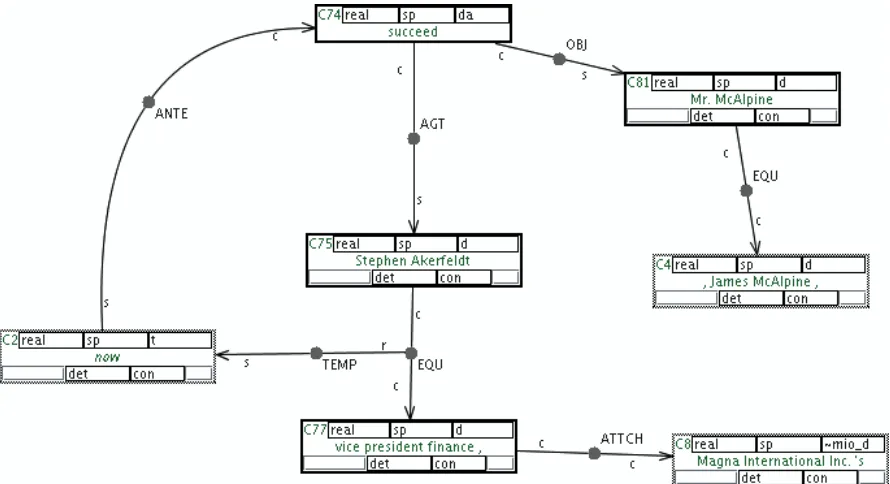
The representation of the Multilayered Extended Semantic Networks (MultiNet), which is described in (Helbig, 2006), provides a universal formalism for the treatment of semantic phenomena of natu-ral language. To this end, they offer distinct ad-vantages over the use of the classical predicate calculus and its derivatives. For example, Multi-Net provides a rich ontology of semantic-concept types. This ontology has been constructed to be language independent. Due to the graphical inter-pretation of MultiNets, we believe manual anno-tation and interpreanno-tation is simpler and thus more cognitively compatible. Figure 1 shows the Multi-Net annotation of a sentence from the WSJ corpus:
“Stephen Akerfeldt, currently vice president fi-nance, will succeed Mr. McAlpine.”
In this example, there are a few relationships that il-lustrate the representational power of MultiNet. The main predicatesucceedis aANTEdependent of the nodenow, which indicates that the outcome of the event described by the predicate occurs at some time later than the time of the statement (i.e., the succes-sion is taking place after the current time as captured by the future tense in the sentence). Intra-sentential coreference is indicated by the EQU relationship. From the previous context, we know that the vice presidentis related to a particular company, Magna
International Inc. The pragmatically defined rela-tionship betweenMagna International Inc.andvice president financeis captured by theATTCH (con-ceptual attachment) relationship. This indicates that there is some relationship between these entities for which one is a member of the other (as indicated by the directed edge).Stephen Akerfeldtis the agent of the predicate described by this sub-network.
The semantic representation of natural language expressions by means of MultiNet is generally in-dependent of the considered language. In contrast, the syntactic constructs used in different languages to express the same content are obviously not iden-tical. To bridge the gap between different languages we employ the deep syntactico-semantic representa-tion available in the Funcrepresenta-tional Generative Descrip-tion framework (Sgall et al., 1986).
1.2 Prague Dependency Treebank
The Prague Dependency Treebank (PDT) presents a language resource containing a deep manual analy-sis of texts(Sgall et al., 2004). The PDT contains annotations on three layers:
Morphological A rich morphological annotation is provided when such information is available in the language. This includes lemmatization and detailed morphological tagging.
Analytical The analytical layer is a dependency analysis based purely on the syntactic interpre-tation.
Tectogrammatical The tectogrammatical annota-tion provides a deep-syntactic (syntactico-semantic) analysis of the text. The formal-ism abstracts away from word-order, function words (syn-semantic words), and morphologi-cal variation.
The units of each annotation level are linked with corresponding units on the preceding level. The morphological units are linked directly with the original tokenized text. Linking is possible as most of these interpretations are directly tied to the words in the original sentence. In MultiNet graphs, addi-tional nodes are added and nodes are removed.
Figure 1: MultiNet annotation of sentence “Stephen Akerfeldt, currently vice president finance, will succeed Mr. McAlpine.” Nodes C4 and C8 are re-used from previous sentences. Node C2 is an unexpressed (not explicitly stated in the text) annotator-created node used in previous annotations.
computational-linguistics research needs. The theo-retical basis of the tectogrammatical representation lies in the Functional Generative Description of lan-guage systems (Sgall et al., 1986). Software tools for corpus search, lexicon retrieval, annotation, and language analysis are included. Extensive documen-tation in English is provided as well.
2 Integrated Annotation Process
We propose an integrated annotation procedure aimed at acquiring high-quality MultiNet semantic annotations. The procedure is based on a combi-nation of annotation tools and annotation resources. We present these components in the this section.
2.1 Annotation Tool
The core annotation is facilitated by the cedit
tool1, which uses PML (Pajas and ˇStˇep´anek, 2005),
an XML file format, as its internal representa-tion (Nov´ak, 2007). The annotarepresenta-tion tool is an application with a graphical user interface imple-mented in Java (Sun Microsystems, Inc., 2007). The
1Theceditannotation tool can be downloaded from http://ufal.mff.cuni.cz/∼novak/files/cedit.zip.
cedittool is platform independent and directly con-nected to the annotators’ wiki (see Section 2.4), where annotators can access the definitions of indi-vidual MultiNet semantic relations, functions and at-tributes; as well as examples, counterexamples, and discussion concerning the entity in question. If the wiki page does not contain the required information, the annotator is encouraged to edit the page with his/her questions and comments.
2.2 Online Lexicon
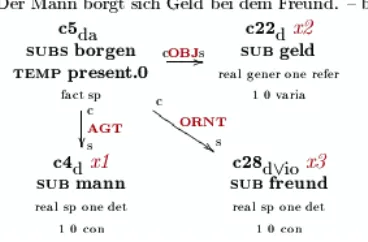
val-Figure 2: HaGenLex entry showing an example sentence for the German verb “borgen.1.1” (“to borrow”). The sentence is literally “The man borrows himself money from the friend.”
idated semantic representation is displayed in Fig-ure 2. The quality of example parses is assFig-ured by comparing the marked-up complements in the ex-ample to the ones in the semantic network. In the rare case that the parse is not optimal, it will not be visible to annotators.
2.3 Online Parser
Sometimes the annotator needs to look up a phrase or something more general than a particular noun or verb. In this case, the annotator can use the workbench for (MultiNet) knowledge bases (MWR (Gn¨orlich, 2000)), which provides conve-nient and quick access to the parser that translates German sentences or phrases into MultiNets.
2.4 Wiki Knowledge Base
A wiki (Leuf and Cunningham, 2001) is used collab-oratively to create and maintain the knowledge base used by all the annotators. In this project we use Dokuwiki (Badger, 2007). The entries of individ-ual annotators in the wiki are logged and a feed of changes can be observed using an RSS reader. The
ceditannotation tool allows users to display appro-priate wiki pages of individual relation types, func-tion types and attributes directly from the tool using their preferred web browser.
3 Network Evaluation
We present an evaluation which has been carried out on an initial set of annotations of English arti-cles from The Wall Street Journal (covering those
annotated at the syntactic level in the Penn Tree-bank (Marcus et al., 1993)). We use the annotation from the Prague Czech-English Dependency Tree-bank (Cuˇr´ın et al., 2004), which contains a large por-tion of the WSJ Treebank annotated according to the PDT annotation scheme (including all layers of the FGD formalism).
We reserved a small set of data to be used to train our annotators and have excluded these articles from the evaluation. Three native English-speaking anno-tators were trained and then asked to annotate sen-tences from the corpus. We have a sample of 67 sentences (1793 words) annotated by two of the an-notators; of those, 46 sentences (1236 words) were annotated by three annotators.2 Agreement is
mea-sured for each individual sentences in two steps. First, the best match between the two annotators’ graphs is found and then the F-measure is computed. In order to determine the optimal graph match be-tween two graphs, we make use of the fact that the annotators have the tectogrammatical tree from which they can select nodes as concepts in the Multi-Net graph. Many of the nodes in the annotated graphs remain linked to the tectogrammatical tree, therefore we have a unique identifier for these nodes. When matching the nodes of two different annota-tions, we assume a node represents an identical con-cept if both annotators linked the node to the same tectogrammatical node. For the remaining nodes, we consider all possible one-to-one mappings and construct the optimal mapping with respect to the F-measure.
Formally, we start with a set of tectogrammatical trees containing a set of nodesN. The annotation is a tupleG= (V, E, T, A), whereV are the vertices, E⊆V ×V ×P are the directed edges and their la-bels (e.g., agent of an action:AGT∈P),T ⊆V×N is the mapping from vertices to the tectogrammati-cal nodes, and finallyAare attributes of the nodes, which we ignore in this initial evaluation.3
Analo-gously,G0 = (V0, E0, T0, A0) is another annotation
2The data associated with this experiment can be down-loaded from http://ufal.mff.cuni.cz/∼novak/files/data.zip. The
data is inceditformat and can be viewed using thecediteditor at http://ufal.mff.cuni.cz/∼novak/files/cedit.zip.
[image:4.612.76.260.57.178.2]of the same sentence and our goal is to measure the similaritys(G, G0)∈[0,1]ofGandG0.
To measure the similarity we need a setΦof ad-missible one-to-one mappings between vertices in the two annotations. A mapping is admissible if it connects vertices which are indicated by the an-notators as representing the same tectogrammatical node:
Φ =
(
φ⊆V ×V0 (1)
∀
n∈N v∈V v0∈V0
(v,n)∈T∧(v0,n)∈T0→(v,v0)∈φ
∧ v∈∀V v0,w0∈V0
(v,v0)∈φ∧(v,w0)∈φ→(v0=w0)
∧ v,w∀∈V v0∈V0
(v,v0)∈φ∧(w,v0)∈φ→(v=w) )
In Equation 1, the first condition ensures thatΦis constrained by the mapping induced by the links to the tectogrammatical layer. The remaining two con-ditions guarantee thatΦis a one-to-one mapping.
We define the annotation agreementsas:
sF(G, G0) = max
φ∈Φ(F(G, G
0, φ))
whereF is the F1-measure:
Fm(G, G0, φ) = 2·m(φ)
|E|+|E0|
wherem(φ)is the number of edges that match given the mappingφ.
We use four versions of m, which gives us four versions ofFand consequently four scoressfor ev-ery sentence:
Directed unlabeled:mdu(φ) =
n
(v,w,ρ)∈E
∃v0,w0∈V0,ρ0∈P
v0, w0, ρ0∈E0
∧(v, v0)∈φ∧(w, w0)∈φo
Undirected unlabeled:muu(φ) =
n
(v,w,ρ)∈E
∃v0,w0∈V0,ρ0∈P
(v0, w0, ρ0)∈E0∨(w0, v0, ρ0)∈E0
∧(v, v0)∈φ∧(w, w0)∈φo
Directed labeled:mdl(φ) =
n
(v,w,ρ)∈E
∃v0,w0∈V0
v0, w0, ρ∈E0
∧(v, v0)∈φ∧(w, w0)∈φo
Undirected labeled:mul(φ) =
n
(v,w,ρ)∈E
∃v0,w0∈V0
(v0, w0, ρ)∈E0∨(w0, v0, ρ)∈E0
∧(v, v0)∈φ∧(w, w0)∈φo
These fourm(φ) functions give us four possible Fm measures, which allows us to have four scores
for every sentence:sdu,suu,sdlandsul.
Figure 3 shows that the inter-annotator agreement is not significantly correlated with the position of the sentence in the annotation process. This suggests that the annotations for each annotator had achieved a stable point (primarily due to the annotator training process).
10 20 30 40 50
0.2
0.4
0.6
0.8
1.0
Sentence length
Inter−annotator F−measure − Undirected Unlabeled
[image:5.612.84.293.170.290.2]Annotators CB−CW SM−CW SM−CB
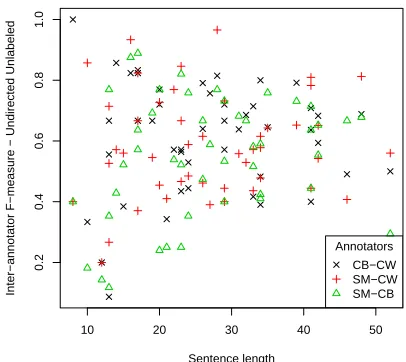
Figure 4: Inter-annotator agreement depending on the sentence length. Each point represents a sentence.
[image:5.612.318.521.435.616.2]0 10 20 30 40
0.2
0.4
0.6
0.8
1.0
Index
Undirected Unlabeled F−measure Annotators
CB−CW SM−CW SM−CB
0 10 20 30 40
0.0
0.2
0.4
0.6
Index
Undirected Labeled F−measure
Annotators
[image:6.612.81.548.84.289.2]CB−CW SM−CW SM−CB
Figure 3: Inter-annotator agreement over time. Left: unlabeled, right: labeled. Each point represents a sentence; CB, CW, and SM are the annotators’ IDs.
sentences are not more difficult than short sentences. The variance decreases with the sentence length as expected.
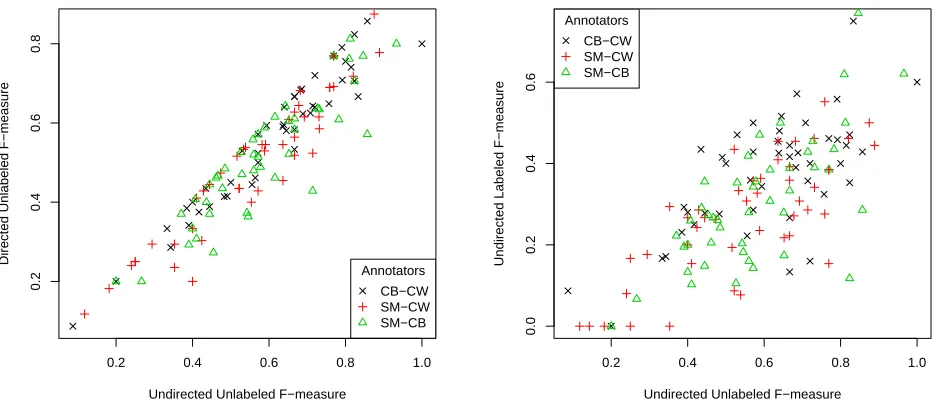
In Figure 5 we show the comparison of directed and labeled evaluations with the undirected unla-beled case. By definition the undirected unlaunla-beled score is the upper bound for all the other scores. The directed score is well correlated and not very different from the undirected score, indicating that the annotators did not have much trouble with de-termining the correct direction of the edges. This might be, in part, due to support from the formal-ism and its tool cedit: each relation type is speci-fied by asemantic-concept typesignature; a relation that violates its signature is reported immediately to the annotator. On the other hand, labeled score is significantly lower than the unlabeled score, which suggests that the annotators have difficulties in as-signing the correct relation types. The correlation coefficient between suu and sul (approx. 0.75) is
also much lower than than the correlation coefficient betweensuuandsdu(approx.0.95).
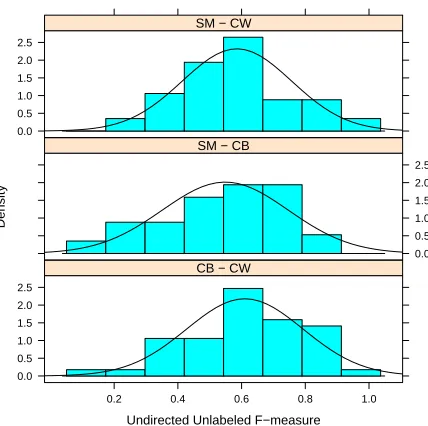
Figure 6 compares individual annotator pairs. The scores are similar to each other and also have a sim-ilar distribution shape.
Undirected Unlabeled F−measure
Density
0.0 0.5 1.0 1.5 2.0 2.5
0.2 0.4 0.6 0.8 1.0
CB − CW
0.0 0.5 1.0 1.5 2.0 2.5
SM − CB
0.0 0.5 1.0 1.5 2.0 2.5
[image:6.612.322.536.366.579.2]SM − CW
Figure 6: Comparison of individual annotator pairs.
0.2 0.4 0.6 0.8 1.0
0.2
0.4
0.6
0.8
Undirected Unlabeled F−measure
Directed Unlabeled F−measure
Annotators
CB−CW SM−CW SM−CB
0.2 0.4 0.6 0.8 1.0
0.0
0.2
0.4
0.6
Undirected Unlabeled F−measure
Undirected Labeled F−measure
Annotators
[image:7.612.80.548.84.287.2]CB−CW SM−CW SM−CB
Figure 5: Left: Directed vs. undirected inter-annotator agreement. Right: Labeled vs. unlabeled inter-annotator agree-ment. Each point represents a sentence.
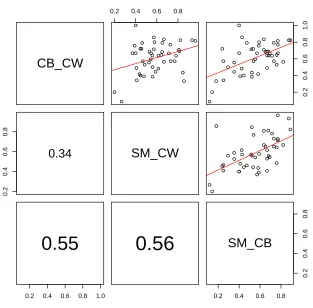
annotation, the third is likely to also agree, but this correlation is not a very strong one. The actual cor-relation coefficients are shown under the main diag-onal of the matrix.
Sample Annotators Agreement F-measure suu sdu sul sdl
Smaller CB-CW 61.0 56.3 37.1 35.0 Smaller SM-CB 54.9 48.5 27.1 25.7 Smaller SM-CW 58.5 50.7 31.3 30.2 Smaller average 58.1 51.8 31.8 30.3 Larger CB-CW 64.6 59.8 40.1 38.5
Table 1: Inter-annotator agreement in percents. The re-sults come from the two samples described in the first paragraph of Section 3.
Finally, we summarize the raw result in Table 1. Note that we report simple annotator agreement here.
4 Conclusion and Future Work
We have presented a novel framework for the anno-tation of semantic network for natural language dis-course. Additionally we present a technique to
eval-uate the agreement between the semantic networks annotated by different annotators.
[image:7.612.73.301.421.530.2]CB_CW
0.2 0.4 0.6 0.8
● ● ● ● ● ●● ● ● ● ● ● ● ● ● ● ● ● ● ● ● ● ● ● ● ● ● ● ● ● ● ● ● ● ● ● ● ● ● ● ● ● ● ● ● ● 0.2 0.4 0.6 0.8 1.0 ● ● ● ● ● ● ● ● ● ● ● ● ● ● ● ● ● ● ● ● ● ● ● ● ● ● ● ● ● ● ● ● ● ● ●● ● ● ● ● ● ● ● ● ● ● 0.2 0.4 0.6 0.8
0.34
SM_CW
● ● ● ● ● ● ● ● ● ● ● ● ● ● ● ● ● ● ● ● ● ● ● ● ● ● ● ● ● ● ● ● ● ● ● ● ● ● ● ● ● ● ● ● ● ●0.2 0.4 0.6 0.8 1.0
0.55
0.56
0.2 0.4 0.6 0.8
0.2
0.4
0.6
0.8
SM_CB
[image:8.612.151.464.82.390.2]Undirected Unlabeled F−measure with Correlation Coefficients
Figure 7: Undirected, unlabeled F-measure correlation of annotator pairs. Each cell represents two different pairs of annotators; cells with graphs show scatter-plots of F-scores for the annotator pairs along with the optimal linear fit; cells with values show the correlation coefficient (each point in the plot corresponds to a sentence). For example, the top row, right-most column, we are comparing the F-score agreement of annotators CB and CW with that of the F-score agreement of annotators SM and CB. This should help identify an outlier in the consistency of the annotations.
Acknowledgment
This work was partially supported by Czech Academy of Science grants 1ET201120505 and 1ET101120503; by Czech Ministry of Educa-tion, Youth and Sports projects LC536 and MSM0021620838; and by the US National Science Foundation under grant OISE–0530118. The views expressed are not necessarily endorsed by the spon-sors.
References
Mike Badger. 2007. Dokuwiki – A Practical Open Source Knowledge Base Solution. Enterprise Open Source Magazine.
Johan Bos. 2008. Let’s not Argue about Semantics. In European Language Resources Association (ELRA), editor, Proceedings of the Sixth International Lan-guage Resources and Evaluation (LREC’08), Mar-rakech, Morocco, may.
Jan Cuˇr´ın, Martin ˇCmejrek, Jiˇr´ı Havelka, and Vladislav Kuboˇn. 2004. Building parallel bilingual syntacti-cally annotated corpus. In Proceedings of The First International Joint Conference on Natural Language Processing, pages 141–146, Hainan Island, China. Carsten Gn¨orlich. 2000. MultiNet/WR: A Knowledge
Engineering Toolkit for Natural Language Informa-tion. Technical Report 278, University Hagen, Hagen, Germany.
CD-ROM, Linguistic Data Consortium, LDC Catalog No.: LDC2006T01, Philadelphia, Pennsylvania. Sven Hartrumpf, Hermann Helbig, and Rainer Osswald.
2003. The Semantically Based Computer Lexicon Ha-GenLex – Structure and Technological Environment.
Traitement Automatique des Langues, 44(2):81–105. Hermann Helbig. 2006. Knowledge Representation and
the Semantics of Natural Language. Springer, Berlin, Germany.
Bo Leuf and Ward Cunningham. 2001. The Wiki Way. Quick Collaboration on the Web. Addison-Wesley, Reading, Massachusetts.
Mitchell P. Marcus, Mary Ann Marcinkiewicz, and Beat-rice Santorini. 1993. Building a large annotated cor-pus of English: the Penn treebank. Computational Linguistics, 19(2):313–330.
V´aclav Nov´ak. 2007. Cedit – semantic networks man-ual annotation tool. In Proceedings of Human Lan-guage Technologies: The Annual Conference of the North American Chapter of the Association for Com-putational Linguistics (NAACL-HLT), pages 11–12, Rochester, New York, April. Association for Compu-tational Linguistics.
Petr Pajas and Jan ˇStˇep´anek. 2005. A Generic XML-Based Format for Structured Linguistic Annotation and Its Application to Prague Dependency Treebank 2.0. Technical Report 29, UFAL MFF UK, Praha, Czech Republic.
Petr Sgall, Eva Hajiˇcov´a, and Jarmila Panevov´a. 1986.
The Meaning of the Sentence in Its Semantic and Prag-matic Aspects. D. Reidel, Dordrecht, The Netherlands. Petr Sgall, Jarmila Panevov´a, and Eva Hajiˇcov´a. 2004. Deep syntactic annotation: Tectogrammatical repre-sentation and beyond. In Adam Meyers, editor, Pro-ceedings of the HLT-NAACL 2004 Workshop: Fron-tiers in Corpus Annotation, pages 32–38, Boston, Massachusetts, May. Association for Computational Linguistics.