User Annotations of Minority Languages
Nathan Green1,2,∗ Paul Breimyer1,2,∗ Vinay Kumar1 Nagiza F. Samatova1,2,∓
1North Carolina State University 890 Oval Drive
Raleigh, NC 27695
2Oak Ridge National Laboratory 1 Bethel Valley Rd
Oak Ridge, TN 37831
Abstract
Annotated corpora are sets of structured text used to enable Natural Language Pro-cessing (NLP) tasks. Annotations may include tagged parts-of-speech, semantic concepts assigned to phrases, or seman-tic relationships between these concepts in text. Building annotated corpora is labor-intensive and presents a major ob-stacle to advancing machine translators, named entity recognizers (NER), part-of-speech taggers, etc. Annotated corpora are specialized for a particular language or NLP task. Hence, a majority of the world’s 6000+ languages lack NLP re-sources, and therefore remain minority, orunder-resourced, languages in modern language technologies.
In this paper we present WebBANC, a framework for Building Annotated NLP Corpora from user annotations on the Web. With WebBANC, a casual user can anno-tate parts of HTML or PDF text on any website and associate the text with seman-tic concepts specific to an NLP task. User annotations are combined by WebBANC to produce annotated corpora potentially comparable in diversity to corpora in En-glish, minority languages, and human gen-erated categories, such as those on Ya-hoo.com, with an average precision and recall of 0.80, which is comparable to au-tomated NER tools on the CoNLL bench-mark.
* Both authors contributed equally
∓Corresponding author: [email protected]
1 Introduction
The Web is the holy grail of linguistic data (Rayson et al., 2006). It has recently gained pop-ularity as a resource for minority (Ghani and Mladenic, 2001), or under-resourced, languages that lack automatic Natural Language Processing (NLP) resources, even from the Basic Language Resource Kit (BLARK) (Krauwer, 2003). “Web as Corpus” has been especially valuable for con-structing text corpora from the Web for these lan-guages (Scannell, 2007; Baroni and Bernardini, 2004). Language specific corpora are useful for many language technology applications, includ-ing named entity recognition, machine translation, spelling correction, and machine-readable dictio-naries. The An Cr´ubad´an Project, for example, has succeeded in creating corpora for more than 400 of the world’s 6000+ languages by web crawling. With a few exceptions, most of the 400+ corpora, however, lack any linguistic annotations due to the limitations of the annotation tools (Rayson et al., 2006).
but primarily exist formajoritylanguages. For minority languages, however, few auto-mated corpora annotation systems exist and dif-ferent approaches are needed. In this paper, we hypothesize that the Web, coupled with web user community efforts, represent a paradigm shift in annotated corpora construction. We extend the concept of community-based web content cre-ation, such as Wikipedia (Zesch et al., 2007), by assuming that websites, especially frequently vis-ited ones, present an ideal platform for large-scale community-level annotations for NLP tasks. We also argue that if given an opportunity to link an-notations with semantic concepts, such as those represented in the form of ontologies, the web community can potentially create semantically-rich annotated corpora at an unprecedented scale.
The actual impact of web user annotated cor-pora creation remains to be seen, but the poten-tial benefits of such a framework are manifold. It may reduce the time required to create annotated corpora for NLP tasks potentially from months to days. For NER tasks, for example, commercial ap-plications currently support a handful of entities. For instance, NetOwl Extractor is a commercial application that supports seven entity types and seventy subtypes, including people, organizations, places, etc. The lack of entity breadth is explained by the intense human-labor required for entity type development.
A framework could potentially enable build-ing semantically richer and larger corpora by supporting any ontology, which would allow re-searchers to introduce new levels of semantic rich-ness into corpora. For example, the Gene Ontol-ogy (GO) (Ashburner et al., 2000) contains over 100,000 biological concepts that can enrich anno-tations and the correspondingly generated corpora. A web user annotation framework may also en-able automatic processing of minority languages by supporting minority corpora generation. The Open American National Corpus (OANC) (Ide and Macleod, 2001) is a major initiative meant to parallel the British National Corpus (Burnard, 1995), which contains over 100 million words. Minority languages do not enjoy the same support as American and British English, and it is unlikely that similar scale corpora will be generated for mi-nority languages. The WebBANC framework can potentially enable annotated corpora generation of many less common domains, such as minority
lan-guages, by distributing the annotation effort over many users.
2 WebBANC Framework
We introduce a framework that leverages user an-notations on the Web to Build Annotated NLP
Corpora (WebBANC). We show that given such a framework, user annotations of commonly vis-ited websites may contain enough linguistically diverse text to create sufficiently diverse corpora for various NLP tasks. To evaluate the results, we compare corpora created from the most visited websites to the human organized categories on Ya-hoo.com, and to commonly used corpora such as the OANC (Ide and Macleod, 2001), a freely avail-able massive collection of American English texts with over fourteen million words.
We also compare the corpora against a minority language corpus generated from the Icelandic Fre-quency Dictionary (IFD) (Pind et al., 1991), a bal-anced corpus including Icelandic Fiction, Trans-lated Fiction, and other categories compiled from text fragments written between 1980-1989 (Hel-gadttir, 2004). We show, through large-scale sim-ulation, that aggregate user annotations covering approximately 50% of the words in the top 100 most visited websites can generate corpora that represent 35%-70% of the diversity of these cor-pora at 70%-90% precision. Small-scale user stud-ies show that the average precision and recall for English named entity recognition (NER) tasks are comparable with those achieved by more than a dozen automatic NER tools when tested against the widely accepted CoNLL benchmark (Sang and Meulder, 2003).
2.1 Requirements
To be successful, a distributed free-text annotation framework must support annotations of most web-pages that thelaymanuser regularly encounters on the Web. For this reason, the framework should allow users to annotate both PDF and HTML doc-uments, including pages built by underlying tech-nologies that display HTML, such as PHP. Build-ing corpora usBuild-ing distributed annotations should adhere to standards in the machine learning com-munity, such as those proposed by the W3C, to enable standardized interfaces between clients and the framework. These standards may include the
web browser (the client) and the annotation man-ager (the server) and XPointers (DeRose et al., 1998) to locate text in HTML documents, allow-ing users to annotate any text on a webpage.
The framework should also provide easy-to-use annotation plug-ins for diverse web browsers with intuitive Graphical User Interfaces, poten-tially customized for individual NLP tasks. A sim-ple drag-and-drop or right-mouse-click-and-select interface to choose a semantic concept, such as person or location for a highlighted word or phrase on the webpage, can serve as an example interface for NER tasks. Designing a simple and functional interface for different NLP tasks, such as entity re-lationships, may not be trivial.
A major issue for future minority language NLP developments is the need to generate and use con-sistent annotations (Leitner and Valencia, 2008). The framework should use standard semantic tags and allow user communities to supply their own standards; various scenarios are described below.
The framework should allow users to supply their own semantic tags for annotations. However, maintaining consistency may be quite difficult and may ultimately restrict the resulting annotated cor-pora uses for NLP tools.
The framework should permit users to choose semantic concepts and/or relationships from col-lections of controlled vocabularies, synonymous sets, and standard ontologies. Ontologies are for-mal representations of a set of domain concepts and the relationships between those concepts, and can provide a natural and standard hierarchy to tag a document. The W3C Web Ontology Lan-guage (OWL) (Bechhofer et al., 2004) is a stan-dard for well-structured representations. Different domains have developed domain-specific ontolo-gies, such as the Gene Ontology (GO) terms in Bi-ology (Ashburner et al., 2000), but they may be too complex and require some adaptation to facilitate use by layman users, as well as domain experts. While the framework should allow users to select from a set of default ontologies, individual users and user communities should be free to create and integrate their own ontologies into the framework. The framework should support semi-automated NLP tools or models to pre-annotate possibly rel-evant terms using existing NLP tools. The tools should use standard collections of semantic tags and offer the tagged annotations to users for vali-dation via easy-to-use graphical interfaces.
Semi-automated predictive models exist for some NLP tasks, such as part-of-speech and NER (Sang and Meulder, 2003). These models can be leveraged by the framework to validate manual annotations and may help identify poor annotations. Incorpo-rating both ontologies and automated NLP anno-tation tools into the framework should be realized through the use of webservices (Alonso, 2004) us-ing standard communication protocols.
Two critical and non-trivial issues for such a framework are annotation quality and the quality-control mechanisms. Unlike manually annotated corpora by domain experts, annotations by web users will likely be noisy. Although such anno-tated web corpora can still be utilized for man-ual curation, it would be desirable for the frame-work to provide analytical intelligence to make de-cisions about collating and resolving possibly con-flicting and uncertain annotations from potentially numerous users and/or various NLP tools. This is an open area of research and deserves an active in-vestigation.
2.2 Framework Architecture
The current implementation of the WebBANC framework consists of the following main com-ponents: an Annotation Server, the Annotation database, an OWL Ontology Interface, a Query and Retrieval Interface, and an Annotation Fron-tend.
The Annotation Frontend is a Firefox plug-in that uses XUL and JavaScript and supports two interfaces: one handles standard text and the other annotates PDF documents. The browser im-plementation allows distributed users to annotate websites. Users highlight words or phrases to an-notate and link them to semantic tags by dragging or double-clicking the tag. The plain text inter-face builds upon the W3C Annotea project (Ka-han et al., 2002). The PDF client leverages jPDFNotes (2008) and is compiled with Java 5.
The Annotation Server handles communication between the Annotation Frontend and the backend database, which uses MySQL 5. Communication between clients and servers uses XML, and specif-ically either RDF or OWL, depending on the re-quest context. The MySQL database is stored on an annotation server to support permanent storage and querying of manually annotated text. This al-lows NLP models to refine their prediction algo-rithms and also allows WebBANC to generate cor-pora in multiple formats. We intend to extend the framework with the ability to plug-in NLP mod-els to support semi-automation, thereby allowing users to curate model-specific tags.
3 Results
We evaluated WebBANC at two levels: small-scale actual user annotation performance and large-scale simulation-based results. The purpose of the former is to determine the efficacy and accu-racy of annotated corpora generated by untrained casual users. The latter was designed to draw conclusions regarding the diversity of user anno-tations generated on the Web and to compare the generated corpora with existing corpora in En-glish, minority languages, and human generated categories, such as those found on Yahoo.com.
3.1 Small-Scale Study of Casual Annotators
To examine the effectiveness of untrained annota-tors using a web based annotation platform, Web-BANC was released to several users. The purpose of this study was to test whether volunteer casual annotators are effective in terms of accuracy and throughput.
3.1.1 Evaluation Methodology
To examine the effectiveness of untrained anno-tators we conducted a study of users annotating web pages of their choosing for a named entity task. While annotating, users were restricted to the tags Person, Organization, and Location and were instructed to only use the system for fifteen minutes a day over four consecutive days. Users were also instructed for one of those days to an-notate approximately 60 sentences extracted from the 2003 Conference on Natural Language Learn-ing (CoNLL) trainLearn-ing corpus with the same en-tity types; the sentences were un-tagged prior to the experiment. We refer to the training corpus as the CoNLL corpus, and selected it for our
evalu-ation due to its widespread adoption as a bench-mark corpus.
3.1.2 Small-Scale Study Results
The seven users created a corpus of 1,634 anno-tations: 1028 for general web pages and 606 for CoNLL data. Volunteer casual annotators with no previous annotation experience demonstrated high throughput, in comparison to the GENIA cor-pus (Kim et al., 2008).
Table 1: Recall and Precision for CoNLL annota-tions.
Per Loc Org Avg CoNLL Avg Recall
(All Data) 1.00 0.94 0.82 0.92 0.81 Precision
(All Data) 0.70 0.82 0.42 0.58 0.82
Table 2: Precision for CoNLL annotations with fil-tering.
Per Loc Org Avg Precision
(Majority Voting) 0.76 0.86 0.48 0.64 Precision
(Coverage Req.) 0.73 0.90 0.55 0.69 Precision
(Majority Voting +
Coverage Req.) 0.79 0.95 0.69 0.79
While throughput is important, the accuracy of the annotations directly impacts the usefulness of the corpus. To test users’ annotation accuracy we directly compared their annotations to the ex-pertly created standard CoNLL corpus. Table 1 shows that the users collectively annotated every Person entity tagged by CoNLL, giving a recall of 1. User-level annotation of the Location entity also achieved a high recall of 0.94, but the Orga-nization entity yielded a lower recall of 0.82. The average recall over the three entities is 0.92, which is an improvement over the average recall of 0.81 provided by the sixteen automated predictive tools in CoNLL.
Table 2, were calculated using majority voting af-ter removing annotations with singular coverage. Based on users’ feedback, annotating the Orga-nization entity was the most unclear of the three. The average precision for the Person and Location entities was 0.87. Again, the casual user-level pre-cision was comparable with the automated tools that attained an average precision of 0.82 over the three entities. For user-level annotations of arbi-trary web pages of their choosing, 42.1%(31.2%) of the web pages were found the top 70(50) web pages viewed in the United States according to Alexa.com, an internet traffic rating site. Due to these results, the subsequent evaluation considered up to the top 100 websites in the United States in an effort to better represent possibly annotated websites. The webpage categories annotated in-cluded News, Politics, Technology, Blogs, Sci-ence, and others, showing a range of diverse entity types that casual users may annotate using Web-BANC.
3.2 Large-Scale System Generated Simulations
Section 3.1 shows WebBANC’s potential for high throughput and accuracy, but effectiveness is de-pendent on regularly visited web pages containing words that are useful to NLP annotated corpora. Therefore, our experiment compares the content of frequently visited web sites to established cor-pora.
3.2.1 Evaluation Methodology
For large-scale simulation-based evaluation, we conducted three experiments comparing different sets of corpora to web generated corpora. The first experiment identified human-curated categories using Yahoo.com, which has about twenty primary categories, such as Health, Politics, and Weather. The corpora generated from these categories al-lowed us to evaluate category-specific corpora, for example, a Sports corpus. The second experi-ment used the most commonly visited web sites for a minority language, specifically Icelandic, and compared the results to a half-million word Ice-landic corpus published by the Institute of Lexi-cography in 1991 (Pind et al., 1991) and produced from the IFD, supplied by the ´Arni Magn´usson In-stitute for Icelandic Studies. The final experiment is compared against the OANC to assess the po-tential for building general English corpora.
A simple examination of word counts and word
diversity derived from web corpus annotations from popular websites can help determine the like-lihood of creating a diverse corpus, and therefore assess whether the generated corpus is likely to be useful. However, the rate at which users collec-tively annotate words encountered during regular web browsing, which we call theannotation per-centage, directly affects the expected word counts and will vary. We consideredannotation percent-agesfrom 100%, 90%, . . . , 50% to simulate dif-ferent user scenarios.
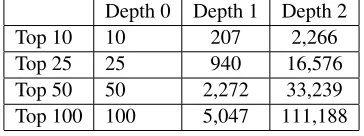
[image:5.612.327.509.562.630.2]The experiments contained simulations that per-mute the recursive depth searched, the annotation percentage, and the numberX of frequently vis-ited sites explored. To simulate the web pages a casual user might browse on a daily basis we used data from Alexa.com to identify the most popu-larX websites in the United States, whereX ∈ {10, 25, 50, 100}, referred to as thetop X sites. The depth is varied to simulate different user be-havior; some users will only visit the main web page, while others will drill-down into sublevels. Corpora generated from depth 0 contain the text on the front page of each URL; depth 1 corpora contain all text from depth 0, and all text gath-ered by following URL links at depth 0; similarly, depth 2 corpora contain all text obtained from the depth 1 traversal, including text collected by fol-lowing all links discovered at depth 1. The num-ber of links, or URLs, harvested for the top 100 corpus at depth 2 (see Table 3) became too large to process and were left out of the results. We used thewgetUnix program to recursively follow these links. These 3 depths, 4 groupings of popu-larities and 6 annotation percentages generated 72 datasets (3*4*6=72) per corpus.
Table 3: The number of documents harvested for the top X corpora at each depth.
Depth 0 Depth 1 Depth 2 Top 10 10 207 2,266 Top 25 25 940 16,576 Top 50 50 2,272 33,239 Top 100 100 5,047 111,188
We used recall and precision to compare per-formance in our top X generated corpora. Given an established corpus or category system, called a
in a URL list or base corpus, apply a Perl mod-ule from BootCaT (Baroni and Bernardini, 2004) to retrieve the text from that URL and remove all HTML tags; remove all punctuation and words that appear in the stop word filter; apply Porter stemming; and generate a unique term list.
3.2.2 Large-Scale Study Results
[image:6.612.314.524.62.158.2]Human-Curated Corpora: To evaluate Web-BANC’s ability to generate category or entity spe-cific corpora, we ran several simulations varying the traversal depth and quantity of top X sites. This experiment was designed to compare cate-gory recognition between the top X corpora and humanly-curated corpora. The results indicate that both the value of X and the traversal depth affect the quality of generated corpora.
[image:6.612.315.520.209.303.2]Table 4 shows unique word counts for a select set of Yahoo.com categories including Nutrition, Sports, and Technology. Due to the limited text at depth 0 and the great expansion of text at depth 2, the decision was made to examine the human-curated categories at depth 1. There are fewer web pages to annotate at depth 1 than depth 2, and therefore depth 1 may better simulate likely user behavior.
Table 4: Unique word counts for human-curated corpora from Yahoo.com.
Depth 0 Depth 1 Depth 2 Nutrition 417 7,071 16,452 Sports 796 17,760 74,840 Technology 432 16,440 100,163
As Table 4 shows, depth had less impact on the Nutrition corpus size. The pages retrieved at consecutive depths for Nutrition returned sim-ilar words, which negatively affected the unique-ness and diversity of the corpus. Sports benefited greatly from increased depth due to its hierarchi-cal information content. Similar to Sports, infor-mation content for the Technology category was organized in a product-driven hierarchy, resulting in a higher dependence on the depth level.
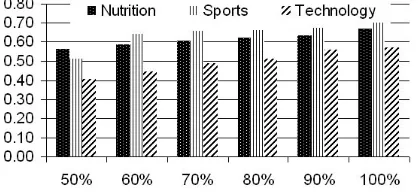
We examined the top 100 most visited sites, compared them to three Yahoo.com human-curated corpora, both at depth 1, and examined the results with annotation percentages ranging from 100% to 50%. Figure 1 shows maximum recall of 67%, 70%, and 57% for the Nutrition, Sports, and Technology corpora, respectively. In the less
Figure 1: Recall of the top 100 corpus (depth 1) vs. human-curated Yahoo.com corpora (depth 1).
Figure 2: Recall of top X corpora at depths 0, 1, and 2 vs. Sports Yahoo.com corpus (depth 1) with annotation percentage of 70%.
ideal scenario, in which users collectively only an-notate half of what they see, Figure 1 shows recall above 50% for two of the three Yahoo.com cate-gories, indicating that users collectively annotat-ing half of all encountered words can cover about half the possible words in a specialized corpus.
Finally, we examined recall of the top X cor-pora at different depths against the Sports corpus at depth 1 using an annotation percentage of 70% to demonstrate X’s effect on word diversity. As Figure 2 shows, recall improved from depths 0 to 1 for the top 10 and top 100 sites by a factor of eight (1.6% to 12.9%) and a smaller factor of 5.3 (12.4% to 66.5%), respectively. The top 100 sites did not perform as well because increasing X decreases word uniqueness, which attenuates the benefits. As X increases for the top X sites, Figure 2 suggests that recall increases. The fig-ure also shows that similar recall performance can be achieved at smaller X values by increasing the depth. fGiven that our results showed higher re-call with larger X values and increased depth, it would be interesting to harvest larger numbers of websites in future work to determine if a satura-tion point for the number of documents examined exists.
[image:6.612.100.297.431.485.2]an-Figure 3: Precision of Icelandic top X corpora vs. IFD corpus.
[image:7.612.90.302.60.162.2]notated corpora for minority languages is a pri-mary cause for the dearth of machine learning tasks in these languages. The following experi-ment is designed to show that minority language speakers can annotate words during their daily browsing to aid in the construction of annotated corpora using the Icelandic language.
Figure 3 compares the precision of Icelandic top X corpora to the IFD corpus. The results sug-gest that words in the top X sites are useful for corpora generation, but diversity may be less than desirable, although 70% precision is attained for the top 10 and top 25 Icelandic websites at 50% annotation percentage. The results indicate that words encountered by Icelandic speakers in every-day web browsing may yield relatively precise Ice-landic corpora.
Recall for Icelandic top X corpora is relatively low, around 30%, in comparison to the other ex-periments, for several reasons. Unlike the English corpora results, we did not apply a complete stem-ming or morphological tool, such as the Porter stemmer, and therefore many Icelandic words did not match their root words in the base corpora. In this simulation only a basic stemmer was applied (e.g. umlauts were not taken into account) causing some words to differ from their root words with the same semantic meaning. Future experiments on this topic should make use of newer lemmatiza-tion software for Icelandic, such as Lemmald (In-gason et al., 2008). IFD’s use of literature is also a likely cause for the low recall since the most pop-ular websites are news related.
[image:7.612.314.523.61.169.2]The IFD corpus contained 35,883 unique words after applying a suffix stemmer and removing punctuation. Similar to the English corpora results for the top X sites, the Icelandic equivalents had low unique word counts for the top 10 (2,819) and top 25 (3,178) depth 0 searches, but increased at
Figure 4: Precision comparison at different anno-tation percentages between OANC and the top X corpora.
Figure 5: Recall comparison at different annota-tion percentages between OANC and the top X corpora.
depth 1. For example, the top 25 contained 22,661 unique words, which more closely approximates the size of the IFD corpus. The majority of depth 0 corpora exclusively contain Icelandic words, how-ever, examining corpora at depth 1 shows that other languages, mostly English, pollute the cor-pora due to depth 0 sites linking to web sites in other languages, although some English phrases are filtered by the stop word list.
General Corpora: To encourage corpus cre-ation from the Web, it is important to determine if the Web represents the breadth of a particular lan-guage, which this experiment addresses by com-paring the top X corpora to the OANC corpora.
Figure 4 suggests that the top X corpora may be useful, with precision values almost 70%, if users annotate text at the top X sites at depths 0 and 1. The precision values decline at depth 2; this may be caused by pages at increased depth containing more category specific language that does not rep-resent American English as precisly.
[image:7.612.313.522.232.341.2]This is partly caused by OANC being a balanced collection of texts, which includes categories sel-dom found in the top X sites, such as Fiction and Technical, although the results for X∈ {25, 50}
at depth 2 represent dramatic improvements over depths 0 and 1.
The precision results support the hypothesis that the Web may be useful for annotating the Ameri-can Nation Corpus (ANC) for specific genres or categories that are covered in-depth on the Web, such as Technology, Business, or Sports docu-ments. However, the recall results validate work by Ide, Reppen and Suderman (Ide et al., 2002) claiming that general corpora constructed from web documents would not cover the same breadth of topics as the ANC, which is a testament to the scope of the ANC project.
4 Conclusion and Future Work
Annotated corpora generation presents a major ob-stacle to advancing modern Natural Language Pro-cessing technologies, especially for minority lan-guages. In this paper we introduced the Web-BANC framework, which aims to leverage a dis-tributed web user community to build sufficiently diverse, semantically-rich, and large-scale corpora from user annotations. Accuracy and throughput were examined through a small-scale user study with promising results. We evaluated the diversity of the web-based corpora by comparing statistics against (a) corpora built from human-curated Ya-hoo.com categories, (b) a minority language cor-pus generated from the IFD, and (c) established domain corpora, such as OANC and CoNLL. Us-ing up to 100 of the most commonly visited web-sites, according to Alexa.com, captured 35%-70% of the diversity of these base corpora at 70%-90% percent precision even using just half of the words encountered in these webpages. The actual user studies demonstrated a relatively high accuracy for the NER task that was comparable in performance to the majority of automatic NER tools.
The success of collaborate annotation projects, such as WebBANC rely heavily on user involve-ment. To increase the possibility of success for multi-lingual projects in the future we are develop-ing other interfaces, such as collaborative games, that are beyond the scope of this paper. Collab-orative annotation is likely to benefit from filter-ing and weightfilter-ing techniques, as shown in Ta-ble 2, and our future work will incorporate
inter-annotator agreement such as Kappa statistics.
Acknowledgments
We would like to thank the Fulbright Program for the year of support for Nathan Green in Iceland as well as the ´Arni Magn´usson Institute for Ice-landic Studies for supplying the IceIce-landic corpus. This work was funded by the Scientific Data Man-agement Center under the Department of Energy’s Scientific Discovery through Advanced Comput-ing program. Oak Ridge National Laboratory is managed by UT-Battelle for the LLC U.S. D.O.E. under contract no. DEAC05-00OR22725.
References
G. Alonso. Web Services: Concepts, Architectures and Applications. Springer, 2004.
M. Ashburner, C. A. Ball, J. A. Blake, D. Botstein, H. Butler, J. M. Cherry, A. P. Davis, K. Dolinski, S. S. Dwight, and J. T. Eppig. Gene Ontology: tool for the unification of biology. Nature Genetics, 25:25, 2000.
M. Baroni and S. Bernardini. BootCaT: Bootstrapping corpora and terms from the web. The 4th Interna-tional Conference on Language Resources and Eval-uation (LREC2004), Lisbon, Portugal, 2004.
S. Bechhofer, F. van Harmelen, J. Hendler, I. Horrocks, D. L. McGuinness, P. F. Patel-Schneider, and L. A. Stein. OWL Web Ontology Language Reference. W3C Recommendation, 10:2006–01, 2004.
L. Burnard. The Users Reference Guide for the British National Corpus. British National Corpus Consor-tium.Oxford University Computing Service, 1995.
S. DeRose, R. D. Jr., and E. Maler. XML Pointer Language (XPointer). World Wide Web Consortium Working Draft. March, 1998.
S. Helgad´ottir. Testing data-driven learning algorithms for POS tagging of Icelandic. Nordisk Sprogte-knologi, pages 2000–2004, 2004.
N. Ide and C. Macleod. The American National Cor-pus: A Standardized Resource of American English.
Corpus Linguistics, pages 274–280, 2001.
N. Ide, R. Reppen, and K. Suderman. The American National Corpus: More than the web can provide.
The Third Language Resources and Evaluation Con-ference, pages 839–844, 2002.
jPDFNotes Development Team. jPDFNotes. http://www.qoppa.com/pdfnotes/jpnindex.html.
J.D. Kim, T. Ohta, and J. Tsujii. Corpus annotation for mining biomedical events from literature. BMC Bioinformatics, 9:10, 2008.
G. Klyne and J. J. Carroll. Resource Description Framework (RDF): Concepts and Abstract Syntax. W3C Recommendation, 10, 2004.
D. Krafzig, K. Banke, and D. Slama. Enterprise SOA: Service-Oriented Architecture Best Practices. Pren-tice Hall Ptr, 2004.
S. Krauwer. The Basic Language Resource Kit (BLARK) as the First Milestone for the Language Resources Roadmap. The International Workshop Speech and Computer (SPECOM 200), Moscow, Russia, 2003.
Y. Labrou and T. Finin. Yahoo! as an ontology: us-ing Yahoo! categories to describe documents. The eighth international conference on Information and knowledge management, pages 180–187, 1999.
F. Leitner and A. Valencia. A text-mining perspective on the requirements for electronically annotated ab-stracts.FEBS Letters, 582:1178–1181, 2008.
C. Mair. The corpus-based study of language change in progress: The extra value of tagged corpora. The AAACL/ICAME Conference, Ann Arbor, 2005.
J. Pind, F. Magn´usson, and S. Briem. The Icelandic Frequency Dictionary. The Institute of Lexicog-raphy, University of Iceland, Reykjavik, Iceland, 1991.
R. Ghani and D. Mladenic. Mining the Web to Create Minority Language Corpora. The 10th international conference on Information and knowledge manage-ment, pages 279–286, Athens, Georgia, 2001.
P. Rayson, J. Walkerdine, W. H. Fletcher, and A. Kil-garriff. Annotated web as corpus. A. Kilgarriff and M.Baroni, editors,The 2nd International Workshop on Web as Corpus(EACL06), pages 27–34, Trento, Italy, 2006.
E. Sang and F. D. Meulder. Introduction to the CoNLL-2003 shared task: language-independent named en-tity recognition. The seventh conference on Natural language learning at HLT-NAACL2003-Volume 4, pages 142–147, 2003.
K. Scannell. The Cr´ubad´an Project: Corpus build-ing for under-resourced languages. C. Fairon, H. Naets, A. Kilgarriff, and G.-M. de Schryver, ed-itors,Building and Exploring Web Corpora, pages 5–15, Louvain-la-Neuve, Belgium, 2007.
V. Uren, P. Cimiano, J. Iria, S. Handschuh, M. Vargas-Vera, E. Motta, and F. Ciravegna. Semantic annota-tion for knowledge management: Requirements and a survey of the state of the art. Web Semantics: Sci-ence, Services and Agents on the World Wide Web, 4:14–28, 2006.
A. Ingason, S. Helgad´ottir, H. Loftsson, and Eir´ıkur R¨ognvaldsson A Mixed Method Lemmatization Al-gorithm Using a Hierarchy of Linguistic Identities (HOLI). Advances in Natural Language Processing, 205–216, 2008.