A Cognitive-based Annotation System for Emotion Computing
Ying Chen, Sophia Y. M. Lee and Chu-Ren Huang Department of Chinese & Bilingual Studies
The Hong Kong Polytechnic University
{chenying3176,sophiaym,churen.huang}@gmail.com
Abstract
Emotion computing is very important for expressive information extraction. In this paper, we provide a robust and versatile emotion annotation scheme based on cog-nitive emotion theories, which not only can annotate both explicit and implicit emotion expressions, but also can encode different levels of emotion information for the given emotion content. In addition, motivated by a cognitive framework, an automatic emotion annotation system is developed, and large and comparatively high-quality emotion corpora are created for emotion computing, one in Chinese and the other in English. Such an annota-tion system can be easily adapted for dif-ferent kinds of emotion applications and be extended to other languages.
1 Introduction
Affective information is important for human language technology, and sentiment analysis, a coarse-grained affective computing (Shanahan et al., 2006), which is attitude assessment, has be-come the most salient trend. The polarity-driven approach in sentiment analysis is, however, often criticized as too general to satisfy some applica-tions, such as advertisement design and robot design, and one way to capture more fine-grained affective information is to detect emotion expres-sions. Unlike sentiment, emotions are cognitive-based, which consistently occur across domains because of its human psychological activities. We believe that emotion computing, which is a fine-grained and cognitive-based framework of affective computing, will provide a more robust and versatile model for human language technol-ogy.
Since the concept of emotion is very compli-cated and subjective, comparing to some annota-tions such as POS annotation and Chinese word segmentation annotation, emotion annotation is highly labor intensive as it requires careful hu-man judgment. Both explicit and implicit tions must be recognized and tagged during emo-tion annotaemo-tion, therefore, emoemo-tion annotaemo-tion is not a simple assignment exercise as in POS an-notation. Technically, emotion annotation can be divided into two subtasks: emotion detection (i.e. differentiate emotional content from neutral con-tent), which is a very important task for affective information extraction, and emotion classifica-tion (i.e. assign emoclassifica-tion tags to emoclassifica-tional con-tent.)
Emotion computing often requires a large and high-quality annotated data, however, there is a lack of this kind of corpus. This is not only be-cause of the enormous human involvement, but also because of the unavailability of emotion an-notation scheme, which is robust and versatile for both emotion annotation and emotion com-puting. Tokuhisa et al. (2008) is the only work that explores the issue of emotion detection while most of the previous studies concentrate on the emotion classification given a known emo-tion context (Mihalcea and Liu, 2006; Kozareva et al., 2007.) Even for emotion classification, some issues remain unresolved, such as the com-plicated relationships among different emotion types, emotion type selection, and so on. Thus, it is still far from solving the emotion problem if emotion annotation is just considered as emo-tion-tag assignment.
In this paper, we first explore the relationships among different emotion types with the support of a proposed emotion taxonomy, which com-bines some psychological theories and linguistic semantics. Based on the emotion taxonomy, a robust and versatile emotion annotation scheme is designed and used in both Chinese and English
emotion corpora. Our emotion annotation scheme is very flexible, which is only a layer added to a sentence, although it can easily be extended to a higher level of a text. Our annota-tion scheme not only can provide the emoannota-tion type information, but also can encode the infor-mation regarding the relationship between emo-tions. With this versatile annotated emotion in-formation, different NLP users can extract dif-ferent emotion information from a given anno-tated corpus according to their applications.
With such an emotion annotation scheme, a large and comparatively high-quality annotated emotion corpus is built for emotion computing through an unsupervised approach. Tokuhisa et al. (2008) pointed out that besides emotion cor-pus, neutral corpus (i.e. sentences containing no emotion) is also very important for emotion computing. Therefore, a high-quality neutral corpus is also automatically collected using con-textual information. These two corpora are com-bined to form a complete emotion-driven corpus for emotion computing. Although the unsuper-vised method cannot provide a perfectly-annotated corpus, it can easily adapt for different emotion computing.
The remainder of this paper is organized as follows. In Section 2, we give an overview of the previous work on emotion annotation and some related psychological and linguistic theories. In Section 3, we describe our emotion taxonomy and emotion annotation scheme. Section 4 dis-cusses how the unsupervised corpus is created. Section 5 presents the pilot experiments for emo-tion computing with our corpus, which suggests that the unsupervised approach of our corpus creation is effective. Finally, a conclusion is made in Section 5.
2 Related work
There is no clear consensus among many psy-chological and linguistic theories on the concept of emotions. Here, we limit our work by the clas-sic definition of “emotions” (Cannon, 1927): Emotion is the felt awareness of bodily reactions to something perceived or thought.
Emotion is a complicated concept, and there are complicated relationships among different emotions. For example, the relationship between “discouraged” and “sad” is different with the one between “remorse” and “sad.” Hobbs & Gordon (2008) and Mathieu (2005) explore emotions mainly from a lexical semantics perspective, and
Schröder et al. (2006) designed an annotation
scheme, EARL, mainly for speech processing. Because of the disagreements in emotion theories, EARL did not explore the relationships among emotion types. In this paper, we focus on emo-tions in written data, which is very different from that of in spoken data in terms of expressions. Here, we first adopt psychological theories (Plutchik, 1980; Turner, 2000) to create an emo-tion taxonomy, and then design an emoemo-tion anno-tation scheme based on the taxonomy.
Since most of the previous emotion corpora are either too small (Xu et al., 2008) or compara-tively ineffective in terms of accuracy (Tokuhisa et al., 2008), they cannot satisfy the requirements of emotion computing. In this paper, based on Natural Semantic Metalanguage (NSM), a cogni-tive approach to human emotions (which will be discussed in the later section), we create an au-tomatic emotion annotation system. While this annotation system needs only a little training da-ta and does not require human supervision, the corpus still maintains a comparatively high qual-ity. Another significant advantage of our auto-matic annotation system is that it can easily adapt to different emotion applications by simply sup-plying different training data.
Most of the existing emotion theories study emotions from the biological and psychological perspectives, hence they cannot easily apply to NLP. Fortunately, NSM, one of the prominent cognitive models exploring human emotions, offers a comprehensive and practical approach to emotions (Wierbicka 1996.) NSM describes complex and abstract concepts, such as emotions, in terms of simpler and concrete ones. In such a way, emotions are decomposed as complex events involving a cause and a mental state, which can be further described with a set of uni-versal, irreducible cores called semantic primi-tives. This approach identifies the exact differ-ences and connections between emotion concepts in terms of the causes, which provide an imme-diate cue for emotion detection and classification. We believe that the NSM model offers a plausi-ble framework to be implemented for automatic emotion computing.
3 Emotion annotation scheme
3.1 The emotion taxonomy
primary emotions.) There is still controversy over the selection of primary emotions, nonethe-less, “happiness”, “sadness”, “anger”, and “fear” are considered as primary emotions by most of emotion theories.
Plutchik’s emotion taxonomy (Plutchik 1980), one of the classic emotion taxonomies, also fol-lows the division of primary emotions and com-plex emotions, and Turner's taxonomy (Turner 2000), which is based on Plutchik’s work, allows more flexible combinations of primary emotions. In this paper, we adopt Turner’s taxonomy, with the two main points emphasized:
1) For each primary emotion, it is divided into three levels according to its intensity: high, mod-erate, and low. Besides “happiness,” “sadness,” “anger” and “fear,” Turner also suggests that “disgust” and “surprise” can be primary emo-tions (Turner 1996; Turner 2007). In Chinese, the character “惊” (“surprise”) has a strong abil-ity to form many emotion words, such as 惊喜 (surprise and happiness), and 惊吓 (surprise and fear), which is consistent with the explanation of “surprise” emotion by Plutchik (1991): “when the stimulus has been evaluated, the surprise may quickly change to any other emotion.” Therefore, in our annotation scheme, we consider “happi-ness,” “sad“happi-ness,” “anger,” “fear,” and “surprise” as primary emotions.
2) Complex emotion can be divided into first-order complex emotions (consisting of two pri-mary emotions), second-order complex emotions (consisting of three primary emotions), and so on, according to the number of primary emotions that involves in the complex emotion. For exam-ple, “pride” (happiness + fear) is a first-order complex emotion, which contains a greater amount of “happiness” with a lesser amount of “fear.”
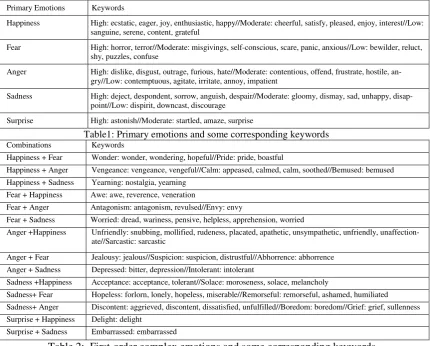
Tables 1 and 2 show some keywords in Turn-er’s taxonomy, and the symbol “//” is to separate different emotion types. Table 1 lists the five most common English keywords and their cor-responding primary emotions, and Table 2 lists the English keywords and their corresponding complex emotions. In Table 2, several emotion keywords, which express similar emotion meaning, are grouped into an emotion type. For example, the emotion keywords “awe, reverence, veneration” are grouped into emotion type “awe.” For a complex emotion, the order of pri-mary emotions indicates the importance of those primary emotions for that complex emotion. For examples, “envy” is “fear + anger,” which
con-tains a greater amount of “fear” with a lesser amount of “anger” whereas “awe” is “fear + happiness,” which contains a greater amount of “fear” with a lesser amount of “happiness.”
For English emotion keywords, as Turner’s taxonomy missed some common emotion key-words, we add the emotion keywords from Plutchik's taxonomy. Besides, unlike Chinese, English words have morphological variations, for example, the emotion keyword “pride” can occur in text with the various formats: “pride,” “prides,” “prided,” “proud,” “proudly.” As shown in Tables 1 and 2, there are 188 English lemmas in our taxonomy. In total, there are 720 emotion keywords if morphology is taken into account.
Since Turner’s emotion taxonomy is cogni-tive-based, it is versatile for different languages although there is no one-to-one mapping. We also explore Chinese emotion taxonomy in our previous work (Chen at el., 2009). We first select emotion keywords from the cognitive-based feel-ing words listed in Xu and Tao (2003), and then map those emotion keywords to Turner’s taxon-omy with adaptation for some cases. Lastly, some polysemous emotion keywords are re-moved to reduce ambiguity, and 226 Chinese emotion keywords remain.
Moreover, Turner’s taxonomy is a compara-tively flexible structure, and more extensions can be done for different applications. For example, for a complex emotion, not only its primary emo-tions are listed, but also the intensity of the pri-mary emotions can be given. For instance, three emotion types, which belong to “anger + fear,” are extended as follows:
Jealousy: Anger (Moderate) + Fear (Moderate)
Suspicion: Anger (Low) + Fear (Low)
Abhorrence: Anger (High) + Fear (Low)
Finally, we should admit that the emotion tax-onomy is still an on-going research topic and needs further exploration, such as the position of a given emotion keyword in the emotion taxon-omy, whether and how to group similar emotion keywords, and how to decompose a complex emotion into primary emotions.
3.2 The emotion annotation scheme
Primary Emotions Keywords
Happiness High: ecstatic, eager, joy, enthusiastic, happy//Moderate: cheerful, satisfy, pleased, enjoy, interest//Low: sanguine, serene, content, grateful
Fear High: horror, terror//Moderate: misgivings, self-conscious, scare, panic, anxious//Low: bewilder, reluct, shy, puzzles, confuse
Anger High: dislike, disgust, outrage, furious, hate//Moderate: contentious, offend, frustrate, hostile, an-gry//Low: contemptuous, agitate, irritate, annoy, impatient
Sadness High: deject, despondent, sorrow, anguish, despair//Moderate: gloomy, dismay, sad, unhappy, disap-point//Low: dispirit, downcast, discourage
Surprise High: astonish//Moderate: startled, amaze, surprise
Table1: Primary emotions and some corresponding keywords
Combinations Keywords
Happiness + Fear Wonder: wonder, wondering, hopeful//Pride: pride, boastful
Happiness + Anger Vengeance: vengeance, vengeful//Calm: appeased, calmed, calm, soothed//Bemused: bemused Happiness + Sadness Yearning: nostalgia, yearning
Fear + Happiness Awe: awe, reverence, veneration
Fear + Anger Antagonism: antagonism, revulsed//Envy: envy
Fear + Sadness Worried: dread, wariness, pensive, helpless, apprehension, worried
Anger +Happiness Unfriendly: snubbing, mollified, rudeness, placated, apathetic, unsympathetic, unfriendly, unaffection-ate//Sarcastic: sarcastic
Anger + Fear Jealousy: jealous//Suspicion: suspicion, distrustful//Abhorrence: abhorrence Anger + Sadness Depressed: bitter, depression//Intolerant: intolerant
Sadness +Happiness Acceptance: acceptance, tolerant//Solace: moroseness, solace, melancholy
Sadness+ Fear Hopeless: forlorn, lonely, hopeless, miserable//Remorseful: remorseful, ashamed, humiliated Sadness+ Anger Discontent: aggrieved, discontent, dissatisfied, unfulfilled//Boredom: boredom//Grief: grief, sullenness Surprise + Happiness Delight: delight
[image:4.595.91.522.71.417.2]Surprise + Sadness Embarrassed: embarrassed
Table 2: First-order complex emotions and some corresponding keywords
beyond a sentence, and encodes emotion infor-mation for a sentence. This annotation scheme can be compatible for any TEI-based annotated corpora as long as sentences are clearly marked.
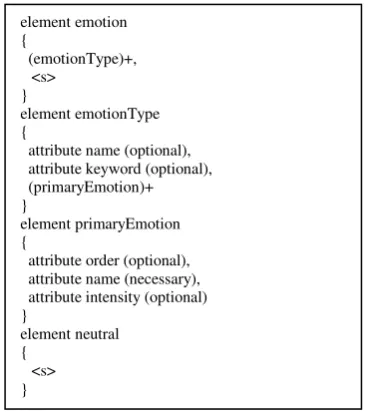
The emotion-related elements (tags) in our annotation scheme are described as follows. For easy demonstration, our elements are defined with the format of British National Corpus (BNC) annotation scheme1, and our examples are also based on BNC annotated text. Figure 1 gives the definition of each element, and Figure 2 shows several examples using our annotation scheme. Note that <s> element is a tag for a sen-tence-like division of a text, and its attribute “n” gives the sentence index. In Figure 2, Sentence 1, which expresses emotions by emotion keywords, contains two types of emotions: “surprise” (pri-mary emotion) and “jealousy” (complex emo-tion); Sentence 2 is a neutral sentence.
<emotion> element
It is used only when the sentence expresses emotions. It contains a list of <emotionType> elements and a <s> element. As a sentence may
1
http://www.natcorp.ox.ac.uk/XMLedition/U RG/
express several emotions, an <emotion> element can contain several <emotionType> elements, and each <emotionType> element describes an emotion occurring in that sentence separately. <neutral> element
It is used only when the sentence does not contain any emotion expression. It contains only a <s> element.
<emotionType> element
<primaryEmtion> element
It describes the property of a primary emotion involved in the emotion type. There are three attributes: “order,” “name,” and “intensity.” “Order” gives the weight of this primary emo-tion in the emoemo-tion type, and the weight value decreases with the ascending “order” value. “Name” and “intensity” provide the name and intensity of a primary emotion. To encode the information in our emotion taxonomy, the value of “order” is {1,2,3,4,5}, the value of “name” is {“happiness,” “sadness,” “anger,” “fear”, “sur-prise” }, and the value of “intensity” is {“high”, “moderate”, “low”.}
The <primaryEmotion> element seems to be redundant because its encoded information can be obtained from the given emotion taxonomy if the name of the emotion type is available, but the presence of this element can make our anno-tation scheme more robust. Sometimes emotion
is so complicated (especially for those emotion expressions without any explicit emotion key-word) that an annotator may not be able to find an exact emotion type to match this emotion, or to list all involved primary emotions. For those subtle cases, emotion annotation can be simpli-fied to list the involved primary emotions as many as possible through <primaryEmotion> elements. For example, in Sentence 3 in Figure 2, although there is no emotion keyword occurring, the word “hurt” indicates the presence of an emotion, which at least involves “sadness.” However, because it is hard to explicitly list oth-er primary emotions, thoth-erefore, we give only the annotation of “sadness.”
Our annotation scheme has the versatility to provide emotion data for different applications. For example, if textual information input anno-tated with our scheme is provided for the Japa-nese robot Saya (Hashimoto et al, 2006) to con-trol her facial emotion expression, a simple mapping from our 24 emotion types can be done automatically to Saya’s six emotion types, i.e. surprise, fear, disgust, anger, happiness, and sadness. As four of her emotion types are also unique primary emotions, using information en-coded in <emotionType> element and <pri-maryEmotion> element will ensure unique many-to-one mapping and the correct robotic expressions. A trickier case involves her “anger” and “disgust’ emotions. The emotion type “an-ger” in our taxonomy includes emotion words “anger” and “disgust”. However, with the “key-word” information provided in <emotionType> element, a small subset of “anger” emotion in our taxonomy can be mapped to “disgust” in Saya’s system. For example, we could map keywords “dislike, disgust, hate” to “disgust”, element emotion
{
(emotionType)+, <s>
}
element emotionType {
attribute name (optional), attribute keyword (optional), (primaryEmotion)+ }
element primaryEmotion {
attribute order (optional), attribute name (necessary), attribute intensity (optional) }
element neutral {
[image:5.595.91.517.73.262.2]<s> }
Figure 1: The definition of emotion-related elements <emotion>
<emotionType name = "surprise" keyword ="surprised">
<primaryEmotion order = "1" name = "surprise" intensity = "moderate"></primaryEmotion> </emotionType>
<emotionType name = "jealousy" keyword = “jealousy”>
<primaryEmotion order = "1" name = "anger" intensity = "moderate"></primaryEmotion> <primaryEmotion order = "2" name = "fear" intensity = "moderate"></primaryEmotion> </emotionType>
<s n = "1"> Hari was surprised at the rush of pure jealousy that swept over her at the mention of Emily Grenfell .</s> </emotion>
<neutral>
<s n = "2"> By law no attempts may be made to hasten death or prolong the life of the sufferer . </s> </neutral>
<emotion> <emotionType>
<primaryEmotion name = "sadness"></primaryEmotion> </emotionType>
[image:5.595.78.265.282.491.2]<s n = "3">He looked hurt when she did n't join him , his emotions transparent as a child 's . </s> </emotion>
and all the remaining ones, such as “outrage, furious,” to “anger.”
4 Emotion-driven corpus creation
Similar to most corpora, our corpus creation is designed to satisfy the requirements of real emo-tion computing. Emoemo-tions can be expressed with or without emotion vocabulary in the text. It seems to be intuitive that emotion computing for a context with emotion keywords can be satis-factory when the collection of emotion vocabu-lary is comprehensive, such as “joyful” indicates the presence of “happiness” emotion. However, this intuitive approach cannot work well because of the ambiguity of some emotion keywords and the emotion context shift as the sentiment shift (Polanyi and Zaenen, 2004). Moreover, the de-tection of emotions in a context without emotion keywords is very challenging. To deal with these problems, we build the emotion corpus, which is motivated by the NSM theory.
According to the NSM theory, an emotion is provoked by a stimulus. This indicates one pos-sible way to detect emotions in text, i.e. the de-tection of emotional stimulus, which is often provided in the text. In other words, emotion corpus is a collection of emotion stimuli. Since emotion is subjective, the stimulus-based ap-proach works only when its context is provided. For example, the stimulus – “build a gym for this community” – may cause different emotions, such as “surprise”, “happy” and so on, depend-ing on its context. We also notice that the text containing an emotion keyword may contain emotional stimulus and its context. Thus, a natu-ral corpus creation approach comes out.
In our system, a pattern-based approach is used to collect the emotion corpus, which is sim-ilar to the one used in Tokuhisa et al. (2008), but we do not limit to event-driven emotions (Kozareva et al., 2008), and adjust our rules to improve the quality of emotion annotation. There are five steps in our emotion sentence an-notation as given below, and Steps (2) and (3) are to improve the annotation quality.
1) Extract emotion sentences: sentences con-taining emotion keywords are extracted by keyword matching.
2) Delete ambiguous structures: some ambigu-ous sentences, which contain structures such as negation and modal, are filtered out. 3) Delete ambiguous emotion keywords: if an
emotion keyword is very ambiguous, all
sen-tences containing this ambiguous emotion keyword are filtered out.
4) Give emotion tags: each remaining sentence is marked with its emotion tag according to the emotion type which the focus emotion word belongs to (refer to Tables 1 and 2.)
5) Ignore the focus emotion keywords: for emotion computing, the emotion word is re-moved from each sentence.
Polanyi and Zaenen (2004) addressed the is-sue of polarity-based sentiment context shift, and the similar phenomenon also exists in emo-tion expressions. In our corpus creaemo-tion, two kinds of contextual structures are handled with: the negation structure and the modal structure. In both English and Chinese, a negated emotion expression can be interpreted as one of the three possible meanings (as shown in Figure 3): oppo-site to the target emotion (S1), deny the exis-tence of the target emotion (S2), or confirm the existence of the target emotion (S3). The modal structure often indicates that the emotion expres-sion is based on the counter-factual assumption, hence the emotion does not exist at all (S4 and S5 in Figure 3). Although Chinese and English have different interpretations about the modal structure, for emotion analysis, those sentences often do not express an emotion. Therefore, to ensure the quality of the emotion corpus, all sen-tences containing a negation structure or a modal structure, which are detected by some rules plus a list of keywords (negation polarity words for the negation structure, and modal words for the modal structure), are removed.
To overcome the high ambiguity of some emotion keywords, after Step (2), for each emo-tion keyword, five sentences are randomly se-lected and annotated by two annotators. If the accuracy of five sentences is lower than 40%, this emotion keyword is removed from our emo-tion taxonomy. Finally, 191 Chinese keywords and 645 English keywords are remained.
Tokuhisa et al. found that a big challenge for emotion computing, especially for emotion de-tection, is to collect neutral sentences. Since neutral sentences are unmarked and hard to de-tect, we develop a naïve yet effective algorithm
S1 (Neg_Happiness): I am not happy about that.
S2 (Netural): Though the palazzo is our family home, my father had never been very happy there. S3 (Pos_Happiness): I 've never been so happy.
S4 (Netural): I can die happy if you will look after them when I have gone.
S5 (Netural): Then you could move over there and we'd all be happy.
to create a neutral corpus. A sentence is consid-ered as neutral only when the sentence itself and its context (i.e. the previous sentence and the following sentence) do not contain any of the given emotion keywords.
We run our emotion sentence extraction and neutral sentence extraction on three corpora: the Sinica Corpus (Chinese), the Chinese Gigaword Corpus, and the British National Corpus (BNC, English), and create three emotion corpora and three neutral corpora separately. The Sinica Corpus is a balanced Chinese corpus, which in-cludes documents in 15 kinds of genres; The Chinese Gigaword Corpus is a huge collection of news reports; The BNC is also a balanced corpus, which collects documents from different domains.
To estimate the accuracy of our emotion sen-tence extraction, we randomly select about 1000 sentences from the three emotion corpora, and have two annotators to check it. Table 3 lists the accuracy of those emotions sentences (emotion corpus.) To test how good this straightforward neutral sentence extraction strategy is, about 1000 sentences are randomly selected from each of the three neutral corpora and are checked by two annotators. Table 3 lists the accuracy of those neutral sentences (neutral corpus.)
Emotion corpus Neutral corpus
Gigaword 82.17 98.61
Sinica 77.56 98.39
BNC 69.36 99.50
Table 3: The accuracy of the emotion-driven corpora From Table 3, the high accuracy of neutral corpus proves that our approach is effective in extracting neutral sentences from the document-based corpus which contains contextual informa-tion. Although the accuracy of emotion corpus is lower, it is still much higher than the one re-ported by Kozareva et al. (2008), i.e. 49.4. The accuracy is significantly increased by deleting ambiguous emotion keywords in Step (3). For the 2,474 randomly selected Chinese sentences, the overall accuracy of the remaining 1,751 sen-tence is increased by about 14% after Step (3). For the 803 randomly selected English sentences, the accuracy of the remaining 473 sentence is increased about 21% after Step (3). Whether or how the ambiguous emotion keywords in Step 3 are removed is a tradeoff between the coverage and the accuracy of the emotion corpus.
From Table 3, we also find that the accuracy of English emotion corpus is much lower than Chinese emotion corpus, which indicates
Eng-lish emotion sentences expressed by emotion keywords are more ambiguous than that of Chi-nese. Moreover, during our emotion corpus building, 20.2% of Sinica sentences and 22.4% of Gigaword sentences are removed in Step (2) and (3), on the contrary, 41.2% of BNC sen-tences are deleted. Although it is more difficult to develop the rules in Step (2) and (3) for Chi-nese than for English, it also confirms the higher ambiguity of emotion expressions in English due to the ambiguity of emotion keyword. Finally, because of the comparatively-high percentage of the sentences removed in Step (2) and (3), more exploration about those sentences is needed, such as the emotion distribution, the expression patterns and so on, and how to re-incorporate them into the emotion corpus without hurting the whole quality is also our future work.
We also explore emotions through the sen-tences (no-emotion-keyword sensen-tences) that do not contain any given emotion keyword, because our approach extracts only partial neutral sen-tences and partial emotion sensen-tences in reality. For each corpus, about 1000 no-emotion-keyword sentences are randomly selected and checked by two annotators. It is surprising that only about 1% of those sentences express emo-tions. This indicates that it is important for real emotion computing, which mainly works on formal written text, to deal with the emotion ex-pressions which contain emotion keywords and however are ambiguous, such as the sentences deleted in Steps (2) and (3). More exploration is needed for the emotion and neutral sentence dis-tribution on other kinds of written text, such as blogs, and on spoken text.
The unsupervised corpus creation approach can easily be adapted for different languages and different emotion applications, provided that the keyword collection and patterns in Step (2) and (3) need some changes. Moreover, another big advantage of our approach is that it can avoid the controversy during emotion annotation. Emotion is subjective, and therefore disagree-ment for emotion types often arises if the emo-tion is not expressed through an explicit emoemo-tion keyword.
combin-ing with its correspondcombin-ing emotion sentences to form a complete emotion-driven corpus.
5 Emotion computing system
In this paper, we present some pilot work to prove that our emotion-driven corpus is useful for emotion computing. With the inclusion of neutral sentences, emotion detection and classi-fication is simplified into a general classiclassi-fication problem, and a supervised machine learning method can be directly applied if enough anno-tated data are obtained. Here, we choose the MaxEnt learning in Mallet as a classifier.
Both the Sinica Corpus and the Chinese Gi-gaword Corpus are segmented, and POS-tagged. This allows us to implement the bag-of-words approach in the focus sentences in both Chinese and English. However, emotions are mostly hu-man attitudes or expectations arising from situa-tions, where situations are often expressed in more than a single word. Such kind of situations tends to be more easily extracted by word bi-grams (2-gram word) than by word unigram (gram word.) To take this into account, besides 1-gram words, we also extract word bi-1-grams from the focus sentences.
There are too many emotion types in our cor-pus, which can cause data sparse; therefore, we choose the most frequent emotions to do explo-ration. Besides the five primary emotions, for Chinese, we select another nine complex emo-tions, and for English, we select another four complex emotions. Other emotion types are re-named as “Other Emotions.”
Since Chinese emotion-driven corpus is much larger than the English one, to fairly compare the performance, we reduce the size of Chinese cor-pus in our experiments. Then, for each corcor-pus, we reserve 80% as the training data, 10% as the development data, and 10% as the test data (there are two sets of test data as follows.) In the evaluation, for each emotion sentence, if our system detects one of its emotion tags, we con-sider this sentence is correctly tagged.
Test data set 1 (TDS 1): contains about 10%
of the sentences from the complete emotion-driven corpus, and emotion tags are automati-cally given during the corpus creation.
Test data set 2 (TDS 2): contains the
sen-tences used in Table 3, which is checked by two annotators. If more than one emotion tags co-exist in a sentence, all of them are chosen to la-bel the sentence. If there exists an emotion that
does not belong to any of the emotion types, it is labeled as “Other Emotions.”
Table 4 shows the performance (accuracy) of our system for Test data set 1 and 2 for both Chinese and English. We notice that our corpus creation approach is effective for emotion com-puting. As we expect, the 2-gram words can par-tially catch the emotion stimulus, and improves the performances. However, the overall per-formance is still very low, which indicates that emotion computing is a difficult task. From the error analysis, it is surprised that for Chinese, the mislabeling of emotion sentences as neutral sentences (“emotion” vs. “neutral”) is a common error, and whereas, for English, two kinds of errors: “emotion” vs. “neutral” and “focus emo-tions” vs. “Other emoemo-tions” (the mislabeling of a sentence with a focus emotion as “Other emo-tions,”) occupy at least 50%. The error distribu-tion confirms the importance of emodistribu-tion detec-tion during emodetec-tion computing. The high fre-quency of the error of “focus emotions” vs. “Other Emotions” in English may be because there are fewer focus emotion types for English.
1-gram words {1,2}-gram words
Chinese TDS 1 53.92 58.75
English TDS 1 44.02 48.20
Chinese TDS 2 37.18 39.95
English TDS 2 33.24 36.31
Table 4: The performances of our system for the test data
6 Conclusion
Emotion, no matter its annotation or computing, is still a new and difficult topic. In this paper, we apply emotion theories to design a cognitive-based emotion annotation scheme, which are robust and versatile so that it can encode differ-ent levels of emotion information for differdiffer-ent emotion computing. Moreover, motivated from NSM, we develop an unsupervised approach to create a large and comparatively high-quality corpus for emotion computing, which is proven in our pilot experiments to be useful. Moreover, this approach makes emotion computing for dif-ferent applications possible through a little mod-ification.
References
W. B. Cannon. 1927. The James-Lange theory of emotions: A Critical Examination and an Alterna-tive Theory. American Journal of Psychology, 39, 106-124.
Y. Chen, S. Y. M. Lee and C. R. Huang, 2009. Con-struction of Chinese Emotion Corpus with an Un-supervised Approach. In CNCCL-2009, 2009. (in Chinese)
T. Hashimoto, S. Hiramatsu, T. Tsuji and H. Kobaya-shi. 2006. Development of the Face Robot SAYA for Rich Facial Expressions. SICE-ICASE Inter-national Joint Conference, Busan,Korea.
J. Hobbs and A. Gordon. 2008. The Deep Lexical Semantics of Emotions. Workshop on Sentiment Analysis: Emotion, Metaphor, Ontology and Terminology (EMOT-08), 6th International con-ference on Language Resources and Evaluation (LREC-08), Marrakech, Morocco, May 27, 2008. P. Livia, A. Zaenen. 2004. Contextual Valence Shift-ers. In Shanahan, J. G., Y. Qu, and J. Wiebe (Eds.), Computing Attitude and Affect in Text: Theory and Applications, pp. 1-10.
Z. Kozareva, Borja Navarro, Sonia Vazquez, and Andres Nibtoyo. 2007. UA-ZBSA: A Headline Emotion Classification through Web Information. In Proceedings of the 4th International Workshop on Semantic Evaluations.
Y. Y. Mathieu. 2005. Annotations of Emotions and Feelings in Texts. In Conference on Affective Computing and intelligent Interaction (ACII2005), Beijing, Springer Lecture Notes in Computer Sci-ence, pp. 350-357.
R. Mihalcefa, and Hugo Liu. 2006. A Corpus-based Approach to Finding Happiness. In Proceedings of AAAI.
R. Plutchik. 1991. The Emotions. University Press of America, Inc.
R. Plutchik. 1980. Emotions: A psychoevolutionary synthesis. New York:Harper & Row.
M. Schröder, H. Pirker and M. Lamolle. 2006. First suggestions for an emotion annotation and repre-sentation language. In L. Deviller et al. (Ed.), Proceedings of LREC'06 Workshop on Corpora for Research on Emotion and Affect (pp. 88-92). Genoa, Italy.
J. G. Shanahan, Y. Qu and J. Wiebe. 2006. Comput-ing attitude and affect in text: theory and applica-tions, Springer.
R. Tokuhisa, K. Inui, and Y. Matsumoto (Eds.) 2008. Emotion Classification Using Massive Examples Extracted from the Web. COLING.
J. H. Turner. 2007. Human Emotions: A sociological theory. New York : Routledge, 2007.
J. H. Turner. 2000. On the origins of human emotions: A sociological inquiry into the evolution of hu-man affect. Stanford, CA: Stanford University Press.
J. H. Turner. 1996. The Evolution of Emotions in Humans: A Darwinian–Durkheimian Analysis. Journal for the theory of social behaviour26:1-34 L. Xu, H. Lin, J. ZHAO.2008. Construction and
Analysis of Emotional Corpus. JOURNAL OF
CHINESE INFORMA TION PROCESSIN.
X. Y. Xu, and J. H. Tao. 2003. The study of affective categorization in Chinese. The 1st Chinese Con-ference on Affective Computing and Intelligent Interaction. Beijing, China.