Original Research Article
Cervical effacement, as an independent parameter versus modified
bishop score, for predicting the favorability of vaginal delivery in a
primigravida at 40 weeks gestation and beyond
Saniyah Khan Galzie*, Smitha B. Rao
INTRODUCTION
In the 1964, Dr Edward Bishop developed a pelvic scoring system using cervical dilatation, effacement, station, consistency, and position with a range from 0 to 13.1 Based on clinical experience, he concluded that
elective induction in multiparous women with
uncomplicated pregnancies at term was successful with a score of greater than 8. Bishop was the first to attempt to
quantify the physical examination of the cervix by the use of a numeric scoring system.1 Calder, later modified the
original bishop score, which is known as modified bishop score and is more commonly used. He replaced cervical effacement which was expressed as percentage in the original bishop score with cervical length in cms. The total test score is 12. 0-5 is unfavourable and 6-12 being favourable.2 The original Bishop score was created on an
empiric basis without modern statistical methods and the
ABSTRACT
Background: Dr. Edward Bishop developed the original bishop score. He concluded that elective induction in multiparous women was successful with a score > 8. Calder introduced the modified bishop score in which he replaced cervical effacement with cervical length in cms. Score of 6-12 is favourable. In this study, studied the cervical effacement/ length as an independent predictor of vaginal delivery in a primigravida.
Methods: A retrospective observational study was conducted from May 2018 to January 2019. Total participants were divided into two groups on the basis of spontaneous labor and induced labor. Both the groups were assessed individually and collectively in terms of cervical effacement/length and modified bishop score. Study primary outcome was vaginal delivery. The results were reflected in terms of sensitivity, specificity, PPV and NPV. These values were compared for cervical effacement/ length as well as modified bishop score and p value calculated. Also, association between modified bishop score and cervical effacement/length was established.
Results: Total number of participants included was n = 91. Those with modified bishop score > 6, 78.16% had vaginal delivery. This gave a sensitivity of 78.16%, specificity of 50%, PPV of 97.14%. Those with cervical effacement of >/=50% or cervical length of </= 2 cms, 78.82% had vaginal delivery. This gave a sensitivity of 78.82%, specificity of 55%, PPV of 95.71%. Thus, it had similar sensitivity, specificity, PPV to that of modified bishop score, and therefore has the same accuracy in predicting vaginal delivery. Also, 89.01% participants who had cervical effacement >/= 50% had modified bishop score >/= 6, reflecting the association between them.
Conclusions: Cervical effacement of >/= 50% or cervical length </= 2 cms yielded an equivalently high predictive ability similar to modified bishop score, for spontaneous as well as induced labor. Hence, cervical effacement can be taken as an independent parameter to assess the favorability of successful vaginal delivery in a primigravida.
Keywords: Bishop score, Cervical effacement, Labor, Primigravida, Vaginal delivery
Department of Obstetrics and Gynecology, Yenepoya Medical College, Manglore, Karnataka, India
Received: 09 March 2020
Accepted: 16 March 2020
*Correspondence:
Dr.Saniyah Khan Galzie,
E-mail: [email protected]
Copyright: © the author(s), publisher and licensee Medip Academy. This is an open-access article distributed under the terms of the Creative Commons Attribution Non-Commercial License, which permits unrestricted non-commercial use, distribution, and reproduction in any medium, provided the original work is properly cited.
five components are correlated, the question remains whether all components are necessary in predicting vaginal delivery. In case, some of the components are independently associated with successful induction, then the score can be reduced to contain only those components with equivalent ability to predict a successful induction. Of all the parameters of the score, the degree of cervical dilatation was considered most important in some studies, however these studies did not differentiate between primigravidas and multigravidas.2 In this study,
studied the cervical effacement/ length as an independent predictor of vaginal delivery in a primigravidas at full term gestation. Cervical effacement precedes cervical dilatation in a primigravida, and the descent of the presenting part helps in further cervical effacement. Thus, cervical effacement may be considered to be the single most important factor to predict vaginal delivery in early labor in case of a primigravida.
Hypothesis
Cervical effacement of 50% or more/cervical length of </= 2 cm or less; can be taken as a single parameter to predict vaginal delivery. Any cervical effacement less than 50%/ cervical length of >/= 2 cms should be subjected to various methods of cervical ripening, for a successful vaginal delivery.
METHODS
Relevant data in terms of antenatal, intranatal data, modified bishop score, method of induction, mode of delivery, duration of first stage of labor, induction delivery interval, was collected from the patient records
who were admitted in the labor room of department of obstetrics and gynecology at Yenepoya Medical College, after excluding the candidates as per exclusion criteria. Patients were selected as per inclusion criteria. A retrospective observational time-based descriptive study was conducted. Data was collected from the department of obstetrics and gynecology at Yenepoya Medical College from May 2018 to January 2019.
Inclusion criteria
• All primigravidas with singleton pregnancy
• Without pregnancy associated complications,
• Without any medical high-risk
• Gestational age >/= 40 weeks 0/7 days - 6/7 days
• Irrespective of their registration status (booked as well as un-booked cases) were included.
Exclusion criteria
• Malpresentation
• Multiple pregnancies
• Premature rupture of membranes (PROM)
• Oligohydramnios (AFI < 5)
• Any obstetrical complication
• Any surgical high risk.
[image:2.595.53.549.505.584.2]The total study participants were divided into two groups. Those who had spontaneous onset of labor and those who underwent induction of labor. Further, both the groups were assessed individually and in combination in terms of cervical effacement/ cervical length and modified bishop score.
Table 1: Modified bishop score: Calder score.
Cervical feature Score: 0 1 2 3
Cervical dilatation < 1cm 1-2 cm 2-4 cm > 4 cm
Cervical length 4 cm 2-4 cm 1- 2 cm < 1 cm
Station of presenting part -3 cm -2 cm -1/0 cm +1/+2 cm
Consistency of cervix Firm Average Soft
Position of cervix posterior Mid position/ anterior
Ian Donald’s practical obstetric problems, 7th edition, chapter 26, page 498, table 26.1.
The modes of induction were noted. With modified bishop score of less than 6 and cervical effacement of less than 50%/cervical length more than 2 cm, cervical priming and induction was done using various methods such as prostaglandin E2 gel, up to 3 doses, tab misoprostol 25 microgram per vagina or 50 microgram per oral, Foleys catheter alone or followed by prostaglandin E2 gel, or oxytocin, etc. In participants, whom cervical priming was done with prostaglandins i.e. Dinoprostone gel/ misoprostol were reassessed after 6 hours and cervical changes recorded. Those who underwent Foleys induction were reassessed after 12 hours or when Foleys was expelled. Those with modified
primary outcome was vaginal delivery as this is what the cervical scoring is supposed to predict successfully. The results were reflected in terms of -
• Sensitivity = true positive/(true positive + false negative)
• Specificity = true negative/(true negative + false positive)
• Positive predictive value = true positive/(true
positive + false positive)
• Negative predictive value = true negative/(false
negative + true negative).
These values were compared for cervical effacement/ cervical length as well as modified bishop score and p value was calculated. Also, co relation between modified bishop score and cervical effacement was established.
RESULTS
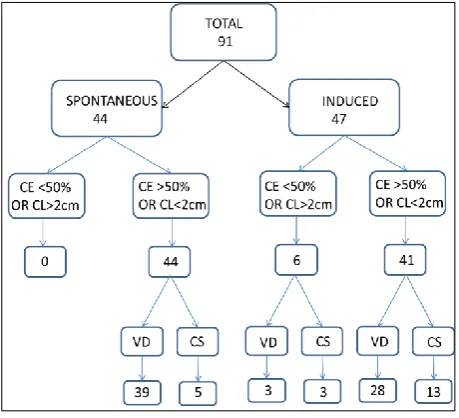
[image:3.595.53.283.411.620.2]Total study participants were 91 as per data collected from May 2018 to January 2019, in the age group 18 to 25 years, with gestational age 40 (0/7) to 40 (6/7) weeks. Among these 44 had spontaneous onset of labor and 47 underwent induction of labor. The results were evaluated in both the induction of labor group and spontaneous onset of labor group individually and collectively, in terms of cervical effacement and modified bishop score.
Figure 1: Results in terms of cervical effacement/cervical length.
In terms of cervical effacement (CE)/cervical length (CL)
Figure 1 depicts the results in terms of cervical effacement/cervical length in the two groups, i.e. the spontaneous onset of labor group and the induced labor group.
Spontaneous onset of labor group (44)
Cervical effacement < 50% or cervical length > 2 cm
None of the participants in the spontaneous group had cervical effacement of < 50% or cervical length of > 2 cm.
Table 2: Mode of delivery in case of cervical effacement > 50% or cervical length </= 2 cm.
Mode of delivery Number Percentage
Vaginal delivery 39 88.63%
Caesarean section 5 11.36%
Total 44 100%
Table 2 depicts the mode of delivery in case of cervical effacement > 50% or cervical length </= 2 cm. Out of the 39 vaginal deliveries, 4 were instrumental deliveries.
Table 3: Induction of labor group.
Method of induction
Foleys 21
Prostaglandin E2 gel 1 dose 1
Prostaglandin E2 gel, 2/3 doses 4
Foleys followed by prostaglandin E2gel 7
oxytocin 3
Tab. Misoprostol 50 microgram per oral 1
Tab. Misoprostol 25 microgram per
vagina 1
Foleys followed by oxytocin 9
Also, out of the 44 participants who had spontaneous onset of labor, all had cervical effacement > 50%, among them 88.63% had vaginal delivery and 11.36% underwent caesarean section.
Table 3 depicts the various methods of induction of labor, which the participants had undergone and their number.
Table 4: Mode of delivery in case of cervical effacement </=50% or cervical length > 2 cm.
Mode of delivery Number Percentage
Vaginal delivery 3 50%
Caesarean section 3 50%
Total 6 100%
Table 5: Mode of delivery in case of cervical effacement > 50% or cervical length </= 2 cm.
Mode of delivery Number Percentage
Vaginal delivery 28 68.29%
Caesarean section 13 31.71%
Table 4 depicts the mode of delivery in case of cervical effacement <50% or cervical length > 2 cm in the induced labor group. 6 participants had cervical effacement of < 50%, out of which 3 had vaginal delivery and 3 underwent caesarean section
Table 5 depicts mode of delivery in case of cervical effacement > 50% or cervical length </= 2 cm. 68.29% had vaginal delivery, and 31.71% had caesarean section. Out of the 28 vaginal deliveries, 2 were instrumental deliveries.
Spontaneous and induced group combined
Table 6 depicts mode of delivery in case of cervical effacement <50% or cervical length >/= 2 cm in both, induced labor group and spontaneous onset of labor group taken collectively. This includes only 6 participants. 50% had vaginal delivery and 50% underwent caesarean section.
Table 6: Mode of delivery in case of cervical effacement < 50% or cervical length > 2 cm.
Mode of delivery Number Percentage
Vaginal delivery 3 50%
Caesarean section 3 50%
Total 6 100%
Table 7 depicts mode of delivery in case of cervical effacement > 50% or cervical length </= 2 cm in both, induced labor group and spontaneous onset of labor group taken collectively. 78.82% had vaginal delivery and 21.18% underwent caesarean section.
Table 7: Mode of delivery in case of cervical effacement > 50% or cervical length </= 2 cm.
Mode of delivery Number Percentage
Vaginal delivery 67 78.82%
Caesarean section 18 21.18%
Total 85 100%
This gave a sensitivity of 78.82%, specificity of 55%, positive predictive value of 95.71% and negative predictive value of 14.29%.
In terms of modified bishop score (MBS)
Figure 2 depicts flow chart showing results in terms of modified bishop score in the two groups, i.e. the spontaneous onset of labor group and the induced labor group.
Spontaneous group (44)
Table 8 depicts the mode of delivery in case of modified Bishop score < 6 in the spontaneous onset of labor group.
4 participants had bishop score of < 6, out of them 2 had vaginal delivery and 2 underwent caesarean section.
Figure 2: Results in terms of modified Bishop score.
Table 8: Mode of delivery in case of modified Bishop score < 6.
Mode of delivery Number Percentage
Vaginal delivery 2 50%
Caesarean section 2 50%
Total 4 100%
Table 9 depicts the mode of delivery in case of modified Bishop score > 6 in the group with spontaneous onset of labor. Vaginal delivery occurred in 92.50% and caesarean section was performed in 7.50%. Out of the 37 vaginal deliveries, 4 were instrumental deliveries (10.81%).
Table 9: Mode of delivery in case of modified Bishop score > 6.
Mode of delivery Number Percentage
Vaginal delivery 37 92.50%
Caesarean section 3 7.50%
Total 40 100%
Induction of labor group
Table 10 depicts the mode of delivery in case of modified Bishop score < 6 in the induced labor group, none of the participants had bishop score of < 6.
Table 10: Mode of delivery in case of modified Bishop score <6.
Mode of delivery Number Percentage
Vaginal delivery 0 0%
Caesarean section 0 0%
Table 11 depicts the mode of delivery in case of modified Bishop score >6 in the induced labor group. 65.95% had vaginal delivery, and 34.05% underwent caesarean section. Out of the total 31 vaginal deliveries, 2 were instrumental deliveries (6.45%).
Table 11: Mode of delivery in case of modified Bishop score > 6.
Mode of delivery Number Percentage
Vaginal delivery 31 65.95%
Caesarean section 16 34.05%
Total 47 100%
Spontaneous and induced group combined
Table 12 depicts the mode of delivery in case of modified Bishop score < 6 in both, induced labor group and spontaneous onset of labor group taken collectively. A total of 4 participants were in this group. 50% underwent vaginal delivery, whereas 50% underwent caesarean section.
Table 12: Mode of delivery in case of modified Bishop score < 6.
Mode of delivery Number Percentage
Vaginal delivery 2 50%
Caesarean section 2 50%
Total 4 100%
Table 13: Mode of delivery in case of modified Bishop score > 6.
Mode of delivery Number Percentage
Vaginal delivery 68 78.16%
Caesarean section 19 21.84%
Total 87 100%
Table 13 depicts the mode of delivery in case of modified Bishop score > 6 in both, induced labor group and spontaneous onset of labor group taken collectively. Out of the 87 participants, 78.16% had vaginal delivery and 21.84% underwent caesarean section. Accordingly, this gave a sensitivity of 78.16%, specificity of 50%, positive predictive value of 97.14% and negative predictive value of 9.52%.
Comparison between cervical effacement/cervical length and modified bishop score
Table 14 depicts comparison between cervical
effacement/cervical length > 50% or cervical length < 2 cm and modified bishop score in terms of sensitivity, specificity, positive predictive value and negative predictive value. On comparison, cervical effacement of 50% or more/cervical length < 2 cms had similar sensitivity, specificity, positive predictive value and negative predictive value as compared to that of modified bishop score, and thus has almost the same accuracy in predicting vaginal delivery as that of modified bishop score.
Table 14: Comparison between cervical effacement/cervical length and modified Bishop score.
Cervical assessment Sensitivity Specificity Positive
predictive value
Negative predictive value
Cervical effacement > 50% or cervical length </= 2
cms 78.82% 55% 95.71% 14.29%
Mod. Bishop score 78.16% 50% 97.14% 9.52%
Figure 3: Results of co relation between cervical effacement/cervical length with modified
Bishop score.
Co-relation between cervical effacement/cervical length with modified bishop score
Figure 3 depicts flow chart showing results of co relation between cervical effacement/ cervical length with modified bishop score in both, the groups, i.e. the spontaneous onset of labor group and the induced labor group.
Table 15: Association between cervical effacement/ length and modified bishop score in both the groups.
Mod. Bishop score < 6 Percentage Mod. Bishop score > 6 Percentage
Cervical effacement < 50%/ > 2 cms 0 0% 6 6.59%
Cervical effacement > 50%/ < /= 2 cms 4 4.40% 81 89.01%
Table 16: Duration of first stage.
Onset of labor N Mean SD Median Man Whitney
test p value
IQR
Lower Upper
Onset of labor Spontaneous 36 5.93 3.52 4.65 0.358 3.59 7.43
Stage of labor Induced labor 31 6.47 3.46 6.00 Ns 4.15 8.00
Table 17: Induction delivery interval.
Induction delivery interval N Mean SD Median Lower IQR Upper IQR
31 16.74 5.77 15.39 12.37 21.23
Table 16 shows the duration of first stage in both the groups. The average duration of first stage in spontaneous onset of labor was 5.93 hours, the induced group 6.47 hours.
Table 17 shows the induction delivery interval in the induced labor group. The, mean induction to delivery interval was 16.74 hours. Keeping in view that those induced with Foleys catheter were reassessed after 12 hours and those with Dinoprostone gel/Misoprostol, were reassessed after 6 hours, the median induction to delivery interval was 15.39 hours.
DISCUSSION
In primigravidas at term gestation, with uncomplicated pregnancies who underwent induction of labor, cervical effacement predicted vaginal delivery similarly to the modified Bishop score. Even in women who presented with spontaneous labor at term, the predictivity of the degree of cervical effacement was similar to the modified Bishop score, suggesting that the degree of cervical effacement is equivalent to the modified bishop score in the setting that it was evaluated. In various studies aimed at modifying or evaluating the Bishop score different outcomes were used such as length of labor or achieving active labor, and many included multiparous women who are known to have more successful inductions.3-6 In this
study vaginal delivery was taken as the primary outcome as cervical assessment is supposed to be predictive of a successful vaginal delivery, and moulds the further course of labor and management. We were able to test the cervical effacement in induction and spontaneous labor, in term pregnancies, cervical effacement as an independent parameter performed similarly to the modified Bishop score in predicting vaginal delivery in all of these settings, which suggests that in primigravida cervical effacement may be taken as the only parameter to predict vaginal delivery. Study findings are similar to a prospective study done by Reis et al of 134 women who
underwent induction of labor at term, in which the cervical components of dilation and effacement were associated with vaginal delivery within 24 hours.7 Using
an “abbreviated” Bishop score including dilation and effacement only greater than 3, the predictive characteristics of vaginal delivery (excluding 23 women who had an emergency cesarean delivery for maternal or fetal indications) were positive predictive value 85.5%, negative predictive value 65.7%, which were similar to this study. In another study, 5610 nulliparous women with term gestation, between 37 to 41 weeks 6 days were analyzed and a simplified bishop score was developed by logistic regression method. The simplified bishop score consisted of cervical effacement, cervical dilatation and station of the presenting part. Compared with the original Bishop score (greater than 8), the simplified Bishop score (greater than 5) had a similar or better positive predictive value (87.7% compared with 87.0%), negative predictive value (31.3% compared with 29.8%), as the original bishop score.8 This result is similar to this study which
also had similar sensitivity, specificity, PPV or NPV to the modified bishop score. Another study, done by Laughon SK et al, of 40 nulliparous and 69 multiparous women also found that only dilation was associated with the length of latent phase of labor after labor induction.9
However, this study has taken only primigravidas into consideration, in whom cervical effacement precedes cervical dilatation to a much greater extent. The descent of the presenting part further helps in effacement in case of primigravidas. Reis et al, found that cervical dilation and effacement were the only components that were significantly associated with prediction of vaginal delivery within 24 hours so of induction.8 Segel et al,
investigated the relationship between fetal station on admission for labor in nulliparous patients and subsequent vaginal delivery.10 They found that lower
predictive value of simplified bishop score, including the 3 components i.e., cervical dilatation, effacement and station of the presenting part was evaluated.11 Of the
4,733 patients admitted in spontaneous labor during the study period, 2,469 (52.2%) women had a favorable admission SBS. Nulliparous and multiparous patients with a favorable SBS of > 5 were more likely to have a vaginal delivery [aOR 1.96, 95% confidence intervals (CI) 1.49-2.57; aOR 1.91, 95% CI 1.44-2.53]. Compared with dilation alone, the SBS in its entirety was associated with a higher likelihood of vaginal delivery in nulliparous. Although the addition of cervical dilatation, position or consistency, station of the presenting part may be associated with successful vaginal delivery, however the aim of this study was to identify the most important cervical parameter which could singly predict vaginal delivery in primigravidas.
CONCLUSION
To summarize, cervical effacement of >/= 50% or cervical length </= 2 cms yielded an equivalently high predictive ability similar to modified bishop score in case of primigravidas with term gestation. The degree of cervical effacement/ cervical length as an independent parameter performed similarly to the modified Bishop score in predicting vaginal delivery in term inductions as well as in spontaneous labor at term. Given that this study is a comprising singleton, uncomplicated term gestations in primigravidas, this study findings are generalizable. Accordingly, cervical effacement can be taken as an independent parameter to assess the favourability of successful vaginal delivery in a primigravida.
Funding: No funding sources Conflict of interest: None declared
Ethical approval: The study was approved by the Institutional Ethics Committee
REFERENCES
1. Posner GD, Jones GD, Black AY, Dy J. Oxorn foote
human labor and birth. 6th Edition. McGraw Hill Professional; 2013:20.
2. Misra R. Ian Donald's Practical Obstetric Problem, 7th Edition. BI Publications Pvt Ltd.; 2014.
3. Friedman EA, Niswander KR, Bayonet-Rivera NP,
Sachtleben MR. Prelabor status evaluation. II. Weighted score. Obstet Gynecol. 1967;29:539-44.
4. Burnett JE. Pre-induction scoring: an objective
approach to induction of labor. Obstet Gynecol. 1966;28:479-83.
5. Fields H. Induction of labor. Readiness for induction. Am J Obstet Gynecol. 1966;95:426-9.
6. Lange AP, Secher NJ, Westergaard JG, Skovgard I. Pre-labor evaluation of inducibility. Obstet Gynecol. 1982;60:137-47.
7. Reis FM, Gervasi MT, Florio P, Bracalente G,
Fadalti M, Severi FM, et al. Prediction of successful induction of labor at term: role of clinical history, digital examination, ultrasound assessment of the cervix, and fetal fibronectin assay. Am J Obstet Gynecol. 2003;189:1361-7.
8. Laughon SK, Zhang J, Troendle J, Sun L, Reddy UM. Using a simplified Bishop score to predict vaginal delivery. Obstet Gynecol. 2011;117(4):805. 9. Watson WJ, Stevens D, Welter S, Day D. Factors
predicting successful labor induction. Obstet
Gynecol. 1996;88:990-2.
10. Segel SY, Carreño CA, Weiner SJ, Bloom SL,
Spong CY, Varner MW, et al. Eunice Kennedy Shriver national institute of child health and human development maternal-fetal medicine units network. Relationship between fetal station and successful vaginal delivery in nulliparous women. Am J Perinatol. 2012;29(9):723-30.
11. Raghuraman N, Stout MJ, Young OM, Tuuli MG,
López JD, Macones GA, et al. Utility of the simplified Bishop score in spontaneous labor. Am J Perinatol. 2016;33(12):1176-81.