Volume 4, No. 4, March-April 2013
International Journal of Advanced Research in Computer Science
RESEARCH PAPER
Available Online at www.ijarcs.info
ISSN No. 0976-5697
Various Edge Detection Techniques: Survey, Implementation and Comparison
Krupa Shah*
Abstract: Edge Detection from colored images or gray scaled images belongs to the field of Digital Image Processing and Computer Vision. An edge defines the boundaries between or among regions or objects in an image therefore edge detection helps to identify objects from the given images and also assists in image segmentation. Many techniques are being used for detecting edge(s) from a given image for various kinds of applications like boundary detection, object recognition and many more. Prewitt, Sobel and Canny are the most popular and more frequently used techniques for the same. Each technique has its own advantages and limitations. This review paper consists of discussion of such techniques with their implementations and comparisons using certain parameters like lightning conditions, image acquisition methods, image quality, and presence of noise.
Keywords: Image Processing, Computer Vision, Edge. Gray-scaled image, Image Segmentation, Image acquisition
I. INTRODUCTION
Edges are significant local changes of intensity in an image. An edge is the boundary between an object and the background, and indicates the boundary between overlapping objects [1]. Edges form the outline of object(s). Edge detection is one of the most commonly used operations in image analysis, and there are probably more algorithms in the literature for enhancing and detecting edges [2]. Edge detection is a fundamental operation in digital image processing, machine learning and computer vision, particularly useful in the areas of object recognition [3] , image segmentation [4], and feature extraction [5].
The goals [6] of edge detection are to produce a line drawing of a scene from an image of that scene and important features can be extracted from the edges of an image (e.g., boundary, corners, lines, curves). These features are used by higher-level computer vision algorithms.
II. BASIC STEPS IN EDGE DETECTION TECHNIQUES
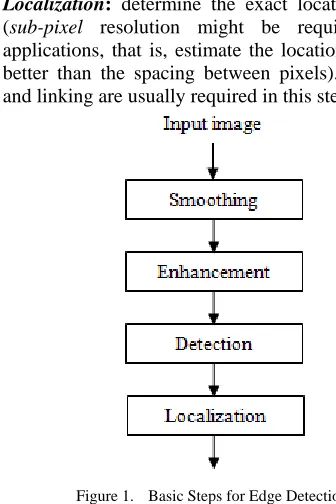
The basic steps [6] for edge detection are shown in figure.
A. The discussions of these steps are given as:
a. Smoothing: suppress as much noise as possible, without
destroying the true edges.
b. Enhancement: apply a filter to enhance the quality of the edges in the image (sharpening).
c. Detection: determine which edge pixels should be
discarded as noise and which should be retained (usually, thresholding provides the criterion used for detection).
d. Localization: determine the exact location of an edge
(sub-pixel resolution might be required for some applications, that is, estimate the location of an edge to better than the spacing between pixels). Edge thinning and linking are usually required in this step.
Figure 1. Basic Steps for Edge Detection
III. VARIOUS EDGE DETECTION TECHNIQUES
method. Each of these edge detection techniques does not give perfect or better results in all the situations like poor lightning conditions, average quality of an image, noisy images and many more. The another technique, augmented, adds some refined method or approach like fuzzy logic, and neural networks to work under the above listed situations and gives better results than classical techniques. In this paper, only classical techniques have been discussed and compared.
A. Sobel Edge Detector:
The Sobel operator [9], [11] performs a 2-D spatial gradient measurement on an image and so emphasizes regions of high spatial frequency that correspond to edges. Typically it is used to find the approximate absolute gradient magnitude at each point in an input grayscale image.
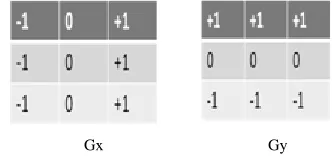
The sobel operator [9] consists of a pair of 3×3 convolution kernels as shown in Figure 2. These kernels are designed to respond towards the edges running vertically and horizontally relative to the pixel grid, one kernel for each of the two perpendicular orientations. The kernels can be applied separately to the input image, to generate separate measurements of the gradient component in each orientation which were named as Gx for horizontal gradient and Gy for vertical gradient. These values of Gx and Gy then combined together to find the absolute magnitude of the gradient at each point and the orientation of that gradient.
Gx Gy
Figure 2. Masks used by Sobel Operator
The gradient magnitude is given by:
|G|=sqrt(Gx2 + Gy2) (1) where sqrt is squared root of value.
Typically, an approximate magnitude is computed using: |G| = |Gx| + |Gy| (2)
Which is much faster to compute. The angle of orientation of the edge (relative to the pixel grid) giving rise to the spatial gradient is given by:
q = arctan(Gy /Gx) (3) The result of Sobel Edge detector is shown in figure 3. Figure 3(a) is an input image and its corresponding result is shown in figure 3(b) without consideration of threshold.
Figure 3. (a) An input image (b) Result obtained by Sobel Edge detector without threshold
B. Previtt Edge Detector:
Prewitt operator [9] is similar to the Sobel operator and is used for detecting vertical and horizontal edges in images by using following masks as shown in Figure 3.
Gx Gy
Figure 4. Masks for the Prewitt gradient edge detector
The result of Prewitt Edge detector is shown in figure 5. Figure 5(a) is an input image and its corresponding result is shown in figure 5(b) without consideration of threshold.
(a) (b)
Figure 5. (a) An input image (b) Result obtained by Prewitt Edge detector without threshold
C. Canny Edge Detector:
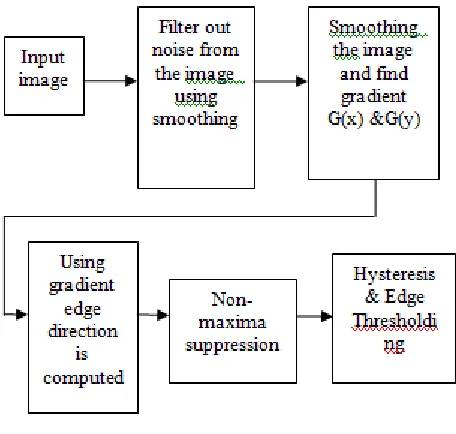
The Canny edge detector [10] is widely considered as the standard edge detection algorithm in image processing. Canny saw the edge detection problem as a signal processing optimization problem, so he developed an objective function to be optimized. The solution to this problem was a rather complex exponential function, but Canny found several ways to approximate and optimize the edge-searching problem [9-10]. The steps in the Canny edge detector are shown in figure 6 and the discussion of these steps is given as:
a. Smoothing is blurring of the image to remove noise. b. The process of finding gradients means the edges
should be marked where the gradients of the image has large magnitudes.
c. Only local maxima should be marked as edges in non- maximum suppression.
d. Double thresholding means Potential edges are determined by thresholding (two values for double thresholding).
Figure 6: Steps of Canny Edge Detection
The result of Canny Edge detector is shown in figure 7. Figure 7(a) is an input image and its corresponding result is shown in figure 7(b) without consideration of threshold.
Figure 7. (a) An input image (b) Result obtained by Canny Edge detector without threshold
IV. VISUAL COMPARISONS WITH MORE RESULTS
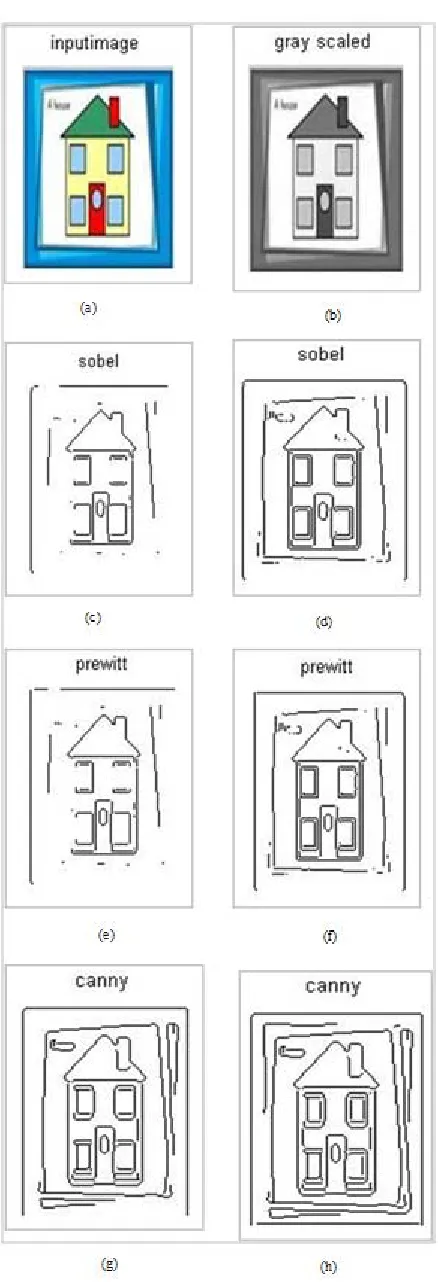
More experiments on various colored images using the classical methods, Sobel, Prewitt and Canny, have been carried out which are shown in figure 8, figure 9 and figure 10. In these, figure (a) is an colored input image and its corresponding gray scaled image is shown in figure (b). Figure (c), (e) and (g) give detected edges using Sobel, Prewitt and Canny edge detection method without threshold. If we consider threshold (=0.15) with the above mentioned edge detection methods, we obtain the results in figure (d), (f) and (h). From the visual appearances, it is seen that classical methods, Sobel, Prewitt and Canny, give better results than without threshold. Again it is an obvious that the results also rely on the value of threshold and the common value cannot be fixed for the all kinds of images. It is somewhat difficult to
choose value for threshold. Figure 8. (a) An input image (b) gray scaled input image (c) sobel edge detection (d) sobel edge detection with threshold (e) Prewitt edge detection (f)
Prewitt edge detection with threshold (g) Canny edge detection (h) Canny edge detection with threshold (Threshold = 0.15)
(b)
Figure 9. (a) An input image (b) gray scaled input image (c) sobel edge detection (d) sobel edge detection with threshold (e) Prewitt edge detection (f)
Prewitt edge detection with threshold (g) Canny edge detection (h) Canny
Figure 10. (a) An input image (b) gray scaled input image (c) sobel edge detection (d) sobel edge detection with threshold (e) Prewitt edge detection (f)
V. PERFORMANCE ANALYSIS
Since edge detection is one of the primitive steps of image recognition, it is very important to know the difference between different edge detection algorithms [12], [13]. Sobel edge detector and Prewitt edge detector is easy and simple to understand and implement in detection of edges and their orientations. But both are sensitive to noise and hence somewhat give inaccurate and not precise results in noisy images. Canny edge detector gives better edge detection in noisy conditions but it consists of many complex computations, problem of false zero crossing [7], [10],[14] and hence time consuming [9].
VI. CONCLUSION
After performing edge detection on different images , as shown in previous section, the conclusion is made that among the three classical edge detection methods, Canny edge detector provides better and more accurate result i.e. the edges of the image are uninterrupted and clearly separated; thus making the image recognizable. In case of Sobel and Prewitt edge detection techniques, both give approximately the same results but they do not provide better precision and hence resultant image with edge detection is not as recognizable as that of Canny. But in the presence of threshold, Sobel and Prewitt give better results. But in general Canny edge detection technique provides best results due to its intelligent way of detecting edges in which it maintains both precision and image identity at the same time, with and without considering threshold.
VII. REFERENCES
[1] E. Nadernejad, S. Sharifzadeh and H. Hassanpour, “Edge Detection Techniques: Evaluations and Comparisons”, Applied Mathematical Sciences, Vol. 2, no. 31, 1507 – 1520, 2008.
[2] M.B. Ahmad and T. S. Choi , Local Threshold and Boolean Function Based Edge Detection, IEEE Transactions on Consumer Electronics, Vol. 45, No 3. August 1999.
[3] S. Belongie, J. Malik and J. Puzicha, “Shape Matching and Object Recognition using Shape Contexts”, IEEE Transactions
on Pattern Analysis and Machine Intelligence, Vol 24, No 24, 509 - 522, April 2002.
[4] M. Tabb and N. Ahuja, “Multiscale Image Segmentation by Integrated Edge and Region Detection”, IEEE Transactions on Image Processing, Vol. 6, No. 5, 642 – 655, May 1997.
[5] Cui, Feng-ying Zou, Li-jun and Song, Bei, “Edge feature extraction based on digital image processing techniques”, IEEE International Conference on Automation and Logistics, pp 2320 – 2324, 2008.
[6] Webpage: www.cse.unr.edu/~bebis/CS791E/Notes/ Edge Detection.pdf , visited on 4th March 2013.
[7] R. C. Gonzalez and R. E. Woods. “Digital Image Processing”. 2nd ed. Prentice Hall, 2002.
[8] E. Argyle. “Techniques for edge detection,” Proc. IEEE, vol. 59, pp. 285-286, 1971.
[9] Raman Maini & Dr. Himanshu Aggarwal, “Study and Comparison of Various Image Edge Detection Techniques”. InternationalJournal of Image Processing (IJIP),Vol. 3, Issue 1, August 2010.
[10] J. F. Canny. “A computational approach to edge detection”. IEEE Trans. Pattern Anal. Machine Intell., vol. PAMI-8, no. 6, pp. 679-697, 1986.
[11] Webpage http://homepages.inf.ed.ac.uk/rbf/HIPR2/sobel. htm , visited on 6th March 2013.
[12] P. Rakshit, D. Bhaumik and K Bhowmik, “A Comparative Assessment of the Performances of Different Edge Detection Operator using Harris Corner Detection Method”, International Journal of Computer Applications (0975 – 8887) Volume 59– No.19, December 2012.
[13] T. Peli and D. Malah. “A Study of Edge Detection Algorithms”. Computer Graphics and Image Processing,vol. 20, pp. 1-21, 1982.