Volume 4, No. 2, Jan-Feb 2013
International Journal of Advanced Research in Computer Science
RESEARCH PAPER
Available Online at www.ijarcs.info
ISSN No. 0976-5697
Developing Digital Library: A Model for Kwara State Polytechnic Digital Library
Raji, Ayodele Kamaldeen*
Computer Science Department, Kwara State Polytechnic, Ilorin, Nigeria.
kamalayo2004@ yahoo.com
Agboola, Oladiran Matins
Computer Science Department, Kwara State Polytechnic, Ilorin, Nigeria.
Abiodun, Emmanuel Taye
Computer Science Department, Kwara State Polytechnic, Ilorin, Nigeria.
Abdulrahman, Tosho Abdullahi
Computer Science Department, Kwara State Polytechnic, Ilorin, Nigeria.
Abstract: Advancement in development of Information and Communication Technology as engendered by invention of Internet has fundamentally altered the ways libraries accomplish their traditional missions of selecting, organizing, preserving, and providing access to information. This paper mainly focuses on planning, designing and management of Digital library. It covers mission and scope, time frame, evaluation, assessment and infrastructures required. The paper also discusses the needs for Digital library, basic facilities to keep the technology functioning and enhancement of user awareness. A Local Area Network (LAN) setup is proposed for Kwara State Polytechnic. Estimated cost of hardware and software requirements is also provided.
Keywords: Digital library, Local Area Network, Hardware and software requirements, Cost implications, Staff
I. INTRODUCTION
Advent of Internet has brought changes to various human endeavors especially as regards issue of Information and Communication. It has revolutionized the concept of library systems to digitized systems. Library, as an important and integral component of high quality research institutions, needs to be digitalized to meet the current trend in Information Technology. Increasingly, libraries use computer facilities for searching the library’s collections, reading CD-ROMs, accessing the Internet and researching online databases. Users have facility to access all created and acquired digital sources of information in the form of electronic text, image, map, sound, video and multimedia. The users gain on-line access to electronic versions of full text documents and their associated images.
A digital library has been defined as an electronic or virtual library where information is selected, acquired, processed, organised, stored and retrieved in digital form [1]. Reference [2] also defines digital library to be library in which collections are stored in digital formats (as opposed to print, microform, or other media) and accessible by computers. Digital library also describe to be a collection of documents in organized electronic form, available on the Internet or on CD-ROM (compact-disk read-only memory) disks [3]. According to Reference [4], a digital library is an organization comprehensively collects, manages and preserves for the long term rich digital content and offers to user communities specialized functionality on that content, of measurable quality according to codified policies.
A digital library is in form of a large database for the people working on hypertext environment of electronic
materials and services. Virtual Library is the library that only exists virtually- that is it does not exist “in real life”. Virtual library consists of material from variety of separate libraries which are organized in virtual space, using computers and computer networks. Hybrid library operate both in electronic or digital and print environments. Automated library is incorporate machine-readable catalog, computerized acquisition; circulation and OPAC (Online Public Access Catalogue).
Reference [5] identifies various stages along the road towards developing a digital library. Reference [6] reports that the academic staff of University of Ilorin is fully aware of the availability of electronic library resources. 70% claimed that they do not visit e-library to access e-resources. Only 36.6% indicated that they access the e-library resources from their offices. The statistics reveal that slow internet access, power outage and non availability of e-resources relevant to their needs were hindrances to the use of e-library.
Reference [7] broadly categorized online reference and information services into three groups:
a. Those from publishers, database search services and specialized institutions.
b. Those provided by libraries and /or experts through the Internet.
c. Where the users need to conduct a search and find information through the web.
According to [8] in a research survey on wireless Internet access reported that 100% of academic staff respondents are fully aware while 5.5% of students’ respondents are aware of the Polytechnic wireless Internet access. Unavailability of wireless Internet signal at several parts of the Polytechnic and failure to release the password to the staff and students were factors contributed to low usage.
Digital libraries are full-text databases which replicate, in digital media, many of the functions of traditional libraries. The following are needs for digital library in tertiary institutions [9]:
a. To preserve Documents: That is to allow people to read older or unique documents without damage to the originals.
b. To make documents more accessible: This is to serve the existing users better; e.g. to allow the users to search the full text of the documents or to serve more users than envisaged in remote locations at a time.
c. To reuse documents: This means to convert documents into different formats; for example to use images in a slide show and to adopt the content for a different purpose.
Use of digital libraries as a means of easily and rapidly accessing books, archives and images of various types are now widely recognized by commercial interests and public bodies alike. Benefits from use of digital library include no physical boundary, 24/7 availability, multiple accesses, easy information retrieval, preservation and conservation, requires no space, cost of value added services and downloading [10].
The following setbacks are envisaged. Computer viruses, lack of standardization for digitized information, quick degrading properties of digitized material, different display standard of digital product and its associated problem, health hazard nature of the radiation from monitor etc. makes digital libraries not so attractive. The system suffers from Copyright and licensing, digital preservation, speed of access, high initial cost, bandwidth and efficiency [10].
This paper is aimed to
a. determine the type of information technology (IT) infrastructure required for establishing and maintaining digital library.
b. design a Local Area Network set up for establishment of Polytechnic digital library.
c. determine the financial and personnel requirements involved in setting up and maintaining a digital library.
d. allow Polytechnic management to articulate its goals and justify budget expenditures.
II. SYSTEMDEVELOPMENT
The following methods are adopted in carrying out the studies.
A. Data Collection:
The search for literatures for this journal paper was performed mainly with reading existing project work, journal papers, proceeding of conferences, text books, personal observation, and browsing the World Wide Web (www).
Investigation on the cost of hardware and software requirements was done by moving from one computer vendor to another within Ilorin metropolis.
B. Planning:
Planning mainly involves identifying various tasks related to creating a digital library collection, developing strategies for handling these tasks, identifying required resources and formulating a timeline for accomplishing these tasks. If there is a need to have a large digital project, feasibility study may be conducted to access the viability of the project before detailed planning. The outcome of the feasibility study could be a formal proposal for obtaining Polytechnic management approval or grant for the project.
a. The first step in planning a digital library collection development project is to specify the need for creating the digital library collection, its purpose and target user community.
b. There is the need to define the source material that constitutes the digital library collections and the key attributes of this source material. There is also the need to specify what portion of the material is to be digitized.
c. Identify the nature of the collection e.g. static or dynamic. Indicate the type of usages that would allow the users to adhere to and the kind of service delivery they should expect, e.g. CD-ROM or on-line or both. d. Identify the resources and money required for creating
and maintaining digital collections.
e. Finally, there is the need to define how the project is going to be implemented.
C. Implementation:
Implementation is the process of getting down to the actual steps required to set up the collection. This means that there must be a need to obtain the Polytechnic management approval for the plan and the required resources before proceeding with the implementation. There is also need to identify and designate a project manager to lead the implementation of the digital project. For large digital library projects, it is essential to have a full time project manager for the project period. The Implementation of a digital library project involves the following activities [11]:
a. Establish the project team,
b. Set up the Information Technology (IT)
infrastructure,
c. Procure and install digital library software, d. Finalize policies and specifications,
e. Complete arrangement of workflow for digitization, f. Set up the digital library collection site.
g. Obtain copyright permissions and
h. Release the digital library collection for use.
D. Infrastructure:
Raji, Ayodele Kamaldeen et al, International Journal of Advanced Research in Computer Science, 4 (2), Jan –Feb, 2013,65-69 reality, an information technology infrastructure that ensures
easy, seamless access to resources and services must be in place. For any digital library to start from the ground up with completely new purchase of equipment, staff and software is unlikely [12].
E. Management:
The management and organization structures determine how the digital library will be managed, maintained, and developed over time. Organizational structure must be designed with clear delineations of responsibilities and reporting structure. The structure should be in place before implementation of the library begins, so, managers and staff understand the responsibilities associated with their roles [13].
F. Staffing:
Staffing for the digital library is a part of organizational structure. Library staff may work solely for the digital library or be part of a more traditional library structure with hours dedicated to staffing the services provided by the digital library. Network Administrator and Database Administrator will be required to handle the network and database maintenance respectively. Training of the library staff is also essential for the handling of IT infrastructures [14].
G. Funding:
Funding for digital library may be tapped from varied sources and is one of the most crucial factors in planning and development. Preparation of a budget for start-up, the first year operations and five-year operation and development by anticipating upgrades and expansion. Each budget should include costs for equipment (hardware, software), licensing or purchase of resources, marketing and public relations, development, and other operating expenses. Funding may involve state allocation, grants from library consortia or associations, member fees and support, vendor partnerships, and private or non-profit organizations [15].
III.MODELPOLYTECHNICDIGITALLIBRARY SYSTEMS
A network is a collection of computers, printers and other devices that are connected together with cables or sometimes wireless. A network usually has three layers of components, namely Application Software, Network Software and Network Hardware [16].
Application Software consists of computer programs that interface with users and permit the sharing of information, such as files, graphics, as well as resources such as printers and disks. Network Software consists of computer programs that establish protocols, or rules for computer to talk to one another. Network Hardware is made up of the physical components that connect computers. The two important components are the transmission media that carry the computer’s signals (e.g. cables) and the network adapter, which access the physical media that link computers, receive packet from network software, and transmits instructions and request to other computer [16].
For the proposed Polytechnic digital library, a Local area Network (LAN) needs to be setup and connect it to the
existing Polytechnic wireless Internet access. To set up the LAN, the following are required:
a. Thirty three sets of personal computers,
b. One Network Interface Card (NIC) for each computer,
c. Four 24-port switches and d. Cable for the connection. e. Network Operating System
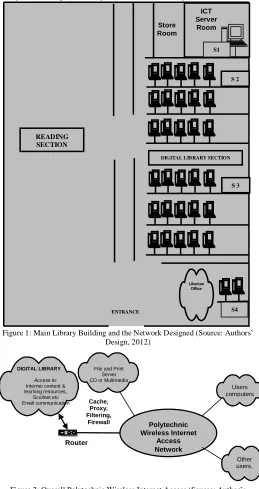
The LAN will consist of thirty two (32) workstations connected to a special computer called a server within the same designated room. The server stores and manages programs and often contains all networked group’s data which enables LAN workstations to be set up without large storage capabilities. The figures below represent the simple LAN set up for the Polytechnic digital library and the overall Polytechnic network.
[image:3.612.322.581.226.715.2]Figure 1: Main Library Building and the Network Designed (Source: Authors’ Design, 2012)
Figure 2: Overall Polytechnic Wireless Internet Access (Source: Author’s Design, 2012)
ENTRANCE
S 2
S 3
READING SECTION
Liberian Office
DIGITAL LIBRARY SECTION
ICT Server
Room Store
Room
S1
S4
Users computers
Other users, Polytechnic
Wireless Internet Access Network Router
File and Print Server CD or Multimedia
Cache, Proxy, Filtering,
Firewall
DIGITAL LIBRARY
As shown in figure 1, the library main building is divided into two sections. One side is for reading section and the other is for digital library section. In the digital library section, thirty two computer systems (workstations) and a server were connected together with the aid of four 24-port switches (i.e S1 S2, S3 and S4) using linear bus topology. Topology is the physical arrangement of the systems in the network.
a. The server in the server room was connected to Switch 1. b. Fifteen workstations were connected to Switch 2.
c. Fifteen workstations were connected to Switch 3.
d. Two workstations at the Librarian office were connected to Switch 4.
e. The server in the server room is connected to the Internet through the existing Polytechnic wireless Internet access. To complete the LAN of the digital library section, some networking materials were used. The tables below represent the hardware and software configuration of the server and the other workstations as well as quantity and estimated cost.
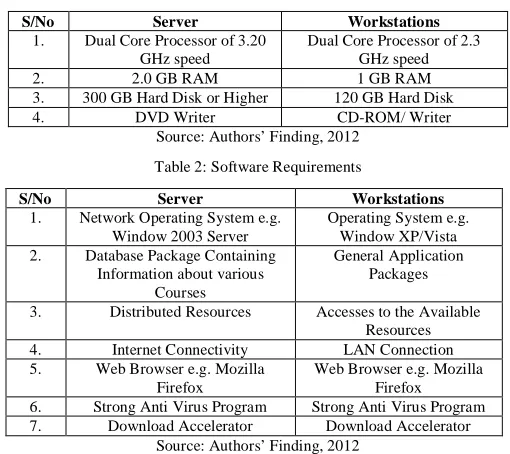
Table 1: Hardware Configuration
S/No Server Workstations
1. Dual Core Processor of 3.20 GHz speed
Dual Core Processor of 2.3 GHz speed
2. 2.0 GB RAM 1 GB RAM
3. 300 GB Hard Disk or Higher 120 GB Hard Disk
4. DVD Writer CD-ROM/ Writer
[image:4.612.321.584.65.340.2]Source: Authors’ Finding, 2012
Table 2: Software Requirements
S/No Server Workstations
1. Network Operating System e.g. Window 2003 Server
Operating System e.g. Window XP/Vista 2. Database Package Containing
Information about various Courses
General Application Packages
3. Distributed Resources Accesses to the Available Resources 4. Internet Connectivity LAN Connection 5. Web Browser e.g. Mozilla
Firefox
Web Browser e.g. Mozilla Firefox 6. Strong Anti Virus Program Strong Anti Virus Program 7. Download Accelerator Download Accelerator
Source: Authors’ Finding, 2012
IV.COSTIMPLICATIONS
Table 3: Estimated Cost of Hardware
S/N Material Estimated Unit Price (N)
Estimated Cost (N)
1. Window XP professionals (Multiple User)
30,000:00 30,000:00
2. Novell Netware 20,000:00 20,000:00 3. Window NT 20,000:00 20,000:00 4. Internet Explorer Pre-installed Pre-installed 5. Mozilla Firefox Downloaded Downloaded E-mail Services Pre-installed Pre-installed 6. Library Software Package 30,000:00 30,000:00 7. Other Software Packages
(Online Journal Database Subscription, Online Database Subscription and Procurement of E-Books)- Renewable Yearly.
500,000:00 500,000:00
Total 600,000:00
Source: Authors’ Finding, 2012
Table 4: Estimated Cost of Software
S/N Material Qty Estimated Unit Price (N)
Estimated Cost (N)
1. 24-port Ethernet Switch
4 35,000:00 140,000;00
2. Pentium M Computer
1 80,000:00 80,000:00
3. Pentium IV Computer
32 60,000:00 1,920,000:00
4. RJ-45 Connector 50 50:00 2,500:00 5. Unshielded
Twisted Pair (UTP)-Cat6
4 Rolls
15,000:00 60,000:00
6. External Modem 1 150,000:00 150,000:00
7. Screw 8
Packs
500:00 4,000:00
8. Desk jet Printer 1 30,000:00 30,000:00 9. Laser jet Printer 1 50,000:00 50,000:00 10. Scanner 1 15,000:00 15,000:00
11. UPS 35 3,000:00 105,000:00
12. Router 1 40,000:00 40,000:00 13. LAN Tester 1 10,000:00 10,000:00 14. Crimping Tools 2 5,000:00 10,000:00 15. Air Conditioner
(Split)
4 40,000:00 160,000:00
16. CD-RW/DVD-RW 10 Packs
1,000:00 10,000:00
Total 2, 786,500:00
Source: Authors’ Survey, 2012
Table 5: Overall Estimated Cost for Establishing Digital Library
S/N Description Estimated Cost (N)
1. Hardware 2,786,500:00
2. Software 600,000:00
3. Installation and Workmanship 500,000:00 4. Miscellaneous (5 years
Maintenance) 500,000:00
Total 4,386,500:00
Source: Authors’ Survey, 2012
V. CONCLUSION
Table 1 and 2 show the hardware and software requirements for both the server and the other workstations. From table 3, the estimated cost of hardware is N2, 786,500:00. Table 4 reveals that the estimated cost of software is N600, 000:00. From table 5, installation and workmanship will cost N 500, 00:00. Table 5 also shows that 5 years maintenance will gulp N 500, 00:00. The overall cost for the establishment and maintenance of the Polytechnic digital library will cost N 4,386,500:00 as shown in table 5.
[image:4.612.33.288.277.504.2]Raji, Ayodele Kamaldeen et al, International Journal of Advanced Research in Computer Science, 4 (2), Jan –Feb, 2013,65-69 relevant electronic sources etc. thus the librarian then be more
or less a hypertext engineer.
VI.RECOMMENDATION
The following are recommended for the Polytechnic: a. Considering the benefits of digital library, it is
recommended that the Polytechnic should have one. b. A Steering committee could be set up with the view of
digitalizing the Polytechnic library.
c. The wireless Internet facilities of the Polytechnic should also be improved to facilitate easy access for the creation of the Polytechnic digital library.
d. The Polytechnic librarians should orientate the academic staff of the Polytechnic on how to access the electronic resources/databases that will be subscribed to by the Polytechnic.
VII. ACKNOWLEDGMENT
We appreciate the effort and understanding of our family members. Thanks also to the Management of Kwara State Polytechnic, Ilorin and all members of staff of Computer Science Department, Kwara State Polytechnic, Ilorin.
VIII. REFERENCES
[1]. Parida Baman, “Emergence of Digital library Services in India,” 2nd International CALIBER-2004, INFLIBNET Centre, New Delhi, 2004.
[2]. Definitions of Digital library on the Web
th
November 2009.
[3].
February, 2012.
[4]. L. Candela et al, “The DELOS Digital library Reference Model - Foundations for Digital Libraries,” Version 0.98, (PDF) February 2008.
[5]. Rosenberg Diana, “Towards the Digital Library: Findings of an investigation to establish the current status of University
libraries in Africa,” International Network for Availability of Scientific publication, U.K, 2005.
[6]. A. Issah, “Electronic Library Use by Academic Staff at the University of Ilorin, Nigeria, A journal of Library and Information Sciences,” A publication of the University Library O. O. U, Ago-Iwoye, Nigeria. Vol. 7 No. 1 & 2, 2010, pp 138-149.
[7]. G. Chowudhury and S. Chowdhury, “Introduction to digital libraries,” London, Facet Publishing, 2003.
[8]. A. K. Raji, F. S. Oyedepo and T. A. Abdulrahaman, “Wireless Internet Access Use by the Staff and Students of Kwara State Polytechnic, Ilorin-Nigeria,” International Journal of Advanced Research in Computer Science, Vol.3, No. 4, , July-August 2012 pp 279- 282.
[9]. Withen I. H and Bainbridge D. How to Build Digital library, Morgan Kaufmann Publishers, San Francisco, 2003.
[10]. Definitions of Digital library on the Web
[11]. A. F. Edward,
Science, Vol. 26, No. 1, 1999.
[12]. Kelly, Kevin,
th April
2007.
[13]. th
January, 2012.
[14].
12th May, 2011.
[15].
April, 2010.