Plasticity of grammatical recursion in German learners of Dutch
Douglas J. Davidson & Peter Indefrey
F.C. Donders Centre for Cognitive Neuroimaging
Max Planck Institute for Psycholinguistics
Nijmegen, The Netherlands
[email protected], [email protected]
Abstract
We examined the multilingual compre-hension and learning of cross-serial and embedded constructions in German-speaking learners of Dutch using mag-netoencephalography (MEG). In several experimental sessions, learners performed a sentence-scene matching task with Dutch sentences including two different verb orders (Dutch or German verb order). The results indicated a larger evoked response for the German order relative to the Dutch order over frontal sensors after three months, but not initially. The response implies that sensitivity to vio-lations of verb order remains plastic into adulthood.
1
Introduction
Psycholinguistic studies have examined cross-serial and embedded complement clauses in West Germanic in order to distinguish between different types of working memory models of human sen-tence processing (Bach, Brown, & Wilson 1986; Joshi, 1990), and this contrast has been impor-tant in applications of Tree-Adjoining Grammar (Joshi, 1985). Many language users are bilin-gual in German and Dutch, suggesting that they maintain knowledge akin to a synchronized gram-mar (Shieber and Schabes, 1990). Psycholinguis-tic studies of production, using syntacPsycholinguis-tic prim-ing, suggest that syntactic representations from L1 and L2 can influence each other during production (Harsuiker and Pickering, 2007). However, these effects seem to be limited to structures where word order is shared. Also, it is not yet well understood
how bilingual users comprehend or acquire com-plement structures. For example, adult language users may have difficulty adopting the verb order preference of another language if it is not consis-tent with their first language. In principle, this could be the case when German-speaking learners of Dutch learn to adopt the verb order preference of Dutch in infinitival embedded clauses because German does not permit the same verb orders as Dutch (see Section 2.1).
Adult plasticity in the use of these constructions is investigated here by examining the response of German-speaking learners of Dutch using magne-toencephalography (MEG), a measurement tech-nique that can reveal the electrophysiological re-sponse to grammatical violations. Recent work has shown that electrophysiology is sensitive to learning-related changes in adult language learn-ers (Mueller et al 2005; Osterhout et al. 2006). The hypothesis under investigation is that the abil-ity to adapt to different forms of recursion remains plastic in adulthood.
1.1 Linguistic and Computational Models of Grammatical Complexity
(1) . . . dass . . . that
wir we
das the
Kreuz cross
das the
Dreieck triangle ber¨uhren
touch
lassen let
’that we let the cross touch the triangle’
(2) *. . . dass wir das Kreuz das Dreieck lassen ber¨uhren
The German constituent order of a complement clause,NP1NP2NP3V2V1. Note that in this structure, the verb clusterV2V1 is ordered so that the most-embedded verb, V2 (ber¨uhren), is first. The de-pendency between the object NP3andV2 is there-fore the shortest, while the dependency between the subjectNP1andV1is the longest.
In contrast to German, Standard Dutch licenses a crossed dependency, as shown in (3–4), with the same interpretation as the earlier German exam-ples. In this construction, the sequence of verbs in the complement clause is V1V2, e.g., (laten raken). The first-encountered verbal head, V1, is to be matched to its dependency higher in the con-stituent structure, NP1, crossing over the other de-pendents.
(3) *. . . dat . . . that
wij we
het the
kruis cross
de the
driehoek triangle raken
touch laten let
’that we let the cross touch the triangle’
(4) . . . dat wij het kruis de driehoek laten raken
The comparison between German and Dutch complement clauses has been influencial in the de-velopment of formal language models with higher generative capacity (Shieber, 1985; Joshi, 2004). Specifically, the crossed dependencies in Dutch and other languages in the West Germanic fam-ily cannot be modeled using context-free gram-mars (Evers, 1975; Shieber, 1985). The con-strast between these structures has been addressed by diverse linguistic frameworks that have vary-ing representational assumptions (Bobaljik, 2004; Kroch & Santorini, 1991; Evers, 1975). Joshi and collegues have shown that a number of linguistic frameworks can be grouped into the mildly con-text sensitive languages (Joshi, 1985; Joshi, Vijay-Shanker, & Weir, 1991). The capacity of LTAG to model the crossing dependency has led, in turn,
to an algorithmic analysis of the time and memory requirements necessary to parse the crossing and embedded verb orders (Joshi, 1990). This analysis predicts that the Dutch crossing structure is eas-ier to recognize because verbs can be individually linked to their dependent arguments in a queue, rather than first encoding the series of verbs into a (stack-like) working memory as in German (Joshi, 1990).
On the face of it, the difference between Dutch and German embedded constructions with respect to formal language properties might lead one to ex-pect a relatively high threshold for acquiring these constructions in a second language or borrowing them in language contact settings. However, this assumption is not supported by the considerable synchronic and diachronic variability among the West Germanic languages and/or dialects (Barbi-ers et al. in press; Pauwels, 1953; Wurmbrand, 2004). For example, the embedded clause con-struction is found in Frisian and the cross-serial construction is found in Swiss German. Also note that both Dutch and German allowed either or-der earlier in their language histories. During the 14th century, Early New High German permitted either the nested or crossed verb orders but Mod-ern German does not (Sapp, 2006). The substan-tial dialectal and diachronic variation in the use of these structures would suggest that the subor-dinate clause verb order is relatively susceptible to change.
1.2 Working Memory Processing Models
Within psycholinguistics, processing models of complexity (Gibson, 1998; Lewis, 1996; Gordon et al., 2002) have addressed why some structures appear to be more difficult to parse or interpret than others in comprehension. They also address why, in some extreme cases, certain types of gram-matical sentences seem to be impossible to pro-cess, even when the constructions are unambigu-ous and involve only two or three clauses. In most cases, these theories employ a complexity metric as a linking assumption. This complexity met-ric associates strings and hypothesized grammat-ical representations with processing difficulty and breakdown.
construc-tion consumes working memory storage or com-putational resources. The DLT proposal is that the processing cost of a construction increases propor-tional to the number of incomplete syntactic de-pendencies that must be held in working memory before they are resolved. This type of resource cost is strongly influenced by the locality of the head and a dependent, such that longer-distance dependencies between a head and a dependent in-cur a greater resource cost. A second type of cost is incurred when new discourse entities must be set up in a discourse model. Other models of lin-guistic processing complexity emphasize interfer-ence in working memory as a potential source of processing difficulty (Lewis, 1996; Gordon et al. 2002). In these accounts, the number of open de-pendencies of the same type (e.g., the same gram-matical case) will determine processing difficulty, other factors held constant.
The contrast between crossed versus embedded dependencies has been used to support these mod-els. Bach et al. (1986) had separate groups of Dutch and German native speakers rate the com-prehensibility, as well as answer paraphrase ques-tions, concerning sentences similar to those in (1-2), but with an increasing number of verbs. They observed equivalent question answering perfor-mance for both Dutch and German participants for the constructions using two verbs, but differences between the two language groups for higher levels of embedding and more verbs. With three or more verbs, Dutch participants made fewer errors with the Dutch cross-serial construction than the Ger-man participants made with the GerGer-man embed-ded construction. Also, the Dutch subjects rated the (three-verb) cross-serial construction easier to process than the Germans rated the German (three-verb) embedded construction. These differences have been taken as evidence first, that the cross-serial construction is easier to process than the em-bedded construction, and second, that human pars-ing does not employ a stack-based workpars-ing mem-ory for linguistic material, but rather a queue-like working memory, because a stack-like architecture would not have predicted the advantage for Dutch. Joshi (1990) has argued that the performance dif-ferences observed by Bach et al. (1986) could be accounted for by representational assumptions as well.
The DLT account (Gibson, 1998) of these
find-ings assumes that syntactic categories that are pre-dicted first will accrue a greater memory cost be-cause they must be maintained in working mem-ory. In Dutch, this cost is initially higher be-cause the first verb of a three-verb cluster closes a longer-distance dependency than the correspond-ing German version of the sentence. However, be-cause this dependency is closed, the other verbs can be processed with less cost. In the German version, the first verb of the cluster closes a short-distance dependency, but the other dependencies must be kept active in working memory. Later in the German verb cluster the longer distance depen-dency is resolved with a higher cost. Thus, in the DLT account the linear order of the verbs allows Dutch to distribute integration costs over the verb cluster more equally than in the German version, which concentrates the higher–cost dependencies near the end of the verb cluster.
The difference between fewer versus more em-beddings was also investigated by Kaan and Vasi´c (2004), who investigated reading times of Dutch subjects presented with two- and three-verb ver-sions of the Dutch cross-serial dependency. They showed that average reading times increased at the first verb of the three-verb constructions relative to the two-verb constructions, and in addition, that the type of NP presented in the pre-verbal string affected integration at the verb. They concluded that a storage component like that proposed in Gib-son (1998) along with a role for interference pro-posed by Gordon et al. (2001) would best account for the reading time data.
each verb in Dutch, but crucially, only at the end of the verb sequence in German. Thus, the Joshi (1990) account formalizes the explanation for the processing differences between Dutch and Ger-man, and provides a linking hypothesis between the linguistic representation and the complexity metrics.
The above models, while offering a detailed account of performance parameters observed in controlled experimental settings, nevertheless ab-stract away from the fact that linguistic function is implemented in networks of neurons arranged in the cerebral cortex that is subject to experience-dependent change. Some work within psycholin-guistics has addressed learning linguistic com-plexity. In artificial neural network approaches, grammatical knowledge is modeled with a net-work for string sequences, termed a simple recur-rent network (SRN), rather than a symbolic gram-mar. Christiansen and Chater (1999) addressed the cross-serial versus embedded contrast with this approach, and have also argued that approaches like the SRN have important properties such as experience-dependent plasticity and robustness to non-ideal input. However, Gr¨uning (2006) has re-cently argued that models of sequences consistent with embedded constructions are arguably sim-pler than systems that model sequences consis-tent with cross-serial dependencies, which is not completely consistent with the behavioral data re-viewed above. However there are few experimen-tal data on human learning of these types of struc-tures, so it is not yet clear which human learning patterns these networks (or symbolic approaches) would be expected to model.
In the population-based approach of Niyogi (2006) a learner hears a grammar selected from a population of individuals (who may speak some-what different languages). One major distinction between this approach and that of the SRN is that it models the population of speakers as a dynamical system rather than an individual. This approach is relevant for the present experiment because the approach assumes a model of grammatical plas-ticity in which (hypothesized) grammars become stable (Niyogi, 2006, pp. 187-189). It is not yet clear whether aspects of grammar such as verb or-der constraints should be viewed as either stable or plastic in such a model.
While artificial neural network models of
guistic processing offer an account of how lin-guistic complexity might arise in networks of threshold-based processing units, they nonetheless abstract away from realistic details of electrophys-iological responses usually modeled within psy-chophysiology and neuroscience, and more impor-tantly, how those electrophysiological responses change with experience. SRN models emphasize the role of experience-dependent change in re-sponse to statistics of the input, but there have been few attempts to link these hypotheses to physical neural systems.
2
Method
The present experiment attempts to make this link by examining the electrophysiological response of learners over time (see Davidson & Indefrey, submitted). In three experimental sessions span-ning their initial acquisition of Dutch in an in-tensive Dutch course, German learners performed a sentence-scene matching task with Dutch sen-tences including two different verb constituent or-ders (Dutch verb order, German verb order). In addition they rated the grammaticality of similar constructions in a separate rating task. The ses-sions took place over a period of three months (at the start of the course, at two weeks, and at three months after the start of the course).
2.1 Participants and Materials
The participants (n= 13) were all over 18 years old. The materials consisted of sentences that de-scribed a simple scene involving geometric ob-jects. Half of the sentences contained a verb or-der consistent with Dutch (crossing dependencies, 5) and half consistent with German (embedded de-pendencies, 6).
(5) Je You
zal will
zien see
dat that
wij we
het the
rode red
kruis cross de
the
blauwe blue
driehoek triangle
laten let
raken touch ‘You will see that we let the red cross touch the blue triangle’
(6) Je zal zien dat wij het rode kruis de blauwe driehoek raken laten
A control group (n= 25) of native Dutch speak-ers also rated the same sentences, but were not scanned with the MEG.
2.2 Procedure, Recordings, and Analysis
MEG signals were recorded in a magnetically-shielded room using a CTF system equipped with 151 axial gradiometers (VSM Tech Ltd., CTF Sys-tems, Coquitlam, B. C., Canada), at a sampling rate of 1 kHz, low-pass filtered at 150 Hz dur-ing acquisition. The MEG provides a measure of magnetic field fluctuations due to electrical activity of synchronized post-synaptic potentials (H¨am¨al¨ainen et al., 1993), analogous to EEG. The planar gradient of the sensor activity was derived to increase the spatial sensitivity of the measure. The data were analyzed with a clustering algo-rithm and tested for significance using randomiza-tion tests (Maris and Oostenveld, 2007). The anal-ysis tested the null hypothesis of no differential vi-olation response to the verb orders in each of the sessions. The behavioural data were analyzed us-ing a mixed effect model (Baayen et al., 1986). For contrasts, posterior density intervals (HPDd) were
computed to assess whether the distribution of the parameter of interest is likely to include zero.
3
Results
3.1 Behavioural Classification
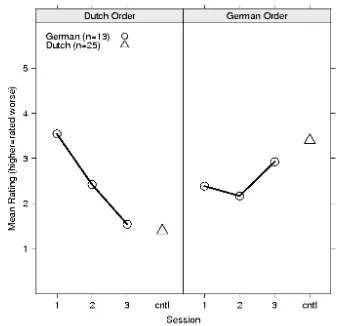
Figure 1 shows that the Dutch control participants rated the Dutch verb order as acceptable, and the German verb order as unacceptable, as expected. The German learners initially rated the sentences that were incompatible with German grammar as unacceptable, but over time rated the sentences as acceptable as the Dutch-speaking control group. Similarly, they rated the sentences compatible with German grammar more acceptable at the start of acquisition but less so later in acquisition, again approximating the Dutch control group’s rating.
A direct comparison of the ratings for the Ger-man versus the Dutch order showed that the learn-ers rated the Dutch order worse at the first session (d= 1.15,HPDd= 0.25,2.02), equal in the second session (d = -0.90, HPDd = -2.18,0.36, includes
[image:5.595.312.484.83.246.2]zero), and the German order worse in the last (d= -2.54,HPDd = -3.79,-1.30).
Figure 1: Average of median ratings of sentences following the German and Dutch verb orders.
3.2 Event-Related Fields
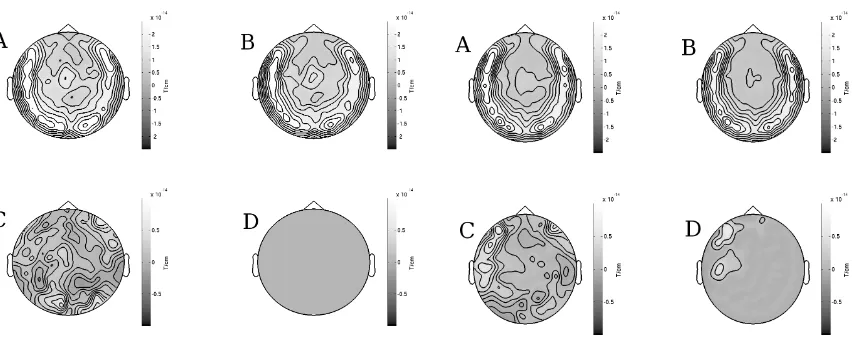
The average planar gradient of the evoked field to the initial verb within the cluster revealed a larger evoked response for the German order rel-ative to the Dutch order over frontal sensors af-ter two weeks, but not initially. At the second and third test sessions there was a significantly larger amplitude response for the German order compared to the Dutch order; session 2: sumT = 32.72,p = 0.0073, 12 sensors; session 3:sumT = 72.88, p = 0.0006, 25 sensors. Figures 2 and 3 show the topography of the response at sessions one and three for a time window of 0.2 to 0.4 s after the onset of the initial verb.
4
Discussion
embed-Figure 2: Topography of the average planar gradi-ent of the evgradi-ent-related fields (0.2 to 0.4 s) for the German and Dutch verb orders in initial session. A. German order, B. Dutch order, C. German-Dutch contrast, D. statistically significant differ-ence (none present).
ding of verbs and their dependents.
The behavioural and electrophysiological re-sults suggest that cortical responses to verb or-der preferences in complement clauses can change within three months after the onset of adult lan-guage learning, implying that this aspect of gram-matical processing remains plastic into adulthood. The primary implication of this result is that the preference for crossed versus the embedded order is relatively flexible. This is in contrast to the as-sumptions of some theoretical models of language change (Labov, 2007), which assume that adult ac-quisition is relatively slow and error-prone. How-ever, it must be stressed that Dutch and German are similar in many other respects, so it is likely that the learners in the present study acquired pro-ficiency at a faster rate than learners with a differ-ent L1.
The results reported here have several implica-tions for representational and processing models. Work on formal grammar has highlighted the dis-tinction between crossed versus nested dependen-cies because of the implications that these struc-tures have for different families of mathematical grammars. The existence of crossed dependencies like those in Dutch imply that grammars that are more expressive than context free grammars are
Figure 3: Topography of the average planar gradi-ent of the evgradi-ent-related fields (0.2 to 0.4 s) for the German and Dutch verb orders after three months. A. German order, B. Dutch order, C. German-Dutch contrast, D. statistically significant differ-ences.
necessary in order to successfully model linguis-tic grammalinguis-tical patterns. Although this property is fundamental for frameworks which attempt to find a proper structural description of human lan-guages using a constrained formal system, the for-mal distinction between context free and context sensitive grammars does not, in itself, imply that crossed dependencies are more complex to cess, or more complex to learn. The work on pro-cessing reviewed in the Introduction in fact sug-gests that crossed dependencies are in fact easier for comprehenders to parse than nested dependen-cies. The results presented here add to this liter-ature by showing that crossing dependencies can be acquired in a relatively short period of time by adult learners, at least when other aspects of the L1 are similar (e.g., Germanic).
[image:6.595.101.528.71.243.2]modeling advantages found in TAG can be used in modeling correspondences between grammati-cal systems. In TAG, lexigrammati-cal items are associated with elementary trees to model local dependen-cies (factoring dependendependen-cies and recursion; Joshi, 1990). In the case of German and Dutch, pairs of elementary trees with inverted verb orders would be associated with each other in the transfer lexi-con. Learning the Dutch verb order when the L1 is German would consist of learning that a subset of Dutch verbs (non-finite verbs, causative verbs, perception verbs) requires an inverted order in a complement clause. The links in the STAG trans-fer lexicon would model the fact that bilingual or learning speakers know that the meaning of the Dutch version of the sentence is the same as the German version, with a different verb order. A model of this type may account for the relative speed at which the learners acquired the Dutch or-der.
The present study, along with several other re-cent findings in the EEG literature (Osterhout et al. 2006; Mueller et al. 2005), offers evidence that the representational capacity of adult language users can change quickly during adult language learning. However, resource-based psycholinguis-tic models of processing complexity like those re-viewed in the introduction have not yet addressed how the grammatical or representational resources used to parse complex sentences can change with language experience. Future modeling efforts could be directed at jointly modeling how gram-matical representations are learned under resource limitations. An interesting modeling issue con-cerns how a network model (e.g., Christiansen & Chater, 1999) could learn to be sensitive to both the German and Dutch verb orders in the same speaker. Note that Dutch permits both verb orders, depending on finiteness of the verbs involved, so it appears to be necessary to address this issue in order to model single languages as well. Also, the work reported here has not explored the extent to which learning the Dutch verb order impacts pro-cessing of German sentences, or how long the sen-sitivity to verb order differences remains in the absence of direct experience with Dutch. Future empirical work could address these issues by ex-amining behavioral or electrophysiological indices of parsing complexity in proficient German-Dutch bilinguals, as well as learners who are no longer
active users of Dutch.
References
Baayen, R. H., Davidson, D. J. & Bates, D. M. in press. Mixed-effects modelling with crossed ran-dom effects for subjects and items. Journal of
Mem-ory and Language.
Bach, E., Brown, C. & Marslen–Wilson, W. D. 1986. Crossed and nested dependencies in Dutch and Ger-man: A psycholinguistic study. Language and
Cog-nitive Processes, 1(4), 249–262.
Barbiers et al. (in press). Syntactic Atlas of Dutch
Di-alects. Volume 2: Auxiliaries, verbal clusters, and negation. Amsterdam, Amsterdam University Press.
Bobaljik, J. D. 2004. Clustering theories. In Verb
clus-ters: A study of Hungarian, German, and Dutch,
Eds. K. ´E. Kiss and H. van Riemsdijk, Pp. 121-146. Amsterdam/Philadelphia: John Benjamins Publish-ing Company.
Christiansen, M. H. & Chater, N. 1999. Toward a connectionist model of recursion in human linguistic performance, Cognitive Science, 23, 157–205.
Evers, A. 1975. The transformational cycle in Dutch
and German. PhD Dissertation. University of
Utrecht. Distributed by the Indiana University Lin-guistics Club, Bloomington, IL.
Davidson, D. J. & Indefrey, P. (submitted). Electro-physiological responses to crossed versus nested structures in German learners of Dutch.
Gibson, E. 1998. Linguistic complexity: Locality of syntactic dependencies. Cognition, 68, 1–76.
Gordon, P. C., Hendrick, R., & Levine, W. H. 2002. Memory-load interference in syntactic processing.
Psychological Science, 13, 425–430.
Gr¨uning, A. 2006. Stack-like and queue-like dynamics in recurrent neural networks. Connection Science,
18, 23–42.
H¨am¨al¨ainen, M. Hari, R., Ilmoniemi, R., Knuutila, J., & Lounasmaa, O. V. 1993. Magnetoencephalog-raphy: Theory, instrumentation, and applications to non-invasive studies of signal processing in the hu-man brain. Reviews in Modern Physics, 65, 413– 497.
Hartsuiker, R. J. & Pickering, M. J. 2007. Language integration in bilingual sentence production. Acta
Psychologica, doi:10.1016/j.actpsy.2007.08.005.
Joshi, A. K. 1990. Processing crossed and nested dependencies: An automaton perspective on psy-cholinguistic results. Language and Cognitive
Joshi, A. K. 1985. Tree adjoining grammars: How much context-sensitivity is required to pro-vide reasonable structural descriptions? In D. Dowty, L. Karttunen, and A. Zwicky (eds.)
Natu-ral Language Processing: Psycholinguistic, Compu-tational, and Theoretical Perspectives., Cambridge
University Press, New York.
Joshi, A. K. 2004. Starting with complex primatives pays off: Complicate locally, simplify globally.
Cog-nitive Science, 28, 637–668.
Joshi, A. K., Vijay-Shanker, K., & Weir, D. 1991. The convergence of mildly context sensitive gram-mar formalisms. In P. Sells, S. Shieber & T. Wa-sow (Eds), Foundational Issues in Natural Language Processing. MIT Press, Cambridge, Massachusetts, pages 31–81.
Kaan, E. & Vasi´c, N. 2004. Cross-serial dependencies in Dutch: Testing the influence of NP type on pro-cessing load. Memory & Cognition, 32, 175–184.
Kroch, A. S. & Santorini, B. 1991. The derived con-stituent structure of the West Germanic verb-raising construction. In R. Freidin (Ed.) Principles and
Parameters in Comparative Grammar. MIT Press,
Cambridge, Mass.
Labov, W. 2007. Transmission and diffusion.
Lan-guage, 83, 344–387.
Lewis, R. L. 1996. Interference in short-term memory: The magical number two (or three) in sentence pro-cessing. Journal of Psycholinguistic Research, 25, 93–113.
Maris, E. & Oostenveld, R. 2007. Nonparametric sta-tistical testing of EEG- and MEG-data. Journal of
Neuroscience Methods, 164 (1), 177–190.
Mueller, J. L., Hahne, A., Fujii, Y., & Friederici, A. D. 2005. Native and nonnative speakers’ process-ing of a miniature version of Japanese as revealed by ERPs. Journal of Cognitive Neuroscience, 17(8), 1229–1244.
Niyogi, P. 2006. The computational nature of language
learning and evolution. MIT Press.
Pauwels, A. 1953. De plaats van hulpwerkwoord,
verleden deelwoord en infinitief in de Nederlandse bijzin. Leuven, Symons. [The position of the
auxil-iary, past participle, and infinitive in the Dutch sub-ordinate clause.]
Osterhout, L., McLaughlin, J., Pitk¨anen, I., Frenck-Mestre, C. & Molinaro, N. 2006. Novice learners, longitudinal designs, and event-related potentials: A means for exploring the neurocognition of second language processing. Language Learning, 56, 199– 230.
Sapp, C. D. 2006. Verb order in subordinate clauses
from Early New High German to Modern German.
Unpublished PhD dissertation. Indiana University.
Shieber, S. 1985. Evidence against the context-freeness of natural language. Linguistics and Philosophy, 8, 333–343.
Shieber, S. & Schabes, Y. 1990. Synchronous Tree Adjoining Grammars. Proceedings of the 13th
In-ternational Conference on Computational Linguis-tics (COLING 90), Helsinki, Finland.
Wurmbrand, S. 2004. West Germanic verb clusters: The empirical domain. In Verb clusters: A study