A Rule-Driven Dynamic Programming Decoder for Statistical MT
Christoph Tillmann
IBM T.J. Watson Research Center Yorktown Heights, N.Y. 10598
Abstract
The paper presents an extension of a dynamic programming (DP) decoder for phrase-based SMT (Koehn, 2004; Och and Ney, 2004) that tightly integrates POS-based re-order rules (Crego and Marino, 2006) into a left-to-right beam-search algorithm, rather than handling them in a pre-processing or re-order graph generation step. The novel decoding algo-rithm can handle tens of thousands of rules efficiently. An improvement over a standard phrase-based decoder is shown on an Arabic-English translation task with respect to trans-lation accuracy and speed for large re-order window sizes.
1 Introduction
The paper presents an extension of a dynamic programming (DP) decoder for phrase-based SMT (Koehn, 2004; Och and Ney, 2004) where POS-based re-order rules (Crego and Marino, 2006) are tightly integrated into a left-to-right run over the input sentence. In the literature, re-order rules are applied to the source and/or target sentence as a pre-processing step (Xia and McCord, 2004; Collins et al., 2005; Wang et al., 2007) where the rules can be applied on both training and test data. Another way of incorporating re-order rules is via extended monotone search graphs (Crego and Marino, 2006) or lattices (Zhang et al., 2007; Paulik et al., 2007). This paper presents a way of handling POS-based re-order rules as an edge generation process: the POS-based re-order rules are tightly integrated into a left to right beam search decoder in a way that
29 000 rules which may overlap in an arbitrary
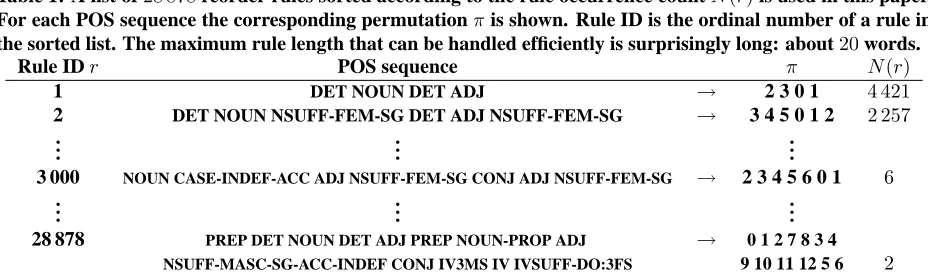
way (but not recursively) are handled efficiently. Example rules which are used to control the novel DP-based decoder are shown in Table 1, where each POS sequence is associated with possibly several permutationsπ. In order to apply the rules, the input sentences are POS-tagged. If a POS sequence of a rule matches some identical POS sequence in the in-put sentence the corresponding words are re-ordered according toπ. The contributions of this paper are as follows: 1) The novel DP decoder can handle tens of thousands of POS-based rules efficiently rather than a few dozen rules as is typically reported in the SMT literature by tightly integrating them into a beam search algorithm. As a result phrase re-ordering with a large distortion window can be carried out efficiently and reliably. 2) The current rule-driven decoder is a first step towards including more complex rules, i.e. syntax-based rules as in (Wang et al., 2007) or chunk rules as in (Zhang et al., 2007) using a decoding algorithm that is con-ceptually similar to an Earley-style parser (Earley, 1970). More generally, ’rule-driven’ decoding is tightly linked to standard phrase-based decoding. In future, the edge generation technique presented in this paper might be extended to handle hierarchical rules (Chiang, 2007) in a simple left-to-right beam search decoder.
In the next section, we briefly summarize the baseline decoder. Section 3 shows the novel rule-driven DP decoder. Section 4 shows how the current decoder is related to both DP-based decoding algo-rithms in speech recognition and parsing. Finally,
Table 1: A list of28 878reorder rules sorted according to the rule occurrence countN(r)is used in this paper. For each POS sequence the corresponding permutationπis shown. Rule ID is the ordinal number of a rule in the sorted list. The maximum rule length that can be handled efficiently is surprisingly long: about20words.
Rule IDr POS sequence π N(r)
1 DET NOUN DET ADJ → 2 3 0 1 4 421
2 DET NOUN NSUFF-FEM-SG DET ADJ NSUFF-FEM-SG → 3 4 5 0 1 2 2 257 ..
. ... ...
3 000 NOUN CASE-INDEF-ACC ADJ NSUFF-FEM-SG CONJ ADJ NSUFF-FEM-SG → 2 3 4 5 6 0 1 6 ..
. ... ...
28 878 PREP DET NOUN DET ADJ PREP NOUN-PROP ADJ → 0 1 2 7 8 3 4
NSUFF-MASC-SG-ACC-INDEF CONJ IV3MS IV IVSUFF-DO:3FS 9 10 11 12 5 6 2
Section 5 shows experimental results.
2 Baseline DP Decoder
The translation model used in this paper is a phrase-based model (Koehn et al., 2003), where the trans-lation units are so-called blocks: a blockbis a pair consisting of a source phrase sand a target phrase
t which are translations of each other. The ex-pression block is used here to emphasize that pairs of phrases (especially longer phrases) tend to form closely linked units in such a way that the transla-tion process can be formalized as a block segmen-tation process (Nagata et al., 2006; Tillmann and Zhang, 2007). Here, the input sentence is segmented from left to right while simultaneously generating the target sentence, one block at a time. In prac-tice, phrase-based or block-based translation mod-els which largely monotone decoding algorithms ob-tain close to state-of-the-art performance by using skip and window-based restrictions to reduce the search space (Berger et al., 1996). During decod-ing, we maximize the scoresw(bn1)of a phrase-pair sequencebn
1 = (si, ti)n1:
sw(bn1) =
n
X
i=1
wT ·f(bi, bi−1), (1)
where bi is a block, bi−1 is its predecessor block, and f(bi, bi−1) is a 8-dimensional feature vector
where the features are derived from some probabilis-tic models: language model, translation model, and distortion model probabilities. n is the number of blocks in the translation and the weight vectorwis trained in a way as to maximize the decoderBLEU score on some training data using an on-line algo-rithm (Tillmann and Zhang, 2008). The decoder that
carries out the optimization in Eq. 1 is similar to a standard phrase-based decoder (Koehn, 2004; Och and Ney, 2004), where states are tuples of the fol-lowing type:
[C; [i, j] ], (2)
whereCis the so-called coverage vector that keeps track of the already processed source position,[i, j]
is the source interval covered by the last source phrase match. In comparison, (Koehn, 2004) uses only the position of the final word of the last source phrase translated. Since we are using the distortion model in (Al-Onaizan and Papineni, 2006) the entire last source phrase interval needs to be stored. Hy-pothesis score and language model history are omit-ted for brevity reasons. The states are stored in lists or stacks and DP recombination is used to reduce the size of the search space while extending states.
The algorithm described in this paper uses an in-termediate data structure called an edge that repre-sents a source phrase together with a target phrase that is one of its possible translation. Formally, we define:
[ [i, j], tN1 ], (3)
where tN
1 is the target phrase linked to the source phrasesi,· · ·, sj. The edges are stored in a so-called
chart. For each input interval that is matched by
de-e = 1 e = 2
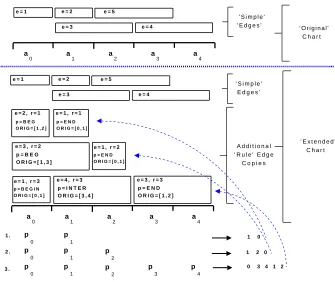
Figure 1: Addition of rule edges to a chart containing 5simple edges (some rule edges are not shown). The simple edges remain in the chart after the rule edges have been added: they are used to carry out monotone translations.
coder generating all the simple edges takes less than
0.3% of the overall decoding time.
3 DP-Search with Rules
This section explains the handling of the re-order rules as an edge generation process. Assuming a monotone translation, for the baseline DP decoder (Koehn, 2004) each edge ending at positionjcan be continued by any edge starting at positionj+ 1, i.e. the simple edges are fully connected with respect to their start and ending positions. For the rule-driven decoder, all the re-ordering is handled by generat-ing additional edges which are ’copies’ of the sim-ple edges in each rule context in which they occur. Here, a rule edge copy ending at position j is not fully connected with all other edges starting at po-sitionj+ 1. Once a rule edge copy for a particular rule id r has been processed that edge can be con-tinued only by an edge copy for the same rule until the end of the rule has been reached. To formalize the approach, the search state definition in Eq. 2 is
modified as follows:
[s; [i, j], r , sr, e∈ {false,true}] (4)
Here, the coverage vectorCis replaced by a single numbers: a monotone search is carried out and all the source positions up to position s (including s) are covered.[i, j]is the coverage interval for the last source phrase translated (the same as in Eq. 2). ris the rule identifier, i.e. a rule position in the list in Table 1.sris the starting position for the rule match
of ruler in the input sentence, and eis a flag that indicates whether the hypothesis hhas covered the entire span of ruleryet. The search starts with the following initial state:
[−1 ; [−1,−1],−1, −1, e=true], (5)
where the starting positions s,sr, and the coverage
States are extended by finding matching edges and the generation of these edges is illustrated in Fig. 1 for the use of3overlapping rules on a source segment of5wordsa0,· · ·, a4 1. Edges are shown as rectangles where the number on the left inside the box corresponds to the enumeration of the simple edges. In the top half of the picture the simple edges which correspond to5phrase-to-phrase translations are shown. In the bottom half all the edges after the rule edge extension are shown (including simple and rule edges). A rule edge contains additional compo-nents: the rule idr, a relative edge position p (ex-plained below), and the original source interval of a rule edge before it has been re-ordered. A rule edge is generated from a simple edge via a re-order rule application: the newly generated edges are added into the chart as shown in the lower half of Figure 1. Here, rule1and2generate two new edges and rule
3generates three new edges that are added into the chart at their new re-ordered positions, e.g. copies of edge 1 are added for the rule id r = 1 at start position2, for ruler = 2at start position3, and for ruler = 3 at start position0. Even if an edge copy is added at the same position as the original edge a new copy is needed. The three rules correspond to matching POS sequences, i.e. the Arabic input sen-tence has been POS tagged and a POSpj has been
assigned to each Arabic word aj. The same POS
sequence might generate several different permuta-tions which is not shown here.
More formally, the edge generation process is car-ried out as follows. First, for each source interval
[k, l] all the matching phrase pairs are found and added into the chart as simple edges. In a second run over the input sentence for each source inter-val[k, l]all matching POS sequences are computed and the corresponding source words ak,· · ·, al are
re-ordered according to the rule permutation. On the re-ordered word sequence phrase matches are computed only for those source phrases that already occurred in the original (un-reordered) source sen-tence. Both edge generation steps together still take less than1% of the overall decoding time as shown in Section 5: most of the decoding time is needed to access the translation and the language model
prob-1
Rule edges and simple edges may overlap arbitrarily, but the final translation constitutes a non-overlapping boundary se-quence.
abilities when extending partial decoder hypotheses 2. Typically rule matches are much longer than edge
matches where several simple edges are needed to cover the entire rule interval, i.e. three edges for rule
r = 3in Fig. 1. As the edge copies corresponding to the same rule must be processed in sequence they are assigned one out of three possible positionsp:
• BEG: Edge copy matches at the begin of rule match.
• INTER: Edge copy lies within rule match inter-val.
• END: Edge copy matches at the end of rule match.
Formally, the rule edges in Fig. 1 are defined as fol-lows, where a rule edge includes all the components of a simple edge:
h
[i, j], tN1 , r, p,[π(i), π(j)]i, (6)
wherer is the rule id andpis the relative edge po-sition. [π(i), π(j)] is the original coverage inter-val where the edge matched before being re-ordered. The original interval is not a necessary component of the rule-driven algorithm but it makes a direct com-parison with the window-based decoder straight-forward as explained below. The rule edge defi-nition for a rule r that matches at position sr is
slightly simplified: the processing interval is ac-tually [sr +i, sr + j] and the original interval is
[sr+π(i), sr+π(j)]. For simplicity reasons, the
off-setsris omitted in Fig 1. Using the original interval
has the following advantage: as the edges are pro-cessed from left-to-right and the re-ordering is con-trolled by the rules the translation score computation is based on the original source interval [π(i), π(j)]
and the monotone processing is based on the match-ing interval [i, j]. For the rule-driven decoder it looks like the re-ordering is carried out like in a reg-ular decoder with a window-based ordering re-striction, but the rule-induced window can be large, i.e. up to 15 source word positions. In particular a distortion model can be applied when using the
2Strictly speaking, the edge generation constitutes two
e = 1 e = 2 e = 3
e = 4 e = 5 e = 6 e = 7 e = 8
2 , B E G I N
e = 9
6 , E N D
e = 1 1 e = 1 0
5 , I N T E R
6 , B E G I N 8 , I N T E R 7 , E N D
1 , E N D 7 , B E G I N
2 0 1
1 0 3 2
2 . R U L E :
3 . R U L E :
a 1
a 2
a 3
a 4
a 5
a 6
1 2 3 0
1 . R U L E :
a 0
7 , B E G I N
3 , I N T E R
8 , I N T E R
h
1 h2 h3 h4 h5 h6
h
7
h
8
h
9 h1 0
h
1 1 h1 2 h1 3
h
1 4
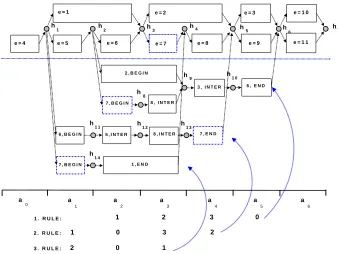
Figure 2: Search lattice for the rule-driven decoder. The gray circles indicated partial hypotheses. An hypothesis is expanded by applying an edge. DP recombination is used to restrict the search space throughout the rule lattice.
re-order rules. Additionally, rule-based probabilities can be used as well. This concept allows to directly compare a window-based decoder and the current rule based decoder in Section 5.
The search space for the rule-driven decoder is il-lustrated in Fig. 2. The gray shaded circles represent translation hypotheses according to Eq. 4. A trans-lation hypothesish1 is extended by an edge which covers some uncovered portion of the input sen-tence to produce a new hypothesish2. The decoder searches monotonically through the entire chart of edges, and word re-ordering is possible only through the use of rule edges. The top half of the picture shows the way simple edges contribute to the search process: they are used to carry out a monotone trans-lation. The dashed arrows indicate that hypotheses can be recombined: when extending hypothesis h3 by edge e = 2and hypothesis h4 by edge e = 8 only a single hypothesish5 is kept as the history of edge extensions can be ignored for future decoder decisions with respect to the uncovered source posi-tions. Here, the distortion model and the language model history are ignored for illustration purposes. As it can be seen in Fig. 2, the rule edge generation step has created3copies of the simple edgee= 7,
which are marked by a dashed borderline. Hypothe-ses covering the same input may not be merged, i.e. hypothesesh9 andh13 for rules r = 1 andr = 2 have to be kept separate from the hypothesish4. But state merging may occur for states generated by rule edges for the same ruler, i.e. ruler = 1and state
h9.
Since rule edges have to be processed in a sequen-tial order, looking up those that can extend a given hypothesis h is more complicated than a phrase translation look-up in a regular decoder. Given the search state definition in Eq. 4, for a given rule idr
and coverage positionswe have to be able to look-up all possible edge extensions efficiently. This is implemented by storing two lists:
1. For each source position j a list of possible ’starting’ edges: these are all the simple edges plus all rule edges with relative edge position
p=BEG. This list is used to expand hypotheses according to the definition in Eq. 4 where the rule flage =true, i.e. the search has finished covering an entire rule interval.
2. The second list is for continuing edges (p =
start positionsr and source positionja list of
rule edges has to be stored that can continue an already started rule coverage. This list is used to expand hypotheses for which the rule flage
is e = false, i.e. the hypothesis has not yet finished covering the current rule interval, e.g. the hypothesesh9andh11in Fig. 2.
The two lists are computed by a single run over the chart after all chart edges have been generated and before the search is carried out (the CPU time to generate these lists is included in the edge gener-ation CPU time reported in Section 5). The two lists are used to find the successor edges for each hypoth-esish that corresponds to a ruler efficiently: only a small fraction of the chart edges starting at posi-tion j needs to be retrieved for an extension. The rule start positionsr has to be included for the
sec-ond list: it is possible that the same rule r matches the input sentences for two intervals[i, j]and[i′, j′]
which overlap. This results in an invalid search state configuration. Based on the two lists a monotone search is carried out over the extended rule edge set which implicitly generates a reordering lattice as in similar approaches (Crego and Marino, 2006; Zhang et al., 2007). But because the handling of the edges is tightly integrated into the beam search algorithm by applying the same beam thresholds it potentially handles10’s of thousands of rules efficiently.
4 DP Search
The DP decoder described in the previous section bears some resemblance with search algorithms for large vocabulary speech recognition. For exam-ple, (Jelinek, 1998) presents a Viterbi decoder that searches a composite trellis consisting of smaller HMM acoustic trellises that are combined with lan-guage model states in the case a trigram lanlan-guage model. Multiple ’copies’ of the same acoustic sub models are incorporated into the overall trellis. The highest probability word sequences is obtained us-ing a Viterbi shortest path findus-ing algorithm in a possibly huge composite HMM (cf. Fig. 5.3 of (Jelinek, 1998)). In comparison, in this paper the edge ’copies’ are used to generate hypotheses that are hypotheses ’copies’ of the same phrase match, e.g. in Fig. 2 the states h4, h8, and h14 all result from covering the same simple edge e7 as the most
recent phrase match. The states form a potentially huge lattice as shown in Fig. 2. Similarly, (Ort-manns and Ney, 2000) presents a DP search algo-rithm where the interdependent decisions between non-linear time alignment, word boundary detec-tion, and word identification (the pronunciation lex-icon is organized efficiently as a lexical tree) are all carried out by searching a shortest path trough a pos-sibly huge composite trellis or HMM. The similar-ity between those speech recognition algorithms and the current rule decoder derives from the following observation: the use of a language model in speech recognition introduces a coupling between adjacent acoustic word models. Similarly, a rule match which typically spans several source phrase matches intro-duces a coupling between adjacent simple edges. Viewed in this way, the handling of copies is a technique of incorporating higher-level knowledge sources into a simple one-step search process: ei-ther by processing acoustic models in the context of a language model or by processing simple edges in the context of bigger re-ordering units, which exploit a richer linguistic context.
The Earley parser in the presentation (Jurafsky and Martin, 2000) also uses the notion of edges which represent partial constituents derived in the parsing process. These constituents are interpreted as edges in a directed acyclic graph (DAG) which represents the set of all sub parse trees considered. This paper uses the notion of edges as well fol-lowing (Tillmann, 2006) where phrase-based decod-ing is also linked to a DAG path finddecod-ing problem. Since the re-order rules are not applied recursively, the rule-driven algorithm can be linked to an Earley parser where parsing is done with a linear grammar (for a definition of linear grammar see (Harrison, 1978)). A formal analysis of the rule-driven decoder might be important because of the following consid-eration: in phrase-based machine translation the tar-get sentence is generated from left-to-right by con-catenating target phrases linked to source phrases that cover some source positions. Here, a coverage vector is typically used to ensure that each source position is covered a limited number of times (typi-cally once). Including a coverage vectorCinto the search state definition results in an inherently expo-nential complexity: for an input sentence of length
Table 2: Translation results on the MT06 data.wis the distortion limit.
words / sec generation [%] BLEU PREC TER Baseline decoder w= 0 171.6 1.90 34.6 35.2 65.3
w= 2 25.4 0.29 36.6 37.7 63.5
w= 5 8.2 0.10 35.0 36.1 65.1
Rule decoder N(r)≥2 9.1 0.75 37.1 38.2 63.5
(w= 15) N(r)≥5 10.5 0.43 37.2 38.2 63.5
the contrary, the search state definition in Eq. 4 ex-plicitly avoids the use of a coverage vector result-ing in an essentially linear time decodresult-ing algorithm (Section 5 reports the size of the the extended search graph in terms of number of edges and shows that the number of permutations per POS sequence is less than 2on average). The rule-driven algorithm might be formally correct in the following sense. A phrase-based decoder has to generate a phrase align-ment where each source position needs to be cov-ered by exactly one source phrase. The rule-based decoder achieves this by local computation only: 1) no coverage vector is used, 2) the rule edge genera-tion is local to each individual rule, i.e. looking only at the span of that rule, and 3) rules whose appli-cation spans overlap arbitrarily (but not recursively) are handled correctly. In future, a formal correctness proof might be given.
5 Experimental Results
We test the novel edge generation algorithm on a standard Arabic-to-English translation tasks: the MT06 Arabic-English DARPA evaluation set con-sisting of1 529sentences with58 331Arabic words and4 English reference translations . The transla-tion model is defined in Eq. 1 where 8 probabilis-tic features (language, translation,distortion model) are used. The distortion model is similar to (Al-Onaizan and Papineni, 2006). An on-line algorithm similar to (Tillmann and Zhang, 2008) is used to train the weight vector w. The decoder uses a 5 -gram language model , and the phrase table consists of about3.2million phrase pairs. The phrase table as well as the probabilistic features are trained on a much larger training data consisting of 3.8 million sentences. Translation results are given in terms of the automaticBLEUevaluation metric (Papineni et al., 2002) as well as theTERmetric (Snover et al.,
2006).
Our baseline decoder is similar to (Koehn, 2004; Moore and Quirk, 2007). The goal of the current paper is not to demonstrate an improvement in de-coding speed but show the validity of the rule edge generation algorithm. While the baseline and the rule-driven decoder are compared with respect to speed, they are both run with conservatively large beam thresholds, e.g. a beam limit of500 hypothe-ses and a beam threshold of7.5(logarithmic scale) per source positionj. The baseline decoder and the rule decoder use only2stacks to carry out the search (rather than a stack for each source position) (Till-mann, 2006). No rest-cost estimation is employed. For the results in line2the number of phrase ’holes’
n in the coverage vector for a left to right traver-sal of the input sentence is restricted using a typi-cal skip-based decoder (Berger et al., 1996). Up to
2phrases can be skipped. Additionally, the phrase re-ordering is restricted to take place within a given window sizew. The28,878rules used in this paper are obtained from14 989manually aligned Arabic-English sentences where the Arabic sentences have been segmented and POS tagged . The rule selec-tion procedure is similar to the one used in (Crego and Marino, 2006) and rules are extracted that oc-cur at least twice. The rule-based re-ordering uses an additional probabilistic feature which is derived from the rule unigram countN(r)shown in Table. 1:
p(r) = PN(r)
r′
N(r′). The average number of POS
se-quence matches per input sentence is34.9where the average number of permutations that generate edges is 57.7. The average number of simple edges i.e. phrase pairs per input sentence is 751.1. For the rule-based decoder the average number of edges is
3187.8which includes the simple edges.
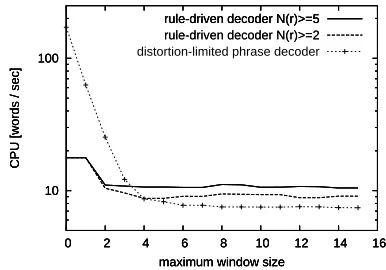
of translation performance and decoding speed. The second column shows the distortion limit used by the two decoders. For the rule-based decoder a max-imum distortion limit w is implemented by filter-ing out all the rule matches where the size of the rule in terms of number of POS symbols is greater than w, i.e. the rule edges are processed mono-tonically but a monotone rule edge sequence for the same rule id may not span more than wsource positions. The third column shows the translation speed in terms of words per second. The fourth column shows the percentage of CPU time needed for the edge generation (including both simple and rule edges). The final three columns report transla-tion results in terms of BLEU,BLEUprecision score (PREC), andTER. The rule-based reorder-ing restriction obtains the best translation scores on the MT06 data: a BLEUscore of37.2 compared to aBLEUscore of36.6for the baseline decoder. The statistical significance interval is rather large: 2.9 % on this test set as text from various gen-res is included. Additional visual evaluation on the dev set data shows that some successful phrase re-ordering is carried out by the rule decoder which is not handled correctly by the baseline decoder. As can be seen from the results reducing the number of rules by filtering all rules that occur at least 5
times (about 10 000 rules) slightly improves trans-lation performance from 37.1 to 37.2. The edge generation accounts for only a small fraction of the overall decoding time. Fig. 3 and Fig. 4 demonstrate additional advantages when using the rule-based de-coder. Fig. 3 shows the translationBLEUscore as a function of the distortion limit window w. The BLEUscore actually decreases for the baseline
de-coder as the sizew is increased. The optimal win-dow size is surprisingly small: w = 2. A simi-lar behavior is also reported in (Moore and Quirk, 2007) wherew= 5is used . For the rule-driven de-coder however the BLEUscore does not decrease for largew: the rules restrict the local re-ordering in the context of potentially very long POS sequences which makes the re-ordering more reliable. Fig. 4 which shows the decoding speed as a function of the window sizewdemonstrates that the rule-based de-coder actually runs faster than the baseline dede-coder for window sizesw≥5.
Figure 3:BLEUscore as a function of window sizew.
10
Figure 4: Decoding speed as a function of window size
w.
6 Discussion and Future Work
The handling of the re-order rules is most similar to work in (Crego and Marino, 2006) where the rules are used to create re-order lattices. To make this feasible, the rules have been vigorously filtered in (Crego and Marino, 2006): only about30rules are used in their experiments. On the contrary, the cur-rent approach tightly integrates the re-order rules into a phrase-based decoder such that 29 000rules can be handled efficiently. In future work our novel approach might allow to make use of lexicalized re-order rules as in (Xia and McCord, 2004) or syntac-tic rules as in (Wang et al., 2007).
7 Acknowledgment
References
Yaser Al-Onaizan and Kishore Papineni. 2006. Dis-tortion Models for Statistical Machine Translation. In Proceedings of ACL-COLING’06, pages 529–536, Sydney, Australia, July.
Adam L. Berger, Peter F. Brown, Stephen A. Della Pietra, Vincent J. Della Pietra, Andrew S. Kehler, and Robert L. Mercer. 1996. Language Translation Ap-paratus and Method of Using Context-Based Trans-lation Models. United States Patent, Patent Number
5510981, April.
David Chiang. 2007. Hierarchical Machine Translation.
Computational Linguistics, 33(2):201–228.
Michael Collins, Philipp Koehn, and Ivona Kucerova. 2005. Clause restructuring for statistical machine translation. In Proc. of ACL’05, pages 531–540, Ann Arbor, Michigan, June. Association for Computational Linguistics.
J.M. Crego and Jos´e B. Marino. 2006. Integration of POStag-based Source Reordering into SMT Decoding by an Extended Search Graph. In Proc. of AMTA06, pages 29–36, Cambridge, MA, August.
Jay Earley. 1970. An Efficient Context-Free Parsing Al-gorithm. Communications of the ACM, 13(2):94–102. Michael A. Harrison. 1978. Introduction to Formal
Lan-guage Theory. Addison Wesley.
Fred Jelinek. 1998. Statistical Methods for Speech Recognition. The MIT Press, Cambridge, MA.
Daniel Jurafsky and James H. Martin. 2000. Speech and
Language Processing. Prentice Hall.
Philipp Koehn, Franz J. Och, and Daniel Marcu. 2003. Statistical phrase-based translation. In
HLT-NAACL’03: Main Proceedings, pages 127–133,
Ed-monton, Alberta, Canada, May 27 - June 1.
Philipp Koehn. 2004. Pharaoh: a Beam Search De-coder for Phrase-Based Statistical Machine Transla-tion Models. In Proceedings of AMTA’04, Washington DC, September-October.
Robet C. Moore and Chris Quirk. 2007. Faster Beam-search Decoding for Phrasal SMT. Proc. of the MT
Summit XI, pages 321–327, September.
Masaaki Nagata, Kuniko Saito, Kazuhide Yamamoto, and Kazuteru Ohashi. 2006. A Clustered Global Phrase Reordering Model for Statistical Machine Translation. In Proceedings of ACL-COLING’06, pages 713–720, Sydney, Australia, July.
Franz-Josef Och and Hermann Ney. 2004. The Align-ment Template Approach to Statistical Machine Trans-lation. Computational Linguistics, 30(4):417–450. Stefan Ortmanns and Hermann Ney. 2000. Progress in
Dynamic Programming Search for LVCSR. Proc. of
the IEEE, 88(8):1224–1240.
Kishore Papineni, Salim Roukos, Todd Ward, and Wei-Jing Zhu. 2002. BLEU: A Method for Auto-matic Evaluation of Machine Translation. In Proc. of
ACL’02, pages 311–318, Philadelphia, PA, July.
Matthias Paulik, Kay Rottmann, Jan Niehues, Silja Hildebrand, and Stephan Vogel. 2007. The ISL Phrase-Based MT System for the 2007 ACL Workshop on SMT. In Proc. of the ACL 2007 Second Workshop
on SMT, June.
Matthew Snover, Bonnie Dorr, Richard Schwartz, Lin-nea Micciulla, and John Makhoul. 2006. A Study of Translation Edit Rate with Targeted Human Annota-tion. In Proc. of AMTA 2006, Boston,MA.
Christoph Tillmann and Tong Zhang. 2007. A Block Bi-gram Prediction Model for Statistical Machine Trans-lation. ACM-TSLP, 4(6):1–31, July.
Christoph Tillmann and Tong Zhang. 2008. An Online Relevant Set Algorithm for Statistical Machine Trans-lation. Accepted for publication in IEEE Transaction
on Audio, Speech, and Language Processing.
Christoph Tillmann. 2006. Efficient Dynamic Program-ming Search Algorithms for Phrase-based SMT. In
Proceedings of the Workshop CHPSLP at HLT’06,
pages 9–16, New York City, NY, June.
Chao Wang, Michael Collins, and Philipp Koehn. 2007. Chinese Syntactic reordering for statistical machine translation. In Proc. of EMNLP-CoNLL’07, pages 737–745, Prague, Czech Republic, July.
Fei Xia and Michael McCord. 2004. Improving a sta-tistical mt system with automatically learned rewrite patterns. In Proc. of Coling 2004, pages 508–514, Geneva, Switzerland, Aug 23–Aug 27. COLING. Yuqi Zhang, Richard Zens, and Hermann Ney. 2007.
Chunk-level Reordering of Source Language Sen-tences with Automatically Learned Rules for Statis-tical Machine Translation. In Proc. of SSST,
NAACL-HLT’07 / AMTA Workshop, pages 1–8, Rochester, NY,
![Table 2: Translation results on the MT06 data. wis the distortion limit.words / secgeneration [%]](https://thumb-us.123doks.com/thumbv2/123dok_us/733155.1082881/7.612.95.517.79.166/table-translation-results-data-distortion-limit-words-secgeneration.webp)