Proceedings of the Workshop on Cognitive Aspects of Computational Language Acquisition, pages 41–48,
A Cognitive Model for the Representation and Acquisition
of Verb Selectional Preferences
Afra Alishahi
Department of Computer Science University of Toronto [email protected]
Suzanne Stevenson
Department of Computer Science University of Toronto [email protected]
Abstract
We present a cognitive model of inducing verb selectional preferences from individ-ual verb usages. The selectional preferences for each verb argument are represented as a probability distribution over the set of semantic properties that the argument can
possess—a semantic profile. The
seman-tic profiles yield verb-specific conceptual-izations of the arguments associated with a syntactic position. The proposed model can learn appropriate verb profiles from a small set of noisy training data, and can use them in simulating human plausibility judgments and analyzing implicit object alternation.
1 Introduction
Verbs have preferences for the semantic properties of the arguments filling a particular role. For ex-ample, the verb eat expects that the object receiving its theme role will have the property of being edi-ble, among others. Learning verb selectional pref-erences is an important aspect of human language acquisition, and the acquired preferences have been shown to guide children’s expectations about miss-ing or upcommiss-ing arguments in language comprehen-sion (Nation et al., 2003).
Resnik (1996) introduced a statistical approach to learning and use of verb selectional preferences. In this framework, a semantic class hierarchy for words is used, together with statistical tools, to in-duce a verb’s selectional preferences for a particu-lar argument position in the form of a distribution
over all the classes that can occur in that position. Resnik’s model was proposed as a model of human learning of selectional preferences that made min-imal representational assumptions; it showed how such preferences could be acquired from usage data and an existing conceptual hierarchy. However, his and later computational models (see Section 2) have properties that do not match with certain cognitive plausibility criteria for a child language acquisition model. All these models use the training data in “batch mode”, and most of them use information theoretic measures that rely on total counts from a corpus. Therefore, it is not clear how the representa-tion of selecrepresenta-tional preferences could be updated in-crementally in these models as the person receives more data. Moreover, the assumption that children have access to a full hierarchical representation of semantic classes may be too strict. We propose an alternative view in this paper which is more plausi-ble in the context of child language acquisition.
In previous work (Alishahi and Stevenson, 2005), we have proposed a usage-based computational model of early verb learning that uses Bayesian clus-tering and prediction to model language acquisition and use. Individual verb usages are incrementally grouped to form emergent classes of linguistic con-structions that share semantic and syntactic proper-ties. We have shown that our Bayesian model can incrementally acquire a general conception of the semantic roles of predicates based only on expo-sure to individual verb usages (Alishahi and Steven-son, 2007). The model forms probabilistic associa-tions between the semantic properties of arguments, their syntactic positions, and the semantic primitives
of verbs. Our previous experiments demonstrated that, initially, this probability distribution for an ar-gument position yields verb-specific conceptualiza-tions of the role associated with that position. As the model is exposed to more input, the verb-based roles gradually transform into more abstract representa-tions that reflect the general properties of arguments across the observed verbs.
A shortcoming of the model was that, because the prediction of the semantic roles was based only on the groupings of verbs, it could not make use of verb-specific knowledge in generating expectations about a particular verb’s arguments. That is, once it was exposed to a range of verbs, it no longer had access to the verb-specific information, only to gen-eralizations over clusters of verbs.
In this paper, we propose a new version of our model that, in addition to learning general seman-tic roles for constructions, can use its verb-specific knowledge to predict intuitive selectional prefer-ences for each verb argument position. We introduce a new notion, a verb semantic profile, as a prob-ability distribution over the semantic properties of an argument for each verb. A verb semantic pro-file is predicted from both the verb-based and the construction-based knowledge that the model has learned through clustering, and reflects the prop-erties of the arguments that are observed for that verb. Our proposed prediction model makes appro-priate generalizations over the observed properties, and captures expectations about previously unseen arguments.
As in other work on selectional preferences, the semantic properties that we use in our representa-tion of arguments are drawn from a standard lex-ical ontology (WordNet; Miller, 1990), but we do not require knowledge of the hierarchical structure of the WordNet concepts. From the computational point of view, this makes use of an available re-source, while from the cognitive view, this avoids ad hoc assumptions about the representation of a conceptual hierarchy. However, we do require some properties to be more general (i.e., shared by more words) than others, which eventually enables the model to make appropriate generalizations. Other-wise, the selected semantic properties are not fun-damental to the model, and could in the future be replaced with an approach that is deemed more
ap-propriate to child language acquisition. Each argu-ment contributes to the semantic profile of the verb through its (potentially large) set of semantic prop-erties instead of its membership in a single class. As input to our model, we use an automatically parsed corpus, which is very noisy. However, as a result of our novel representation, the model can induce and use selectional preferences using a relatively small set of noisy training data.
2 Related Computational Models
A variety of computational models for verb selec-tional preferences have been proposed, which use different statistical models to induce the preferences
of each verb from corpus data. Most of these
models, however, use the same representation for verb selectional preferences: the preference can be thought of as a mapping, with respect to an argument position for a verb, of each class to a real number (Light and Greiff, 2002). The induction of a verb’s preferences is, therefore, modeled as using a set of training data to estimate that number.
Resnik (1996) defines the selectional preference strength of a verb as the divergence between two probability distributions: the prior probabilities of the classes, and the posterior probabilities of the classes given that verb. The selectional association of a verb with a class is also defined as the contribu-tion of that class to the total seleccontribu-tional preference strength. Resnik estimates the prior and posterior probabilities based on the frequencies of each verb and its relevant argument in a corpus.
Li and Abe (1998) model selectional preferences of a verb (for an argument position) as a set of nodes in the semantic class hierarchy with a probability distribution over them. They use the Minimum De-scription Length (MDL) principle to find the best set for each verb and argument based on the usages of that verb in the training data. Clark and Weir (2002) also find an appropriate set of concept nodes to rep-resent the selectional preferences for a verb, but do
so using aχ2 test over corpus frequencies mapped
and Light (1999) use a different representational ap-proach: they train a separate hidden Markov model for each verb, and the selectional preference is rep-resented as a probability distribution over words in-stead of semantic classes.
3 The Bayesian Verb-Learning Model
3.1 Overview of the Model
Our model learns the set of argument structure
frames for each verb, and their grouping across verbs
into constructions. An argument structure frame is a set of features of a verb usage that are both syn-tactic (the number of arguments, the synsyn-tactic pat-tern of the usage) and semantic (the semantic prop-erties of the verb, the semantic propprop-erties of each argument). The syntactic pattern indicates the word order of the verb and arguments. A construction is a grouping of individual frames which probabilisti-cally share syntactic and semantic features, and form probabilistic associations across verb semantic prop-erties, argument semantic propprop-erties, and syntactic
pattern. These groupings typically correspond to
general constructions in the language such as tran-sitive, intrantran-sitive, and ditransitive.
For each verb, the model associates an argument position with a probability distribution over a set of semantic properties—a semantic profile. In doing so, the model uses the knowledge that it has learned for that verb, as well as the grouping of frames for that verb into constructions.
The semantic properties of words are taken from WordNet (version 2.0) as follows. We extract all the hypernyms (ancestors) for all the senses of the word, and add all the words in the hypernym synsets to the list of the semantic properties. Figure 1 shows an ex-ample of the hypernyms for dinner, and its resulting
set of semantic properties.1
The following sections review basic properties of the model from Alishahi and Stevenson (2005, 2007), and introduce extensions that give the model its ability to make verb-based predictions.
3.2 Learning as Bayesian Clustering
Each argument structure frame for an observed verb usage is input to an incremental Bayesian clustering
1
We do not remove alternate spellings of a term in WordNet; this will be seen in the profiles in the results section.
Sense 1 dinner
=> meal, repast
=> nutriment, nourishment, nutrition, sustenance, aliment, alimentation, victuals
=> food, nutrient => substance, matter
=> entity Sense 2
dinner, dinner party => party
=> social gathering, social affair => gathering, assemblage
=> social group => group, grouping
dinner:{meal, repast, nutriment, nourishment, nutrition, substance, aliment, alimentation, victuals, food, nutrient, substance, matter, entity, party, social gathering, social affair, gathering, assemblage, social group, group, grouping}
Figure 1: Semantic properties for dinner from Word-Net
process. This process groups the new frame together with an existing group of frames—a construction— that probabilistically has the most similar semantic and syntactic properties to it. If no construction has sufficiently high probability for the new frame, then a new construction is created for it. We use the prob-abilistic model of Alishahi and Stevenson (2007) for learning constructions, which is itself an adaptation of a Bayesian model of human categorization pro-posed by Anderson (1991). It is important to note that the categories (i.e., constructions) are not prede-fined, but rather are created according to the patterns of similarity over observed frames.
Grouping a frameF with other frames
participat-ing in constructionkis formulated as finding thek
with the maximum probability givenF:
BestConstruction(F) = argmax k
P(k|F) (1)
wherekranges over the indices of all constructions,
with index 0 representing recognition of a new con-struction.
Using Bayes rule, and dropping P(F) which is
constant for allk:
P(k|F) = P(k)P(F|k)
P(F) ∝ P(k)P(F|k) (2)
The prior probability, P(k), indicates the degree of
entrenchment of constructionk, and is given by the
relative frequency of its frames over all observed
frames. The posterior probability of a frame F is
P(F|k) = Y i∈FrameFeatures
Pi(j|k) (3)
where j is the value of the ith feature of F, and
Pi(j|k) is the probability of displaying value j on
featureiwithin constructionk. Given the focus here
on semantic profiles, we next focus on the calcula-tion of the probabilities of semantic properties.
3.3 Probabilities of Semantic Properties
The probability in equation (3) of valuejfor feature
i in construction k is estimated using a smoothed
version of this maximum likelihood formula:
Pi(j|k) = count k i(j)
nk
(4)
where nk is the number of frames participating in
construction k, and countk
i(j) is the number of
those with valuejfor featurei.
For most features, countki(j) is calculated by
simply counting those members of construction k
whose value for feature iexactly matchesj.
How-ever, for the semantic properties of words, counting only the number of exact matches between the sets is too strict, since even highly similar words very rarely have the exact same set of properties. We instead use the following Jaccard similarity score to measure the overlap between the set of semantic
properties,SF, of a particular argument in the frame
to be clustered, and the set of semantic properties,
Sk, of the same argument in a member frame of a
construction:
sem score(SF, Sk) =
|SF ∩Sk|
|SF ∪Sk|
(5)
For example, assume that the new frameF
repre-sents a usage of John ate cake. In the construction
that we are considering for inclusion of F, one of
the member frames represents a usage of Mom got
water. We must compare the semantic properties of
the corresponding arguments cake and water:
cake: {baked goods,food,solid,substance,matter,entity}
water: {liquid,fluid,food,nutrient,substance,matter,entity}
The intersection of the two sets is{food, substance,
matter, entity}, yielding asem scoreof 49.
In general, to calculate the conditional probability
for the set of semantic properties, we setcountki(j)
in equation (4) to the sum of the sem score’s for
the new frame and every member of constructionk,
and normalize the resulting probability over all pos-sible sets of semantic properties in our lexicon.
3.4 Predicting Semantic Profiles for Verbs
We represent the selectional preferences of a verb for an argument position as a semantic profile, which is a probability distribution over all the semantic
properties. To predict the profile of a verb v for
an argument positionarg, we need to estimate the
probability of each semantic propertyjseparately:
Parg(j|v) = X
k
Parg(j, k|v) (6)
∝ X
k
P(k, v)Parg(j|k, v)
Here,jranges over all the possible semantic
proper-ties that an argument can have, andkranges over all
constructions. The prior probability of having verbv
in constructionk, orP(k, v), takes into account two
important factors: the relative entrenchment of the
construction k, and the (smoothed) frequency with
whichvparticipates ink.
The posterior probability Parg(j|k, v) is
calcu-lated analogously toPi(j|k)in equation (4), but
lim-iting the count of matching features to those frames
inkthat containv:
Parg(j|k, v) = verb count k
arg(j, v) nkv
(7)
wherenkv is the number of frames for v
participat-ing in construction k, and verb countkarg(j, v) is
the number of those with semantic property j for
argument arg. We use a smoothed version of the
above formula, where the relative frequency of each
propertyjamong all nouns is used as the smoothing
factor.
3.5 Verb-Argument Compatibility
In one of our experiments, we need to measure the
compatibility of a particular nounnfor an argument
positionargof some verbv. That is, we need to
es-timate how much the semantic properties ofn
con-form to the acquired semantic profile of v forarg.
We formulate the compatibility as the conditional
probability of observingnas an argumentargofv:
where jn is the set of the semantic properties for
word n, and Parg(jn|v) is estimated as in
equa-tion (7). However, since jn here is a set of
prop-erties (as opposed to j in equation (7) being a
single property), verb countkarg in equation (7)
should be modified as described in Section 3.3:
we set verb countkarg(jn, v) to the sum of the
sem score’s (equation (5)) forjnand every frame
ofvthat participates in constructionk.
4 Experimental Results
In the following sections, we first describe the train-ing data for our model. In accordance with other computational models, we focus here on the verb
preferences for the direct object position.2 Next, we
provide a qualitative analysis of our model through examination of the semantic profiles for a number of verbs. We then evaluate our model through two tasks of simulating verb-argument plausibility judg-ment, and analyzing the implicit object alternation,
following Resnik (1996).3
4.1 The Training Data
In earlier work (Alishahi and Stevenson, 2005, 2007), we used a method to automatically generate training data with the same distributional properties as the input children receive. However, this relies on manually-compiled data about verbs and their argu-ment structure frames from the CHILDES database (MacWhinney, 1995). To evaluate the new version of our model for the task of learning selectional pref-erences, we need a wide selection of verbs and their arguments that is impractical to compile by hand.
The training data for our experiments here are
generated as follows. We use 20,000 sentences
randomly selected from the British National
Cor-pus (BNC),4automatically parsed using the Collins
parser (Collins, 1999), and further processed with
TGrep2,5and an NP-head extraction software.6 For
2
To our knowledge, the only work that considers selectional preferences of subjects and prepositional phrases as well as di-rect objects is Brockmann and Lapata (2003).
3
Computational models of verb selectional preference have been evaluated through disambiguation tasks (Li and Abe, 1998; Abney and Light, 1999; Ciaramita and Johnson, 2000; Clark and Weir, 2002), but for to evaluate our cognitive model, the experiments from Resnik (1996) are the most interesting.
4http://www.natcorp.ox.ac.uk 5http://tedlab.mit.edu/∼dr/Tgrep2
6
The software was provided to us by Eric Joanis, and
Af-each verb usage in a sentence, we construct a frame by recording the verb in root form, the number of the arguments for that verb, and the syntactic pattern of the verb usage (i.e., the word order of the verb and the arguments). We also record in the frame the semantic properties of the verb and each of the ar-gument heads (each noun is also converted to root form); these properties are extracted from WordNet (as discussed in Section 3.1 and illustrated in Fig-ure 1). This process results in 16,300 frames which serve as input data to our learning model.
4.2 Formation of Semantic Profiles for Verbs
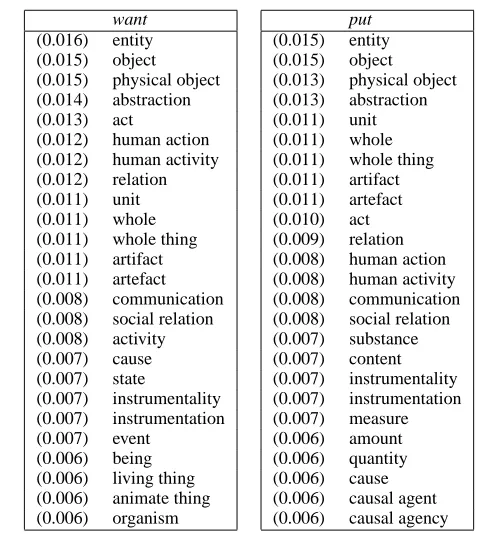
After training our model on the above data, we use equation (7) to predict the semantic profile of the di-rect object position for a range of verbs. Some of these verbs, such as write and sing, have strong se-lectional preferences, whereas others, such as want and put, can take a wide range of nouns as direct object (as confirmed by Resnik’s (1996) estimated strength of selectional preference for these verbs). The semantic profiles for write and sing are dis-played in Figure 2, and the profiles for want and put are displayed in Figure 3. (Due to limited space, we only include the 25 properties that have the highest probability in each profile.)
Because we extract the semantic properties of words from WordNet, which has a hierarchical structure, the properties that come from nodes in the higher levels of the hierarchy (such as entity and
abstraction) appear as the semantic property for a
very large set of words, whereas the properties that come from the leaves in the hierarchy are specific to a small set of words. Therefore, the general prop-erties are more likely to be associated with a higher probability in the semantic profiles for most verbs. In fact, a closer look at the semantic profiles for want and put reveals that the top portion of the semantic profile for these verbs consists solely of such gen-eral properties that are shared among a large group of words. However, this is not the case for the more restrictive verbs. The semantic profiles for write and
sing show that the specific properties that these verbs
demand from their direct object appear amongst the highest-ranked properties, even though only a small set of words share these properties (e.g., content,
write
(0.009) piece of music (0.009) psychological
Figure 2: Semantic profiles of write and sing for the direct object position.
message, written communication, written language, ... for write, and auditory communication, music, musical composition, opus, ... for sing).
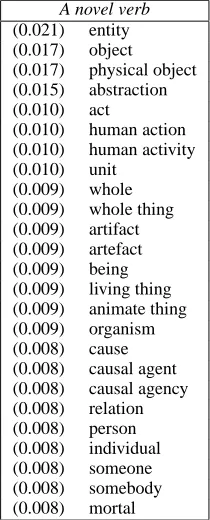
The examination of the semantic profiles for fairly frequent verbs in the training data shows that our model can use the verb usages to predict an appro-priate semantic profile for each verb. When pre-sented with a novel verb (for which no verb-based information is available), equation (7) predicts a se-mantic profile which reflects the relative frequencies of the semantic properties among all words (due to the smoothing factor added to equation (7)), modu-lated by the prior probability of each construction. The predicted profile is displayed in Figure 4. It shows similarities with the profiles for want and put in Figure 3, but the general properties in this profile have an even higher probability. Since the profile for the novel verb is predicted in the absence of any evi-dence (i.e., verb usage) in the training data, we later use it as the base for estimating other verbs’ strength of selectional preference.
Figure 3: Semantic profiles of want and put for the direct object position.
4.3 Verb-Argument Plausibility Judgments
Holmes et al. (1989) evaluate verb argument plau-sibility by asking human subjects to rate sentences like The mechanic warned the driver and The
me-chanic warned the engine. Resnik (1996) used this
data to assess the performance of his model by com-paring its judgments of selectional fit against the plausibility ratings elicited from human subjects. He showed that his selectional association measure for a verb and its direct object can be used to select the more plausible verb-noun pair among the two (e.g.,
<warn,driver>vs. <warn,engine>in the previous
example). That is, a higher selectional association between the verb and one of the nouns compared to the other noun indicates that the former is the more plausible pair. Resnik (1996) used the Brown corpus as training data, and showed that his model arrives at the correct ordering of more and less plausible ar-guments in 11 of the 16 cases.
We repeated this experiment, using the same 16 pairs of verb-noun combinations. For each pair of
<v, n1> and <v, n2>, we calculate the
A novel verb
(0.021) entity (0.017) object (0.017) physical object (0.015) abstraction (0.010) act
(0.010) human action (0.010) human activity (0.010) unit
(0.009) whole (0.009) whole thing (0.009) artifact (0.009) artefact (0.009) being (0.009) living thing (0.009) animate thing (0.009) organism (0.008) cause (0.008) causal agent (0.008) causal agency (0.008) relation (0.008) person (0.008) individual (0.008) someone (0.008) somebody (0.008) mortal
Figure 4: Semantic profile of a novel verb for the direct object position.
log-probabilities and therefore negative numbers,
a lower absolute value of compatibility(v, n)
shows a better compatibility between the verb v
and the argument n.) For example, <see,friend>
has a higher compatibility score (-30.50) than
<see,method> (-32.14). Similar to Resnik, our
model detects 11 plausible pairs out of 16. How-ever, these results are reached with a much smaller training corpus (around 500,000 words), compared to the Brown corpus used by Resnik (1996) which contains one million words. Moreover, whereas the Brown corpus is tagged and parsed manually, the portion of the BNC that we use is parsed automat-ically, and as a result our training data is very noisy. Nonetheless, the model achieves the same level of accuracy in distinguishing plausible verb-argument pairs from implausible ones.
4.4 Implicit Object Alternations
In English, some inherently transitive verbs can ap-pear with or without their direct objects (e.g., John
ate his dinner as well as John ate), but others
can-not (e.g., Mary made a cake but can-not *Mary made). It is argued that implicit object alternations involve a
Verb Plausible Implausible
see friend -30.50 method -32.14
read article -32.76 fashion -33.33
find label -32.05 fever -33.30
hear story -32.11 issue -32.40
write letter -31.37 market -32.46 urge daughter -36.73 contrast -35.64
warn driver -33.68 engine -34.42
judge contest -39.05 climate -38.23 teach language -45.64 distance -45.11
show sample -31.75 travel -31.42
expect visit -33.88 mouth -32.87
answer request -31.89 tragedy -33.95 recognize author -32.53 pocket -32.62 repeat comment -33.80 journal -33.97 understand concept -32.25 session -32.93 remember reply -33.79 smoke -34.29
Figure 5: Compatibility scores for plausible vs. im-plausible verb-noun pairs.
particular relationship between the verb and its argu-ment. In particular, for verbs that participate in the implicit object alternation, the omitted object must be in some sense inferable or typical for that verb (Levin, 1993, among others).
Resnik (1996) used his model of selectional pref-erences to analyze implicit object alternations, and showed a relationship between his measure of se-lectional preference strength and the notion of
typ-icality of an object. He calculated this measure
for two groups of Alternating and Non-alternating verbs, and showed that, on average, the Alternating verbs have a higher strength of selectional prefer-ence for the direct object than the Non-alternating verbs. However, there was no threshold separating the two groups of verbs.
Alternating verbs Non-alternating verbs
write 0.61 hang 0.56
sing 0.67 wear 0.71
drink 0.67 say 0.75
eat 0.74 catch 0.76
play 0.74 show 0.77
pour 0.76 make 0.78
watch 0.77 hit 0.78
pack 0.78 open 0.81
steal 0.80 take 0.83
push 0.80 see 0.87
call 0.80 like 0.87
pull 0.80 get 0.87
explain 0.81 find 0.87
read 0.82 give 0.88
hear 0.87 bring 0.89
want 0.89
put 0.90
Mean: 0.76 Mean: 0.81
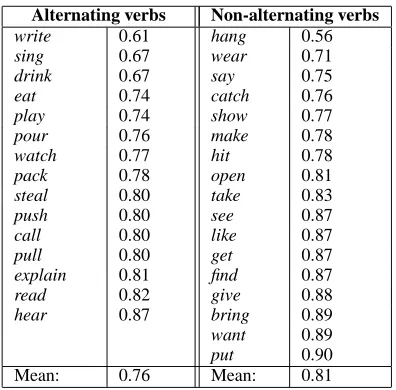
Figure 6: Similarity with the base profile for Alter-nating and Non-alterAlter-nating verbs.
than verbs with stronger preferences. We use the
cosine measure to estimate the similarity between
two profilespandq:
cosine(p, q) = p×q
||p|| × ||q|| (9)
The similarity values for the Alternating and Non-alternating verbs are shown in Figure 6. The larger values represent more similarity with the base pro-file, which means a weaker selectional preference. The means for the Alternating and Non-alternating verbs were respectively 0.76 and 0.81, which con-firm the hypothesis that verbs participating in im-plicit object alternations select more strongly for the direct objects than verbs that do not. However, like Resnik (1996), we find that it is not possible to set a threshold that will distinguish the two sets of verbs.
5 Conclusions
We have proposed a cognitively plausible model for learning selectional preferences from instances of verb usage. The model represents verb selectional preferences as a semantic profile, which is a prob-ability distribution over the semantic properties that an argument can take. One of the strengths of our model is the incremental nature of its learning mech-anism, in contrast to other approaches which learn selectional preferences in batch mode. Here we have only reported the results for the final stage of learn-ing, but the model allows us to monitor the semantic
profiles during the course of learning, and compare it with child data for different age groups, as we do with semantic roles (Alishahi and Stevenson, 2007). We have shown that the model can predict appropri-ate semantic profiles for a variety of verbs, and use these profiles to simulate human judgments of verb-argument plausibility, using a small and highly noisy set of training data. The model can also use the pro-files to measure verb-argument compatibility, which was used in analyzing the implicit object alternation.
References
Abney, S. and Light, M. (1999). Hiding a semantic hierarchy in a Markov model. In Proc. of the ACL Workshop on
Unsu-pervised Learning in Natural Language Processing.
Alishahi, A. and Stevenson, S. (2005). A probabilistic model of early argument structure acquisition. In Proc. of the CogSci
2005.
Alishahi, A. and Stevenson, S. (2007). A computational usage-based model for learning general properties of semantic roles. In Proc. of the EuroCogSci 2007.
Anderson, J. R. (1991). The adaptive nature of human catego-rization. Psychological Review, 98(3):409–429.
Brockmann, C. and Lapata, M. (2003). Evaluating and com-bining approaches to selectional preference acquisition. In
Proc. of the EACL 2003.
Ciaramita, M. and Johnson, M. (2000). Explaining away am-biguity: Learning verb selectional preference with Bayesian networks. In Proc. of the COLING 2000.
Clark, S. and Weir, D. (2002). Class-based probability estima-tion using a semantic hierarchy. Computaestima-tional Linguistics, 28(2):187–206.
Collins, M. (1999). Head-Driven Statistical Models for Natural
Language Parsing. PhD thesis, University of Pennsylvania.
Holmes, V. M., Stowe, L., and Cupples, L. (1989). Lexical expectations in parsing complement-verb sentences. Journal
of Memory and Language, 28:668–689.
Levin, B. (1993). English verb classes and alternations: A
pre-liminary investigation. The University of Chicago Press.
Li, H. and Abe, N. (1998). Generalizing case frames using a thesaurus and the MDL principle. Computational
Linguis-tics, 24(2):217–244.
Light, M. and Greiff, W. (2002). Statistical models for the in-duction and use of selectional preferences. Cognitive
Sci-ence, 26(3):269–281.
MacWhinney, B. (1995). The CHILDES project: Tools for
an-alyzing talk. Lawrence Erlbaum.
Miller, G. (1990). WordNet: An on-line lexical database.
Inter-national Journal of Lexicography, 17(3).
Nation, K., Marshall, C. M., and Altmann, G. T. M. (2003). In-vestigating individual differences in children’s real-time sen-tence comprehension using language-mediated eye move-ments. J. of Experimental Child Psych., 86:314–329. Resnik, P. (1996). Selectional constraints: An