PoCoS – Potsdam Coreference Scheme
1Olga Krasavina
Moscow State University
[email protected]
Christian Chiarcos
University of Potsdam
[email protected]
Abstract
1This document outlines minimal design principles underlying annotation of coreference relations in PoCoS, a scheme for cross-linguistic anaphoric annotation. We identify language-independent princi-ples for markable identification which are essential for comparability of annotations produced for different languages. We fur-ther suggest a clear and motivated structure of annotation stages, the separation of a coarse-grained core and a family of more elaborate extended schemes, and strategies for the systematic treatment of ambiguity. Explicit mark-up of ambiguities is a novel feature. We implemented three instantia-tions of PoCoS for German, English and Russian applied to corpora of newspaper texts.
1
Introduction
Anaphoric annotation is notoriously problematic because of ambiguity and subjectivity issues. One has to deal with them at two stages: 1) by design-ing annotation guidelines; 2) by performdesign-ing anno-tation. As for 1), it is a well-known problem that different schemes propose different annotation de-cisions. As for 2), different annotators may have different judgments on coreference-related issues. The current paper focuses on the general principles and strategies of annotating coreference – the theo-retical core that should logically precede any anno-tation decisions or schemes, but has not been for-mulated explicitly by now.
The number of existing schemes released just in the last few years is overwhelming and is out of the
1The research by Olga Krasavina was supported by Russian Foundation for the Humanities, grant 05-04-04240а.
scope here. The MUC is still generally accepted as the most standard-like annotation scheme (Hirschman, 1997). Given its simplicity is its most important advantage, it has been criticized for its limited coverage and its contra-intuitive under-standing of coreference. One of the most well-known later approaches is MATE/GNOME (Poe-sio, 2004). As the author fairly notices, “there can be no such thing as a general-purpose anaphoric annotation instructions”, due to the complexity of phenomena associated with the term of anaphora. So, its essential idea is combining a “general-purporse markup scheme” (MATE) with applica-tion-specific scheme instantiations (GNOME). In PoCoS, we adapted and elaborated this idea, by suggesting the Core and Extended Schemes.
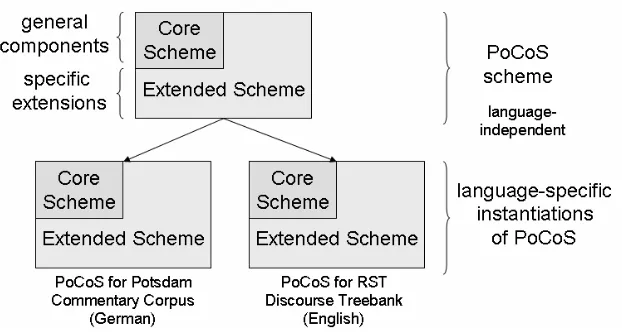
The PoCoS, the Potsdam Coreference Scheme, both adapts selected features of existing schemes and implements a set of innovative features. We distinguish between the Core and Extended Scheme: the Core Scheme is general and reusable, while the Extended Scheme supports a wider range of specific extensions, see fig. 1. Here, we are talk-ing about English and German instantiations of the PoCoS Core Scheme.
2 Coreference annotation
Coreference is a relation between textual elements, “referring expressions”, which denote the same entity. Semantically, these expressions are proto-typical objects or “(discourse) referents” (Kart-tunen, 1976). Given a pair of two coreferring ex-pressions, the preceding expression is termed ante-cedent, the subsequent one is termed anaphor.
the substitution of anaphor and antecedent yield the same interpretation of the text, these are deemed coreferential.
Syntactically, a markable is typically a phrase with a nominal or a pronominal head. According to the referential properties a syntactic construction typically has, we distinguish between primary markables, i.e. potential anaphors, and secondary markables, expressions which can not serve as
anaphors, but only as antecedents.
3
Annotation principles
3.1 A principled approach
In order to develop an annotation scheme which is maximally consistent, we initially identified a set of axiomatic requirements:
• CONSTITUENCY
o a primary or secondary markable must be an independent syntactic constituent
• COMPLETENESS
o neither sub-tokens nor non-phrasal nomi-nals are subject to annotation, only syntac-tic words (tokens) and phrases are
• CONSISTENCY
o corresponding features have to be analyzed in a corresponding way
CONSTITUENCY and COMPLETENESS are necessary
pre-conditions for an alignment between syntactic and anaphoric annotation, CONSISTENCY implies
that annotation principles must be formulated in a way that allows for inter-subjective and cross-linguistically valid annotation decisions. While
CONSTITUENCY and COMPLETENESS define
con-straints for markable identification, consistency also affects selection preferences among potential antecedents, and it motivates the explicit represen-tation of anaphoric ambiguity in PoCoS.
In addition to these requirements, we add the preference for MAXIMAL ANALYSIS. It suggests longer anaphoric chains are preferred to the shorter ones by annotation. This defines preferences for coding decisions by ambiguity (see 4.1).
In the remainder of this section, annotation prin-ciples employed in the PoCoS scheme are shortly presented and discussed as to their relationship to these four requirements.
3.2 Markable identification
Cross-linguistically consistent markable identifica-tion strategies are a necessary pre-condiidentifica-tion for a comparative evaluation of anaphor annotation and anaphor resolution across different languages. It has been controversial, however, how to set mark-able boundaries. So, for example, Ge et al. (1998) and, MUC (Hirschman, 1997) propose a minimal string constraint motivated by evaluation consid-erations. This procedure leads to systematic viola-tions of the CONSTITUENCY and COMPLETENESS
principles, though, cf. the potential markables Denver and bankruptcy in ex. (1)
(1) The [Denver]?-based con-cern, which emerged from ban-cruptcy ... its new, post-[bancruptcy]? law structure ..." (WSJ, 1328)
We explicitly propose a maximum size principle as an alternative to the minimum string constraint (see Principle 1 below). So, a markable consists of the head, usually a noun or a pronoun, and of all modifiers, attributes, relative clauses, appositions, and dislocated elements attached to the head.
Principle 1 Maximum size
One markable includes all modifications of its head.
Prepositions can be regarded as modifications of a noun as well, and following this line of argumentation, the seemingly clear-cut differentiation between NPs and PPs becomes questionable, cf. the unclear status of Japanese postpositions that can also be interpreted as morphological case markers (Givón 2001:115f).
Further, in most European languages, functional elements such as prepositions and determiners tend to be fused. In combination with the
COMPLETENESS constraint, a possible
NP-preference for the selection of markables will result in the selection of either PPs or non-phrasal markables if preposition-determiner fusion occurs.
considerations call for the choice of PPs rather than NPs as markables where possible.
Principle 2 Syntactic characterization
If a referring expression is modified by func-tion words, e.g. a determiner or an adposifunc-tion, these are to be integrated into the markable. Like Principle 1, Principle 2 originates from CON-SISTENCY and COMPLETENESS requirements
ap-plied both within one language and considering
cross-linguistic validity, as the function of inflec-tional marking in one language and the function of prepositions in another language are exchangeable. If a markable includes another markable, both are specified as markables in annotation. Such treatment provides consistency across languages, (cf. the fragment of parallel text in ex. 2), and has an additional advantage of representing the syntac-tic structure of a markable.
(2)[Dieses Recht]right kann nicht in Anspruch genommen werden [im
Falle einer Strafverfolgung auf Grund von Handlungen, die [gegen die Ziele [der Vereinten Nationen]UN]purp verstoßen]prosec.
[This right]right may not be invoked [in the case of prosecutions
arising from acts contrary [to the purposes [of the United Na-tions]UN]purp]prosec.
[Это право]right не может быть использовано [в случае преследования,
основанного на совершении деяния, противоречащего [целям
[Организации Объединенных Наций]UN]purp]prosec. (www.unhchr.ch/udhr,
shortened)
3.3
Antecedent selection
For interconnecting co-referring expressions three basic strategies can be employed: (i) leave this de-cision to an annotator, (ii) connect all mentions to the first one, or (iii) connect each following men-tion to the immediately preceding one. In line with previous research and in order to enhance consis-tency, we opted for (iii), as Principle 3 states:
Principle 3 Chain principle
Mark the most recent mention of a referent as antecedent, so that all mentions of the same ref-erent make up an ordered chain.
Possessive pronouns can often be used at the be-ginning of a sentence, in case they are resolved in the same sentence as in (3) and (4). The chain principle suggests selecting a pronoun as the chain-initial element which is contra-intuitive in this case: a pronoun introduces no lexical material which serves for subsequent re-identification of a referent. In order to respect the inter-subjective intuition to identify the controller of the possessive as a markable, we posit an exception to the chain principle for the case of pronominal cataphora. According to the CONSISTENCY requirement (see
3.1), any bound pronoun, no matter if its is
chain-Principle 4 Cataphora at sentence level
If a pronoun which is typically used as a bound pronoun is bound by an intrasentential controller, annotate a pointing relation to the controller rather than to a candidate antecedent in previous dis-course.
In the Core Scheme for German, English and Russian, Principle 4 applies to possessive pronouns only.
(3) Through [his]a lawyers,
[Mr. Antar]a has denied
alle-gations in the SEC suit…(WSJ, 3) (4) [Die einstige Fußball-Weltmacht]d zittert [vor einem
Winzling]s. Mit [seinem]s Tor
zum 1:0 [für die Ukraine]u
stürzte [der 1,62 Meter große Gennadi Subow]s [die deutsche
Nationalelf]d vorübergehend in
ein Trauma… (PCC, 10374)
3.4 Identifying pointing relations
A special case for annotation is pronominal or nominal reference by plural or NPs or both to mul-tiple concrete antecedents mentioned at different
points in a text. Thus, they cannot be regarded as single constituent. Since a referent of a plural NP is not the same as the sum of its parts, we deal with multiple antecedents by introducing a separate an-notation layer called groups. Group referents are
linked to their anaphors by regular anaphoric rela-tions, see (5).
(5) [Montedison]m now owns
about 72% of [Erbamont’s]e
shares outstanding. [The com-panies]m+e said … a sale of all
of [Erbamont’s]e assets ...
[to Montedison]m … [The
compa-nies]m+e said … (WSJ, 660)
Special treatment of groups is important as they introduce an exception to the Chain Principle. Formally, the same group of people can be referred to at different points of time. However, following the preference for MAXIMAL ANALYSIS (see 3.1), longer anaphoric chains are preferred, and thus, once a pre-established group reference exists, it is marked as an antecedent instead of establishing a new group referent. Accordingly, in ex. (5), the preferred antecedent of the second companies is the previously established group reference The companies. More generally, this is formulated in Principle 5.
Principle 5 Maximize anaphoric chains
The annotation of anaphoric references is pre-ferred over the annotation of alternative analy-ses.
This principle is motivated by CONSISTENCY and
coverage considerations.
4
Dealing with vagueness
4.1 Ambiguity resolution strategies
The problem of identifying an appropriate pointing relation is especially acute in connection with ana-phoric ambiguity. As opposed to general annota-tion strategies, however, the ambiguity strategies apply only in case of doubt, i.e. if the annotator perceives different readings as equally possible. Consider ex. (6) as a continuation of ex. (4):
(6) Je kleiner [die
Ki-cker]u?/d? daherkommmen, desto
größer wird [der Gegner]d?/u?
geredet. (PCC, 10374)
„The smaller [the kickers]u?/d? are, the greater [the rivals]d?/u? are rumoured to be.” Antecedent of die Kicker “kickers” depends on the understanding of the “size” metaphor, it can be either the Ukrainian team (presented as having short players), or the German team (which has not been favored in the first match), or a generic description (which would mean that the sentence is not directly linked with the discourse). Here, also Principle 5 can be applied, since we are facing alternative readings, and accordingly, the generic reading in the example is excluded. This application of Principle 5 is reformulated in Principle 6.
Principle 6 Primacy of anaphora
In case of uncertainty between different read-ings prefer anaphoric interpretation to antece-dentless one.
However, in the example under consideration, we still have the choice between two possible antecedents. The substitution test (see Sec. 2) fails to determine a unique antecedent, as both possible substitutions are plausible, depending on whether “size” refers to physical size or an-ticipated defeat. From the preference for MAXI-MAL ANALYSIS, however, a more rigid version of Principle 5 can be motivated, cf. Principle 7.
Principle 7 Avoid ambiguous antecedents
In case of two possible antecedents, primary markable is preferred to secondary ones or to group referents.
In case of two primary markables are possible antecedents, choose the one which leads to the longer anaphoric chain.
In ex. (6), this results in a preference for the Ger-man team as the antecedent of die Kicker.
Principle 8 Primary markables as preferred antecedents
Prefer antecedents which are unambiguous in their reference to antecedents which are am-biguous.
4.2 Annotation of ambiguities
In order to investigate the effect of ambiguity and to document its influence on inter-annotator-agreement, ambiguities are to be explicitly marked. For this purpose, we classified ambiguities as fol-lows.
Ambiguous antecedent ambiguity of
antece-dent of a markable, cf. (6).
Ambiguous relation ambiguity wrt relation
be-tween a markable and the context:
(7) Weil [die Polizei]p das
weiß, richten sich [die Beam-ten]? … auf viele Anzeigen ...
ein. (PCC, 19442)
“As [the police]p knows this, [the officials]? are expecting … a lot of statements…”
The relation between “the police” and “the po-licemen” is either bridging (part-whole) or
corefer-ence.
Ambiguous idiomatic ambiguity wrt whether a
markable could be either understood as coreferen-tial or as a part of an idiom. In (8), der Spatz in der Hand, a definite NP in German, can be generic,
part of an idiom, or referring:
(8) Lieber [der Spatz in der Hand] als [die Taube auf dem Dach] (PCC, 12666)
„A bird in the hand is worth two in the bush” (Context: a mayor finds an investor for his town willing to make only minimal investments).
5
PoCoS annotation scheme
PoCoS disposes of three annotation levels: mark-ables, relations and attributes (5.1, 5.2. and 5.3). In what follows, we concentrate on the Core Scheme because of relevance and space considerations.
5.1 Markables
Primary markables are all potential anaphors, i.e.
referential forms which can be used to indicate subsequent mentions of a previously introduced referent in the discourse, such as definite NPs, pro-nouns, and proper names. Secondary markables are
(e.g. indefinites; in the Extended Scheme also clauses). Secondary markables are subject to anno-tation only if they serve as antecedents of a pri-mary markable.
The basic distinctive feature between primary and secondary markables is if they can refer to previously mentioned nominals or not. Using the above-mentioned grammatical criteria, most prob-able referring expressions (i.e. primary markprob-ables) can be extracted automatically from syntactic an-notation, which is an important advantage.
Further, using this differentiation a more precise definition of the coreference annotation task can be given. Coreference annotation is complete, if all
primary markables are classified as having an an-tecedent or not.
5.2 Coreference Relations
We distinguish between two types of coreference: nominal and non-nominal. The Core Scheme only deals with nominal coreference, which we define
as reference of NPs to explicitly mentioned NPs establishing a relation of identity (cf. Mitkov’s (2002) “identity-of-reference direct nominal anaphora”). If a relation other than identity holds between a primary markable and an element from the preceding context, e.g. the bridging relation, the relation remains underspecified and can be as-signed later, as part of Extended Scheme.
Differently from MUC, we do not consider predicative nominals as coreferential with the sub-ject in the sense of textual coreference defined above (for similar view, see van Deemter and Kib-ble, 1999), as the relationship with the hypothetical antecedent is expressed by syntactic means.
5.3 Annotation principles
In sec. 3 and 4, we outlined a small set of heuris-tics serving to guide annotators to more consistent annotation decisions. These principles are, how-ever, not equal in their restrictive force, but rather they build the following preference hierarchy (cf. Carlson et al., 2003):
obligatory principles > exception principles > default principles > ambiguity principles
Principles 1 and 2 are obligatory and do not allow
exceptions; 4, 5 and 8 are exceptions to the default,
Figure 1. PoCoS: Core Scheme, Extended Scheme and language-specific instantiations
5.4 Attributes
Markables and relations are enriched by a set of additional features. These features encode attrib-utes of pointing relations (e.g. anaphora type) or specify parameters of anaphoricity (e.g. referential-ity, ambiguity). Further, certain grammatical fea-tures of markables are integrated which are of gen-eral interest when analyzing patterns of anaphora in corpora and can be extracted from other pre-existing annotations. This way we gain a common minimal representation of grammatical features which can be extracted from different annotation schemes. This allows us to abstract from language-, tool- or annotation-specific expressions oflanguage-, saylanguage-, grammatical roles. As a consequence, the scheme is self-contained to a higher degree, and thus, the cross-linguistic validity of the assembled data is enhanced.
5.5. Annotation procedure
The scheme suggests structuring annotation into several annotation cycles performed manually or semi-automatically:
I. Core Scheme Annotation 1. Identify primary markables
2. Connect markables with coreference links a. assign to every primary markable a
unique antecedent
b. if antecedent is not a primary markable, annotate it is as secondary markable if necessary
3. Set attribute values
II. Extended Scheme: steps 1 to 3 accordingly These stages correspond to the 3 annotation levels within the Core and Extended Schemes respec-tively, because annotating at all levels at the same time has proved to be very labor-intensive and more time-consuming than one level at a time.
6
Application and evaluation
The original annotation guidelines were drafted in 2004 by the authors for the annotation of the Pots-dam Commentary Corpus of German newspaper commentaries (PCC) (Stede, 2004) and the RST Discourse Treebank of Wall Street Journal articles (WSJ) (Carlson et al., 2003).
After a series of annotation experiments, the PoCoS Core Scheme was applied to the PCC by two instructed annotators, students of linguistics, whose portions had an overlap of 19 texts (11%). Based upon these texts, inter-annotator agreement was calculated using different agreement scores along the methodology of Popescu-Belis et al. (2004). So, with respect to German, we achieved moderate to substantial agreement (full chains, κ=0.61 with union of markables; κ=0.77 with in-tersection of markables).
These results are reasonable in the light of κ values reported for an annotation experiment by Artstein and Poesio (2005, p.22) on English which yielded κ=0.48. However, κ is affected by parame-ters of the text as a whole, and thus should be in-terpreted with certain reservations. The texts of the PCC are generally short, but very demanding in their interpretation.
A detailed study of outliers revealed several sources of errors in both corpora. Besides „soft errors“ such as inclusion of punctuation and con-junctions within markables, occasionally missed integration of function words into markables, or obviously missed anaphors, we found several „hard“ errors on syntax (e.g. different assumptions about PP attachment), semantics (e.g. vagueness, exact relationship between abstract concepts in a given context), and pragmatics (e.g. differentiation between metonymy and bridging). Above, we sug-gested the annotation of ambiguity as an attempt to capture typical semantic and pragmatic sources of disagreement (cf. sec. 4.2 for examples).
In order to evaluate the impact of such „hard er-rors“ in the German data, two instructed annotators corrected 13 texts from the overlapping part of the portions independently. As a concequence, the original κ values increased by about 7%: original κ = 0.69 (union)/0.82 (intersection), and corrected κ =0.76 (union)/0.89 (intersection). These results, however, still suffer from the special problems with the demanding – though, very interesting – type of texts assembled in the PCC as well.
Note that in spite of these short remarks, this paper has focused on the presentation of the
scheme principles rather than on its evaluation. Currently, the PCC is annotated with information structure and a more thorough evaluation address-ing both information status and co-reference is in preparation. A corpus of Russian is currently under construction, which PoCoS is being applied to (cf. Krasavina et al. 2007).
7
Discussion
The majority of earlier coreference annotation ex-periences were dealing with English, including the standard-like MUC-scheme (Hirschman, 1997). MATE was an attempt to extend annotation to other languages than English (Poesio, 2004). For German, several annotation schemes appeared and
newspaper texts, such as the TüBa-D/Z (Naumann, 2006) and for hypertexts, Holler et al. (2004). As for Slavic languages, the Prague Dependency Treebank has been recently enriched by corefer-ence annotation, see Kučová and Hajičová (2004) . For Russian, though, we are aware of no similar experiences so far. The current approach is an ad-vance on the existing work as it attempts at provid-ing language-independent and systematic annota-tion principles, including a language-neutral reper-toire of relations and a language-neutral apparatus for identification of markables. This makes the resulting annotation scheme extendable and appli-cable across languages.
The Core Scheme is comparable to MUC by Hirschman, 1997; DRAMA by Passonneau, 1996; MATE by Poesio, 2004. Its specific instantiations formalized in a family of Extended Scheme(s) are comparable to Rocha, 1997, GNOME by Poesio, 2004. By distinguishing between fundamental (“obligatory”), project-specific (“recommended”) and language-specific (“optional”) levels of anno-tation (cf. Leech and Wilson, 1996), a compromise between a general character and a greater level of detail is achieved.
Another important novel aspect is the systematic treatment of ambiguity in the annotation of large corpora. This aspect has never been included in coreference annotation before (except for one ex-periment described by Poesio and Artstein, 2005) and thus defines the task of coreference annotation in a more precise way. Moreover, we specified a set of heuristic rules to guide an annotator to a spe-cific decision in case of ambiguity or vagueness. These rules are ranked according to their priority. Similarly, Versley (2006) has recently argued that a “light-weight theory” of anaphoric ambiguity is due, in order to ensure consistent coding decisions. Finally, splitting annotation procedure into stages allows explicit structuring of the process, in existing approaches presented no more than im-plicitly (cf. Naumann, 2006, see p. 12).
8
Conclusion
This paper has presented the general coreference annotation framework and the PoCoS Scheme for coreference annotation. As an innovative feature for coreference annotation, it implements ambigu-ity resolution strategies and proposes annotation of ambiguities. Also, by introducing language-neutral criteria for identification of markables, it both re-duces the notorious complexity of anaphoric anno-tation on the systematic basis and enables applica-bility of similar principles across languages. Thus, it has a better portability and cross-language com-parability as compared to the previous work. One possible field of application of the scheme can be seen in its utilisation for the anaphoric annotation of parallel corpora, an idea which is currently ex-plored by the authors.
References
Artstein, R. and М. Poesio. 2005. Kappa3=Alpha (or Beta). Technical Report CSM-437, Univ. of Essex. Carlson, L., D. Marcu and M. E. Okurowski. 2003.
Building a Discourse-Tagged Corpus in the Frame-work of Rhetorical Structure Theory. Current direc-tions in discourse and dialogue, Kluwer.
Deemter van, K. and R Kibble. 1999. What is corefer-ence, and what should coreference annotation be? Proc. of the ACL Workshop on Coreference. Ge, M, J. Hale, and E. Charniak. 1998. A statistical
ap-proach to anaphora resolution. Proc. of the Sixth Workshop on very Large Corpora.
Holler, A., J.F.Maas and A.Storrer. 2004. Exploiting Coreference Annotations for Text-to-Hypertext Con-version. Proc. of LREC 2004, Lissabon, Portugal. Hirschman, L. 1997. MUC-7 coreference task
defini-tion. Version 3.0.
Karttunen, L. 1976. Discourse referents. Syntax and Semantics. J. McCawley, New York Academic Press. Krasavina, O., Ch. Chiarcos and D. Zalmanov. 2007.
Aspects of topicality in the use of demonstrative ex-pressions in German, English and Russian. Proc. of DAARC-2007, Lagos, Portugal, 29-30 March. Kučová, L. and E. Hajičová (2004). Prague Dependency
Treebank: Enrichment of the Underlying Syntactic Annotation by Coreferential Mark-Up. The Prague Bulletin of Mathematical Linguistics 81.
Leech, G. and J. Svartvik. 2003. A communicative grammar of English. London [u.a.].
Leech, G. and A. Wilson. 1996. EAGLES Recommen-dations for the Morphosyntactic Annotation of Cor-pora.
www.ilc.cnr.it/EAGLES/annotate/annotate.html Mitkov, R. 2002. Anaphora resolution. London [u.a.]. Naumann, K. 2006. Manual for the Annotation of
in-document Referential Relations. http://www.sfs.uni-tuebingen.de/de_tuebadz.shtml (July 2006).
Passonneau, R. 1996. Instructions for applying Dis-course Reference Annotation for Multiple Applica-tions (DRAMA). Unpublished document.
Poesio, M. 2004 The MATE/GNOME Proposals for Anaphoric Annotation, Revisited. Proc. of SIGDIAL. Poesio, M. and R. Artstein, 2005. Annotating
(Ana-phoric) Ambiguity. Proc. of Corpus Linguistics-05. Popescu-Belis, A., L. Rigouste, S. Salmon-Alt, and L-
Romary. 2004, Online Evaluation of Coreference Resolution. Proc. of LREC 2004.
Rocha de, M. 1997. Supporting anaphor resolution with a corpus-based probabilistic model. Proc. of the ACL'97 workshop on Operational factors in practical, robust anaphora resolution. Madrid, Spain.
Stede, M. 2004. The Potsdam Commentary Corpus. Proc. of ACL-04 Workshop on Discourse Annota-tion, Barcelona, July.