Volume 2, No. 6, Nov-Dec 2011
International Journal of Advanced Research in Computer Science
RESEARCH PAPER
Available Online at www.ijarcs.info
Automatic Collaboration and Intelligent Analysis in e_Learning
Vishwanath gupta*, Prof.Amit Agrawal
Shri ram institute of technology Jabalpur,India
[email protected]*, [email protected]
Abstract- Semantic web technology enables machine to read and process web pages without human intervene. Semantic web information will no longer only be intended for human readers, but also for processing by machines, enabling intelligent information services, personalized web sites, and semantically empowered search-engines. The web has become a major vehicle in performing research and education related activities for researches and students. With increasing student mobility and boom of the international student exchange programmes, a need arises for unifying and presenting information about academic study programmes on the Web. Publishing study programmes using semantic web technologies enables students to easily search and select study topic of their interest. In this paper we present an enterprise semantic framework for Learning system which improved the quality of web mining results but also enhanced the functions, services and the interoperability of e-Learning system. The system helps to find suitable semantic data related to students, faculties and courses for the clients. We have implemented semantic web mining in parallel distributed environment in all tiers for decision making, and also increased speed and efficiency of information retrieval.
Keywords- Semantic web, Ontology, web services, RDF, access control, information retrieval
I. INTRODUCTION
Web mining [1] is the application of data mining technologies to automatically interact and discover information from web documents, which can be in structured, unstructured or semi-structured form. Semantic Web[2] which can be seen as a new generation of information infrastructure is a new distributed intelligent network platform based on semantic information processing. The basic idea of Semantic Web is that embed machine-readable, on behalf of certain types of knowledge mark in the Web message. So that the data on the Web is not only used to display, but also be understood by the machine so as to enhance the quality of the information services and explore a variety of new, intelligent information services. The Semantic Web is considered an evolving extension of the World Wide Web in which the semantics of information and services on the web is made explicit by adding metadata. Metadata provides the web content with descriptions, meaning and inter-relations. The Semantic Web is envisioned as a universal medium for data, information, and knowledge exchange.
With the ability of intelligent analyses, it can help people acquire appropriate information and discovery the latent semantic knowledge effectively. From the perspective of semantic web proposed by Berners- Lee as the core hierarchical of describing semantics, ontologies have promoted and facilitated interoperability among information systems, intelligent processing by agents and sharing and reusing of knowledge that can be communicated among people, machine, heterogeneous and widely spread application systems. Nowadays, semantic web and ontology have shown their usefulness in application areas such as intelligent information integration, information brokering and Natural Language processing.
The Web has become a major vehicle in performing research and education related activities for researches and
students. With increasing student mobility and boom of the international student exchange programmes, a need arises for unifying and presenting information about academic study programmes on the Web. Publishing study programmes using semantic web technologies enables students to easily search and select study topic of their interest. The core technique of Semantic web mining is ontology. In computer science, ontology represents a set of precisely defined terms about a specific domain and accepted by this domain’s community. Ontology is an explicit specification of a conceptualization. XML allows the representation of semi-structured and hierarchal data containing not only the values of individual items but also the relationships between data items. Element tags and their nesting therein dictate the structure of an XML document. XML was designed to transport and store data. The RDFis a simple meta model for defining and exchanging information on the semantic web. The basis of a particular way of providing meaning for metadata is embodied in the model theory for RDF, the language at the base of the Semantic Web.
II. SEMANTIC WEB ARCHITECTURE , ONTOLOGY, RDF, XML
Web mining can be generally defined as: Extract interested, useful patterns and implicit information from the WWW resources and behavior. In general, Web mining can be divided into three categories: Web content mining, Web structure mining and Web usage mining.
Web content mining is used to extract the text, image, or other information and knowledge component of the web content. Web content mining has two strategies: page text mining; process results for search engine query further to get more accurate and useful information.
Web structure mining is used to extract the network topology information, that is, the link between pages of information. Mine knowledge from the WWW organization and links. Which pages are linked to other pages? It extracts interested patterns from the access to records of Web Semantic Web: The basic idea of Semantic Web[2] is that embed machine-readable, on behalf of certain types of knowledge mark in the Web message. So that the data on the Web is not only used to display, but also be understood by the machine so as to enhance the quality of the information services and explore a variety of new, intelligent information services. If the knowledge that reflect the link between data and application are embedded in a variety of different information sources in a user transparent manner, Web pages, database, procedures will be able to link up through the agent and each other collaborate.
A. Semantic web mining architecture:
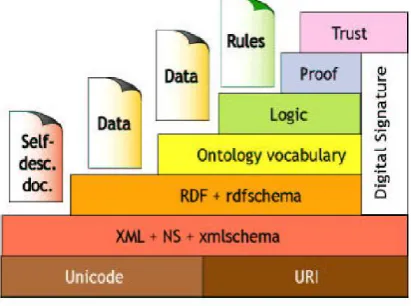
The bottom layer is the Unified Resource Identifiers (URIs) and Unicode [3]. The URI is an industry standard of representing entities, objects or concepts in the Semantic Web. Unicode is required by modern standards to represent a unique number for every character and for exchanging symbols. The next layer over URI and Unicode is XML and its namespaces.
Figure 1: Semantic web mining architecture
Semantic web is made up of XML which is independent of any platforms, hardware or software. Wireless Access Protocol (WAP) is the standard for information services on wireless terminals and is based on some internet standards, such as XML, TCP/IP, and HTML. WAP used Wireless Mark-up Language (WML), which is based on XML. XML Schema Definition (XSD) is an alternative to the Documentation Type Definitions (DTDs), which are used to describe document structure and the legal building blocks used in an XML document. An XML document and its
XML Schema Definition (XSD) have namespaces to differentiate between contexts. The Resource Description Framework (RDF) is a W3C standard for describing resources on the Web, such as document author, creation/modification date, document title, document content, and some related copyright information of a Web page. RDF is adding metadata to resources on the Web so that computers can understand the content of the subject other than just displaying what it contains. Since RDF follows the XML syntax, computers can exchange RDF documents just like the exchange of XML documents. RDF documents are not for humans to view, but are designed for computer applications to read and understand. It describes resources on the Web using simple statements consisting of subject, predicate and object. The subject can be any resource that has a URI. A property describes the resource to a value. OWL (Web Ontology Language)[14] is very similar to RDF, but it is a heavier language with greater machine-interpretability than RDF. It describes the exact nature of resources and relationships between them. Spanning across these standards is the all-time requirement of security through signatures and encryption.
B. Ontology:
The core technique of Semantic web mining is ontology [4].In computer science, ontology represents a set of precisely defined terms about a specific domain and accepted by this domain’s community. Ontology is an explicit specification of a conceptualization. an ontology is a formal explicit description of concepts in a domain of discourse (classes (sometimes called concepts)), properties of each concept describing various features and attributes of the concept (slots (sometimes called roles or properties)), and restrictions on slots (facets (sometimes called role restrictions)). An ontology together with a set of individual instances of classes constitutes a knowledge base. In reality, there is a fine line where the ontology ends and the knowledge base begins. Classes are the focus of most ontologies. Classes describe concepts in the domain.
C. RDF:
The RDF [5] is a simple meta model for defining and exchanging information on the semantic web. The basis of a particular way of providing meaning for metadata is embodied in the model theory for RDF [5,6], the language at the base of the Semantic Web. In particular, RDF has a very limited collection of syntactic constructs, and these are treated in a very uniform manner in the semantics of RDF.
III. RELATED WORK
According to [8] semantic e-business is founded upon three active stream of research: Semantic Web technologies with ontologies, knowledge representation, and intelligent software agents. The purpose of this literature review is to study, analyze and identify the opportunities and limitation of various techniques regarding the application of semantic technologies in educational domain.
Ideas presented in [9] explain the concept of using semantic web in educational application to overcome the educational domain problems like decision making on the basis of incomplete knowledge, due to excess of unstructured information, and difficulties in integration between different educational applications. Semantic technologies provide a possible solution to their problems by associating ontologies with unstructured information and to provide uniform access layer to heterogeneous data practical approach has been adopted. Ontology mediation and exploring semantic web services may leads more comparative advantages to educational domain.
It is considered that object-oriented programming (OOP) is a mainstream paradigm to design software development. Due to difference between RDF data model and OOP, RDF data format triples [11] cannot directly used by OOP languages such as Java. It is called Triple-to-Object impedance mismatch, just like Relational-to-Object impedance mismatch. Of course, the usual way is to implement Triple- Object mapping framework. SOF is proposed to realize direct mapping between object-oriented classes and Semantic Web classes. It embeds semantic descriptions in source code to convert objects to RDF data.
It is independent of programming languages. JenaBean1 is another mapping framework which can perform the mapping between triples and objects. It mainly utilizes Java annotation. ActiveRDF [9,10] is an object-oriented API for managing RDF data that offers full manipulation and querying of RDF data. It does not rely on a schema and fully conforms to RDFS semantics. Different from Triple-Object mapping framework,
It is popular that N-tier architecture is used to build web applications. In [9], Martin introduces a few famous layers architecture such as Microsoft DNA, Java EE etc. Java EE 3-tier architecture is undoubtedly used greatly in enterprise applications. [6] elaborately discusses what Java EE layers are and what responsibilities each layer owns. And it also explains why this architecture is more suitable for constructing enterprise applications running on internet. The key of Java EE 3-tier architecture [12] is how to implement model-view-controller (MVC) pattern. There are two main types of Java web frameworks: one is based on request and response mechanism such as Struts2, SpringMVC etc, the other is based on event-driven, such as Tapestry, Wicket etc.
IV. PROPOSED WORK
A. Algorithm:
Input: Data set R, Attribute set Ai
Output: data set R’
If rule r is not logically included in a rule r’ E MRULE then MRULE <- r U MRULE
Endif
End
<rdfs:comment>Teacher Class</rdfs:comment> <rdfs:subClassOf rdf:resource="#Person"/> </rdfs:Class>
<rdfs:Class rdf:ID="Course">
<rdfs:comment>Course Class</rdfs:comment> <rdfs:subClassOf technology, Jena and Java programming language for implementation. We have used our college web site as database. In experiment, we built student, faculty and courses ontology and input into the model. To test the developed method, we have created ontology for students and faculties from education domain. The student ontology was created from total 45 classes and 89 properties. The faculty consisted of 21 classes and 34 properties. Some concept pairs were chosen from each ontology and the relationships between them. The results are shown in table 1 and table 2.
VI. CONCLUSION AND FUTURE WORK
The Web contains huge amounts of data intended for clients. This information is mainly stored in hypertext form. The Semantic Web is considered an evolving extension of the World Wide Web [16] in which the semantics of information and services on the web is made explicit by adding metadata. Metadata provides the web content with descriptions, meaning and inter-relations. The Semantic Web is envisioned as a universal medium for data, information, and knowledge exchange. We propose a framework for personalised e-Learning [17,18] based on aggregate usage profiles and domain ontology. We have distinguished two stages in the whole process, one of offline tasks that
includes data preparation, ontology creation and usage mining and one of online tasks that concerns the production of recommendations. The system helps to find suitable semantic data related to students, faculties and courses for the clients. We have implemented semantic web mining in parallel distributed environment in all tiers for decision making, and also increased speed and efficiency of information retrieval.
In our future work the main task is to provide security using role back access control. We are planning to implement semantic web mining in parallel distributed environment[19] in all tiers for decision making, and increasing speed and efficiency.
VII. REFERENCES
[1]. WANG Yong-gui, JIA Zhen ,” Research on Semantic Web Mining”, IEEE 2010, vol 1, pp 67-70
[2]. Miklos Nagy and Maria Vargas-Vera, “Multiagent Ontology Mapping Framework for the Semantic Web”, IEEE TRANSACTIONS ON SYSTEMS, MAN, AND CYBERNETICS vol 41, , 2011, pp 693-704
[3]. Zhang Yofeng, Wu Jinhong, Wang Cuibo, Automatic Competitive Intelligence Collection Based On Semantic web mining IEEE 2007
[4]. Wang Jain, Li Zhuo, Research and Realization of long Distance Education platform based on Web Mining, IEEE 2009
[5]. Soe Lai Phyue, Myint Myint Thein, Thinn Thinn Win, ,” Semantic Web Information Retrieval in XML By Mapping To RDF Schema”, International Conference on Networking and Information Technology, IEEE 2010, pp 500-503
[6]. Chang-xin Song, Ke Ma ,Applications of Data Mining in the Education resource based on XML, International Conference on Advanced Computer Theory and Engineering, 2008 [7]. Kiavash Bahereini and Atilla Elci ,A New Software
Architecture for J2EE enterprise environments via semantic access to web mining by distributed intelligent software agents, IEEE international software and Applications conference, 2008
[8]. E. Oren and R. Delbru. “ActiveRDF: Object-Oriented Semantic Web Programming,”Proc. International World Wide Web Conference (WWW), Cananda, pp. 817-823, May 2007. [9]. Stefan Decker, Frank van Harmelen, Jeen Broekstra,Michael
Erdmann, Dieter Fensel, Ian Horrocks , Michel Klein, Sergey Melnik ,The Semantic Web - on the respective Roles of XML and RDF, IEEE 2006
[10].S. Kodde, J. Aasman and S. Hafich, “OWL vs. Object oriented Programming,” Proc. International Workshop on Semantic Web Enabled Software Engineering (SWESE), 2005.
[11].Jiang Huiping ,” Information Retrieval and the Semantic Web”, International Conference on Educational and Information Technology, IEEE 2010, vol 3, pp 461-463 [12].Aikaterini K. Kalou Tzanetos Pomonis Dimitrios
Koutsomitropoulos Theodore Papatheodorou,” Intelligent Book Mashup : Using Semantic Web Ontologies and Rules for User Personalisation”, International Conference on Semantic Computing 2010 IEEE, pp 536-541
[13].Ili Farhana Md Mahtar, Nor Azan Mat Zin ,” Mathematical Knowledge Representation for Education Semantic Web based on Learning Style”, IEEE 2010
[15].Yang Xin, Jianjing Shen, Zhigang Si, “A New Access Control Method for Semantic Web Services Based on Security Control Center”, Sixth International Conference on Natural Computation, IEEE 2010, pp 3711-3714
[16].Djelloul Bouchiha, Mimoun Malki,” Towards Re-engineering Web Applications into Semantic Web Services”, IEEE 2010, pp 350-353
[17].J.Anitha Josephine S.Sathiyadevi , “Ontology Based Relevance Criteria for Semantic Web Search Engine”, IEEE 2011, pp 60-64
[18]. Hongjiang Cao, Guihua Nie, Donglin Chen , ”Research on the Web Service Composition Based on Semantic”, IEEE 2010, Vol 7, pp 770-773