Volume 6, No. 1, Jan-Feb 2015
International Journal of Advanced Research in Computer Science
RESEARCH PAPER
Available Online at www.ijarcs.info
ISSN No. 0976-5697
Implementation of Relevance Feedback for Content Based Image Retrieval using
Image Mining User Navigation Pattern
Mrunmayi Joshi
Post Graduate Student, Department of Computer Science, Marathwada Institute of Technology,
Aurangabad, Maharashtra, India
Supriya A. Kinariwala
Professor, Department of Computer Science, Marathwada Institute of Technology,
Aurangabad, Maharashtra, India
Lalita B. Randive
Professor, Department of Computer Science, Marathwada Institute of Technology,
Aurangabad, Maharashtra, India
Abstract:Image retrieval is the basic requirement task in the present scenario. Nowadays, content-based image retrieval (CBIR) is the mainstay of image retrieval systems in which the target image to be retrieved based on the useful features of the given image. Image mining is the arising concept which can be used to extract potential information from the general collection of images. This paper proposes a new method, Navigation-Pattern-based Relevance Feedback (NPRF) image mining which is implemented in MATLAB, to achieve the preciseness of results and effectiveness of CBIR even when large-scale image data is present. In terms of preciseness, feedback iterations are reduced in substantial amount by using the navigation patterns discovered from the user query log. In terms of effectiveness, our proposed search algorithm NPRF Search makes use of the discovered navigation patterns and three kinds of query refinement strategies, Query Point Movement (QPM), Query Reweighting (QR), and Query Expansion (QEX), to converge the search space toward the user‟s intention effectively. By using NPRF method, high quality of image retrieval can be achieved in a small number of feedbacks. The experimental results reveal that NPRF outperforms other existing methods significantly in terms of precision, coverage, and number of feedbacks.
Keywords:Image Mining, Feature Extraction, Query Point Movement, Query Reweighting, Query Expansion, Feedback
I. INTRODUCTION
Multimedia contents are growing explosively and the need for multimedia retrieval is occurring more and more frequently in our daily life. Due to the complexity of multimedia contents, image understanding is a difficult but interesting issue in this field. Extracting valuable knowledge from a large-scale multimedia repository, so-called multimedia mining, has been recently studied by some researchers. On one hand, high-priced manual annotation cost is prohibitive in coping with a large-scale data set. On the other hand, inappropriate automated annotation yields the distorted results for semantic image retrieval. As a result, a number of powerful image retrieval algorithms have been proposed to deal with such problems over the past few years. Content-Based Image Retrieval (CBIR) is the mainstay of current image retrieval systems. In general, the purpose of CBIR is to present an image conceptually, with a set of low-level visual features such as color, texture, and shape. These conventional approaches for image retrieval are based on the computation of the similarity between the user‟s query and images via a query by example (QBE) system. Despite the power of the search strategies, it is very difficult to optimize the retrieval quality of CBIR within only one query process. The hidden problem is that the extracted visual features are too diverse to capture the concept of the user‟s query. To solve such problems, in the QBE system, the users can pick up some preferred images to refine the image explorations iteratively. The feedback procedure, called Relevance
Feedback (RF), repeats until the user is satisfied with the retrieval results.
The problem occurred in this is extracted visual features are too diverse to be captured with the concept of query given by user. To, solve such problem in QBE system, user need to provide feedback like pick relevant images from retrieval of images iteratively, the feedback procedure is called RF. This feedback is given up to user satisfaction with the retrieval results profiles. The same method is presented for automatic image annotation using cross media relevance models.
II. LITERATURESURVEY
Numerous researches have been carried on this image mining. This section of the paper presents a survey on various image mining techniques that were proposed earlier.
A. Directional Spatial Constraint Image Mining:
Aksoy & Cinbi proposed a new image mining technique using directional spatial constraints. The significant contributions in their approach include expanding the association model to numerous reference objects, integrating the spatial information into the bayesian decision rule as spatial priors for background classification, and facilitating dynamic queries by using directional associations as spatial parameters with support for the visibility of image areas that are incompletely enclosed by reference objects [1].
the image space I into [0, 1]. The fuzzy membership value
B(x) of an image point x corresponds to the 2 degree of its satisfaction of the spatial relation. Given the unit vector along the direction with respect to the horizontal axis, Bloch suggested that the angle (x, b) measured between this vector and the vector from a point b in the reference object to the image point x corresponds to the visibility of the image point from the reference object in the direction .
(1)
Where βα(B)(x) = Fuzzy Directional Landscape. x = Image point.
B = Reference Object
Θα(x,b) = Angle between x and point b in the reference object where b € B.
B. Image Mining Using Clustering Technique:
Image mining approach using clustering and data compression techniques was projected by Pattnaik. Satellite images of clouds play a substantial role in forecasting weather conditions. The CBIR focuses on Image „features‟ to enable the query and have been the recent focus of studies of image databases. The features further can be classified as low-level and high-level features. Users can query example images based on these features such as texture, color, shape, region and others. By similarity comparison the target image from the image repository is retrieved. Meanwhile, the next important phase today is focused on clustering techniques. Clustering algorithms can offer superior organization of multidimensional data for effective retrieval. Clustering algorithms allow a nearest neighbor search to be efficiently performed [2],[10].
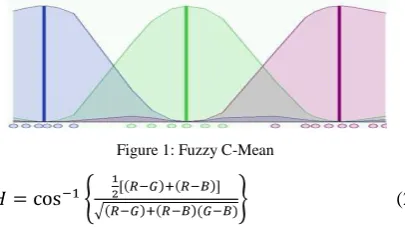
Clustering will be more advantage for reducing the searching time of images in the database. Fuzzy C-means is one of the clustering methods which allow one piece of data to belong to two or more clusters. In this clustering, each point has a degree of belonging to clusters, as in fuzzy logic, rather than belonging completely too just one cluster. Thus, points on the edge of a cluster may be in the cluster to a lesser degree than points in the centre of cluster. FCM groups data in specific number of clusters.
Fuzzy C-mean algorithm consists of following steps which are as follows:
a. Fixed number of clusters and one centroid per cluster b. Clusters are fuzzy sets
c. Membership degree of a point can be any number between 0 and 1
[image:2.595.60.263.666.779.2]d. Sum of all degrees for a point must be add up to 1 Hue saturation value has been chosen as the color histogram feature since HSV color space gives better results. The conversion of RGB space into HSV space is given by below formulae.
Figure 1: Fuzzy C-Mean
(2)
(3)
(4)
Where,
HSV= Hue Saturation Value
RGB= Red Green Blue Component in the image.
C. Image Mining Using Decision Tree Approach: Decision tree based image processing and image mining technique was projected by Kun-Che (2009). Important information can be hidden in images, conversely, few research talks about data mining on them. In their approach, they developed a common framework depending on the decision tree for mining and processing image data. Pixel-wised image characteristics were extracted and changed into a database-like table which permits a variety of data mining algorithms to make explorations on it. Each tuple of the changed table has a feature descriptor produced by a collection of characteristics in conjunction with the target label of a particular pixel. With the label feature, they adopted the decision tree induction in order to comprehend associations among features and the target label from image pixels, and to build up a model for pixel-wised image processing based on a specified training image dataset. Both experimental and theoretical analyses were performed in their study. Their results confirmed that this model can be extremely capable and effectual for image processing and image mining. It is estimated that by using this model, various existing data mining and image processing methods could be worked on together in different ways [3].
III. PROPOSEDWORK
Content-Based Image Retrieval (CBIR) is to present an image conceptually, with a set of low-level visual features such as color, texture and shape. CBIR is based on the computation of the similarity between the user‟s query and images via a query by example system.
This stage focuses on the discovery of relations among the users browsing behaviors on RF. Basically; the frequent patterns mined from the user logs are regarded as the useful browsing paths to optimize the search direction on RF. In our NPRF approach, the users‟ common interests can be represented by the discovered frequent patterns (also called frequent item sets). Through these navigation patterns, the user‟s intention can be precisely captured in a shorter query process. In this phase, the Apriori-like algorithm is performed to exploit navigation patterns using the transformed data.
The Navigation Pattern Relevance Feedback proposed approach divides the task generally into two major operations, namely offline knowledge discovery and online image retrieval. The major difference between our proposed approach and other contemporary approaches is that we approximate an optimal solution to resolve the problems existing in current relevance feedback such as redundant browsing and exploration conversion. To this end, the approximated solution takes advantage of exploited knowledge (navigation patterns) to assist the proposed search strategy in efficiently hunting the desired images.
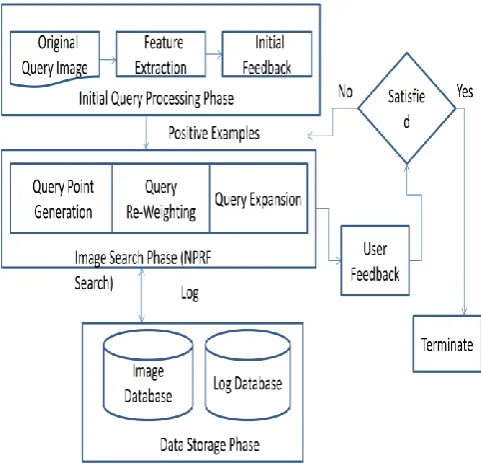
The proposed system block diagram which represents workflow of Navigation Pattern Relevance Feedback mainly consists of four phases by which NPRF works.
b. Image Search Phase (NPRF search) c. Data Storage Phase
Figure 2 shows all the four phases along with different blocks in those phases and the operation of each block. The system works on two operations i.e. online operation and offline operation.
A. System Architecture:
Proposed System GUI is implemented with different push buttons such as Set Image Dataset, Select Query Image, Process Initial Feedback, QPM, QR, QEX, View log and Reset System. The system divides the structure on three different phases which are Initial query processing phase in which one input image is provided as an input image and different features of that image is extracted. Second phase is image search phase which contain NPRF query refinement strategy which refines query image and third and the last data storage phase which stores the logs of the input image.
Phase 1: Initial Query Processing Phase:
[image:3.595.37.278.528.762.2]The first phase i.e. Initial Query Processing Phase consists of selection of query image followed by feature extraction and initial feedback. Process Initial feedback is the second block by which the different features of image like color, shape, texture, and histogram are being extracted from query image and then returns a set of the most similar images. In this phase without considering any feature weights system extracts the visual features from original query image and similar images. The positive examples or good examples are picked up by the end user is called initial feedback or iteration 0. The Initial feedback block coding is implemented in Matlab program. In this program query image is taken as input and features are extracted from the image. Query Image is the image for which the similar images need to be retrieved from the database. Any .JPG format can be used as a query image. After pressing the tab for selecting query image dialog box opens in the matlab, through which user can select any one image. Query image is displayed after selection. Once query image is selected dialog box showing message query image selected successfully displays.
Figure 2: Proposed Block Diagram
Query image is the image for which the similar images need to be retrieved from the database which s also called as an input image which user will provide as input to the system. After pressing the tab for selecting query image dialog box opens in the matlab, through which user can select any one image. Query image is displayed after selection. Query image is taken as an input to initial feedback block and following features are extracted from the image.
a. Color:
First color image will be converted into the gray level image in order to generate histogram and in order to extract various features from the image. Color can be find using two color spaces like RGB color space and HSV color spaces. Computing distance measures based on color similarity is achieved by computing a color histogram for each image that identifies the proportion of pixels within an image holding specific values (that humans express as colors). Current research is attempting to segment color proportion by region and by spatial relationship among several color regions. Examining images based on the colors they contain is one of the most widely used techniques because it does not depend on image size or orientation. Color searches will usually involve comparing color histograms.
b. Shape:
Shape can be detected using edge detection algorithm which is Sobel edge detection and canny edge detection. In Sobel edge detection, Sobel filter is used for edge detection. Sobel filter creates an image which emphasizes on edges and transitions. In canny edge detection multistage edge detection algorithm is used. In this first Gaussian filter is applied for smoothening. After that intensity gradient of the image is found and double thresholding is applied. Finally edge tracking by Hysteresis is done.
c. Texture:
Concept of range filtering is used to extract the texture from the image. Range filtering gives the image with each output pixel containing the range value (Maximum value – Minimum Value) around the corresponding pixel in the input image Texture comparison is done using the euclidean distance calculation between texture of query image and texture of images in database. Texture is a very interesting image feature that has been used for characterization of images, with application in content based image retrieval.
Phase II: Image Search Phase:
In this phase the intent is to extend one‟s search point to multiple search points by integrating the navigation patterns and the proposed search algorithm NPRF search. In this phase user intension is successfully implied. A new query point is generated at each feedback by using preceding positive examples. The search procedure is continuing up to user is satisfied. The aim of the search strategy is to solve the problems in existing approaches; these problems result in large limitation in RF. By using RF query refinement strategies the results generated by multiple query refinement systems produce better results than individual systems.
search range from a query point to a number of relevant navigation paths; as a result user‟s interest is satisfied. The discovered navigation patterns are taken as the shortest paths to derive the efficient results in a few feedback processes. Because of high cost of navigation process for the massive image databases iterative search can be a solution. The NPRF Search algorithm can be divided as an important part of our proposed iterative solution to RF, which is combination of QEX, QP, and QR strategies.
a. Query Point Generation:
Solution for enhancing the accuracy of image retrieval is moving the query point toward the contour of the user‟s preference in feature space. QPM regards multiple positive examples as a new query point at each feedback. Moreover, the modified query point of each feedback probably moves toward the local optimal centroid. Thus, global optimal results are not easily touched in QPM like work.
In the query point generation stage any area to be selected in the query image so as to recover exact similar image. Feature point extracted from the selected area from the query image Strong feature points are extracted from query image and displayed. User can select any area from the query image for feature point extraction. Selected area in the query image in the query point generation is as shown below. Feature points are extracted using SURF (Speeded up Robust Features) algorithm.
a) SURF Algorithm:
SURF is a local feature detector algorithm. SURF is a detector and high performance descriptor point of interest in an image where the image is transformed into coordinates using a technique called multi resolution.
Steps in SURF algorithm are as follow:
(a). Strongest Point of interest extraction in the Hessian Matrix.
(b). Descriptor based on the sum of wavelet response.
SURF uses a blob detector based on the hessian to find points of interest. The determinant of the Hessian matrix expresses the extent of the response and is an expression of a local change around the area.
The detector is based on the Hessian matrix, due to its good performance in accuracy. More precisely, blob structures are detected in places where the determining factor is the maximum. In contrast to the detector Hess& Laplace mikolajczyk and schmid, also is based on the determinant of the Hessian for selecting scale, as it is done by Lindeberg. Given a point x = (x, y) in an image I, the Hessian matrix H (x, σ) in x at scale σ , is defined as follows:
(5)
Where is the convolution of second order derivative with the image in the point x, y similarly
with and .
The box filters 9x9 are approximations of a Gaussian with σ = 1.2 and represents the lowest level (higher spatial resolution) for computerized maps blob response. Is denoted
Dxx, Dyy, Dxy. The weights applied to the rectangular regions are maintained by the efficiency of the CPU. Following image is generated:
(6)
The relative weighting (w) of the filter response is used to balance the expression for the Hessian determinant. It is
necessary for the conservation of energy between Gaussian kernels and Gaussian kernels approximate.
(7)
0.9 factors appears such a correction factor using squares instead of Gaussians. It can generate several images
det (H) for several filter sizes. This is called multi- resolution analysis. |x|F is the Frobenius norm.
b. Query Reweighting:
Nearest Features are matched in the query reweighting stage with the query image and result displayed. KD Tree search algorithm is used to find the nearest number features. Visual features are important for those images (positive examples) picked up by the users at each feedback. The notion behind QR is that, if the ith feature fi exists in positive examples frequently, the system assigns the higher degree to fi. QR like approaches were first proposed by Rui [4], which convert image feature vectors to weighted-term vectors in early version of multimedia analysis and retrieval system (MARS) Rui provided a new method for query reweighting to deal with document retrieval. The projected method uses genetic algorithms to reweight a user's query vector, based on the user's relevance feedback, to improve the performance of document retrieval systems. Chromosome is found, the projected method decodes the chromosome into the user's query vector for dealing with document retrieval. The projected query reweighting method can find the best weights of query terms in the user's query vector, based on the user's relevance feedback. It can increase the precision rate and the recall rate of the document retrieval system.
(a). KD Tree Search Algorithm :
KD Tree search algorithm is used to find the nearest number features. KD Tree is a structure for organizing points in k dimensional space. KD Tree algorithm uses the descriptor result from the query point generation stage for nearest feature matching. Nearest Neighbor search in KD Tree algorithm used to find the point in the tree that is nearest to the given point.
Steps in the nearest neighbor search using KD Tree. Searching for a nearest neighbor in a k-d tree proceeds as follows:
(a). Starting with the root node, the algorithm moves down the tree recursively, in the same way that it would if the search point were being inserted (i.e. it goes left or right depending on whether the point is lesser than or greater than the current node in the split dimension). (b). Once the algorithm reaches a leaf node, it saves that
node point as the "current best"
(c). The algorithm unwinds the recursion of the tree, performing the following steps at each node:
i. If the current node is closer than the current best, then it becomes the current best.
distance (overall coordinates) from the search point to the current best.
(d). When the algorithm finishes this process for the root node, then the search is complete.
c. Query Expansion:
In the query expansion stage nearest features are further compared using feature matching distance tests and final similar images are displayed. Because QR and QPM cannot elevate the quality of RF, QEX has been another hot technique in the solution space of RF recently. That is, straightforward search strategies, such as QR and QPM, cannot completely cover the user‟s interest spreading in the broad feature space. As a result, diverse results for the same concept are difficult to obtain. For this reason, the modified version of MARS [5] groups the similar relevant points into several clusters, and selects good representative points from these clusters to construct the multipoint query. Wu proposed FALCON, which is designed to handle disjunctive queries within arbitrary metric spaces [6].
The technique QR and QPM cannot elevate the quality of RF and cannot completely cover the user‟s interest spreading in the broad feature space therefore QEX is used. For this reason, the modified version of groups the similar relevant points into several clusters, and selects good representative points from these clusters to construct the multipoint query. It is designed to handle disjunctive queries within arbitrary metric spaces [7],[8]. In this stage the input query image is again finally refine in order to obtain the proper result for the final output. Here based on the results of the distance test the images are being retrieved properly and those images which are out of range of the threshold distance or that are out of the given range are eliminated and remaining images are considered as an output and generate the result. Thus on this background the result is being generated. The following two images are declared as an output of the given query image.
d. User Feedback:
Using user feedback and 3 stages of feature comparison the result displayed after query expansion completely matches with the query image. If user is not satisfied with the output of the query expansion stage, he can again start from the query point generation stage until he gets proper results. One of the best ways to increase usability of your own product or website is to get feedback from your users. In this post we will focus on making sure you hear what your users are looking for from your web site. Users sometimes leave comments or contact you through your contact forms, but if you ask for feedback specifically you will get a greater response. User feedback is used to improve to performance of the search engine. In this post we will focus on making sure you hear what your users are looking for from your web site. Feed back is one the best way of the increase performance. User can get search data result is query based. User feedback is used to improve to performance of the search engine [9],[10].
Phase III: Data Storage Phase:
The third and the last phase is Data Storage Phase which takes input from third phase in the form of logs and patterns and proceed further. Data Storage Phase as the name indicates that it consists of different databases containing different images and from which we have to
mine query image [11]. Image database, log database are two main databases in the system log database consists of the logs at each stage as explained earlier [12], [13]. The log data generated for the example. The Reference database consists of five classes are composed of different kinds of categories. In each category contains different images. In our project we take a dataset consists of categories are Tribes, Beaches, Buildings, Buses and Dinosourous. Total number of images in this reference database is 125. This project is work with different databases like reference database and query database. Query database contains query images which are images among all above classes which user will provide as an input [14].
IV. PERFORMANCEEVALUATIONANDANALYSIS
The system is tested for variety of different cases. The different performance parameters are tested for the given system and results are analyzed. The knowledge discovered from the navigation patterns can be enhanced once the new query is submitted to NPRF. Indeed, it does need time to gather the usage logs. However, a larger log that needs longer collection time can help achieve higher retrieval quality. An alternative way to reduce the whole collection time is to increase the size of collected logs incrementally such that the precision will also be enhanced gradually.
In practice, the primary intentions behind our experiments are: Parameters for Performance Evaluation, comparisons Comparison between different classes of images using Precision and Coverage, and Performance Analysis in different image mining technique by calculating Accuracy.
A. Performance Parameters:
Evaluation of retrieval performance is a crucial problem in content based image retrieval. Many different methods for measuring the performance of a system have been created and used by researchers. We have used the most common evaluation methods namely, Precision, Accuracy and Coverage.
a. Accuracy:
Accuracy of a measurement system is the degree of closeness of measurements of a quantity‟s actual value. Accuracy depends on the instrument we are measuring with. Accuracy is the closeness of the measured value to the true value. In this proposed system it is the ratio of Number of retrieved images to the number of expected images.
(8)
b. Precision:
The Precision of a measurement system, related to repeatability is the degree to which repeated measurements under unchanged conditions. Precision is how close the measured values are to each other. Precision is the deviation of the result from the mean of a set.
(9)
c. Coverage:
(10)
B. Comparison using Precision and Coverage: Case I: Comparison using Precision:
[image:6.595.316.569.56.206.2]To calculate the Precision randomly input query image is selected from the query database of each class and number of images retrieved in each case is calculated and by putting the generated value in above formula the table is generated.
Table 1: Precision of all Classes
Sr. No. Class of Image Precision
1 Tribes 0.34
2 Buses 0.8
3 Beaches 0.67
4 Buildings 0.7
5 Dinosaurs 0.82
[image:6.595.39.285.293.458.2]For above table the graph generated is as follows.
Figure 3: Precision values for Different Classes of Images
Case II: Comparison using Coverage:
Coverage means the amount or extent to which something is covered. Coverage here represents the number of images covered from the database in every iteration for different query image. The table is generated for Coverage which contains different classes of images present in the database.
Table 2: Coverage of Different Classes
Sr. No. Classes of Image Coverage (%)
1 Tribes 29
2 Buses 37.5
3 Beaches 33
4 Buildings 23
5 Dinosaurs 15.3
[image:6.595.335.541.328.425.2]The graph is generated for above table for Coverage of database with respect to images of different classes of images is as follows,
Figure 4: Coverage values for Different Classes of Images
Case III: Comparison using Accuracy:
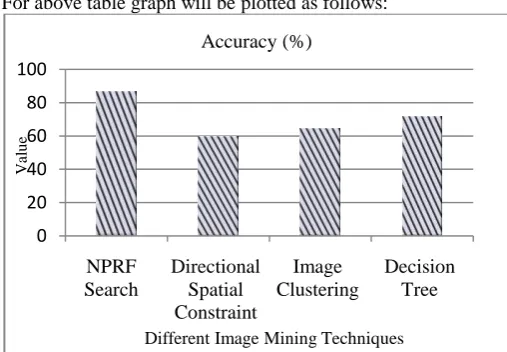
Accuracy is the proximity of measurement results to the true value. A measurement system can be accurate but not precise, precise but not accurate. Different techniques shows different accuracy values based on the experimental results and various features used in various approaches which can be compared as follows:
Table 3: Accuracy of Different Techniques
Technique No. of Image Features
Accuracy (%)
NPRF Search 5 87
Directional Spatial Constraint
1 60
Image Clustering
1 65
Decision Tree
3 72
For above table graph will be plotted as follows:
Figure 5: Accuracy values for Different Techniques
V. CONCLUSION
The proposed system contains improved image mining technique as compared to the other image mining techniques. This method uses navigation pattern based relevance feedback approach which contain three different query refinement strategies which improves the image retrieval strategy and increases the accuracy. This is an improved image mining method due to use of different query refinement strategies along with the feature extraction mechanism and user feedback. Also this image mining technique deals with multiple features such as color, shape
0 0.2 0.4 0.6 0.8 1
Tribes Buses Beaches Buildings Dinosaurs
Precision
P
re
ci
si
o
n
Classes of Images
0 10 20 30 40
Tribes Buses Beaches Buildings Dinosaurs
Coverage (%)
Classs of Images
V
alu
e
0 20 40 60 80 100
NPRF Search
Directional Spatial Constraint
Image Clustering
Decision Tree Accuracy (%)
Different Image Mining Techniques
V
al
u
[image:6.595.315.569.441.617.2] [image:6.595.62.258.585.686.2]and texture which improve the system performance. So this is the effective and efficient method compared to previous methods. To deal with the long iteration problem of CBIR with RF, a new approach named. Also it is analyzed that by using this technique of image mining of content based image retrieval using user navigation approach the accuracy is increased to 20% as compare to the previous image mining techniques. Also this technique covers approximately 90% database.
VI. REFERENCES
[1] Selim Aksoy & R. Gokberk Cinbis , “ Image Mining using Directional Spatial Constraints”, Member,IEEE ,pp 15-17,(2009).
[2] A.Kannan, Dr.V.Mohan, Dr.N.Anbazhagan , “Image Clustering and Retrieval using Image Mining Techniques”, pp 18-20, 2010 IEEE International Conference on Computational Intelligence and Computing Research.
[3] Kun-che Lu and Don-Lin Yang , “ Decision tree based image processing and image mining technique” Journal of Information Science and Engineering 25, 989-1003 ,pp 20-22 (2009).
[4] Y. Rui, T. S. Huang, M. Ortega, and S. Mehotra, “ Relevance Feedback: A power tool for interactive content-based image retrieval”, IEEE Transaction of Circuits and Systems for Video Technology, Vol. 8, No.5, Sept., pp. 31,Sept. 1998.
[5] Y. Rui, T. S. Huang, and S. Mehotra, “ Content-based image retrieval with relevance feedback in MARS”, Proceedings IEEE International Conference on Image Processing, ICIP 97, October 1997.
[6] Ja-Hwung Su, Wei-Jyun Huang, Philip S. Yu ,“ Efficient Relevance Feedback for Content-Based Image Retrieval by
Mining User Navigation Patterns”, Fellow, IEEE, and Vincent S. Tseng, Member, IEEE , pp 22-25,March 2011.
[7] Y. Rui, T. S. Huang, “Optimizing learning in image retrieval”, Proceedings. IEEE Int. Conference On Computer Vision and Pattern Recognition (CVPR), Hilton Head, SC, June 2000.
[8] J.R. Smith and S.F. Chang, “VisualSEEK: A Fully Automated Content-Based Image Query System,” Proc. ACM Multimedia Conf. Nov. 1996.
[9] Grosky W., Stanchev P., An Image Data Model, in Advances in Visual Information Systems, Laurini, R. (edt.), Lecture Notes in Computer Science 1929, 2000.
[10] A. Berman and L.G. Shapiro, “ A flexible image database system for content-based retrieval”, Computer Vision andImage Understanding, Vol. 75, pp. 175-195, July/August 1999.
[11] A. Berman and L.G. Shapiro, “ Triangle-inequality-based pruning algorithms with triangle tries”, Proceedings of IS&T and SPIE Storage and Retrieval of Image and Video Databases VII, San Jose, CA, Jan 1999.
[12] G. Healey and A. Jain, “Retrieving multispectral satellite images using physics-based invariant representations,” IEEE Transactions on Pattern Analysis and Machine Intelligence, Vol. 18, No.8, August 1996.
[13] G. Marchisio and A.Q. Li, “ Intelligent system technologies for remote sensing repositories,” in Information Processing for Remote Sensing, C.H. Chen editor, World Scientific, 1999.