Volume 4, No. 11, Nov-Dec 2013
International Journal of Advanced Research in Computer Science
RESEARCH PAPER
Available Online at www.ijarcs.info
Quality Controlled ECG Signal Compression using Genetic Algorithm
Vibha Aggarwal
Department of Electronics & Communication Engineering, COEM, Punjabi University Neighborhood Campus,
Rampura Phul, Punjab, India [email protected]
Manjeet Singh Patterh
Department of Electronics & Communication Engineering, UCOE, Punjabi University,
Patiala, Punjab, India [email protected]
Abstract: In this paper, calculations of threshold using genetic algorithm (GA) is studied. From the results, it can be found that the threshold value calculated using GA is such that the actual PRD (Percent root mean square difference) after threshold is almost equal to the UPRD (User specified PRD). First ECG signal is transformed using wavelet transform (WT) and discrete cosine transform (DCT). The transformed coefficients (TC) are then thresholded by genetic algorithm. The thresholding is done in a way so that error between actual PRD and UPRD remains within the specified limits.
Keywords: ECG Signal, quality controlled compression, Discrete Cosine Transform, Wavelet Transform, Genetic Algorithm.
I. INTRODUCTION
Many quality controlled ECG compression algorithms have recently been developed that gives good performance [1]-[8]. Among the reported algorithms [1]-[8], the threshold value is calculated by the bisection algorithms (BA) in order to match the UPRD within the tolerance. Most of them are using the WT. In 2003, Benzid et al. [5] presented quality controlled ECG compression based on wavelet transform, after decomposition the resultant coefficients are subjected to an iterative threshold until a fixed percentage target of wavelet coefficients to be zeroed is reached. Then, the Look-up table is made to store the zero and non-zero coefficients (NZC). NZC are quantized by linear quantizer. The NZC and look up table encoding is done by Huffman coding. Blanco-Velasco et al., [3] developed a filter bank- based algorithm for quality controlled ECG compression. The procedure is same as [5] but here the bisection algorithm (BA) is used for calculation. And this method for threshold calculation found to be better than [5]. In 2006, Benzid et al. [1] used wavelet transform and Max-Lloyd quantizer. Chen et al. [8] presents quality controlled ECG compression based on wavelet transform, these coefficients are quantized with a uniform scalar dead zone quantizer and Exp-Golomb and Golomb-Rice coding is used to code the lengths of runs of the zero coefficients and nonzero coefficients respectively. Benzid et al. [2] proposed the effective method of ECG compression based on the adaptive wavelet coefficients quantization combined with a modified two-role encoder.
The algorithm is same as explained in [1] but the NZC are encoded by two role encoder and here quantizer is linear. Blanco-Velasco et al. [4] methodology is same as [5] this paper used the Wavelet Packet transform instead of wavelet transform. Benzid et al., [6] represents ECG compression
which is based on the mechanics of natural genetics and natural selection. The back- bone of every GA is the reproduction of an original population, the performance of crossover and mutation and the selection of the best [9]. For the performance analysis, the metrics like compression ratio (CR) and PRD are used. CR is defined as the ratio of the number of bits used to represent the original signal to the number of bits used to represent the compressed signal [4] and PRD is calculated as [5]:
(
)
∑
∑
= = − × = N i i N i i i x x x PRD 1 2 1 2 ˆ100 (1.1) Where
x
i andx
ˆ
i arethe ith sample of original and reconstructed ECG signal of length
N
[5].II. METHODOLOGY
The proposed technique is implemented in three steps: (i) the TC are thresholded using genetic algorithm and (ii) the thresholded coefficients are quantized and (iii) Final stage is the entropy coder that provides the final compressed bitstream. The pseudo code for the algorithm is explained as follows [1][2].
Step 0: Initialization; Get the UPRD; Select the threshold in the range [THmin, THmax] where the range may be initialized by [*TCmin, **TCmax]. Where *TCmin is minimum value of TC and **TCmax is maximum value of TC. Get the convergence precision . Calculate the mean. Subtract the mean from the original signal. Transform the zero mean ECG signal using DCT and WT .
Step 1: Take a copy of TC.
And select threshold using GA
thresholding in Step1. This binary lookup table is encoded using Huffman coding.
Step6: The non-zero coefficients are quantized using Max-Lloyd algorithm followed by Arithmetic coding.
Step7: End.
III. RESULTS
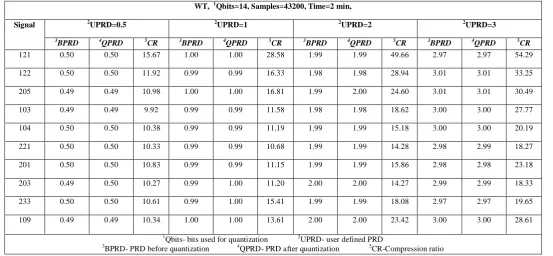
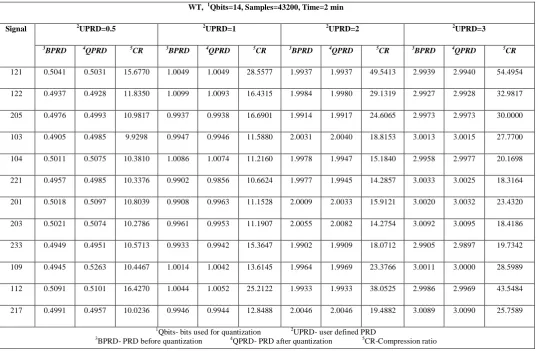
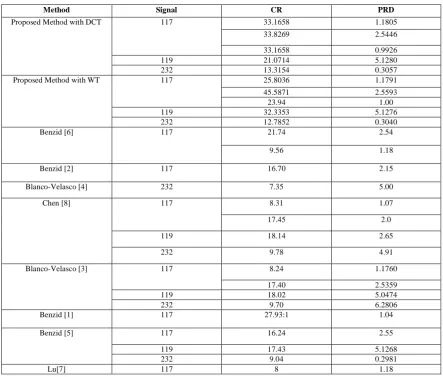
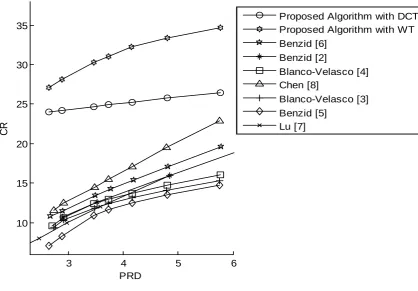
The efficiency of the proposed algorithm is tested by well known ECG database, MIT-BIH Arrhythmia. Each record contains 11 bit resolution and 360 Hz a sampling frequency. In the WT, ECG signal is decomposed to four levels using biorthogonal swapped filters. The results presented in Table 1, 2, 3 and 4 represents the CR at fixed PRD=0.5, PRD=1, PRD=2 and PRD=3 respectively for different ECG signals using BA and GA. From the numerical results, it can be observed that PRD before quantization (BPRD) is nearly equal to fixed PRD (UPRD) and PRD after quantization (QPRD) using BA and GA. Table 5 and Figure 1 compares the proposed method to that compression methods reported in the literature which is best threshold-based ECG compression. For comparison the average CR and the average PRD of the proposed method are taken according to that reported in the literature. Testing dataset is of 2 min duration long (43200 samples) lead extracted from records 100, 101, 102, 103, 107, 109, 111, 115, 117, 118 and 119. This dataset has been chosen for Table 5 and Figure 1 because it has been used in the literature. Figure 1 , Table 5 and Table 6 conclude that the proposed method gives better CR as compared to that reported in [2]-[8].
But as far as BA is concerned the CR of the proposed method using GA is almost same. For example, in case of record MIT-BIH 121 at UPRD =0.5, QPRD= 0.52, CR is 17.85 for DCT from Table 1 and at UPRD= 0.5, QPRD= 0.50, CR is 15.67 for WT from Table 2 with BA and with GA at UPRD=0.5, QPRD=0.50, CR is 18.21 for DCT from Table 3 and at UPRD=0.5, QPRD= 0.50, CR is 15.67 for WT from Table 4. It can be observed from the result that in case of GA the actual PRD is very close to the UPRD. So, in general GA is recommended over BA. But during the implementation of GA based threshold calculations it has been observed that GA based method requires more time for calculations of threshold at high UPRD. Therefore, it is recommended that GA method for threshold calculation should be used in case of low UPRD.
IV. CONCLUSION
In this paper, to calculate the threshold value with the help of genetic algorithm has been studied. The method of calculating threshold value is very good and it gives final
PRD which is within the specified error as compared to UPRD. But computational time is more in case of GA as compared to that of BA for higher values of UPRD. So, GA is recommended for low PRD ECG compression. So, GA is recommended for low PRD ECG compression.
The method gives high performance for ECG compression due to the combined effect of transforms (DCT and WT), thresholding algorithm, non-uniform quantizer, look-up table encoded by Huffman coding and non-zero quantized coefficients are encoded by Arithmetic coding. But computational time is more in case of GA as compared to that of BA for higher values of UPRD.
V. REFERENCES
[1]. R. Benzid, F. Marir and N. E. Bouguechal, “Quality-controlled compression method using wavelet transform for electrocardiogram signals”, Int. J. of Biomed. Sciences, 2006, 1, (1),pp. 28-33.
[2]. R. Benzid, F. Marir and N. E. Bouguechal, “Electrocardiogram compression method based on the adaptive wavelet coefficients quantization combined to a modified two-role encoder”, IEEE Signal Process. Lett., 2007, 1-4.
[3]. M. Blanco-Velasco, F. Cruz-Roldan, J. I. Godino-Llorente and K. E. Barner, “ECG compression with retrived qualtiy guranteed”, Electron. Lett., 2004, 40, (23).
[4]. M. Blanco-Velasco, F. Cruz-Roldan, J. I. Godino-Llorente and K. E. Barner, “Wavelet packets feasibility study for the design of an ECG compressor”, IEEE Trans. on Biomed. Eng., 2007, 54, (4), pp. 766-769.
[5]. R. Benzid, F. Marir, M. Benyoucef and D. Arar, “Fixed percentage of wavelet coefficients to be zeroed for ECG compression”, Electron. Lett., 2003, 39,(11), pp. 830-831. [6]. R. Benzid, A. Messaoudi, A. Boussaad, “Constrained ECG
compression algorithm using block-based discrete cosine transfrom”, Digital Signal Processing, 2008, 18, pp. 56-64. [7]. Z. Lu, D. Y. Kim and W. A. Pearlman, “Wavelet
compression of ECG signals by the set partitioning in hierarchical trees algorithm”, IEEE Trans. on Biomed. Eng., 2000,47, (7), pp. 849-856.
[8]. J. Chen, J. Ma, Y. Zhang and X. Shi, “ECG compression based on wavelet transform and Golomb coding”, Electronics Letters, 2006, 42 (6).
Table 1: Performance of ECG compression with BA using DCT on different ECG signals
DCT, 1Qbits=14, Samples=43200, Time=2 min,
Signal 2UPRD=0.5 2UPRD=1 2UPRD=2 2UPRD=3
3
BPRD 4QPRD 5CR 3BPRD 4QPRD 5CR 3BPRD 4QPRD 5CR 3BPRD 4QPRD 5CR
121 0.49 0.52 17.85 1.00 1.00 37.66 1.99 1.99 50.55 2.99 2.99 51.69
122 0.49 0.53 15.16 0.99 0.99 22.27 2.01 2.01 24.63 3.00 3.00 26.89
205 0.50 0.54 12.60 1.00 1.01 26.47 1.98 1.98 29.72 2.99 3.00 30.18
103 0.50 0.52 10.41 0.99 1.00 13.83 1.99 1.99 19.14 2.98 2.98 20.86
104 0.49 0.55 13.37 0.99 1.02 15.47 1.98 1.98 17.83 2.97 2.97 17.74
221 0.49 0.52 10.33 0.99 1.00 11.79 1.99 1.98 20.57 3.02 3.02 23.94
201 0.50 0.53 11.05 0.99 1.01 12.82 1.98 1.98 23.77 2.98 2.98 28.86
203 0.49 0.51 11.64 1.00 1.01 14.89 2.01 2.01 15.75 2.97 2.97 16.43
233 0.50 0.51 11.49 1.00 1.00 18.36 1.99 1.99 20.06 2.97 2.97 20.61
109 0.49 0.52 11.21 0.99 1.00 17.53 1.99 1.99 23.84 3.00 3.00 27.99
1Qbits- bits used for quantization 2UPRD- user defined PRD 3
BPRD- PRD before quantization 4QPRD- PRD after quantization 5CR-Compression ratio
Table 2: Performance of ECG compression with BA using WT on different ECG signals
WT, 1Qbits=14, Samples=43200, Time=2 min,
Signal 2UPRD=0.5 2UPRD=1 2UPRD=2 2UPRD=3
3BPRD 4QPRD 5CR 3BPRD 4QPRD 5CR 3BPRD 4QPRD 5CR 3BPRD 4QPRD 5CR
121 0.50 0.50 15.67 1.00 1.00 28.58 1.99 1.99 49.66 2.97 2.97 54.29
122 0.50 0.50 11.92 0.99 0.99 16.33 1.98 1.98 28.94 3.01 3.01 33.25
205 0.49 0.49 10.98 1.00 1.00 16.81 1.99 2.00 24.60 3.01 3.01 30.49
103 0.49 0.49 9.92 0.99 0.99 11.58 1.98 1.98 18.62 3.00 3.00 27.77
104 0.50 0.50 10.38 0.99 0.99 11.19 1.99 1.99 15.18 3.00 3.00 20.19
221 0.50 0.50 10.33 0.99 0.99 10.68 1.99 1.99 14.28 2.98 2.99 18.27
201 0.50 0.50 10.83 0.99 0.99 11.15 1.99 1.99 15.86 2.98 2.98 23.18
203 0.49 0.50 10.27 0.99 1.00 11.20 2.00 2.00 14.27 2.99 2.99 18.33
233 0.50 0.50 10.61 0.99 1.00 15.41 1.99 1.99 18.08 2.97 2.97 19.65
109 0.49 0.49 10.34 1.00 1.00 13.61 2.00 2.00 23.42 3.00 3.00 28.61
1
Qbits- bits used for quantization 2UPRD- user defined PRD
3
[image:3.595.24.578.326.582.2]Table 3: Performance of ECG compression with GA using DCT on different ECG signals
DCT, 1Qbits=14, Samples=43200, Time=2 min
Signal 2UPRD=0.5 2UPRD=1 2UPRD=2 2UPRD=3
3
BPRD 4QPRD 5CR 3BPRD 4QPRD 5CR 3BPRD 4QPRD 5CR 3BPRD 4QPRD 5CR
121 0.5084 0.5067 18.2153 0.9985 0.9997 37.4200 1.9935 1.9945 50.5532 2.9982 2.9983 51.6971
122 0.4912 0.4911 15.1030 0.9944 0.9941 22.2806 2.0097 2.0097 24.6371 3.0017 3.0017 26.8900 205 0.5098 0.5100 12.7222 0.9971 0.9958 26.3531 1.9981 1.9982 29.6259 3.0030 3.0021 30.2444 103 0.5000 0.4989 10.4200 0.9906 0.9899 13.7436 2.0022 2.0045 19.1737 2.9980 2.9967 20.9302 104 0.5061 0.5177 13.3572 0.9989 1.0008 15.4688 1.9909 1.9959 17.8325 2.9974 2.9928 17.7525 221 0.4948 0.4975 10.3466 1.0003 0.9980 11.8091 2.0097 2.0083 20.6681 3.0057 3.0051 24.0194 201 0.5100 0.5057 11.0573 1.0057 1.0012 12.8349 1.9962 1.9948 23.9613 2.9982 2.9956 28.9756 203 0.5086 0.5112 11.6975 1.0065 1.0078 14.9134 2.0035 2.0025 15.7434 2.9964 2.9985 16.4863 233 0.5020 0.5068 11.5027 0.9935 0.9943 18.3107 1.9969 1.9983 20.0743 2.9928 2.9956 20.6322 109 0.4914 0.4973 11.1696 1.0001 1.0004 17.5325 2.0028 1.9999 23.8842 3.0016 3.0018 28.0321 112 0.4961 0.4977 19.7671 1.0005 0.9994 34.1576 1.9974 1.9982 38.8489 3.0100 3.0111 40.5788 217 0.5042 0.5158 12.3160 0.9960 1.0015 17.5948 2.0082 2.0110 18.2882 3.0019 3.0023 19.0568
1Qbits- bits used for quantization 2UPRD- user defined PRD
3BPRD- PRD before quantization 4QPRD- PRD after quantization 5CR-Compression ratio
Table 4: Performance of ECG compression with GA using WT on different ECG signals
WT, 1Qbits=14, Samples=43200, Time=2 min
Signal 2UPRD=0.5 2UPRD=1 2UPRD=2 2UPRD=3
3
BPRD 4QPRD 5CR 3BPRD 4QPRD 5CR 3BPRD 4QPRD 5CR 3BPRD 4QPRD 5CR
121 0.5041 0.5031 15.6770 1.0049 1.0049 28.5577 1.9937 1.9937 49.5413 2.9939 2.9940 54.4954
122 0.4937 0.4928 11.8350 1.0099 1.0093 16.4315 1.9984 1.9980 29.1319 2.9927 2.9928 32.9817
205 0.4976 0.4993 10.9817 0.9937 0.9938 16.6901 1.9914 1.9917 24.6065 2.9973 2.9973 30.0000
103 0.4905 0.4985 9.9298 0.9947 0.9946 11.5880 2.0031 2.0040 18.8153 3.0013 3.0015 27.7700
104 0.5011 0.5075 10.3810 1.0086 1.0074 11.2160 1.9978 1.9947 15.1840 2.9958 2.9977 20.1698
221 0.4957 0.4985 10.3376 0.9902 0.9856 10.6624 1.9977 1.9945 14.2857 3.0033 3.0025 18.3164
201 0.5018 0.5097 10.8039 0.9908 0.9963 11.1528 2.0009 2.0033 15.9121 3.0020 3.0032 23.4320
203 0.5021 0.5074 10.2786 0.9961 0.9953 11.1907 2.0055 2.0082 14.2754 3.0092 3.0095 18.4186
233 0.4949 0.4951 10.5713 0.9933 0.9942 15.3647 1.9902 1.9909 18.0712 2.9905 2.9897 19.7342
109 0.4945 0.5263 10.4467 1.0014 1.0042 13.6145 1.9964 1.9969 23.3766 3.0011 3.0000 28.5989
112 0.5091 0.5101 16.4270 1.0044 1.0052 25.2122 1.9933 1.9933 38.0525 2.9986 2.9969 43.5484
217 0.4991 0.4957 10.0236 0.9946 0.9944 12.8488 2.0046 2.0046 19.4882 3.0089 3.0090 25.7589
1Qbits- bits used for quantization 2UPRD- user defined PRD
[image:4.595.31.570.350.701.2]Table 5: Compression results
Proposed method with DCT PRD 2.6427 2.8776 3.4578 3.7278 4.1512 4.8009 5.7648
CR 24.0514 24.2419 24.6988 24.9055 25.2669 25.7487 26.4071 Proposed method with WT PRD 2.6405 2.8808 3.4575 3.7304 4.1420 4.7945 5.7614
CR 27.1251 28.1654 30.2581 31.0241 32.2080 33.3796 34.6589 Benzid [6] PRD 2.66 2.89 3.48 3.77 4.18 4.81 5.79
CR 10.84 11.46 13.45 14.29 15.43 17.10 19.64 Benzid [2] PRD -- 2.89 3.51 -- -- 4.84 --
CR -- 10.70 12.61 -- -- 15.95 -- Blanco-Velasco [4] PRD 2.69 2.90 3.45 3.73 4.16 4.80 5.77
CR 9.62 10.65 12.38 12.98 13.76 14.78 16.05 Chen[8] PRD 2.72 2.91 3.47 3.73 4.15 4.79 5.75
CR 11.59 12.48 14.45 15.51 17.12 19.53 22.87 Blanco-Velasco [3] PRD 2.72 2.91 3.47 3.73 4.15 4.79 5.75
CR 9.41 10.33 11.84 12.44 13.19 14.13 15.32 Benzid[5] PRD 2.64 2.88 3.46 3.73 4.15 4.80 5.76
CR 7.05 8.28 10.89 11.62 12.46 13.49 14.74 Lu [7] PRD 1.19 1.56 2.46 2.96 3.57 4.85 6.49
[image:5.595.76.520.309.686.2]CR 4:1 5:1 8:1 10:1 12:1 16:1 20:1
Table 6: Comparison with other methods
Method Signal CR PRD
Proposed Method with DCT 117 33.1658 1.1805 33.8269 2.5446
33.1658 0.9926
119 21.0714 5.1280
232 13.3154 0.3057
Proposed Method with WT 117 25.8036 1.1791 45.5871 2.5593
23.94 1.00
119 32.3353 5.1276
232 12.7852 0.3040
Benzid [6] 117 21.74 2.54
9.56 1.18
Benzid [2] 117 16.70 2.15
Blanco-Velasco [4] 232 7.35 5.00
Chen[8] 117 8.31 1.07
17.45 2.0
119 18.14 2.65
232 9.78 4.91
Blanco-Velasco [3] 117 8.24 1.1760
17.40 2.5359
119 18.02 5.0474
232 9.70 6.2806
Benzid [1] 117 27.93:1 1.04
Benzid [5] 117 16.24 2.55
119 17.43 5.1268
232 9.04 0.2981
3 4 5 6 10
15 20 25 30 35
PRD
CR
Proposed Algorithm with DCT Proposed Algorithm with WT Benzid [6]
Benzid [2]
Blanco-Velasco [4] Chen [8]
Blanco-Velasco [3] Benzid [5]
[image:6.595.97.516.76.367.2]Lu [7]