Volume 2007, Article ID 37574,9pages doi:10.1155/2007/37574
Research Article
Diversity Characterization of Optimized Two-Antenna
Systems for UMTS Handsets
A. Diallo,1P. Le Thuc,1C. Luxey,1R. Staraj,1G. Kossiavas,1M. Franz ´en,2and P.-S. Kildal3
1Laboratoire d’Electronique, Antennes et T´el´ecommunications (LEAT), Universit´e de Nice Sophia-Antipolis,
CNRS UMR 6071, 250 rue Albert Einstein, Bˆat. 4, Les Lucioles 1, 06560 Valbonne, France
2Bluetest AB, Gotaverksgatan 1, 41755 Gothenburg, Sweden
3Department of Signals and Systems, Chalmers University of Technology, 41296 Gothenburg, Sweden
Received 16 November 2006; Revised 20 June 2007; Accepted 22 November 2007
Recommended by A. Alexiou
This paper presents the evaluation of the diversity performance of several two-antenna systems for UMTS terminals. All the mea-surements are done in a reverberation chamber and in a Wheeler cap setup. First, a two-antenna system having poor isolation between its radiators is measured. Then, the performance of this structure is compared with two optimized structures having high isolation and high total efficiency, thanks to the implementation of a neutralization technique between the radiating elements. The key diversity parameters of all these systems are discussed, that is, the total efficiency of the antenna, the envelope correlation coefficient, the diversity gains, the mean effective gain (MEG), and the MEG ratio. The comparison of all these results is especially showing the benefit brought back by the neutralization technique.
Copyright © 2007 A. Diallo et al. This is an open access article distributed under the Creative Commons Attribution License, which permits unrestricted use, distribution, and reproduction in any medium, provided the original work is properly cited.
1. INTRODUCTION
Nowadays, wireless mobile communications are growing ex-ponentially in several fields of telecommunications. The new generation of mobile phones must be able to transfer large amounts of data and consequently increasing the transfer rate of these data is clearly needed. One solution is to imple-ment a diversity scheme at the terminal side of the commu-nication link. This can be done by multiplying the number of the radiating elements of the handset. In addition, these radiators must be highly isolated to achieve the best diver-sity performance. Also, the antenna engineers must take into account the radiator’s environment of the handset to design suitable multiantenna systems. In practice, the terminal can be considered to operate in a so-called multipath propaga-tion environment: the electromagnetic field will take many simultaneous paths between the transmitter and the receiver.
In such a configuration, total efficiency, diversity gain, mean
effective gain (MEG), and MEG ratio are the most important
parameters for diversity purposes.
Only few papers are actually focusing on the design of a specific technique to address the isolation problem of sev-eral planar inverted-F antennas (PIFAs) placed on the same finite-sized ground plane and operating in the same
fre-quency bands. In [1,2], the authors are evaluating the
iso-lation between identical PIFAs when moving them all along a mobile phone PCB for multiple-input multiple-output
(MIMO) applications. The same kind of work is done in [3–
6] for different antenna types. The best isolation values are
always found when the antennas are spaced by the largest available distance on the PCB, that is, one at the top edge and the other at the bottom. Excellent studies can be found in [7–16], but no specific technique to isolate the elements is
described in these papers. One solution is reported in [17],
however, for two thin PIFAs for mobile phones operating in
different frequency bands (GSM900 and DCS1800). It
con-sists in inserting high-Q-value lumped LC components at the
feeding point of one antenna to achieve a blocking filter at the resonant frequency of the other. This solution gives sig-nificant results in terms of decoupling but strongly reduces the frequency bandwidth. Another very interesting solution
reported in [18,19] consists in isolating the antennas by a
decoupling network, at their feeding ports, this solution suf-fers from the fact that in small handsets available space is re-stricted. Finally, a promising solution is described in [20], but in this work the PIFAs are operating around 5 GHz.
PCB 100×40 mm2
UMTS PIFA
Feeding strip 1 Shorting strip 1
Shorting strip 2 Feeding strip 2 z y
x
Figure1: 3D view of the initial two-antenna system.
phone applications. In [21], the isolation problem has been
addressed for closely spaced PIFAs operating in very close frequency bands with the help of a neutralization tech-nique. Recently, several two-antenna systems operating in the UMTS band (1920–2170 MHz) and especially including neu-tralization line to achieve high isolation between the feeding ports of their radiating parts have been designed for diversity
and MIMO applications [22]. Two prototypes have already
been characterized in terms of scattering parameters, total
efficiency, and envelope correlation coefficient. The obtained
results show that these structures have a strong potential for
an efficient implementation of a diversity scheme at the
mo-bile terminal side of a wireless link. However, to completely characterize these prototypes, some particular facilities and
the associated expertise are needed [23]. The antenna group
of Chalmers Institute of Technology possesses these
capabil-ities through the Bluetest reverberation chamber [24].
This paper is the result of a short-term mission granted by the COST 284. The antenna-design competencies of the LEAT have been combined with the reverberation chamber measurement skills of the antenna group of Chalmers Insti-tute of Technology. Several prototypes have been measured at
Chalmers in terms of total efficiency, diversity gain, envelope
correlation coefficient, and mean effective gain. Efficiency
re-sults are compared with the same measurements obtained through a homemade Wheeler Cap at the LEAT. The
enve-lope correlation coefficient, the MEG, and the MEG ratio
cal-culated from simulated values are also presented and
com-pared [23,25–27]. We focus on the comparison of the
per-formance of an initial two-antenna system with two diff
er-ent neutralized structures and especially the benefit brought back by the neutralization technique.
2. DESIGNED STRUCTURES AND
S-PARAMETER MEASUREMENTS
The multiantenna systems were designed using the
electro-magnetic software tool IE3D [28]. The initial two-antenna
system is presented inFigure 1(the design procedure was
al-ready described in [22]). It consists of two PIFAs
symmetri-cally placed on a 40×100 mm2PCB and separated by 0.12λ
0
0.8 1 1.2 1.4 1.6 1.8 2 2.2 2.4 2.6 Frequency (GHz)
−50 −40 −30 −20 −10 0
(dB)
Simulated Measured S21
S11/S22
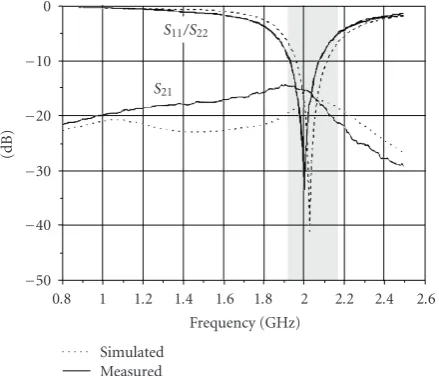
Figure2: Simulated and measuredS-parameters of the initial two-antenna system.
PCB 100×40 mm2
UMTS PIFA
Feeding strip 1 Shorting strip 1
Shorting strip 2 Feeding strip 2 z y
x
Neutralization line
Figure3: 3D view of the two-antenna system with a suspended line between the PIFA shorting strips.
(18 mm at 2 GHz). They are fed by a metallic strip soldered to an SMA connector and shorted to the PCB by an iden-tical strip. Each PIFA is optimized to cover the UMTS band
(1920–2170 MHz) with a return loss goal of−6 dB. The
opti-mized dimensions are of 26.5 mm length and of 8 mm width. A prototype was fabricated using a 0.3-mm-thick nickel
sil-ver material (conductivity σ = 4×10⁶ S/m). InFigure 2,
we present the simulated and the measuredS-parameters of
the structure. The absolute valueS21reaches a maximum of
−5 dB in the middle of the UMTS band.
In the first attempt to improve the isolation between the radiating elements, a suspended line as a neutralization de-vice was inserted between the shorting strips of the two
PI-FAs (seeFigure 3). The optimization of this line was already
explained in [21]. Figure 4shows theS-parameters of this
new structure. We can see a good matching and a strong im-provement of the isolation in the bandwidth of interest: the
measuredS21parameter always remains below−15 dB.
How-ever, a different isolation can be obtained if we implement the
0.8 1 1.2 1.4 1.6 1.8 2 2.2 2.4 2.6
Figure 4: Simulated and measured S-parameters of the two-antenna system with a line between the PIFA shorting strips.
PCB 100×40 mm2
Figure5: 3D view of the two-antenna system with a suspended line between the PIFA feeding strips.
of the PIFAs (seeFigure 5). We can observe inFigure 6that a
deep null is now achieved in the middle of the UMTS band.
Moreover, the measuredS21always remains below−18 dB in
the whole UMTS band. All these values seem to be very sat-isfactory for diversity purposes.
3. COMPARISON OF THE DIVERSITY PERFORMANCE
3.1. Total efficiency
Traditionally, the radiation performance of an antenna is measured outdoors or in an anechoic chamber. In order to
obtain the total efficiency, we need to measure the
radia-tion pattern in all direcradia-tions in space and integrate the re-ceived power density to find the total radiated power. This
gives the total efficiency when compared to the
correspond-ing radiated power of a known reference antenna. This final result is obtained after a long measurement procedure. This parameter can be measured very much faster and easier in a reverberation chamber. However, it is necessary to
mea-sure a reference case (a dipole antenna having an efficiency
0.8 1 1.2 1.4 1.6 1.8 2 2.2 2.4 2.6
Figure 6: Simulated and measured S-parameters of the two-antenna system with the line between the PIFA feeding strips.
of 96% in our case) and then the antenna system under test (AUT). It is also important that the chamber is loaded in ex-actly the same way for these both measurements. For the ref-erence case, the transmission between the refref-erence antenna and the excitation antennas is measured in the chamber with the reference antenna in free space that means at least half a wavelength away from any lossy objects and/or the metallic walls of the chamber. As soon as the reference case is com-pleted, we can measure the AUT. From both measurements, we can then computePref(1) andPAUT(2):
whereS21is the averaged transmission power level,S11is the
free space reflection coefficient of the excitation antenna, and
S22is the free space reflection coefficient of the reference
an-tenna (or the anan-tenna under test). The− denotes averaging
overnpositions of the platform stirrer, polarization stirrer,
and mechanical stirrers. The total efficiency can be then
cal-culated from (3)
Figure 7shows the total efficiency in dB of all the antenna systems (without the neutralization line (a), with the line between the feeding strips (b), and with the line between the shorting strips (c)). The simulated curves have been ob-tained with the help of IE3D which uses the simulated scat-tering parameters. The experimental curves have been mea-sured in the reverberation chamber and with the help of a
homemade Wheeler-Cap setup [16]. With frequency
Table1: Comparison ofηtotand the MEG of both antennas of the different structures atf =2 GHz.
ηtot(dB) antenna1 MEG (dB) antenna1 ηtot(dB) antenna2 MEG (dB) antenna2
Sim. RC Sim. RC Sim. RC Sim. RC
Table2: MEG ratio of the antennas for all the prototypes at f =
2 GHz.
MEG1/MEG2
Initial 1,12
Line between the feeding strips 1,07 Line between the shorting strips 1,07
given as +/−0.5 dB in the reverberation chamber. The
un-certainty of the homemade Wheeler Cap system is assumed
to be quite the same. The total efficiency of both antennas
from each prototype is presented. It can be seen that they
are slightly different in the two measurement cases (dotted
lines and solid lines) due to the fact that the fabricated
proto-types suffer from small inherent asymmetries. However, only
one curve is presented for each simulation case due to perfect symmetries and identical structure on the CAD software. We can observe that all these curves are in a good agreement es-pecially if we compare their maximums. The small frequency shift observed in all the curves with the dotted lines is due to the fact that the antenna was mechanically modified dur-ing transportation for measurement, and therefore frequency
is detuned. This effect impacts directly theS11and then the
frequency location of the maximum of the total efficiency.
The improvement brought by the neutralization technique
is clearly shown: the maximum total efficiency of the
neu-tralized antennas is around−0.25 dB, whereas the one of the
initial structure is less than−1 dB.
3.2. Mean effective gain and mean effective gain ratio
In order to characterize the performance of a multichannel
antenna in a mobile environment, different parameters as the
MEG and the MEG ratio are used. The total efficiency is the
average antenna gain in the whole space. Equation (4) shows
that it can be calculated from the integration of the radiation pattern cuts
whereGθandGϕare the antenna power gain patterns.
The MEG is a statistical measure of the antenna gain in a mobile environment. It is equal to the ratio of the mean
received power of the antenna and the total mean incident. It can be expressed by (5) as in [6]:
wherePθandPϕare the angular density functions of the
inci-dent power, and XPR represents the cross-polarization power gain which is defined in (6):
In the case where the antenna is located in a statistically uni-form Rayleigh environment (i.e., the case in the
reverbera-tion chamber), we have XPR=1 andPθ =Pϕ=1/4π. The
MEG is then equal to the total antenna efficiency divided by
two or−3 dB [27]. Moreover, to achieve good diversity gain,
the average received power from each antenna element must be nearly equal: this corresponds to getting the ratio of the
MEG between the two antennas close to unity [29].Table 1
presentsηtotand the MEG of both antennas for the three
pro-totypes at f =2 GHz. The “Sim.” values have been computed
using the simulated radiation patterns while the reverbera-tion chamber results “RC” are taken from the previous mea-surements.
The neutralization line provides an enhancement of the
ηtotand the MEG as expected from the previous values. The
improvement of the MEG is about 0.7 dB with regard to the
initial structure.Table 2presents the MEG ratio between the
two antennas of the different prototypes (computed from
the RC MEG) at 2 GHz. It is seen that the antennas have comparable-average-received power because these entire ra-tios are close to unity. Such a result was somewhat expected due to the symmetric antenna configuration of our
proto-types. In fact, the MEG difference only shows here the
proto-typing errors we made during the fabrication process. Nev-ertheless, all the results of this section confirm the benefit of using a neutralization technique between the radiators.
3.3. Correlation
1.8 1.85 1.9 1.95 2 2.05 2.1 2.15 2.2
Figure7: Total efficiency of the two-antenna structures: (a) with-out the neutralization line, (b) with the neutralization line between the feeding strips, and (c) with the neutralization line between the shorting strips.
−35 −30 −25 −20 −15 −10 −5 0 5 10 Relative received power (dB)
10−3 Relative received power (dB)
10−3 Relative received power (dB)
10−3
Figure9: Cumulative probability of the two-antenna systems over a 4 MHz bandwidth at 2 GHz: (a) without the neutralization line, (b) with the neutralization line between the feeding strips, and (c) with the neutralization line between the shorting strips.
−35 −30 −25 −20 −15 −10 −5 0 5 10 Relative received power (dB)
10−3 Relative received power (dB)
10−3 Relative received power (dB)
10−3
a wireless link is an important figure of merit. Usually, the en-velope correlation is presented to evaluate the diversity
capa-bilities of a multiantenna system [30]. This parameter should
be preferably computed from 3D-radiation patterns [31,32],
but the process is tedious because sufficient pattern cuts must
be taken into account. In the case of a two-antenna system, the envelope correlationρeis given by (7) as in [31,32]:
system when the portiis excited, and•denotes the
Hermi-tian product.
However, assuming that the structure will operate in a uniform multipath environment, a convenient and quick al-ternative consists by using (8) (see [31–33]):
It offers a simple procedure compared to the radiation
pat-tern approach, but it should be emphasized that this equation is strictly valid when the three following assumptions are ful-filled:
(i) lossless antenna case that means having antennas with
high efficiency and no mutual losses [29,30];
(ii) antenna system is positioned in a uniform multipath environment which is not strictly the case in real envi-ronments, however, the evaluation of some prototypes
in different real environments has already shown that
there are no major differences in these cases [34];
(iii) load termination of the nonmeasured antenna is 50Ω.
In reality, the radio front-end module does not always
achieve this situation, but the 50Ωevaluation
proce-dure is commonly accepted [35,36].
All these limitations are clearly showing that in real systems the envelope correlation calculated based on of the help of theSi jparameters is not the exact value, but nevertheless is a
good approximation. In addition, it should be noted that
an-tennas with an envelope correlation coefficient less than 0.5
are recognized to provide significant diversity performance [30].
To measure the correlation between the antennas of our systems in the reverberation chamber, each branch is
con-nected to a separate receiver. The two different received
sig-nals are recorded, and the envelope correlation can be
di-rectly computed. Figure 8 presents the measured envelope
correlation coefficients of all the antenna systems. They are
compared with those obtained using (7) (computation from
the simulated IE3D complex 3D-radiation patterns) and
with those obtained using (8) (measuredS-parameter
val-ues). All these curves are in a moderate agreement, but it can
be seen that the envelope correlation coefficients of all the
prototypes are always lower than 0.15 on the whole UMTS band: good performance in terms of diversity is thus
ex-pected [1]. Here, it is however somewhat difficult to claim
that the neutralization technique provides an improvement of the correlation. It seems rather obvious that with such spaced antennas operating in a uniform multipath
environ-ment, low correlation is not very difficult to achieve.
3.4. Apparent diversity gain and actual diversity gain
The concept of diversity means that we make use of two or more antennas to receive a signal and that we are able to com-bine the replicas of the received signal in a desirable way to improve the communication link performance. One require-ment is high isolation between the antennas; otherwise the
diversity gain will be low. The apparent diversity gainGdiv app
relative to antenna1 and the actual diversity gainGdiv actare
defined in (9)
whereηtot1is the total efficiency of antenna1.
Note that these formulas are valid only if the noise signals
N1(andN2for the second antenna) are independent of the
total efficiency. This is the case if the system noise is
dom-inated by those of the receivers or if the antenna noise tem-perature is the same as the surrounding temtem-perature. The last condition is often close to being satisfied in mobile systems because the antenna is rather omnidirectional and picks up thermal noise mainly from the environment (ground, build-ings, trees, human) around the antenna, and less from the low sky temperature.
We can see inFigure 9the power samples of each
two-antenna system (without the neutralization line (a), with the line between the feeding strips (b), and with the line between the shorting strips (c)) averaged over a 20-MHz frequency band at 2 GHz. We can observe that the combined signal curves with the selection combining scheme (solid lines) are steeper than the two curves of the antenna elements taken alone (dotted lines). This is the benefit of combining the two signals received by each antenna of the structure. By just
looking at the curves inFigure 9, the uncertainty is
undoubt-edly very large. This is due to the obvious lack of samples at low-probability levels coming from the measurement proce-dure.
The apparent diversity gain is determined by the power-level improvement at a certain probability power-level. In Figures 9(a),9(b), and9(c), we have chosen 1% probability. It is then
the difference between the strongest antenna element curve
and the combined signal curve. The power improvement is 7.6 dB for the system with low isolation, whereas it is 8.8 dB and 9.1 dB for the system with high isolation, respectively, for the line between the shorting strips and the line between
the feeding strips. As the total efficiency is not taken into
ac-count in the apparent diversity gain, the improvement only comes from the fact that the radiation patterns are slightly
different in the case of the two neutralized structures.
Table3: Summary of the measured and computed diversity gains of all the antenna systems.
fact that a strong current is flowing on the line. This increase of the X-pol appears to be beneficial for the diversity gain.
When taking into account the total efficiency of the
anten-nas, we can compute the actual diversity gain as 6.3 dB for the initial system, 8 dB and 8.6 dB for the neutralized short-ing strips and feedshort-ing strips systems, respectively. The data fromFigure 9were also processed with the smooth function
of MATLAB [37] in order to evaluate the validity of our
mea-surements. Several “smooth steps” were tried out in this
op-eration and the new curves are presented inFigure 10. It
ap-pears that all the apparent diversity gains were formerly un-derestimated. The new actual diversity gains are now 7.8 dB, 8.8 dB, and 9.5 dB for, respectively, the initial, the neutralized shorting strips and feeding strips systems. A summary of all
these values can be found inTable 3.
It seems obvious that the neutralization technique en-hances the actual diversity gain. These results are consistent
with other publications [38] and even better due to the use of
highly efficient antennas here. We should also point out that
the apparent diversity gain and the actual diversity gain are
not so much different due to the same reason [39].
4. CONCLUSION
In this paper, we have presented different two-antenna
sys-tems with poor and high isolations for diversity purposes. The reverberation chamber measurements at the antenna group of Chalmers University of Technology have shown that
even if the envelope correlation coefficient of these systems is
very low, having antennas with high isolation will improve the total efficiency and the effective diversity gain of the sys-tem. The same conclusions have been drawn regarding the MEG values. All these results point out the usefulness of our
simple solution to achieve efficient antenna systems at the
terminal side of a wireless link for diversity or MIMO
appli-cations. Next studies will focus on the effect of the users upon
the neutralization technique by positioning the antenna sys-tems next to a phantom head.
ACKNOWLEDGMENT
The authors express their gratitude to the COST284 project for providing the opportunity to make a short-term scientific mission from the LEAT to Chalmers Institute.
REFERENCES
[1] Z. Ying and D. Zhang, “Study of the mutual coupling, corre-lations and efficiency of two PIFA antennas on a small ground
plane,” inProceedings of IEEE Antennas and Propagation Soci-ety International Symposium, vol. 3, pp. 305–308, Washington, DC, USA, July 2005.
[2] J. Thaysen and K. B. Jakobsen, “MIMO channel capacity ver-sus mutual coupling in multi antenna element system,” in
Proceedings of the 26th Annual Meeting & Symposium on An-tenna Measurement Techniques Association (AMTA ’04), Stone Mountain, Ga, USA, October 2004.
[3] M. Karakoikis, C. Soras, G. Tsachtsiris, and V. Makios, “Com-pact dual-printed inverted-F antenna diversity systems for portable wireless devices,”IEEE Antennas and Wireless Prop-agation Letters, vol. 3, no. 1, pp. 9–14, 2004.
[4] K.-L. Wong, C.-H. Chang, B. Chen, and S. Yang, “Three-antenna MIMO system for WLAN operation in a PDA phone,”
Microwave and Optical Technology Letters, vol. 48, no. 7, pp. 1238–1242, 2006.
[5] S. H. Chae, S.-K. Oh, and S.-O. Park, “Analysis of mutual coupling, correlations, and TARC in WiBro MIMO array an-tenna,”IEEE Antennas and Wireless Propagation Letters, vol. 6, pp. 122–125, 2007.
[6] H. T. Hui, “Practical dual-helical antenna array for diver-sity/MIMO receiving antennas on mobile handsets,”IEE Pro-ceedings: Microwaves, Antennas and Propagation, vol. 152, no. 5, pp. 367–372, 2005.
[7] J. Villanen, P. Suvikunnas, C. Icheln, J. Ollikainen, and P. Vainikainen, “Advances in diversity performance analysis of mobile terminal antennas,” inProceedings of the International Symposium on Antennas and Propagation (ISAP ’04), Sendai, Japan, August 2004.
[8] M. Manteghi and Y. Rahmat-Samii, “Novel compact tri-band two-element and four-element MIMO antenna designs,” in
Proceedings of the International Symposium on Antennas and Propagations (ISAP ’06), pp. 4443–4446, Albuquerque, NM, USA, July 2006.
[9] M. Manteghi and Y. Rahmat-Samii, “A novel miniaturized tri-band PIFA for MIMO applications,”Microwave and Optical Technology Letters, vol. 49, no. 3, pp. 724–731, 2007.
[10] D. Browne, M. Manteghi, M. P. Fits, and Y. Rahmat-Samii, “Experiments with compact antenna arrays for MIMO radio communications,”IEEE Transaction on Antennas and Propa-gation, vol. 54, no. 11, part 1, pp. 3239–3250, 2007.
[11] B. Lindmark and L. Garcia-Garcia, “Compact antenna array for MIMO applications at 1800 and 2450 MHz,”Microwave and Optical Technology Letters, vol. 48, no. 10, pp. 2034–2037, 2006.
[12] R. G. Vaughan and J. B. Andersen, “Antenna diversity in mo-bile communications,”IEEE Transactions on Vehicular Tech-nology, vol. 36, no. 4, pp. 149–172, 1987.
[14] J. B. Andersen and B. K. Lau, “On closely coupled dipoles in a random field,”IEEE Antennas and Wireless Propagation Letter, vol. 5, no. 1, pp. 73–75, 2006.
[15] J. W. Wallace and M. A. Jensen, “Termination-dependent diversity performance of coupled antennas: network theory analysis,” IEEE Transactions on Antennas and Propagation, vol. 52, no. 1, pp. 98–105, 2004.
[16] M. A. J. Jensen and J. W. Wallace, “A review of antennas and propagation for MIMO wireless communications,”IEEE Transactions on Antennas and Propagation, vol. 52, no. 11, pp. 2810–2824, 2004.
[17] J. Thaysen and K. B. Jakobsen, “Mutual coupling reduction us-ing a lumped LC circuit,” inProceedings of the 13th Interna-tional Symposium on Antennas (JINA ’04), pp. 492–494, Nice, France, November 2004.
[18] S. Dossche, S. Blanch, and J. Romeu, “Optimum antenna matching to minimise signal correlation on a two-port an-tenna diversity system,”IET Electronics Letters, vol. 40, no. 19, pp. 1164–1165, 2004.
[19] S. Dossche, J. Rodriguez, L. Jofre, S. Blanch, and J. Romeu, “Decoupling of a two-element switched dual band patch antenna for optimum MIMO capacity,” in Proceedings of the International Symposium on Antennas and Propagations (ISAP ’06), pp. 325–328, Albuquerque, NM, USA, July 2006. [20] Y. Gao, X. Chen, C. Parini, and Z. Ying, “Study of a
dual-element PIFA array for MIMO terminals,” inProceedings of the International Symposium on Antennas and Propagations (ISAP ’06), pp. 309–312, Albuquerque, NM, USA, July 2006. [21] A. Diallo, C. Luxey, P. Le Thuc, R. Staraj, and G.
Kossi-avas, “Study and reduction of the mutual coupling between two mobile phone PIFAs operating in the DCS1800 and UMTS bands,”IEEE Transactions on Antennas and Propaga-tion, vol. 54, no. 11, part 1, pp. 3063–3074, 2006.
[22] A. Diallo, C. Luxey, P. Le Thuc, R. Staraj, and G. Kossiavas, “Enhanced diversity antennas for UMTS handsets,” in Pro-ceedings of the European Conference on Antennas and Propa-gations (EuCAP ’06), Nice, France, November 2006.
[23] P.-S. Kildal and K. Rosengren, “Correlation and capacity of MIMO systems and mutual coupling, radiation efficiency, and diversity gain of their antennas: simulations and mea-surements in a reverberation chamber,”IEEE Communications Magazine, vol. 42, no. 12, pp. 104–112, 2004.
[24] http://www.bluetest.se/.
[25] T. Bolin, A. Derneryd, G. Kristensson, V. Plicanic, and Z. Ying, “Two-antenna receive diversity performance in indoor envi-ronment,”Electronics Letters, vol. 41, no. 22, pp. 1205–1206, 2005.
[26] T. Taga, “Analysis for mean effective gain of mobile antennas in land mobile radio environments,”IEEE Transactions on Ve-hicular Technology, vol. 39, no. 2, pp. 117–131, 1990.
[27] K. Kalliola, K. Sulonen, H. Laitinen, O. Kivek¨as, J. Krogerus, and P. Vainikainen, “Angular power distribution and mean ef-fective gain of mobile antenna in different propagation envi-ronments,”IEEE Transactions on Vehicular Technology, vol. 51, no. 5, pp. 823–838, 2002.
[28] IE3D, Release 11.15, Zeland software, 2005.
[29] C. C. Chlau, X. Chen, and C. Q. Parinl, “A compact four-element diversity-antenna array for PDA terminals in a mimo system,” Microwave and Optical Technology Letters, vol. 44, no. 5, pp. 408–412, 2005.
[30] S. C. K. Ko and R. D. Murch, “Compact integrated diversity antenna for wireless communications,”IEEE Transactions on Antennas and Propagation, vol. 49, no. 6, pp. 954–960, 2001.
[31] I. Salonen and P. Vainikainen, “Estimation of signal correla-tion in antenna arrays,” inProceedings of the 12th International Symposium Antennas (JINA ’02), vol. 2, pp. 383–386, Nice, France, November 2002.
[32] P. Brachat and C. Sabatier, “R´eseau d’antennes `a 6 Capteurs en Diversit´e de Polarisation,” inProceedings of the 13th Interna-tional Symposium Antennas (JINA ’04), Nice, France, Novem-ber 2004.
[33] J. Thaysen and K. B. Jakobsen, “Envelope correlation in (N, N) MIMO antenna array from scattering parameters,”Microwave and Optical Technology Letters, vol. 48, no. 5, pp. 832–834, 2006.
[34] Z. Ying, V. Plicanic, T. Bolin, G. Kristensson, and A. Derneryd, “Characterization of Multi-Channel Antenna Performance for Mobile Terminal by Using Near Field and Far Field Parame-ters,” COST 273 TD (04)(095), G¨oteborg, Sweden, June 2004. [35] A. Derneryd and G. Kristensson, “Signal correlation including antenna coupling,”Electronics Letters, vol. 40, no. 3, pp. 157– 159, 2004.
[36] A. Derneryd and G. Kristensson, “Antenna signal correlation and its relation to the impedance matrix,”Electronics Letters, vol. 40, no. 7, pp. 401–402, 2004.
[37] http://www.mathworks.fr/.