R E S E A R C H
Open Access
Cognitive full-duplex relay networks
under the peak interference power constraint
of multiple primary users
Xuan-Toan Doan
1, Nam-Phong Nguyen
1, Cheng Yin
1, Daniel B. da Costa
2and Trung Q. Duong
1*Abstract
This paper investigates the outage performance of cognitive spectrum-sharing multi-relay networks in which the relays operate in a full-duplex (FD) mode and employ the decode-and-forward (DF) protocol. Two relay selection schemes, i.e., partial relay selection (PRS) and optimal relay selection (ORS), are considered to enhance the system performance. New exact expressions for the outage probability (OP) in both schemes are derived based on which an asymptotic analysis is carried out. The results show that the ORS strategy outperforms PRS in terms of OP, and increasing the number of FD relays can significantly improve the system performance. Moreover, novel analytical results provide additional insights for system design. In particular, from the viewpoint of FD concept, the primary network parameters (i.e., peak interference at the primary receivers, number of primary receivers, and their locations) should be carefully considered since they significantly affect the secondary network performance.
Keywords: Cognitive radio networks, Full-duplex, Decode-and-forward, Performance analysis
1 Introduction
The explosion of data traffic over wireless communica-tion has brought a huge demand for spectrum resources. Cognitive radio has arisen as a promising technology for efficiently utilizing the limited spectrum [1, 2]. The key principle behind the functionality of a spectrum sharing approach (also known as underlay strategy) in cognitive radio networks (CRNs) is that unlicensed secondary users are allowed to access the licensed spectrum as long as the interference from the secondary transmitters is harmless to the primary receivers [3]. In order words, the secondary transmitters need to set their transmit powers in order to not cause any interference to the primary network that is above a predefined level. This power adjustment implies a reduction in the coverage area of the secondary net-work. Fortunately, cooperative relay schemes, which can enhance the coverage of wireless networks by deploying helping nodes to transfer information from the source
*Correspondence: [email protected]
This paper has been presented in part at International Conference on Recent Advances on Signal Processing, Telecommunications & Computing (SigTelCom), Da Nang, Vietnam, January 2017
1Queen’s University Belfast, Belfast, UK
Full list of author information is available at the end of the article
to the destination, have been introduced in CRNs with spectrum-sharing environment (see, for instance, [4–8]). Specifically, different relay selection schemes assuming amplify-and-forward (AF) and decode-and-forward (DF) relaying protocols, were studied in [6–8], and the results showed that by applying appropriate cooperative schemes, cognitive relay networks can significantly attain improved performance.
However, the aforementioned studies employed half-duplex (HD) relays, which are inefficient from the spec-trum usage point of view. Note that a conventional relay uses two time-slots for two operating phases, i.e., listen-ing to messages from the information source node and relaying message to the destination. To tackle this spec-tral inefficiency, full-duplex (FD) techniques have been proposed for relay networks [9, 10], which enable relay nodes to transmit and receive signals simultaneously at the price of self-interference. Although self-interference is an undesirable effect in practice, the developments in signal processing and antenna technologies have proven that FD techniques are a promising solution for effi-cient spectrum usage in the next generation of wireless communication [11–13]. Moreover, the effect of FD tech-niques on relay networks has attracted wide attention
recently [14–16]. The authors in [17–19] investigated a FD, dual-hop, AF system, in which the self-interference variance was modeled as a function of transmit power. In [20], the authors studied different relay selection policies based on the availability of system’s channel state infor-mation (CSI) at the source node of a multiple AF FD relay system. In [21], motivated by incremental-DF protocol, the authors proposed a new cooperative protocol for FD relays named as incremental-selective-DF and compared its performance with selective-DF protocol in Nakagami-mfading environment. In [9], the authors examined the outage probability (OP) of a DF relay network to find the optimal duplex mode of the considered system. How-ever, in all these aforementioned studies, the influence of spectrum-sharing environment on FD relay networks is not well understood. Motivated by this observation, in this paper, we study the performance of cognitive FD relay net-works in the presence of multiple FD relays and multiple primary receivers. The contributions of the paper can be summarized as follows:
• Two relay selection schemes, namely, optimal relay selection (ORS) and partial relay selection (PRS), based on the availability of the system CSI at the secondary information source are proposed.
• Due to the existence of the common random variables (RVs), i.e., the channels from the source and/or selected relay to multiple primary receivers, the signal-to-noise-ratios (SNRs) of all links become correlated which makes the analysis troublesome. To get around this challenge, we first apply the
conditional probability on these RVs and then derive the analytical expressions for the OP of the
considered system. Specifically, the exact and asymptotic expressions of OP in PRS and ORS schemes are also obtained.
• The derived results reveal several insights. For instance, it is shown that the primary network’s parameters, i.e., the peak interference constraint, the distance from the primary receivers to the secondary transmitters, and the number of primary receivers, have a high impact on the performance of the secondary network and should be carefully designed. In addition, ORS strategy outperforms PRS 1 in terms of OP, and increasing the number of FD relays can significantly improve the system performance.
The rest of this paper is organized as follows. The sys-tem and channel models are introduced in Section 2. Exact and asymptotic expressions for the OP assuming ORS and PRS policies are derived in Sections 3 and 4, respectively. Numerical results are presented in Section 5, which are corroborated through Monte Carlo simula-tions. Finally, the main conclusions are outlined in Section
6. Appendices A, B, C, and D present the proofs of four Lemmas.
2 System and channel models
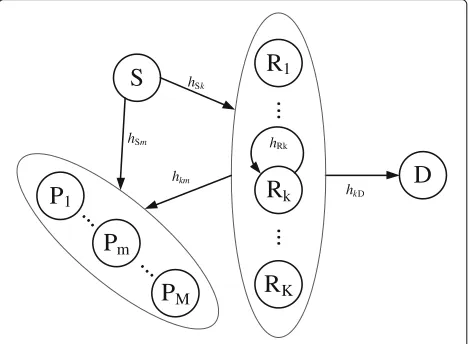
We consider a cognitive relay network consisting of one secondary transmitter S, K secondary FD DF relays Rk, k ∈ {1,. . .,K}, one secondary receiver D, and M pri-mary receivers Pm,m ∈ {1,. . .,M}, as shown in Fig. 1. We assume that the primary transmitters are located suf-ficiently far away from the secondary nodes so as not to impinge any interference upon the received signals at the relays and destination and not to cause perturbation on the relay selection process. The node S is equipped with a single antenna and employs a transmit power PS. Meanwhile, Rk is equipped with two antennas (one receive antenna and one transmit antenna) for operating in FD mode1. All the channels are assumed to experience Rayleigh fading, in which the respective channel power gains are exponentially distributed.
Since a spectrum sharing approach is adopted and Rk is in full-duplex mode, the transmit power fromSandRk is constrained by the primary network’s peak interference parameterIpas follows:
Ip≥PS max m=1,...,M|hSPm|
2+P
R max
m=1,...,M|hRkPm|
2 (1)
From (1), non-optimal condition for PS andPR can be selected as follows:
PS =
Ip 2 max
m=1,...,M|hSPm|
2, (2)
PR= Ip
2 max
m=1,...,M|hRkPm|
2, (3)
where PS andPR are the transmit powers of S andRk, respectively, hSPm and hRkPm denote the channel
coeffi-cients pertaining to the S → Pm andRk → Pm links,
S
Rk
D
Pm
hkD
hRk
R1
RK
P1
P
Mhkm hSm
hSk
respectively. The CSI of the channel gains from the source and relays to primary users can be obtained from direct feedback from PU-Rx or indirect feedback from band manager [22].
The transmission is performed in two hops. In the first hop,Stransmits information toRk∗, where the subscript k∗ indicates the aiding relay that is chosen in the relay selection process, which will be detailed next. Because
Rk∗ simultaneously receives and forwards information, self-interference occurs at the receive antenna of Rk∗. Furthermore, althoughRk∗ applies self-interference can-cellation techniques, the self-interference channel atRk∗, i.e.,hRk∗, cannot be fully mitigated and is modeled as an
independent Rayleigh distributed channel [23]. In addi-tion, we assume that the impact of interference from the primary transmitter on secondary network is neglected when the primary transmitter is located far away from sec-ondary receiver [24, 25]. Thus, the received signal atRk∗is given by wherexS andxRrepresent the transmitted signals fromS andRk∗, respectively,hSRk∗is the channel coefficient from
StoRk∗, andnR∼N(0,N0)is the additive white Gaussian noise (AWGN) atRk∗.
After decoding the received information fromS,Rk∗ for-wards the decoded message toDin the second hop. The received information atDcan be expressed as
yD=
PRhRk∗DxR+nD, (5)
wherehRk∗Ddenotes the channel coefficient fromRk∗toD
andnD∼N(0,N0)stands for the AWGN term atD. The signal-to-interference-plus-noise-ratio (SINR) at
Rk∗and SNR atDcan be written, respectively, as
γ1k∗=
In the considered system, we assume thatRkemploys a DF protocol thanks to its better performance in the pres-ence of self-interferpres-ence compared to that of AF protocol [26]. Thus, the end-to-end SNR can be computed as [5]
γk∗ =min(γ1k∗,γ2k∗). (8)
From (8), the capacity of the overall transmissionS → Rk→Dcan be expressed as
C=log2[1+γk∗] . (9)
Knowing that the OP is defined as the probability that the channel capacity of the considered system falls below a given threshold, such a metric can be formulated as
P{C<Rth} =P 1, andRthis the target rate of the secondary network.
3 Outage probability analysis 3.1 Partial relay selection (PRS)
In some networks, such as wireless sensor networks, the energy and computational resources are limited. There-fore, utilizing aiding relay based on full global CSI is infeasible. Motivated by this fact, in PRS scheme, the node
Suses the CSI solely of the channels pertaining to first-hop transmission to select the aiding relayRpthat has the best link fromS, i.e., the SNR of the second hop are formulated, respectively, as
γPRS SNR of the considered PRS policy is given by
γPRS
From (12)–(14), we have the following lemma.
where 2F1(·,·;·;·) symbolizes the Gaussian hypergeo-metric function ([27], Eq. (9.14.1)) and λ−X1 is the mean value of exponential random variable |hX|2, X ∈ {SRk,RkD,SPm,RkPm,Rk}.
ProofThe proof is given in Appendix A.
3.2 Optimal relay selection (ORS)
In ORS scheme, the nodeSis assumed to be a stationary base station that has rich energy and powerful computa-tional resources. Therefore,Sis able to collect and process all the system CSI to choose the aiding relay that can max-imize the capacity of the considered system. In this case, the aiding relayRois selected according to the following rule:
kORS∗ =arg max
k=1,...,Kmin(γ1k,γ2k) (16)
The end-to-end SNR is given by
γORS
k∗ =k=max1,...,Kmin(γ1k,γ2k), (17)
whereγ1kandγ2kdenote the SINR of the first hop and the SNR of the second hop, respectively, and are expressed as
γ1k=
From (17)–(19), we have the following lemma.
Lemma 2 The OP of the considered ORS scheme is given as follows:
ProofThe proof is given in Appendix B.
4 Asymptotic outage analysis
In this section, an asymptotic outage analysis is carried out in order to gain further insights into the system per-formance. As will be shown, the considered system has null diversity order because of the self-interference effect inherent to the FD technique2. In addition, from the asymptotic expressions, we can observe that in the high SNR regime, the performance of the considered system does not depend on the channel of the second hop. In other words, to enhance the performance of the consid-ered system, the performance of the first hop must be strengthen.
4.1 Partial relay selection
Lemma 3In the high SNR regime, the OP of the consid-ered system with PRS scheme can be expressed as
PPRS
Proof The proof is given in Appendix C.
4.2 Optimal relay selection
Lemma 4In the high SNR regime, the OP of the considered system with ORS scheme can be expressed as
PORS
Proof The proof is given in Appendix D.
5 Numerical results and discussions
is observed. Without loss of generality, we adopt a two-dimensional topology in which the coordinates (x,y) of
S,R, andDare(0, 0),(2, 0), and(3, 0), respectively. Thus, the Euclidian distance between the nodes can be cal-culated as dAB =
(xA−xB)2+(yA−yB)2, where A is placed at (xA,yA) and B has the coordinate (xB,yB). In order to take the path-loss into account, we assume
λX = d−αX , where α denotes the path-loss exponent and λX ∈ {λSP,λSR,λRP,λRD,}. Without loss of gener-ality, in the plots, we set α = 4 and the target rate of the secondary network Rth = 0.4 bits/s/Hz, and
λR=22.
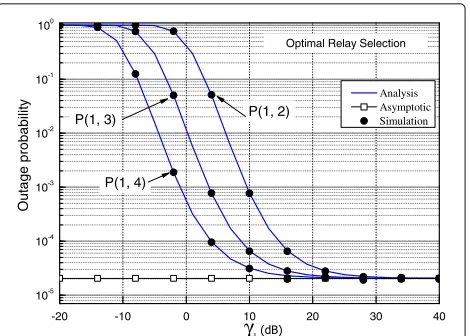
Figures 2 and 3 show the effect of the primary users’ locations on the system OP for the PRS and ORS schemes, respectively. From these figures, one can observe that as the primary receivers move farther from the sec-ondary transmitters, the performance of the secsec-ondary network improves. The reason is that the longer the distance between the primary receiver and the sec-ondary transmitter results in the higher the transmit power of the secondary transmitter, which implies a better secondary transmission. In addition, the effects of the primary network’s peak interference constraint on the secondary network are also revealed. Note that, if the peak interference constraint is too small, the secondary transmitters will not have sufficient trans-mit power to ensure good transmissions. On the other hand, if the peak interference constraint is too high, the transmit power at the FD relays will be large, result-ing in high levels of self-interference. Besides, these two figures also show that the ORS scheme outperforms PRS one.
In Fig. 4, the effect of the number of primary receivers on system OP is investigated. As can be seen, when the SNR is low, increasing the number of primary
-20 -10 0 10 20 30 40
10-3
10-2
10-1
100
P(1,4) P(1,3)
γ1(dB)
O
u
tage
probabilit
y
Analysis Simulation Asymptotic Partial Relay Selection
P(1,2)
Fig. 2Effect of primary users’ positions on system OP for PRS scheme
-20 -10 0 10 20 30 40
10-5
10-4
10-3
10-2
10-1 100
P(1, 4) P(1, 3)
γ1
Optimal Relay Selection
O
u
tage
probabilit
y AnalysisAsymptotic
Simulation
P(1, 2)
Fig. 3Effect of primary users’ positions on the system OP for ORS scheme
receivers decreases the performance of the considered system. However, at high SNR regions, increasing the number of primary receivers will force the secondary transmitters to reduce their transmit powers, reduc-ing the self-interference at the relay and consequently the OP.
Figures 5 and 6 illustrate the influence of self-interference on the secondary network’s performance by varying the mean power of self-interference chan-nel, i.e., λ1
R. As expected, the worse the quality of the
self-interference channel is, the better the system perfor-mance is. Particularly, as the SNR of the considered system is high, the smaller the mean power of self-interference channel is, the higher the system diversity gain is. In addition, the results show that applying ORS scheme can
-20 -10 0 10 20 30 40
10-5
10-4
10-3
10-2
10-1
100
M=3,6,9 M=3,6,9
ORS
O
ut
age
probabilit
y
γ1(dB) Analysis (M=3)
Analysis (M=6) Analysis (M=9) Simulation Asymptotic
PRS
-20 -10 0 10 20 30 40 10-2
10-1 100
Partial Relay Selection
O
u
tage
probabilit
y
γ1(dB)
Analysis Asymptotic Simulation
λR= 5
λR= 10
λR= 15
Fig. 5Effect of self-interference on the system OP with PRS scheme
restraint the effect of self-interference better than PRS scheme.
Figure 7 demonstrates the influence of the number of relays on the system OP. When the number of relays increases, the performance of the considered system is enhanced. Particularly, a more significant improve-ment can be witnessed in ORS scheme than in PRS scheme.
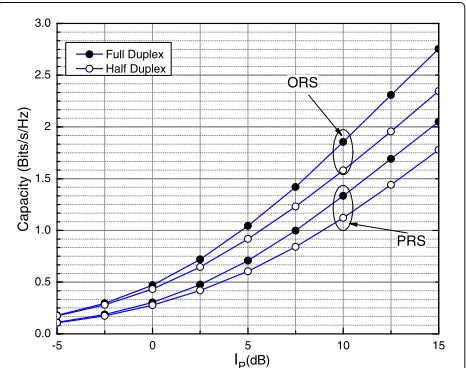
Figure 8 shows the comparison in system’s capac-ity between FD and HD relays. We can observe that applying FD relays can help the system achieve a higher capacity. The reason is that FD relays can listen and transmit information simultaneously while HD relays have two phases of operation, i.e., listening to the information source and relaying signal to the destination.
-20 -15 -10 -5 0 5 10 15 20 25 30 35 40
10-5
10-4
10-3
10-2
10-1 100
λR= 15 λR= 10
O
ut
age
probabilit
y
γ1(dB) Analysis
Asymptotic Simulation
λR= 5
Optimal Relay Selection
Fig. 6Effect of self-interference on the system OP with ORS scheme
-20 -10 0 10 20 30 40
10-4
10-3
10-2
10-1
100
K=7,8,9
O
u
tage
probabilit
y
γ1(dB) Simulation
Analysis Asymptotic
PRS
ORS K=7,8,9
Fig. 7OP for different numbers of FD relays
6 Conclusions
In this paper, the system performance in terms of outage probability of a cognitive FD relay network in the pres-ence of multiple primary receivers has been evaluated. In particular, two relay selection strategies, namely ORS and PRS, have been proposed to enhance the performance of the system. New exact and asymptotic expressions for the OP of the PRS and ORS schemes were derived. The results showed that the ORS scheme has a better per-formance than PRS scheme. In addition, increasing the number of FD relays can enhance the system performance. Primary network designing parameters, i.e., the peak interference constraint, the number of primary receivers, and their locations, have great influences on the perfor-mance of the secondary network and should be mindfully considered.
-5 0 5 10 15
0.0 0.5 1.0 1.5 2 2.5 3.0
PRS
Capacit
y
(Bit
s
/s
/H
z)
Full Duplex Half Duplex
IP(dB)
ORS
Endnotes
1Dual-antenna FD implementation is one of many ways
to deploy FD mode, including single-antenna FD imple-mentation.
2In the considered system, the transmit power at the
full-duplex relay is non-optimal. A transmit power opti-mization scheme at full-duplex relay can be considered to restrain the self-interference effect.
Appendix A: Proof of Lemma 1 Let
The CDF and the probability density function (PDF) of X1can be expressed as
FX1(x)=1−
Finally, the CDF and PDF ofX3are given by
FX3(x)=1−exp(−λRx), (32)
be expressed as
FγPRS
Similarly,FγPRS
1k∗|X4(β)can be calculated as
Appendix B: Proof of Lemma 2 can be calculated as
Fγ2k|Y4k(β)=P be calculated as
Fγ1k|X2,Y4k(β)=P tioned onX2can be calculated as
Fk|X2(β)=1−
where (49) is obtained with the help of ([27], Eq. (3.352.4)). Now, by substituting (49) and
fX2(x)=
into (45), (20) is attained.
Appendix C: Proof of Lemma 3
Thus, the CDF ofγ1PRSk∗ conditioned onX4is given by
Now, analyzingFγPRS
2k∗|X4(β)at highγ1, we have that
where step(a)is obtained by using the McLaurin expan-sion of exp(x) and neglecting the high order items for smallx.
Making use of the above results, it can be shown that the CDF ofγkPRS∗ is given by
where step(b)is performed by neglecting the high order terms. By substituting (51) into (53), and after some math-ematical manipulations, (22) is obtained.
Appendix D: Proof of Lemma 4
For highγ1,Fγ2k|X2|Y4k andFγ1k|X2|Y4k can be rewritten as
where steps (c) and (d) are performed by using the McLau-rin expansion of exp(x) and neglecting the high order terms for smallx.
In addition, the CDF ofk conditioned onX2andY4k can be formulated as
Fk|X2,Y4k(β)=1−
where step(e)is performed by neglecting the high order terms. From (55) and (56), the CDF ofk conditioned on X2can be found as
Finally, by replacing (57) and
fX2(y)=
into (45), (23) is obtained.
Acknowledgements
This work was supported by the Newton Institutional Link under Grant ID 172719890.
Competing interests
The authors declare that they have no competing interests.
Author details
1Queen’s University Belfast, Belfast, UK.2Department of Computer
Engineering, Federal University of Ceará, Sobral, Brazil.
Received: 12 June 2016 Accepted: 12 December 2016
References
1. J Mitola, GQ Maguire, Cognitive radio: making software radios more personal. IEEE Pers. Commun.6(4), 13–18 (1999)
2. KJ Kim, TQ Duong, HV Poor, Performance analysis of cyclic prefixed single-carrier cognitive amplify-and-forward relay systems. IEEE Trans. Wireless Commun.12(1), 195–205 (2013)
3. A Goldsmith, S Jafar, I Maric, S Srinivasa, Breaking spectrum gridlock with cognitive radios: an information theoretic perspective. Proc. IEEE.97(5), 894–914 (2009)
4. VNQ Bao, TQ Duong, DB da Costa, GC Alexandropoulos, A Nallanathan, Cognitive amplify-and-forward relaying with best relay selection in non-identical Rayleigh fading. IEEE Commun. Lett.17(3), 475–478 (2013) 5. KJ Kim, TQ Duong, X-N Tran, Performance analysis of cyclic prefixed
single-carrier spectrum sharing systems with best relay selection. IEEE Trans. Signal Process.60(12), 6729–6734 (2012)
6. Y Yang Yan, J Jianwei Huang, J Jing Wang, Dynamic bargaining for relay-based cooperative spectrum sharing. IEEE J. Sel. Areas Commun. 31(8), 1480–1493 (2013)
7. TQ Duong, DB da Costa, TA Tsiftsis, C Zhong, A Nallanathan, Outage and diversity of cognitive relaying systems under spectrum sharing environments in Nakagami-m fading. IEEE Commun. Lett.16(12), 2075–2078 (2012)
8. T Duong, V Bao, H-J Zepernick, Exact outage probability of cognitive AF relaying with underlay spectrum sharing. IET Electronics Lett.47(17), 1001 (2011)
9. T Kwon, S Lim, S Choi, D Hong, Optimal duplex mode for df relay in terms of the outage probability. IEEE Trans. Veh. Technol.59(7), 3628–3634 (2010)
10. I Krikidis, HA Suraweera, S Yang, K Berberidis, Full-duplex relaying over block fading channel: a diversity perspective. IEEE Trans. Wireless Commun.11(12), 4524–4535 (2012)
11. T Riihonen, S Werner, R Wichman, Mitigation of loopback self-interference in full-duplex MIMO relays. IEEE Trans. Signal Process.59(12), 5983–5993 (2011)
12. D Kim, H Lee, D Hong, A survey of in-band full-duplex transmission: from the perspective of PHY and MAC layers. IEEE Commun. Surv. Tuts.17(4), 2017–2046 (2015)
14. HA Suraweera, I Krikidis, G Zheng, C Yuen, PJ Smith, Low-complexity end-to-end performance optimization in MIMO full-duplex relay systems. IEEE Trans. Wireless Commun.13(2), 913–927 (2014)
15. M Mohammadi, HA Suraweera, Y Cao, I Krikidis, C Tellambura, Full-duplex radio for uplink/downlink wireless access with spatially random nodes. IEEE Trans. Commun.63(12), 5250–5266 (2015)
16. M Mohammadi, BK Chalise, HA Suraweera, C Zhong, G Zheng, I Krikidis, Throughput analysis and optimization of wireless-powered multiple antenna full-duplex relay systems. IEEE Trans. Commun.64(4), 1769–1785 (2016)
17. NH Tran, L Jimenez Rodriguez, T Le-Ngoc, Optimal power control and error performance for full-duplex dual-hop AF relaying under residual self-interference. IEEE Commun. Lett.19(2), 291–294 (2015)
18. LJ Rodriguez, NH Tran, T Le-Ngoc, Performance of full-duplex AF relaying in the presence of residual self-interference. IEEE J. Sel. Areas Commun. 32(9), 1752–1764 (2014)
19. LJ Rodriguez, NH Tran, T Le-Ngoc, Optimal power allocation and capacity of full-duplex AF relaying under residual self-interference. IEEE Wireless Commun. Lett.3(2), 233–236 (2014)
20. I Krikidis, HA Suraweera, PJ Smith, C Yuen, Full-duplex relay selection for amplify-and-forward cooperative networks. IEEE Trans. Wireless Commun. 11(12), 4381–4393 (2012)
21. MG Khafagy, A Ismail, M-S Alouini, S Aissa, Efficient cooperative protocols for full-duplex relaying over Nakagami- m fading channels. IEEE Trans. Wireless Commun.14(6), 3456–3470 (2015)
22. J Peha, Approaches to spectrum sharing. IEEE Commun. Mag.43(2), 10–12 (2005)
23. G Chen, Y Gong, P Xiao, JA Chambers, Physical layer network security in the full-duplex relay system. IEEE Trans. Inf. Forensics Secur.10(3), 574–583 (2015)
24. KJ Kim, TQ Duong, M Elkashlan, PL Yeoh, HV Poor, MH Lee, Spectrum sharing single-carrier in the presence of multiple licensed receivers. IEEE Trans. Wireless Commun.12(10), 5223–5235 (2013)
25. KJ Kim, TQ Duong, HV Poor, Outage probability of single-carrier cooperative spectrum sharing systems with decode-and-forward relaying and selection combining. IEEE Trans. Wireless Commun.12(2), 806–817 (2013)
26. DWK Ng, ES Lo, R Schober, Dynamic resource allocation in MIMO-OFDMA systems with full-duplex and hybrid relaying. IEEE Trans. Commun.60(5), 1291–1304 (2012)
27. IS Gradshteyn, IM Ryzhik,Table of integrals, series, and products, 7th edn. (Academic press, San Diego, 2007)
Submit your manuscript to a
journal and benefi t from:
7Convenient online submission
7Rigorous peer review
7Immediate publication on acceptance
7Open access: articles freely available online 7High visibility within the fi eld
7Retaining the copyright to your article