R E S E A R C H
Open Access
Joint spectrum sensing and access for stable
dynamic spectrum aggregation
Wei Wang
1,2*, Lingcen Wu
1, Zhaoyang Zhang
1and Lin Chen
3Abstract
Spectrum aggregation is an emerging technology to satisfy the data rate requirement of broadband services for next-generation wireless communication systems. In dynamic spectrum environment, in which the spectrum availability is time-varying, it is quite challenging to maintain the stability of spectrum aggregation. In this paper, we investigate the spectrum sensing and access schemes to minimize the times of channel switching for achieving stable dynamic spectrum aggregation, taking into consideration the hardware limitations of spectrum sensing and
aggregation capability. We develop an analytical framework for the joint spectrum sensing and access problem based on partially observable Markov decision process (POMDP). Especially, we derive the reward function by estimation of the stability of different spectrum sensing and access strategies. Based on the POMDP framework, we propose a rollout-based suboptimal spectrum sensing and access scheme which approximates the value function of POMDP, and propose a differential training method to improve its robustness. It is proved that the rollout policy achieves performance improvement over the basis heuristics. The simulation results show that the proposed POMDP-based spectrum sensing and access scheme improves the system stability significantly and achieves near-optimal performance with a much lower complexity.
Keywords: Cognitive radio; Spectrum aggregation; Spectrum sensing; POMDP
1 Introduction
Spectrum aggregation [1,2] enables the utilization of dis-crete spectrum bands or fragments to support broadband services. By spectrum aggregation, the discrete spectrum bands can provide the same transmission service as con-tinuous spectrum bands. Recently, spectrum aggregation becomes one of the key features during LTE-advanced standardization. The performance on the system effi-ciency and fairness of spectrum aggregation is investi-gated in [3] and [4]. The energy efficiency of spectrum aggregation is also considered in [5].
The introduction of cognitive radio (CR) [6,7] increases spectrum efficiency by utilizing the spectrum dynam-ically, and further facilitates the application of spec-trum aggregation. To exploit the instantaneous specspec-trum
*Correspondence: [email protected]
1Department of Information Science and Electronic Engineering, Zhejiang Key Lab of Information Network Technology, Zhejiang University, Hangzhou 310027, P.R. China
2State Key Laboratory of Integrated Services Networks, Xidian University, Xi’an 710071, P.R. China
Full list of author information is available at the end of the article
opportunities in dynamic spectrum environment, the sec-ondary users (SUs) identify available spectrum resources by spectrum sensing and then access the available chan-nels without interrupting primary users (PUs).Dynamic spectrum aggregation (DSA) provides a feasible way to support the broadband services in dynamic spectrum environment. With DSA, multiple available spectrum bands discovered via CR can be aggregated dynamically to fulfill the service requirement.
There have been a few existing publications on spec-trum sensing and access schemes in dynamic specspec-trum environment. In [8], a decentralized MAC protocol is pro-posed for the SUs to sense the spectrum opportunities. The optimal sensing and channel selection are investi-gated to maximize the expected total number of bits delivered over a finite number of slots. In [9] and [10], the authors investigate the impacts of sensing errors on the system performance and try to alleviate their neg-ative effects. In [11], by adopting the fusion strategy of collaborative spectrum sensing, the authors design a multi-channel MAC protocol. However, these existing works have all focused on the cases that each user uses
only a single channel without considering the cases with spectrum aggregation. In [12], we propose a Maximum Satisfaction Algorithm (MSA) for admission control and a Least Channel Switch (LCS) strategy for DSA, but the spectrum sensing and access schemes are not considered jointly. In [13], we provides some preliminary results on a general POMDP framework for cognitive radio networks. In this paper, we investigate the joint spectrum sens-ing and access for DSA considersens-ing several practical limitations:
• Spectrum Sensing Limitation: Due to the limitation of spectrum sensing capability, it is not always possible to sense all the spectrum bands for a large-span spectrum. Each SU chooses only a subset of channels (i.e., a part of the spectrum) to sense. As a result, the system is lack of the perfect information on channel availability, which brings new technical challenges for DSA.
• Spectrum Aggregation Limitation: Due to the hardware capability, only the spectrum bands within a certain range can be aggregated together for a single user. The spectrum aggregation range leads to an additional constraint when the SUs access the spectrum.
• Channel Switch Overhead : When an SU adjusts his access strategy and switches to other channels, it is unavoidable for the channel switch to result in extra system overhead, such as rendezvous,
synchronization, etc. When designing the spectrum sensing and access scheme with the overhead consideration, it is necessary to reduce as many times of channel switch as possible.
Taking the above practical issues into consideration, we propose a decision-theoretic approach by casting the design of joint spectrum sensing and access for stable DSA in the partially observable Markov decision pro-cess (POMDP) [14] framework. In order to provide the reward function for the POMDP framework, the prob-ability of channel switch is estimated based on Markov chain. Since the optimal solution of POMDP is very inten-sive computationally due to the curse of dimensionality, i.e., the computational time and storage requirements grow exponentially with the number of channels. We fur-ther introduce an approximation technique called rollout [15] to design the suboptimal joint spectrum sensing and access scheme. A heuristics is proposed first as the base policy, which can greedily choose the spectrum sensing and access actions to reduce the channel switch times. By rolling out the base policy, the proposed rollout algorithm can approximately calculate the value function defined in the POMDP framework and reduces the times of chan-nel switch. A theoretical analysis is provided to prove
the performance improvement of rollout policy over the heuristics. Furthermore, we propose a differential training method which reduces the sensitivity to approximation errors. The performance of the proposed scheme is evalu-ated by simulation which demonstrates that the proposed policies in the POMDP framework reduce the times of channel switch significantly, and the rollout-based scheme achieves a near-optimal performance compared to the optimal scheme.
The rest of this paper is organized as follows. Section 2 describes the system model and formulates the prob-lem. Section 3 introduces the POMDP framework and the approach to estimate the access and switching probabili-ties. In Section 4, the rollout-based suboptimal spectrum sensing and access schemes are proposed. Section 5 pro-vides the performance evaluation by simulation. Finally, Section 6 summarizes this paper.
2 System model and problem formulation
2.1 Dynamic spectrum aggregation model
We consider a large-span licensed spectrum consisting of Nchannels, which have the same bandwidthBW. Time is slotted and the duration of each time slot isTp. The avail-abilities of channels, which depends on the PU activities, are modeled as the following assumption:
Assumption 1(Channel Availability).The availabilities of N channels compose a system which can be modeled as a discrete-time Markov process with2N states,
S(t)=[S1(t),. . .,SN(t)]∈S= {0, 1}N, (1)
where Sn(t)∈ {0(occupied), 1(idle)}denotes the occupancy state of channel n ∈ {1,. . .,N} at time slot t, which is independent over channels.
Denotepij as the transition probability from statei to statej, i.e.,
pij=Pr{S(t+Tp)=j|S(t)=i},∀i,j∈S, (2)
which can be obtained by multiplying the transition prob-ability of each channela
pij= N
n=1
Pr{Sn(t+Tp)=jn|Sn(t)=in}, (3)
wherein ∈ {0, 1}andjn ∈ {0, 1}are thenth element of the system states i and j, respectively. For simplicity of expression, we denotePn(t)=Pr{Sn(t)=1}.
Assumption 2 (Spectrum Sensing).Due to the spec-trum sensing capability, the SU can only sense at most L channels, which means the size of A1(t)is no more than L, i.e.,|A1(t)| ≤ L. When L < N, the SU only obtains the availability information of a subset of channels.
Note that althoughLchannels can be sensed by the SU, the availability states of theseLchannels are not always accurate because of the existence of sensing errors. The SU performs a binary hypotheses test:
• H0: Null hypothesis indicating that the sensed
channel is available.
• H1: Alternative hypothesis indicating that the sensed
channel is occupied.
If the SU obtains an incorrect sensing resultH1when
the channel state isH0, i.e., false alarm, the SU will refrain
from transmitting and a spectrum opportunity is wasted. On the other hand, if the SU obtains an incorrect sens-ing result H0 when the channel state is H1, i.e., miss
detection, the SU will collide with a PU. LetPf and Pm denote the probabilities of false alarm and miss detection, respectively.
Based on the spectrum sensing results, the SU aggre-gates a set of channelsA2for the data transmission with
spectrum aggregation.
Assumption 3 (Spectrum Aggregation).Due to the spectrum aggregation limitation, the SU can only aggre-gate the channels within, which means that the channels in A2(t)are within the frequency range, i.e., D(i,j) ≤
, ∀i,j ∈ A2(t), where D(i,j) indicates the frequency distance between channel i and channel j. The total band-width of the available channels in A2(t)should satisfy the SU’s bandwidth requirement, denoted asϒ.
We illustrateA1(t)andA2(t)in a large-span spectrum
in Figure 1.
2.2 Problem formulation
The SU can detect the return of PUs and utilize the chan-nels unoccupied by PUs to avoid the interference to PUs. To satisfy the bandwidth requirementϒ in the dynamic spectrum environment, the SU adopts different spectrum sensing and access strategies according to the number of the current available channelsR(t) withinA2(t)for time
slott, which is defined asR(t)=n∈A2(t)Sn(t).
• IfR(t)≥ϒ/BW, the SU reselects onlyA1(t). The
spectrum aggregation decision does not change, i.e., A2(t)=A2(t−Tp).
• IfR(t) < ϒ/BW, the SU has to reselect bothA1(t)
andA2(t)and trigger achannel switch.
With the consideration of reducing the system over-head and maintaining the stability of dynamic spectrum aggregation, our aim is to minimize the expected times of channel switchesc by adjusting the spectrum sensing
and access strategies,A1(t)andA2(t). Denoteη(t)as the
expected times of channel switches from time slot 0 to t. The joint spectrum sensing and access optimization problem for stable DSA can be formulated formally as follows:
min A1,A2
lim t→∞
η(t)
t (4)
s.t. |A1(t)| ≤ L ∀t
D(i,j) ≤ , ∀i,j∈A2(t),∀t
R(t) = n∈A2(t)
Sn(t)≥ ϒ BW, ∀t
The first two constraints indicate the spectrum sens-ing and spectrum aggregation limitations respectively, and the last constraint guarantees the satisfactory of the SU’s bandwidth requirement.
1 A
2 A
Γ
3 A POMDP framework for dynamic spectrum aggregation
In this section, we propose a decision-theoretic frame-work for DSA based on POMDP [14]. Especially, we convert minimizing the times of channels switches into a new objective, i.e., maximizing the time interval of chan-nel switches, and provide an approach to estimate this interval as the reward of the POMDP model, which is challenging in dynamic spectrum environment.
If the SU is able to sense the whole spectrum accurately in the network, all the elements ofS(t)can be obtained and the optimization problem is a standard Markov deci-sion process (MDP) since the channel availability states S(t) is a discrete-time Markov process. However, in the practical situation with the limitation of spectrum sens-ing ability and the existence of senssens-ing errors, the SU can only obtain the imperfect occupancy states of a part of channels, which means L < N andS(t)is partially and inaccurately observable. As a result, we need to cast the optimization problem into the POMDP framework, which is a particular case of MDP in which the state of the system is partially observed by the decision maker.
3.1 POMDP framework
Before the discussion of POMDP framework, we first introduce a new concept called control interval, each of which is composed of a number of consecutive time slots and delimited by channel switches. It is obvious that the length of a control interval is uncertain depending on how long time the current aggregated channels keep sat-isfying the SU’s bandwidth requirement. Incorporating the control interval structure, the joint spectrum sensing and access scheme are designed based on the POMDP framework, and the framework in [8] is no longer suitable. Let T denotes the number of control intervals within the whole time horizon (finite number of time slots), and the indexmindicates themth last control interval. Denote ts(m) as the time slot when the mth channel switch is triggerred. If the current control interval includesκtime slots, the state transition probability at the next control interval is
pκij =Pr{S(m−1)=j|S(m)=i}. (5)
Now, we define the key components of the POMDP framework for DSA. For simplicity of expression, we adopt A1(m) and A2(m) instead of A1(ts(m)) and A2(ts(m)), respectively.
Action The actions of the SU have two stages: deter-miningA1(m)to sense andA2(m)to access. Definea(m)
as the SU action for themth last control interval,
a(m)= {A1(m);A2(m)} = {C1,C2,. . .,CL;Cstart}, (6)
where Ci is the index of the ith sensed channel, ∀i ∈ {1,. . .,L}andCstartis the starting index of the accessed
channel set A2(m). Define A as the set of all possible
actions, i.e.,a(m)∈A.
Observation By sensing the channels inA1(m), the
SU can obtain their occupancy states inaccurately. Let i,A1(m) denotes the sensing results based on the cur-rent system state i and the sensed channel set A1(m).
The observing output in themth last control interval is expressed as
i,A1(m)= {θC1(m),θC2(m),. . .,θCL(m)} (7)
where θCj(m) ∈ {0, 1}, ∀Cj ∈ A1(m). AlthoughθCj(m) may be different to the actual channel availability state SCj(m)due to the sensing errors, they are correlated and θCj(m) ∈ {0, 1} provides useful information for estimat-ingSCj(m). Specifically, the conditional probabilities of the channel states can be calculated by the Bayes rule [16]. If θCj(m)=0, we have
Pr{SCj(m)=1|θCj(m)=0} (8)
= Pr{SCj(m)=1,θCj(m)=0}
Pr{θCj(m)=0}
= Pr{θCj(m)=0|SCj(m)=1} ·Pr{SCj(m)=1}
Pr{θCj(m)=0}
where Pr{θCj(m) = 0|SCj(m) = 1} = Pf , Pr{SCj(m) = 1} =PCj(m), and
Pr{θCj(m)=0}
= Pr{SCj(m)=1} ·Pr{θCj(m)=0|SCj(m)=1} +Pr{SCj(m)=0} ·Pr{θCj(m)=0|SCj(m)=0} = PCj(m)Pf +(1−PCj(m))(1−Pm) (9)
Thus, we have
Pr{SCj(m)=1|θCj(m)=0}
= PfPCj(m)
PCj(m)Pf +(1−PCj(m))(1−Pm)
(10)
Similarly, ifθCj(m)=1, we can obtain that
Pr{SCj(m)=1|θCj(m)=1}
= (1−Pf)PCj(m)
PCj(m)(1−Pf)+(1−PCj(m))Pm (11)
(m)=(δi(m))i∈S (12) where δi(m) = Pr{S(m) = i|H(m)} and H(m) = {a(i),(i)}i≥m.
The 2N-dimensional belief vector (m) is updated according to the action and the observation in the last control interval:
(m−1)= ((m)|a(m),(m))=(δj(m−1))j∈S (13)
where (·|a(m),(m)) indicates the update operator. The updated belief vector can be calculated by the Bayes rule, which also depends on the length of the control interval under consideration, information provided by Equations (10) and (11).
It has been proved in [14] that the belief vector(m)is a sufficient statistics for determining the optimal actions for future control intervals.
PolicyDenote the policy vector asπ =[μ1,μ2,. . .,μT], where μm is a mapping from a belief vector (m) to an action a(m) for each control interval. The set of all possible policies is denoted as, i.e.,π∈.
μm:(m)∈[ 0, 1]2 N
→a(m)= {A1(m)A2(m)} (15)
A policy is said to be stationary if the mappingμmonly depends on the belief vector(m)and is independent to the number of remaining control intervalsm. Denote the set of stationary policies ass, and it is usual to restrict the set of policies tos in POMDP. In our framework, a spectrum sensing and access scheme are essentially a policy of this POMDP.
RewardTo quantify the SU’s objective, we define the reward of a control interval as the length of this control interval, i.e., the number of time slots it includes, denoted asU(m). We now demonstrate that minimizing the num-ber of channel switches equals to maximizing the average reward. For a given total number of time slotst, we have
η(t)=min
which means that over the finite time horizon, the longer the control intervals are, the less expected total times of channel switches will occur, and our objective can be converted into maximizing the average reward.
For control intervalm, a set of accessed channelsA2(m)
is determined according to the belief vector (m). To evaluate the reward of A2(m), we first define the access
probability and the switching probability as follows.
Definition 1(Access Probability).The access probabil-ity indicates the probabilprobabil-ity that the bandwidth of the available channels in A2(m)is more than the number of required channelsϒ, i.e.,
ζ(a(m))=Pr{R(ts(m))≥ϒ|A2(m)}. (18)
Definition 2 (Switching Probability).The switching probability indicates the probability that the bandwidth of the available channels in A2(m)at the next time slot is not more than the number of required channelsϒ, i.e.,
ξ(a(m))=Pr{R(ts(m)+Tp) < ϒ|A2(m)}. (19)
Both the access probabilityζ and the switching prob-ability ξ can be calculated based on the sensing and access actiona, which will be discussed with details in the next subsection. We omitain the notations of both probabilities for simplicity of expression.
The rewardU(m)is a function of the sensing and access actionawhen the system state isjin themth last control interval, which is a Bernoulli random variable with prob-ability density function (p.d.f.)p(κ) (κ ∈ Z+)derived as follows:
p(κ)=ζ·(1−ξ)κ−1·ξ (20)
Using Equations (14) and (20), we can update the belief vector as
In summary, our goal in the POMDP framework is to find the optimal policyπ∗to maximize the average reward as follows:
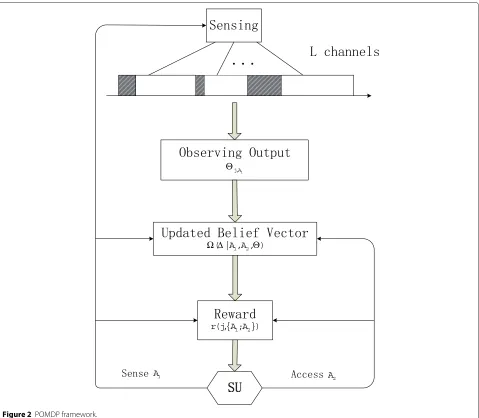
and the POMDP framework for joint spectrum sensing and access for DSA is illustrated in Figure 2, which also indicates the Markovian dynamics of the system.
3.2 Estimation of access probability and switching probability
Figure 2POMDP framework.
For the channels in the access set A2(m), we have
the state vector [SCstart,SCstart+1,. . .,SCstart+M−1]. All the
states in the vector can be taken as independent ran-dom variables, with μi = Pi and σi2 = Pi − P2i for i∈ {Cstart,Cstart+1,. . .,Cstart+M−1}. According to the central limit theorem [17], we have
R(t)=
Cstart+M− 1
i=Cstart
Si(t)∼N(μ,σS) (23)
whereμ =
Cstart+M− 1
i=Cstart Piandσ
2 = Cstart+M− 1
i=Cstart (Pi−P
2
i), as
illustrated in Figure 3.
Based on the distribution ofR(t), we calculate the access probabilityζand the switching probabilityξin the follow-ing two propositions.
Proposition 1(Calculation of Access Probability).If the spectrum sensing obtains the accurate channel availability information of all channels, the access probabilityζ is
ζ =
1 if R≥ BWϒ
0 if R< BWϒ (24)
Otherwise, the access probabilityζ is calculated as
ζ = ϒM
BW 1
√
2πσe −(R−μ)2
2σ2 dR (25)
Figure 3The distribution ofR(t).
f(R)= √1 2πσe
−(R−μ)2
2σ2 (26)
The access probability is the probability ofR ≥ BWϒ , which is also shown by the shadow region in Figure 3. Therefore, Equation (25) is obtained and the proposition holds.
Now we estimate the switching probabilityξ by asymp-totic analysis, in which the sensing period Tp is equally divided intokslim time spans. The situation within one slim time span Tpk is analyzed firstly, and then the period Tpis investigated by considering multiple slim time spans.
1) The case with complete and accurate sensing.
There areRavailable channels andM−Rchannels occu-pied by the PUs in setA2(m)at the beginning of period Tp. The sensing periodTpis equally divided intokparts, in which the parameter k is large enough, so that we can assume that only one single channel’s state is altered during one slim time span.
During the slim time span Tpk , the number of avail-able channelsRin setA2(m)has three possible situations:
increased by one, decreased by one, or unchanged. The probabilities of these three situations are denoted byPup, Pdown, andPhold, respectively.
Here, we have two assumptions for approximation which are proposed based on the actual facts. First, the number of occupied channelsM−Rstays unchanged at the beginning of each slim time span Tpk, which is the most likely case. Second, we take the geometric average of all the channels in setA2to approximately calculate the
probability of each channel to keep occupied, since the
application of geometric average reflects the influence of small probabilities. The probability that the state of one channel keeps occupiedP00is calculated as follows:
P00= M
n=Cstart+M− 1
n=Cstart
P00n (27)
wherePnij be the transition probability of channelnfrom
stateito statejduring timeTpk .
According to these assumptions, we can obtain
Pup=1−(P00)M−R=1−
⎛ ⎜
⎝M
n=Cstart+M− 1
n=Cstart P00n
⎞ ⎟ ⎠
M−R
(28)
Similarly, we have
Pdown=1−(P11)R=1− ⎛ ⎜
⎝M
n=Cstart+M− 1
n=Cstart Pn11
⎞ ⎟ ⎠ R
(29)
Based onPupandPdown, we havePhold =1−Pup−Pdown. According to the above analysis, we obtain the expression of switching probability ξ in the following proposition.
Proposition 2 (Calculation of Switching Probability). For a given R, the switching probabilityξ(R)is
ξ(R)=
H
l=
R−BWϒ +H 2
+1
where
Proof. During the sensing period Tp, there are H = k(1−Phold) =
k(Pup+Pdown)
alterations of channel state in total, in which we assume that there areltimes of decrease andH−ltimes of increase of the number of available channels
If a channel switch occurs, which means that the band-width requirement of the SU is no longer satisfied, then the number of available channels Ris less than BWϒ . In other words,l−(H−l) > R− BWϒ , and consequently
l > R−BWϒ+H
2 . We can calculate the switching probability
as
Based on Equation (33), Equation (30) can be obtained.
2) The case with partial or inaccurate sensing.
Similar to the case for estimating ζ, R is a random variable instead of a deterministic variable, which has
the p.d.f. of f(R) = √1
2πσe
−(R−μ)2
2σ2 . Based on the result
in Proposition 2, we can calculate the average switching probability by
ξ = M
R=0
f(R)ξ(R)dR (34)
4 Joint spectrum sensing and access: Rollout policy
On basis of the proposed POMDP framework in Section 3, we can derive the optimal spectrum sensing and access scheme. For optimality, the value functionVm()is com-puted by averaging over all possible state transitions and observations. Since the number of system states grows exponentially with the number of channels, the realization of the optimal scheme suffers from the curse of dimen-sionality and is computationally overwhelming. In this section, we exploit the specific structure of the problem and develop a rollout-based suboptimal spectrum sensing and access scheme with a much lower complexity.
4.1 Rollout policy
The most essential issue of designing the spectrum sens-ing and access scheme is the calculation of the value functionVm(), which is also the most computationally
intensive part. To alleviate the complexity, we adopt an approximation technique that can offer an effective and computation-saved solution. Rollout algorithm [15], as an approximate dynamic programming methodology based on policy iteration ideas, has been successfully applied to various domains such as combinatorial optimization [18] and stochastic scheduling [19]. Instead of tracing the accurate value, the rollout algorithm can estimate the value function approximately. By use of Monte Carlo method, the results of a number of randomly generated samples are averaged, and the number of samples is typi-cally smaller than the dimensionality of the total strategy space. When the sample number is large enough, we can obtain a joint spectrum sensing and access scheme with reduced complexity and limited performance loss.
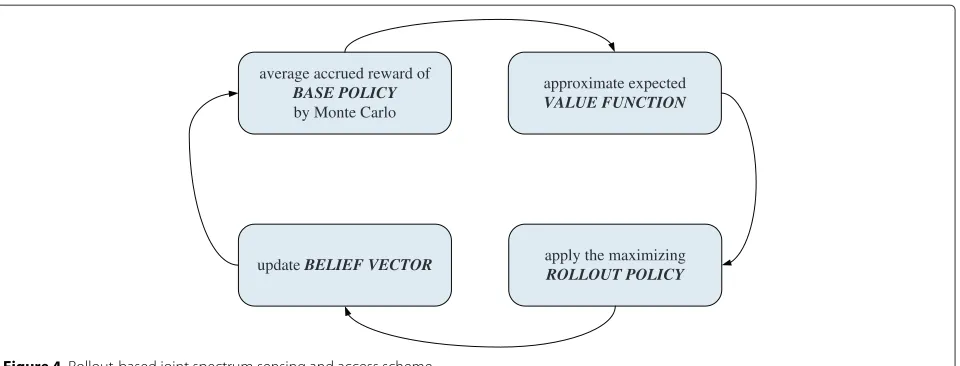
To obtain a suboptimal solution, a problem-dependent heuristics is proposed first as the base policy, and then the reward of the base policy can be used by the rollout algorithm in a one-step lookahead method to approximate the value function. The procedure of the rollout-based scheme is illustrated in Figure 4.
The value function of POMDP can be written as
Vm()=max a∈AE
κm(a)+Vm−1( (|a,θ)) (35)
whereκm(a)denotes the amount of time slots included in them-th last control interval, namely the reward function which depends on the action choicea.
Base Policy In the rollout algorithm, a heuristic algo-rithm is needed to serve as the base policy, which is also designed on the basis of control interval structure.
πH=μH
1,μH2,. . .,μHT
(36)
Here, we propose two different heuristics based on our designing objective, namelyBandwidth-Oriented Heuris-tics (BOH)andSwitch-Oriented Heuristics (SOH).
In BOH, we simply choose the sensing and access sets A1andA2which can obtain the widest expected available
bandwidth currently, toA1(m). Intuitively, the wider the available bandwidth is,
the better the requirement of SU will be satisfied, and it is less possible to trigger the channel switch in the next time slot. But in this heuristics, the statistics of the PU traffic is not taken into consideration to predict the future dynamic behaviors of the channels.
Figure 4Rollout-based joint spectrum sensing and access scheme.
μH2
m :(m)→aH2(m)=arg maxa∈A
κm
κm(a)p κm(a)
(38)
where the calculation of pκm includes the operation of prediction on the access probabilityζ and the switching probability ξ. Making full use of the dynamic statistics of the channels, SOH is more sophisticated and achieves better performance than BOH.
Both heuristics are greedy and require low computa-tional complexity. With either of the two heuristics as the base policy, the relevant expected reward from cur-rent control interval to termination can be calculated by recursion,
VHm()=Eκm(aH)+VHm−1( (|aH,θ)) (39)
with the initial conditionVH0()=0.
Rollout Policy The rollout policy based on the base policyπHis denoted by
πRL=μRL
1 ,μRL2 ,. . .,μRLT
(40)
and is defined through the following operation.
μRL
m :(m)→aRL(m) (41)
where
aRL(m)=arg max a∈AE
κm(a)+Vm−1
H ((m−1))
(42)
The rollout policy can approximate the value function by the use of the reward of the base policy, and conse-quently decide the near-optimal actionaRL(m). We prove by theoretical deduction that the rollout policy is guar-anteed to substantially improve the performance of the heuristics as the base policy.
Proposition 3(Rollout Improving Property).The roll-out policy is guaranteed to obtain better aggregated reward than the base policy.
VHT((T)) ≤ EκT(aRL(T))+VHT−1((T−1))
· · ·
≤ E{κT(aRL(T))+κT−1(aRL(T−1)) + · · · +κ1(aRL(1))} (43)
Proof.The proposition is proved by backward mathe-matical induction.
Form=T, according to the essence of the rollout policy (42), we obtain
aRL(T)=arg max a∈AE
κT(a)+VT−1
H ((T−1))
(44)
Consequently, we have
VHT((T)) = E
κT(aH)+VT−1
H ((T−1))
≤ EκT(aRL)+VT−1
H ((T−1))
(45)
Hence, the proposition holds form=T. Assume it holds form<T, i.e.,
VHT((T)) ≤ E
κT(aRL(T))+VT−1
H ((T−1))
· · ·
≤ E{κT(aRL(T))+κT−1(aRL(T−1)) + · · · +κm(aRL(m))+Vm−1
H ((m−1))}
Using the essence of the rollout policy (42) again,
aRL(m−1)=arg max a∈AE
κm−1(a)+Vm−2
H ((m−2))
we can obtain that
Therefore, the property holds form−1. According to the mathematical induction, the proposition is proved.
4.2 Suboptimal spectrum sensing and access
Focusing on the implementation of the proposed rollout policy (42), we define Q-factor as
Qm(a)=E
which indicates expected reward that the SU can accrue during the lifetime of the process from current control interval, and then the rollout action can be expressed as aRL(m)=arg max
a∈AQm(a).
However, as the key point of the rollout policy, the Q-factor may not be known in a closed form, which makes the computation of aRL(m) an nontrivial issue [20]. To overcome this difficulty, we adopt a widely used Monte Carlo method [21].
Here, we define thetrajectoryas a sequence of the form
(S(T),a(T),S(T−1),a(T−1),· · ·,S(1),a(1)) (50)
Using the Monte Carlo method, we consider any possible actiona ∈ Aand generate a large number of trajectories of the system starting from belief vector(m), usingaas the first action and the base policyπHthereafter. Thus, a trajectory has the form as
S(m),a,S(m−1),aH(m−1),· · ·,S(1),aH(1) (51)
where the system statesS(m),S(m−1),· · ·,S(1)are ran-domly sampled according to the belief vectors which are updated based on the action and observation history:
(i−1)=
(|aH(i),θ) i=m−1,m−2,· · ·, 1
(|a,θ) i=m
(52)
The rewards corresponding to these trajectories are averaged to compute!Qm(a)as an approximation to the Q-factorQm(a). The approximation value becomes increas-ingly accurate as the number of trajectories increases. Once the approximate Q-factor!Qm(a)corresponding to each action a ∈ A is computed, we can obtain the approximate rollout action!aRL(m)by the maximization
!aRL(m)=arg max a∈A
!
Qm(a) (53)
This rollout-based suboptimal spectrum sensing and access scheme can reduce the computational complexity a lot by estimating the value function approximately rather than tracing the accurate value.
4.3 Robustness via differential training
It is obvious that, in a stochastic environment, the Monte Carlo method of computing the rollout policy is particu-larly sensitive to the approximation error, which is closely related to the number of trajectories. In this subsection, we adoptdifferential training[22] in the proposed rollout-based suboptimal scheme to improve the robustness. In the differential training method, we estimate the relative Q-factor difference rather than absolute Q-factor value, which is a suitable improvement of the recursively gener-ating rollout policy in the context of Monto Carlo-based policy iteration methods.
In order to compute the rollout action aRL(m) = arg max
a∈AQm(a), the Q-factor differences Qm(a1) − Qm(a2), ∀a1,a2 ∈Ashould be computed accurately. By
comparing the Q-factor differences with 0, these possi-ble actions can be accurately compared. Unfortunately, in a stochastic environment, the approximation !Qm(a) fluctuated around the accurate Q-factor value, bigger or smaller than Qm(a) randomly, as a result of which, the preceding differences computing operation enlarges the approximation error. For example, in the case thata1
per-forms better thana2and thus,Qm(a1)is definitely bigger
than Qm(a2), which results in Qm(a1) − Qm(a2) > 0.
However, when using stochastic Monte Carlo method, the approximate!Qm(a1)may be smaller than the accurate
valueQm(a1), and meanwhile!Qm(a2)may be bigger than
the accurate valueQm(a2), which makes it quite possible
that!Qm(a1)−!Qm(a2) < 0, and this computation result
will lead to a fatal error when determining which action is chosen for spectrum sensing and access.
by maximizing the approximation of the Q-factor differ-error due to the limited number of trajectories. We take the same example thata1 actually performs better than a2andQm(a1) > Qm(a2). If the approximate!Qm(a1)is
smaller than the accurate value, so is!Qm1(aH). Similarly,
if!Qm(a2)is larger than the accurate value, so is!Qm2(aH).
Using the differential training operation!Qm(a)−!Qm(aH), the effect of approximation error can be eliminated. Thus, it probably holds that!Qm(a1)−!Qm1(aH) > !Qm(a2)−
!
Qm2(aH), consequently the SU will choose the better
actiona1.
From the above discussion, the approximate Q-factor difference !Qm(a) − !Qm(aH) is more robust than the approximate independent Q-factor!Qm(a). By the differ-ential training of the rollout policy, the approximation error caused by Monte Carlo method can be reduced a lot and the proposed suboptimal spectrum sensing and access scheme performs more robustly.
5 Simulation results
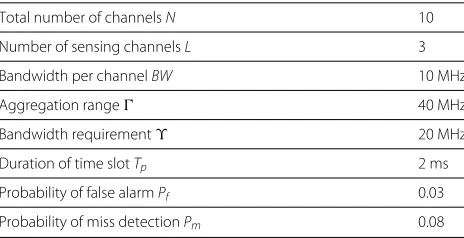
In this section, we evaluate the performance of the pro-posed joint spectrum sensing and access scheme by sim-ulation. We investigate the effect of the number of Monte Carlo random trajectories, the proportion of sensing channelsL/N, and the ratio of aggregation range to band-width requirement/γ. The PU traffic statistics follows the model of Erlang-distribution [23], and the simulation configuration is listed in Table 1. The average simulation results are obtained by 100 runs with random channel states.
In Figure 5, for different number of Monte Carlo ran-dom trajectories, we compute the value of the approxi-mate independent Q-factor !Qm(a) and the value of the approximate Q-factor difference!Qm(a)−!Qm(aH), respec-tively. Two pairs of curves represent two different rollout
Table 1 Simulation configuration
Total number of channelsN 10
Number of sensing channelsL 3
Bandwidth per channelBW 10 MHz
Aggregation range 40 MHz
Bandwidth requirementϒ 20 MHz
Duration of time slotTp 2 ms
Probability of false alarmPf 0.03
Probability of miss detectionPm 0.08
actionsa1,a2 ∈ Achosen in the current control
inter-val. It is shown that, no matter which action to take, the fluctuation range of !Qm(a) and !Qm(a) − !Qm(aH) converges with the increase of the number of random tra-jectories. With a small number of random trajectories, !
Qm(a)−!Qm(aH)has less fluctuation than that of!Qm(a). If the trajectory number exceeds about 1,500, both approxi-mate values converge. It is indicated that the approxiapproxi-mate Q-factor difference is more robust than the approximate independent Q-factor, and the differential training of the rollout policy can reduce the negative effect of the approx-imation error a lot. In the case that the trajectory number is large enough, both approximate values are nearly accu-rate compared with the original values.
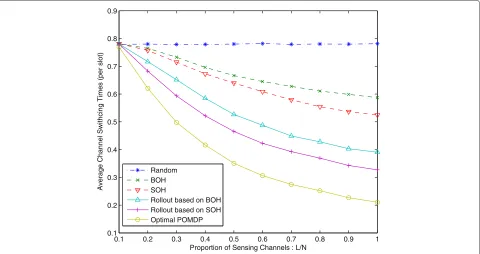
Figure 6 illustrates the effect of the proportion of sens-ing channels L/N on the performance of both optimal and suboptimal schemes. The random scheme is adopted as a baseline for performance comparison, in which M channels are chosen randomly to access. Besides, we also evaluate the performance of the base policies, the sub-optimal rollout schemes based on BOH and SOH, and the POMDP-based optimal scheme. Here, we adopt the performance with 1,500 random trajectories for approxi-mation in rollout policies, which can achieve the perfor-mance in convergence.
In Figure 6, as the number of sensing channels L increases, the numbers of channel switches decrease for the BOH, SOH, BOH- and SOH-based rollout, and opti-mal POMDP-based schemes. When the whole spectrum can be sensed (L/N = 1), these schemes achieve their corresponding best performance because the more chan-nels the SU senses, the more information about the system state can be obtained. The spectrum aggregation action determined on the basis of sensing results has better per-formance in minimizing the expected times of channel switches. For the random access scheme, which deter-mines the access channels without considering the sens-ing results, the performance does not change with the increase ofL.
Figure 5Algorithm convergence.(a)Convergence of approximate independent Q-factor and(b)Convergence of approximate Q-factor difference.
loss, but makes significant improvement in reducing the computational complexity.
Figure 7 illustrates the effect of the ratio of aggregation range to bandwidth requirement/γ on the performance of both optimal and suboptimal schemes. The perfor-mance comparison of these schemes is similar to those in Figure 6. The performance gaps of different schemes are large when the aggregation range is small, because sophis-ticated schemes can select the channels whose availability state is stable. On the contrary, all the schemes can achieve a good performance when the aggregation range is large enough.
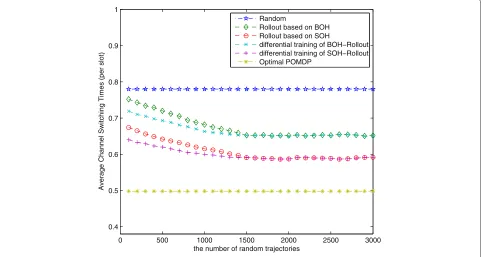
In Figure 8, we evaluate the performance of the rollout-based schemes with different number of random trajecto-ries when L = 3. The performances of the random and optimal schemes stay constant with the increase of the number of random trajectories. The performance of the
rollout-based scheme approaches to the optimal scheme until the number of random trajectories reach the con-verging boundary which is 1,500 in this simulation. The differential training method improves the performance of the rollout-based schemes significantly when the num-ber of random trajectories is small. After convergence, the advantage of differential training is small since the perfor-mance is not so sensitive to the approximation error with a large enough number of random trajectories. It is proved again in Figure 8 that the SOH-based rollout outperforms the BOH-based one.
6 Conclusion
In this paper, we investigate the spectrum sensing and access schemes to minimize the channel switching times for achieving stable DSA, taking into consideration the practical limitations of both spectrum sensing and
0.1 0.2 0.3 0.4 0.5 0.6 0.7 0.8 0.9 1
0.1 0.2 0.3 0.4 0.5 0.6 0.7 0.8 0.9
Proportion of Sensing Channels : L/N
Average Channel Swithcing Times (per slot)
Random BOH SOH
Rollout based on BOH Rollout based on SOH Optimal POMDP
1 1.5 2 2.5 3 3.5 4 4.5 5 0
0.1 0.2 0.3 0.4 0.5 0.6 0.7 0.8 0.9 1
Ratio of Aggregation Range to Bandwidth Requirement: Γ/γ
Average Channel Swithcing Times (per slot)
Random BOH SOH
Rollout based on BOH Rollout based on SOH Optimal POMDP
Figure 7Performance comparison with different spectrum aggregation capability.
aggregation capability. We develop an POMDP frame-work for joint spectrum sensing and access. Especially, we derive the reward function by estimation of the stability of different spectrum sensing and access strategies. Based on the POMDP framework, we propose a rollout-based suboptimal spectrum sensing and access scheme which approximates the value function of POMDP. It is proved
that the rollout policy achieves performance improvement over the basis heuristics. By numerical evaluation, we find that with the increase of number of random trajectories, the performance of the proposed rollout-based scheme gets close to the optimal performance. When the num-ber of random trajectories is large enough, the proposed scheme performs near-optimally with a lower complexity,
0 500 1000 1500 2000 2500 3000
0.4 0.5 0.6 0.7 0.8 0.9 1
the number of random trajectories
Average Channel Switching Times (per slot)
Random
Rollout based on BOH Rollout based on SOH
differential training of BOH−Rollout differential training of SOH−Rollout Optimal POMDP
which also achieves a significant improvement over the base policy. In the rollout-based schemes, the basis heuris-tics affects the performance of its corresponding rollout policy, and the differential training method improves the robustness to the approximation error.
Endnotes
aThe transition probabilities can be estimated by the
statistics of the channel availabilities of two adjacent slots and is assumed to be known by the SUs [23].
bThe schemes proposed in this paper can be easily
extended to multiple SU cases by adopting the RTS/CTS scheme [24] for the access coordination between SUs.
cMinimizing the expected times of channel switches
can also be treated equally as maximizing the throughput with the consideration of the system overhead of channel switches.
Competing interests
The authors declare that they have no competing interests.
Acknowledgements
This work was supported in part by National Natural Science Foundation of China (No. 61261130585), National Key Basic Research Program (No. 2012CB316006), National Hi-Tech R&D Program (No. 2014AA01A702), Fundamental Research Funds for the Central Universities, and Open Research Fund of State Key Laboratory of Integrated Services Networks (No. ISN13-08).
Author details
1Department of Information Science and Electronic Engineering, Zhejiang Key
Lab of Information Network Technology, Zhejiang University, Hangzhou 310027, P.R. China.2State Key Laboratory of Integrated Services Networks, Xidian University, Xi’an 710071, P.R. China.3Laboratoire de Recherche en Informatique (LRI), Department of Computer Science, University of Paris-Sud 11, Orsay 91405, France.
Received: 1 October 2014 Accepted: 17 April 2015
References
1. W Wang, Z Zhang, A Huang, Spectrum aggregation: Overview and challenges. Net. Protoc. Appl.2(1), 184–196 (2010)
2. QinetiQ Ltd, A study of the provision of aggregation of frequency to provide wider bandwidth services. Final report for Office of Communications (Ofcom) (2006). http://www.indepen.uk.com/docs/ aggregation[1].pdf
3. F Wu, Y Mao, S Leng,et al, A carrier aggregation based resource allocation scheme for pervasive wireless networks. Proc. of IEEE DASC 2011, 196–201 (2011)
4. H Shajaiah, A Abdel-Hadi, C Clancy, Utility proportional fairness resource allocation with carrier aggregation in 4G-LTE. Proc. of IEEE Milcom 2013, 412–417 (2013)
5. F Liu, K Zheng, W Xiang,et al, Design and performance analysis of an energy-efficient uplink carrier aggregation scheme. IEEE J. Sel. Areas Commun.32(2), 197–207 (2014)
6. J Mitola, G Maguire, Cognitive radio: making software radios more personal. IEEE Pers. Commun.6(4), 13–18 (1999)
7. W Wang, KG Shin, W Wang, Joint spectrum allocation and power control for multi-hop cognitive radio networks. IEEE Trans. Mobile Comput.10(7), 1042–1055 (2011)
8. Q Zhao, L Tong, A Swami, Y Chen, Decentralized cognitive MAC for opportunistic spectrum access in ad hoc networks: a POMDP framework. IEEE J. Sel. Areas Commmun.25(3), 589–600 (2007)
9. AA El-Sherif, KJR Liu, Joint design of spectrum sensing and channel access in cognitive radio networks. IEEE Trans. Wireless Commum.10(6), 1743–1753 (2011)
10. W Wang, K Wu, H Luo, G Yu, Z Zhang, Sensing error aware delay-optimal channel allocation scheme for cognitive Radio Networks. Telecommun. Sys.52(4), 1895–1904 (2013)
11. J Park, P Pawelczak, D Cabric, Performance of joint spectrum sensing and MAC algorithms for multichannel opportunistic spectrum access Ad Hoc networks. IEEE Trans. Mobile Comput.10(7), 1011–1027 (2011) 12. F Huang, W Wang, H Luo, G Yu, Z Zhang, Prediction-based spectrum
aggregation with hardware limitation in cognitive Radio Networks. Proc. of IEEE VTC. 2010 (2010)
13. L Wu, W Wang, Z Zhang, L Chen, A POMDP-based optimal spectrum sensing and access scheme for cognitive radio networks with hardware limitation. Proc. of IEEE WCNC 2012 (2012)
14. GE Monahan, A survey of partially observable Markov decision processes: Theory, models, and algorithms. Manage. Sci.28(1), 1–16 (1982) 15. DP Bertsekas, JN Tsitsiklis, Neuro-dynamic programming: an overview.
Proc. of IEEE CDC 1995 (1995)
16. R Smallwood, E Sondik, The optimal control of partially observable Markov processes over a finite horizon. Oper. Res, 1071–1088 (1971) 17. BV Gendenko, AN Kolmogorov,Limit Distributions for Sums of Independent
Random Variables, (Addison-Wesley, 1954)
18. DP Bertsekas, JN Tsitsiklis, C Wu, Rollout algorithms for combinatorial optimization. J. Heuristics.3(2), 245–262 (1997)
19. DP Bertsekas, DA Castanon, Rollout algorithms for stochastic scheduling problems. J. Heuristics.5(1), 89–108 (1998)
20. L Wu, W Wang, Z Zhang, L Chen, A Rollout-based joint spectrum sensing and access policy for cognitive radio networks with hardware limitation. Proc. of IEEE Globecom 2012 (2012)
21. G Tesauro, GR Galperin, On-line policy improvement using Monte Carlo search. Proc. of Neural Inf Process. Syst. Conf (1996)
22. DP Bertsekas, Differential training of rollout policies. Proc. of Allerton Conference on Communication, Control, and Computing (1997) 23. H Kim, KG Shin, Efficient discovery of spectrum opportunities with
MAC-layer sensing in cognitive radio networks. IEEE Trans. Mobile Comput.7, 533–545 (2008)
24. G Bianchi, Performance analysis of the IEEE 802.11 distributed coordination function. IEEE J. Sel. Areas Commun.18(3), 535–547 (2000)
Submit your manuscript to a
journal and benefi t from:
7 Convenient online submission
7 Rigorous peer review
7 Immediate publication on acceptance
7 Open access: articles freely available online
7 High visibility within the fi eld
7 Retaining the copyright to your article