
Volume 2010, Article ID 176083,14pages doi:10.1155/2010/176083
Research Article
Bit Error Rate Approximation of MIMO-OFDM Systems with
Carrier Frequency Offset and Channel Estimation Errors
Zhongshan Zhang,
1Lu Zhang,
2Mingli You,
2and Ming Lei
11Department of Wireless Communications, NEC Laboratories China (NLC), 11th Floor Building A, Innovation Plaza TusPark,
Beijing 100084, China
2Research & Innovation Center (R&I), Alcatel-Lucent Shanghai Bell, No. 388 Ningqiao Road, Pudong, Shanghai 201206, China
Correspondence should be addressed to Zhongshan Zhang,zhang [email protected]
Received 23 February 2010; Revised 10 August 2010; Accepted 16 September 2010
Academic Editor: Stefan Kaiser
Copyright © 2010 Zhongshan Zhang et al. This is an open access article distributed under the Creative Commons Attribution License, which permits unrestricted use, distribution, and reproduction in any medium, provided the original work is properly cited.
The bit error rate (BER) of multiple-input multiple-output (MIMO) orthogonal frequency-division multiplexing (OFDM) systems with carrier frequency offset and channel estimation errors is analyzed in this paper. Intercarrier interference (ICI) and interantenna interference (IAI) due to the residual frequency offsets are analyzed, and the average signal-to-interference-and-noise ratio (SINR) is derived. The BER of equal gain combining (EGC) and maximal ratio combining (MRC) with MIMO-OFDM is also derived. The simulation results demonstrate the accuracy of the theoretical analysis.
1. Introduction
Spatial multiplexing multiple-input multiple-output (MI-MO) technology significantly increases the wireless system capacity [1–4]. These systems are primarily designed for flat-fading MIMO channels. A broader band can be used to support a higher data rate, but a frequency-selective fading MIMO channel is met, and this channel experiences intersymbol interference (ISI). A popular solution is MIMO-orthogonal frequency-division multiplexing (OFDM), which achieves a high data rate at a low cost of equalization and demodulation. However, just as single-input single-output-(SISO-) OFDM systems are highly sensitive to frequency offset, so are MIMO-OFDM systems. Although one can use frequency offset correction algorithms [5–10], residual frequency offsets can still increase the bit error rate (BER).
The BER of SISO-OFDM systems impaired by frequency offset is analyzed in [11], in which the frequency offset is assumed to be perfectly known at the receiver, and, based on the intercarrier interference (ICI) analysis, the BER is eval-uated for multipath fading channels. Many frequency offset estimators have been proposed [8,12–14]. A synchronization algorithm for MIMO-OFDM systems is proposed in [15], which considers an identical timing offset and frequency
offset with respect to each transmit-receive antenna pair. In [10], where frequency offsets for different transmit-receive antennas are assumed to be different, the Cramer-Rao lower bound (CRLB) for either the frequency offsets or channel estimation variance errors for MIMO-OFDM is derived. More documents on MIMO-OFDM channel estimation by considering the frequency offset are available at [16,17].
However, in real systems, neither the frequency offset nor the channel can be perfectly estimated. Therefore, the residual frequency offset and channel estimation errors impact the BER performance. The BER performance of MIMO systems, without considering the effect of both the frequency offset and channel estimation errors, is studied in [18,19].
perform channel estimation. The statistics of these RVs are used to derive the degradation in the receive SINR and the BER. Following [10], the frequency offset of each transmit-receive antenna pair is assumed to be an independent and identically distributed (i.i.d.) RV.
This paper is organized as follows. The MIMO-OFDM system model is described in Section 2, and the SINR degradation due to the frequency offset and channel esti-mation errors is analyzed in Section 3. The BER, taking into consideration both the frequency offset and channel estimation errors, is derived in Section 4. The numerical results are given in Section 5, and the conclusions are presented inSection 6.
Notation. (·)T and (·)H
are transpose and complex conjugate transpose. The imaginary unit is j =√−1.R{x} and I{x} are the real and imaginary parts of x, respec-tively. arg{x} represents the angle of x, that is, arg{x} = arctan(I{x}/R{x}). A circularly symmetric complex Gaus-sian RV with meanmand variance σ2 is denoted byw ∼
CN(m,σ2).I
N is theN×Nidentity matrix, andON is the N×N all-zero matrix.0N is theN×1 all-zero vector.a[i] is theith entry of vectora, and [B]mnis themnth entry of matrixB.E{x}and Var{x}are the mean and variance ofx.
2. MIMO-OFDM Signal Model
Input data bits are mapped to a set ofN complex symbols drawn from a typical signal constellation such as phase-shift keying (PSK) or quadrature amplitude modulation (QAM). The inverse discrete fourier transform (IDFT) of these N symbols generates an OFDM symbol. Each OFDM symbol has a useful part of durationTsseconds and a cyclic prefix of lengthTg seconds to mitigate ISI, where Tg is longer than the channel-response length. For a MIMO-OFDM system withNttransmit antennas andNrreceive antennas, anN×1 vectorxntrepresents the block of frequency-domain symbols
sent by thentth transmit antenna, wherent ∈ {1, 2,. . .,Nt}. The time-domain vector for the ntth transmit antenna is given by mnt =
Es/NtFxnt, whereEsis the total transmit
power andFis theN×NIDFT matrix with entries [F]nk = (1/√N)ej2πnk/N for 0 ≤ n,k ≤ N−1. Each entry ofx
nt is
assumed to be i.i.d. RV with mean zero and unit variance; that is, σ2
x = E{|xnt[n]| 2} =
1 for 1 ≤ nt ≤ Nt and 0≤n≤N−1.
The discrete channel response between thenrth receive antenna and ntth transmit antenna is hnr,nt = [hnr,nt(0),
hnr,nt(1),. . .,hnr,nt(Lnr,nt−1),0
T
Lmax−Lnr,nt]
T
, whereLnr,nt is the
maximum delay between the ntth transmit and the nrth receive antennas, and Lmax = max{Lnr,nt : 1 ≤ nt ≤ Nt,
1 ≤ nr ≤ Nr}. Uncorrelated channel taps are
assumed for each antenna pair (nr,nt); that is, E{h∗nr,nt(m)hnr,nt(n)} = 0 when n /=m. The corresponding
frequency-domain channel response matrix is given by
Hnr,nt = diag{H (0)
nr,nt,H (1)
nr,nt,. . .,H (N−1)
nr,nt } with H (n)
nr,nt =
Lnr,nt−1
d=0 hnr,nt(d)e−j2πnd/N representing the channel
attenuation at thenth subcarrier. In the sequel, the channel power profiles are normalized asLnr,nt−1
d=0 E{|hnr,nt(d)| 2} =
1 for all (nr,nt). The covariance of channel frequency response
is given by
CH(n) nr,ntH(pl,)q=
Lmax−1
d=0
Eh∗nr,nt(d)hp,q(d)
e−j2πd(l−n)/N,
0≤d≤Lmax, 0≤l,n≤N−1.
(1)
Note that ifnr=/ pandnt=/qare satisfied simultaneously, we assume that there is no correlation betweenhnr,nt andhp,q.
Otherwise the correlation betweenhnr,ntandhp,qis nonzero.
In this paper, ψnr,nt andεnr,nt are used to represent the
initial phase and normalized frequency offset (normalized to the OFDM subcarrier spacing) between the oscillators of the nt-th transmit and the nrth receive antennas. The frequency offsetsεnr,nt for all (nr,nt) are modeled as
zero-mean i.i.d. RVs. (Multiple rather than one frequency offset are assumed in this paper, with each transmit-antenna pair being impaired by an independent frequency offset. This case happens when the distance between different transmit or receive antenna elements is large enough, and this big distance results in a different angle-of-arrive (AOA) of the signal received by each receive antenna element. In this scenario, once the moving speed of the mobile node is high, the Doppler Shift related to different transmit-receive antenna pair will be different.)
By considering the channel gains and frequency offsets, the received signal vector can be represented as
y=yT
1,y2T,. . .,yNTr
T
, (2)
where ynr =
Es/Nt
Nt
nt=1Enr,ntFHnr,ntxnt + wnr, Enr,nt =
diag{ejψnr,nt,. . .,ej(2πεnr,nt(N−1)/N+ψnr,nt)} and wn
r is a vector
of additive white Gaussian noise (AWGN) with wnr[n] ∼
CN(0,σ2
w). Note that the channel state information is available at the receiver, but not at the transmitter. Conse-quently, the transmit power is equally allocated among all the transmit antennas.
3. SINR Analysis in MIMO-OFDM Systems
This paper treats spatial multiplexing MIMO, where inde-pendent data streams are mapped to distinct OFDM symbols and are transmitted simultaneously from transmit antennas. The received vectorynr at the nrth receive antenna is thus
a superposition of the transmit signals from all the Nt transmit antennas. When demodulatingxnt, the signals from
the transmit antennas other than thentth transmit antenna constitute interantenna interference (IAI). The structure of MIMO-OFDM systems is illustrated inFigure 1, whereΔf represents the subcarrier spacing.
Here, we first assume thatεnr,i andHnr,i for each (1 ≤ i ≤ Nt,i /=nt) have been estimated imperfectly; that is, εnr,i = εnr,i+Δεnr,i andHnr,i = Hnr,i+ΔHnr,i, whereΔεnr,i andΔHnr,i = diag{ΔHn(0)r,i,. . .,ΔH
(N−1)
· · ·
H1Nt
Nr
Nt x1
H11
1
xNt
r11
. . . . . . . . .
. . . . . . . . . . . .
. . .
. . . .
. . . . . . . .
1 2
ej2π(fc+ε11·Δf)t
ej2π(fc+εNt1·Δf)t
wN r
r1
yN r
x1Λ IFFT
IFFT CP
CP P/S
P/S Transmit antenna 1
Transmit antennaNt
y
IAI cancellation
IAI cancellation
CFO estimation
CFO estimation
Channel estimation
Channel estimation
Demodulation Combining, e.g., EGC, MRC
1 2 w1
rNr1
Figure1: Structure of MIMO-OFDM transceiver.
estimatingεnr,nt, that is,εnr,nt = εnr,nt +Δεnr,nt,εnr,nt can be
compensated for andxnt can be demodulated as
rnr,nt=F
HEH nr,nt
⎛ ⎝ynr−
Es Nt
Nt
i=1,i /=nt
Enr,iFHnr,ixi ⎞ ⎠
=
Es Nt
FHEH
nr,ntEnr,ntFHnr,ntxnt
snr,nt
+
Es Nt
Nt
i=1,i /=nt FHEHnr,nt
Enr,iFHnr,i−Enr,iFHnr,i
xi
Υnr,nt
+FHEH nr,ntwnr
wnr,nt
,
(3)
where Enr,i is derived from Enr,i by replacing εnr,i with εnr,i andΥnr,nt and wnr,nt are the residual IAI and AWGN
components ofrnr,nt, respectively (WhenNt is large enough
and the frequency offset is not too big (e.g.,1), from the Central-Limit Theorem (CLT) [23, Page 59], the IAI can be approximated as Gaussian noise.).
3.1. SINR Analysis without Combining at Receive Antennas.
The SINR is derived for the ntth transmit signal at the
nrth receive antenna. The signals transmitted by antennas
other than thentth antenna are interference, which should be eliminated before demodulating the desired signal of
thentth transmit antenna. Existing interference cancelation
algorithms [24–27] can be applied here.
Let us first define the parameters mn(nr,,ln)t = (sin[π(l−
n − Δεnr,nt)]/Nsin[π(l − n − Δεnr,nt)/N])e
jπ(N−1)(l−n)/N,
m(nnr,,li /)=nt =(sin[π(l−n+εnr,i−εnr,nt)]/Nsin[π(l−n+εnr,i−
εnr,nt)/N])ejπ(N−1)(l−n)/N, andm (n,l)
nr,i /=nt=(sin[π(l−n+εnr,i−
εnr,nt)]/Nsin[π(l−n+εnr,i−εnr,nt)/N])ejπ(N−1)(l−n)/N, 0≤l≤
N−1. Based on (3), thenth subcarrier (0≤n≤N−1) of thentth transmit antenna can be demodulated as
rnr,nt[n]=
Es Nt
snr,nt[n] +Υnr,nt[n] +wnr,nt[n]
=
Es Ntm
(n,n)
nr,ntH (n)
nr,ntxnt[n]
+
Es Nt
l /=n m(nnr,,ln)tH
(l)
nr,ntxnt[l]
ηnr(n),nt=Hnr(n),ntα(nrn),nt+β(nrn),nt
+
Es Nt
Nt
i=1,i /=nt
mn(nr,,ni)Hn(nr,)ixi[n]
λ(nrn),nt
−
Es Nt
Nt
i=1,i /=nt
m(nnr,,ni)H
(n)
nr,ixi[n]
+
which is the ICI contributed by subcarriers other than the nth subcarrier of transmit antennant. (The decomposition of ICI into the format ofHα+βis referred to [11].) We can easily prove thatα(nnr,)nt andβ
(n)
nr,nt are zero-mean RVs subject
to the following assumptions.
(1)εnr,nt is an i.i.d. RV with mean zero and varianceσ
the interfering transmit antennas, that is, the co-subcarrier inter-antenna-interference (CSIAI), and define Δξn(nr,)nt =
ξn(nr,)nt−ξ (n)
nr,nt as the ICI contributed by the subcarriers other
than thenth subcarrier of the interfering transmit antennas, that is, the intercarrier-interantenna interference (ICIAI). Then we derive Var{α(nnr,)nt}and Var{β
this paper, we assume that the integer part of the frequency offset has been estimated and corrected, and only the fractional part frequency offset is considered. Considering small frequency offsets, the following requirements are assumed to be satisfied:
(1)|εnr,i| 1 for all (nr,i),
(2)|εnr,nt|+|εnr,i|<1 for all (nr,nt,i),
(3)| εnr,nt|+| εnr,i|<1 for all (nr,nt,i).
ξn(nr,)nt =
Therefore, the interference due to the nth subcarrier of transmit antennas (other than thentth transmit antenna, i.e., the interfering antennas) is
Δλ(n)
are zero-mean RVs and that their variances are given by
E-Δλ(n)
respectively. After averaging out frequency offset εnr,nt,
frequency offset estimation errorΔεnr,nt, and channel
(parameterized by onlyHn(nr,)nt) is
For signal demodulation in MIMO-OFDM, signal received in multiple receive antennas can be exploited to improve the receive SINR. In the following, equal gain combining (EGC) and maximal ratio combining (MRC) are considered.
3.2. SINR Analysis with EGC at Receive Antennas. In order to demodulate the signal transmitted by the ntth transmit antenna, theNrreceived signals are cophased and combined to improve the receiving diversity. Therefore, the EGC output is given by
rEGCnt [n]=
WhenNris large enough, (17) can be further simplified as
γEGCnt
3.3. SINR Analysis with MRC at Receive Antennas. In a MIMO-OFDM system withNr receive antennas, based on the channel estimation Hn(nr,)nt = H can be combined by using MRC, and therefore the combined output is given by
where ωnr,nt = (H and the noise part can be represented as ℵ = E{|Nr enNris large enough, (20) can be further simplified as
γMRCnt
4. BER Performance
The BER as a function of SINR in MIMO-OFDM is derived in this section. We considerM-ary square QAM with Gray bit mapping. In the work of Rugini and Banelli [11], the BER of SISO-OFDM with frequency offset is developed. The BER analysis in [11] is now extended to MIMO-OFDM.
As discussed in [11,28,29], the BER for thentth transmit antenna with the input constellation being M-ary square QAM (Gray bit mapping) can be represented as
PBER
whereaMi andbMi are specified by signal constellation,γnt is
the average SINR of thentth transmit antenna, and erfc(x)= (2/√π)3x∞e−u2
duis the error function (Please refer to [28] for the meaning ofaM
i andbMi .).
Note that in MIMO-OFDM systems, the SINR at each subcarrier is an RV parameterized by the frequency offset and channel attenuation. In order to derive the average SINR of MIMO-OFDM systems, (22) should be averaged over the distribution ofγias
PBER
Since obtaining a close-form solution of (23) appears impos-sible, an infinite-series approximation ofPBERis developed.
In [11], the average is expressed as an infinite series of generalized hypergeometric functions.
From [30, page 939], erfc(x) can be represented as an
Therefore, (23) can be rewritten as
PBER
has been derived inSection 3and that for thenth subcarrier (0≤n ≤N−1),εnr,nt,Δεnr,nt andΔH
(n)
nr,nt for each (nr,nt)
have been averaged out. Therefore,γntin (25) can be replaced
by γnt(n); that is, the average BER can be expected over
Dnt;mfor the following reception methods: (1) demodulation
without combining, (2) EGC, and (3) MRC.
Note that the SINR for each combining scenario (i.e., without combining, EGC, or MRC) is a function of the second-order statistics of the channel and frequency offset estimation errors (although the interference also comprises the fourth-order statistics of the frequency offset estimation errors, they are negligible as compared to the second-order statistics for small estimation errors). Any probability distribution with zero mean and the same variance will result in the same SINR. Therefore, the exact distributions need not be specified. However, when the BER is derived by using an infinite-series approximation, the actual distribution of the frequency offset estimation errors is required. In [31], it is shown that both the uniform distribution and Gaussian distribution are amenable to infinite-series solutions with closed-form formulas for the coefficients. In the following sections, the frequency offset estimation errors are assumed to be i.i.d. Gaussian RVs with mean zero and variance σ2
[10].
4.1. BER without Receiving Combining. The BER measured at thenrth receive antenna for thentth transmit antenna can be approximated by (25) withDnr
nt;m instead ofDnt;m being
used here; that is,
Pnr
condition is given by
Dnr
4.2. BER with EGC. For a MIMO-OFDM system with EGC reception, the average BER can be approximated by (25) with DEGC
Table1: Parameters for BER simulation in MIMO-OFDM systems.
Subcarrier modulation QPSK; 16QAM
DFT length 128
σ2
res 10−3;10−4
σ2
ΔH 10−4
MIMO parameters (Nt=1, 2;Nr=1, 2, 4) Receiving combining Without combining; EGC; MRC
as derived inAppendix B. The initial condition is given by
DEGCnt;1 =
4.3. BER with MRC. For a MIMO-OFDM system with channel knowledge at the receiver, the receiving diversity can be optimized by using MRC, and the average BER can be approximated by (25) withDMRC
nt;m instead ofDnt;mbeing used
here; that is,
PMRCBER
as derived inAppendix C. The initial condition is given by
DMRC
4.4. Complexity of the Infinite-Series Representation of BER.
Infinite-series BER expression (27), (29), or (32) must be truncated in practice. The truncation error is negligible if the number of terms is large enough: Reference [31] shows that when the number of terms is as large as 50, the finite-order approximation is good. In this case, a total of 151√M multiplication and 101√M summation operations are needed to calculate the BER for each combining scheme.
5. Numerical Results
Quasistatic MIMO wireless channels are assumed; that is, the channel impulse response is fixed over one OFDM symbol period but changes across the symbols. The simulation parameters are defined inTable 1.
The SINR degradation due to the residual frequency offsets is shown inFigure 2forσ2
ΔH=0.01 and SNR=10 dB. The SINR degradation increases withσ2
res. Because of IAI due
7 8 9 10 11 12
2 13
0 1 3 4 5 6 7 8 9 10
σ2 res
SINR
(dB)
SISO
EGC (Nt=2,Nr=2) MRC (Nt=2,Nr=2)
EGC (Nt=2,Nr=4) MRC (Nt=2,Nr=4)
×10−3
σ2
ΔH=0.01;ε=0.1; SNR=10 dB
Figure 2: SINR reduction by frequency offset in MIMO-OFDM systems.
10−4
10−3 10−2
10−1
100
10−5 10−4
10−3
10−2
σ2 res
BER
Eb/N0=10 dB;ε=0.1;σH2 =10−3
QPSK:Nt=Nr=1 16QAM:Nt=Nr=1 EGC (QPSK:Nt=2,Nr=2) MRC (QPSK:Nt=2,Nr=2) EGC (16QAM:Nt=2,Nr=2) MRC (16QAM:Nt=2,Nr=2) EGC (QPSK:Nt=2,Nr=4) MRC (QPSK:Nt=2,Nr=4) EGC (16QAM:Nt=2,Nr=4) MRC (16QAM:Nt=2,Nr=4)
Figure3: BER degradation due to the residual frequency offset in MIMO-OFDM systems.
0 2 4 6 8 10 12 14 16 18 20
10−3
10−2
10−1
100
BER
Eb/N0(dB)
Simulation:σ2 res=10−4
Theory:σ2 res=10−4
Simulation:σ2 res=10−3
Theory:σ2 res=10−3 σ2
ΔH=10−4;Nt=1,Nr=1
Figure4: BER with QPSK when (Nt=1,Nr=1).
0 2 4 6 8 10 12 14 16 18 20
10−3
10−2
10−1
100
BER
Eb/N0(dB) σ2
ΔH=10−4;Nt=1,Nr=1
Simulation: without combining;σ2 res=10−4
Theory: without combining;σ2 res=10−4
Simulation: without combining;σ2 res=10−3
Theory: without combining;σ2 res=10−3
Figure5: BER with 16QAM when (Nt=1,Nr=1).
10−4
10−3
10−2
10−1
100
BER
Simulation: EGC;σ2 res=10−4
Theory: EGC;σ2 res=10−4
Simulation: EGC;σ2 res=10−3
Theory: EGC;σ2 res=10−3
Simulation: MRC;σ2 res=10−4
Theory: MRC;σ2 res=10−4
Simulation: MRC;σ2 res=10−3
Theory: MRC;σ2 res=10−3
0 2 4 6 8 10 12 14 16 18 20
Eb/N0(dB) σ2
ΔH=10−4;Nt=2,Nr=2
Simulation: without combining;σ2 res=10−4
Theory: without combining;σ2 res=10−4
Simulation: without combining;σ2 res=10−3
Theory: without combining;σ2 res=10−3
Figure6: BER with QPSK when (Nt=2,Nr=2).
either EGC or MRC will be higher than that of SISO-OFDM system. For each MIMO scenario, MRC outperforms EGC.
The BER degradation due to the residual frequency offsets is shown inFigure 3 forσ2
ΔH = 10−3 andEb/N0 =
10 dB (Eb/N0is the bit energy per noise per Hz). The BER
for 4-phase PSK (QPSK) or 16QAM subcarrier modulation is considered. Just as with the case of SINR, the BER degrades with large σ2
res. For example, when (Nt = 2,Nr = 2) and σ2
res =10−5 for QPSK (16QAM), a BER of 7×10⁻³(2.5×
10−2) or 6×10⁻³(2×10⁻²) is achieved with EGC or MRC
at the receiver, respectively. Whenσ2
resis increased to 10−2, a
BER of 2×10⁻²(6×10⁻²) or 1×10⁻²(5.5×10⁻²) can be
achieved with EGC or MRC, respectively.
Figures 4 to 9 compare BERs of QPSK and 16QAM with different combining methods. Figures4and5consider SISO-OFDM. The BER is degraded due to the frequency offset and channel estimation errors. For a fixed channel estimation variance errorσΔ2H, a larger variance of frequency offset estimation error, that is,σ2
res, implies a higher BER. For
example, ifσΔ2H =10−4,Eb/N0=20 dB andσres2 =10−4, the
BER with QPSK (16QAM) is about 1.8×10⁻³(5.5×10⁻³);
whenσ2
resincreases to 10−3, the BER with QPSK (16QAM)
increases to 4.3×10⁻³(1.5×10⁻²).
10−4
10−3
10−2
10−1
100
BER
Simulation: EGC;σ2 res=10−4
Theory: EGC;σ2 res=10−4
Simulation: EGC;σ2 res=10−3
Theory: EGC;σ2 res=10−3
Simulation: MRC;σ2 res=10−4
Theory: MRC;σ2 res=10−4
Simulation: MRC;σ2 res=10−3
Theory: MRC;σ2 res=10−3
0 2 4 6 8 10 12 14 16 18 20
Eb/N0(dB) σ2
ΔH=10−4;Nt=2,Nr=2
Simulation: without combining;σ2 res=10−4
Theory: without combining;σ2 res=10−4
Simulation: without combining;σ2 res=10−3
Theory: without combining;σ2 res=10−3
Figure7: BER with 16QAM when (Nt=2,Nr=2).
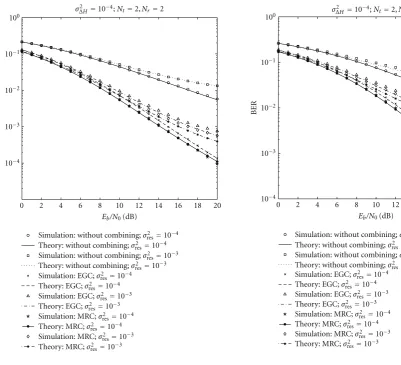
IAI appears with multiple transmit antennas, and the BER will degrade as IAI increases. Note that since IAI cannot be totally eliminated in the presence of the frequency offset and channel estimation errors, a BER floor occurs at the high SNR. IAI can be reduced considerably by exploiting the receiving diversity by using either EGC or MRC, as shown in Figures 6,7,8, and 9. Without receiver combining, the BER is much worse than that in SISO-OFDM, simply because of the SINR degradation due to IAI. For example, when Nt =Nr =2 andσΔ2H =10−4, the BER with QPSK is about 5.5×10⁻³ whenσ2
res = 10−4, which is three times of that
of SISO-OFDM (which is about 1.8×10⁻³), as shown in Figure 6. For a given number of receive antennas, MRC can achieve a lower BER than that achieved with EGC, but the receiver requires accurate channel estimation. For example, in Figure 7, when σΔ2H = 10−4 with Nt = Nr = 2 and 16QAM, the performance improvement of EGC (MRC) over that without combining is about 5.5 dB (6 dB), and that performance improvement increases to 7.5 dB (8.5 dB) ifσ2
res
is increased to 10−3. By increasing the number of receive
antennas to 4, this performance improvement is about 8.2 dB (9 dB) for EGC (MRC), withσ2
ΔH=10−4, or 11 dB (13.9 dB) for EGC (MRC), withσ2
10−4
10−3
10−2
10−1
100
BER
0 2 4 6 8 10 12 14 16 18 20
Eb/N0(dB)
10−9
10−8
10−7
10−6
10−5
σ2
ΔH=10−4;Nt=2,Nr=4
Simulation: EGC;σ2 res=10−4
Theory: EGC;σ2 res=10−4
Simulation: EGC;σ2 res=10−3
Theory: EGC;σ2 res=10−3
Simulation: MRC;σ2 res=10−4
Theory: MRC;σ2 res=10−4
Simulation: MRC;σ2 res=10−3
Theory: MRC;σ2 res=10−3
Simulation: without combining;σ2 res=10−4
Theory: without combining;σ2 res=10−4
Simulation: without combining;σ2 res=10−3
Theory: without combining;σ2 res=10−3
Figure8: BER with QPSK when (Nt=2,Nr=4).
Our theoretical BER approximations are accurate at low SNR with/without diversity combining. However, the simulation and theory results diverge as the SNR increases, especially whenσ2
res is large. For example, inFigure 9, with
16QAM, when (Nt = 2, Nr = 4) and σres2 = 10−3,
about 1 dB difference exists between the simulation and the theoretical result for either EGC or MRC at high SNR. This discrepancy is due to several reasons. As the SNR increases, the system becomes interference limited. When N,Nt, andNr are not large enough, the interferences may not be well approximated as Gaussian RVs with zero mean. In addition, with either EGC or MRC reception, the phase rotation or channel attenuation of the receive substreams should be estimated, and their estimation accuracy will also affect the combined SINR. The instant large phase or channel estimation error also contributes a deviation to the BER when using EGC or MRC.
6. Conclusions
The BER of MIMO-OFDM due to the frequency offset and channel estimation errors has been analyzed. The BER expressions for no combining, EGC, and MRC were derived. These expressions are in infinite-series form and can be
Simulation: EGC;σ2 res=10−4
Theory: EGC;σ2 res=10−4
Simulation: EGC;σ2 res=10−3
Theory: EGC;σ2 res=10−3
Simulation: MRC;σ2 res=10−4
Theory: MRC;σ2 res=10−4
Simulation: MRC;σ2 res=10−3
Theory: MRC;σ2 res=10−3
10−4
10−3
10−2
10−1
100
BER
0 2 4 6 8 10 12 14 16 18 20
Eb/N0(dB)
10−7
10−6
10−5
σ2
ΔH=10−4;Nt=2,Nr=4
Simulation: without combining;σ2 res=10−4
Theory: without combining;σ2 res=10−4
Simulation: without combining;σ2 res=10−3
Theory: without combining;σ2 res=10−3
Figure9: BER with 16QAM when (Nt=2,Nr=4).
truncated in practice. The simulation results show that the truncation error is negligible if the number of terms is large than 50.
Appendices
A. BER without Combining
Without loss of generality, the signal transmitted by the
ntth transmit antenna is assumed in this subsection to be
demodulated at thenrth receive antenna. For each (nr,nt,n), H = |Hn(nr,)nt| has a probability density function (PDF)
f(H) = 2H·e−H2
. When the number of receive antennas mis larger than 2,Dnr
nt;mcan be represented as
Dnr
nt;m=
4∞
0
'5 γnr,nt
n|Hn(nr,)nt
(2m−1
f(H)dH
=
4∞
0
(m−1/2)H(2m−1)
"
μH2+ν#(m−1/2)e
−H2
dH2
=(m−1/2) μ(m−3/2) ·D
nr
nt;m−1
− (m−1/2) μ(m−3/2)
4∞
0
h(m−1/2)e−h "
μh+ν#(m−3/2)dh,
where νis defined in (15),h = H2, = E
nt can be represented as
Znr
Without loss of generality, consider the demodulation of the signal transmitted by thentth transmit antenna. Define
νE=
(B.2) can be further simplified as
DEGC
function ofDEGC
nt;m−2andZnEGCt :
nt can be represented as
By replacing ZEGC
nt in (B.3) with (B.5),D EGC
nt;m can be finally simplified as
DEGC
nt;m =
2σ2 EGC
!
(2m+Nr−4)μ(Nr−1)! +νE $
μ2(m−3/2)(Nr−1)! ·D EGC
nt;m−1
− "
2σ2 EGC
#2
(m+Nr−5/2)
μ2(m−3/2) ·D EGC
nt;m−2.
(B.6)
C. BER of MRC
Without loss of generality, consider the demodulation of the signal transmitted by thentth transmit antenna. Define
HMRC =
5 Nr
nr=1|H (n)
nr,nt| 2
. When m > 2, DMRC
nt;m can be represented as
DMRC
nt;m =
4∞
0
'5 γM
i
n|H1,(ni),. . .,H
(n)
Nr,i (2m−1
f(HMRC)dHMRC
=2Nr
4∞
0
(m−1/2)H(2m−1) MRC
" μ!H2
MRC−(Nr−1) $
+νM#(m−1/2)
· H
(2Nr−2) MRC
(Nr−1)!·e −H2
MRCdH2 MRC
=(m+Nr−3/2)e−(Nr−1) μ(m−3/2) ·D
MRC
nt;m−1
− 2Nre−(Nr−1)(m−1/2) μ(m−3/2)(Nr−1)!
4∞
0
h(m+Nr−3/2)e−h
"
μh+νM#(m−3/2)dh, (C.1)
whereh = H2
MRC andνM = νM−μ(Nr−1). (C.1) can be further simplified as
DMRCnt;m =
(m+Nr−3/2)e−(Nr−1) μ(m−3/2) ·D
MRC
nt;m−1
−2Nre−(Nr−1)(m−1/2)νM μ2(m−3/2)(Nr−1)!
4∞
0
h(m+Nr−5/2)e−h
"
μh+νM#(m−3/2)dh
− 2Nre−(Nr−1)(m−1/2) μ2(m−3/2)(N
r−1)!
4∞
0
h(m+Nr−5/2)e−h
"
μh+νM#(m−5/2)dh
ZMRC nt
= (m+Nr−3/2)e−(Nr−1) μ(m−3/2) ·D
MRC
nt;m−1
+ ν
Me−(Nr−1)
μ2(m−3/2)(N
r−1)!·D
MRC
nt;m−1
− 2Nre−(Nr−1)(m−1/2) μ2(m−3/2)(N
r−1)!·Z
MRC
nt .
(C.2)
From the last step of (C.1),DnMRCt;m−1 can be represented as a
function ofDMRC
nt;m−2andZnMRCt :
DMRC
nt;m−1=
(m+Nr−5/2)e−(Nr−1) μ(m−5/2) ·D
MRC
nt;m−2
− 2Nre−(Nr−1)(m−3/2) μ(m−5/2)(Nr−1)!·Z
MRC
nt .
(C.3)
By resolving (C.3),ZMRC
nt can be represented as
ZMRC
nt =
(m+Nr−5/2)(Nr−1)!·DMRCnt;m−2
2Nr(m−3/2)
−μ(m−5/2)(Nr−1)!e
(Nr−1)·DMRC
nt;m−1
2Nr(m−3/2)
(C.4)
By replacingZMRC
nt in (C.2) with (C.4),D MRC
nt;m can be finally simplified as
DMRC
nt;m =
!(2m+Nr−4)μ(Nr−1)! +νM $
μ2(m−3/2)(N
r−1)! ·D
MRC
nt;m−1
−2(m+Nr−5/2)e−(Nr−1) μ2(m−3/2) ·D
MRC
nt;m−2.
(C.5)
Acknowledgments
This paper has been presented in part at the IEEE Globecom 2007 [32]. Although the conference paper was a brief version of this journal paper and they have the same results and conclusion, this journal paper provides a more detailed proof to each result appeared in the IEEE ICC 2007 paper.
References
[1] G. J. Foschini, “Layered space-time architecture for wireless communication in a fading environment when using multi-element antennas,”Bell Labs Technical Journal, vol. 1, no. 2, pp. 41–59, 1996.
[2] G. J. Foschini and M. J. Gans, “On limits of wireless com-munications in a fading environment when using multiple antennas,”Wireless Personal Communications, vol. 6, no. 3, pp. 311–335, 1998.
[3] A. Goldsmith, S. A. Jafar, N. Jindal, and S. Vishwanath, “Capacity limits of MIMO channels,”IEEE Journal on Selected Areas in Communications, vol. 21, no. 5, pp. 684–702, 2003. [4] T. L. Marzetta and B. M. Hochwald, “Capacity of a mobile
multiple-antenna communication link in rayleigh flat fading,” IEEE Transactions on Information Theory, vol. 45, no. 1, pp. 139–157, 1999.
[5] P. H. Moose, “Technique for orthogonal frequency division multiplexing frequency offset correction,”IEEE Transactions on Communications, vol. 42, no. 10, pp. 2908–2914, 1994. [6] T. Cui and C. Tellambura, “Maximum-likelihood carrier
fre-quency offset estimation for OFDM systems over frequency-selective fading channels,” inProceedings of the IEEE Interna-tional Conference on Communications, vol. 4, pp. 2506–2510, Seoul, Korea, May 2005.
[8] Z. Zhang, M. Zhao, H. Zhou, Y. Liu, and J. Gao, “Frequency offset estimation with fast acquisition in OFDM system,”IEEE Communications Letters, vol. 8, no. 3, pp. 171–173, 2004. [9] Z. Zhang, W. Jiang, H. Zhou, Y. Liu, and J. Gao, “High
accuracy frequency offset correction with adjustable acquisi-tion range in OFDM systems,”IEEE Transactions on Wireless Communications, vol. 4, no. 1, pp. 228–236, 2005.
[10] O. Besson and P. Stoica, “On parameter estimation of MIMO flat-fading channels with frequency offsets,”IEEE Transactions on Signal Processing, vol. 51, no. 3, pp. 602–613, 2003. [11] L. Rugini and P. Banelli, “BER of OFDM systems impaired by
carrier frequency offset in multipath fading channels,”IEEE Transactions on Wireless Communications, vol. 4, no. 5, pp. 2279–2288, 2005.
[12] T. M. Schmidl and D. C. Cox, “Robust frequency and timing synchronization for OFDM,” IEEE Transactions on Communications, vol. 45, no. 12, pp. 1613–1621, 1997. [13] M. Morelli and U. Mengali, “Improved frequency offset
estimator for OFDM applications,” IEEE Communications Letters, vol. 3, no. 3, pp. 75–77, 1999.
[14] X. Ma, C. Tepedelenlioˇglu, G. B. Giannakis, and S. Barbarossa, “Non-data-aided carrier offset estimators for OFDM with null subcarriers: identifiability, algorithms, and performance,” IEEE Journal on Selected Areas in Communications, vol. 19, no. 12, pp. 2504–2515, 2001.
[15] A. Mody and G. Stuber, “Synchronization for MIMO OFDM systems,” in Proceedings of IEEE Global Telecommunications Conference (GLOBECOM ’01), vol. 1, pp. 509–513, San Antonio, Tex, USA, November 2001.
[16] H. Minn, N. Al-Dhahir, and Y. Li, “Optimal training signals for MIMO OFDM channel estimation in the presence of frequency offset and phase noise,” IEEE Transactions on Communications, vol. 54, no. 10, pp. 1754–1759, 2006. [17] M. Ghogho and A. Swami, “Training design for multipath
channel and frequency-offset estimation in MIMO systems,” IEEE Transactions on Signal Processing, vol. 54, no. 10, pp. 3957–3965, 2006.
[18] S. Loyka and F. Gagnon, “Performance analysis of the V-BLASt algorithm: an analytical approach,”IEEE Transactions on Wireless Communications, vol. 3, no. 4, pp. 1326–1337, 2004.
[19] S. Loyka and F. Gagnon, “V-BLAST without optimal ordering: analytical performance evaluation for rayleigh fading chan-nels,”IEEE Transactions on Communications, vol. 54, no. 6, pp. 1109–1120, 2006.
[20] Y. Li, L. J. Cimini Jr., and N. R. Sollenberger, “Robust channel estimation for OFDM systems with rapid dispersive fading channels,”IEEE Transactions on Communications, vol. 46, no. 7, pp. 902–915, 1998.
[21] T. Cui and C. Tellambura, “Robust joint frequency offset and channel estimation for OFDM systems,” inProceedings of the 60th IEEE Vehicular Technology Conference (VTC ’04), vol. 1, pp. 603–607, Los Angeles, Calif, USA, September 2004. [22] H. Minn and N. Al-Dhahir, “Optimal training signals for
MIMO OFDM channel estimation,” IEEE Transactions on Wireless Communications, vol. 5, no. 5, pp. 1158–1168, 2006. [23] J. G. Proakis, Digital Communications, McGraw-Hill, New
York, NY, USA, 4th edition, 2001.
[24] D. N. D`ao and C. Tellambura, “Intercarrier interference self-cancellation space-frequency codes for MIMO-OFDM,”IEEE Transactions on Vehicular Technology, vol. 54, no. 5, pp. 1729– 1738, 2005.
[25] T. Tang and R. W. Heath Jr., “Space-time interference cancellation in MIMO-OFDM systems,”IEEE Transactions on Vehicular Technology, vol. 54, no. 5, pp. 1802–1816, 2005. [26] L. Giangaspero, L. Agarossi, G. Paltenghi, S. Okamura, M.
Okada, and S. Komaki, “Co-channel interference cancellation based on MIMO OFDM systems,”IEEE Wireless Communica-tions, vol. 9, no. 6, pp. 8–17, 2002.
[27] A. Stamoulis, S. N. Diggavi, and N. Al-Dhahir, “Intercarrier interference in MIMO OFDM,”IEEE Transactions on Signal Processing, vol. 50, no. 10, pp. 2451–2464, 2002.
[28] K. Cho and D. Yoon, “On the general BER expression of one- and two-dimensional amplitude modulations,” IEEE Transactions on Communications, vol. 50, no. 7, pp. 1074– 1080, 2002.
[29] L.-L. Yang and L. Hanzo, “Recursive algorithm for the error probability evaluation of M-QAM,” IEEE Communications Letters, vol. 4, no. 10, pp. 304–306, 2000.
[30] I. S. Gradshteyn and I. M. Ryzhik,Table of Integrals, Series, and Products, Academic Press, New York, NY, USA, 5th edition, 1994.
[31] Z. Zhang and C. Tellambura, “The effect of imperfect carrier frequency offset estimation on an OFDMA uplink,” IEEE Transactions on Communications, vol. 57, no. 4, pp. 1025– 1030, 2009.
![Real time processing on the road: a guided tour of [iks]'s abstr/cncr setup](data:image/gif;base64,R0lGODlhAQABAIAAAP///wAAACH5BAEAAAAALAAAAAABAAEAAAICRAEAOw==)