R E S E A R C H
Open Access
Power minimization for OFDM modulated
two-way amplify-and-forward relay wireless
sensor networks
Xiaodong Ji
1,2, Zhihua Bao
1,2and Chen Xu
1,2*Abstract
This paper studies a power minimization problem of an orthogonal frequency-division multiplexing modulated two-way amplify-and-forward relay wireless sensor network (WSN). The objective is to develop effective strategies for controlling the transmit power levels of WSN nodes and assigning the bit rates among different subcarriers to minimize the overall transmit power of the network, while ensuring the end-to-end target rates of the two WSN sources. By using channel knowledge at transmitters, a two-step method is proposed to solve the power minimization problem, resulting in a joint power control and bit rate assignment (JPCBRA) algorithm. At the first step, a
per-subcarrier optimization problem concerning the power minimization issue is solved, giving closed-form solutions for individual transmit powers at the WSN sources and the relay. At the second step, the end-to-end target rates of the two WSN sources are allocated to different subcarriers so that the total transmit power can be reduced further while satisfying the initial data-rate requirement of the two WSN sources. Computer simulation results confirmed the effectiveness of the proposed JPCBRA algorithm. It is shown that with the JPCBRA algorithm, the total transmit power of the network can be significantly reduced in any traffic and/or channel cases in contrast to the compared schemes.
Keywords: Two-way relay, Amplify-and-forward, Orthogonal frequency-division multiplexing, Wireless sensor network, Power minimization, Bit-rate assignment
1 Introduction
Wireless sensor networks (WSNs), sometimes referred to as wireless sensor and actor networks [1], are networks with densely deployed sensor nodes which are capable of monitoring physical or environmental conditions such as sound, pressure, humidity, temperature, wind direc-tion, and speed and to cooperatively deliver their data through the network to a sink node. Normally, WSN nodes are geographically distributed in different places and are mostly battery powered. Thus, energy becomes the scarcest resource of WSN nodes, which determines the lifetime of the network. As such, the power mini-mization problem (i.e., saving as much energy as possible) has become a hot research topic for WSNs. On the other hand, cooperative relay scheme [2] as a novel technique
*Correspondence: [email protected]
1School of Electronics and Information, Nantong University, Nantong 226019,
China
2Nantong Research Institute for Advanced Communication Technologies,
Nantong 226019, China
for wireless communications promises enhancements in throughput and energy efficiency and thus has attracted much attention from the research community in recent years.
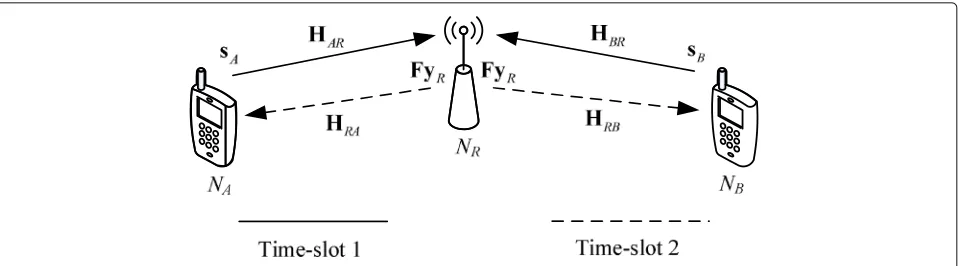
Since cooperative relay scheme could make the data delivery of WSNs more reliable and thus ensure the strict requirements of the network, some pioneer works [3–8] have been trying to apply the cooperative relay scheme to WSNs. In general, there are two transmission fash-ions for a two-hop cooperative relay scheme, namely, one-and two-way relaying. It should be noted that one-way relaying is generally more suitable for the case where data is delivered unidirectionally, namely, from a source to a destination only. In case that data from two nodes is for-warded in opposite directions, two-way relaying (TWR) could make the bi-directional transmission more efficient than one-way relaying [9]. Generally speaking, a TWR network, where two sources deliver data to each other through a relay node as shown in Fig. 1, can apply an amplify-and-forward (AF) or a decode-and-forward or
Fig. 1A TWR network, where two sourcesNAandNBdeliver data to each via a relay nodeNR
a denoise-and-forward [10], or a compress-and-forward [11] protocol while employing either the time division broadcast or the multiple-access broadcast (MABC) pol-icy [12]. Due to the better flexibility of the AF protocol and the larger spectral efficiency of the MABC policy, more research effort has been focused on the AF protocol-based MABC policy in the research community [12].
2 Related work
In recent years, there are some publications focusing on the energy efficient design of TWR networks. By using the channel statistics, the authors of [12] proposed a trans-mit power allocation algorithm to minimize the overall transmit power of the TWR network with asymmetric traffic requirements. Considering the transmit and circuit power consumptions together, a hybrid one- and two-way relaying policy was developed in [13] to enhance the system energy efficiency. By using the instantaneous channel knowledge at transmitters, joint optimum power allocation and beamforming algorithms have been pro-posed for the two-phase TWR network in [14] and the three-phase TWR network in [15] to minimize the sys-tem transmit power, while guaranteeing that the received signal-to-noise ratios (SNRs) at the two sources be larger than the pre-defined thresholds. By exploiting the statis-tical channel knowledge at transmitters, the authors of [16] addressed an optimization problem minimizing the total transmit power of the TWR network with differ-ent outage probability constraints on the two sources. By exploiting the statistical channel knowledge at transmit-ters, a joint power allocation and relay location algorithm was proposed in [17] to reduce the power consumption of an asymmetric two-way AF relay network while ensur-ing the required network quality of service. In [18], the hybrid one- and two-way relaying policy proposed in [13] was extended to an orthogonal frequency-division mul-tiplexing (OFDM) modulated TWR network. Moreover, the study of energy efficiency and spectrum efficiency trade-off for TWR networks can be found in [19] and references therein. In [20], a power allocation technique
In this paper, a phase OFDM modulated two-way relay WSN1is considered, where two WSN sources exchange messages via a half-duplex AF relay. Our objec-tive is to develop effecobjec-tive strategies for controlling the transmit power levels of WSN nodes and assigning the bit rates among different subcarriers to minimize the overall transmit power of the network, while ensuring the end-to-end target rates of the two sources. First, a total power minimization problem is formulated by considering both power control of nodes and bit rate assignment. A two-step method is then proposed to solve this optimization problem. At the first step, a per-subcarrier optimization problem concerning the power minimization issue is solved, giving closed-form solu-tions for individual transmit powers at the sources and the relay. At the second step, the end-to-end target rates of the two sources are allocated to different subcarri-ers so that the total transmit power can be reduced further while satisfying the initial data-rate requirement of the two sources. Computer simulations are con-ducted, and the results validate the proposed algorithm, showing that the proposed algorithm can significantly reduce the total transmit power in any traffic and/or channel cases.
3 Network model
We consider a two-way relay WSN, where each WSN node is equipped with a single antenna and operates in an AF protocol-based half-duplex fashion. As depicted in Fig. 1, two sourcesNAandNBwould like to deliver
mes-sages to each other via a relay node NR. We denote by si = [si(1),si(2),· · ·,si(K)]T, i ∈ {A,B}, the OFDM
symbol transmitted by nodeNi, whereKis the number of subcarriers. Assume thatsi(k),k ∈ {1,· · ·,K}has a unit energy and no direct link exists between the two sources. We denote byEi = diag{ei(1),· · ·,ei(K)},i ∈ {A,B,R},
the transmit power at node Ni, where ei(k) represents
the transmit power of the node for thek- th subcarrier. The channel gain from node Ni to node Nj is denoted
by Hij = diaghij(1),· · ·,hij(K), i,j ∈ {A,B,R} and
i = j, where hij(k) is the corresponding path gain for
the k−th subcarrier. In the paper, hij(k) is modeled as
hij(k)=gij
dijα, wheredijandgijrepresent the distance
and the large-scale behavior of the path gain between nodesNiandNj, respectively, andαis the corresponding
path-loss coefficient [12, 17]. Without loss of generality, we assume thatgijis a complex Gaussian random variable
and obeysCN(0, 1), and the channels are reciprocal, i.e.,
Hij=Hjiand quasi-static. We denote bywi,i∈ {A,B,R},
the additive white Gaussian noise (AWGN) at node Ni.
It is assumed that all the elements of AWGNs obey i.i.d.
CN(0, 1).
As shown in Fig. 1, two sourcesNAandNB, respectively,
sendsA andsBto the relayNRat time slot 1. Then, the
relay receives the following signal
yR=HAR
EAsA+HBR
EBsB+wR. (1)
At time slot 2, the relay NR first scales each sub-carrier of the received signal yR by a factor F =
diagf(1),· · ·,f(K), where
f(k)= 1
eA(k)|hAR(k)|2+eB(k)|hBR(k)|2+1
. (2)
Next, the relay broadcasts the resulting signal to the two sources. At the end of time slot 2, the nodeNireceives
yi=F
⎛ ⎜ ⎝HiRHiR
EiERsi
self−interference
+HiRHjR
EjERsj+HiR
ERwR
⎞ ⎟ ⎠+wi,
(3)
where i,j ∈ {A,B}, andi = j. Assuming perfect chan-nel state information (CSI) at receivers, the sourceNican
implement self-interference removal and then obtain
yi =F
HiRHjR
EjERsj+HiRERwR
+wi. (4)
As such, at the end of time slot 2, the mutual infor-mation achieved by the sourceNican be written as [26]
Ii= K
k=1
1
2log2[1+SNRi(k)], (5)
where the factor 1/2 arises because of the fact that the sig-nal is transmitted over two time slots,Ii(k)and SNRi(k)
are the mutual information and the SNR for the k- th subcarrier and can be given as the following
Ii(k)=
1
2log2[1+SNRi(k)] , (6)
SNRi(k)=
ejeR|hAR(k)|2|hBR(k)|2 (ei+eR)|hiR(k)|2+ejhjR(k)2+1
. (7)
4 Problem description and solution
e∗A(k),e∗B(k),e∗R(k),r∗(k)=
arg
eA(k),eB(k),eR(k),r(k) min
K
k=1
eA(k)+eB(k)+eR(k)
2
(8a)
subject to
K
k=1
r(k)=r (8b)
min(IA,IB)≥r (8c)
whereris the end-to-end target rate of the two sources,
r(k)is the assigned bit rate for thek-th subcarrier, and fac-tor 1/2 in (8a) indicates that each node in the network only uses one-half of the transmission time during one cycle message delivery.
It is observed that closed-form solutions for per-subcarrier optimization problems minimizing the network transmit power can be obtained. In addition, problem (8) can be decomposed into a two-step problem, (i) step 1: power control minimizing the total transmit power without bit rate assignment; (ii) step 2: bit rate assignment (BRA) for reducing the transmit power further. Thus, to solve the JPCAB problem given by (8), a per-subcarrier optimization problem minimizing the transmit power of the network without bit rate assign-ment is examined first. The per-subcarrier optimization problem is written as
ePA(k),ePB(k),ePR(k)= arg
eA(k),eB(k)eR(k)
mineA(k)+eB(k)+eR(k) 2
(9a)
subject to min [IA(k),IB(k)]≥r(k) (9b)
wherer(k)is the assigned bit rate of the nodeNifor the
k-th subcarrier.
The optimal solution to the per-subcarrier optimization problem (9) is presented in the following proposition.
Proposition 1 For an AF protocol-based TWR network, the optimal solution to the per-subcarrier optimization problem(9)can be given by
ePA(k)= z(k)[|hAR(k)| + |hBR(k)|]
|hAR(k)|2|hBR(k)| , (10)
ePB(k)= z(k)[|hAR(k)| + |hBR(k)|] |hAR(k)| |hBR(k)|2
, (11)
ePR(k)= z(k)[|hAR(k)| + |hBR(k)|] 2+ |h
AR(k)| |hBR(k)| |hAR(k)|2|hBR(k)|2
,
(12)
where z(k)=22r(k)−1. ProofSee Appendix 1.
Thus, the total transmit power of the network is given by
ePT(k)= 2z(k)[|hAR(k)|+|hBR(k)|] 2+|h
AR(k)| |hBR(k)| |hAR(k)|2|hBR(k)|2
.
(13)
In the next step, we address the BRA problem allocating the end-to-end target rate of the two sources to differ-ent subcarriers so that the total transmit power can be reduced further while satisfying the end-to-end target rate of the two sources. The BRA problem is formulated as
r∗(k)=arg
r(k)min
K
k=1
ePT(k) (14a)
subject to
K
k=1
r(k)=r (14b)
z(k)=22r(k)−1 (14c)
r(1),r(2),· · ·,r(K)≥0 (14d)
whereePT(k)is given by (13).
Ignoring constraint (14d), (14) can be solved straightfor-wardly by dealing with a linear system and the solution is presented in the following proposition.
Proposition 2 For an AF protocol-based TWR network, the optimal solution to the BRA problem (14) without constraint (14d) can be classified as the following two cases.
(i) Case 1 : k=1or k=K . The solution can be given by
r∗(1)= r
K+
K−1
n=1
(K−n)c(n)
K or r
∗(K)= r
K−
K−1
m=1 mc(m)
K .
(15)
(ii) Case 2: k=1,K . The solution is given by
r∗(k)= r
K −
k−1
m=1 mc(m)
K +
K−1
n=k
(K−n)c(n)
K . (16)
Here, c(k)is defined as
c(k)=log2
|h
AR(k)| |hBR(k)|[|hAR(k+1)| + |hBR(k+1)|]
|hAR(k+1)| |hBR(k+1)|[||hAR(k)| +hBR(k)|]
.
(17)
Proof See Appendix 2.
will be discarded and the target rate will be reallocated again among the other subcarriers until all the assigned bit rates are larger than or equal to 0. Then, based on Proposition 2, a JPCBRA algorithm minimizing the total transmit power of the network is proposed as given in the following table.
Algorithm 1JPCBRA minimizing the network transmit power.
Step 1. SetL=K.
Step 2. Calculate the assigned bit rate according to Proposition 2.
Step 3. Checkr∗(l). Ifr∗(l)≥0,l∈ {1, 2,· · ·,K}, go to step Otherwise, discard the subcarrier with the minimum assigned bit rate and setL=L−1and then go to step 2.
Step 4. Based on the assigned bit rate on each subcarrier, the individual transmit powersePA(k),ePB(k)and
ePR(k)are calculated according to (10), (11), and (12), respectively.
Step 5. End of the algorithm.
5 Simulation results
In this section, simulation results are provided to evaluate the performance of our proposed algorithm. Assume that the relay node is situated on the line betweenNAandNB,
anddAB=1. The parameterαis set to four to model radio
propagation in urban areas [12]. It means that 0<dAR<
1, 0<dBR <1, anddAR+dBR=1. In our simulations, the
transmit power levels are obtained by finding the mean of the node’s transmit powers.
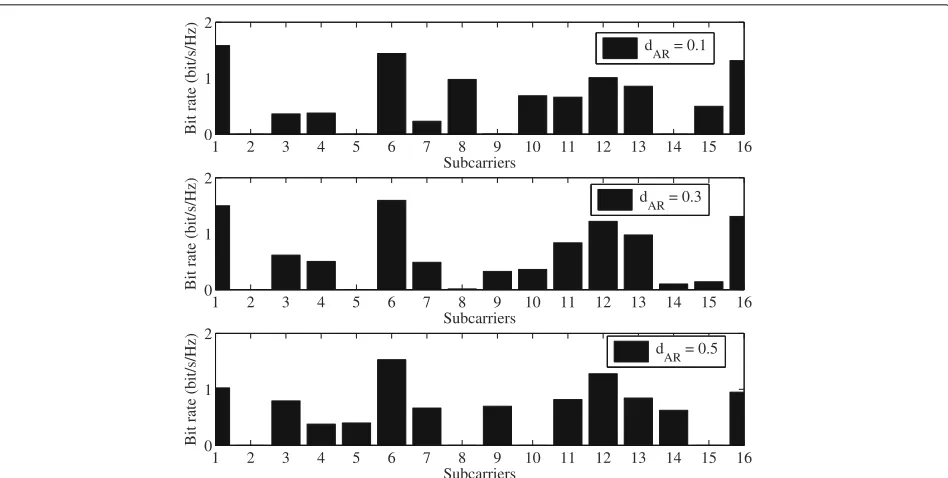
Figure 2 provides the detailed information with respect to the assigned bit rates on each subcarrier, where three different channel cases are involved. In Fig. 2,dAR = 0.5
means the relay node is located at the middle of the two sources and is referred to as the symmetric channel case.
dAR=0.3 anddAR =0.1 are the moderately and strongly asymmetric channel cases, respectively. Here,Kandrare set to 16 and 10 bit/s/Hz, respectively. It can be observed that the bit rates are not equally assigned among all the subcarriers even in the symmetric channel case. Some of the subcarriers are assigned more bit rates than the others, and some of the subcarriers are not used at all, all of which depend upon the actual transmission conditions.
In Fig. 3, we plot the total transmit power as a func-tion ofdAR, whereK andrare set to 16 and 10 bit/s/Hz,
respectively. Here, “equal power” means each node and each subcarrier have identical transmit powers, “without BRA” means bit rates are equally assigned to all the sub-carriers, and “equal power of nodes” means each node has the same transmit power. It can be seen that the JPCBRA
algorithm can significantly reduce the network transmit power in contrast to the compared schemes. When the relay is close to one of the sources, more transmit power can be saved with the proposed algorithm.
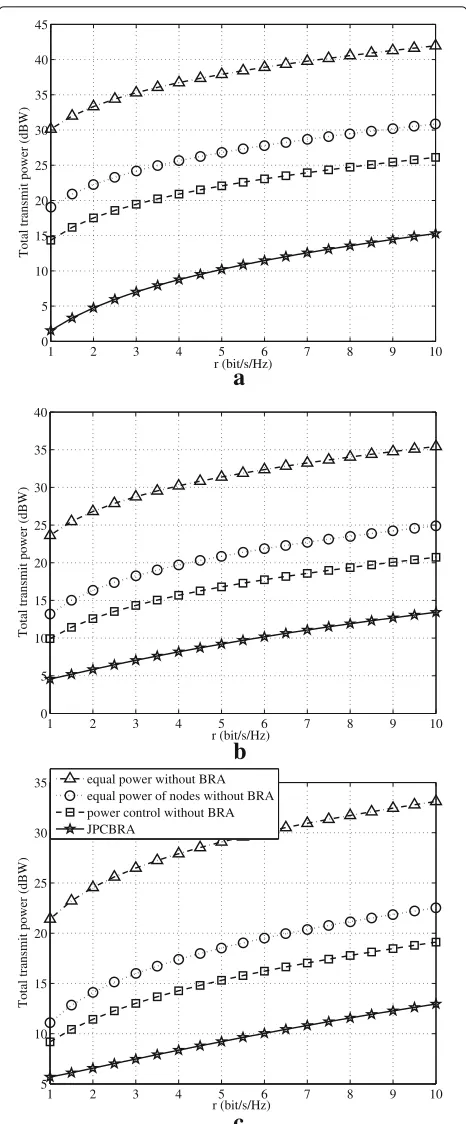
In Fig. 4, we plot the total transmit power as a function ofr, where the three channel cases considered in Fig. 2 are involved, the parameterKis maintained the same as before and ris ranged from 1 to 10 bit/s/Hz. It can be observed that with the JPCBRA algorithm, the total trans-mit power can be significantly reduced and with increas-ing the level of asymmetry of the channel, the superiority of the proposed algorithm becomes more evident. In addi-tion, the total transmit power almost increases linearly with the increasing ofr. However, the total transmit power of the three compared schemes increase logarithmically when the sources’ target rate increases.
6 Conclusions
In this paper, we have addressed an optimization prob-lem concerning the total transmit power minimization of an OFDM modulated two-way AF relay WSN with end-to-end target rate constraint on the two sources. By exploiting the channel knowledge at the transmitters, a two-step method has been proposed to solve the power minimization problem, leading to a JPCBRA algorithm. Computer simulation experiments were conducted with comparison with the schemes of “equal power without BRA,” “equal power of nodes without BRA,” and “power control without BRA.” Simulation results validated the correctness and the efficiency of our proposed algo-rithm. It was shown that with the proposed JPCBRA algorithm, the total transmit power of the network is sig-nificantly reduced. It was also shown that with increasing the level of asymmetry of the channel, the performance enhancement in terms of the reduced power turns into more evident.
Endnotes
1Usually, WSNs only need low data rates. However, in
some settings, e.g., wireless multimedia sensor networks, multimedia content such as video and audio streams and images should be perceived and then delivered. Thus, in order to enable the retrieval of multimedia streams, some advanced physical layer techniques, such as OFDM and ultra-wide band, are employed [27, 28].
Appendix 1: proof of proposition 1
First, it can be observed that the global minimum of the per-subcarrier optimization problem (9) is achieved only when the inequality constraint (9b) holds with equality. In addition, it can be readily proved that for any set of [eA(k),eB(k),eR(k)] satisfying (9b) and
Fig. 2The detailed information with respect to the assigned bit rates on each subcarrier, where three different channel cases are involved
ePA(k),ePB(k),ePR(k) is the optimal solution of (9), minIA
ePA(k),ePB(k),ePR(k),IB
ePA(k),ePB(k),ePR(k) ≥
min{IA[eA(k),eB(k),eR(k)] ,IB[eA(k),eB(k),eR(k)]}
holds. Based on the above results, the per-subcarrier optimization problem (9) can be solved by transforming it to a two-phase problem, phase 1: maximizing the mutual information of the sources subject to a total power con-straint; phase 2: minimizing the total transmit power with the target-rate requirement based on the achieved results at phase 1. The optimization problem at phase 1 can be recognized as a special case of that in [29]. It is
Fig. 3The total transmit power as a function ofdAR, whereKandrare set to 16 and 10 bit/s/Hz, respectively
worth-mentioning that in [29], exact SNR expressions of the two sources are used to solve the optimization problem. For the sake of simplicity, here, the approximate SNR expression as given below is used instead.
SNRi(k)≈
ejeR|hAR(k)|2|hBR(k)|2 (ei+eR)|hiR(k)|2+ejhjR(k)2
Then using the method similar to that in [29], the opti-mization problem at phase 1 can be solved and the solution is given by
⎧ ⎪ ⎨ ⎪ ⎩
eA(k)= 2(|h|ARhBR(k()k|+|)|eTkBR(k)(k)|) eB(k)= 2[|h|ARhAR(k()k|+|)|eThBR(k)(k)|] eR(k)= (|h2AR(|h(ARk)|+|(k)h|+|BRh(BRk)|()ke)T|()k)
, (18)
where eT(k) is the imposed total power constraint at
phase 1.
Next, based on (18) and using simple algebraic manipu-lations, one can obtain the solution of the phase 2 problem being given by
⎧ ⎪ ⎪ ⎪ ⎪ ⎪ ⎨ ⎪ ⎪ ⎪ ⎪ ⎪ ⎩
e∗A(k)= (|hAR(k)|+|hBR(k)|)
22r(k)−1 |hAR(k)|2|hBR(k)| e∗B(k)= (|hAR(k)|+|hBR(k)|)
22r(k)−1
|hAR(k)||hBR(k)|2 e∗R(k)= (|hAR(k)|+|hBR(k)|)
222r(k)−1 |hAR(k)|2|hBR(k)|2
. (19)
a
b
c
Fig. 4The total transmit power as a function ofr, where the three channel cases considered in Fig. 2 are involved, the parameterKis maintained the same as before andris ranged from 1 to 10 bit/s/Hz
satisfied. To that end, we make a modification to the solu-tion achieved earlier. According to (7), one can find that the received SNRs of the two sources are both monotoni-cally increasing functions ofeR(k). Thus, we modifyeR(k)
in (18). The idea is to increaseeR(k)such that the resulting
SNRs of the two sources can satisfy the initial require-ments. Then, by performing some simple manipulations, we can obtain the final solution of (9) as presented in Proposition 1.
Appendix 2: proof of proposition 2
The Lagrangian function of (14) without constraint (14d) can be given by
L=
where v is a Lagrangian multiplier. Thus, the Karush-Khun-Tucker conditions can be formulated as
⎧
Based on (21), it is ready to deduce that the optimal solution should satisfy the following equation:
⎧
X−1=
Then, according toy = X−1c, one can straightforwardly obtain the final solution as presented in Proposition 2.
Acknowledgements
This work is supported in part by the National Natural Science Foundation of China (grant nos. 61371111 and 61401238), the Natural Science Foundation of Jiangsu Province (grant no. BK20140433), and the Natural science foundation of Jiangsu Universities (grant no. 16KJB510038).
Competing interests
The authors declare that they have no competing interests.
Publisher’s Note
Springer Nature remains neutral with regard to jurisdictional claims in published maps and institutional affiliations.
Received: 11 July 2016 Accepted: 11 March 2017
References
1. F Akyildiz, IH Kasimoglu, Wireless sensor and actor networks: research challenges. Ad Hoc Net.2(4), 351–367 (2004)
2. JN Laneman, DNC Tse, GW Wornell, Cooperative diversity in wireless networks: efficient protocols and outage behavior. IEEE Trans. Inform. Theory.50(12), 3062–3080 (2004)
3. F Engel, T Abrao, L Hanzo, inProc. WCNC2013 Con. Relay selection methods for maximizing the lifetime of wireless sensor networks, (Shanghai, 2013), pp. 2339–2344
4. W Fang, Q Zhou, Z Wang, Q Liu, An adaptive transmission scheme for wireless sensor networks. Int. J. Future Generation Commun. Netw.6(1), 35–44 (2013)
5. R Liu, IJ Wassell, K Soga, inProc. WiMob2010 Con. Relay node placement for wireless sensor networks deployed in tunnels, (Niagara Falls, 2010), pp. 144–150
6. T Krikidis, Z Ding, CD Charalambous, Noncoherent energy detection with orthogonal signaling for an uncoded two-way relay channel. IEEE Trans. Veh. Technol.61(1), 404–409 (2012)
7. H Zhang, H Xing, J Cheng, A Nallanathan, VCM Leung, Secure resource allocation for OFDMA two-way relay wireless sensor networks without and with cooperative jamming. IEEE Trans. Ind. Inform.12(5), 1714–1725 (2016)
8. Z Chen, A Kuehne, A Klein, A Loch, M Hollick, J Widmer, inProc. WSA2012 Con. Two-way relaying for multiple applications in wireless sensor networks, (Dresden, 2012), pp. 318–324
9. X Ji, On the study of cognitive bidirectional relaying with asymmetric traffic demands. J. RF-Eng. Telecommun.69(5–6), 185–303 (2015) 10. Z Zhao, M Peng, Z Ding, W Wang, H-H Chen, Denoise-and-forward
network coding for two-way relay MIMO systems. IEEE Trans. Veh. Technol.63(2), 775–788 (2014)
11. R Vaze, RW Heath J, On the ccapacity and diversity-multiplexing tradeoff of the two-way relay channel. IEEE Trans. Inform. Theory.57(7), 4219–4234 (2011)
12. X Ji, W-P Zhu, D Massicotte, Transmit power allocation for asymmetric bi-directional relay networks using channel statistics. IET Commun.9(13), 1649–1660 (2015)
13. C Sun, C Yang, Energy efficient hybrid one- and two-way relay transmission. IEEE Trans. Veh. Technol.62(8), 3737–3751 (2013) 14. V Havary-Nassab, S Shahbazpanahi, A Grami, Optimal distributed
beamforming for two-way relay networks. IEEE Trans. Signal Process. 58(3), 1238–1250 (2010)
15. M Zaeri-Amirani, S Shahbazpanahi, T Mirfakhraie, K Ozdemir, Performance tradeoffs in amplify-and-forward bidirectional network beamforming. IEEE Trans. Signal Process.60(8), 4196–4209 (2012)
16. Y Li, X Zhang, M Peng, W Wang, Power provisioning and relay positioning for two-way relay channel with analog network coding. IEEE Signal Process. Lett.18(9), 517–520 (2011)
17. X Ji, W-P Zhu, D Massicotte, M Ahmed-Ouameur, inProc. GlobalSIP2015 Con. Energy efficient power allocation and relay location for asymmetric bi-directional relaying, (Orlando, 2015), pp. 1–5
18. C Sun, Y Cen, C Yang, Energy efficient OFDM relay systems. IEEE Trans. Commun.61(5), 1797–1809 (2013)
19. C Zhang, J Ge, Y Cai, J Li, Y Ji, MA Farah, Energy efficiency and spectral efficiency tradeoff for asymmetric two-way AF relaying with statistical CSI. IEEE Trans. Veh. Technol.65(4), 2833–2839 (2016)
20. S Chung, I Joe, Intelligent transmission power allocation for distributed beamforming in wireless sensor networks. Int. J. Distrib. Sens. Net.2015, 1–10 (2015)
21. S Kim, YH Lee, Energy-efficient power allocation for OFDM signaling over a two-way AF relay. IEEE Trans. Veh. Technol.64(10), 4856–4863 (2015) 22. Z Chang, Q Zhang, X Guo, T Ristaniemi, Energy-efficient resource
allocation for OFDMA two-way relay networks with imperfect CSI. EURASIP J. Wirel.Comm.2015(225), 1–11 (2015)
23. C Xiong, L Lu, GY Li, Energy-efficient OFDMA-based two-way relay. IEEE Trans. Comm.63(9), 3157–3169 (2015)
24. DE Simmons, JP Coon, Two-way OFDM-based nonlinear amplify-and-forward relay systems. IEEE Trans. Veh. Technol.65(5), 3808–3812 (2016)
25. DE Simmons, JP Coon, inProc. EuCNC2015 Con. Two-way OFDM-based nonlinear amplify-and-forward relaying: power allocation, (Paris, 2015), pp. 280–284
26. Y-U Jang, E-R Jeong, YH Lee, A two-step approach to power allocation for OFDM signals over two-way amplify-and-forward relay. IEEE Trans. Signal Process.58(4), 2426–2430 (2010)
27. IA Akyildiz, T Melodia, KR Chowdhury, A survey on wireless multimedia sensor networks. Comput. Net.51(4), 921–960 (2007)
28. R Han, W Yang, K You, MB-OFDM-UWB based wireless multimedia sensor networks for underground coalmine: a survey. Sensors.16(12), 1–20 (2016)
29. X Ji, W-P Zhu, D Massicotte, Adaptive power control for asymmetric two-way amplify-and-forward relaying with individual power constraints. IEEE Trans. Veh. Technol.63(9), 4315–4333 (2014)
Submit your manuscript to a
journal and benefi t from:
7 Convenient online submission 7 Rigorous peer review
7 Immediate publication on acceptance 7 Open access: articles freely available online 7 High visibility within the fi eld
7 Retaining the copyright to your article