CSEIT172115 | Received: 08 Feb 2017 | Accepted: 15 Feb 2017 | January-February-2017 [(2)1: 48-54 ]
International Journal of Scientific Research in Computer Science, Engineering and Information Technology © 2017 IJSRCSEIT | Volume 2 | Issue 1 | ISSN : 2456-3307
48
Image Denoising using Bilateral Filter and Wavelet Thresholding
Sirisha B., K. Dhilli, E. Govinda
Department ECE, Avanthi Institute of Engineering and Technology, Narsipatnam, Visakhapatanam, Andhra Pradesh, India
ABSTRACT
In this work, a hybrid denoising algorithm which combines spatial domain bilateral filter and hybrid thresholding function in the wavelet domain is being proposed. The wavelet transform is used to decompose the noisy image into its different subbands namely LL, LH, HL, and HH. A two-stage spatial bilateral filter is applied. The first stage is applied to the noisy image before wavelet decomposition. This stage will be called a pre-processing stage. The second stage spatial bilateral filtering is applied on the low-frequency subband of the decomposed noisy image namely subbands LL. This stage will tend to cancel or at least attenuate any residual low-frequency noise components. The intermediate stage deal with high-frequency noise components by thresholding detail subbands LH, HL, and HH using hybrid thresholding function. The performance of the proposed denoising algorithm will be superior to that of the conventional denoising approach which may be proved after experimental analysis.
Keywords: Bilateral Filter, Wavelet Thresholding, Image Denoising
I.
INTRODUCTION
Digital images play an important role in various applications such as satellite television, medical imagining, remote sensing, computer vision, pattern recognition etc. While collecting the information from the image sensors due to intrinsic (lens arrangement, lens distortion factors) and extrinsic parameters (atmosphere, human beings) of the camera device may chance have occurred the noise in the image. Furthermore, noise can be introduced by transmission errors and compression. Therefore, image denoising is a fundamental problem in the field of image processing. It is necessary to apply an efficient denoising technique to reduce the noise in the data.
Image denoising still remains a challenge for researchers because noise removal introduces artefacts and causes blurring of the images because of noise modelling in images is greatly affected by capturing devices, data transmission media, image quantization and discrete sources of radiation. Different algorithms are used depending on the noise model. Most of the natural images are affected by Gaussian noise.This
project introduces a novel algorithm to reduce noise in the image and evaluate the quality of the denoised image in terms of quality parameters.
The basic idea behind this thesis is the estimation of the uncorrupted image from the distorted or noisy image and is also known as image denoising. There are various techniques present to remove the noise from the corrupted image. Selecting the appropriate method plays a major role in getting the desired image. In this paper, a study is made on the various denoising algorithms like Gaussian/Bilateral filtering (GBF), GBF with wavelet thresholding (Wavelet threshold based GBF) and each technique is compared in terms of its quality parameters like PSNR (Peak Signal to Noise Ratio), IQI (Image Quality Index).
II.
METHODS AND MATERIAL
A. Edge Preserving Filters
The main objective of image denoising is to remove the noise from the degraded image without preserving the image features like edges, details as much as possible.
B. Linear Filters
Linear filters are a well-known technique for removal of Gaussian or additive noise image. Linear filters, which consist of convolving the image with a constant matrix to obtain a linear combination of neighbourhood values. However, they can produce a blurred and smoothed image with poor feature localisation and incomplete noise suppression.
C. Gaussian Filter
Filters based on Gaussian functions are quite popular, because their shapes are easily specified and both the forward and inverse Fourier transforms of a Gaussian function are realGaussian functions. Further, if the frequency domain filter is narrower, the spatial domain filter will be wider which attenuates the low frequencies resulting in increased smoothing/blurring.These Gaussian filters are typical linear filters that have been widely used for image denoising.
In Gaussian filters, weight of the pixels is given by
( ) ( ) (1)
Gaussian filters assume that images have smooth spatial variations and pixels in a neighbourhood have close values, by averaging the pixel values over a local neighbourhood suppresses noise while preserving image features. However, this assumption fails at edges where the spatial variations are not smooth. Due to that, the Gaussian filter blurs the edges. To overcome this problem we introduce a bilateral filter.
D. Bilateral Filter
The bilateral filter filtering the image in both range and space domain.Bilateral filtering is a local, nonlinear and non-iterative technique which considers both grey
level similarities and geometric closeness of the neighbouring pixels.Mathematically,the bilateral filter output at a pixel location ‘p’ is calculated as follows
( ) ∑ (‖ ‖) (| ( ) ( )|) ( ) (2)
Where (‖ ‖) ‖ ‖ is a geometric closeness function
(| ( ) ( )|)
| ( ) ( )|
is a gray level similarity function
W= Normalization constant
‖ ‖is the Euclidian distance between ‘p’ and ‘q’. and 's’ is a spatial neighbourhood of ‘p’.
The two parameters and controls the behavior of the bilateral filter. The optimal value is relatively insensitive tonoise variancecompared to the optimal value and is chosen based on the desired amount oflow-pass filtering.A large blurs more, i.e., it combines values from more distant image locations. Also, if an image is scaled up or down, must be adjusted accordingly in order toobtain equivalent results.It appears that a good range for the value is roughly [1.5 - 2.1]. On the other hand, the optimal value changes significantly as the noise standard deviation changes.
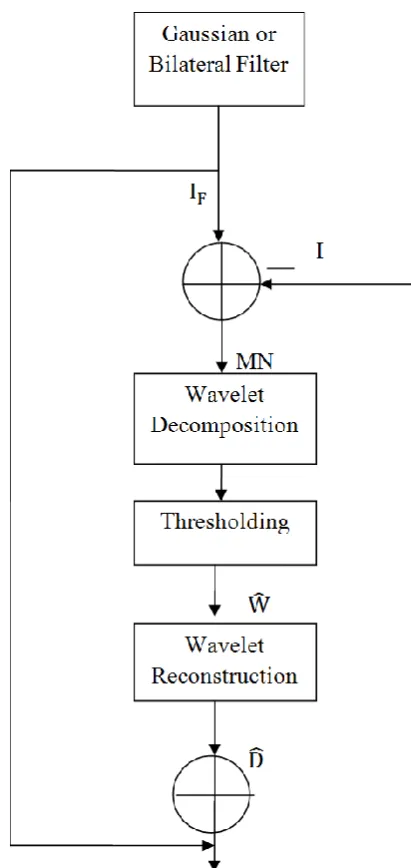
E. Gaussian Bilateral Filter And Wavelet
Thresholding
Figure 1: Proposed image denoising algorithm
(3)
Where ‘An’ is the original image and is the output of denoising operatorfor a input image ‘A’.
F. Gaussian/Bilateral Filter
The bilateral filter on the noisy image averages the noise along with the image details while preserving edges/sharp boundaries very well provided the standard deviation of the noise is less than the edge contrast. In the case of the Gaussian filter, its method noise is zero inharmonic parts of the image and very large near edges or texture, where the Laplacian can not be small. As a consequence, the Gaussian convolution is optimal in flat parts of the image bulges and texture is blurred. To capture what is removed from the noisy image by
theGaussian/Bilateral filter, the definition of the method noise is redefined as the difference between the noisy image and its denoised image. Hence, Equation (4.3) is rewritten as
(4)
Where I= A + Z is a noisy image obtained by corrupting the original image ‘A’ by a whiteGaussian noise ‘Z’ and is the output of Gaussian/Bilateral filter for a input image I.
Since the Gaussian/Bilateral filter has removed the noise as well as image details by averaging the pixels, the method noise will consist of noise as well as image details along with some edges. The method noise due to Gaussian filtering will have more strong edges as compared to that of bilateral filtering as the edges are preserved by range filtering . So, the methodnoise ‘MN’ is a combination of image details ‘D’ and a white Gaussian noise ‘N’ and is written as
(5)
Now the problem is to estimate the detail image ‘D’, which has only the original image features and edges/sharp boundaries that are removed by Gaussian/Bilateral filter, as accurately as possible according to some criteria and is added to the Gaussian/Bilateral filtered image to get better denoised image with details. In wavelet domain, Equation (5) can be represented as
(6)
Where ‘Y’ is the noisy wavelet coefficient (method noise), ‘W’ is the true wavelet coefficient(detail image) and is independent Gaussian noise.
G. Wavelet Thresholding
image will give the denoised image ‘B’, certainly have more imagedetails and edges as compared with Gaussian/Bilateral filtered image .
Wavelet thresholding adds power to the proposed method as noise components can be eliminated better in detail subbands of method noise. As BayesShrink provides a better MSEperformance than SureShrink, it is used in the proposed method to threshold the method noisy wavelet coefficients. BayesShrink is also an adaptive, data-driven thresholding strategy via soft-thresholding which derives the threshold in a Bayesian framework assuming a generalizedGaussian distribution. This method is adaptive to each sub-band because it depends on data-driven estimates of the parameters. The threshold for a given subband derived by minimizingBayesian risk and is given by
(7)
Where is the noise variance estimated from subband by a robust median estimator givenby
̂ (| |)
* + (8)
And is the variance of wavelet coefficients in that subband, whose estimate is computedusing
̂ ( ̂ ̂ ) (9)
Where ̂ ∑
H. Quality Metrics
In this section, we will discuss various image quality measurements to find out the quality of a denoised image obtained from different restoration methods as we discussed in chapter 4.
Mean Square Error (MSE)
The the mean square error is used as a part of the digital image processing method to check for errors .two MSEs are calculated and then compared to determine the accuracy of an image. In statistics, the mean squared error mean squared deviation (MSD) of an estimator measures the average of the squares of the error or deviation, that is, he difference between the estimator and what is estimated.The difference occurs
because of randomness or because the estimator does not account for information that could produce a more accurate estimate.
Let f(x, y) and g (x, y) represents original image and denoised image with a dimension M*N, then Mean square error is given by
∑ ∑ ( ( ) ( )) (10)
Peak Signal to Noise Ratio (PSNR)
PSNR is defined as the ratio between the maximum possible power of a signal and the power of the corrupting noise that affects the fidelity of its representation because many signals have a very wide dynamic range. PSNR is usually expressed in terms of the logarithmic decibel scale. PSNR is most commonly used to measure the quality of reconstruction of lossy compression codecs(eg :for image compression). Let f(x, y) and g (x, y) represents original image and denoised image with a dimension M*N, then Peak signal to noise ratio is given by
( ⁄ ) (11)
Image Quality Index (IQI)
Let f(x, y) and g (x, y) represents original image and denoised image with a dimension M*M then Image Quality Index (IQI) is given by
̅ ̅
( )[ ̅ ̅ ] (12)
Where ̅ ∑ and ̅ ∑
∑ ( ̅) and ∑ ( ̅)
III.
RESULTS AND DISCUSSION
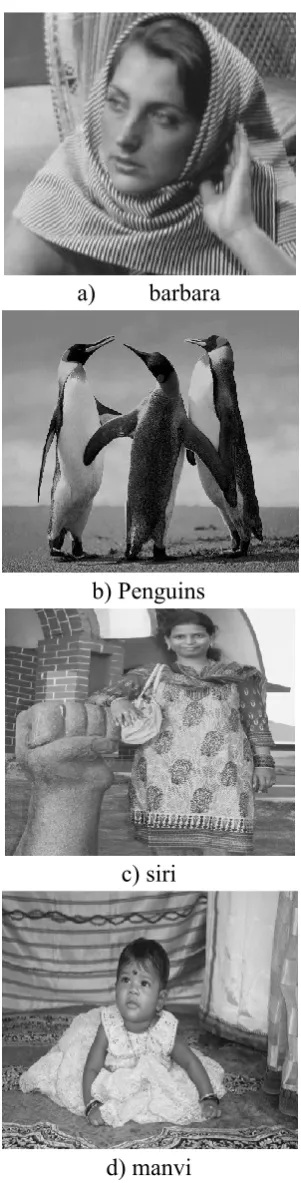
a)
barbara
b) Penguins
c) siri
d) manvi
Figure 2 :
Data Set for image denoising
Table 1 : Quality Parameters for various images using
GF
Table 2 : Quality Parameters for various images using
BFWT the quality parameters PSNR and IQI we can infer that Bilateral Filter with the method of Wavelet Thresholding provides better filtering compared to Guided Filter.
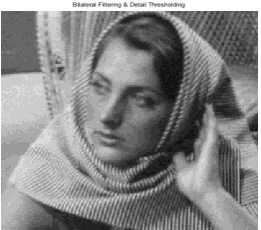
Figure 3 represents the GF, BFWT filtering images of siri, manvi and Barbara by using db8 wavelet with soft thresholding.
b) BFWT of siri Image
c) Guided filtering of manvi image
d) BFWT of manvi image
e) Guided filtering of barbara image
f) BFWT of Barbara image
Figure 3 : GF and BFWT of different images
Table 3 :
PSNR of GF and BFWT under different
wavelets for Penguins image
sigma 10 20 30 40 50
Table 4 :
IQIof GF and BFWT under different
wavelets for Penguins image
sigma 10 20 30 40 50
Bilateral Filtering & Detail Thresholding
filtered image
Bilateral Filtering & Detail Thresholding
filtered image
It is known that different wavelets like Db8, Sym8, Db16, Coif5 and Bior6.8 are used to decompose the method noise. The performance of Wavelet based denoising method depends on the type of wavelet used. In order to analyse the effect different wavelets like db8, sym8, db16, coif5 and bior6.8 are used to decompose the method noise in BFWT. PSNR and IQI of the denoised image of Penguins by GF and BFWT with different wavelets are tabulated in Tables 6.3 and 6.4 respectively. The values in these tables show the highest PSNR and IQI of the denoised images by different wavelets.
It is observed from the Table 6.3 and 6.4 that, BFWT provides better performance compared to GF. It is also clear from table 6.3 and 6.4 that for various decompositions the PSNR and IQI are better for Bior6.8, Db8 in many cases.
Table 5 : Comparison of GF, BFWT with different
thresholding techniques for manvi image
Sigm
The above table 6.5 compares GF and BFWT with soft thresholding and BFWT with hard thresholding techniques for manvi image. The quality parameters PSNR and IQI are tabulated. From the table, we can observe that BFWT with soft thresholding provides better performance compared to GF and BFWT with hard thresholding.
IV.CONCLUSION
In this work, the combination of bilateral filter and its method noise thresholding using wavelets has been proposed. The performance of the proposed methods is compared with guided filter, BF, based methods. Through experiments conducted on standard images, it was found that, BFWT has shown a good denoising performance in terms of PSNR, IQI but at the cost of increased computational complexity. With lesser computational complexity, the proposed methods have shown a similar performance as that of WT and superior/comparable performance to that ofBF and Guided filter based methods, in terms of method noise PSNR and IQI.
V.
REFERENCES
[1]. Scott E Umbaugh, "Computer Vision and Image Processing", Prentice Hall PTR, New Jersey, 1998. [2]. Langis Gagnon, "Wavelet Filtering of Speckle
Noise-Some NumericalResults," Proceedings of the Conference Vision Interface 1999, Trois-Riveres. [3]. Motwani, M.C., Gadiya, M. C., Motwani, R.C.,
Harris, F. C Jr. "Survey of Image Denoising Techniques".
[4]. J.N. Lin, X. Nie, and R. Unbehauen, "Two-Dimensional LMS Adaptive Filter Incorporating a Local-Mean Estimator for Image Processing," IEEE Transactions on Circuits and Systems-II: Analog and Digital Signal Processing, Vol 40, No.7 July 1993, "Image denoising via wavelet-domain spatially adaptive FIR Wiener filtering", in IEEE Proc. Int. Conf. Acoust., Speech, Signal Processing, Istanbul, Turkey, June 2000.
[8]. Kim, J.-Y., L.-S. Kim, et al., "An advanced contrast enhancement using partially overlapped sub-block histogram equalization," IEEE Trans. Cir. and Sys. for Video Technol. Vol. 11, pp. 475–484.