International Journal of Scientific Research in Computer Science, Engineering and Information Technology © 2017 IJSRCSEIT | Volume 2 | Issue 1 | ISSN : 2456-3307
Image Inpainting Algorithm for Competition of Missing
Region of Image a Review
Manoj S Ishi
Department of Information Technology, RCPIT, Shirpur, Maharashtra, India
ABSTRACT
Digital Inpainting becomes very popular topic of research in image processing in today’s world of technology. It is much application, which includes graphical object, in film postproduction, removing superimposed text like subtitles, dates, time, and removing the complete object from image, which is unwanted in image. While completing the missing region of image, information required is filled by using structural information available in nearby area of that image. This filling done in such manner that it is difficult to find the area restored with image Inpainting. The viewer that is unaware of this fact saw that image is normal. This image Inpainting finds the pixel with maximum match to complete the image. In this paper various Inpainting algorithms are discuss.
Keywords: Inpainting, Superimposed Text, Completition, Exemplar, Pixel
I.
INTRODUCTION
Image Inpainting is method of recovering the missing parts of image from the information available from surrounding area. This technique was previously used by the restores of museum to restore the images of museums. This is done in such a way that it is undetectable for common user. The common problems which are occurs with image are noise, old photographs, the stains and dust part of image occurs during scan, scratches on image, red eye correction, superimposed text. Image Inpainting algorithm try to solve such kind of problem. Inpainting algorithm is used replicate the pixel available in nearby area. It finds the pixel with maximum match to find out the missing region of image. It fills the mission area automatically. Inpainting allows simultaneous filling many regions of memory at same time with different backgrounds and structure [1][2]. Inpainting algorithm is also used to remove the object that is larger in size and which is unwanted in image. It takes the help of background information to from the pixel that used to fill missing region of image. This problems of damaged images are occurs due to storage of image for more time. This technique is used to re-establishment of images by completing the mission region of image. The Inpainting algorithm is not only used to recover the missing region
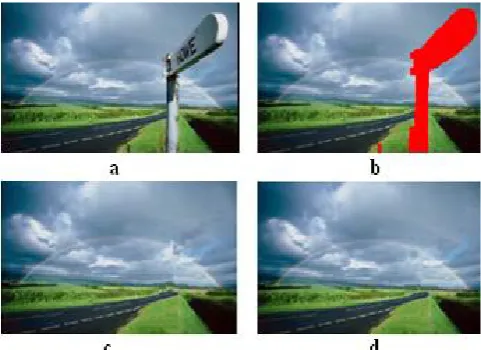
of memory, but it also used to produces images that are closely matching with original image. Two types of algorithm are available to recover the image. First is texture synthesis, it focuses on structure parts of image only. It works fine if image area to recover is small. It recovers the image with small gap. Second is Inpainting technique, which used to recover the image with large damaged region. The following figure shows the working of image Inpainting algorithm. In this image, the portion to remove is mark with RGB pattern. Then Inpainting algorithm is applied to object which results in output image. The final image with removed unwanted object is obtained. In this way, Inpainting algorithm applied to recover image from the unwanted object. In this paper section, two consist literature survey, section three consists of problem discussion, section four consist conclusion.
Figure 1. a) original image b) image marked with region to removed c) & d) image after Inpainting
II.
METHODS AND MATERIAL
LITERATURE SURVEY
1. Image Restoration using Inpainting [3]
Two techniques are comparing here for restoration of image. Images were recovered with CDD and TV inpainting technique. Images that are corrupted with noise inpainted with the help of this method. It is applies with gray scale and RGB images.
The two techniques of inpainting described here are: 1) CDD: Curvature driven diffusion CDD working is
based on Partial Differential Equation of isophote for filling the missing region of images.
2) TV : Total Variation
Images with different texture, structure are filled with this texture inpainting. It collects the surrounding information to complete the image.
Time required to inpaint images depends on size of images; it varies from few seconds to minutes to complete the image. The signal to noise ratio is compared.
Advantage : provides inpainted images with good resolution
Disadvantage: More time is required for the computation.
2. Hybrid Exemplar-Based Image in Painting Algorithm [4]
Image inpainting using Exemplar algorithm is very popular technique in this area of inpainting. It works in two steps; first, it decides the order to fill the missing region. Second, it decides the good exemplar to fill this area. The problem with traditional exemplar technique is selection of suitable exemplar to recover image. For solving of this problem author provides modified technique with non-local total variation method. This method consists of two steps priority of patch and completition of patch.
The main steps of algorithm are:
(i) Patch selection to complete the image based on the priority from the nearby area of target region.
(ii) Complete the image with patch that found with maximum pixel matching with target region.
Advantage: This algorithm produced good result for all digital images.
Disadvantage: If more than one pixel patch with same priority found then ambiguity is occurred.
3. Digital Image Inpainting Using Patch Priority Based Method [5]
This algorithm proposed for removing the object with larger size, the pixel value with maximum confidence is found here and propagated into area to inpainted. Actual color is found using exemplar based inpainting. Previously texture synthesis algorithms are used which repeats two-dimensional pattern. The inpainting algorithm is design, which works linear structures.
The algorithm described by author in this technique combines the both approach two produce better algorithm that consist of following steps:
1. Input Image: - Image is provided as a input to inpaint with different sizes.
2. Mask Image: - Mask the area to recover or the object want to remove with paint called as mask image. 3. Incomplete Structure filling: - connect the pixel to fill the structure to obtain result. Texture properties are considered to fill the region.
Advantage: Benefits of texture synthesis and inpainting are combined to remove the large object and blur region.
Disadvantage : Authors are not able to recover the satellite images.
4. Modified Image Exemplar-Based Inpainting [6]
Here author modifies the image-inpainting algorithm based on Exemplar technique. The focus of this algorithm is on patch priority. To fill the images with inpainted region here pixels maintains the confidence value. Pixel with confidence value and image isophote gives the priority. After finding the priority of pixel image divided into four parts. Then the image recovered with the pixel information available from surrounding are. The previous exemplar is unable to preserve the sharpness of images. However, this approach works well even the image is divided into segment.
Advantage: Patch filling provides Speed efficiency, texture synthesis accuracy and propagation with maximum accuracy in linear structure.
Disadvantage: It is slow, improvements needed in performance and video Inpainting.
5. Object Removal Using Modified Directional Median Filtering For Digital Image Inpainting
In this algorithm, it consists of following steps to recover image [7].
a) Damages region found with mask. b) Pixel size of 5 X 5 selected.
c) Boundary is detected of target region.
d) Median is computed from all three directions. e) Then replaced the damaged pixel with this new
value obtained for recovering.
In this way author proposed algorithm median filter for digital images were object removal selected by user. One centre window found to fill the image with maximum pixel to fill that mask region.
Advantage: Fast and simple algorithm is defined. The image recovered closely resemble with original image so that common user cannot detect the region that recovered with this technique.
Disadvantage: This algorithm cannot used for non-homogenous images.
6. An Efficient Algorithm for the Exemplar Based Image Inpainting [8]
Exemplar based inpainting algorithm with mean square method is designed. This algorithm is also consist of following outline
i. Selection of target region by marking with some color. Author uses green color to mark image. ii. Then getting the area of target region.
iii. Select the patch size of 9X9 size.
iv. Finding the patch with maximum accuracy. Mean square error method defined here to find this patch. This method also called as normalized mean square error method. With this mean square error, method weight of pixel is found. This weight act as priority for the pixel to fill the necessary information. This helps when more than one pixel with same information is found in nearby area.
v. Then the updating of patch is performed according to information obtained from previous step.
vi. Finally, the patch is propagated into the inpainted region.
Advantage: Patch founding is efficient to recover image.
Disadvantage: Extra computation time is required to find the patch and because of that, more time required for completition of image.
7. Extended Wavelet Transform Based Image Inpainting Algorithm For Natural Scene Image Completion [9]
In this algorithm, exemplar technique is combined with wavelet transform. Extended wavelet transform implemented in two dimensions. Laplacian pyramid and directional filter bank together used to find the area that is discontinues. Contours and edges are finding effectively with the help of this algorithm. It consists of following parameter.
Contourlet Transform
perform the linking of linear structure. It is good technique for detection of images in images.
Exemplar- texture synthesis
This restoration method used after detecting the boundary of images to complete the image. It restores texture as well as structural part of images effectively with the help of wavelet transform.
Advantage: It is better algorithm to detect the edge of algorithm to locate the target region.
Disadvantage: This method not working properly for the region that consists of corners and curves.
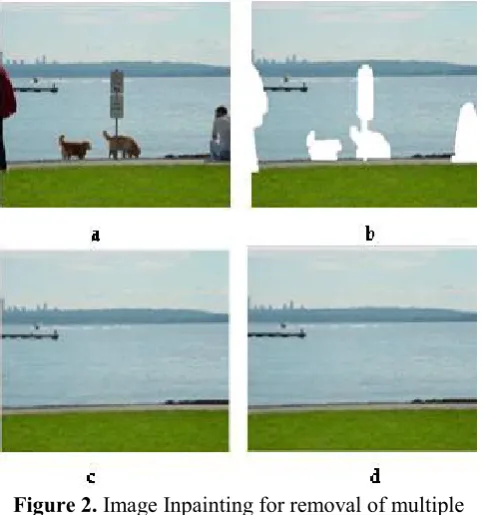
Following figure shows the restoring of images with multiple objects to remove.
Figure 2. Image Inpainting for removal of multiple objects
III.
PROBLEM DISCUSSION
The problems with Inpainting approaches are they are unable to inpaint images with large missing areas. Even Exemplar approach is suffers with same problem. While working with Inpainting algorithm another problem is patch should contains enough pixel to complete the image. The propagation of patch into target region is also important part of image Inpainting algorithm. Some of the algorithm divides target image into number of segment and then completes the image. It requires more computation time to complete the image. Some of the algorithm cannot work efficiently
for non-homogenous image. To solve the problem of selection of patch mean square error method is design, but still it requires more computation time to recover the image. Contourlet transform is designed which uses the wavelet transform to find the patch with maximum priority. This methods also not working properly when regions contains more curves and corners. In this way, numbers of algorithms designed to recover the image but they are still lacking in some points to get recovery of image.
IV.CONCLUSION
In this paper, numbers of algorithms are discussing to recover the image or to complete the missing part of image by collecting information from the nearby area. The pixel to fill the area consists of block size of 5 X 5 sizes or 9 X 9 sizes. The pixels with maximum priority are found by using different methods. If patch is found then image is completed. Authors proposed number of methods that consists of partial differential based equation, mean square error method, counterlet transform, hybrid algorithm etc. This algorithm are avoiding the disadvantages of previous algorithm, still they are suffering with some drawbacks. So there is need to define efficient algorithm for filling the missing region of image. The algorithm should find the image patch that is closely resemblance with missing region of image. Then selection of size of pixel block. Finally propagation of that patch into target region. All this steps need to perform effectively so that recover image looks original to unknown user. While computing this entire step time is also important factor. To perform all this step computation time must be less. In this way there is needed to design efficient algorithm that works for all images and for video recovery.
V.
REFERENCES
[1]. A. C. Kokaram, R.D. Morris, W.J. Fitzgerald and P.J.W. Rayner, "Interpolation of missing data in image sequences", In IEEE Transactions on Image Processing 11(4), pp. 1509- 1519, 1995. [2]. A.N. Hirani and T.Totsuka, "Dual Domain
Interactive Image Restoration: Basic Algorithm", In proceedings of ICIP 1996, pp.797-800, 1996. [3]. Chaitali P.Sathe, Dr. Shubhalaxmi P. Hingway,
[4]. Preeti Gupta, Kuldip Pahwa, "Hybrid Exemplar Based Image in Painting Algorithm Using Non Local Total Variation Model", Vol 2,ISSN 2454 132X, IJARIIT,2016.
[5]. Geeta K. Sarpate, Shanti K. Guru, "Digital Image Inpainting Using Patch Priority Based Method", Vol 1, ISSN 2348 – 4853, IJAFRC, May 2014. [6]. Mrs. Waykule J.M., "Modified Image
Exemplar-Based Inpainting", Vol 2, ISSN-2278 1021, IJARCCE, Sept. 2013.
[7]. Anupama Sanjay Awati, Meenakshi R. Patil, "Object Removal Using Modified Directional Median Filtering For Digital Image Inpainting", Vol 4, ISSN- 2394-1537, IJSTM, Feb.2015. [8]. Ms. Pooja Jain,"An Efficient Algorithm for the
Exemplar Based Image Inpainting", Vol 2, ISSN: 2348 9510, IJCEM, July 2015.