Volume 2010, Article ID 435189,11pages doi:10.1155/2010/435189
Research Article
A Fluid Model for Performance Analysis in Cellular Networks
Jean-Marc Kelif,
1Marceau Coupechoux,
2and Philippe Godlewski
21France Telecom R&D, 38-40, rue du G´en´eral Leclerc, 92794 Issy-Les-Moulineaux, France 2TELECOM ParisTech & CNRS LTCI UMR, 5141 Paris, France
Correspondence should be addressed to Jean-Marc Kelif,[email protected]
Received 30 October 2009; Accepted 8 June 2010
Academic Editor: Jinhua Jiang
Copyright © 2010 Jean-Marc Kelif et al. This is an open access article distributed under the Creative Commons Attribution License, which permits unrestricted use, distribution, and reproduction in any medium, provided the original work is properly cited.
We propose a new framework to study the performance of cellular networks using a fluid model and we derive from this model analytical formulas for interference, outage probability, and spatial outage probability. The key idea of the fluid model is to consider the discrete base station (BS) entities as a continuum of transmitters that are spatially distributed in the network. This model allows us to obtain simple analytical expressions to reveal main characteristics of the network. In this paper, we focus on the downlink other-cell interference factor (OCIF), which is defined for a given user as the ratio of its outer cell received power to its inner cell received power. A closed-form formula of the OCIF is provided in this paper. From this formula, we are able to obtain the global outage probability as well as the spatial outage probability, which depends on the location of a mobile station (MS) initiating a new call. Our analytical results are compared to Monte Carlo simulations performed in a traditional hexagonal network. Furthermore, we demonstrate an application of the outage probability related to cell breathing and densification of cellular networks.
1. Introduction
Estimation of cellular networks capacity is one of the key points before deployment and mainly depends on the char-acterization of interference. As downlink is often the limited link w.r.t. capacity, we focus on this direction throughout this paper, although the proposed framework can easily be extended to the uplink. An important system parameter for this characterization is the other-cell interference factor (OCIF). It represents the “weight” of the network on a given cell.
OCIF is traditionally defined as the ratio of other-cell interference to inner-cell interference. In this paper, we rather consider an OCIF, which is defined as the ratio of total other-cell received power to the total inner-cell received power. Although very close, this new definition is interesting for three reasons. Firstly, total-received power is the metric mobile stations (MS) are really able to measure on the field. Secondly, the power ratio is now a characteristic of the net-work and does not depend on the considered MS or service. At last, the definition of OCIF is still valid if we consider cellular systems without inner-cell interference; in this case,
the denominator of the ratio is reduced to the useful power. The precise knowledge of the OCIF allows the derivation of performance parameters, such as outage probabilities, capacity, as well as the definition of Call Admission Control mechanisms, in CDMA (Code Division Multiple Access) and OFDMA (Orthogonal Frequency Division Multiple Access) systems.
Pioneering works on the subject [1] mainly focused on the uplink. Working on this link, [2] derived the distribution function of a ratio of path-losses, which is essential for evaluating the external interference. For this purpose, authors approximated the hexagonal cell with a disk of same area. Based on this result, Liu and Everitt proposed in [3] an iterative algorithm for the computation of the OCIF for the uplink.
distribution of the other-cell interference. They, however, provided formulas that are difficult to handle in practice. Baccelli et al. [9] studied spatial blocking probabilities in random networks. Focusing on random networks, power ratios were nevertheless not their main concern and authors relied on approximated formulas, which are not validated by simulations.
In contrast to previous works in the field, the modeling key of our approach is to consider the discrete BS entities of a cellular network as a continuum. Recently, the authors of [10] described a network in terms of macroscopic quantities such as node density. The same idea was used in [11] for ad hoc networks. They however assumed a very high density of nodes in both papers and infinite networks. We show hereafter that our model is accurate even when the density of BS is very low and the network size is limited (see Section 3.2).
Central idea of this paper has been originally proposed in conference papers [12–15], which provide a simple closed-form closed-formula for the OCIF on the downlink as a function of the distance to the BS, the path-loss exponent, the distance between two BS, and the network size. We validate here the formulas by Monte Carlo simulations and show that it is possible to get a simple outage probability approximation by integrating the OCIF over a circular cell. In addition, as this ratio is obtained as a function of the distance to the BS, it is possible to derive a spatial outage probability, which depends on the location of a newly initiated call. Outage probability formula allows us to analyze the phenomenon of cell breathing, which results in coverage holes when the traffic load increases. An answer to this issue is to increase the BS density (i.e., network densification). Thanks to the proposed formulas, we are able to quantify this increase.
We first introduce the interference model and the notations (Section 2), then present the fluid model and its validation (Section 3). In the fourth section, we derive outage probabilities. In the last section, we apply the theoretical results to the characterization of cell breathing and to network densification.
2. Interference Model and Notations
We consider a cellular network and focus on the downlink. BS have omnidirectional antennas, so that a BS covers a single cell. Let us consider a mobile stationuand its serving base stationb.
The propagation path gaingj,udesignates the inverse of the path-lossplbetween base stationjand mobileu; that is,
gj,u=1/ plj,u.
The following power quantities are considered:
(i)Pb,u is the transmitted power from serving base stationbto mobileu(for user’s traffic);
(ii)Pj is the total transmitted power by a generic base stationj;
(iii)Pb =Pcch+ΣuPb,uis the total power transmitted by stationb,Pcch represents the amount of power used
to support broadcast and common control channels;
(iv)pb,uis the power received at mobileufrom stationb; we can writepb,u=Pbgb,u;
(v)Su = Sb,u = Pb,ugb,uis the useful power received at mobile u from serving station b (for traffic data). Since we do not consider soft-handover (SHO), serving station is well defined and the subscriptbcan be omitted for the sake of readability.
The total amount of power experienced by a mobile stationuin a cellular system consists of three terms: useful signal power (Su), interference and noise power (Nth). It is
common to split the system power into two terms: pint,u+ pext,u, where pint,u is the internal (or own-cell) received power and pext,uis the external(or other-cell) interference. Note that we made the choice of including the useful signal Suinpint,u, and, as a consequence, it should not be confused
with the commonly considered own-cell interference. With the above notations, we define the OCIF inu, as the ratio of total power received from other BS to the total power received from the serving BSbas
fu= pext,u
pint,u. (1)
The quantitiesfu,pext,u, andpint,uare location dependent and can thus be defined in any locationxas long as the serving BS is known.
In this paper, we use the signal to interference plus noise ratio (SINR) as the criteria of radio quality:γ∗u is the SINR target for the service requested by MSu. This figure is a priori different from the SINR γu evaluated at mobile station u. However, we assume perfect power control, so that SINR =
γ∗u for all users.
2.1. CDMA Network. On the downlink of CDMA networks, orthogonality between physical channels may be approached by Hadamard multiplexing if the delay spread is much smaller than the chip duration Tc. As a consequence, a coefficient αmay be introduced to account for the lack of perfect orthogonality in the own cell.
With the introduced notations, the SINR experimented byucan thus be derived (see, e.g., [16])
From this relation, we can expressSuas
The transmitted power for MSu,Pb,u =Su/gb,ucan now be
From this relation, the output power of BS b can be computed as follows:
In HSDPA (High Speed Downlink Packet Access), (2) and (8) are valid for each TTI (Transmission Time Interval). Parameterγu∗ should be now interpreted as an experienced SINR and not any more as a target. Sums are done on the number of scheduled users per TTI. If a single user is scheduled per TTI (which is a common case), sums reduce to a single term. Even in this case, parameter α has to be considered since common control channels and traffic channels are not perfectly orthogonal due to multipath.
Even if previous equations use the formalism of CDMA networks, it is worth noting that they are still valid for other multiplexing schemes. For cellular technologies with-out internal interference (TDMA, Time Division Multiple Access, and OFDMA), pint,u reduces to Su and pext,u is the cochannel interference in (2). The definition of fu is unchanged provided that sums in (4) and (5) are done over the set of cochannel interfering BS (to account for frequency reuses different from reuse one).
2.2. OFDMA Network. In OFDMA, (2) can be applied to a single carrier. Pb is now the base station output power per subcarrier. In OFDMA, data is multiplexed over a great number of subcarriers. There is no internal interference, so we can consider that α(pint,u −Su) = 0. Since pext,u = for cell radii less than about 1 Km, we can neglect this term and write
γu=
1
fu. (11)
For each subcarrier of an OFDMA system (e.g., WiMax, LTE), the parameter fu represents the inverse of the SIR (Signal-to-Interference Ratio).
Consequently, fuappears to be an important parameter characterizing cellular networks. This is the reason why we focus on this factor in the next section and, with the purpose of proposing a closed form formula of fu, we develop a physical model of the network.
Continuum of base stations
2Rc
Rc
Rnw
Figure 1: Network and cell of interest in the fluid model; the
minimum distance between the BS of interest and interferers is 2Rc and the interfering network is made of a continuum of base stations.
3. Fluid Model
In this section, we first present the model, derive the closed-form closed-formula for fu, and validate it through Monte-Carlo simulations for a homogeneous hexagonal network.
3.1. OCIF Formula. The key modelling step of the model we propose consists in replacing a given fixed finite number of interfering BS by an equivalent continuum of transmitters, which are spatially distributed in the network. This means that the transmitting interference power is now considered as a continuum field all over the network. In this context, the network is characterized by a MS density ρMS and a
cochannel base station densityρBS[12]. We assume that MS
and BS are uniformly distributed in the network, so thatρMS
andρBS are constant. As the network is homogeneous, all
base stations have the same output powerPb.
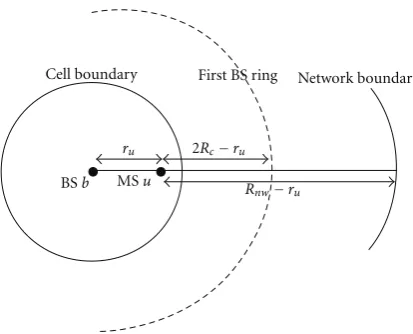
We focus on a given cell and consider a round shaped network around this central cell with radiusRnw. InFigure 1, the central disk represents the cell of interest, that is, the area covered by its BS. The continuum of interfering BS is located between the dashed circle and the outer circle. By analogy with the discrete regular network, where the half distance between two BS isRc, we consider that the minimum distance to interferers is 2Rc.
For the assumed omnidirectional BS network, we use a propagation model, where the path gain,gb,u, only depends
on the distancerbetween the BSband the MSu. The power, pb,u, received by a mobile at distancerucan thus be written pb,u=PbKru−η, whereKis a constant andη >2 is the path-loss exponent.
Let us consider a mobile u at a distance ru from its serving BSb. Each elementary surfacez dz dθat a distance zfromucontainsρBSz dz dθbase stations which contribute
2Rc−ru
ru
Rnw−ru
Cell boundary First BS ring Network boundary
BSb MSu
Figure2: Integration limits for external interference computation.
ρBSz dz dθ PbKz−η. We approximate the integration surface
by a ring with centreu, inner radius 2Rc−ru, and outer radius Rnw−ru(seeFigure 2)
pext,u=
2π
0
Rnw−ru
2Rc−ru
ρBSPbKz−ηz dz dθ
=2πρBSPbK
η−2 (2Rc−ru)
2−η−(R
nw−ru)2−η
. (12)
Moreover, MSureceives internal power fromb, which is at distanceru:pint,u=PbKru−η. So, the OCIF fu=pext,u/ pint,u can be expressed by
fu=
2πρBSr
η u
η−2 (2Rc−ru)
2−η−(R
nw−ru)2−η
. (13)
Note that fudoes not depend on the BS output power. This is due to the assumption of a homogeneous network (all base stations have the same transmit power). In our model, fuonly depends on the distance ru to the BS. Thus, if the network is large; that is,Rnwis large compared toRc, fucan be further approximated by
fu=
2πρBSruη
η−2 (2Rc−ru)
2−η. (14)
This closed-form formula will allow us to quickly compute performance parameters of a cellular network. However, before going ahead, we need to validate the different approximations we made in this model.
3.2. Validation of the Fluid Model. In this section, we validate the fluid model presented in the last section. In this perspective, we will compare the figures obtained with (13) to those obtained numerically by simulations. Our simulator assumes a homogeneous hexagonal network made of several rings surrounding a central cell.Figure 3shows an example of such a network with the main parameters involved in the study: Rc, the half distance between BS,R = 2√3Rc/3, the maximum distance in the hexagon to the BS, andRnw, the range of the network.
Rnw
Rc
R
· · ·
Figure3: Hexagonal network and main parameters of the study.
The fluid model and the traditional hexagonal model are both simplifications of the reality. None is a priori better than the other but the latter is widely used, especially for dimensioning purposes. That is the reason why a comparison is useful.
The validation is done by Monte Carlo simulations:
(i) at each snapshot, a location is randomly chosen for MS u in the cell of interestb with uniform spatial distribution;
(ii) fuis computed using (5) withgj,u=Kr−ηj,u, whererj,u is the distance between the BS j and the MSu. The serving BSbis the closest BS to MSu;
(iii) the value of fuand the distance to the central BSbare recorded;
(iv) at the end of the simulation, all values of fu corresponding to a given distance are averaged and we plot the average value inFigure 4.
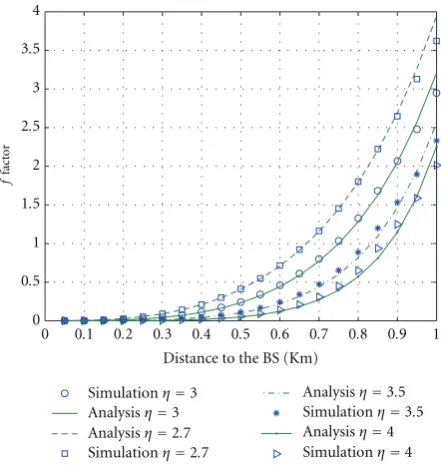
Figure 4 shows the simulated OCIF as a function of the distance to the base station. Simulation parameters are the following: R = 1 Km; η between 2.7 and 4; ρBS =
(3√3R2/2)−1;R
nwis chosen, such that the number of rings of interfering BS is 15; and the number of snapshots is 1000. Equation (13) is also plotted for comparison. In all cases, the fluid model matches very well the simulations on a hexagonal network for various figures of the path-loss exponent. Note that at the border of the cell (between 0.95 and 1 Km), the model is a little bit less accurate because hexagon corners are not well captured by the fluid model.
Note that the considered network size can be finite and chosen to characterize each specific local network environment. Figure 5shows the influence of the network size. This model allows thus to develop analyses, adapted to each zone, taking into account each specific considered zone parameters.
model for systems with frequency reuse different from one since in this case distances between cochannel BS are greater. Figure 7shows the dispersion of fuat each distance for η = 3. For example, at ru = 1 Km, fu is between 2.8 and 3.3 for an average value of 3.0. This dispersion around the average value is due to the fact that in a hexagonal network,
fuis not isotropic.
3.3. OCIF Formula for Hexagonal Networks. Two frameworks for the study of cellular networks are considered in this paper: the traditional hexagonal model and the fluid model. While the former is widely used, the latter is very simple and allows the derivation of an analytical formula for fu. The last section has shown that both models lead to comparable results for the OCIF as a function of the distance to the BS. If we want to go further in the comparison of both models, in particular with the computation of outage probabilities, we need however to be more accurate.
Such calculations require indeed the use of the Q function (seeSection 4.3and (23) and (24)), which is very sensitive to its arguments (mean and standard deviation). This point is rarely raised in literature: analysis and Monte Carlo simulations can lead to quite different outage probabil-ities even if analytical average and variance of the underlying Gaussian distribution are very close to simulated figures.
In this perspective, we provide an alternative formula for futhat better matches the simulated figures in a hexagonal network. Note that this result is not needed if network designers use the new framework proposed in this paper.
We first note that fu can be rewritten in the following way: only depends on the relative distance to the serving BS,x, and on the path-loss exponent,η. For hexagonal networks, it is thus natural to find a correction of futhat only depends onη. An accurate fitting of analytical and simulated curves shows that fu should simply be multiplied by an affine function ofηto match with Monte Carlo simulations in a hexagonal network. Equation (14) can then be rewritten as follows:
fhexa,u=
correction is tiny) and Ahexa(4) = 0.28 (the correction is
significative).
4. Outage Probabilities
In this section, we compute the global outage probability and the spatial outage probability with the Gaussian approx-imation. Closed-form formulas for the mean and standard deviation of fuover a cell are provided.
Quality of service in cellular networks can be charac-terized by two main parameters: the blocking probability
0
Distance to the BS (Km)
Figure4: OCIF versus distance to the BS; comparison of the fluid
model with simulations on a hexagonal network withη =2.7, 3, 3.5, and 4.
and the outage probability. The former is evaluated at the steady state of a dynamical system considering call arrivals and departures. It is related to a call admission control (CAC) that accepts or rejects new calls. The outage probability is evaluated in a semistatic system [9], where the number of MS is fixed and their locations are random. This approach is often used (see, e.g., [17]) to model mobility in a simple way: MS jump from one location to another independently. For a given number of MS per cell, outage probability is thus the proportion of configurations, where the needed BS output power exceeds the maximum output power:Pb> Pmax.
4.1. Global Outage Probability. For a given number of MS per cell, n, outage probability, P(outn), is the proportion of
configurations, for which the needed BS output power exceeds the maximum output power:Pb > Pmax. If noise is
neglected and if we assume a single service network (γ∗u =γ∗
0 0.2 0.4 0.6 0.8 1
Distance to the BS (Km)
(a)
Distance to the BS (Km)
(b)
Figure5: OCIF versus distance to the BS; comparison of the fluid model with simulations on a two ring (a) and a five ring (b) hexagonal
network (η=3).
As for fu, we make the approximation that the spatial outage,Psout(n)(ru), only depends on the distance to the BS and
thus, can be written
P(soutn)(ru)
4.3. Gaussian Approximation. In order to compute these probabilities, we rely on the Central Limit theorem and use a Gaussian approximation. As a consequence, we need to compute the spatial mean and standard deviation of fu. The area of a cell is 1/ρBS = πR2e withRe = Rc
2√3/π. So, we integrate fu on a disk of radius Re. As MS are uniformly distributed over the equivalent disk, the probability density function (pdf) of ru is: pru(t) = 2t/R
2
e.Let μf andσf be
respectively the mean and standard deviation of fu, whenru is uniformly distributed over the disk of radiusRe
μf =
integral form is given by
2F1(a,b,c,z)= Γ(c andΓis the gamma function.
Note that forη=3, we have the simple closed formula
0 0.1 0.2 0.3 0.4 0.5
f
fact
or
0 1 2 3
0.5 1.5 2.5 3.5
Distance to the BS (Km)
SimulationR=500 m AnalysisR=500 m
(a)
f
fact
or
0 0.5 1 1.5 2 0
1 2 3
0.5 1.5 2.5 3.5
Distance to the BS (Km)
SimulationR=2 Km AnalysisR=2 Km
(b)
Figure6: OCIF versus distance to the BS; comparison of the fluid model with simulations assuming cell radiiR=500 m andR=2 Km
(η=3).
whereν = Re/Rc. In the same way, the variance of f(r) is given by
σ2
f =E
f2−μ2
f,
Ef2=24−2η
2πρBSR2c
2
η+ 1η−22
Re
Rc
2η
×2F1
2η−4, 2η+ 2, 2η+ 3, Re 2Rc
. (22)
As a conclusion of this section, the outage probability can be approximated by
P(outn)=Q
1−ϕ/β−nμf−nα
√
nσf
, (23)
where Q(x) = (1/√2π)x∞exp(−u2/2)du. And the spatial outage probability can be approximated by:
Psout(n)(ru)=
Q1−ϕ/β−nμf −(n+ 1)α−fu
/√nσf
−Q1−ϕ/β−nμf −nα
/√nσf
1−Q1−ϕ/β−nμf −nα
/√nσf
, (24)
where fu is given by (14). This equation allows us to precisely compute the influence of an entering mobile station whatever its position in a cell and is thus the starting point for an efficient call admission control algorithm.
For cellular systems without internal interference, the definition of fuis unchanged and (23) and (24) are still valid provided thatα=0.
Note that for an accurate fitting of the analytical formu-las, which are presented in this section, to the Monte Carlo
simulations performed in a hexagonal network,μfshould be multiplied by (1 +Ahexa(η)),σf by (1 +Ahexa(η))2and (14)
replaced by (16).
0 0.1 0.2 0.3 0.4 0.5 0.6 0.7 0.8 0.9 1 0
1 2 3
0.5 1.5 2.5 3.5
f
fac
tor
Analysis
Simulation dispersion Simulation average
Distance to the BS (Km)
Figure7: OCIF versus distance to the BS; comparison of the fluid
model with simulations (average value and dispersion over 500 snapshots) on a hexagonal network withη=3.
1/nuf(ru) and its Gaussian approximation
0.5 1 1.5 2 2.5 3 3.5
0 4
0.5
−0.5 1 1.5 2
n=30
n=10
n=5
0
Figure8: Probability density function of (1/n)ufu (solid line)
and its Gaussian approximation (dotted line).
been obtained by Monte Carlo simulations done on a single cell, assuming fluid model formula for fu. We observe that gaussian approximation matches better and better when the number of mobiles increases. Even for very few mobiles in the cell (n=10), the approximation is acceptable. So we can use it to calculate the outage probability
4.4. Simulation Methodology. Monte Carlo simulations have been performed in order to validate the analytical approach. A fixed number nof MS are uniformly drawn on a given cell. All interferers are assumed to have the same transmitted power (homogeneous network). OCIF is computed accord-ing to (5). Power transmitted by the cell is then compared to Pmaxfor the calculation of the global outage probability.
5 10 15 20 25 30 35 0
1
0.1 0.2 0.3 0.4 0.5 0.6 0.7 0.8 0.9
Outage
p
ro
babilit
y
Simulation Analysis
Path-loss exponent
=2.7
3.5
Number of MS 3
4
Figure9: Global outage probability as a function of the number
of MS per cell and for path-loss exponentsη = 2.7, 3.5, and 4, simulation and analysis.
2.5 3 3.5 4
8 10 12 14 16 18 20 22 24
Path-loss exponent
C
apacit
y
w
ith
2%
outage
Simulation Analysis
Figure10: Capacity with 2% outage as a function of the path-loss
exponentη, simulations (solid lines) and analysis (dotted lines) are compared.
For the spatial outage probability calculation, only snapshots without outage are considered. A new MS is added in the cell. The new transmitted power is again compared to Pmaxand the result is recorded with the distance of the new
MS.
(16) is used.Figure 9shows the global outage probabilities as a function of the number of MS per cell for various values of the path-loss exponentη. It allows us to easily find the capacity of the network for any target outage. For example, a maximal outage probability of 10% leads to a capacity of about 16 users whenη=3.Figure 10shows, as an example, the capacity with 2% outage as a function ofη.
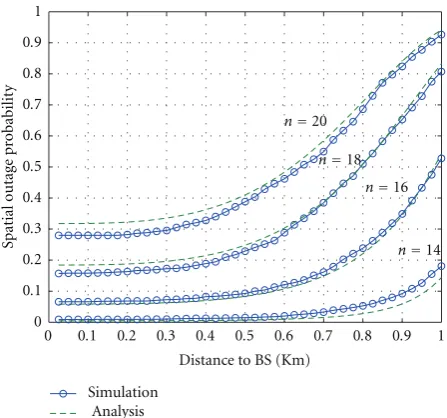
Figure 11 shows the spatial outage probability as a function of the distance to the BS forη=3 and for various numbers of MS per cell. Given that there are alreadyn, these curves give the probability that a new user, initiating a new call at a given distance, implies an outage. As an example, a new user in a cell with already 16 ongoing calls, will cause outage with probability 10% at 550 m from the BS and with probability 20% at 750 m from the BS.
Traditional admission control schemes are based on the number of active MS in the cell. With the result of this paper, an operator would be able to admit or reject new connections also according to the location of the entering MS.
In this section, we show the application of previous results to network densification. During the dimensioning process, the cell radius is determined by taking into account a maximum value of outage probability. This value charac-terizes the quality of service in terms of coverage the network operator wants to achieve. The number of BS to cover a given zone is directly derived from the cell radius.
Considering a maximum value of the outage probability, we first characterize cell breathing; that is, the fact that cell coverage decreases when the cell load increases. We then analyze BS densification as an answer to cell breathing.
4.6. Cell Breathing Characterization. Let consider a maxi-mum value of outage probabilityPout∗ =P
(n)
wherenis the maximum number of mobiles served by a BS for maximum outage probabilityPout∗ , and Acov is the area
covered by the BS. LetAcell = 2
√
3R2
c = 1/ρBS be the cell
area. When mobile density increases,Acovdecreases, so that
Acov≤Acell.
5. Application to Network Densification
We now obtain the following equation
Distance to BS (Km)
Figure11: Spatial outage probability as a function of the distance
to the BS for various numbers of users per cell and forη=3.
This equation has two solutions. The maximum mobile density can be expressed as
ρMS=
In this equation, mean and standard deviation of fu,μf, andσf, are computed over the covered areaAcovwith surface
Acov
Equation (28) shows the link between the mobile density and the covered area and is now used to characterize cell breathing.
Numerical values inFigure 12shows the results we obtain thanks to (28) assuming voice service (γ∗u = −16 dB),ϕ = 0.2,α=0.7,η=3 in a CDMA network.
The solid curve shows the mobile density as a function of the coverage area of base stations. On this curve, the BS density is supposed to be constant, Rc = 1 Km and thus
Acell = 2
√
3 ≈ 3.46 Km2. The coverage area A
cov however
shrinks when the traffic (characterized here by the density of mobiles ρMS) increases. For example, going from point
1 with ρMS = 10 mobiles/Km2 to point 2 with ρMS =
0.5 1 1.5 2 2.5 3 3.5
Cell breathing, fixed BS density Continuous coverage, variable BS density
1
Figure12: Cell breathing (fixed BS density) and BS densification
(variable BS density) in a cellular network.
approximately 2.6 Km2. As a consequence, the cell is not
completely covered, and due to cell breathing, coverage holes appear.
5.1. Base Station Densification. A way of solving the issue of cell breathing is to densify the network. The dotted line in Figure 12 plots the mobile density as a function of the covered area assuming full coverage of the cell. Along this curve, Acov = Acell and when Acov is decreasing, the BS
density is increasing. We are thus able to find, for a given mobile density, the BS density that will ensure continuous coverage in the network. For example, for 20 mobiles/Km2,
the cell area should be approximately 1.5 Km2 in order to
avoid coverage holes.
The sequence 1-2-3 shows an example of scenario, where BS densification is needed. In point 1, the network has been dimensioned for 10 mobiles/Km2. If the cellular operator is
successful and so more subscribers are accessing the network, mobile density increases along the solid line ofFigure 12. At point 2, coverage holes appear and the operator decides to densify the network. While adding new BS, he has to jump to point 3 in order to ensure continuous coverage. At point 2, he needs approximately 0.38 BS per Km2(A
In this paper, we have proposed and validated by Monte Carlo simulations a fluid model for the estimation of outage and spatial outage probabilities in cellular networks. This approach considers BS as a continuum of transmitters and provides a simple formula for the other-cell power ratio (OCIF) as a function of the distance to the BS, the path-loss exponent, the distance between BS and the network size. Simulations show that the obtained closed-form formula
is a very good approximation, even for the traditional hexagonal network. The simplicity of the result allows a spatial integration of the OCIF leading to closed-form formula for the global outage probability and for the spatial outage probability. At last, this approach allows us to quantify cell breathing and network densification.
References
[1] A. M. Viterbi and A. J. Viterbi, “Erlang capacity of a power controlled CDMA system,”IEEE Journal on Selected Areas in Communications, vol. 11, no. 6, pp. 892–900, 1993.
[2] J. S. Evans and D. Everitt, “Effective bandwidth-based admis-sion control for multiservice CDMA cellular networks,”IEEE Transactions on Vehicular Technology, vol. 48, no. 1, pp. 36–46, 1999.
[3] T. Liu and D. Everitt, “Analytical approximation of other-cell interference in the uplink of CDMA other-cellular systems,” in Proceedings of the IEEE Vehicular Technology Conference (VTC ’06), vol. 2, pp. 693–697, May 2006.
[4] A. J. Viterbi, A. M. Viterbi, and E. Zehavi, “Other-cell interfer-ence in cellular power-controlled CDMA,”IEEE Transactions on Communications, vol. 42, no. 2, pp. 1501–1504, 1994. [5] A. J. Viterbi,CDMA—Principles of Spread Spectrum
Commu-nication, Addison-Wesley, Reading, Mass, USA, 1995. [6] K. S. Gilhousen, I. M. Jacobs, R. Padovani, A. J. Viterbi,
L. A. Weaver Jr., and C. E. Wheatley III, “On the capacity of a cellular CDMA system,”IEEE Transactions on Vehicular Technology, vol. 40, no. 2, pp. 303–312, 1991.
[7] S.-E. Elayoubi and T. Chahed, “Admission control in the downlink of WCDMA/UMTS,” inProceedings of the 1st Inter-national Workshop of the EURO-NGI Network of Excellence, Lecture Notes in Computer Science, pp. 136–151, Springer, 2005.
[8] C. C. Chan and S. V. Hanly, “Calculating the outage proba-bility in a CDMA network with spatial poisson traffic,”IEEE Transactions on Vehicular Technology, vol. 50, no. 1, pp. 183– 204, 2001.
[9] F. Baccelli, B. Błaszczyszyn, and M. K. Karray, “Blocking rates in large CDMA networks via a spatial Erlang formula,” in Proceedings of the 24th Annual Joint Conference of the IEEE Computer and Communications Societies (INFOCOM ’05), pp. 58–67, Miami, Fla, USA, March 2005.
[10] S. Toumpis and L. Tassiulas, “Packetostatics: deployment of massively dense sensor networks as an electrostatics problem,” inProceedings of the 24th Annual Joint Conference of the IEEE Computer and Communications Societies (INFOCOM ’05), pp. 2290–2301, Miami, Fla, USA, March 2005.
[11] P. Jacquet, “Geometry of information propagation in mas-sively dense ad hoc networks,” inProceedings of the 5th ACM International Symposium on Mobile Ad Hoc Networking and Computing (MoBiHoc ’04), pp. 157–162, ACM, May 2004. [12] J.-M. Kelif, “Admission control on fluid CDMA networks,” in
Proceedings of the 3rd International Symposium on Modeling and Optimization in Mobile, Ad Hoc, and Wireless Networks (WiOpt ’06), Trentino, Italy, April 2006.
[13] J.-M. Kelif and E. Alman, “Downlink fluid model of CDMA networks,” in Proceedings of the 2005 IEEE 61st Vehicular Technology Conference (VTC ’05), pp. 2264–2268, June 2005. [14] J.-M. Kelif, M. Coupechoux, and P. Godlewski, “Spatial
[15] J.-M. Kelif, M. Coupechoux, and P. Godlewski, “Fluid model of the outage probability in sectored wireless networks,” in Proceedings of the IEEE Wireless Communications and Networking Conference (WCNC ’08), pp. 2933–2938, April 2008.