Toward Robust Hidden Volumes Using
Write-Only Oblivious RAM
Erik-Oliver Blass
Travis Mayberry
Guevara Noubir
Kaan Onarlioglu
College of Computer and Information Science Northeastern University, Boston MA
Email:{blass|travism|noubir|onarliog}@ccs.neu.edu
ABSTRACT
With sensitive data being increasingly stored on mobile devices and laptops, hard disk encryption is more important than ever. In partic-ular, being able to plausibly deny that a hard disk contains certain information is a very useful and interesting research goal. However, it has been known for some time that existing “hidden volume” so-lutions, like TrueCrypt, fail in the face of an adversary who is able to observe the contents of a disk on multiple, separate occasions. In this work, we explore more robust constructions for hidden vol-umes and present HIVE, which is resistant to more powerful ad-versaries with multiple-snapshot capabilities. In pursuit of this, we propose the first security definitions for hidden volumes, and prove HIVE secure under these definitions. At the core of HIVE, we de-sign a newwrite-onlyOblivious RAM. We show that, when only hiding writes, it is possible to achieve ORAM with optimalO(1) communication complexity and only poly-logarithmic user mem-ory. This is a significant improvement over existing work and an independently interesting result. We go on to show that our write-only ORAM is specially equipped to provide hidden volume func-tionality with low overhead and significantly increased security. Fi-nally, we implement HIVE as a Linux kernel block device to show both its practicality and usefulness on existing platforms.
1. INTRODUCTION
Disk encryption is an important security technology that is in-creasingly being used by individuals and businesses alike. All ma-jor operating systems now support basic encrypted volumes na-tively, and both corporations and governments are increasingly man-dating [5] the use of full disk encryption. Additionally, there are open source software products, most prominently TrueCrypt [21], that provide more advanced solutions.
One of the advanced features that TrueCrypt offers is a so-called “hidden volume”. Instead of a single encrypted volume, a user may optionally have two encrypted volumes. These volumes are encrypted with different keys (derived from passwords), and the user has the ability toplausibly denythe existence of the second volume. An adversary, knowing only the password to the first vol-ume, cannot tell for sure whether there exists a second volvol-ume, let alone what its contents may be. Given the widespread use of
en-Permission to make digital or hard copies of all or part of this work for personal or classroom use is granted without fee provided that copies are not made or distributed for profit or commercial advantage and that copies bear this notice and the full citation on the first page. Copyrights for components of this work owned by others than ACM must be honored. Abstracting with credit is permitted. To copy otherwise, or republish, to post on servers or to redistribute to lists, requires prior specific permission and/or a fee. Request permissions from [email protected]. CCS’14,November 3–7, 2014, Scottsdale, Arizona, USA.
Copyright 2014 ACM 978-1-4503-2957-6/14/11 ...$15.00. http://dx.doi.org/10.1145/2660267.2660313.
crypted disks, this is a very useful feature. If an adversary takes possession of an encrypted disk, they know that there is at least somedata on that disk. They can then coerce the user to reveal their password used to encrypt the disk. With a hidden volume, the user can reveal the password to the first volume while withholding the password for the second. The adversary will not know whether the second volume exists, and therefore cannot be sure if there even is a second password for the user to reveal.
TrueCrypt accomplishes this by storing the second, “hidden” volume inside the free space of the first, “main” volume. Since the semantics of TrueCrypt guarantee that all free space in the en-crypted volume will be filled with random data, and the encryption used is presumed to be indistinguishable from random, an adver-sary cannot tell if the blocks marked “free” in the main volume are actually free or if they contain encrypted data that is part of a hidden volume.
However, as already noticed by Czeskis et al. [3], TrueCrypt’s approach has a significant flaw: if the adversary has the ability to take multiple “snapshots” of the hard disk at different times, they can determine with high probability whether a hidden vol-ume exists. Since disk encryption is specifically designed to protect against scenarios where the user loses control of their device, this is a major drawback. Requiring that an adversary has access to the machine and hard disk only one time is in many situations un-realistic. As a motivating example for why we consider multiple access to a hard disk a real threat, it is common for users to travel with their devices and lose direct possession of them on multiply occasions (checking bags, leaving them in a hotel room, etc.).
Consequently, we design a system whereby a user can plausi-bly deny the existence of a hidden volume even if the adversary has been able to take several snapshots of their disk and knows the password for the main volume. The reason that TrueCrypt does not maintain security against multiple snapshots is that it makes no attempt to hide thepattern of accessesthat the user makes to the disk. That, combined with the fact that the hidden volume is stored separately from the main volume (in the free blocks of the main volume), gives the adversary a large advantage. An adversary can compare separate snapshots and see if a large number of “free” blocks have changed values. This would indicate that they are ac-tually encrypted blocks that are part of a hidden volume, since they would otherwise not have a reason to change spontaneously.
iswrite-only, but provides sufficient security for our purposes and has a significantly lower overhead than related work. Based upon this write-only ORAM, we finally present HIVE, a new scheme for Hidden Volume Encryption.
The technical highlights of this paper are:
• The first formal treatment for hidden volume encryption and
security, including multiple adversarial models. In addition, we show that several intuitive notions of security against a strong adversary are impossible to achieve.
• HIVE, a new solution which provides hidden volume
encryp-tion and provably achieves our noencryp-tions of security using any write-only ORAM.
• A novel write-only ORAM construction which achieves op-timal (constant) communication complexity. This result is of independent interest.
• An implementation of HIVE in the Linux kernel that is prac-tical. Our implementation realizes hidden volumes as regular Linux block devices. We evaluate our implementation, and our benchmarks show that HIVE is both efficient and usable. The source code is available for download [19].
Plausibly Deniable Encryption: The hidden volume function-ality offered by HIVE, TrueCrypt, and others [4, 8, 17] is also called plausibly deniable encryption. Yet, in this paper, we refrain from using this term, not to confuse it with the slightly different ideas ofdeniable encryptionby Canetti et al. [2], see Section 7. Instead, we usehidden volume encryptionin this paper.
2. ROBUST HIDDEN VOLUMES
We start by introducing the system and adversary model for hid-den volume encryption. We envision a typical scenario with a user
Uhaving read/write access to a block storage device, e.g., a hard disk, USB stick or a network block device. UserUis running a special software for hidden volume encryption. This software gives access to a sequence of independentvolumesVithat are mapped to
the underlying storage device. To get access to these volumes,U
knows a sequence of passwordsP. We stress that eachPi∈ P
givesfullaccess to hiddenVi, i.e., encryption keys used inViare
derived from passwordsPi, andU chooses thePicarefully.
Al-though passwords have notorious security issues, we simplify the exposition and assume that eachPiis chosen securely and can be
used to derive a key with at leastsbits of entropy, wheres is a
security parameter [10].
2.1 Model
One of our main contributions is the first formalization for hid-den volume encryption. A hidhid-den volume encryption schemeΣ provides an interface to accessmaxvolumes. We generalize to maxvolumes instead of two for increased flexibility. Each volume Vihas a passwordPiassociated with it and holdsniblocks of data,
each of sizeB. The size of the entire disk isNblocks. For
simplic-ity, both volume blocks and hard disk blocks have the same sizeB.
Usually,B= 512Byte, butBcan be varied up to 4096 Byte as
dis-cussed later. We do not try to hide the value ofmax, but rather
al-low the user,U, to choose some number of volumes`≤maxwhich
he will be actively using. It is this choice`that will be hidden. Thus
a hidden volume encryption schemeΣworks in such a way that an adversary, seeing changes to the blocks of a hard disk and knowing one or more passwords, has some uncertainty about`. We also
as-sume that the user hastblocks of RAM which are not visible to the
adversary. To avoid the trivial solution of storing everything out of
sight of the adversary, we constrict the size of the RAM to be much smaller than the size of the disk (i.e., logarithmic inN).
Typically, a hidden volume encryption schemeΣis embedded in an operating system. There, it provides the functionality of a block device driver, yet it resides on top of an underlying (hard-ware) block device which we now callthe diskfor simplicity.
DEFINITION1 (HIDDENVOLUMEENCRYPTIONΣ). Lets
denote the security parameter, tdenotes the number of available RAM blocks, andP=< P1,...,P`>denotes the sequence of user
passwords. A hidden volume encryption (HVE) scheme Σ com-prises the following algorithms.
• HVESetup(s,t,P,B,< n1,...,n`>): Using parameterss,
t, the sequence of passwordsP, block sizeB, and the size of each volumeni, this algorithm generates volumes< V1,...,
V`,V`+1,...,Vmax>.
• HVEWrite(b,d,i,P): Using passwordsP, ifi≤`, then this algorithm stores datadat block indexbin volumeVi, where
Viwas output byHVESetup(s,P).
• HVERead(b, i,P): Using passwordsP, ifi≤`, then this algorithm returns data from the block indexed bybin volume
Vi, whereViwas output byHVESetup(s,P).
DEFINITION2 (SOUNDNESS). Hidden volume encryption scheme Σis called sound,ifffor any sequence ofHVEReadandHVEWrite operations, the lastHVEWrite(b,d,i,P)to blockbin volumeVi,
i≤`,impliesd=HVERead(b,i,P).
To allow a schemeΣto read from and to write to the disk, we assume availability of regular read and write system calls. In the rest of this paper, we will useDiskRead(β)to denote a read from block indexβof the disk andDiskWrite(β,d)to denote a write of datadto blockβ. Again for simplicity, we assume that a scheme
Σcreates, for each volume, a new virtual block device within the operating system, which can be formatted with a file system and used just like a regular device. Informally speaking, a schemeΣ has to 1) translate OS reads and writes to one of the block devices (volumes) into calls ofHVEReadandHVEWrite, and 2) apply its logic to finally useDiskRead(β)andDiskWrite(β). Note thatb
denotes the index of a virtual block in one of the volumes, whileβ
denotes the index of a physical block of the disk.
2.2 Security Definitions
We now formalize security for hidden volume encryption. To start, we define anaccesso= (op, b, V, d). If op=write, then this access is a write to blockbwith valuedin volumeV, and if
op=read, then this access is a read of blockbin volumeV which
returns data valued. We call the sequence of accessesO=< o1,
...,on>the accesspattern. We also allowo=⊥, which is a “null”
operation that is simply ignored.
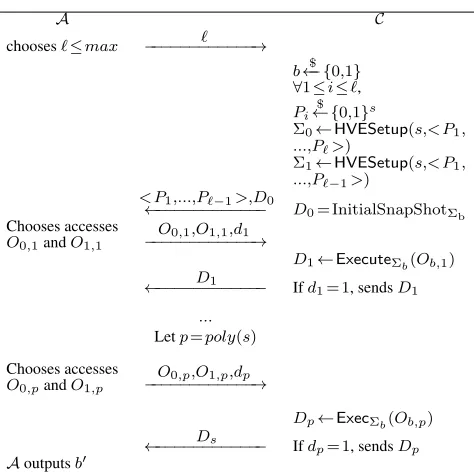
Our formalization of different security levels uses standard game-based definitions. All gamesΓwill be played between an adversary Aand a challengerCrunning a schemeΣ. All gamesΓwill adhere to the followinggenericgame. We present the specific differences between the games and corresponding levels of security after the generic game.
In our games, an adversaryAis allowed to repeatedly retrieve snapshotsof the disk. We define a snapshot as the entire contents of the disk (i.e., addresses and current values of every block), and a snapshot is meant to represent a dump or capture of the hard drive from a machine.
The generic gameΓgenericA,Σ (s), cf. Fig. 1, is defined as:
A C
chooses`≤max −−−−−−−−−−−−→`
b←− {0,1}$ ∀1≤i≤`,
Pi $
← {0,1}s
Σ0←HVESetup(s,< P1,
...,P`>)
Σ1←HVESetup(s,< P1,
...,P`−1>)
< P1,...,P`−1>,D0
←−−−−−−−−−−−− D0= InitialSnapShotΣb Chooses accesses O0,1,O1,1,d1
−−−−−−−−−−−−→ O0,1andO1,1
D1←ExecuteΣb(Ob,1)
D1
←−−−−−−−−−−−− Ifd1= 1, sendsD1
··· Letp=poly(s)
Chooses accesses O0,p,O1,p,dp
−−−−−−−−−−−−→ O0,pandO1,p
Dp←ExecΣb(Ob,p)
Ds
←−−−−−−−−−−−− Ifdp= 1, sendsDp
Aoutputsb0
The outcome of this game is1,iffb=b0, and0otherwise.
Figure 1: Security GameΓgenericA,Σ (s)
2. Using security parameters,Cchooses`passwords and a
ran-dom bitb.Cinitializes two different hidden volume encryp-tion schemes: Σ0 (with `passwords) andΣ1 (with `−1
passwords). Finally,Csends passwords< P1,...,P`−1>and
an initial snapshotD0of the disk toA.
3. Achooses two accesses and sends them toC, along with a
bitdthat specifies whetherAwould like a snapshot of the disk after execution. Both the access patterns and bitdwill
adhere to specific restrictions that we detail below.
4. Following schemeΣb,C“executes” one of the two accesses,
depending on bitb.
5. Ifd= 1,Csends a snapshotDiof the disk toA.
6. Repeat steps 3 to 5 forp=poly(s)times (roundsi). Oi,j
denotes accessj∈ {0,1}in roundi,1≤i≤poly(s). E 7. Aoutputs bitb0. The outcome ofΓgenericA,Σ (s)is 1,iffb
0 =b.
From this general game, we develop two axes along which we can define varying levels of security: 1) the frequency with which
Acan access snapshots of the disk (regulating when and how often
dican be 1 in our game above), and 2) the restriction applied to the
two access patternsO0,O1thatAchooses and submits toC. We
de-note byΓx,yA,Σ(s)a game that follows generic gameΓgenericA,Σ (s), but implies restrictions “x” (defined below) on the frequency of
snap-shots and restrictions “y” (defined below) on the access patterns.
DEFINITION3 (HIDDENVOLUMEENCRYPTION). A hidden volume encryption schemeΣis secure regarding restrictions(x,y), ifffor any probabilistic polynomial time adversaryAthere exists a function(s)that is negligible in security parameters, such that
P r[Γx,yA,Σ(s) = 1]≤1 2+(s).
In conclusion, the rationale behind this game-based definition is to prevent adversaryAfrom successfully guessing whether there exist`−1or`volumes in use, even whenAis able to choose
`. We allowAto specify two patternsO0, O1, similar to classic
Table 1: Different Notions for Hidden Volume Encryption
Restricted Opportunistic Plausible
Hiding Hiding Hiding
Arbitrary Impossible HIVE-B HIVE
On-Event Reencryption HIVE-B HIVE
One-Time TrueCrypt, HIVE TrueCrypt, HIVE TrueCrypt, HIVE
indistinguishability proofs, which allows us to capture a stronger chosen plaintext adversary. The restrictions we place on these ac-cess patterns will lead to an intuitive understanding of the security our scheme provides.
2.2.1
Snapshot Frequency
We consider three different adversarial capabilities in terms of snapshotting:
1. Arbitrary ΓArbitrary,(A,Σ ·): Acan obtain snapshots after every
operation to the disk (any number ofdican be 1).
2. On-EventΓOnA,Σ−Event,(·):Acan obtain snapshots afterUhas
run an “unmount” operation. We represent this by having an additional functionUnmountwhich is called afterExecute, wheneverdi= 1, to generate the snapshot.
3. One-TimeΓOneA,Σ−Time,(·): Acan obtain only a single
snap-shot (di= 1for only a single value ofi).
Our justification for also considering an “on-event” adversary is that, in reality, some adversaries will not have the capability to take arbitrary snapshots of the disk while it is in use. More likely, the machine will be confiscated or compromised whileUdoes not have the hidden volume mounted. Therefore, a model where the adver-sary can only take snapshots after an “unmount” is interesting.
2.2.2
Access Pattern Choice
An important part of our formal security is allowing the adver-sary tochoosesome part of the access pattern. This represents the fact that, in reality, an adversary may have partial knowledge of
U’s access pattern. Informally, allowing adversaryAto choose the
access pattern will guarantee that no matter whata priori knowl-edgeAmight have, they still cannot learn the secret we are trying to protect (i.e., whether there is a volume still unrevealed). To for-malize this, we allowAto choose a value`, between1andmax
which represents the number of volumes in use byU. To maintain some uncertainty about exactly how many volumes are actually be-ing used, we then allowAto also choose two access patterns, one which includes accesses to volume`and one which does not.
We stress that restrictions on access pattern choices are manda-tory to prevent “trivial” impossibility. For instance, in our model
Awill get the passwords for all volumes up toV`−1. If the two
patterns contain different writes to these volumes, then the result-ing snapshots will allowAto distinguish between them easily (i.e.,
he simply decrypts these volumes and checks which values were written). This is to be expected, since the point of hidden volume encryption is to protect accesses to thesecretvolumes which may or may not exist, from the adversary’s perspective. Once a pass-word is given up, we cannot hide the contents any longer.
Therefore, the first restriction which must exist for all of our def-initions is that any access where both patterns write to a volumeV1
throughV`−1must containidentical writesin both patterns chosen
by adversaryA.
O0 and then a second patternO1 that must constrain to some
re-strictions based onO0. Intuitively, the restrictions onO0govern
which types of access patterns are protected, and the restrictions on
O1express the level of security that is achieved.
Restricted Hiding:
Γ(A·),Restricted,Σ.
The first setting we consider is the most straightforward: in each round, we allowAto chooseanyaccess patternO0=< o0,1, ... ,
o1,n>. As stated before, if accesso0,i is a write in volumeVj,
j≤`−1, then accesso1,iin patternO1must beequaltoo0,i. If
o0,iis inV`, theno1,imust be⊥(the null operation, it is simply
ignored byC). The access pattern executed whenb= 1is then the same as whenb= 0, with all accesses toV`ignored byC.
Since the difference betweenO0andO1is only the removal of
all accesses toV`, aRestrictedHiding scheme effectively prevents
an adversary from distinguishing between the case where a user uses`volumes and the case where a user only uses`−1volumes, with no restriction on the user’s access pattern. This means that a scheme withRestrictedHiding would be the ideal system, since it would protect any access pattern and an adversary would not be able to learn whether there are`or`−1volumes in use. Unfortu-nately, this level of security is difficult to achieve.
LEMMA 1. Letn∗be the number of blocks of volumeV`. There
is no schemeΣthat isΓArbitrary,RestrictedA,Σ -secure and requires less
thann∗blocks of RAM.
PROOF(COUNTEREXAMPLE). Asubmits two access patterns of lengthn∗,O0 andO1, whereO0,i= (write,i,`,ri),O1,i=⊥
andri $
←− {0,1}B. In caseAobserves changes to the disk,A
out-puts1. Otherwise,Aoutputs0. IfCexecutesO1, nothing on the
disk will change because⊥operations are ignored. IfCexecutes
O0, then either the disk must change orC must have at leastn∗
blocks or RAM to hold all the writes fromO0.
This essentially means that against an adversary withArbitrary snapshotting capability you can do no better than storing all the hidden volumes in RAM, which is quite unrealistic.
Although none of this paper’s solutions are directly targeted at On-Eventsecurity, we include it in our definitions because it is a distinctly separate adversarial model fromArbitrary and One-Time. It has at least one interesting property: even though it is impossible to achieveΓArbitrary,RestrictedA,Σ security, it is quite simple
(albeit inefficient) to obtainΓOnA,Σ−Event,Restrictedsecurity. If a
True-Crypt-like approach is taken except, upon unmount, every data block isreencryptedand every empty block is filled with a uni-formly random string, we achieve this security. This is highly in-efficient, but we point it out as an interesting observation on our various adversarial models and possible motivation for more effi-cient solutions in the future.
Opportunistic Hiding:
Γ(A·),Opportunistic,Σ.
The second setting we consider, opportunistic hiding, is similar to restricted hiding, but with a slightly more specific access pat-tern: again, ifo0,i is in volumeVj, j≤`−1, theno1,i must be
equal too0,i. Also, ifo0,iis inV`, theno1,iwill be⊥. The
addi-tional restriction is thatbetween snapshots, every write to a volume
V2throughV`inO0must have a corresponding read to volumeV1
which occurs after it. More formally, the additional restriction says that forO0= (o1,...,on), there must exist a one-to-one mapping
f: [1...n]→[1...n]such that ifO0,iis a write to a volume higher
thanV1, thenf(i)> i,O0,f(i)is a read from volumeV1.
What this effectively means is that the system will hide writes to volumes higher thanV1by executing themsimultaneouslywith
reads toV1. This reflects the idea that, if we make execution of
reads and writes similar, there will be extra capacity during a read to simultaneously do a write. We believe this that is not a very onerous constraint, because it is very reasonable that the “secret” volumes will be accessed much less frequently than the lowest vol-ume, which is known to exist to the adversary.
This security definition also provides “complete” security to the user, in that an adversary should not be able to distinguish whether there are`−1or`volumes. In that way, it is similar to our first
definition, however, in order for the user to receive this security, it requires that the access patternO0must have fewer accesses toV2
throughV`thanV1. In practice this means that the user must access
volumeV1more often than the other, more secret volumes.
Plausible Hiding:
Γ(A·),Plausible,Σ.
Finally, we consider an even more restricted setting where writes toV`can be plausibly denied as operations to the other volumesV1,
...,V`−1. Amay choose any accessO0,i. Again, ifO0,iis a write
in volumeVj,j≤`−1, theno1,imust be equal toO0,i. Otherwise,
we only require that neither pattern contains⊥operations (so their “true” lengths are equal).
The intuition of this security definition is that, if an access pat-tern contains writes toV`, there is always a plausible access pattern
containing only accesses toV1 throughV`−1 (with writes toV`
replaced by reads to other volumes) which would have produced the same sequence of disk operations. Therefore an adversary can never be sure of the existence ofV`. Additionally, all writes toV`
will be indistinguishable from each other. In contrast with the pre-vious two definitions, we have restrictions onO1beyond that the
accesses to lower volumes must be equal.
Finally, Table 1 summarizes our two orthogonal axes of hid-den volume encryption. Our new scheme, HIVE, provides plau-sible hiding with arbitrary snapshots. A variant of HIVE, HIVE-B, provides opportunistic hiding with arbitrary snapshots (as well as weaker notions). TrueCrypt and other related work [1, 4, 8, 13, 17, 21] only provide security against one-time snapshots [3]. Addition-ally, as noted above, one can achieve on-event, restricted security with an expensive reencryption technique. Note thatArbitrary⇒
On-Event⇒One-Time, andRestricted⇒Opportunistic. We would like to stress that any hidden volumes scheme needs additional requirements to maintain security. For example, the OS and applications should not keep any trace of previously mounted hidden volumes, e.g. in a “recently opened documents” list. For a detailed discussion, we refer to Czeskis et al. [3] and [20].
3. GENERIC HIDDEN
VOLUME ENCRYPTION
Current hidden volume encryption solution only protect against One−Timeadversaries. We now present a first “generic” proto-col, using Oblivious RAM as a building block, that offers stronger, more robust security againstOne-TimeandArbitraryadversaries.
3.1 ORAM Preliminaries
An ORAM provides three operations:ORAMSetup(n, B,k,s), ORAMRead(i), andORAMWrite(i, d). It is a block-based data structure storingnblocks of sizeBbits, each indexed by alog2n
bit integer, using a keyκfor encryption, andsis the security
e.g., seminal work by Goldreich and Ostrovsky [6] or recently Shi et al. [16] or Stefanov et al. [18].
DEFINITION4 (ORAM SECURITY). An ORAM is secureiff, for any probabilistic polynomial time adversaryAand any two ac-cess patternsO0andO1of the same length there exists a function
negligible in security parameters, such that
|P r[A(Execute(O0)) = 1]−P r[A(Execute(O1)) = 1]| ≤(s).
We note that, although this is the classic definition of ORAM se-curity, it does not capture an adaptive adversary like we need in our setting. Fortunately, although it is not discussed in related work, all major ORAM constructions are adaptively secure. To obtain such a security definition, we simply allowAto choose the operations
inO0andO1 one at a time after receiving the results ofExecute
being called on the previous operation.
The goal of our first, “generic” hidden volume encryption is two-fold: to hide the pattern of writes issued by the user and to give a plausible reason to access the disk when writing into hidden vol-umes. Broadly, we accomplish the first by using ORAM and the second by making a read to a volume cause a “dummy write”. This dummy will cover for a write to a hidden volume, and is in line with the idea that all operations should “look the same” regardless of which volume it is in, or even if it is a read or write.
3.2 Generic Construction
To start, we usemaxseparate ORAMs (ORAM1≤i≤max), each
holding the data for a single volume and encrypted with its own password, e.g., we simply runORAMSetupfor each of these ORAMs. The only requirement we have on our ORAM scheme is that it be efficiently simulatable, i.e., a simulatorS, without the password
or any knowledge of the access pattern beyond its length can out-put a series of disk accesses which are indistinguishable from those output by an actual ORAM. Additionally, this simulator needs to be stateless, in that its output for each operation cannot depend on anything other than the output from the previous operations. Fortunately, typical ORAM constructions meet this definition. So, forj > `,ORAMj is replaced by a simulatorS. Therewith, an
ORAM can execute a “dummy” operation containing no informa-tion, which, to all adversaries, looks identical to a real operation. This is necessary so that the ORAMs not actually in use by the user will not evenhave keys that could be revealed to the adversary. This gives the user deniability, since they can reasonably claim that no key exists for a certain volume.
When the system executes a write to volumei(Algorithm 2), it
executes that write onORAMi. For allj6=i, it picks a random
block inVjand writes its same data value back toORAMj, i.e., a
“dummy” operation which changes no data. When the system exe-cutes a read (Algorithm 3), it reads from the respective ORAM and then does a dummy write for all ORAMs (or executes the simulator, for volumes greater than`). The idea is that, if an adversary does
not have a key to volumei, they cannot tell whether we are reading
from some volume (maybei, but maybe not) or writing to volume i. For the internal encryption and decryption withinORAMi, we
use passwordPias the key.
THEOREM 1. If (ORAMSetup,ORAMRead,ORAMWrite) is a simulatable ORAM, then ourgenerichidden volume encryption is aΓArbitrary,PlausibleA,Σ -secure hidden volume encryption.
PROOF. Under PlausibleHiding security, the access patterns given byAwill differ only when neitherO0,inorO1,iis a write to
a volume less than`. SinceAcannot distinguish on operations of the access patterns that are identical, we only need to show that, for
Input: Security parameters, RAM size
t, passwordsP, block sizeB, volumes sizes< n1,...,n`>
Output: Volumes< V1,...,V`,V`+1,...,Vmax>
1 largestVolume:=maximum(n1,...,n`);
2 fori:= 1tomaxdo
3 Vi:=ORAMSetup(largestVolume,B,Pi,s);
4 return< V1,...,Vmax>;
5 end
Algorithm 1:GenericHVESetup(s,t,P,B,< n1,...,n`>)
Input: Blockb, datad, volume indexi, passwordsP 1 forall thejdo
2 ifj=ithen
3 ORAMj.ORAMWrite(b,d);
4 end
5 else
6 r← {1,...,$ sizeof(ORAMj)};
// Using password Pj as key
7 dummy :=ORAMj.ORAMRead(r);
8 ORAMj.ORAMWrite(r,dummy);
9 end
10 end
Algorithm 2:GenericHVEWrite(b,d,i,P)
Input: Block indexb, volumei, passwordsP
Output: Datad
1 d:=ORAMi.ORAMRead(b); 2 forall theido
3 r← {1,...,$ sizeof(ORAMi)};
// Using password Pi as key
4 dummy :=ORAMi.ORAMRead(r);
5 ORAMi.ORAMWrite(r,dummy);
6 end 7 returnd;
Algorithm 3:GenericHVERead(b,i,P)
operations that differ,Acannot distinguish. So, ifO0,i andO1,i
differ, then they can each be either a read to any volume or a write to a volumej≥`. By the security definition of ORAM, a “dummy”
write in a volumej≥`is not distinguishable from an actual write
with probability greater than1/2+(s). This implies that a read to one of these volumes cannot be distinguished from a write. We also have that for alli,j, a read toViis indistinguishable from a read
toVj. Therefore, sinceAcannot distinguish between the outputs
with probability greater than1/2+(s), they cannot win the game with any non-negligible advantage.
3.3 Opportunistic Hiding Security
Opportunisticsecurity gives more freedom to the user, since it does not require them to “pretend” that they did some reads that were actually writes in other volumes. Thus, it is relatively sim-ple to achieve. Instead of writing a block immediately when the user wants to, if it is part of a volumeVi, i >1, we add it to a
queueQi. Every time the user does an operation onV1(read or
write), for alli >1ifQiis not empty, we write one block from
Qi toVi, instead of doing the dummy write. Reads to volumes
other thanV1are trivial, i.e., we read the requested block, but do
not change anything on the disk. Writing during such a reads is no longer necessary, because writes to all volumes higher thanV1are
simultaneously hidden by accesses toV1.
THEOREM 2. If (ORAMSetup,ORAMRead,ORAMWrite) is a simulatable ORAM, then this modified generichidden volume encryption isΓArbitrary,OpportunisticA,Σ -secure.
PROOF. O0andO1are only different whenO0,iis an operation
inV`. IfO0,iis a read, it will be identical to a⊥operation in our
modified genericscheme. Such a read does not trigger any write. If
O0,iis a write, it equally triggers no writes, as it just adds a block to
show that a read toV1which also writes fromQ`is
indistinguish-able from one which just causes a dummy operation inV`. This
follows directly from the security of our ORAM, and soAcannot win the game with any non-negligible advantage.
4. WRITE-ONLY ORAM
We have proven a generic hidden volume encryption secure us-ing ORAM as a buildus-ing block. Note, however, that the snapshots
Agets in our security game do not include any information about blockreadsthat occur to the disk. This reflects the idea that an ad-versary can see the impact of block writes, in the form of modified data, but they cannot see where or how often userU reads.
Typ-ically, block reads do not leave any discernible trace on the disk. This means that the ORAMs we are using are actually more pow-erful than we need them to be. In fact, an ORAM which only hides writes to the disk is sufficient. We can define the security of such a write-only ORAM as follows:
DEFINITION5 (WRITE-ONLYORAM SECURITY). Let sequence ExecW(O)be the sequence of writescaused to the disk when an ORAM executes access patternO. A write-only ORAM (with algo-rithmsORAMSetup,ORAMRead,ORAMWrite) is secureiff, for any probabilistic polynomial time adversaryAand any two access patternsO0 andO1that contain the same number of writes there
exists a functionnegligible in security parameters, such that
|P r[A(ExecW(O0)) = 1]−P r[A(ExecW(O1)) = 1]| ≤(s).
There has been limited work on write-only ORAMs until now. There are several schemes by Li and Datta [11], but they all have significant drawbacks. They are able to obtain an amortized write communication complexity ofO(B·logn), but only at the cost of reads being inO(B·n). As ORAM communication complexities directly relate to the hidden volume encryption overhead, this does not suit our needs. Applications might perform as many reads as writes, and reads would quickly become too expensive for increas-ingn. For efficient reads, Li and Datta [11] require either memory
or communication complexity to be polynomial inn. We stress that
their schemes only provideamortizedcomplexity guarantees, with worst-case complexity being polynomial inn.
Since we target good read and write performance for our hidden volume encryption to be useful, we now present a new write-only ORAM which achieves worst-case constant communication com-plexity and only poly-logarithmic memory requirements. We will start with a very simple, inefficient construction and show how its shortcomings can be addressed one at a time until we have our final, efficient construction HIVE.
4.1 Basic Write-Only ORAM Construction
We now present our new ORAM that only supports write opera-tions. Our ORAM makes use of a mapping data structureMapthat maps blocks from the ORAM to physical blocks (sectors) on the disk. For now, we will consider it as an associative array such that Map[b]contains the physical addressβon the disk where ORAMblockbis currently located. Later, we will show how this map is
structured and actually implemented, but for now assume that it is simply stored in RAM and can be efficiently accessed. Also as-sume that the hard disk has at least twice the size of the ORAM, i.e.,N≥2·n, so we have at least twice as much storage available
as needed. All mapping entriesMap[b]are set to⊥. For
encryp-tion and decrypencryp-tion, we employ any pairEnc,Decof algorithms realizingIND$-CPAencryption [15]. AnIND$-CPAencryption is an encryption that produces ciphertexts indistinguishable from
ran-Input: Block indexb, datad 1 S:=< βi>,
such thatβi← {1,...,N}∧1$ ≤i≤k∧∀u,v:βu6=βvholds;
2 β← S$ , such thatβis free; 3 DiskWrite(β,Encκ(d)); 4 ReencryptOrRandomize(S \β);
// Find out which block
in the Map ORAM has the address we want
5 M:=b B logNc;
6 mapblock:=Map.ORAMRead(bMbc);
// Retrieve the address from the map block
7 mapblock[b modM] :=β;
8 Map.ORAMWrite(bb
Mc,mapblock);
Algorithm 4:ORAMWrite(b,d)
Input: Block indexb 1 M:=blogNB c;
2 mapblock:=Map.ORAMRead(bMbc);
3 β:=mapblock[b modM];
4 returnDecκ(DiskRead(β));
Algorithm 5:ORAMRead(b)
dom strings, e.g., AES in CBC or counter mode. The encryption makes use of secret keyκ, only known to the ORAM userU.
ORAMWrite: For anORAMWrite(b, d)operation (see Algo-rithm 4), U picks a sequenceS of k random, distinct hard disk
block indices βi, wherek is a security parameter. U then
ran-domly picks one index β∈ S that is “free”. Here, free means that there is no block in the ORAM that is mapped to disk block
β. UserU writesEncκ(d)at position β to disk. Of thek−1
remaining block indices, if their corresponding blocks contain en-crypted data,Ureencrypts their contents, and if the blocks are free Uwrites a random strings into them (“ReencryptOrRandomize”). Finally,Uupdates the mapping forb. SinceUpicks thekblock
in-dices inSrandomly and independently fromb, and the encryption
produces ciphertexts indistinguishable from random, an adversary seeing thesekblocks change cannot learn anything aboutbord.
ORAMRead: Our ORAM does not aim at protecting read oper-ations. Thus, reads are trivial as shown in Algorithm 5.
ORAMSetup: For initialization, we require only that the map be initialized to an “empty” state, e.g. looking up the address of any block should return a⊥value indicating that the block has not
been written in the system yet.
Choice ofk: To guarantee thatUalways finds at least one free block inSto put datadinto,Uhas to chooseksufficiently large.
Since at least half the disk is empty, the probability that any ran-domly chosen block is free is at least1/2. LetX be the random
variable that, when selectingkblocks uniformly from allN,
de-scribes the number of blocks among thosekthat are free. AsNis
typically large compared tok, we approximate the
hypergeometri-cally distributedX with a binomial distributedX. P r[X≥1] = 1−P r[X= 0]≈1− k0
·(n N)
k= 1−2−kforN= 2·n. Therefore,
if we setkequal to our security parameters, the probability ofnot finding at least one free block for any single write will be negligi-ble small inswith2−s. SettingNto twicenwill “only” double
storage requirements, but leads to high efficiency and practicality as we will show in Section 4.2.
Free Blocks: A remaining detail is how to determine which physical blocksβ on the disk are actually “free”, so no blockb
of the ORAM maps to them. The challenge is to do this in an efficient way in order to keep a low complexity. A simple so-lution is a reverse mapping that tags each block β on the disk
isEncκ(d)||Encκ(b). Then, whenUneeds to determine if a disk
blockβis free,U decryptsβ’s content to restore ORAM address band checks ifMap[b] =β. If that condition isnottrue, then it means thatβis an “old” version of ORAM blockb, soβis free,
and it can be safely overwritten. Consequently,Ucan therewith check if a block is free in constant time.
In practice, we cannot write the two ciphertextsEncκ(d)||Encκ(b)
into a single block of sizeB, as|d|=B already. Also, for each
IND$-CPAencryption, we need to store random coins such as an IV or counter. Consequently, we write the ciphertext ofEncκ(d)
into blockβ, and we writeEncκ(b)and the encryptions’ random
coins into anothermetadata blockβ0. One can imagine that, in
addition to theN hard disk blocks for the write-only ORAM, we
need additionalNblocks for metadata. Each time an ORAM block βis written to disk, the corresponding metadata blockβ0is also
up-dated. As the mapping between an ORAM block and its metadata block is fixed, this does not have any consequences for security. A straightforward optimization of this idea is to store multiple IVs and multipleEncκ(b)for multiple ORAM blocks in a single
meta-data blockβ0, as typically|IV|+|Encκ(b)|< B.
In conclusion,Uwrites a blockbinto one of thekblocks from
Schosen randomly and thus independently ofb, updatingMap ac-cordingly. Sincekis a security parameter independent fromn, we
only need to actually write a constantO(1)number of blocks to disk for each ORAM write operation. Still, our write-only ORAM has two drawbacks: first, it requires us to access a large number of blocks per operation (kis, for example, 64), and second, it requires O(n·logN)memory complexity to store theMap.
We now move on to optimizing our initial write-only ORAM to allow for smallerkand for efficient storage of the map.
4.2 Stash-Optimized Write-Only ORAM
We have setkto be equal to a security parameters. This is toensure that with probability1−2s Uwill choose a free block to write new data into on every write operation. It turns out that this is quite wasteful, because in expectation,Uwill finds/2free blocks per operation – many more than are necessary. We only have to set
kso high to avoid a potential worst-case situation whereU does not find any free blocks.
We now exploit that fact that typically there will be many more blocks free than just one. We setksuch that in expectation we will
have one (or slightly more than one) free blocks, e.g., by settingk
to only4. The intuition is that in that case, there will be many times whereUdoes not find a free block, but there will even more times whenUfinds more than one free block. We can take advantage of
this situation by having a smallstashof pending blocks in memory. IfUchooseskblocks, and none of them are free, thenUputs the block to be written at that time in the stash, to be written later. If
Uends up with more than one free block during a write, thenU
additionally writes out some extra blocks from the stash. Note that this idea and its analysis is different from the one by Stefanov et al. [18], where a stash is used in case one of the bucket ORAMs is full. The first challenge is to bound the size of the stash, such that we do not overburden userU’s memory, but still have high probabil-ity of the stash not overflowing. To determine the stash’s size, we use a standard queueing argument. Our stash can be modeled as aD/M/1queue with deterministic arrival rateγ= 1and service times exponentially distributed with rate parameterµ=k/2. As shown by Jansson [9], we can then express the steady state proba-bilityPof havingiitems in the stash at any time asP= (1−δ)·δi,
whereδis the root of the equationδ= 2−µγ(1−δ)with the smallest
absolute value. Ifµis larger than1, thenδ <1, and the steady state probability of havingiblocks in the stash will beO(2−i). That
means that the size of the stash will beO(B·s)with probability all but negligible ins.
This optimization allows us a huge savings in performance. We can go fromk=stokbeing a small constant, independent of the
security parameter. For example, ifk= 3, we can solve to findδ= 0.41718, and we can bound the probability of overflowing the stash at2−64using only a stash of size50blocks. With a block/sector
size of 4096 Byte, the stash would consume only 200 KByte RAM. Security: The actual writing thatUperforms to thekblocks of
S is hidden by the security of theIND$-CPAencryption. There-fore, whetherUwrites one, two, or no blocks from the stash on any given operation is not observable by the adversary. Consequently, the stash does not impact security at all.
4.3 Recursive map
As we have described our write-only ORAM thus far, we have good communication complexity, but at the cost of a large map that must be kept in memory. The total size of the map will beO(B·n· logN), prohibitively large if we hope to store it in memory. How-ever, we can use a standard technique [11, 12, 16] which is to recur-sively store the map in smaller and smaller ORAMs. If our block sizeBis at leastχ·logNfor some constantχ >2, then we are guar-anteed that if we (recursively) store our map in another ORAM, that ORAM in turn will have a map that is no greater than half the size of the original map. Therefore, afterO(logn)recursive ORAMs, we will have a map that is constant size and can be stored in memory.
This reduces the map to a much more comfortable size, but at the expensive of increasing the communication complexity: now, to access the map, we have to, in turn, accessO(logn)recursive ORAMs. This will also slightly impact our stash analysis, since the ORAMs that hold the map do not have deterministic arrival rates, since their arrivals are in fact the result of service on the above queue. Fortunately, we can model them asM/M/1queues with expectedarrival rate equal to 1 which still results in exponentially distributed stationary probabilities [7], and we end up with the same
O(logn)bound on the size.
As seen in algorithms 5 and 4, we can then simply treat the map for each level as another ORAM and issueORAMReadand ORAMWritecalls as necessary. Each level is unaware of how the next level structures itself, only that it provides an interface to read and write, and that it can do so securely. However, we cannot treat the map as a simple associative array now because the recursive ORAM will need to store more than one address per block in or-der to guarantee that we have onlyO(logn) levels of recursion. Therefore, to read an entry from the map, we have to calculate
N=b B
logNc, the number of entries we can fit per block, then
fig-ure out which block the entry we want will be in. For instance, if we want the address for blocki, we would get blockbi
ncfrom the
map, and read thei modNth entry from it.
4.4 Write Complexity
For eachORAMWriteoperation, our write-only ORAM readsk
random blocks, checks if they are empty, fills from zero tok−1of them with blocks from our stash, and updates the map accordingly. The initial reading of thek blocks from the map (and hence
checking if a block is empty) requires reading one block from each oflognrecursive levels. Therefore, we can accomplish that first
This overhead would be disappointing, as there are several full-functionality (read and write) ORAMs which provide the same over-head. However inspired by Stefanov et al. [18], we can use the following optimization to reduce the cost of the expensive map ac-cesses. If we set the size of only the data blocks on our disk to
B= Ω(log2n), the total size oflognblocks in the recursive map is
no greater than the size of oneB-sized data block at the “top level”.
What we end up with is non-uniform block sizes: top level blocks (actual data blocks) have sizeΩ(log2n), and blocks that are part of the map have only sizeχlognfor some constantχ≥2. We are still guaranteed that the map will haveO(logn)levels, but we reduce the communication complexity of a map operation by a factor of
O(logn). Consequently, in terms of communication complexity, reading from the map is constant inO(B), and updating/writing is inO(B·logn). We can apply the same optimization again, as long asB= Ω(log3n). In terms of communication for anORAMWrite, we reduce total complexity toO(B).
In conclusion, our write-only ORAM featuresO(B·s)memory and constantO(B)communication complexity.
4.5 Security Analysis
Security for our scheme follows directly from the fact that we only write to uniformly randomly chosen blocks at each level of the ORAM. Since the blocks we choose are independent of the ad-dresses in the user’s access pattern, they cannot reveal any infor-mation about it to the adversary. Additionally, all the data we write is freshly encrypted with a semantically secure encryption, so the data itself cannot reveal any information.
Simulator:We note in the previous section that, to be useful in our scheme, an ORAM needs to be (efficiently) simulatable. Fortu-nately, such a simulatorSis simple to construct for our scheme.S
proceeds in every operation to changekuniformly random blocks
at each level of the recursion to fresh random strings. Since, in normal operation of our ORAM, we will accesskrandom blocks
at each level, and those blocks will be filled with either random strings orIND$-CPAencryptions indistinguishable from random,
Swill be indistinguishable from an actual execution of our ORAM.
5. PRACTICAL HIDDEN VOLUME
ENCRYPTION WITH HIVE
Thus far we have presented a generic hidden volume encryp-tion scheme which uses a write-only ORAM as a building block and has constant communication complexity per access. We now present HIVE that builds upon this idea and makes it practical. We start by addressing an important consideration that we must take into account when designing a practical, real-world system.
5.1 Uniform vs. Non-uniform Blocks
Current storage devices, e.g., today’s hard disks, have fixed size blocks (sectors). This means that we cannot use our non-uniform block optimization from the previous section, unless we wanted to use the base device blocks as “small” blocks and combine many of these blocks together to make “large” blocks. However, most sys-tems use either 512 or 4096 byte blocks, so there is not much room for optimizing these parameters.
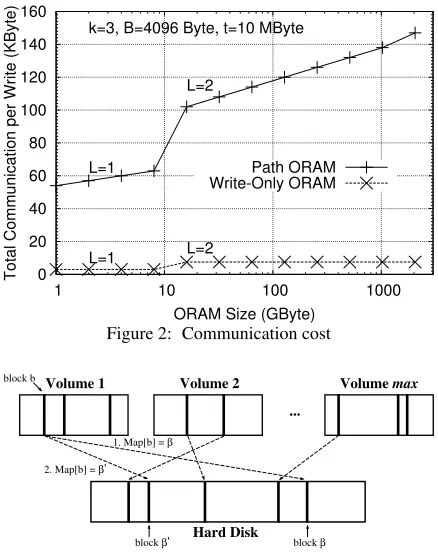
Fortunately, although we cannot easily obtain optimalO(B) com-plexity with uniform blocks, our write-only scheme is still substan-tially more efficient than the currently most efficient full-functio-nality ORAMs, e.g., Path ORAM [18]. In Figure 2, we show the comparative costs for our scheme and Path ORAM for a concrete selection of parameters (see Appendix A for the recurrence
0 20 40 60 80 100 120 140 160
1 10 100 1000
Total Communication per Write (KByte)
ORAM Size (GByte) k=3, B=4096 Byte, t=10 MByte
L=1
L=2
L=1 L=2
Path ORAM Write-Only ORAM
Figure 2: Communication cost
Volume 1 Volume 2 Volume max
...
block b
1. Map[b] = β
2. Map[b] = β'
block β
block β' Hard Disk
Figure 3: Random mapping of blocks from volumes to disk blocks
tions used to calculate these numbers). Our write-only ORAM is more than an order of magnitude more efficient than Path ORAM.
To see why we are more efficient, it is useful to consider the complexity of our write-only ORAM and Path ORAM in terms of the level of recursions required to store the map. We denote this required level of recursion withL. In the uniform block setting,
Path ORAM hasO(B·L·logn)communication complexity. Since
L=O(logn), this leads to the overall complexity ofO(B·log2n).
Our write-only ORAM, by comparison, hasO(B·L2) complex-ity, with no independentlognfactor. Again, sinceL=O(logn) our scheme has overallO(B·log2n)complexity. However, for
Lto actually approach the worst-caselogn, the block size needs
to be close to2·logn. In other words, with 512 byte = 4096 bit
blocks, we would need a disk holding22056bytes to approach that
many levels of recursion (4096 = 2·logn, son= 22048blocks, each of sizeB= 512byte. Note that our write-only ORAM wastes 50% of all blocks, though). In contrast, up to 16 TB requires only
L≤3levels of recursion. However, for that same disk, we have logn= 35. Therefore, for practical parameter choices,L2will be
significantly smaller thanL·logn, resulting in large savings of at
least an order of magnitude.
The “jump” at 16 GByte ORAM size in Figure 2 is due to an increased level of recursionLrequired for ORAMs of this size.
5.2 HIVE: Combining Volumes
A significant drawback of our generic hidden volume construc-tion is that it requires a separate ORAM for each volume. This requires us to do a full operation on each of those ORAMs, result-ing in a complexity dependent onmax. If we make a reasonable
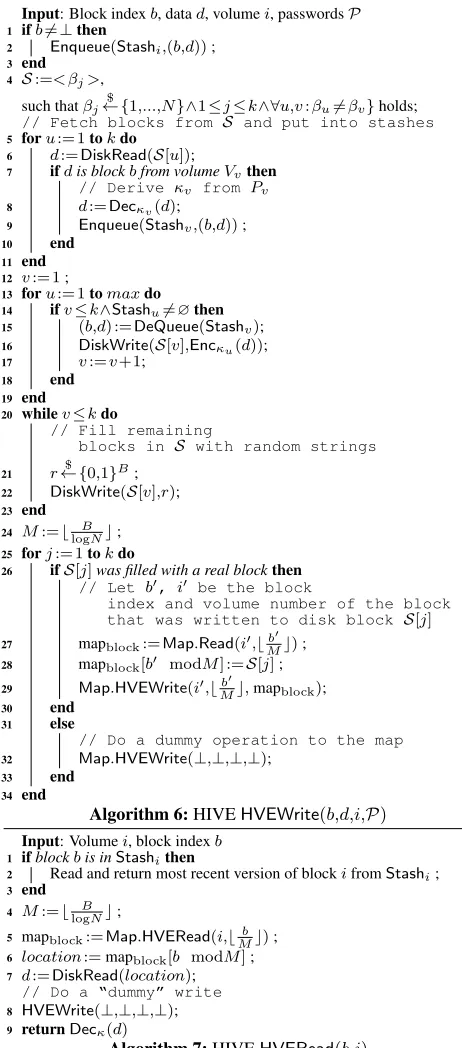
Overview: HIVE’s approach will be to store all the volumes randomly interleaved. Then, as shown in Figure 3, after writing to a blockb, we will randomly changeb’s mappingMap[b]fromβtoβ0
using our write-only ORAM trick. This hides the write pattern for all volumes. We now present the full procedure for HIVE’s writing (HVEWrite) in Algorithm 6 and for HIVE’s reading (HVERead) in Algorithm 7.
HVEWrite: Compared with our original ORAM scheme, there is only one major change: instead of only modifying one block out ofk given by the indices inS, we now have to potentially
mod-ify allkblocks. To see why, it is useful to consider the following
scenario. Imagine userU wants to write a block intoV1. In
or-der to do that, they randomly choosekblocks to formS. If, for instance, three of these blocks contain data fromV2, and one is
empty, we cannot simply write our block fromV1into this empty
space because, after continuously writing “around” blocks inV2,A
could infer its presence by the pattern we make trying to avoid it. Therefore, in order to be secure, we have to make sure that no pre-viouswrites to aVj,j > ican influence a write toVi. Intuitively, if
operations in higher volumes cannot influence operations in lower volumes, then the existence of a higher volume cannot be inferred from the observed behavior in a lower volume.
This can be accomplished by structuring the stash as a series of multiplequeues(calledStashiin Algorithm 6), one for each
vol-umeVi. For anHVEWrite, all the blocks inSare read and their
content copied into the respective queues for their volume. A block on the disk may belong to some volumei, or it may be a random
string not containing any information. To put it into the correct queue, we have to attempt to decrypt the block with every key until we find the right volume or we run out of keys. This means that our ciphertexts must contain some redundant information, for decryp-tion verificadecryp-tion, but this can easily be accomplished by padding our plaintexts with a number of zero bits proportional to security parameters. Verification then consists of decrypting and
check-ing if the plaintext begins with a sufficient number of zeroes. This meshes with our notion of security, becauseA, knowing some
num-ber of keys, cannot tell whether a block is part of a volume which he does not have the key for or if it is simply a random string.
Now, having freedkblocks on the disk, we will writekblocks
back to the positions given byS. For this, we read out of our stash
queues, giving priority to the queues for lower volumes. That is, we empty the queueStash1forV1first, followed byStash2forV2,
etc. If there are less thankblocks in all stashes, then the leftover
blocks fromSare filled with random strings.
HVERead: For aHVERead, we read the block just like in our regular ORAM by querying the recursive map for the address and then reading that block from the disk. After we retrieve the target block, we also perform a “dummy” write to make reads and writes look identical to adversaryA. This write does not change any
val-ues in the system, but it gives us a chance to write items from the stash, if necessary. Note that a blockbwe want to read in volume Vimight reside in the stash, so we first lookupbinStashi.
HVESetup: Initialization is identical to our base ORAM, we simply initialize the map to an “empty” state where every block starts unmapped.
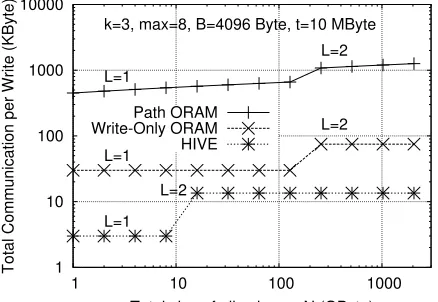
Complexity:Figure 4, moved together with its recurrence rela-tions to Appendix A, shows how HIVE is more efficient than the generic construction usingmaxseparate ORAMs. Although HIVE
performs better for a large range of parameters, note that HIVE scales exponentially inL. Since we have to change up tokblocks at
each level, which in turn requires changingkblocks in all the levels
below them, the overall complexity isO(kL). Withmax= 10, for
up to 1 Exabyte, HIVE is still cheaper than our generic construction
since it is independent ofmax. However, with larger volumes and
more levels of recursion, HIVE becomes less practical than our first construction. Therefore, depending on the choice of parameters, it can be more efficient to use one or the other.
For completeness sake, we note that Path ORAM can also be modified to produce a “combined volume” version in a similar manner (due to its use of a stash), but it would be significantly less efficient than our construction, just as Path ORAM is less efficient than our write-only ORAM.
Security: Since a block fromVj, j > iis written only if the
queue forViis already empty, blocks fromVjcannot influenceA’s
view ofVi. Additionally, since an encryption underPjis
indis-tinguishable from a random string toAwhich does not knowPj.
What this means is thatA’s view of the disk cannot be impacted by
volumes which he does not have the key to, therefore we achieve ΓArbitrary,PlausibleA,Σ security as before.
HIVE-B:To make HIVE secure againstOpportunistic adver-saries, we can follow the same idea as in Section 4.2. Instead of immediately writing in volumesVi, i >1, we just add the block
toStashi. When we do operations inV1, we proceed as normal,
writing as much as we can fromStash2,Stash3, etc. We omit full
algorithms and proofs for HIVE-B, because of space constraints, but they follow immediately from existing descriptions and proofs.
5.3 Discussion
We have shown that, under various adversarial models, HIVE does not give any information about the number of volumes in use, beyond what is known a priori. Yet, in practice, just the presence of HIVE on a user’s system is an indication that there might be more than one volume.
However, we stress that there is a legitimate reason a user would want to use HIVE with only asinglevolume: even with a single volume, HIVE offer stronger security than related work such as TrueCrypt. It provides security against multiple snapshot adver-saries that could deduce information from the user’s access pattern. For instance, between snapshots adversaryAmay see a particu-lar file has been written that matches the size of a known file. A
does not need the decryption key then to determine what the file is. Therefore, even without the encryption key, significant data leak-age can occur to a multiple snapshot adversary just by observing patterns of changes.
This gives a plausible reason why a user would be using only a single volume and hence allows for deniability in the case that they actually do have hidden volumes.
Since HIVE acts as an Oblivious RAM for each of the volumes, the user’s access pattern is hidden. Given our new write-only ORAM, our approach is more efficient than simply using existing ORAMs not tailored for disk encryption.
6. IMPLEMENTATION
To show its real-world practicality, we have implemented HIVE for Linux. Our implementation comprises a kernel module offering a virtual block device for each volume and a userland tool to man-age these volumes. The source code is available for download [19]. The kernel module is built usingdevice-mapper, a standard Linux kernel framework for mapping block devices onto virtual devices, also used to implement technologies such as LVM, dm-crypt and software RAID.
Input: Block indexb, datad, volumei, passwordsP 1 ifb6=⊥then
2 Enqueue(Stashi,(b,d)); 3 end
4 S:=< βj>,
such thatβj← {1,...,N}∧1$ ≤j≤k∧∀u,v:βu6=βv}holds;
// Fetch blocks from S and put into stashes
5 foru:= 1tokdo 6 d:=DiskRead(S[u]);
7 ifdis blockbfrom volumeVvthen
// Derive κv from Pv
8 d:=Decκv(d); 9 Enqueue(Stashv,(b,d));
10 end
11 end 12 v:= 1;
13 foru:= 1tomaxdo 14 ifv≤k∧Stashu6=∅then 15 (b,d) :=DeQueue(Stashv); 16 DiskWrite(S[v],Encκu(d));
17 v:=v+1;
18 end
19 end
20 whilev≤kdo
// Fill remaining
blocks in S with random strings
21 r← {0,1}$ B;
22 DiskWrite(S[v],r); 23 end
24 M:=b B logNc;
25 forj:= 1tokdo
26 ifS[j]was filled with a real blockthen
// Let b0, i0 be the block
index and volume number of the block that was written to disk block S[j] 27 mapblock:=Map.Read(i0,bb
0
Mc);
28 mapblock[b0 modM] :=S[j];
29 Map.HVEWrite(i0,bb0
Mc,mapblock);
30 end
31 else
// Do a dummy operation to the map
32 Map.HVEWrite(⊥,⊥,⊥,⊥);
33 end
34 end
Algorithm 6:HIVEHVEWrite(b,d,i,P)
Input: Volumei, block indexb 1 ifblockbis inStashithen
2 Read and return most recent version of blockifromStashi;
3 end
4 M:=blogNB c;
5 mapblock:=Map.HVERead(i,bMbc);
6 location:=mapblock[b modM];
7 d:=DiskRead(location);
// Do a “dummy” write
8 HVEWrite(⊥,⊥,⊥,⊥); 9 returnDecκ(d)
Algorithm 7:HIVEHVERead(b,i)
that our implementation works on any block device (e.g., hard disks, USB sticks, network block devices, etc.) since it stacks on top of the actual device driver which communicates with hardware.
We use AES-CBC with 256 Bit keys for encryption and PBKDF2 for key derivation. For performance reasons, we generate random-ness using RC4, using the kernel’s entropy pool only to generate an initial key for RC4. Our implementation supports up to a 4 KB logical block size (this limit is imposed by the x86 architecture and kernel internals), regardless of the underlying hardware’s physical structure. In our evaluation presented below, we set the block size
Bto 4 KB, even though our test device has 512-byte sectors. This
Table 2: HIVE Benchmarks,L= 2,k= 3 Seq. Write Seq. Read Create Stat Delete
(MB/s) (MB/s) (Kfiles/s) (Kfiles/s) (Kfiles/s) Raw disk 216.04 221.74 82.29 201.18 105.10
HIVE 0.97 0.99 1.57 3.23 1.79
minimizes the number of random disk accesses performed during IO and results in a significant performance improvement. As an-other performance optimization, our system disables IO reordering and scheduling in the kernel for the virtual devices, because HIVE always performs random device access and cannot benefit from ker-nel’s access pattern anticipation features.
The userland tool allows users to create, mount and unmount HIVE devices/dev/mapper/HIVEifor volumeVion top of
any other block device (e.g.,/dev/sda). Upon receiving the cre-ate command, our tool formats the specified device by creating the necessary metadata structures, such as the maxdifferentMaps, maxstashes of fixed size,IVs and the reverse mappings for data
blocks. Note that our implementation allows for recursion, so it recursively stores and accesses theMaps of fixed size as described in Section 4.3. Finally, to mount or unmount these volumes, our tool issues the appropriate ioctl commands to the kernel’s device-mapper module.
Benchmarks:We have tested our implementation on a standard desktop computer with an Intel i7-930 CPU, 9 GB RAM (although RAM was not an issue during our evaluation), running Arch Linux x86-64 with kernel 3.13.6. As the underlying block device, we have used an off-the-shelf Samsung 840 EVO SSD.
For the evaluation, we used bonnie++, a standard disk and filesys-tem benchmarking tool. Note that in the face of IO caching by the OS, files created in the bonnie++ benchmarks must be set to twice the size of system memory installed (9 GB in our case) to reliably measure device performance. To speed up the total bench-mark time, we modified bonnie++, flushing IO buffers to the device after running a benchmark, and signaling the kernel to droppage, dentry, andinodecaches before the next run. This ensured that
our performance measurements remained unaffected from caching. We have first tested an ext4 filesystem with 4 KB blocks on the “raw” disk to get a baseline. We then created 2 hidden volumes on our disk and setL= 2andk= 3. With this configuration, HIVE supports volumes of a total size of up to 16 TByte. We repeated the experiments by running bonnie++ on an ext4 filesystem created on top of the HIVE block device. Table 2 presents the results, aver-aged over 5 runs with a relative standard deviation of<6%. These results show that IO operations (sequential writes and reads in MB per second) were slower by a factor of≈200, while filesystem operations (create, stat, and delete in thousands of files per second) were slower by a factor of 50 to 60. Random seek performance was not measurable on the raw SSD (i.e., bonniee++ reported that the tests completed too quickly to measure reliable timings), whereas HIVE achieved1.2Kseeks/s. The HIVE induced CPU utilization was low with<1%during measurements, indicating that random access IO constitutes the main bottleneck.
We conclude that, while the slowdown is certainly significant, a throughput of 1 MB/s on an off-the-shelf disk is acceptable in many scenarios, rendering HIVE practical for the real-world. Fu-ture work is dedicated for additional performance tuning.
7. RELATED WORK
password-based linear combination of the cover files. As the security of this scheme is based on the number of linear combinations possible, note that knowledge of some user files jeopardizes secrecy of other files. Modifications to files with unknown passwords are not deni-able in the case of multiple snapshots. Consequently, this technique offers weaker security than the ones discussed in this paper. The second technique by Anderson et al. [1] (and its extension [13]) is based on a simple hash scheme, where an encrypted file is stored in the hard disk block indexed byβ :=h(file name). To avoid resulting hash collisions, Pang et al. [14], iterate over the physical blocks followingβ, until a free block is found. While this mitigates
the original problem of known files, none allow deniability against multiple snapshots, as write access patterns are not protected.
The same holds for prominent disk encryption tools such as True-Crypt [21], Mobiflage [17], FreeOTFE [4], and Rubberhose [8]: these tools use a fixed mapping between blocks of a volume (“vir-tual disks”, “aspects”) to hard disk blocks. With access to one vol-ume, other (hidden) volumes look like free space to adversaryA. Thus, repeated access to the same blocks in the hidden volumes will be impossible to deny.
The idea of deniable disk encryption originates to work by Canetti et al. [2]. There,Aintercepts ciphertextc=Encpk(m,r)sent from
a sender to a receiver, wherepkis the receiver’s public key,ma
(delicate) plaintext, andra random coin. The goal is that, under
coercition, the sender can present an innocent plaintext, random coin pair(m0,r0), wherem06=m, such thatc=Encpk(m0,r0).
8. CONCLUSION
In this paper, we have proposed new, parameterized definitions of formal security for hidden volume encryption. Existing work lacks security against strong adversaries with multiple snapshot and chosen plaintext capabilities. We have proposed new constructions which meet strong security definitions using ORAM as a build-ing block. Observbuild-ing that strong security can be provided with less powerfulwrite-onlyORAM, we have then introduced a novel construction of a write-only ORAM which achieves optimalO(1) communication complexity. This is a surprising result, indicating that writes are easier to hide than reads. We leave further explo-ration of this idea to future work. Additionally, we have shown how our ORAM can be specially adapted to the problem of hid-den volume encryption to produce an even more efficient solution, which we dub HIVE. Finally, we have implemented our scheme as a kernel-level block device and benchmarked its performance on commodity hardware, achieving a throughput of≈1MByte/s.
Acknowledgments:
This work was partially supported by NSF grant 1218197.
References
[1] R.J. Anderson, R.M. Needham, and A. Shamir. The Stegano-graphic File System. InProceedings of Information Hiding, pages 73–82, Portland, USA, 1998. ISBN 3-540-65386-4. [2] R. Canetti, C. Dwork, M. Naor, and R. Ostrovsky. Deniable
Encryption. In Proceedings of CRYPTO, pages 90–104, Santa Barbara, USA, 1997. ISBN 3-540-63384-7.
[3] A. Czeskis, D.J. St. Hilaire, K. Koscher, S.D. Gribble, T. Kohno, and B. Schneier. Defeating Encrypted and De-niable File Systems: TrueCrypt v5.1a and the Case of the Tattling OS and Applications. InProceedings of HotSec, San Jose, USA, 2008.
[4] S. Dean. FreeOTFE, 2010. Archive available athttps:// web.archive.org/web/20130531062457/http: //freeotfe.org/.
[5] Executive Office of the President. Protection of Sensitive Agency Information, 2006.http://www.whitehouse. gov/sites/default/files/omb/memoranda/ fy2006/m06-16.pdf.
[6] O. Goldreich and R. Ostrovsky. Software protection and simulation on oblivious RAMs. Journal of the ACM, 43(3): 431–473, 1996. ISSN 0004-5411.
[7] P.G. Harrison and N.M. Patel. Performance Modelling of Communication Networks and Computer Architectures. Addison-Wesley Longman Publishing Co., Inc., 1992. ISBN 0201544199.
[8] R.P. Weinmann J. Assange and S. Dreyfus. Rubber-hose Filesystem, 2001. Archive available at http:// web.archive.org/web/20120716034441/http: //marutukku.org/.
[9] B. Jansson. Choosing a good appointment system – A study of queues of the type(D,M,1). Operations Research, 14(2): 292–312, 1966. ISSN 0030-364X.
[10] B. Kaliski. RFC 2898, PKCS 5: Password-Based Cryptography Specification Version 2.0, 2000. https://tools.ietf.org/html/rfc2898.
[11] L. Li and A. Datta. Write-Only Oblivious RAM based Privacy-Preserved Access of Outsourced Data, 2013. Cryp-tology ePrint Archive, https://eprint.iacr.org/ 2013/694.
[12] T. Mayberry, E.-O. Blass, and A.H. Chan. Efficient Private File Retrieval by Combining ORAM and PIR. In Pro-ceedings of Annual Network & Distributed System Security Symposium, pages 1–11, San Diego, USA, 2014.
[13] A.D. McDonald and M.G. Kuhn. StegFS: A Steganographic File System for Linux. In Proceedings of Information Hiding, pages 462–477, Dresden, Germany, 1999. ISBN 3-540-67182-X.
[14] H.H. Pang, K.-L. Tan, and X. Zhou. StegFS: A stegano-graphic file system. In International Conference on Data Engineering, pages 657–667, Bangalore, India, 2003. ISBN 0-7803-7665-X.
[15] P. Rogaway. Nonce-Based Symmetric Encryption. In Proceedings of Fast Software Encryption, pages 348–358, Delhi, India, 2004. ISBN 978-3-540-22171-5.
[16] E. Shi, T.-H.H. Chan, E. Stefanov, and M. Li. Oblivious RAM with O(log3(N))Worst-Case Cost. In
Proceedings of Advances in Cryptology – ASIACRYPT, pages 197–214, Seoul, South Korea, 2011. ISBN 978-3-642-25384-3. [17] A. Skillen and M. Mannan. On Implementing Deniable
Storage Encryption for Mobile Devices. InProceedings of Annual Network & Distributed System Security Symposium, San Diego, USA, 2013.
[18] E. Stefanov, M. van Dijk, E. Shi, C. Fletcher, L. Ren, X. Yu, and S. Devadas. Path ORAM: An Extremely Simple Oblivious RAM Protocol. In Proceedings of Conference on Computer & Communications Security, pages 299–310, Berlin, Germany, 2013. ISBN 978-1-4503-2477-9.
[19] The Authors. HIVE Source Code, 2014. http: //hive.ccs.neu.edu.
[20] TrueCrypt. Security Requirements and Precautions, 2014. http://www.truecrypt.org/docs/ security-requirements-and-precautions.
APPENDIX
A. RECURRENCE RELATIONS
For Path ORAM, we define relationA(n)expressing the number of block operations (reads and writes) which need to be performed for one ORAM access.
A(n) =
(
0, ifn≤t
B
2·kdlog2ne+A(d n
b B
dlog2nec
e), ifn >t B
Access requires that the user retrievekblocks from each bucket
on a path of a heighlog2ntree, plus retrieval of one block from the
map which is itself stored in an ORAM.
For a generic hidden volume construction, the number of block operations using Path ORAM is thenmax·A( n
max).
Similarly, we can define relationsW(n)andR(n)for our write-only ORAM which express the number of block accesses required per write and read operation respectively.
W(n) =
0, ifn≤t
B
k·R(d n
b B
dlog22nec e)+
W(d n
b B
dlog22nec
e)+2k, ifn >t B
Writing requires reading and writingkblocks, plus readingk
entries from the recursive map and writing one entry.
R(n) =
(
0, ifn≤t
B
1+R(d n
b B
dlog22nec
e), ifn >t B
Reading requires just one block per level of the recursive map. Again, for a generic hidden volume construction, the number of block operations using our ORAM is thenmax·W( n
max).
Finally, we define a similar set of recurrences for HIVE as fol-lows.
W(n) =
0, ifn≤t
B
k·R(d n
b B
dlog22nec e)+
k·W(d n
b B
dlog22nec
e)e+2·k, ifn >Bt
Writing is the same as above, except now we have to changek
blocks in the recursive map instead of just one.
R(n) =
(
0, ifn≤t
B
1+R(d n
b B
dlog22nec
e), ifn >Bt
However, for this construction the total number of access is just
W(n), since we do not divide the system into separate volumes.
1 10 100 1000 10000
1 10 100 1000
Total Communication per Write (KByte)
Total size of all volumes N (GByte) k=3, max=8, B=4096 Byte, t=10 MByte
L=1
L=2
L=1
L=2
L=1 L=2 Path ORAM Write-Only ORAM HIVE