Available Online atwww.ijcsmc.com
International Journal of Computer Science and Mobile Computing
A Monthly Journal of Computer Science and Information Technology
ISSN 2320–088X
IMPACT FACTOR: 6.199IJCSMC, Vol. 8, Issue. 4, April 2019, pg.127 – 135
Building Accurate and Efficient
Color Image Recognizer
Prof. Ziad A. AlQadi1; Eng. Ahmad S. AlOthman2; Eng. Mahmoud O. Alleddawi3; Eng. Mohammad AlHiary4; Eng. Osama T. Ghazal5; Eng. Sameh S. Salman6
Al-Balqa Applied University, Jordan http://www.bau.edu.jo
[email protected]; [email protected]; [email protected]; [email protected]; [email protected]; [email protected]
Abstract: Digital color image recognition is one of the most important tasks used in digital image processing, due to the various applications requiring this task. Color image recognition system deals with huge data, thus minimizing the memory space and recognition time will be an important issue. In this paper a method of color image features extraction will be introduced, the extracted features will be minimized and will be unique for each image. A data set if color images features will be built and passed to artificial neural network to be used for recognition purposes,, deferent ANN architectures will be trained , tested and implemented , the obtained results will be used as a guide for selecting the suitable , efficient and accurate ANN.
Keywords: Features array, ANN, FFANN, CFANN, architecture, activation function
1- Introduction
Digital color image is a 3D matrix, the first dimension represents the red color; the second represents the green color; while the third one represents the blue color [1], [2], [3].
Color image can be represented by 2D matrix by reshaping the original color image to 2D matrix as shown in figure 1.
Figure 1: Reshaped color image
Original color image
Digital color image recognition is one of the most important task used in digital image processing [3], due to the various applications requiring this task such as automobile industry, gamming, healthcare industry, merged reality, retail industry, security industry, social media platforms, visual search engines.
Color images usually have high resolution, and this leads to a huge image size, thus the recognition phase based on pixel by pixel matching will require a lot of processing time and more storage space, table 1 shows the required time using pixel by pixel matching:
Table 1: Recognition time based on pixel matching
Image dimensions Image size(pixels) Matching time(seconds)
1854x1473x3 8192826 1.272000
819x1024x3 2515968 0.394000
423x476x3 604044 0.091000
187x269x3 50303 0.011000
543x800x3 1303200 0.203000
395x500x3 592500 0.099000
1600x1600x3 7680000 1.188000
163x288x3 46944 0.014000
400x600x3 720000 0.116000
526x639x3 1008342 0.155000
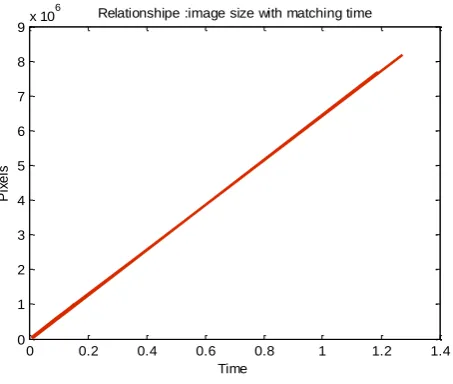
The matching time increases when the image size increases and there is a linear relationship between them as show in figure 2:
Figure 2: Relationship between matching time and image size
To build an efficient recognition system [4] we have to consider the following important issues:
- Selecting a method to create a features for each image, these features must be unique for every image to make it possible to use a features as a signature or key to retrieve or recognize the image,
0 0.2 0.4 0.6 0.8 1 1.2 1.4
0 1 2 3 4 5 6 7 8 9x 10
6
Time
P
ix
e
ls
Taking these issues into consideration we can apply the approach of creating recognition system to be built and designed performing the following tasks (as shown in figure 3):
Figure 3: Phases of creating image recognition system
- Building image features data set: this data set will be a 2D matrix, one column for each image features, here we have to select an accurate and efficient method to generate unique features for each image.
- Creating and training ANN to be used later as a recognizer, here we must pay attention on defining the type, and the architecture of ANN [8].
- The good trained ANN must be saved to be used later as a recognition tool.
2- Creating Color Images Features
Many methods of color image features[9], [10], [11] extraction are based on local binary pattern (LBP) [12], [13], these method are implemented in deferent variations [12], [13] to produce a features array of 256, 32, 16, and 4 values[14], [15],[16],[17],[18] .
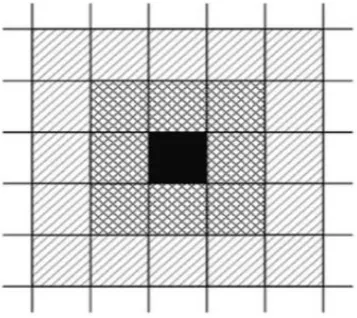
Here in this paper we will introduce features are method which is based on pixels 8-neighbours and 16-neighbours as shown in figure 4:
To extract the features array for each image we have to follow the following steps:
1. For each image do the following
2. Get the original color image.
3. Reshape the 3D color image to 2D image.
4. Initialize the features array (one column with 4 values) to zeros.
5. For each pixel do the following:
6. Find the average of the 8-neighbours (av8).
7. Find the average of the 16-neighbours (av16).
8. If av8>= pixel value let c0=1, else let c0=0. 9. If av16>= pixel value let c1=1, else let c1=0.
10. Find the features array index, index=c0+2xc1.
11. Add 1 to the repetition of this index.
12. End for
13. Add the features array to features matrix. 14. Save features matrix.
15. End for
The following matlab code was implemented using various color images in type and size:
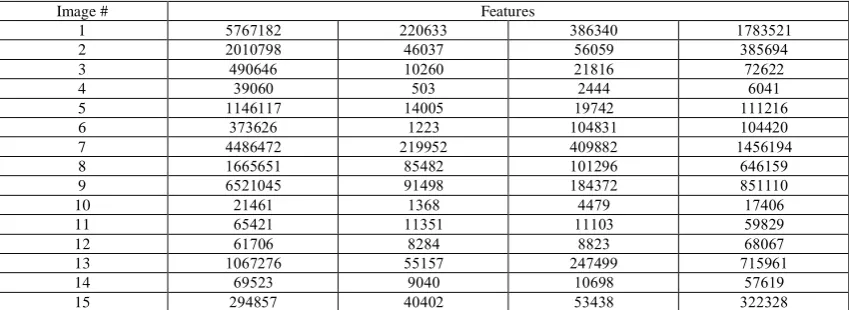
Table 2 shows the obtained features for some images:
Table 2: Color image features
Image # Features
1 2717675 556122 271286 6772256
2 5666707 81627 21620 272108
3 806181 66516 56761 75155
4 20616 262 5888 1686
5 6681667 68662 60785 666561
6 272151 6552 668726 668856
7 8871875 560025 860775 6821608
8 6112126 72875 666501 181620
9 1256682 06807 678275 726666
From the results shown in table 2 we can raise the following facts:
- Each image feature array is unique, thus we can use this array as a key or signature to retrieve or recognize the image, and this key must be passed to ANN for recognition purposes.
- The feature array is very sensitive to any changes in the image pixels values, this will lead to deferent image and deferent features array as shown in table 3:
- The used method of features extraction is very simple and flexible, any rotation of the image
does not affect the features array values, and here the original image and the rotated versions can be treated as one image.
Table 3: Changing pixels values leads to changing features array Image features Changing 1 pixel
changed
Changing 2 pixel changed
Changing 3 pixel changed
Changing 4 pixel changed
12856 12856 12856 12861 12861
66226 66222 66225 66226 66226
66662 66668 66668 66666 66665
20750 20751 20757 20727 20721
The obtained results using the proposed method of color image features extraction were compared with other LBP based methods (LBP, CSLBP, and RLBP) [9],[15], [16],[17] and here we can raise the followings which can be considered as advantages of the proposed method:
- Image features array is reduced to 4 values, this will reduce the size of the input data set to be passed to ANN recognizer, and the smaller data set size will simplify ANN architecture, which leads to memory space reduction and training time reducing.
- The feature array is sensitive to any change in the image; this will increase the recognition ratio and make it equal or much closed to 100%.
- The features array of the image is not sensitive to process of image rotation, so the original image and the rotated version will have the same features array.
3- Building the Recognizer
The proposed color image recognizer is to be built using ANN.
Artificial neural network a model which contains a set of computational elements called neurons, neurons are organized in one or more layers, each layer must be specified by an activation function, and according this function the output of the neuron will be calculated.
Figure 5: Neuron operations
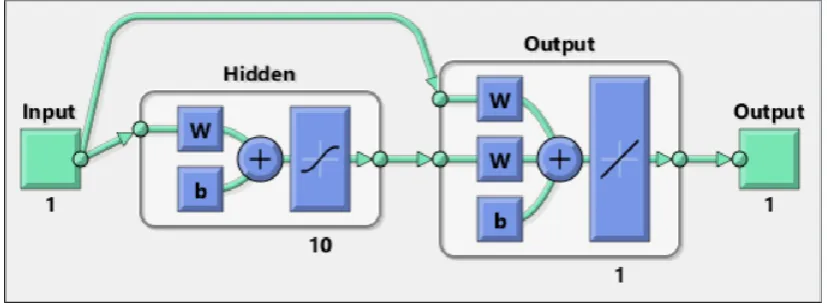
There are many types of ANN, and here we will focus on feed forward (FFANN), and cascade feed forward ANN (CFANN). Both types of ANN can be used as a tool to recognize the image or generate the image index or classifier which can be used to retrieve or recognize the image.
FFANN architecture contains a set of fully connected neuron organized in one or more layers as shown in figure 6, CFANN likes FFANN, but the inputs of the input layer are connected to the output layer as shown in figure 7.
To select a suitable ANN we have to pay attention to:
- Selecting an input data set (in our case images features).
- Data normalization (in our case we divide the data by 10000000).
- Selecting the targets (in our case images classifiers or indexes.
- Selecting the type of ANN.
- Selecting ANN architecture by defining the number of layers, the number of neurons in each
layer and the activation function for each layer. - Initializing the weights to zeros.
- Setting some parameters for ANN such as the error(goal must lead to zero), and number of training cycles (epochs);
ANN must be created by considering the above mentioned factors, and then ANN must be trained.
The training phase may be repeated several times until we reach the goal. If ANN does not provide a zero or closed to zero error we can adjust ANN architecture by adding extra layer and/or change the activation function (AF) except for the output layer which must remain linear.
3-1 Using FFANN
The following matlab code was written to create and train FFANN, the code was implemented several times using various architectures and parameters to reach the optimal ANN architecture which will generate the accurate image index which is specified by a selected features array.
Table 4 shows the results on FFANN implementations:
Table 4: FFANN implementation results
Layers[neurons] AF Number of
epochs
Training phases Error %
2[4 1] Logsig, linear 100 9 0
2[4 1] Tansig, linear 100 28 26.67
2[4 1] Tansig, linear 500 12 0
2[4 1] linear, linear 100 20 100
2[4 1] linear, linear 1000 20 100
3[4 4 1] Logsig,logsig,linear 100 24 95
3[4 4 1] Logsig,logsig,linear 1000 3 0
3[4 4 1] tansig,logsig,linear 1000 2 0
3[4 4 1] logsig,tansig,linear 1000 3 0
3[4 4 1] tansig,tansig,linear 100 23 Closed to target
3[4 4 1] tansig,tansig,linear 1000 2 0
3[4 4 1] linear,logsig,linear 1000 7 0
From table 4 we can see the following facts:
- We have to be careful when selecting FFANN architecture, some of the selected architecture
does not give accurate results regardless the number of training cycles and the number of training phases (green rows in table 4).
- Some time the selected architecture requires more training cycles and training phases (Red rows in table 4).
- Different architectures may give accurate results but with more training time.
3-1 Using CFANN
The following matlab code was written to create and train CFANN, the code was implemented several times using various architectures and parameters to reach the optimal ANN architecture which will generate the accurate image index which is specified by a selected features array.
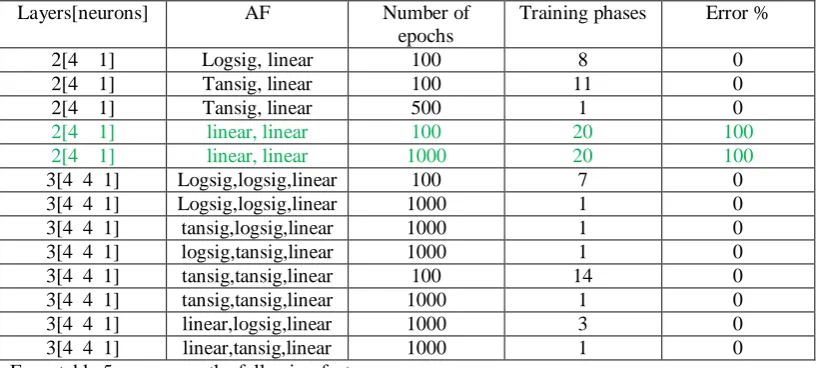
Table 5 shows the results on FFANN implementations:
Table 5: CFANN implementation results
Layers[neurons] AF Number of
epochs
Training phases Error %
2[4 1] Logsig, linear 100 8 0
2[4 1] Tansig, linear 100 11 0
2[4 1] Tansig, linear 500 1 0
2[4 1] linear, linear 100 20 100
2[4 1] linear, linear 1000 20 100
3[4 4 1] Logsig,logsig,linear 100 7 0
3[4 4 1] Logsig,logsig,linear 1000 1 0
3[4 4 1] tansig,logsig,linear 1000 1 0
3[4 4 1] logsig,tansig,linear 1000 1 0
3[4 4 1] tansig,tansig,linear 100 14 0
3[4 4 1] tansig,tansig,linear 1000 1 0
3[4 4 1] linear,logsig,linear 1000 3 0
3[4 4 1] linear,tansig,linear 1000 1 0
From table 5 we can see the following facts:
- CFANN enhances the performance of FFANN, by comparing the results in table 4 and table 5
we can see much improvement when using CFANN
- As For FFANN linear activation function can't be used in hidden layers because it always
leads to incorrect results.
Conclusion
Color image features extraction method was introduced, tested and experimental results were obtained. The Obtained results were compared with LBP based methods results; the proposed method gave optimized data set which can be used to minimize ANN architecture which leads to minimizing training time and memory space size.
Two deferent ANN were selected, trained and tested and it was shown that CFANN provides more efficiency and accuracy in color image recognition process.
References
[1] Majed O. Al-Dwairi, Ziad A. Alqadi, Amjad A. AbuJazar and Rushdi Abu Zneit, Optimized True-Color Image Processing World Applied Sciences Journal 8 (10): 1175-1182, 2010 ISSN 1818-4952. [2] Akram A. Moustafa and Ziad A. Alqadi, Color Image Reconstruction Using A New R'G'I Model, Journal of Computer Science 5 (4): 250-254, 2009 ISSN 1549-3636.
[3] Musbah J. Aqel, Ziad ALQadi, Ammar Ahmed Abdullah, RGB Color Image Encryption-Decryption Using Image Segmentation and Matrix Multiplication, International Journal of Engineering & Technology, 7 (3.13) (2018) 104-107.
[4] Dr. Ghazi. M. Qaryouti, Dr.Saleh Khawatreh, Prof. Ziad A.A. Alqadi, Prof.Mohammed Abu Zalata, Optimal Color Image Recognition System (OCIRS), International Journal of Advanced Computer Science and Technology. ISSN 2249-3123 Volume 7, Number 1 (2017), pp. 91-99.
[5] Akram A. Moustafa1, Ziad A. Alqadi and Eyad A. Shahroury, Performance Evaluation of Artificial Neural Networks for Spatial Data Analysis, WSEAS TRANSACTIONS on COMPUTERS, Issue 4,Volume 10, pp 115-124 April 2011.
[6] Khaled M. Matrouk,Haitham A. Alasha'ary, Abdullah I. Al-Hasanat, Ziad A. Al-Qadi, Hasan M. Al-Shalabi, Investigation and Analysis of ANN Parameters, European Journal of Scientific Research, ISSN 1450-216X / 1450-202X Vol.121 No.2, 2014, pp.217-225.
[7] Jamil Al-Azzeh, Ziad Alqadi, Mohammed Abuzalata,Performance Analysis of Artificial Neural Networks used for Color Image Recognition and Retrieving, JCSMC, Vol. 8, Issue. 2, February 2019, pp .20–33.
[8] Abdullah Al-Hasanat, Haitham Alasha'ary, Khaled Matrouk, Ziad Al-Qadi, Hasan Al-Shalabi, Experimental Investigation of Training Algorithms used in Back propagation Artificial Neural Networks to Apply Curve Fitting , European Journal of Scientific Research ISSN 216X / 1450-202X Vol.121 No.4, 2014, pp.328-335.
[9] AbuZneit, R., Z. AlQadi, and M. AbuZalata, A Methodology to Create a Fingerprint for RGB Color
Image. International Journal of Computer Science and Mobile Computing, 2017. 16(1): p. 205-212.
[10] AlQadi, Z. and H. M.Elsayyed, Window Averaging Method to Create a Feature Victor for RGB
Color Image. International Journal of Computer Science and Mobile Computing, 2017. 6(2): p. 60-66. [11] AlZudool, M., S. Khawatreh, and Z. Alqadi, Efficient Methods used to Extract Color Image Features. International Journal of Computer Science and Mobile Computing, 2017. 16(12): p. 7-14. [12] Marko H., Matti P. and Cordelia S., “Description of interest regions with local binary patterns,” Pattern Recognition, vol. 42 no. 3, (2009), pp. 425-436.
[13] T. Ojala, M. Pietikainen and D. Harwood, “A comparative study of texture measures with classification based on feature distributions,” Pattern Recognition, vol. 29 no. 1, (1996), pp. 51-59. [14] K. J. Priya and R. S. Rajesh, “A Local Min-Max Binary Pattern Based Face Recognition Using Single Sample per Class,” International Journal of Advanced Science and Technology, vol. 36, (2011), pp. 41-50.
[15] Zhang J., Marszalek M., Lazebnik S. and Schmid C., “Local features and kernels for classification of texture and object categories: A comprehensive study,” International Journal of Computer Vision June, vol. 73 no. 2, (2007), pp. 213-238.
[16] Rami, H., M. Hamri, and L. Masmoudi, Objects Tracking in Images Sequence Using Center-Symmetric Local Binary Pattern (CS-LBP). International Journal of Computer Applications Technology and Research, 2013. 2(5): p. 504-508.
[17] Gupta, R., H. Patil, and A. Mittal. Robust order-based methods for feature description. in IEEE conference on computer vision and pattern recognition (CVPR). 2010. USA.
[18] Hong, X., et al., Combining LBP difference and feature correlation for texture description. IEEE