
Redefining the Transparency Order
Kaushik Chakraborty1, Sumanta Sarkar2, Subhamoy Maitra2, Bodhisatwa Mazumdar3, Debdeep Mukhopadhyay3, and Emmanuel Prouff4
1
SECRET Team, INRIA, Rocquencourt
2 Indian Statistical Institute, Kolkata
[email protected], [email protected]
3 Indian Institute of Technology, Kharagpur
[email protected], [email protected]
4 Agence Nationale de la S´ecurit´e des Syst`emes d’Information (ANSSI)
Abstract. In this paper, we consider the multi-bit Differential Power Analysis (DPA) in the Hamming weight model. In this regard, we revisit the definition of Transparency Order (TO) from the work of Prouff (FSE 2005) and find that the definition has certain limitations. Although this work has been quite well referred in the literature, surprisingly, these limitations remained unexplored for almost a decade. We analyse the definition from scratch, modify it and finally provide a definition with better insight that can theoretically capture DPA in Hamming weight model for hardware implementation with precharge logic. At the end, we confront the notion of (revised) transparency order with attack sim-ulations in order to study to what extent the low transparency order of an s-box impacts the efficiency of a side channel attack against its processing. To the best of our knowledge, this is the first time that such a critical analysis is conducted (even considering the original notion of Prouff). It practically confirms that the transparency order is indeed re-lated to the resistance of the s-box against side-channel attacks, but it also shows that it is not sufficient alone to directly achieve a satisfying level of security. Regarding this point, our conclusion is that the (revised) transparency order is a valuable criterion to consider when designing a cryptographic algorithm, and even if it does not preclude to also use classical countermeasures like masking or shuffling, it enables to improve their effectiveness.
Keywords:AES, Auto-correlation, Cross-correlation, Differential Power Anal-ysis,PRINCE, s-box, Transparency Order, Walsh Spectrum.
1
Introduction
efficiency of these attacks is naturally much higher than linear or differential cryptanalysis due to the information related to the power traces. To resist such attacks, algorithmic countermeasures like masking [8] and leakage resistant logic [30] exist, that may lead to increased footprint on the implementation platforms in terms of area and power consumptions. Because of phenomenon like glitches, it should be noted that in practical scenarios even masked circuits can be subjected toDPA. With this backdrop, it is evident that the s-boxes in block ciphers would be the prime target of DPA. From the designers point of view, the s-boxes should be chosen carefully such that they should have highDPAresilience in addition to the resistance to other classical cryptanalytic attacks like linear and differential cryptanalysis.
In [15], the theoretical resistance ofAESandDESs-boxes to linear cryptanaly-sis vis a visDPAattacks in terms of signal-to-noise ratio (SNR) was investigated. Then, an attempt to quantify theDPAresilience of the s-boxes was made in [24], where the parameter Transparency Order (TO) was introduced. This was an im-portant attempt in defining a metric for theDPAresilience ofS-boxes for almost a decade ago. Based on a side-channel efficiency metric close to the standard score measure involved in [15, 31], the paper [24] tried to explain that s-boxes with smallerTOhave higherDPAresilience. TheTO, as defined in [24] was found to depend on the propagation characteristics (PC) of the co-ordinate functions of the s-boxes. The bent functions that satisfy the PC for all orders have been found to have worstTOvalue (though we show in this paper that by the defini-tion of [24],TOcannot be measured for a bent function), while the linear s-boxes have the bestDPAresilience. However, the linear s-boxes are not acceptable as a secure cryptographic primitive. Further analyses ofTO, as defined in [24], have been followed in e.g., [5, 11, 18, 22].
In this paper, we exhibit several inconsistencies in the original definition given in [24] and we provide an improved definition of the transparency order that appears to be a better metric for quantifying the resistance the resistance of an s-box toDPAattacks. Eventually, its soundness to quantify the resistance of an s-box against side-channel attacks is investigated thanks to several at-tack simulations. We also provide Appendices A, B, C and D for some detailed calculations, bounds, examples and comparisons with other related works.
Before presenting these contributions, we hereafter start by introducing some useful basics on Boolean functions andDPAattacks which are subsequently used to present our analyses in a formal way.
2
Preliminaries
2.1 Basics of Boolean functions
Let Fn
2 be the vector space that contains all the n-bit binary vectors. For a vectoru∈Fn
denote the set of n-variable Boolean functions as Bn. It is easy to note that
|Bn|= 22
n
.
The support of a Boolean functionf is defined asSupp(f) ={x∈Fn2|f(x) = 1}. When we use a Boolean function as a cryptographic primitive, we generally consider the functions which output 0 and 1 with equal probability. Thus, we generally consider functions in Bn for which the cardinality of the support is
2n−1. These are known asbalanced functions.
Letx= (x1, . . . , xn) and ω= (ω1, . . . , ωn) both belong to Fn2 and the inner product x·ω =x1ω1⊕ · · · ⊕xnωn. TheWalsh transform of f(x) is an integer
valued function over Fn2 which is defined asWf(ω) =Px∈Fn2(−1)
f(x)⊕x·ω. The
autocorrelation transform of f(x) is again an integer valued function over Fn
2 which is defined asAf(ω) =Px∈Fn
2(−1)
f(x)⊕f(x⊕ω). The Walsh and
autocorre-lation spectra are important properties in designing Boolean functions that may be used as cryptographic primitives. In general, it is expected that the maxi-mum absolute value in any of these spectra should be low for better resistance against cryptanalysis (see e.g., [6]). In this paper, we also use the notion of cross-correlation spectrum between two Boolean functions; forf1, f2 ∈ Bn, it is
defined for everyω∈Fn2 as the valueCf1,f2(ω) =
P
x∈Fn2(−1)
f1(x)⊕f2(x⊕ω)(note
that we haveCf,f(ω) =Af(ω)).
Ann×ms-boxF can be seen as a multi-output Boolean function, namely a function fromFn
2 into Fm2 with m≤n. Letu∈Fm2 be a vector whose binary coordinates are all zero except one which is assumed to be at indexj. The jth component function of the s-boxF is the single output Boolean functionu·F. IfF = (F1, . . . , Fm), then one may note thatu·F =Fj. By abuse of notation,
we may also denote this component function as Fu. That is, the notationsFu
andFj are used interchangeably for a component function in this paper. The set
of linear (resp. affine) functions fromFn2 into itself will be denoted byLn (resp.
An).
2.2 Basics on DPA attacks
Differential Power Analysis (DPA) is one kind of side channel attack that exploits the difference between the power consumed by a single gate when its output changes from zero to one or vice versa. Initial results in this direction have been presented by Kocher et al [16]. It consists in observing the processing of a cryptographic algorithm (e.g., a block cipher) and in measuring a sample of power consumption tracesTxrelated to a sufficiently large number of plaintexts
xand a constant secret parameter. These traces (which may be viewed as real-valued vectors) actually give the information about the power consumed by each gate when output changes. Next, based on these power traces, the actual attack can be mounted off-line.
index of the targeted bit and let K˙ denote a secret sub-part that statistically depends on this bit (assuming that the block cipher is iterative, K˙ may corre-spond to the secret parameter of an s-box and is typically 4, 6 or 8 bit long). The attacker makes a guessKonK˙ and then the traces are assigned in either of the two bins, sayS0 andS1, according to hypotheses on the targeted bit which are deduced fromK and the plaintextsx. To discriminate the good guess from the wrong ones, [16] proposes to compute thedifferential traceDK,j defined by
DK,j=|S1
1|
P
Tx∈S1Tx− 1
|S0|
P
Tx∈S0Tx. The quantityDK,jworks as a distin-guisher in the single-bit power attack model. According to the theory proposed in [16] the vectorDK,j should show a peak for the correct keyK=K˙.
In single-bitDPAattack, the setsS0andS1are constructed on the basis of a fixed bit coordinatej. To improve the efficiency of the attack and to better dis-criminate the wrong key-hypotheses, a natural idea is to simultaneously consider several bit indicesj. This kind of DPAattack, initially introduced by Messerges in [20], is called multi-bit DPA. It works as follows; for each of the guessed key K, the quantityDK,jis computed for severalj (e.g.,j∈[1..m]) and the results
are added to form a new distinguisher DK. As in the single-bit case, DK is
expected to show a peak if K=K˙. In [10], it has been proved that this attack is equivalent to the so-calledCPAattack introduced in [4] up to a change of the attacker model5. In [1], it has been proposed to add the absolute values of the
DK,j (instead of the values themselves) to build DK. This approach may be a
valuable alternative in practice and it is not equivalent to aCPA[10].
The work presented in this paper focuses on multi-bit DPAwhich is today systematically tested against industrial cryptographic implementations when it comes to test their security with respect to side-channel attacks. Before proceed-ing further, let us introduce hereafter a few basic concepts related to Boolean functions.
2.3 DPA Attack and Transparency Order of s-boxes
As discussed in Section 1, the DPA provides the attacker a verifier (or distin-guisher) to guess the correct key. The distinguisher based on the so called dif-ferential traces(Dk,j)k∈Fn2,j∈[1..m] (resp. (Dk)k∈Fn2 for multi-bitDPA/CPA) works on the hypothesis that it takes the maximum value for the correct key (though, due to the presence of system noises one can get several other “ghost peaks” for wrong keys as observed in [4]). Now, from the designer’s point of view, one should design the s-boxes in such a manner so that the distribution of the dif-ferential trace becomes almost uniform. In such a case, the correct key cannot be distinguished from a wrong key. This idea has been the starting point of two studies published in 2004 [15, 24] aiming at defining a new security criterion for the design of s-boxes with improved resistance againstDPAattacks.
5 Such a model is used in CPA, together with the key hypothesis K, to compute the predictions that are correlated to each point of the tracesTx (see [4] for a detailed
In [15], a few ideas were presented to measure the efficiency of DPA on an s-box. They studied single-bitDPAduring the manipulation of the s-box output, the information being assumed to leak in the Hamming distance model with independent additive noise [4]. This model assumes that the leakage takes the form H(β⊕F(x⊕K˙)) +B, wherexandK˙ respectively denote a plaintext and a round key sub-part, whereβ denotes the initial content of the register before updating with F(x⊕K˙) and where B denotes an independent (measurement) noise. In this model, the authors of [15] show that the coordinate with highest amplitude in the single-bit distinguisherDK,j related to the j-th coordinate of
F is asymptotically equivalent to:
∆K,K˙(j, β)
. = 2−n
m
X
i=1
(−1)βi X
x∈Fn2
CFi,Fj(K⊕K˙) , (1)
whereβi denotes thei-th binary coordinate ofβ.
The original idea of [15] has been afterwards developed and extended in [24] to encompass multi-bit DPA. This leads the author to introduce the notion of transparency order(TOfor short) to quantify the resistance of s-boxes towards
DPA attacks; if some s-box shows low TO, then that s-box is more resistant against DPA attack, i.e., the number of power traces to identify the correct key will be higher. The TO notion introduced in [24] not only depends on the s-box’s algebraic properties but also on the register initial state β ∈Fm
2 which is assumed to be constant for some platforms like smart cards which are based on precharge logic. The precharge logic is applied for some microcontrollers in which there is a precharge phase during which the registers are initialized to some fixed value (e.g., before each round in a block cipher implementation). After certain assumptions, the final formula defining the TO of an×ms-box F = (F1, . . . , Fm) is given by:
TO(F) = max
β∈Fm2
|m−2H(β)| −
1 22n−2n
X
a∈Fn2∗ |
m
X
i=1
(−1)βiA
Fi(a)|
. (2)
Remark 1. TheTOnotion share the same basic ideas with the side-channel effi-ciency metric (standard score) discussed in [31]. In those papers, the effectiveness of an attack is measured by computing the difference between the score of the distinguisher for the good key and the average score for the wrong hypotheses, the difference being normalized with the variance of the scores.
of little interest, though those values may be computed for noting the bounds onTO.
In this paper, we critically study the above definition of TO. In the next section (Section 3), we actually show that this definition has redundancy in terms of considering the maximum over all β ∈ Fm
2. Then in Section 4, we critically analyse the definition of TO in the Hamming weight model from the basic background and identify all the limitations of the existing definition [24]. Next, in Section 5, we present our modified definition of TOthat explains the
DPAin Hamming weight model more appropriately than [24] (see also Remark 5). Eventually, Section 6 confronts the notion of (revised) transparency order with attack simulations. The goal is to investigate how the low transparency order of an s-box impacts the efficiency of a side channel attack against its processing.
3
Redundant Definition of Transparency Order [24]
In this section, we explain why the definition (2) is redundant. For such a pur-pose, we denote byτFβthe value|m−2H(β)|− 1
22n−2n P
a∈Fn2∗|
Pm
i=1(−1)
βiA
Fi(a)|
in (2) and by νF,β the value 22n1−2n P
α∈Fn2∗|
Pm
i=1(−1)
βiA
Fi(α)|. With these
new notations, we have TO(F) = maxβ∈Fm2 τF,β. We give hereafter our first result.
Proposition 1. τFβ =τFβ.
Proof. Note that|m−2H(β)|=|m−2(m−H(β))|=|−m+2H(β)|=|m−2H(β)|. One may also check thatνF,β =νF,β, which directly concludes the proof. ut
Next we present the most important result of this section.
Proposition 2. Let 0<H(β)≤ bm
2c. Thenτ
β F ≤τ
0 F.
Proof. Consider that 0 < k = H(β)≤ bm
2c. Now, τ
0
F = (m−νF,0) and τFβ =
(m−2k−νF,β).
Let, in contrast to the statement of the proposition,τFβ > τ0
F. ThenνF,0−
νF,β>2k,i.e.,
X
α∈Fn2∗
"
|
m
X
i=1
(AFi(α))| − |
m
X
i=1
(−1)βiA
Fi(α)
|
#
>(22n−2n)2k.
LetS={1,2, . . . , m}and T ⊆S, such thati∈T if and only ifβi = 1. That is
T is the support ofβ.
Then we can rewrite the above inequality as
X
α∈Fn2∗
|
m
X
i=1
(AFi(α))| − | X
i∈S\T
(AFi(α))− X
i∈T
(AFi(α))|
Using the inequality|x| − |y| ≤ |x−y|, we obtain,
X
α∈Fn2∗
|
m
X
i=1
(AFi(α))− X
i∈S\T
(AFi(α)) + X
i∈T
(AFi(α))|
>(2
2n−2n)2k,
i.e., X
α∈Fn2∗ 2
X
i∈T
(AFi(α))
>(22n−2n)2k.
We know that|AFi(α)| ≤2
n, and thus we land into a contradiction as the left
hand side is always less than or equal to the right hand side. (Even taking the maximum value 2n, we get that the left hand side is equal, but cannot be greater
than the right hand side.) Thus the proof. ut
Therefore, we have the following result that shows that the definition of trans-parency order is actually redundant and it does not depend on β. The proof follows from Propositions 1, 2.
Theorem 1. TO(F) =τ0 F =m−
1 22n−2n
P
α∈Fn2∗|
Pm
i=1AFi(α)|.
4
Critically analyzing
TO
for Multi-bit
DPA
Attack
Given the redundancy in the definition ofTOas in [24], we look into the definition from the basic principle and obtain various other limitations of the definition. We highlight several assumptions considered in [24] and critically comment on those.
The output of the s-box becomesF(x⊕K˙) fromβ, whereβ is the precharge logic value that is fixed with the system,i.e., β is constant. So, the number of bits, changed after storing the s-box output bits isH(F(x⊕K˙)⊕β). The basic idea of DPAworks as follows.
Given the correct keyK˙ (the attacker does not know this), the power trace of the encryption or decryption can be collected by the adversary corresponding to the known plaintexts. As the correspondingn×ms-boxes are in general not very large, one may expect that the power traces are available corresponding to all the 2npossible inputsx. Once the data is available, the attack may work off-line
where the attacker tries each of the possible 2n keysK (these are actually parts
of round keys that are XORed withx) and partitions the power traces in two bins. It is expected that for the correct key K˙, the partitioning will show some distinguishing feature than that in the case of the incorrect keys.
Let us concentrate on the j-th output bit of the s-box. Given any key K (which may or may not beK˙), we put the power related information in two bins depending on the value of Fj(x⊕K). As in [24], for theoretical analysis, the
Hamming weight of F(x⊕K)⊕β can be considered as a logical model for the power related information. The difference of average value in the two bins is
∆K,K˙(j, β) =
1 |SK,1|
X
x∈SK,1
HF(x⊕K˙)⊕β− 1 |SK,0|
X
x∈SK,0
whereSK,0={x|Fj(x⊕K) = 0} andSK,1={x|Fj(x⊕K) = 1}. At this point
let us present a technical result.
Proposition 3. Let F = (F1, . . . , Fm)be an n×m s-box (i.e., F :Fn2 →Fm2). Let the co-ordinate functions be such that they are pairwise complement whenm is even. In case m is odd, then we consider m−1
2 pairs of pairwise complement functions and one constant function. For any such s-box,∆K,K˙(j,0) = 0for any
j, 1≤j≤m.
Proof. The proof follows by noting that H(F(x)) is constant for all x ∈ Fn2. Thus it is immediate to note that HF(x⊕K˙) is always constant making
∆K,K˙(j,0) = 0, for anyj. ut
Consider a special case whenmis even. For any such s-box, where all the func-tions are taken to be pairwise complement and bent, no DPA is possible under the model we are working on. However, the measure presented in [24, 5] shows thatTOis maximum (i.e., equalsm) for such functions, which means that they are maximally prone to suchDPA. The conclusion in [24, 5] is not correct and it happened due to certain assumptions that make the definition of TO invalid for s-boxes with unbalanced co-ordinate functions such as bent.
Assumption 1. The analysis of [24] implicitly assumes that the co-ordinate functions of the s-box are balanced.
Note that, while the above assumption thatFj is balanced is true for most
popular s-boxes in block ciphers, it is not true in general. Most importantly, it is incorrect to hence apply the old formulation of Transparency Order to bent functions, as done in [24, Theorem 1] and later in [5]. To clarify the situation, we show more explicitly how the assumption of the balancedness of the co-ordinate functions led to the old definition of transparency order.
IfFj is balanced, then|SK,0|=|SK,1|= 2n−1 and one can show (see [24] or
Equations (17) and (18) in Appendix B for details):
∆K,K˙(j, β) =
1 2n
(−1)
βjA
Fj(K⊕K˙) +
m
X
i=1,i6=j
(−1)βiC
Fi,Fj(K⊕K˙)
, (3)
which implies the following forK=K˙;
∆K˙,K˙(j, β) = (−1)βj +
1 2n
m
X
i=1,i6=j
(−1)βiC
Fi,Fj(0) . (4)
Assumption 2 [24].Fi⊕Fj is balanced for every (i, j)∈[1..m]2withi6=j.
Under Assumption 2, we haveCFi,Fj(0) = 0 for every pair of distinct indices
2 are satisfied when the involved (n, m) s-box is balanced (which is the case of the vast majority of cryptographic s-boxes).
In single-bit DPAattack the expression ∆K,K˙(j, β) is calculated for a fixed
indexjand for all hypothesesK∈Fn2. In the multi-bit case, the latter calculation is done for everyj∈[1..m]. This actually leads to the processing of the following quantityδK,K˙(β) [24, Equation (10)]:
δK,K˙(β) =|
m
X
j=1
∆K,K˙(j, β)|. (5)
ForK6=K˙, we have:
δK,K˙(β) =
1 2n m X j=1 m X i=1
(−1)βiC
Fi,Fj(K⊕K˙) . (6)
And, forK=K˙, we have:
δK˙,K˙(β) = m X j=1 (−1)βj
1 +
1 2n
m
X
i=1,i6=j
(−1)βi⊕βjC
Fi,Fj(0) , (7)
and Assumption 2 impliesδK˙,K˙(β) =
Pm
j=1(−1)
βj
=|m−2H(β)|.
We now introduce the last assumption made in [24].
Assumption 3.The cross-correlation terms CFi,Fj(K⊕K˙) can be considered
to be zero for everyi6=j and every (K,K˙).
Remark 2. Clearly, this third assumption is not true as we cannot have all the values zero in cross-correlation spectrum in general. In fact, we will later present a detailed study for the 8×8 s-box used in AES that will clearly show the limitation of the Assumption 3 made in [24].
Given Assumption 3, we haveδK,K˙(β) =
1 2n Pm
j=1(−1)
βjA
Fj(K⊕K˙) . It is
expected that if K =K˙, then δK,K˙(β) takes the maximum value. Hence, from
the designer’s point of view, s-boxes should be chosen in such a manner so that for most ofK 6=K˙, the value of δK,K˙(β) does not deviate much fromδK˙,K˙(β).
The core idea is the following one: a small average distance betweenδK,K˙(β) and
δK˙,K˙(β) will render the discrimination ofK˙ more difficult. This led the author
of [24] to introduce the following definition of transparency orderTO:
TO(F) = max
β∈Fm2
τFβ, where τFβ= 1 2n−1
X
K∈Fn
2−{K˙}
δK˙,K˙(β)−δK,K˙(β)
As we have described, the work in [24] considered a few assumptions, but several critical comments can be made on that. To be specific, we point out the following.
– Assumption 1 is logical and it works for practical s-boxes that the co-ordinate Boolean functions are balanced. However, given this assumption, it is not possible to consider unbalanced co-ordinate functions in the s-box under this definition. However, this had been improperly done in [24, 5] in concluding certain results related to bent functions.
– Assumption 2 is also logical in the sense that it is quite practical to consider that the XOR of two co-ordinate functions should be balanced.
– Assumption 3 considers that the cross-correlation spectrum between two co-ordinate functions will contain all zero values due to certain independence. This is indeed not correct and one should specifically calculate these value that we will also present here. For example, for the 8×8 s-box used in AES, the values in the spectrum are indeed significant. Ignoring this significance led to the redundant definition ofTO(F) in [24] where it does not depend onβ at all as we have described in Section 3.
4.1 Considering the cross-correlation terms
For a proper measure, we need to add the cross-correlation terms as given in (6). Thus, we should consider the following definition for further investigation in this area:
τ0βF =|m−2H(β)| (9)
− 1
2n(2n−1)
X
a∈Fn2∗
m
X
j=1
(−1)βjAFj(a) +
m
X
i=1,i6=j
(−1)βiC
Fi,Fj(a)
.
Similar to Proposition 1, one may note that under the modified definition of
τ0βF as given in (9),τ0βF andτ0βF are equal (see (19) in Appendix B for details). Let us now consider τ0F as in (10). This definition will only be valid for the
n×ms-boxesF = (F1, . . . , Fm), where each co-ordinate functionFiand further
the functionsFi⊕Fj for 0≤i6=j ≤mare balanced.
τ0F = max β∈Fm2
[|m−2H(β)| (10)
− 1
22n−2n
X
a∈Fn2∗
m
X
j=1
(−1)
βjA
Fj(a) +
m
X
i=1,i6=j
(−1)βiC
Fi,Fj(a)
].
Now consider the definition from cryptanalysts’ viewpoint. The power traces will be available to the attacker and she can analyse the data off-line to guess the correct key. Thus, the attacker will try to use the power traces in such a way so that the correct keyK˙ can be distinguished from the other keys.
0 50 100 150 200 250
β
2 0 2 4 6 8
τ
β F,τ β F
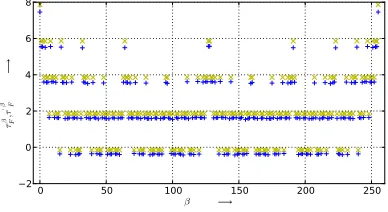
Fig. 1.Values ofτFβ (in Yellow) andτ0βF (in Blue) asβ varies overF
8
2 forAESs-box. The 8-bit patterns ofβare written as their integer values.
ForAESs-box, the values of τFβ andτ0βF are plotted in Figure 1 for different
values β. The figure shows that for some values ofβ, τFβ and τFβ are negative. For those values of β, the coefficientδK,K˙(β) , which prevents the attacker to
guess the correct key for these β. This happens because the absolute value is processed after taking the sum of the ∆K,K˙(j, β) (see (5)). Note that if the
precharge logic β is indeed all-zero or all-one, then the existing idea of [24] works well. However, when H(β) becomes closer to m2, the term |m−2H(β)| reduces substantially, makingτFβandτ0βF negative in some cases, that makes the definition unacceptable from cryptanalyst’s point of view.
5
Redefining
TO
: where to take the absolute values
As explained before Proposition 3, the quantity ∆K,K˙(j, β) corresponds to the
test of the key candidate K in a single-bitDPA attack. The attack is assumed to target thej-th bit of the updating withF(x⊕K˙) of a register whose initial content is alwaysβ. In [24], the author suggests to extend this attack to several bits by processing the absolute value of the quantities ∆K,K˙(j, β) for several
indicesj(e.g., j∈[1..8] for an 8-bit register). In [10], it is argued that this kind of attack is equivalent to aCPAup to a change of the attacker leakage modeling. Here, we propose another approach to extend the initial single-bit attack to a multi-bit one. This exactly corresponds to the proposal made by B´evan and Knudsen in [1], and consists in summing the absolute values of ∆K,K˙(j, β) for
reducible to aCPAattack and is actually a valuable alternative in practice [10]. Our proposal leads to the following definition of a coefficientδK,K˙(β):
δK,K˙(β) =
m
X
j=1
|∆K,K˙(j, β)| . (11)
Similarly as for (7), Assumption 2 implies that δK˙,K˙(β) equals
Pm
j=1|(−1)
βj|
that is m. Compared to (7), it may be checked that the term related toH(β) is removed. This is indeed important since this Hamming weight ofβ was influ-encing the complete measure without any real justification and was making the definition redundant by maximizing it for all-zero or all-oneβ.
ForK6=K˙, Equation (6) becomes:
δK,K˙(β) =
1 2n m X j=1
(−1)βjA
Fj(K⊕K˙) +
m
X
i=1,i6=j
(−1)βiC
Fi,Fj(K⊕K˙) = 1 2n m X j=1 m X i=1
(−1)βi⊕βjC
Fi,Fj(K⊕K˙) , (12)
which leads to the following new version, called TO(F, β), of the coefficient de-fined in (9);TO(F, β)=. 2n1−1
P
a∈Fn2?δ0,0(β)−δa,0(β), or equivalently
TO(F, β) = 1 2n−1
X
a∈Fn2?
m−
m
X
j=1
|∆a,0(j, β)|
(13)
that is
TO(F, β) =m− 1 2n(2n−1)
X
a∈Fn2∗
m X j=1 m X i=1
(−1)βi⊕βjC
Fi,Fj(a) , (14)
whereaplays the role ofK⊕K˙ in (12).
Remark 3. We still have TO(F, β) =TO(F, β).
We eventually deduce the following new definition of theTOcriterion:
Definition 1 (Improved Transparency Order).Let F be a balanced n×m function. Its improved transparency order is the coefficientTO(F)defined by:
TO(F) = max
β∈Fm2
m−
1 22n−2n
X
a∈Fn2∗
m X j=1 m X i=1
(−1)βi⊕βjC
Fi,Fj(a)
. (15)
Remark 5. From designers’ point of view, it is important to consider the precharge values β for which TO(F, β) is minimum. Indeed, for such precharge values β, the attacker advantage is minimum. In the rest of the paper, the value minβ∈Fm2 TO(F, β) is denoted by TOmin(F) and called minimum transparency order. On the other hand, precharge logic values maximizing TO(F, β) corre-spond to the worst case from designers’ point of view and to the best case for attackers.
In Appendix C, we exhibit an interesting lower bound onTO(F). The main combinatorial contribution in this bound is that, all the cross-correlation terms are replaced by Walsh spectrum values.
5.1 Example with some existing s-boxes
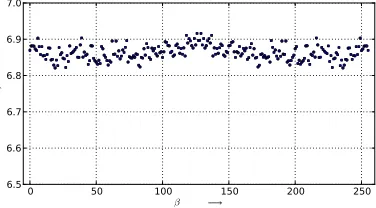
Let us first refer to the 8×8 s-box F of AES [13]. The graphical representa-tionTO(F, β) is presented in Figure 2 and one may note the symmetry due to
TO(F, β) =TO(F, β).
0 50 100 150 200 250
β
6.5 6.6 6.7 6.8 6.9 7.0
Fig. 2.Values ofTO(F, β) as βvaries overF82 for AES s-box. The 8-bit patterns ofβ are written as their integer values.
It may be observed that the minimum value 6.82083 ofTO(F, β) is achieved for β = βmin = (0,0,0,1,0,0,1,1) (integer value 19) and its complement, whereas the maximum value 6.91605 is achieved for βmax = (0,1,1,1,1,1,1,0) (integer value 126) and its complement. We hence deduce that the TO of the
AESs-box isTO(F) = 6.91605. Moreover, from designers’ point of view, it is bet-ter to useβminas the precharge logic as in that case more effort will be required (than when any otherβ is the precharge logic) to identify the peak correspond-ing to the correct key. Our lower bound of TO(F) presented in Theorem 4 of Appendix C provides the value 6.51457. We have also analyzed the family of
PRINCE4×4 s-boxes [3] (details in Appendix A). Our analysis shows that they
5.2 TO of s-boxes in the same (extended) affine equivalence classes
Twon×ns-boxesF andGare affine equivalent if there exist two affine permu-tations A, B ∈ An such that G = B ◦F ◦A, i.e., G(x) = [B ◦F ◦A](x),
for all x ∈ Fn2. Further if there exists C ∈ Ln such that F and G satisfy
G(x) = [B◦F◦A](x)⊕C(x), thenF andGare said to beextended affine(EA) equivalent. Some cryptographic properties remain invariant under such trans-formations. The set of functionsGwhich are EA-equivalent to F is denoted by EA(F). In this section, we would like to pursue whether the DPA resistance of s-boxes is affected because of these transformations. It is an important aspect in design of block ciphers, which often assumes that since affine transformation does not affect properties like non-linearity, maximum value in the auto-correlation spectrum, degree (when more than 1), it is fine to replace one with the other.
The affine invariance of theTO criterion is stated in the following theorem whose proof is given in Appendix B.
Theorem 2. LetF be ann×mbalanced function. Then, for any affine permu-tation A∈An we haveTO(F◦A) =TO(F).
On the other hand, if two functions F and G are EA-equivalent but not affine equivalent (meaning that G=B◦F◦A⊕C with A, B ∈An, C ∈Ln
andCnon-constant), then theirTOare not necessarily equal. For example,F = 084b2ef613ac57d9 and G = 03d5070601ebeff0 are two EA-equivalent s-boxes withTO(F) = 2.466 andTO(G) = 2.766. These two s-boxes are related by the relationF =B◦F+C, whereBandCare the linear mappings associated with
the matrices
1 0 0 0 0 1 0 0 1 0 1 0 0 1 0 1
and
0 1 0 1 1 0 1 0 1 0 0 1 1 0 1 1
, respectively.
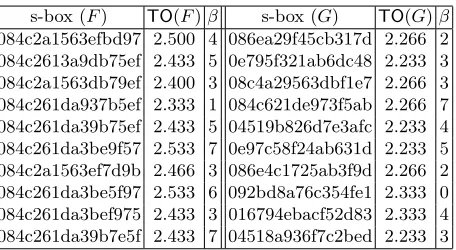
The number of 4×4 s-boxes up to affine equivalence is 302 [2], among which 10 s-boxes have nonlinearity 4, degree 3 and absolute autocorrelation value 8, which are the basic cryptographic properties that make these s-boxes useful in practice. We compute theTOvalues of each of these 10 s-boxes (denoted asF) and their extended affine equivalent ones (denoted asG). The results are shown in Table 1. From these tables it is evident that betterTOvalues are obtained by considering the extended affine equivalent functions of these 10 s-boxes, hence we recommend to use such functionsGfrom Table 1 that give better resistance againstDPA, i.e., lesserTOvalue. Following the Table 1, one should use some Gsuch thatTO(G) = 2.233.
6
Practical Soundness of the Transparency Order
6.1 Attack Simulations
s-box (F) TO(F)β s-box (G) TO(G)β
084c2a1563efbd97 2.500 4 086ea29f45cb317d 2.266 2 084c2613a9db75ef 2.433 5 0e795f321ab6dc48 2.233 3 084c2a1563db79ef 2.400 3 08c4a29563dbf1e7 2.266 3 084c261da937b5ef 2.333 1 084c621de973f5ab 2.266 7 084c261da39b75ef 2.433 5 04519b826d7e3afc 2.233 4 084c261da3be9f57 2.533 7 0e97c58f24ab631d 2.233 5 084c2a1563ef7d9b 2.466 3 086e4c1725ab3f9d 2.266 2 084c261da3be5f97 2.533 6 092bd8a76c354fe1 2.333 0 084c261da3bef975 2.433 3 016794ebacf52d83 2.333 4 084c261da39b7e5f 2.433 7 04518a936f7c2bed 2.233 3
Table 1.All 4×4 s-boxF up to affine equivalence with nonlinearity 4, degree 3 and absolute autocorrelation value 8, and their respective affine equivalent s-boxes that achieve the minimumTO(G); theβvalues are also given where theTOis attained.
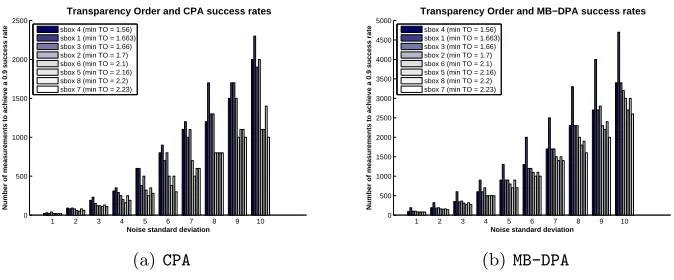
We first performedCPAattack simulations against the 8PRINCEs-boxes listed in Table 2 (Appendix A). We think that the latter ones are good targets for our study since their minimum transparency order are reasonably different and ranges from 1.56667 (for s-box 4) to 2.23333 (for s-box 7). In these first tests campaign, we choose to simulate the information leakage in the classical Ham-ming Distance model with Gaussian noise. Namely, the leakageL(X⊕K˙) related to the processing of the s-box outputF(X+ ˙K) equals H(F(x⊕K˙)⊕β) +B, where B is a random variable whose distribution is Gaussian with null mean and standard deviation σ. The value β corresponds to the initial state of the memory before the writing of F(x⊕K˙). According to the discussion in previ-ous sections, we assumed that it can be chosen by the designer and, for each
PRINCE s-boxF, we selected it to minimizeTO(F, β) (see Table 2)6. Each
hy-pothesis K on ˙K has been tested by estimating the correlation coefficient 7 ρ(HW(F(X ⊕K)⊕β), L(X ⊕K˙)). It can be noticed that the initial content β of the register is assumed to be known by the attacker, which makes sense since it is part of the design parameters and therefore must be public according to Kerckhoff’s rule. The number of leakage observations used to estimate the correlation is denoted byN. Attacks have been tested for different amounts of noise (namely for different standard deviations σ ∈[1..10]). For each of them, we estimated the minimum number of observations N required for the attack to succeed with a probability at least equal to 0.9. As argued in [17, 25], this is a sound way to evaluate the efficiency of a side-channel attack. Results are reported in Figure 3(a).
6
this should correspond to a maximum level of security.
7 We recall that the correlation coefficient between two random variablesUandV can be soundly estimated from respectively N observations (ui)i and (vi)i ofU and V
byρ(U, V)'(NP
iuivi−Piuivi)/(
p
NP
iu2i−(
P
iui)2
p
NP
ivi2−(
P
Remark 6. Since leakages are generated with the same (Hamming distance) model used to compute the predictions, the use of the correlation coefficient as a statistical distinguisher is an optimal choice. In particular, we experimen-tally validated that replacing it by a mutual information (as proposed in [14]) does not improve the attacks success rates, nor change the conclusions we have drawn from our simulations withCPA.
1 2 3 4 5 6 7 8 9 10
0 500 1000 1500 2000 2500
Noise standard deviation
Number of measurements to achieve a 0.9 success rate
Transparency Order and CPA success rates
sbox 4 (min TO = 1.56) sbox 1 (min TO = 1.663) sbox 3 (min TO = 1.66) sbox 2 (min TO = 1.7) sbox 6 (min TO = 2.1) sbox 5 (min TO = 2.16) sbox 8 (min TO = 2.2) sbox 7 (min TO = 2.23)
(a)CPA
1 2 3 4 5 6 7 8 9 10
0 500 1000 1500 2000 2500 3000 3500 4000 4500 5000
Noise standard deviation
Number of measurements to achieve a 0.9 success rate
Transparency Order and MB−DPA success rates
sbox 4 (min TO = 1.56) sbox 1 (min TO = 1.663) sbox 3 (min TO = 1.66) sbox 2 (min TO = 1.7) sbox 6 (min TO = 2.1) sbox 5 (min TO = 2.16) sbox 8 (min TO = 2.2) sbox 7 (min TO = 2.23)
(b)MB-DPA
Fig. 3. Minimum number of Messages (in y-axis) required to achieve a 90% success rateversusthe noise standard deviation (inx-axis)
It may be checked in Figure 3(a) that the transparency order impacts the
CPAattack efficiency in the Hamming distance model. This impact increases with the noise and, forσ = 10, the attack efficiency (i.e., the number of traces) is almost multiplied by 2.5 if we compare s-boxes 1 and 7. One can also observe that TOmin alone does not fully capture the resistance against CPA since sbox 1 seems to be always more resistant than sbox 4 whereas its TOmin is slightly greater (1.663 versus1.56).
In Section 5, we related the new notion of transparency to the multi-bit
DPAattack introduced in [1]. Since the latter attack is not equivalent to aCPA, we ran a second attacks simulation campaign. The results are reported in Figure 3(b). As expected, they essentially confirm the results we had with theCPA: the lowerTOmin(F), the higher the resistance against the attacks.
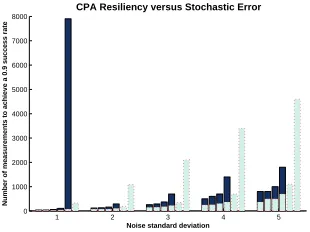
In the second phase of our simulations, we wanted to investigate the robust-ness of the transparency order criterion against stochastic errors. In other words, we studied the impact of an erroneous modelling on the s-boxCPAresistance, by performingCPAattack simulations against the fourth and the seventhPRINCE s-boxes8under the assumption that the information is not leaking in the Hamming distance model but in an erroneous version of it. Namely, for a fixedstochastic
8
error standard deviation σer chosen9 in {0,0.2,0.4,0.6,0.8,1.0}, we simulated
the leakageL(X⊕K˙) such that:
L(X⊕K˙) =ϕ(F(X⊕K˙)⊕β) +B , (16)
where ϕ is a function defined for every y ∈ F42 by ϕ(y) = HW(y) +ε with ε randomly generated according to a normal distribution with mean 0 and stan-dard deviationσer. The variableB still refers to an independent Gaussian noise
with 0 mean and standard deviation σ. For the processing of the predictions, we kept the Hamming weight model (the adversary is not assumed to know the erroneous leakage model). The results of ourCPAattack simulations are reported in Figure 4 (bins in dark blue correspond to s-box 4 whereas those in light blue correspond to s-box 7, for each standard deviation σ – in x-axis – there is one bin for each stochastic errorσer in{0.0,0.2,0.4,0.6,0.8,1.0}).
1 2 3 4 5
0 1000 2000 3000 4000 5000 6000 7000 8000
Noise standard deviation
Number of measurements to achieve a 0.9 success rate
CPA Resiliency versus Stochastic Error
Fig. 4.CPAin presence of stochastic error - Minimum number of Messages (iny-axis) required to achieve a 90% success rateversusthe noise standard deviation (inx-axis)
It may be checked that the fourth s-box, which has minimum TOmin(F), stays more resistant than the seventh s-box for any stochastic error and the noise standard deviation. More interestingly, our simulations show that the difficulty of attacking box 4 increases more quickly with the stochastic error than for s-box 7. Actually, for a stochastic error greater than or equal to 0.8, a 90% success rate was achieved against s-box 4 only when the noise standard deviation was equal to 1. For greater noise standard deviations (and forσer≥0.8), this success
rate was never achieved by CPAattacks with less than 500 000 traces.
9
6.2 Conclusion of the Practical Soundness of the Transparency Order
As shown by our simulations, the (minimum) transparency order is indeed re-lated to the resistance of the s-box implementation against side channel attacks like the CPA or the multi-bit DPA. Choosing s-box with the minimum trans-parency order and using precharge value β for which the minimum is achieved seems therefore a good defence strategy. From this point of view, our simula-tions confirm our theoretical analysis. However, our simulasimula-tions also show that a small minimum transparency order is not sufficient alone to achieve a sat-isfying resistance level against CPA: in the most favourable situation (Figure 3(a), no stochastic error and a great amount of noise), the number of needed observations to attack the s-box output is “only” multiplied by 2.5 when consid-ering the two extreme cases of s-boxes 1 and 7. This is definitely not sufficient in practice where one usually expects that no attack succeeds with less than 1 million observations (or even more). As a conclusion, choosing s-boxes with small minimum transparency order is a sound strategy if it is combined with other classical countermeasures like e.g., masking [7], shuffling [28] or thresh-old implementation [21]. Moreover, our analysis (e.g., Table 1) suggests that among s-boxes with equal (and good) cryptographic properties, there may exist significant differences in terms of (minimum) transparency order.
7
Conclusion
In this paper we have critically analysed the definition of transparency order originally introduced in [24] almost a decade back. Even if several works have been published on this notion (e.g.,[5, 11, 18, 22]), we exhibited several inconsis-tencies in the definition as well as in the interpretation of the definition that went unnoticed for a long time. We have then conducted an in-depth analysis of the notion which led us to output a revised definition which answers all the issues identified in the previous version. Then, we critically investigated the practical soundness of the (revised) transparency order notion. Through several attacks simulation campaigns, we have shown that it is indeed related to the efficiency of side channel attacks like CPAand multi-bitDPA (which confirm the theoret-ical analyses in [24] and this paper). Actually, this result is also in line with the metrics studied by Whitnall and Oswald in [31], which share several sim-ilarities with our notion of transparency order10. Our simulations also showed that a small transparency order is not sufficient alone to ensure the practical security of the implementation and must therefore be combined with other clas-sical countermeasures: combined with the latter ones it will lead to a security improvement.
As a final conclusion of this work, we think that the design of s-boxes with small transparency order is an interesting open avenue for further research. Also, it will be interesting to precisely study how the (minimum) transparency order
10
impacts the efficiency of attacks like the template attacks [9], the linear regres-sion attacks [10] or the MIA [14], especially when it is combined with masking. Eventually, the (revised) notion of transparency order seems to share several sim-ilarities with the notion of confusion coefficientintroduced in [12] and recently used in [23] to designDPAresistant s-boxes. A comparison analysis between the two approaches appears to be a promising subject for future research on this topic
References
1. R. B´evan and E. Knudsen. Ways to Enhance Power Analysis. In P. Lee and C. Lim, editors,Information Security and Cryptology – ICISC 2002, volume 2587 ofLecture Notes in Computer Science, pages 327–342. Springer, 2002.
2. B. Bilgin, S. Nikova, V. Nikov, V. Rijmen, and G. St¨utz. Threshold implementa-tions of all 3x3 and 4x4 s-boxes. In Prouff and Schaumont [26], pages 76–91. 3. J. Borghoff, A. Canteaut, T. G¨uneysu, E. B. Kavun, M. Knezevic, L. R. Knudsen,
G. Leander, V. Nikov, C. Paar, C. Rechberger, P. Rombouts, S. S. Thomsen, and T. Yal¸cin. PRINCE - A low-latency block cipher for pervasive computing applications - extended abstract. In X. Wang and K. Sako, editors, Advances in Cryptology - ASIACRYPT 2012 - 18th International Conference on the Theory and Application of Cryptology and Information Security, Beijing, China, December 2-6, 2012. Proceedings, volume 7658 of Lecture Notes in Computer Science, pages 208–225. Springer, 2012.
4. E. Brier, C. Clavier, and F. Olivier. Correlation Power Analysis with a Leakage Model. In M. Joye and J.-J. Quisquater, editors,Cryptographic Hardware and Em-bedded Systems – CHES 2004, volume 3156 ofLecture Notes in Computer Science, pages 16–29. Springer, 2004.
5. C. Carlet. On Highly Nonlinear S-boxes and Their Inability to Thwart DPA At-tacks. In S. Maitra, C. E. Veni Madhavan, and R. Venkatesan, editors, Progress in Cryptology – INDOCRYPT 2005, volume 3797 of Lecture Notes in Computer Science, pages 49–62. Springer, 2006.
6. C. Carlet.Vectorial Boolean Functions for Cryptography, chapter 9, pages 398–469. Boolean Models and Methods in Mathematics, Computer Science, and Engineering. Cambridge University Press, June 2010.
7. S. Chari, C. Jutla, J. Rao, and P. Rohatgi. A Cautionary Note Regarding Evalu-ation of AES Candidates on Smart-Cards. InSecond AES Candidate Conference – AES 2, Mar. 1999.
8. S. Chari, C. Jutla, J. Rao, and P. Rohatgi. Towards Sound Approaches to Coun-teract Power-Analysis Attacks. In Wiener [32], pages 398–412.
9. S. Chari, J. Rao, and P. Rohatgi. Template Attacks. In B. Kaliski Jr., C¸ . Ko¸c, and C. Paar, editors,Cryptographic Hardware and Embedded Systems – CHES 2002, volume 2523 ofLecture Notes in Computer Science, pages 13–29. Springer, 2002. 10. J. Doget, E. Prouff, M. Rivain, and F.-X. Standaert. Univariate Side Channel
Attacks and Leakage Modeling. Journal of Cryptographic Engineering, 1(2):123– 144, 2011.
11. M. A. Evci and S. Kavut. DPA Resilience of Rotation-Symmetric S-boxes. In IWSEC, pages 146–157, 2014.
13. FIPS PUB 197. Advanced Encryption Standard. National Institute of Standards and Technology, Nov. 2001.
14. B. Gierlichs, L. Batina, P. Tuyls, and B. Preneel. Mutual information analysis. In E. Oswald and P. Rohatgi, editors, CHES, volume 5154 of Lecture Notes in Computer Science, pages 426–442. Springer, 2008.
15. S. Guilley, P. Hoogvorst, and R. Pacalet. Differential Power Analysis Model and Some Results. In J.-J. Quisquater, P. Paradinas, Y. Deswarte, and A. E. Kalam, editors, Smart Card Research and Advanced Applications VI – CARDIS 2004, pages 127–142. Kluwer Academic Publishers, 2004.
16. P. Kocher, J. Jaffe, and B. Jun. Differential Power Analysis. In Wiener [32], pages 388–397.
17. S. Mangard. Hardware Countermeasures against DPA – A Statistical Analysis of Their Effectiveness. In T. Okamoto, editor,Topics in Cryptology – CT-RSA 2004, volume 2964 ofLecture Notes in Computer Science, pages 222–235. Springer, 2004. 18. B. Mazumdar, D. Mukhopadhyay, and I. Sengupta. Constrained search for a class of good bijective s-boxes with improved DPA resistivity. IEEE Transactions on Information Forensics and Security, 8(12):2154–2163, 2013.
19. W. Meier and D. Mukhopadhyay, editors. Progress in Cryptology - INDOCRYPT 2014 - 15th International Conference on Cryptology in India, New Delhi, India, December 14-17, 2014, Proceedings, volume 8885 of Lecture Notes in Computer Science. Springer, 2014.
20. T. Messerges. Power Analysis Attacks and Countermeasures for Cryptographic Algorithms. PhD thesis, University of Illinois, 2000.
21. S. Nikova, V. Rijmen, and M. Schl¨affer. Secure hardware implementation of non-linear functions in the presence of glitches. J. Cryptology, 24(2):292–321, 2011. 22. S. Picek, B. Ege, K. Papagiannopoulos, L. Batina, and D. Jakobovic. Optimality
and beyond: The case of 4×4 s-boxes. In 2014 IEEE International Symposium on Hardware-Oriented Security and Trust, HOST 2014, Arlington, VA, USA, May 6-7, 2014, pages 80–83. IEEE Computer Society, 2014.
23. S. Picek, K. Papagiannopoulos, B. Ege, L. Batina, and D. Jakobovic. Confused by confusion: Systematic evaluation of DPA resistance of various s-boxes. In Meier and Mukhopadhyay [19], pages 374–390.
24. E. Prouff. DPA attacks and S-Boxes. In H. Handschuh and H. Gilbert, editors, Fast Software Encryption – FSE 2005, volume 3557 ofLecture Notes in Computer Science, pages 424–442. Springer, 2005.
25. E. Prouff, M. Rivain, and R. B´evan. Statistical Analysis of Second Order Differ-ential Power Analysis. IEEE Transactions on Computers, 58(6):799–811, 2009. 26. E. Prouff and P. Schaumont, editors. Cryptographic Hardware and Embedded
Sys-tems - CHES 2012 - 14th International Workshop, Leuven, Belgium, September 9-12, 2012. Proceedings, volume 7428 ofLecture Notes in Computer Science. Springer, 2012.
27. O. Reparaz, B. Gierlichs, and I. Verbauwhede. A note on the use of margins to com-pare distinguishers. In E. Prouff, editor,Constructive Side-Channel Analysis and Secure Design - 5th International Workshop, COSADE 2014, Paris, France, April 13-15, 2014. Revised Selected Papers, volume 8622 ofLecture Notes in Computer Science, pages 1–8. Springer, 2014.
29. S. Sarkar, S. Maitra, and K. Chakraborty. Differential power analysis in hamming weight model: How to choose among (extended) affine equivalent s-boxes. In Meier and Mukhopadhyay [19], pages 360–373.
30. K. Tiri and I. Verbauwhede. A logic level design methodology for a secure DPA resistant ASIC or FPGA implementation. In 2004 Design, Automation and Test in Europe Conference and Exposition (DATE 2004), 16-20 February 2004, Paris, France, pages 246–251. IEEE Computer Society, 2004.
31. C. Whitnall and E. Oswald. A Comprehensive Evaluation of Mutual Information Analysis Using a Fair Evaluation Framework. In P. Rogaway, editor, CRYPTO, volume 6841 ofLecture Notes in Computer Science, pages 316–334. Springer, 2011. 32. M. Wiener, editor.Advances in Cryptology – CRYPTO ’99, volume 1666 ofLecture
Notes in Computer Science. Springer, 1999.
A
Analysis for the s-boxes in context of
PRINCE
Eight 4×4 s-boxes are referred in [3]. In Table 2 we show the maximum and minimum values ofTO(F, β) for each of the s-boxes.
s-box βmax (as integer) TO(F) βmin(as integer)TOmin(F)
s-box-1 0 2.46667 1 1.63333
s-box-2 2 2.56666 1 1.7
s-box-3 2 2.53333 1 1.66667
s-box-4 4 2.46667 1 1.56667
s-box-5 4 2.53333 2 2.16667
s-box-6 0 2.46667 6 2.1
s-box-7 6 2.5 5 2.23333
s-box-8 2 2.66667 7 2.2
Table 2. Maximum (corresponding to βmax) and minimum (corresponding toβmin) values ofTO(F, β) asβvaries overF4
The following sections are given to help the review process but are not planned to be included in the final version.
B
Detailed calculations
∆
K,K˙(
j, β
)
in terms of s-box parameters
∆K,K˙(j, β) =−
1 2n−1
X
x∈Fn2
(−1)Fj(x⊕K)H
F(x⊕K˙)⊕β (17)
=− 1 2n−1
X
x∈Fn2
(−1)Fj(x⊕K)
m
X
i=1
(Fi(x⊕K˙)⊕βi)
=− 1 2n−1
X
x∈Fn2
(−1)Fj(x⊕K) 1
2 m−
m
X
i=1
(−1)Fi(x⊕K˙)⊕βi !
=−m 2n
X
x∈Fn2
(−1)Fj(x⊕K)+ 1
2n m
X
i=1
(−1)βi X
x∈Fn2
(−1)Fj(x⊕K)⊕Fi(x⊕K˙)
Calculations related to
∆
K,K˙(
j, β
)
∆K,K˙(j, β) =Q1+Q2, where (18)
Q1= 1 2n
X
x∈{0,1}n
(−1)βj(−1)Fj(x⊕K)⊕Fj(x⊕K˙), fori=j
=(−1)
βj
2n AFj(K⊕K˙), and
Q2= 1 2n
m
X
i=1,i6=j
(−1)βi X
x∈{0,1}n
(−1)Fj(x⊕K)⊕Fi(x⊕K˙), fori6=j
= 1 2n
m
X
i=1,i6=j
(−1)βiC
Fj,Fi(K⊕K˙).
τ0βF =|m−2H(β)|
− 1
2n(2n−1)
X
a∈Fn2∗
m X j=1 (−1)
βjA Fj(a) +
m
X
i=1,i6=j
(−1)βiC Fi,Fj(a)
=|m−2H(β)|
− 1
2n(2n−1)
X
a∈Fn2∗
m X j=1 −(−1)
βjA
Fj(a)−
m
X
i=1,i6=j
(−1)βiC
Fi,Fj(a)
=|m−2H(β)|
− 1
2n(2n−1)
X
a∈Fn2∗
m X j=1 (−1)
βjA
Fj(a) +
m
X
i=1,i6=j
(−1)βiC
Fi,Fj(a)
=τ0βF. (19)
Proof of Theorem 2
Theorem 3. LetF be ann×mbalanced function. Then, for any affine permu-tation A∈An we haveTO(F◦A) =TO(F).
Proof. SupposeF= (F1, . . . , Fn). Equation (14) implies:
TO(F◦A, β) =m− 1 2n(2n−1)
X
a∈Fn2∗
m X j=1 m X i=1
(−1)βi⊕βjC
Fi◦A,Fj◦A(a) . (20)
SinceAis an affine permutation over Fn2, we have
CFi◦A,Fj◦A(a) = X
x∈Fn2
(−1)Fi◦A(x)⊕Fj◦A(x⊕a)= X
x∈Fn2
(−1)Fi(x)⊕Fj(x⊕A(a)⊕A(0)) ,
that is
CFi◦A,Fj◦A(a) =CFi,Fj(L(a)) , (21)
whereL is the linear function defined byL(a) =A(a)⊕A(0). Equations (20) and (21) together straightforwardly imply:
TO(F◦A, β) =m− 1 2n(2n−1)
X
a∈Fn2∗
m X j=1 m X i=1
(−1)βi⊕βjC
Fi,Fj(a)
C
A lower bound of
TO
(
F
) using Walsh spectrum only
We present a lower bound ofTO(F) for a givenF = (F1, . . . , Fm). The following
result will be used to derive the bound.
Lemma 1. Supposee, f, g, hare Boolean functions of n-variables. Then
X
a∈Fn2
Ce,f(a)Cg,h(a) =
1 2n
X
a∈Fn2
We(a)Wf(a)Wg(a)Wh(a).
Proof. SupposeFn
2 ={a0, . . . , a2n−1}. It is known that
[Ce,f(a0), . . . ,Ce,f(a2n−1)]Hn= [We(a0)Wf(a0), . . . , We(a2n−1)Wf(a2n−1)]
[Cg,h(a0), . . . ,Cg,h(a2n−1)]Hn= [Wg(a0)Wh(a0), . . . , Wg(a2n−1)Wh(a2n−1)],
whereHn is the Hadamard matrix of order 2n×2n. Take the product
[Ce,f(a0), . . . ,Ce,f(a2n−1)]Hn
[Cg,h(a0), . . . ,Cg,h(a2n−1)]Hn
T
= [We(a0)Wf(a0), . . . , We(a2n−1)Wf(a2n−1)]
Wg(a0)Wh(a0 .. .
Wg(a2n−1)Wh(a2n−1)
Since,HnHTn = 2nI2n×2n, whereI2n×2n is the identity matrix of order 2n×2n,
then from the product, we have
X
a∈Fn2
Ce,f(a)Cg,h(a) =
1 2n
X
a∈Fn2
We(a)Wf(a)Wg(a)Wh(a).
Theorem 4. For F = (F1, . . . , Fm) : F2n → Fm2, the value of TO(F) has the following lower bound
m−
√
2n−1
(22n−2n)
m
X
j=1
m
X
i=1
X
a∈Fn
2∗
WF2i(a)WF2j(a) + 2 X 1≤i<k≤m
X
a∈Fn
2∗
WFi(a)W
2
Fj(a)WFk(a) 12
.
Proof. It is clear that TO(F) ≥ TO(F,0). So we calculate a lower bound of
TO(F,0). From (14) we get
TO(F,0) =m− 1 (22n−2n)
m
X
j=1
X
a∈Fn∗
2 |
m
X
i=1
CFi,Fj(a)|
Applying Cauchy-Schwarz inequality we get
X
a∈Fn∗ 2
|
m
X
i=1
CFi,Fj(a)| ≤
(2n−1) X
a∈Fn∗ 2
Xm
i=1
CFi,Fj(a)
2
1 2
=
(2n−1) X
a∈Fn
2
"
Xm
i=1
CFi,Fj(a) 2
−
m
X
i=1
CFi,Fj(0) 2
#1
2
=
(2n−1) X
a∈Fn
2
Xm
i=1
CFi,Fj(a)
2 1 2 (23) Note that X
a∈Fn
2
Xm
i=1
CFi,Fj(a) 2
= X
a∈Fn
2
m
X
i=1
C2Fi,Fj(a) + 2 X
a∈Fn
2
X
1≤i<k≤m
CFi,Fj(a)CFk,Fj(a)
=
m
X
i=1
X
a∈Fn
2 C2
Fi,Fj(a) + 2 X
1≤i<k≤m
X
a∈Fn
2
CFi,Fj(a)CFk,Fj(a)
Then applying Lemma 1,
X
a∈Fn
2
Xm
i=1
CFi,Fj(a) 2 = m X i=1 X
a∈Fn
2
WF2i(a)WF2j(a) + 2 X 1≤i<k≤m
X
a∈Fn
2
WFi(a)W
2
Fj(a)WFk(a).
Replacing this value of P
a∈Fn
2
Pm
i=1CFi,Fj(a) 2
in (23), an upper bound of
P
a∈Fn∗
2 |
Pm
i=1CFi,Fj(a)|is obtained. Then using this upper bound in (22), we
get a lower bound ofTO(F,0) as follows
m−
√
2n−1
(22n−2n)
m X j=1 m X i=1 X
a∈Fn
2
WF2i(a)WF2j(a) + 2 X 1≤i<k≤m
X
a∈Fn
2
WFi(a)W
2
Fj(a)WFk(a) 12
.
Note thatTO(F, β) assumes that all the coordinate functions are balanced, there-fore the above bound can be written as
m−
√
2n−1
(22n−2n)
m X j=1 m X i=1 X
a∈Fn
2∗ WF2
i(a)W
2
Fj(a) + 2 X
1≤i<k≤m
X
a∈Fn
2∗
WFi(a)W
2
Fj(a)WFk(a) 12
.
D
Further exploring the Transparency Order: 1-st Order
Distance
The balancedness of F = (F1,· · ·, Fm) implies that all the functions in the
form Fu⊕Fv, withuandv being distinct elements of [1..m], are balanced. As
originally observed in [24], this directly implies that the coefficient ∆K,K˙(v, β)
equals (−1)βv if K = K˙. Based on this observation, it has been proposed in
[29] to measure the resistance of an s-box againstDPAattacks by computing the following Euclidean distance d(2)
K,K˙(β) between ((−1)
βv)
v∈[1..m] and the vector (∆K,K˙(v, β)))v∈[1..m] for each key candidateK:
d(2)
K,K˙(β) =||((−1)
βv)
v∈[1..m]−(∆K,K˙(v, β)))v∈[1..m]||2 ,
where|| · ||2denotes the Euclidean norm.
The idea of [29] can obviously be extended to any norm. For instance, for the Manhattan norm || · ||1 we can defined a new metricd
(1)
K,K˙(β) such that:
d(1)
K,K˙(β) =||((−1)
βv)
v∈[1..m]−(∆K,K˙(v, β)))v∈[1..m]||1 .
Let us denote byd(F, β) the mean of thed(1)
K,K˙(β) forK 6=
˙
K (i.e., d(β) =
1 2n−1
P
K∈Fn2,K6=K˙d (1)
K,K˙(β)). We prove hereafter that for an s-boxF, maxβ∈Fn2 d(F, β) can serve as an upper bound forTO(F).
Proposition 4. Let F be a balancedn×m s-box, then we have:
TO(F)6max
β∈Fn2
d(F, β) .
Proof. By definition ofd(β) we have
d(F, β) = 1 (2n−1)
X
K∈Fn2
K6=K˙
m
X
v=1
(−1)
βv −∆
K,K˙(v, β) i.e.,
d(F, β)≥ 1 2n−1
X
K∈Fn2
K6=K˙ (m−
m
X
j=1
|∆K,K˙(j, β)|) ,
=TO(F, β) ,by (13) .
Therefore,TO(F) = maxβ∈Fn2 TO(F, β)6maxβ∈Fn2d(F, β) . ut
We went for a similar exercise as in Table 1 for maxβ∈F4
![Table 2. Maximum (corresponding tovalues of βmax) and minimum (corresponding to βmin) TO(F, β ) as βvaries over F42 for the eight PRINCE s-boxes (available in Table3 of Appendix A in the eprint version of [3]).](https://thumb-us.123doks.com/thumbv2/123dok_us/7916105.1314409/21.612.183.435.338.443/maximum-corresponding-tovalues-corresponding-bvaries-prince-available-appendix.webp)
