Available Online at www.ijcsmc.com
International Journal of Computer Science and Mobile Computing
A Monthly Journal of Computer Science and Information Technology
ISSN 2320–088X
IJCSMC, Vol. 5, Issue. 1, January 2016, pg.161 – 169
Content Based Image Retrieval using
Combination of Wavelet Transform
and Color Histogram
Mr. Niraj S. Fegade
1, Prof. Dinesh D. Patil
2¹ME (CSE) Student, Department of Computer Science and Engineering, SSGBCOET, Bhusawal, India ²Associate Professor, Department of Computer Science and Engineering, SSGBCOET, Bhusawal, India
1
[email protected], 2 [email protected]
Abstract— As collections of images are increasing at a rapid rate, demand for effective tools for retrieval of query images from large image databases has increased in significant manner. Among them, content-based image retrieval systems (CBIR) are very popular as they require relatively less human involvement. Content-based image retrieval (CBIR) mainly deals with the retrieval of most similar images corresponding to a query image from an image database by using its visual contents. It mainly requires feature extraction and computation of similarity. In this paper, we have proposed a content-based image retrieval method that uses a combination of wavelet transform and color histogram. The Haar wavelet transform is used for texture feature extraction, and for color feature extraction we use color histograms. Distance between the query image features and the database images features are computed using Euclidean distance. The proposed system has demonstrated a promising and faster retrieval method on a dataset used for calculation of experimental results. The performance evaluated gives better result as in comparison to the existing systems.
Keywords: CBIR, Haar wavelet transform, Euclidean distance, Image Retrieval, Color Histogram, Color Spaces, Precision and Recall.
I. INTRODUCTION
Unlike the traditional approach of using keyword annotation as a method for searching images, a CBIR system performs retrieval based on the similarity of feature vectors such as color, texture, shape and other image content.
II. LITERATURE REVIEW
Content-based retrieval methods can be classified into different classes depending on the various features that they use such as colour, texture, and shape see figure 1. Each features class can be further divided into subclasses on basis of type of the algorithm used for constructing the feature vector. Shape features are further divided as boundary based and region based feature extraction methods.
Fig. 1
In [13] authors idea is first to extract salient points in the image and then in their location to extract local color and texture features. It is quite easy to understand that using a small amount of such points instead of all images reduces the amount of data to be processed. Moreover, local information extracted in the neighbourhood of these particular points is assumed to be more robust to classic transformations (additive noise, affine transformation including translation, rotation and scale effects, partial visibility, etc.). In [12] authors have implemented a CBIR system using different feature of images through four different methods, two were based on analysis of color feature and other two were based on analysis of combined color and texture feature using wavelet coefficients of an image. To extract color feature from an image, one of the standard ways i.e. color histogram was used in YCbCr color space and HSV color space. Daubechies‘ wavelet transformation and Symtel‘s wavelet transform were performed to extract the texture feature of an image. In [15] a new image feature based on curvelet transform has been explained in which first they apply discrete curvelet transform on texture images and compute the low order statistics from the transformed images. After that images are represented using the extracted texture features. Also they describe the theory and implementation of curvelet, apply curvelet transform to a standard image database, and compare its retrieval result with the best texture features in literature Gabor filter feature and wavelet feature. The digital curvelet transform is implemented using the fast discrete curvelet transform. Basically, it is computed in the spectral domain to employ the advantage of FFT. This is a novel method for content-based image retrieval based on interest points. Interest points are being detected from the scale and rotation of normalized image [18]. Then this image is divided into a series of sector sub-regions with different area as per the distribution of interest points. With robustness to the image‘s scale, rotation and translation, local features of every sector sub-region are extracted for describing the image and also to make the similarity measure.
III.PROPOSED METHOD
A. Problem Statement
decomposed into four frequency sub-bands, LL, LH, HL, and HH, where L denotes low frequency and H denotes high frequency. Figure 2 shows sample wavelet transform. In this we use Haar Transform.
Fig. 2
C. Color Histogram
A color histogram represents the distribution of colors in an image, through a set of bins, where each histogram bin corresponds to a color in the quantized color space. A color histogram for a given image is represented by a vector: H = { H[0], H[1], ……., H[i],……, H[n]}, Where i is the color bin in the color histogram and H[i] represents the number of pixels of color I in the image, and n is the total number of bins used in color histogram.
D. Proposed System
The proposed system workflow is illustrated as follows also depicted in figure 3. 1. Start
2. Read the query image from user for which similar images are to be retrieved. 3. Convert the query image into grayscale by RGB to grayscale conversion.
4. Apply Level 1 Haar wavelet on query image to decompose into four frequencies LL1, LH1, HL1, and HH1 respectively.
5. Apply Level 2 Haar wavelet on LL1 image to decompose into four frequencies LL2, LH2, HL2, and HH2 respectively.
6. Apply Level 3 Haar wavelet on LL2 image to decompose into four frequencies LL3, LH3, HL3, and HH3 respectively.
7. Compute Euclidean distances between the energy features of query image with database image and pass for histogram module (in vector/array form).
8. For each image in database compute a 3-D histogram of its HSV values. At the end of the training stage, all 3D HSV histograms are stored in the same .mat file.
9. Enter the number of similar images to be retrieved, In order to retrieve N (user-defined) query results, the following steps are executed:
a. The 3D (HSV) histogram of the query image is computed.
b. Then, the number of bins in each direction (i.e., HSV space) is duplicated by means of interpolation.
c. For each image i in the database: i. Load its histogram Hist (i).
ii. Use interpolation for duplicating the number of bins in each direction.
d. For each 3-D hist bin, compute the distance (D) between the hist of the query image and the ith database image.
e. Keep only distances (D2) for which, the respective hist bins of the query image are larger than a predefined threshold T (let L2 the number of these distances).
f. Use a 2nd threshold T2: find the distance (D3) values which are smaller than T2, and let L3 be the number of such values.
g. Compute The similarity measure which is defined as: S (i) = L2 * average (D3) / (L3^2). h. Sort the similarity vector
i. Display user retrieved images which are the images that have the N smallest S values i.e. most relevant images
Fig. 3 Proposed System Framework
IV.EXPERIMENTS AND RESULTS
The proposed system is implemented in MATLAB. The dataset used for carrying out experiments is WANG [26] which consists of 10,000 images approximately with images belonging to different category. In our experiment, we had selected different types of image, belonging to different category, which are different in dimensions which are shown in table. We also compared the result with existing output by using same category images used in existing work by different authors.
TABLE I
DESCRIPTION OF DIFFERENT SAMPLE QUERY IMAGES USED
Category Title of Sample Query Image Dimensions in pixels
River river2.jpg 480 x 320
People madonna.jpg 400 x 300
Building glasglow3.jpg 180 x 240
Animals corc.jpg 142 x 147
Cartoons bob.jpg 428 x 319
Beach beach.jpg 800 x 600
Cars ferrari.jpg 250 x 188
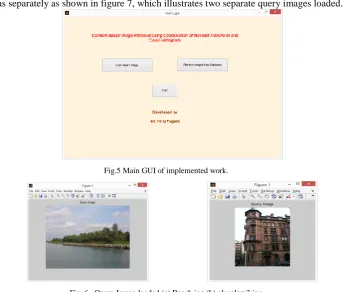
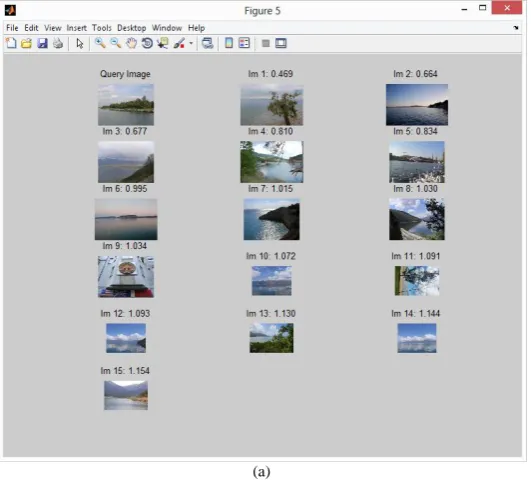
Figure 6 shows the initial user interface of the system that appears on execution, the GUI is kept simple and user friendly, the user just have to click on load query image and select the image. Once image has been selected it can be seen as separately as shown in figure 7, which illustrates two separate query images loaded.
Fig.5 Main GUI of implemented work.
Fig. 6 Query Image loaded (a) Beach.jpg (b) glasglow3.jpg
Now the when we click on Retrieve images from database at time on command prompt message appears how many relevant images to be retrieved, once user enters value after execution the number of relevant images along with their distance are shown in separate window.
(b)
Fig. 7 Results of Haar Wavelet Transformation applied on Query Images (a) beach.jpg (b) glasglow3.jpg
(a) (b)
Fig. 8 Similarity matching computation process for retrieval of N images for Query Image (a) beach.jpg (b) glasglow3.jpg
The Haar wavelet transform for extraction of matching feature decomposition of Level1, level2 and level3 for both query images sample output is as shown in figure 7. While figure 8 illustrates the background computation for similarity matching as per equation stated earlier for matching process on histogram of query image with i number of images in database along with distance calculation with respect to threshold values.
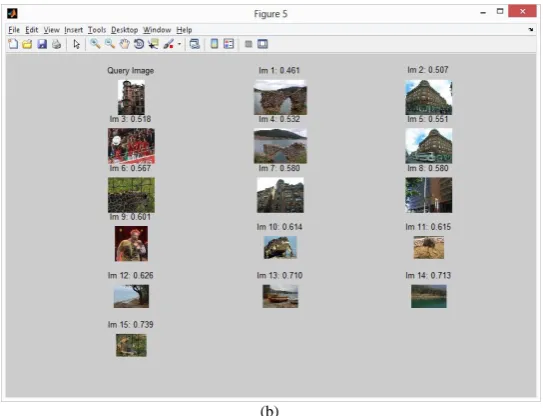
After the overall computation in background figure 9 (a)-(b) illustrates total 15 relevant images retrieved from dataset for image beach and glasglow3 belong to category beach and buildings. The performance evaluation of the proposed system can be measured in terms of its precision and recall. Precision measures the retrieval accuracy; it is the ratio between the number of relevant images retrieved and the total number of images retrieved.
(b)
Fig. 9 Relevant images retrieved for query image (a) beach.jpg (b) glasglow3.jpg
Using precision to measure the performance of proposed system we had taken for experiments all the images as mentioned in table I, the number of relevant images retrieved from image database and the relevant data is mentioned in table II.
TABLE II
PRECISION FOR DIFFERENT CATEGORY IMAGES AND N VALUE ACCEPTED FROM USER
Category Sample Query Image Total Number of Images to be Retrieved for Database
2 5 10 15
River river2.jpg 0.5 1 0.8 0.87
People madonna.jpg 0.5 0.8 0.7 0.8
Building glasglow3.jpg 1 1 0.7 0.8
Cartoons bob.jpg 1 0.8 0.9 0.8
Beach beach.jpg 0.5 0.4 0.9 0.8
Average Precision value 0.7 0.8 0.8 0.81
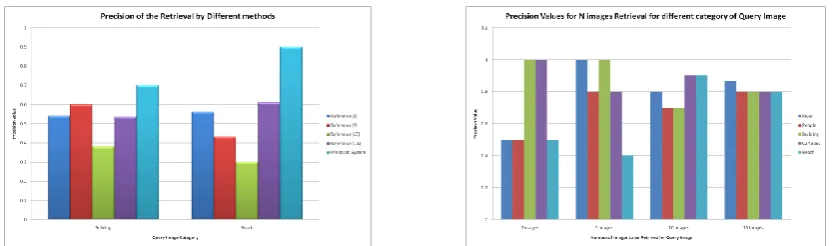
Form table III it clear that the proposed system for query image the number of relevant images retrieved are with precision the results of proposed system are better than the existing system. Figure 10 illustrates the same results with respect to graphical view.
TABLE III
PRECISION VALUES OF RETRIEVAL BY DIFFERENT METHODS IMPLEMENTED
Category Reference [8] Reference [9] Reference[10] Reference [11] Proposed System
Building 0.54 0.6 0.38 0.536 0.7
Beach 0.56 0.43 0.3 0.61 0.9
Fig. 10 Graph showing performance analysis based on precision of proposed system.
V. CONCLUSIONS
In this paper, we have proposed an efficient CBIR method based on combination of the wavelet transform and color histogram. The experimental result shows that the proposed method outperforms the other retrieval methods in terms of Average Precision. Moreover, the computational steps are effectively reduced. As a result, there is a substational increase in the retrieval speed. The whole indexing time for the around 500 image database that can be takes very less time. First we select the query image then apply Haar transform, then calculated the 3-D HSV histogram and perform similarity measure with calculation of Euclidean distance between images. The N relevant images retrieved are with respect to pre-decided threshold values as mention in proposed algorithm. Our experiment results demonstrate that the proposed method has higher retrieval accuracy than the other methods.
ACKNOWLEDGEMENT
We would like to dedicate this work our parents and would like to thank all the staff members from Department of Computer Science and Engineering, SSGBCOET Bhusawal Maharashtra. Special thanks to Dr. R. P. Singh our Principal for his value guidance and support.
REFERENCES
[1] R.Datta, D. Joshi, J.Li, J.Z. Wang, ―Image retrieval: ideas, influences, and trends of the new age, ACM Computing Surveys, vol. 40, no. 2, article 5, pp. 1-60, Apr. 2008.
[2] M. L. Kherfi, D. Brahmi and D. Ziou ―Combining visual features with semantics for more effective image retrieval, in Proc. of 17th Int. Conf. on Pattern Recognition, pp.961 -964, 2004.
[3] B. Ramamurthy and K. R .Chandran, ―Content based Image Retrieval for Medical Images using Canny Edge Detection Algorithm,‖ International Journal of Computer Applications, vol.17, no.6, pp. 32-37, Mar. 2011.
[4] A. Ross, A. Jain and J. Reisman, ―A hybrid fingerprint matcher,‖ in Proc. of Int. Conf. on Pattern Recognition, Quebec City, vol. 3, pp. 795-798, 2002.
[5] Y. Rui, T. S. Huang and S.F. Chang, ―Image Retrieval: Current Techniques, Promising Directions and Open Issues. Journal of Visual Communication and Image Representation. 10(4): pp. 39-62. 1999.
[6] A. M. Smeulders, M. Worring and S. Santini, A. Gupta and R. Jain, ―Content Based Image Retrieval at the End of the Early Years‖, IEEE Transactions on Pattern Analysis and Machine Intelligence, 22(12): pp. 1349-1380, 2000.
[7] Y. Liu, D. Zang, G. Lu and W. Y. Ma, ―A survey of content-based image retrieval with high-level semantics‖, Pattern Recognition, Vol-40, pp-262-282, 2007.
[8] C.H. Lin, R.T. Chen and Y.K. Chan, ―A smart content-based image retrieval system based on color and texture feature‖, Image and Vision Computing vol.27, pp.658–665, 2009.
[9] G. Raghupathi, R.S. Anand, and M.L Dewal, ―Color and Texture Features for content Based image retrieval‖, Second International conference on multimedia and content based image retrieval, July-21- 23, 2010.
[10] P. S. Hiremath and J. Pujari, ―Content Based Image Retrieval based on Color, Texture and Shape features using Image and its complement‖, 15th International Conference on Advance Computing and Communications. IEEE. 2007.
[12] Suchismita Das, Shruti Garg, G. Sahoo, ―Comparison of Content Based Image Retrieval Systems Using Wavelet and Curvelet Transform‖, The International Journal of Multimedia & Its Applications (IJMA) Vol.4, No.4, August 2012, pp. 137-150.
[13] Q Tian, Qi, Nicu Sebe, Michael S. Lew, Etienne Loupias, and Thomas S. Huang. "Content-based image retrieval using wavelet-based salient points." In Photonics West 2001-Electronic Imaging, pp. 425-436. International Society for Optics and Photonics, 2001
[14] L. Ni and H. C. Leng, Curvelet Transform and Its Application in Image Retrieval, 3rd International Symposium on Multispectral Image Processing and Pattern Recognition, Proceedings of SPIE, Vol. 5286, 2003.
[15] Sumana, Islam M, Zhang D S and Lu G, Content Based Image Retrieval Using Curvelet Transform. In Proc. of IEEE International Workshop on Multimedia Signal Processing (MMSP08), Cairns, Queensland, Australia, ISBN 978-1-4244-2295-1:11- 16, (2008).
[16] S. Kulkarni, B. Verma1, P. Sharma and H. Selvaraj ―Content Based Image Retrieval using a Neuro-Fuzzy Technique‖ 2005.
[17] Jia Li and James Z. Wang, ``Real-time Computerized Annotation of Pictures,'' IEEE Transactions on Pattern Analysis and Machine Intelligence, vol. 30, no. 6, pp. 985-1002, 2008.
[18] A. Smeulders, M. Worring, S. Santini, A. Gupta and R. Jain(2000), ‗Content-based image retrieval at the end of the early years‘, IEEE Transactions on Pattern Analysis and Machine Intelligence 22 1349–1380. [19] F. Long, H. J. Zhang, D. D. Feng (2003) , ‗Fundamentals of content – based image retrieval‘, in: D. D.
Feng, W. C. Siu, H. J .Zhang(Eds.), Multimedia Information Retrieval and Management—Technological Fundamentals and Applications, Springer, pp.1–27.
[20] R. Veltkamp, H. Burkhardt, H. -P. Kriegel (2008), ‗State-of-the-Art in Content-Based Image and Video Retrieval‘, Kluwer Academic Publishers, New York.
[21] W. Niblack, R. Barber,W. Equitz, M. Flickner, E. Glasman, D. Pektovic, P. Yanker, C. Faloutsos, and G. Taubin,, ―The QBIC Project: Querying Images by Content using Color Texture and Shape,‖ in Proc. SPIE Int. Soc. Opt. Eng., in Storage and Retrieval for Image and Video Databases, vol. 1908, pp. 173-187, 1993. [22] Ja-Hwung Su, Wei-Jyun Huang, Philip S. Yu, Fellow, IEEE, and Vincent S. Tseng, Member, IEEE
Efficient Relevance Feedback for Content-Based Image Retrieval by Mining User Navigation Patterns,IEEE.
[23] Yangxi Li, Bo Geng, Chao Zhou, and Chao Xu, IEEE on „‟ Learning to Combine ad-hoc Ranking Functions for Image Retrieval‖ 2011 11th IEEE International Conference on Data Mining Workshops. [24] Matei Dobrescu, Manuela Stoian, Cosmin Leoveanu General IT Directorate Insurance Supervisory
Commission on ―Multi-Modal CBIR Algorithm based on Latent Semantic Indexing‖ 2010 Fifth International Conference on Internet and Web Applications and Services
[25] J. barry gomm, member, ieee, and ding li yu on ―selecting radial basis function network centers with recursive orthogonal least squares training‖, pp no:- 1045-9227 ieee transactions on neural networks, vol. 11, no. 2, march 2000.
![Fig. 1 In [13] authors idea is first to extract salient points in the image and then in their location to extract local](https://thumb-us.123doks.com/thumbv2/123dok_us/1934894.1254193/2.595.145.468.179.317/authors-extract-salient-points-image-location-extract-local.webp)
![Fig. 4 Image of different category from WANG Image Dataset [26]](https://thumb-us.123doks.com/thumbv2/123dok_us/1934894.1254193/4.595.85.534.498.700/fig-image-different-category-wang-image-dataset.webp)