Sub-Linear Lattice-Based Zero-Knowledge
Arguments for Arithmetic Circuits
?Carsten Baum1, Jonathan Bootle2, Andrea Cerulli2, Rafael del Pino3, Jens Groth2, and Vadim Lyubashevsky3
1 Bar-Ilan University
2 University College London, London, UK {jonathan.bootle.14, andrea.cerulli.13, j.groth}@ucl.ac.uk
3 IBM Research - Zurich
Abstract. We propose the first zero-knowledge argument with sub-linear communication complexity for arithmetic circuit satisfiability over a primepwhose security is based on the hardness of the short integer solution (SIS) problem. For a circuit withN gates, the communication complexity of our protocol isOpN λlog3N, whereλis the security
parameter. A key component of our construction is a surprisingly simple zero-knowledge proof for pre-images of linear relations whose amortized communication complexity depends only logarithmically on the number of relations being proved. This latter protocol is a substantial improvement, both theoretically and in practice, over the previous results in this line of research of Damg˚ard et al. (CRYPTO 2012), Baum et al. (CRYPTO 2016), Cramer et al. (EUROCRYPT 2017) and del Pino and Lyubashevsky (CRYPTO 2017), and we believe it to be of independent interest.
Keywords: Sigma-protocol, zero-knowledge argument, arithmetic cir-cuit, SIS assumption.
1
Introduction
Zero-knowledge proofs and arguments are used throughout cryptography as a key ingredient to ensure security in complex protocols. They form an important part of applications such as authentication protocols, electronic voting systems, encryption primitives, multi-party computation schemes, and verifiable computa-tion protocols. Therefore, designing zero-knowledge protocols with strong security and high efficiency is of the utmost importance.
?Jonathan Bootle, Andrea Cerulli and Jens Groth were supported by funding from
A zero-knowledge argument allows a prover to convince a verifier that a particular statement is true, without the prover revealing any other information that she knows about the statement. Statements are of the formu∈ L, whereL
is a language in NP. We callw a witness for statementuif (u, w)∈R, whereR
is a polynomial time decidable binary relation associated withL. Zero-knowledge arguments must be complete, sound and zero-knowledge.
Completeness: A prover with witnesswforu∈ Lcan convince the verifier. Soundness: A prover cannot convince the verifier whenu /∈ L.
Zero-knowledge: The interaction should not reveal anything to the verifier except thatu∈ L. In particular, it should not reveal the prover’s witness w. We wish to design a zero-knowledge argument based on the short integer solution (SIS) assumption. Lattice problems appear to resist quantum attacks, and possess attractive worst-case to average-case reductions, in stark contrast with number theoretic assumptions such as the hardness of factoring or computing discrete logarithms. Moreover, using SIS (and the even more efficient Ring-SIS) yields better computational efficiency, which is a significant bottleneck in many zero-knowledge arguments.
1.1 Our Contributions
We provide an honest verifier zero-knowledge argument for arithmetic circuit satisfiability overZp, for an arbitrary prime p. Our argument is based on the SIS assumption [Ajt96, MR04], which is conjectured to be secure even against a quantum adversary. Our argument has an expected constant number of moves and sub-linear communication complexity, as shown in Table 1. Moreover, it achieves small soundness error in a single protocol execution. Moreover, both the prover and verifier have quasi-linear computational complexity in the amount of computation it would require to evaluate the arithmetic circuit directly. The argument therefore improves on the state-of-the-art in communication complexity for lattice proof systems and is efficient on all performance parameters.
Expected Communication Prover Complexity Verifier Complexity # Moves (bits) (bit ops) (bit ops)
O(1) O(pN λlog3N)O(NlogN(logλ)2) O(N(logλ)3)
Table 1: Performance of our zero-knowledge argument for arithmetic circuit satisfiability. HereN is the number of gates in the arithmetic circuit, andλis the security parameter.
commitments, and embeds the wire values into a polynomial that verifies products and linear relations simultaneously, avoiding the cost for addition gates.
Almost all parts of the original arguments adapt seamlessly to the SIS setting, except for two important issues:
– To achieve sub-linear communication, we need a technique for proving knowl-edge of commitment openings in sub-linear space.
– Due to the new algebraic setting, we require new techniques for achieving negligible soundness in a single run of the protocol.
The first of these issues has been an open problem in a fairly active area of research, and we sketch our solution below.
Proof of Knowledge. Suppose that we have a linear relation
As=tmod q, (1)
whereA∈Zrq×v,t∈Z r
q are public and s∈Z v
q is a vector with small coefficients, and we want to give a zero-knowledge proof of knowledge of an ¯s with small coefficients (the coefficients of ¯smay be larger than those ofs) that satisfies
A¯s=tmod q. (2)
We do not currently know of any an efficient linear-communication protocol for proving knowledge of a single relation of the above form in a direct way. There are protocols, however, that allow for proofs of many such relations for the same Abut differentsi (and thus differentti) in linear amortized complexity. We will mention these previous works in more detail in Section 1.2.
In this work, we give a protocol for proving (1) where the proof length is a factor λ` ·O(logv`λ) larger than the total bit-length of` pre-imagess1, . . . ,s` of the relations, whereλis the security parameter. More specifically, to prove knowledge of`pre-imagess1, . . . ,s`whose coefficients have logsbits each, the prover needs to sendλvectors inZvq whose coefficients requireO(logv`λs) bits to represent. Ignoring logarithmic terms, our proof essentially requires a fixed-size proof regardless of the number of relations being proved. The previously best results had proofs that were at least linear in the total size of the pre-images.
To show that the protocol is a proof of knowledge, we make the following observation: if the prover succeeds with probability >2−λ, and she succeeded for a randomC, then there is a probability of −2−λ−2that she would successfully answer another challengeC0 6=C that is constructed such that all rows except theithare the same as that ofC, and theithrow is picked uniformly at random. This property follows from an averaging (or “heavy row”) type argument. The implication is that if the prover succeeds in timetwith probability, then the extractor can extract responses to two such commitments C,C0 in expected timeO(t/). Obtaining two responsesZ,Z0 for two such challenges allows the extractor to compute A(Z−Z0) =T(C−C0) whereC−C0 is 0 everywhere except in row i. Since C 6=C0, this implies that some position in rowi is±1. If ti is the ith column ofT andzi is theithcolumn of Z−Z0, then we have a solutionAzi =±ti. Repeating this extraction` times, each time rewinding by fixing all rows in the challenge except for the ith, results in an algorithm that runs in expected timeO(`·t/), which is only a factor of`larger than the expected running time of a successful prover.
In the case that we are proving (1) over the polynomial ringZ[X]/(Xd+ 1), the proof can be even shorter, as we can reduce the number of columns in C to ≈λ/log 2dbecause we can use challenges of the form ±Xi and prove the knowledge of ¯ssuch thatAs¯= 2tusing the observation from [BCK+14].
Commitment Scheme. Central to the main proof of proving circuit satisfiability is being able to commit toN values inZp and giving a ZKPoK for the values such that the total size of the commitments and the proofs is sub-linear inN. For this, it is necessary to use a compressing commitment scheme – i.e. one in which we can commit tonelements ofZpin space less thannelements. The scheme that we will use is the “classic” statistically-hiding commitment scheme based on the hardness of SIS that was already implicit in the original work of Ajtai [Ajt96]. The public randomness consists of two matricesA∈Zr×2rlogpq
q ,B∈Zrq×n, and committing to a message string s ∈ Zn
p where p < q involves picking a random vector r ∈Z2rp logpq and outputting the commitmentt =Ar+Bsmod q. Thus the commitment ofnelements ofZp requiresrlogqbits. One can set the parameters such thatn=poly(r) and the commitment scheme will still be computationally binding based on the worst-case hardness of approximating SIVP for all lattices of dimensionr.
We now explain the intuition for putting together this commitment scheme with the zero-knowledge proof system we described above to produce a com-mitment to N values in Zp such that the total size of the commitments and the ZKPoK of the committed values is O(√N λlogN). The idea is to create
arithmetic circuit satisfiability is reduced to checking linear-algebraic statements over committed matrices, using a homomorphic commitment scheme.
The total space requirement for these commitments is therefore Nn ·rlogpq. We now have a linear equation of the form
A B
R S
=T mod q. Using our new zero-knowledge proof, the communication complexity of proving the knowledge of a short
¯
R ¯ S
∈ Z(rlogpq+n)×N /n
q such that A B
¯
R ¯ S
=T mod q requires sending λvectors of lengthrlogpq+n with coefficients requiringO(logN λp) bits, for a total bit-length ofn·λ·O(logN λp). Combining the proof size with the commitment size results in a total bit-size of
N
n ·rlogq+n·λ·O(logN λp).
We minimize the above by settingn=
qN rlog pq
λlogN λp, which makes the size
OqN rλ(logpq)(logN λp).
Based on the complexity of the best known algorithm against the SIS problem, one can set logq, r=O(logN), thus making the proof size of orderO(pN λlog3N).
1.2 Related Work
Zero-knowledge proofs were invented by Goldwasser et al. [GMR85]. It is useful to distinguish between zero-knowledgeproofs, with statistical soundness, and zero-knowledgearguments with computational soundness. The most efficient proofs have communication proportional to the size of the witness [IKOS07, KR08, GGI+15] and proofs cannot in general have communication that is smaller than the witness size unless surprising results about the complexity of solving SAT instances hold [GH98, GVW02]. Kilian [Kil92] showed that in contrast to proofs, zero-knowledge arguments can have very low communication complexity. His construction relied on the PCP theorem, and thus incurred a large computational cost.
Group theoretic zero-knowledge arguments. Schnorr [Sch91] and Guillou and Quisquater [GQ88] gave early examples of practical zero-knowledge arguments for concrete number theoretic problems. Extending Schnorr’s protocols, there have been many constructions of zero-knowledge arguments based on the discrete logarithm assumption, for instance [CD97, Gro09b]. The most efficient discrete logarithm based zero-knowledge arguments for arithmetic circuits are by Boo-tle et al. [BCC+16] and later optimised in [BBB+17], which have logarithmic communication complexity and require a linear number of exponentiations.
of group elements. However, it can be shown that all SNARKs must rely on non-falsifiable knowledge extractor assumptions [GW11]. In contrast, since our argument is interactive, we do not need to rely on these strong assumptions.
Lattice-based zero-knowledge arguments. The first zero-knowledge proofs from lattice-based assumptions were aimed at lattice problems themselves. Goldreich and Goldwasser [GG98] presented constant round interactive zero knowledge proofs for the complements of the approximate Shortest Vector Problem (SVP) and the approximate Closest Vector Problem (CVP). Micciancio and Vadhan [MV03] later constructed statistical zero knowledge proofs for these problems which had efficient provers.
Stern’s protocol [Ste94] was one of the first zero-knowledge identification protocols to be based on a post-quantum assumption, namely, on the hardness of syndrome decoding for a random linear code, which is essentially proving (1) whereq= 2 andksk √v. The protocol achieves constant soundness error, and thus requires many parallel repetitions. Stern’s work prompted many variants and similar protocols. For example, [LNSW13] adapts the protocol for larger q, which implies proving knowledge of SIS solutions.
Another technique for creating zero-knowledge proofs is the “Fiat-Shamir with Aborts” approach [Lyu09, Gro10b, Lyu12]. When working over polynomial ringsR, it gives a proof of knowledge of a vector ¯swith small coefficients (though larger than those ins) and a ring element ¯cwith very small coefficients satisfying A¯s= ¯ct . As long as the ringRhas many elements with small coefficients, such proofs are very efficient, producing soundness of 1−2−128with just one iteration. While these proofs are good enough for constructing practical digital signatures (e.g. [GLP12, DDLL13, BG14]), commitment schemes with proofs of knowledge [BKLP15, BDOP16], and certain variants of verifiable encryption schemes [LN17], they prove less than what the honest prover knows. In many applications where zero-knowledge proofs are used, in particular those that need to take advantage of additive homomorphisms, the presence of the element ¯cmakes these kinds of “approximate” proofs too weak to be useful. As of today, we do not have any truly
practical zero-knowledge proof systems that give a proof of (1).
The situation is more promising when one considersamortized proofs. The work of [BD10] uses MPC-in-the-head to prove knowledge of plaintexts for multiple Regev [Reg05] ciphertexts. Damg˚ard and L´opez-Alt [DL12] extend the [BD10] results to prove knowledge of plaintext inZp, rather than bits, and provide a proof for the correctness of multiplications. Combining these together gives a zero-knowledge proof for the satisfiability of arithmetic circuits with linear communication in the circuit size.
number of commitments was a couple of thousand. The schemes are considerably less efficient when one is proving fewer relations.
The amortized zero-knowledge proof in the current work improves on the above series of papers in two important ways. First, the number of relations necessary before the size of our proof is linear only inλ. But more importantly, if we have more thanλrelations, the communication complexity does not increase except for small logarithmic factors (i.e. the proof size becomes sub-linear).
Hash-based zero-knowledge arguments. Recently Bootle et al [BCG+17] used error-correcting codes and linear-time collision-resistant hash functions to give proof systems for the satisfiability of an arithmetic circuit where the prover uses a linear number of field multiplications. Verification is even more efficient, requiring only a linear number of additions. While their proofs and arguments are asymptotically very efficient, they are not quite practical as their choices of error-correcting codes and hash functions involves very large constants.
An another effective way to construct efficient zero-knowledge proofs is to fol-low the so-called MPC-in-the-head paradigm of [IKOS07]. This approach proved itself to give very efficient constructions both theoretically and practically. Most notably, ZKBOO [GMO16] and subsequent optimisation ZKB++ [CDG+17] use hash functions to construct zero-knowledge arguments for the satisfiability of boolean circuits. Their communication complexity is linear in the circuit size, but the use of symmetric primitives gives good performances in prac-tice. Ligero [AHIV17] provides another implementation of the MPC-in-the-head paradigm and used techniques similar to [BCG+17] to construct sublinear argu-ments for arithmetic circuits.
2
Preliminaries
Algorithms in our schemes receive a security parameterλas input (sometimes implicitly) written in unary. The intuition is that the higher the security pa-rameter, the lower the risk of the scheme being broken. Given two functions
f, g:N→[0,1] we writef(λ)≈g(λ) when|f(λ)−g(λ)|=λ−ω(1). We say that
f isnegligiblewhenf(λ)≈0 and thatf isoverwhelmingwhenf(λ)≈1. For any integer N, [N] denotes the set{0,1, . . . , N −1}of integers.
2.1 Notation
Throughout this paper we will consider a ring R, which will be either Z or the polynomial ring Z[X]/(Xd+ 1) for d some power of 2. We will denote elements ofRby lowercase letters, (column) vectors overRin bold lowercase and matrices over Rin bold uppercase. e.g.A=
a1, . . . ,ak
∈ Rl×k withai= (ai1, . . . , aim)T ∈ Rl. We will consider the norm of elements inRto bekak2=|a|
if a∈Z, and kak2=
pP
a2 i ifa=
Pa
iXi ∈Z[X]/(Xd+ 1). We extend the notation to vectors and matriceskak2=
q P
kaik2 2
,kAk2=
q P
kaik2 2
will also consider the quotient ringRq =R/qRfor oddq. In the quotient ring, the norm of an elementRq will be the norm of its unique representative Rwith coefficients in
−q−1 2 ,
q−1 2
.
We will also consider the operator norm of matrices overRdefined ass1(A) =
max
kxk26=0
kAxk
2
kxk2
.
Probability Distributions. LetDdenote a distribution over some set. Then,
d← Dmeans thatdwas sampled from the distributionD. If we writed←$ S for some finite setS without a specified distribution this means thatdwas sampled uniformly random from S. We let ∆(X, Y) indicate the statistical distance between two distributionsX, Y. Define the functionρσ(x) = exp−2σx22
and the discrete Gaussian distribution over the integers,Dσ, as
Dσ(x) =
ρ(x)
ρ(Z) whereρ(Z) =
X
v∈Z
ρ(v).
We will write X ← Dr×m
σ to mean that every coefficient of the matrix X is distributed according toDσ.
Using the tail bounds for the 0-centered discrete Gaussian distribution (cf. [Ban93]), we can show that for any σ >0 the norm of x←Dσ can be upper-bounded usingσ. Namely, for anyk >0 it holds that
Pr x←Dσ
[|x|> kσ]≤2e−k2/2, (3) and whenxis drawn fromDr
σ, we have
Pr
x←Dr σ
[kxk2>√2r·σ]<2−r/4. (4)
We will abuse the notation x ← Dσ when x∈ Z[X]/(Xd+ 1) to denote the distribution in which each coefficient ofxis taken fromDσ. It is clear that in this casekxk2 can be bounded using equation 4 withdinstead ofr.
2.2 Lattice-based Commitment Schemes
A commitment scheme allows a sender to create commitments to secret values, which she might then decide to reveal later. The main properties of commitment schemes are hiding and binding. Hiding guarantees that commitments do not leak information about the committed values, while binding guarantees that the sender cannot change her mind and open commitments to different values.
distribution DRck over Rck and a binding set Bck ⊂ Mck×Rck. The
commit-ment key also specifies a deterministic polynomial-time commmitcommit-ment function Comck:Mck×Rck→Cck. We define Comck(m) to be the probabilistic algorithm that given m∈Mck samplesr←DRck and returnsc= Comck(m;r).
The commitment scheme is homomorphic, if the message, randomness and commitment spaces are abelian groups (written additively) and we have for all
λ∈N, and for allck←Gen(1λ), for allm0,m1∈Mck and for allr0,r1∈Rck Comck(m0;r0) + Comck(m1;r1) = Comck(m0+m1;r0+r1).
Definition 1 (Hiding). The commitment scheme is computationally hiding if a commitment does not reveal the committed value. Formally, we say the commitment scheme is hiding if for all probabilistic polynomial time stateful interactive adversaries A
Pr
ck←Gen(1λ); (m
0,m1)← A(ck);b← {0,1}; r←DRck;c←Comck(mb;r) :A(c) =b
≈ 1
2, whereA outputsm0,m1∈Mck.
Definition 2 (Binding). The commitment scheme is computationally binding if a commitment can only be opened to one value within the binding setBck. For all probabilistic polynomial time adversariesA
Pr
ck←Gen(1λ); (m
0,r0,m1,r1)← A(ck) : m06=m1 andComck(m0;r0) = Comck(m1;r1)
≈0,
whereA outputs(m0,r0),(m1,r1)∈Bck.
The commitment scheme is compressing if the sizes of commitments are smaller than the sizes of the committed values.
Ajtai’s One-Way Function. The standard one-way function used in lattice cryptography maps a vectorRn toRr via the function
fA(s) =As,
whereAis a fixed, randomly-chosen matrix inRr×n. Ajtai’s seminal result [Ajt96] stated that whenR=Zq, it is as hard to find elementsswith some bounded norm
ksk ≤B such thatfA(s) = 0 for randomA, as it is to find short vectors in any
constant δ.4 With such a setting of n0, one expects to find a vector of length
approximately
min{q,2
√
rlogqlogδ}. (5)
Compressing Commitments Based on SIS. The fact that a largern(after a certain point) does not decrease the security of the scheme allows one to construct simple compressing commitment schemes where the messages are elements in Zpfor p < q. The commitment scheme, which was already implicit in the aforementioned work of Ajtai [Ajt96], uses uniformly-random matrices A1∈Zrq×2rlogpq andA2∈Zrq×n as a commitment key, wherenis the number of elements that one wishes to commit to. A commitment to a vectorm∈Znp involves choosing a random vector r∈Z2rp logpq and outputting the commitment vectorv=A1r+A2mmod q. By the leftover hash lemma, (A1,A1rmod q) is statistically close to uniform, and so the commitment scheme is statistically hiding.5
To prove binding, note that if there are two different (r,m)6= (r0,m0) such that
v=A1r+A2m=A1r0+A2m0mod q, then
A1(r−r0) +A2(m−m0) =0mod q,
and the non-zero vectors=
r−r0 m−m0
is a solution to the SIS problem for the
matrixA= [A1 A2]. As long as the parameters are set such thatkskis smaller than the value in (5), the binding property of the commitment is based on an intractable version of the SIS problem.
The commitment scheme we will be working with in this paper works as follows:
Gen(1λ)→ck: Select a ring R (either
Z or Z[X]/(Xd + 1)), and parameter
p, q, r, v, N, B, σaccording to Table 2, and letRq=R/qR. Pick uniformly at random matricesA1← R
r×rlogpq
q andA2← Rrq×n. Returnck= (p, q, r, v, `, N, B,Rq, A1, A2).
The commitment key defines message, randomness, commitment and binding spaces and distribution
Mck=Rnq Rck=R 2rlogpq
q Cck=Rrq
Bck=
s=
m r
∈ Rn+2rlogpq
q
||s||< B
DRck=D
r σ.
4
This constantδ is related to the optimal block-size in BKZ reduction [GN08], which is the currently best way of solving the SIS problem. Presently, the optimal lattice reductions setδ≈1.005.
5 For improved efficiency, one could reduce the number of columns inA
1 and make
Comck(m;r): Givenm∈ Rn
q andr∈ R 2rlogpq
q returnc=A1r+A2s.
In the following, when we make multiple commitments to vectorsm1, . . . ,m`∈ Mck we writeC= Comck(M;R) when concatenating the commitment vectors as C = [c1,· · · ,c`]. It corresponds to computing C = A1R+A2M with M = [m1,· · ·,m`] and randomnessR= [r1,· · ·,r`].
2.3 Arguments of Knowledge
We aim to give efficient lattice-based proofs for arithmetic circuit satisfiability overZp. The strategy we will employ is to commit to the values of a satisfying assignment to the wires, execute a range proof to demonstrate the committed values are within a suitable range, and to prove the committed values satisfy the constraints imposed by the arithmetic circuit. We will now formally define arguments of knowledge.
LetRbe a polynomial time decidable ternary relation. The first input will contain some public parameters (aka common reference string)pp. We define the corresponding languageLpp indexed by the public parameters that consists of elements u with a witness w such that (pp, u, w) ∈ R. This is a natural generalisation of standard NP languages, which can be cast as the special case of relations that ignore the first input.
A proof system consists of a PPT parameter generator PGen, and interactive and stateful PPT algorithmsP andV used by the prover and verifier. We write (tr, b)← hP(pp),V(pp, t)ifor runningP andV on inputspp,s, andtand getting communication transcripttr and the verifier’s decision bitb. Our convetion is
b= 0 means reject andb= 1 means accept.
Definition 3 (Argument of knowledge). The proof system(PGen,P,V)is called an argument of knowledgefor the relationRif it is complete and knowledge sound as defined below.
Definition 4 (Statistical completeness). (PGen,P,V) has statistical com-pleteness with comcom-pleteness error ρ:N→[0; 1]if for all adversariesA
Pr
pp←PGen(1λ); (u, w)← A(pp); (tr, b)← hP(pp, u, w),V(pp, u)i: (pp, u, w)∈R andb= 0
≤ρ(λ).
Definition 5 (Computational knowledge soundness). (K,P,V)is knowl-edge sound with knowlknowl-edge soundness error:N→[0; 1]if for all deterministic polynomial time P∗ there exists an expected polynomial time extractor E such that for all PPT adversariesA
Pr
pp←PGen(1λ); (u, s)← A(pp); (tr, b)← hP∗(pp, u, s),V(pp, u)i;
w← EP∗(pp,u,s)(pp, u, tr, b) : (pp, u, w)∈/R andb= 1
≤(λ).
of pre-images will for instance have “slack”. Thus, even thoughv is constructed usingr,m with coefficients in Zp, we will only be able to prove knowledge of vectors ¯r,m¯ with larger norms. This extracted commitment is still binding as long as the parameters are set such that the vector ¯s =
¯ r−r¯0 ¯ m−m¯0
has norm
smaller than the bound in (5).6
Concretely, if we would like to make a commitment toN values inZp, then to satisfy (5) we need to make sure thatq >k¯skand√rlogqlogδ >logk¯sk. In the protocols in our paper, we will have k¯sk< N2p2 andp < N, which implies that r=O(logN).
We say the proof system ispublic coinif the verifier’s challenges are chosen uniformly at random independently of the prover’s messages. A proof system is special honest verifier zero-knowledge if it is possible to simulate the proof without knowing the witness whenever the verifier’s challenges are known in advance.
Definition 6 (Special honest-verifier zero-knowledge). A public-coin ar-gument of knowledge (PGen,P,V) is said to be statistical special honest-verifier zero-knowledge (SHVZK) if there exists a PPT simulator S such that for all interactive and stateful adversariesA
Pr
pp←PGen(1λ); (u, w, %)← A(pp); (tr, b)← hP(pp, u, w),V(σ, u;%)i: (pp, u, w)∈Rand A(tr) = 1
≈Pr
pp←PGen(1λ); (u, w, %)← A(pp); (tr, b)← S(pp, u, %) : (pp, u, w)∈R andA(tr) = 1
,
where%is the randomness used by the verifier.
Full Zero-Knowledge. In real life applications special honest verifier zero-knowledge may not suffice since a malicious verifier may give non-random chal-lenges. However, it is easy to convert an SHVZK argument into a full zero-knowledge argument secure againstarbitraryverifiers in the common reference string model using standard techniques, and when using the Fiat-Shamir heuristic to make the argument non-interactive SHVZK suffices to get zero-knowledge in the random oracle model.
3
Amortized Proofs of Knowledge
We will consider amortized proofs of knowledge for preimages of the Ajtai one-way function. Formally, given a matrix A ∈ Rrq×v the relation we want to give a zero-knowledge proof of knowledge for is
6 Commitments over other rings, such as
Zq[X]/(Xd+ 1) can be done in the same
R=
(pp, u, w) = ((q, `, β,R,A, c),T,S)
(A,S,T)∈ Rr×v q × R
v×`× Rr×`
q ∧ AS=c·T∧[ksik2≤β]i∈[`]
withS = [s1,· · · ,s`] whereRis implicitly fixed in advance. The multiplierc depends on the instantiation of the proof: for R=Zour proof achieves c= 1 and is exact, while forR=Z[X]/(Xd+ 1) it only guarantees thatc= 2.
P V
A∈ Rr×v
q ,S∈ Rv×`,T ∈ Rrq×` A,T
s.tAS=T
Y ←Dv×n
σ
W =AY W
-C← C$ `×n
C
Z:=SC+Y
Abort if Rej(Z,B, σ, ρ) = 1 Z
z1, . . . ,zn
:=Z
Check:
∀i∈[n],kzik2≤B
AZ=T C+W
Fig. 1: Amortized proof for`equations. The ringRcan be eitherZorZ[X]/(Xd+ 1), the challenge setC will be respectively{0,1} or{0}S
±Xj j<d
We consider a generalization ofΣ-Protocols in which honest instances only complete with some constant probability 1/ρ, this is to accommodate the fact that the rejection sampling step described in Lemma 1 only outputs 1 with probability 1/ρ. In practice such a restriction is not too inconvenient: though the interactive protocol has to be repeated an average ofρtimes to terminate, what we are interested in is usually the non-interactive protocol obtained by using the Fiat-Shamir transform, in which case the prover only has to output a proof when she obtains a challenge which passes the rejection step.
Algorithm 1 Rej(Z,B, σ, ρ) u←[0,1)
if u > 1 ρ·exp
−
2hZ,Bi+kBk2
2σ2
then return 0
else return 1 end if
Lemma 1 ([Lyu12]). LetB∈ Rr×n be any matrix. Consider a procedure that samples a Y ←Drσ×n and then returns the output of Rej(Z:=Y +B,B, σ, ρ) where σ ≥ 12
lnρ · kBk. The probability that this procedure outputs 1 is within 2−100 of 1/ρ. The distribution of Z, conditioned on the output being1, is within statistical distance of2−100 of Dr×n
σ .
We give a useful lemma for knowledge extraction. In essence this lemma will be used to show that a prover who can output a verifying output for a challengec1, . . . ,c`has a high probability of also being able to answer a challenge c01,c2, . . . ,c` in which onlyc016=c1.
Lemma 2 ([Dam10]). Let H ∈ {0,1}`×n for some n, ` > 1, such that a fraction ε of the inputs of H are 1. We say that a row of H is “heavy” if it contains a fraction at leastε/2of ones. Then more than half of the ones in H are located in heavy rows.
We describe our proof system in Figure 1. Our first instantiation is with
R=Zin which case the one-way function will rely on the SIS problem and the challenge set will beC`×n forC={0,1}, this solution allows the extractor of the protocol to obtain exact preimages of theti and requiresn≥λ+ 2. This ensures that communication only grows linearly inλ regardless of the size of ` (since Z∈Zvq×n).
Theorem 1. LetR=Z, C={0,1},v, r=poly(λ), andn≥λ+ 2. Lets >0be an upper bound on s1(S),ρ >1 be a constant,σ∈Rbe such thatσ≥ ln12ρs
√
`n, andB=√2vσ. Then the protocol described in Figure 1 is a zero-knowledge proof of knowledge for R.
Proof. We will prove correctness and zero-knowledge here as the proofs are straightforward and very similar to prior works. We will however defer the proof of soundness to Lemma 3.
Correctness: IfPandVare honest then the probability of abort is exponentially close to 1−1/ρsince kSCk2≤s1(S)kCk2≤s√`n. The equation verified by V
is true by construction ofZ. Since each coefficient ofZ is statistically close to
Dσ, then according to (4) we havekzik2≤
√
Honest-Verifier Zero-Knowledge: We will now prove that our protocol is honest-verifier zero-knowledge. More concretely, we show that the protocol is zero-knowledge when the prover does not abort prior to sendingZ. The reason that this is enough for practical purposes is that HVZKΣ-protocols can be turned into non-interactive proofs via the Fiat-Shamir transform. The non-interactive protocol generates the challenge C as the hash of W and T, and otherwise repeats the prover’s part of the protocol until a non-abort occurs, whereupon the prover outputs the transcript (W,C,Z). Only the non-aborting transcripts will be seen byV, and thus only they need to be simulated. Further below we will also sketch how to modify our protocol to obtain an interactive zero-knowledge proof.
LetS(A,T) be the following PPT algorithm: 1. Sample C← {0,1}`×n
2. Sample Z←Dv×n σ 3. SetW =AZ−T C 4. Output (W,C,Z)
It is clear that Z verifies with overwhelming probability. We already showed in the section on correctness that in the real protocol when no abort occurs the distribution of Z is within statistical distance 2−100 of Dv×n
σ . SinceW is completely determined byA,T,Z andC, the distribution of (W,C,Z) output by S is within 2−100 of the distribution of these variables in the actual non-aborting run of the protocol.
To turn our proof into a full interactive HVZK proof, one can use the above simulator together with a standard transformation: in the first message of the protocol, P will send a statistically hiding commitment of W to the verifier. Later in the third round, she will then send both the opening and the message Z, given that the protocol would not abort. The above simulatorS(A,T) can then, in the beginning of the protocol, flip a coin to determine if the simulation is aborting. If so, then it can just commit to a uniformly random value, and otherwise to the correct valueW. In order to make the protocol secure against arbitrary verifiers one can run an interactive coin-flipping protocol to generate C.
Lemma 3 (Knowledge Soundness). For any proverP∗ who succeeds with
probability ε > 2−λ (i.e.≥2−n+2) over her random tape χ ∈ {0,1}x and the challenge choice C ← C$ `×n, there exists a knowledge extractor E running in expected time poly(λ)/ε who can extract a witness S0 := (s01, . . . ,s0`) ∈ R
v×` , such that AS0=T, and∀i∈[`] ks0ik2≤2B.
Proof. For i∈[`], letti ∈ Rn be the ith column of T, andcTi ∈ R
1×n be the ith row ofC (note thatcT
i are not the transpose of the columns ofC but really its rows). Note that ticTi ∈ R
r×n andT C = P`
Consider a matrix Hi ∈ {0,1}2
n(`−1)+x×2n
whose rows are indexed by the value of
(χ,cT1, . . . ,cTi−1,cTi+1, . . . ,cT`)
and whose columns are indexed by the value ofcTi . An entry ofHi will be 1 if
P∗ succeeds for the corresponding challenge (i.e. produces an acceptingZ). We
will say that a row ofHi is ”heavy” if it contains a fraction of at leastε/2 ones, i.e. if it contains more than 2k∗ε/2>2 ones. The extractorE
i will proceed as follow:
1. Run P∗ on random challenges C0 until it succeeds, and obtains Z0 that
verifies. This takes expected time 1/ε.
2. RunP∗on random challengesC00where∀j 6=i,c00T
j =c0jT andc00iT is freshly sampled. If afterλ/εattemptsP∗has not output a valid responseZ00, abort.
The extractorEiruns in expected timepoly(λ)/ε, and aborts with probability less than 1/2 + 2−λ. The running time is clear from the definition ofEi. To compute the abort probability note that in step 2 all the challengesC00considered are in the same row ofHi asC0, if we callAbortthe event where Ei aborts and Heavy the event thatC0 is in a row ofHi, we have:
Pr [Abort] = Pr
Abort Heavy
Pr [Heavy] + Pr
Abort¬Heavy
Pr [¬Heavy]
According to Lemma 2, Pr [¬Heavy]<1/2. On the other hand if the row is heavy then for a random sample in this rowP∗ has probability at leastε/2−2−n> ε/4 of outputting a valid answer (the probability isε/2−2−n and notε/2 because we want a reply for a challenge different fromC0). Thus the probability thatP∗
does not succeed on any of theλ/εchallenges C00is Pr
Abort Heavy
<(1−ε/4)λε< e−4λ<2−λ and therefore Pr [Abort]<1/2 + 2−λ. By runningE
i O(λ) times we obtain an extractor that runs in expected timepoly(λ)/εand outputs two valid pairsC0,Z0 andC00,Z00 such that∀j6=i,c0T
j =c00jT, and ci0T 6=c00iT. Since both transcripts verify we know:
AZ0=T C0+W = r
X
j=1
tjc0jT +W
AZ00=T C00+W = r
X
j=1
tjc00jT +W
Which implies:
A(Z0−Z00) = r
X
j=1
tj(c0jT−c00 T
If we consider an index l ∈ [`] such that c0T
i [l] 6= c00iT[l], and assume w.l.o.g thatc0T
i [l]−c00iT[l] = 1, then by only considering thelthcolumn of the previous equation we obtain:
A(z0l−z00l) =ti wherekz0l−z00lk2≤2B.
Our second instantiation usesR=Z[X]/(Xd+ 1) andC={0}S ±Xj j<d. This protocol only proves R with c = 2, i.e. the extractor will only obtain preimages of 2ti but the number of columns in the response matrix Z can be reduced by a factor of log(2d+ 1) as the soundness now only requires that
nlog(2d+ 1)≥λ+ 2. It is worth noting that in this protocol the values ofrandv
would typically be chosen to be arounddtimes smaller than in the instantiation withR=Z, becauseAwill be a matrix of polynomials of degreed. We first give a lemma about the difference on monomials in Z[X]/(Xd+ 1) which will be useful in the extraction.
Lemma 4 ([BCK+14] Lemma 3.2).Letdbe a power of2, leta, b∈ {±Xi : i≥ 0} ∪ {0}. Then 2(a−b)−1 modXd+ 1 only has coefficients in {−1,0,1}. In particular 2(a−b)−1
2≤
√
d.
Theorem 2. Let R= Z[X]/Xd+ 1, C ={0}S ±Xj , v, r = poly(λ), and
n ≥(λ+ 2)/log(2d+ 1). Let s ∈R be an upper bound on s1(S), ρ > 1 be a constant,σ∈Rbe such that σ≥ ln12ρs
√
`n, and B=√2mdσ. Then the protocol described in Figure 1 is a SHVZK proof of knowledge.
Proof. The proofs for correctness and zero-knowledge are nearly identical to the ones of Theorem 1. We will prove soundness in Lemma 5.
Lemma 5 (Knowledge Soundness). For any proverP∗ who succeeds with
probability ε > 2−λ(≥ 2−nlog(2d+1)+2) over his random tape χ ∈ {0,1}x and the challenge choice C ← C`×n there exists a knowledge extractor E who can extract a witnessS0 := (s01, . . . ,s0`)∈ Rv×`, such that AS0 = 2T, and∀i∈[`]
ks0ik2≤2√dB, in expected timepoly(λ)/ε.
Proof. The first part of the proof (obtaining C0,Z0 and C00,Z00) is identical to the one of Lemma 3 except for the fact that the matrix Hi has different dimensions. Letδ= log(2d+ 1). Since for eachj∈[`], cT
j is sampled from a set of size 2nδ, we haveH
i∈ {0,1}2
nδ(`−1)+x×2nδ
. The heavy rows ofHi will contain 2nδε/2>2 ones, and the extractor can proceed as in the proof of Lemma 3. Assume thatEi has extractedC0,Z” and C00,Z00 such that∀j 6=i,c0jT =c00
T j , andc0iT 6=c00iT. As previously we have:
A(Z0−Z00) = `
X
j=1
tj(c0jT−c00 T
If we consider an indexl∈[`] such thatc0T
i [l]6=ci00T[l], sinceC={0}
S ±Xj
0≤j≤d−1, we have according to Lemma 4 that there exists ag∈ Rsuch that 2−1(c0T
i [l]− c00T
i [l])g= 1 andkgk2≤
√
d. Hence:
A(z0l−z00l)g= 2ti·2−1(c0iT[l]−c
00T
i [l])g= 2ti withk(z0l−zl00)gk2≤2√dB.
4
Argument for the Satisfiability of an Arithmetic Circuit
In this section, we show how to construct arguments for the satisfiability of an arithmetic circuit based on the SIS assumption. We take inspiration from the arguments of [Gro09a, BCC+16] which rely on homomorphic commitments based on the hardness of discrete logarithm and translate them into the lattice settings. We obtain sublinear communication arguments with improved computational efficiency with respect to [Gro09a, BCC+16].
At a high level, [BCC+16] reduces the satisfiability of an arithmetic circuit to the verification of two sets of constraints: multiplication constraints, arising from multiplication gates; linear constraints, arising from additions and multi-plication by constant gates. Then, it shows how to embed each of these sets of constraints into a polynomial equation overZp. An argument for the satisfiability of an arithmetic circuit can then be constructed by giving arguments for the satisfiability of such polynomial equations. These arguments typically involve testing polynomial identities which can be done by evaluating the polynomials at random challenge points inZp. In order to achieve negligible soundness one can invoke the Schwarz-Zippel lemma by settingpto be super-polynomial in the security parameter.
We give arithmetic circuit arguments overZp for much smallerp(e.g.p=
poly(λ)). Therefore, a straightforward translation of the above approach yield arguments which only have inverse polynomial soundness error, as O(1/p) is inverse-polynomial in the security parameter in this setting. The soundness error could be reduced by repeated the protocol multiple times in parallel, resulting into a significant computational and communication overhead. For example,kparallel repetitions gives a soundness error of O(1/pk), but increases the communication cost and computational overhead by a factor k.
Therefore, we devise a more complex embedding technique in order to apply the Schwarz-Zippel lemma over larger fields. Cramer, Damg˚ard and Keller give in [CDK14] an amortised proof of knowledge ofk commitments overZp are em-bedded intoGF(pk), with soundness errorO(1/pk). We follow a similar approach and embed the constraints for the satisfiability of the circuit into polynomial equations over an extension field. While [CDK14] only give a proof of knowledge, we also construct a product argument for the openings ofkcommitments over Zp embedded into an extension field of degree 2kwith soundnessO(1/p2k).
Reduction of Circuit Satisfiability to a Hadamard Matrix Product and Linear Constraints over Zp. We consider arithmetic circuits with fan-in 2
addition and multiplication gates. Multiplication gates are directly represented as equations of the form a·b =c, and we refer toa, b, c as the left, right and output wires, respectively.
We consider an arithmetic circuit containingN =nmmultiplication gates over a fieldZp. Without loss of generality, we assume that the circuit has been pre-processed (see [BCC+16]), so that the input and the output wires feed into and go out from multiplication gates only. We number the multiplication gates from 1 toN and we arrange the inputs and outputs of these gates into threem×n
matricesA, B andCsuch that the (i, j) entries of the matrices correspond to the left input, right input and output of the same multiplication gate. This process will lead to duplicate values, when a wire is the output of one multiplication gate and the input of another, or when it is used as input multiple times. We keep track of this by using a series of linear constraints. For example, if the output of the first multiplication gate is the right input of the second, we would write
c1−b2= 0.
In addition to the constraints arising from wire duplication, we also add linear constraints representing the addition gates and multiplication by constant gates of the circuit. We then rewrite those equations so that the only wires that are referenced in the equations are those linked to (non-constant) multiplication gates, namely the wires included inA, B, C. We refer to [BCC+16] for a more detailed explanation of this process.
The satisfiability of an arithmetic circuit can be then described as a system of equations in the entries ofA, B, C. The multiplication gates define a set ofN
equations
A◦B =C (6)
where◦is the Hadamard (entry-wise) product.
The circuit description also contains constraints on the wires between multi-plication gates. Denoting the rows of the matrices A, B, C as
ai= (ai,1, . . . , ai,n) bi= (bi,1, . . . , bi,n) ci= (ci,1, . . . , ci,n) fori∈ {1, . . . , m} these constraints can be expressed as U <2N linear equations of inputs and outputs of multiplication gates of the form
m
X
i=1
ai·wu,a,i+ m
X
i=1
bi·wu,b,i+ m
X
i=1
ci·wu,c,i=Ku foru∈ {1, . . . , U} (7)
for constant vectorswu,a,i,wu,b,i,wu,c,iand scalars Ku.
For example, suppose that the circuit contains a single addition gate, with
a1,1anda1,2 as inputs, andb1,1 as output. In this case,U = 1 and we would set w1,a,1= (1,1,0, . . . ,0),w1,b,1= (−1,0, . . . ,0), and all other wvectors would be set to0. Then (7) would simply read
to capture the constraint imposed by the addition gate.
In total, to capture all multiplications and linear constraints, we haveN+U
equations that the wires must satisfy in order for the circuit to be satisfiable.
Reduction to Two Polynomial Equations. LetY be a formal indeterminate. We will reduce theN+U equations above to a two polynomial equations inY by embedding distinct equations into distinct powers of Y. In our argument we will then require the prover to prove that these two equations hold when replacingY
by a random challenge received from the verifier.
LetY denote (Y, Y2, . . . , Ym). Then, we can multiply (6) byY from the left to obtainY(A◦B) =YC, or equivalently
m
X
i=1
Yi(ai◦bi) = m
X
i=1
Yici
Since (a◦b)·Y0= (a◦Y0)·b, we obtain the following expression m
X
i=1
ai·(bi◦Y0)Yi= m
X
i=1
ciYi·Y0
!
This is easily seen to be equivalent to (6), becauseai◦bi=ciappears in the coefficient ofYi.
Moreover, theU linear constraints on the wires in Eq. 7 are satisfied if and only if
U
X
u=1 m
X
i=1
ai·wu,a,i+ m
X
i=1
bi·wu,b,i+ m
X
i=1
ci·wu,c,i
!
Yu= U
X
u=1
KuYu
since the uth constraint arises from comparing the coefficients of Yu. Let us define
wa,i(Y) = U
X
u=1
wu,a,iYN+1+u wb,i(Y) = U
X
u=1
wu,b,iYN+1+u
wc,i(Y) = U
X
u=1
wu,c,iYN+1+u K(Y) = U
X
u=1
KuYN+1+u
Then the circuit is satisfied if and only if
m
X
i=1
ai·wa,i(Y) + m
X
i=1
bi·wb,i(Y) + m
X
i=1
ci·wc,i(Y)−K(Y) = 0 (8)
m
X
i=1
ai◦biYi= m
X
i=1
Sublinear Communication Product Argument. To give an argument for the satis-fiability of an arithmetic circuit it is sufficient to give arguments showing that (8) and (9) are satisfied. For the purpose of constructing sublinear communication arguments, we craft polynomials which will have particular terms equal to zero if and only if (8) and (9) are satisfied. This can then be proved by having the prover reveal evaluations of the polynomials at random points to the verifier, who can check that the evaluations are correct using the homomorphic property of the commitment scheme. We define
a(X) :=a0+ m
X
i=1 aiyiXi
b(X) :=bm+1+ m
X
i=1
biXm+1−i
c:= m
X
i=1 ciyi
a(X)◦b(X) =c+ 2m
X
i6=m+1,i=0
hiXi (10)
We have designed these polynomials such that theXm+1 term ofa(X)◦b(X) is equal toPm
i=1ciyi. We conclude that theXm+1term ofa(X)◦b(X) is exactly cif and only if (9) is satisfied. A similar approach can followed to embed the satisfiability of (8) into the constant term of polynomial which is tested at random challenge evaluation points.
4.1 Amortisation Over Field Extensions
We now show how to extend the previous approach to work over field extensions. This will allow us to give an efficient amortised argument for the product of openings of commitments. This will be used to give efficient arguments for the satisfiability of an arithmetic circuit achieving sublinear communication and
O(1/p2k) soundness error.
LetGF(p2k)'Zp[φ]/hf(φ)i, wheref is a polynomial of degree 2k that is irreducible over Zp. Our goal is to embedkelements of Zp into the extension field in a way so that we can multiply twoGF(p2k) elements in a way that does not interfere with the products of the original Zp elements. Let e1, . . . , ek be distinct interpolation points inZp (note that in particular, this forcesp > k). Letl1(X), . . . , lk(X) be the Lagrange polynomials associated with the pointsei, which have degreek−1. Letl0(X) =Q
k
j=1(X−ei), which has degreek. Now, suppose that we havea1, . . . , ak,b1, . . . , bkandc1, . . . , ck inZpsuch that
point, we see that the following statement about polynomials holds overZp. k X j=1
ajlj(X)
· k X j=1
bjlj(X)
≡ k X j=1
cjlj(X)
modl0(X)
Therefore, there arec00, . . . , c0k−2∈Zp such that
k
X
j=1
ajlj(X)
· k X j=1
bjlj(X)
= k X j=1
cjlj(X)
+l0(X)
k−2
X
j=0
c0jXj
The degree off is 2k, so if we choose the basis
B=l1(φ), . . . , lk(φ), l0(φ), φl0(φ), . . . , φk−1l0(φ)
forGF(p2k), we can perform multiplications of extension field elements without any overflow modulof interfering with the individual product relationsaibi=ci in Zp. We can therefore port he above equality into GF(p2k) as the equality
k
X
j=1
ajlj(φ)
· k X j=1
bjlj(φ)
= k X j=1
cjlj(φ)
+l0(φ)
k−2
X
j=0
c0jφj
This allows one multiplication of committed values to be performed without any overflow modulof. As we shall see in the next subsection, this is sufficient for verifying multiplication triples for arithmetic circuit satisfiability.
We also need to be able to view single commitments to elements ofZp as elements of the extension field in a way that helps to verify linear consistency relations between the elements.
Now, suppose that we havea1, . . . , ak,b1, . . . , bk andc1, . . . , ckinZp, and coef-ficientswa,1, . . . , wa,k,wb,1, . . . , wb,kandwc,1, . . . , wc,kinZpsuch thatPkj=1ajwa,j+
Pk
j=1bjwb,j+P k
j=1cjwc,j=K modp. By comparing coefficients, we see that the following statement about polynomials holds overZp.
k
X
j=1
ajXj−1
· k X j=1
wa,jXk−j
+ k X j=1
bjXj−1
· k X j=1
wb,jXk−j
+ k X j=1
cjXj−1
· k X j=1
wc,jXk−j
=KX
k−1+ 2k−2
X
j=0,j6=k−1
KjXj
where theKj are extra terms determined from thea, b, candwvalues.
By viewing multiplication in GF(p2k) as a linear map over
Z2kp , we can simulate arithmetic in the extension field using arithmetic inZ2kp .
Let A1, . . . , A2k ∈ C2k be homomorphic commitments to single elements,
a1, . . . , ak∈Zp. We can consider the tupleA= (A1, . . . , Ak) to be a commitment to an elementa= (a1, . . . , a2k) ofGF(p2k). Now, if we considerx∈Z2kp as an element ofGF(p2k), then there is a matrixMx which simulates multiplication
by xinZ2kp when we multiply on the left byMx. Since theAi are homomorphic commitments, we can obtain a commitment tox∗aby computingMxA, where ∗ represents multiplication inGF(p2k).
Reduction of Circuit Satisfiability to a Hadamard Matrix Product and Linear Constraints over GF(p2k). Let N = mnk be the number of
multiplication gates in the arithmetic circuit. To reduce circuit satisfiability to constraints over GF(p2k), we can consider the same polynomial equations as before, written overGF(p2k) rather than
Zp. We consider the rows of matrices
A, B, andC as before, but this time, we label the row vectors of the matrices ai,j,bi,j and ci,j ∈Zpn, for 1≤i≤mand 1≤j≤k. Now, we consider the row vectorsai,1, . . . ,ai,k, which are elements ofZnp, as an element inGF(p
2k)n.
Letai =
ai,1 ai,2 .. . ai,k 0 .. . 0
represent this element in GF(p2k)n. Each column of the
matrix represents a separate element ofGF(p2k).
Satisfiability conditions overZpwere embedded using scalar products, denoted by ·, and element-wise products, denoted by ◦. If a andb in Z2kp ×n represent elements ofGF(p2k)n, then each column represents an element ofGF(p2k), and the scalar products and element-wise products ofaandbare computed using the columns. We denote the element-wise product byab and the scalar product byaJ
b to avoid confusion with any other matrix products onaandb.
a=
v1v2. . .vn
b=
w1w2. . .wn
ab=
Mv1w1Mv2w2. . . Mvnwn
a
K
b=Mv1w1+Mv2w2+. . .+Mvnwn
is important, because when we expandaandb in terms of their coefficientsai and bi, we see that the verifier only computes expressions which have degree 2 in the prover’s secret committed wire values, embedded as elements ofGF(p2k). Therefore, considering a field extension of degree 2kwith the basisBis sufficient for our purposes: we only need to ensure that a single multiplication inGF(p2k) preserves the individual product relations embedded in theGF(p) elements.
When embedding satisfiability conditions into a polynomial overZp, using random challengesx, y∈Zp, the prover could send linear combinations of vectors ai∈Znp such as
a(x) =a0+ m
X
i=1 aiyixi
to the verifier.
However, when embedding satisfiability conditions into a polynomial over
GF(p2k), using random challenges x,y ∈ GF(p2k), the prover sends linear combinations of vectorsai∈GF(p2k)n such as
a(x) =a0+ m
X
i=1
(My)i(Mx)iai
Committing and Performing Calculations in a Lattice Setting. Com-mitment schemes based on lattice assumptions often require messages to be ‘small’ elements of the base ring in which the commitment is computed. Therefore, we consider the wire values in the arithmetic circuit to be integers in [p] inside a larger ambient ring Zq where the commitments are computed.
We can still simulate the action ofGF(p2k) over the integers by applying the same multiplication matrices over the integers rather than working modulo
p. Whenever the prover and verifier multiply by powers of random challenges x∈[p]2k, they reduce powers of matrices such as M
xand My modulopbefore
applying these matrices to commitments or openings. For example, the prover will send openingsaandbto the verifier.
a= m
X
i=0
(MxiMyi modp)ai b= m
X
i=0
(Mx(m+1−i) modp)bi
5
Parameter Selection
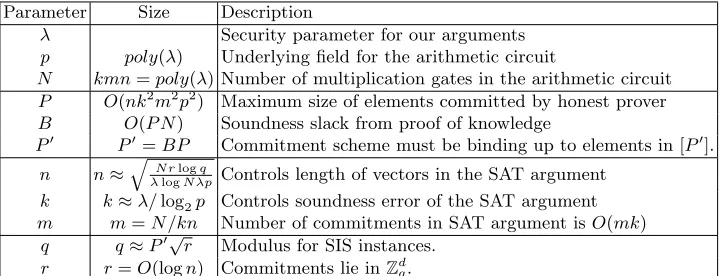
In this section we introduce notation for the parameters in our arithmetic circuit argument, and specify the choice of values in our arguments to ensure asymptotic security. Due to the large number of different variables used in the arithmetic circuit argument, and the fact that the arithmetic circuit argument and earlier proof of knowledge are quite independent of one another, we redefine certain variable names which were used earlier on for use in the arithmetic circuit argument. Parameterλis dictated by the desired security level, and pandN
come from the arithmetic circuit whose satisfiability is to be proven. All other parameters are derived from the table below, can be written in terms ofλ, pand
N, and are chosen in order to ensure that the commitment scheme is binding on a large enough message space for security.
Parameters and Asymptotic Sizes. In order to satisfy the constraints above, we choose the parameters in Table 2. Let λ be the security parameter, and suppose that we wish to verify an arithmetic circuit withN gates, overZp.
Parameter Size Description
λ Security parameter for our arguments p poly(λ) Underlying field for the arithmetic circuit
N kmn=poly(λ) Number of multiplication gates in the arithmetic circuit P O(nk2m2p2) Maximum size of elements committed by honest prover
B O(P N) Soundness slack from proof of knowledge
P0 P0=BP Commitment scheme must be binding up to elements in [P0]. n n≈q N rlogq
λlogN λp Controls length of vectors in the SAT argument
k k≈λ/log2p Controls soundness error of the SAT argument m m=N /kn Number of commitments in SAT argument isO(mk)
q q≈P0√r Modulus for SIS instances. r r=O(logn) Commitments lie inZd
q.
Table 2: Parameter choices for our arithmetic circuit argument.
6
Product Argument
The following protocol allows the prover to prove that they knowN = nmk
triples satisfying multiplicative relations.
We give parameters for our protocol in Section 5. Consider the commitment scheme Comck:Znq ×Z
n0
q 7→ Cintroduced earlier in section 2.2, whereck consists of the public matrices used to generate a SIS instance. Let A ∈ Z2kq ×n and R ∈ Z
2k×n0
scheme Comck∗ as
Comck∗(A;R) :=
Comck(a1;r1) Comck(a2,r2) ..
.
Comck(a2k;r2k)
whereai∈Znp,ri∈Zn
0
p are the row vectors of AandR.
Common Reference String: Commitment keyck. The basisB for the exten-sion fieldGF(p2k), which specifies how elements should be multiplied. Statement: Description of a set of N =kmn multiplication relations overZp. Prover’s Witness: ValuesAi, Bi, Ci∈Zkp×n, 1≤i≤m, such that∀i,Ai◦Bi≡
Ci modp. Argument:
P Since∀i, Ai◦Bi≡Ci modp, then for 1≤i≤m, we can write
Ai 0k×n
Bi 0k×n
=
Ci
C0
i
modp
for someCi0∈[p]k×n, 1≤i≤m, by our choice of basisB. The prover randomly selectsA0, Bm+1←Dσ2k1×n.
The prover selects αi and βi uniformly at random from [p]k×n
0
and γi uniformly at random from [p]2k×n0 for 1≤i≤m, and selectsα
0, βm+1 ←
D2kσ1×n0.
For 1≤i≤m, the prover computes
Ai= Comck∗
Ai 0k×n
;
α
i 0k×n0
Ci= Comck∗
Ci
Ci0
;γi
Bi= Comck∗
Bi 0k×n
;
β
i 0k×n0
Note that by definition,Ai andBi∈ C2k consist ofkcommitments and k trivial commitments in thekfinal components. The prover also computes
A0= Comck∗(A0;α0), Bm+1= Comck∗(Bm+1;βm+1) The prover sends{Ai}mi=0,{Bi}m+1i=1 ,{Ci}mi=1 to the verifier.
P The prover computes polynomials A(X), B(X), which have matrix coeffi-cients, in the indeterminateX ∈Z2k
q , and also computesC.
A(X) =A0+ m
X
i=1
MXi (Myi modp)
Ai 0k×n
B(X) =Bm+1+ m
X
i=1
MXm+1−i
Bi 0k×n
C= m
X
i=1
Myi
Ci
Ci0
modp
The prover computesA(X)B(X) mod p.
A(X)B(X) modp = MXm+1C +
2m
X
l=0,l6=m+1
MXl Hl modp
whereHl∈[p]2k×n.
For 0 ≤ l ≤ 2m, l 6= 0, the prover selects ηl uniformly at random from [p]2k×n0, and computesH
l= Comck∗(Hl;ηl). The prover sends{Hl}2ml=0,l6=mto the verifier.
V The verifier picksx←[p]2k, and sendsxto the prover.
P The prover computes the following values modulop.
A=A0+ m
X
i=1
(MxiMyi modp)
Ai 0k×n
α=α0+ m
X
i=1
(MxiMyi modp)
α
i 0k×n0
B =Bm+1+ m
X
i=1
(Mxm+1−i modp)
Bi 0k×n
β =βm+1+ m
X
i=1
(Mxm+1−i modp)
βi 0k×n0
Note thatA≡A(x) modpandB≡B(x) modp. The prover computes
D= (AB modp)−
m
X
i=1
(Myi modp)
Ci
C0
i
−
2m
X
l=0,l6=m+1
(Mxl modp)Hl
The prover randomly selectsδ←D2k×n0
σ2 and computesD= Comck
∗(D;δ).
The prover randomly selects E ← p·D2k×n
σ3 , ← D 2k×n0
σ4 and computes E= Comck∗(E;). Note that Eis 0 modulop.
V The verifier picksz←[p]2k, and sendsz to the prover.
P The prover runsRej((A||α||B||β),(A||α||B||β)−(A0||α0||Bm+1||βm+1), σ1, e), and aborts according to the result.
The prover computes the following
ρ= m
X
i=1
(Mxm+1Myi modp)γi+ 2m
X
l=0,l6=m+1
(Mxl modp)ηl+δ
The prover runsRej(ρ, ρ−δ, σ2, e).
The prover computes ¯D= (Mz modp)D+E and ¯δ= (Mz modp)δ+.
The prover runsRej( ¯D/p, D/p, σ3, e). The prover runsRej(¯δ, δ, σ4, e).
The prover sendsA, α, B, β, ρ,D,¯ δ¯to the verifier.
V The prover and the verifier engage in a proof-of-knowledge, as shown in Figure 1, including every commitment sent from the prover to the verifier.
The verifier accepts if and only if
Comck∗(A;α) = m
X
i=0
(MxiMyi modp)Ai
Comck∗(B;β) = m+1
X
i=1
(Mxm+1−i modp)Bi
Comck∗(AB modp;ρ) = m
X
i=1
(Mxm+1Myi modp)Ci+ 2m
X
l=0,l6=m+1
(Mxl modp)Hl+D Comck∗( ¯D; ¯δ) = (Mz modp)D+E
¯
D= 0 modp D¯ 2≤2
√
knσ3p
k(A||α||B||β)k2≤4√knσ1 kρk2≤2
√
knσ2
¯δ
2≤2
√
knσ4 and the proof-of-knowledge is accepting.
Sizes of Standard Deviations.
σ1= 48
√
knkmp2, σ2= 72
√
2knkmp, σ3= 24
√
2knkp(1 + 6kmp), σ4= 24
√
2k2pnσ2
Security Analysis.
Theorem 3. Given the statistically hiding, computationally binding commitment scheme based on SIS, the argument for multiplication triples has statistical completeness, statistical special honest verifier zero-knowledge and computational knowledge-soundness.
Efficiency. The above argument uses 7 moves of interaction and results in an overall 9 move argument when combined with the proof-of-knowledge sub-protocols. For the product argument, the prover must send 8mk+6kcommitments to the verifier, and 14nk integers as commitments openings, plus the commu-nication for the proof-of-knowledge. Sub-linear commucommu-nication is achieved by setting parameters as in Table 2. This gives communication of approximately
O(√NlogN) elements ofZq.
The prover’s computational costs are dominated by three computations: – The cost of multiplying polynomials overGF(p2k) to computeA(X)B(X).
This isO(Nlogmlogp(logλ)2) bit operations.
– The cost of computing commitments. Note thatAi andBi consist partly of trivial commitments for 1≤ i≤ m. The dominant cost is bounded by
O(NlogN) multiplications inZq.
– The cost of computing polynomials such asA(X) and matrices such asA,α, andρ. This is O(Nlogq(logk)2) bit operations.
Forq= poly(λ), this gives computational costs ofO(NlogN(logλ)2) bit opera-tions for the prover.
The verifier’s computational costs are dominated by computing the same types of linear combinations as the prover, giving computational costs ofO(N(logλ)3) bit operations.
7
Linear Constraint Argument Description.
In Section A of the Supplementary material, we give a protocol which allows the prover to prove thatN =nmkcommitted values satisfy the linear consistency relations
m,k
X
i=1,j=1
ai,j·wu,a,i,j+ m,k
X
i=1,j=1
bi,j·wu,b,i,j+ m,k
X
i=1,j=1
ci,j·wu,c,i,j =Ku foru∈ {1, . . . , U} (11) Without loss of generality, we pad the linear consistency relations so thatU
is divisible by k.
The protocol, security proof, and complexity analysis are very similar to that of the argument for proving multiplication triples in the previous section.
We select parameters for our protocol in Section 5.
Security Analysis.
Theorem 4. Given the statistically hiding, computationally binding commitment scheme based in SIS, the argument for linear consistency constraints has statistical completeness, statistical special honest verifier zero-knowledge and computational knowledge-soundness.
Efficiency. The above argument uses 7 moves of interaction and results in an over-all 9 move argument when combined with the proof-of-knowledge sub-protocols. For the product argument, the prover must send 7km+9k−1 commitments to the verifier, and 10nk+ 2kintegers as commitment openings, plus the communication for the proof-of-knowledge. The asymptotic costs of the protocol are the same as for the argument for multiplication triples in the previous section. Combined with the proof of knowledge, this gives an arithmetic circuit argument with the stated efficiency.
8
Arithmetic Circuit Argument
The product protocol given in 6 and the linear consistency protocol given in 7 imply an arithmetic circuit protocol with the same asymptotic efficiency as the two subprotocols, in which the prover formsO(mk) commitments, each tonwire values inp, and runs both subprotocols in order to prove that they satisfy the arith-metic circuit, reusing the same commitmentsAi,tothewiresinbothsubprotocols. This yields a zero-knowledge argument for arithmetic circuit satisfiability with communication costsO(√NlogN) elements ofZq, computational costs of
O(NlogN) for the prover, and approximately O(N) for the verifier.
References
AHIV17. Scott Ames, Carmit Hazay, Yuval Ishai, and Muthuramakrishnan Venkita-subramaniam. Ligero: Lightweight sublinear arguments without a trusted setup. In Thuraisingham et al. [TEMX17], pages 2087–2104.
Ajt96. Mikl´os Ajtai. Generating hard instances of lattice problems (extended abstract). In28th ACM STOC, pages 99–108. ACM Press, May 1996. Ban93. Wojciech Banaszczyk. New bounds in some transference theorems in the
geometry of numbers. Mathematische Annalen, 296:625–635, 1993. BBB+17. Benedikt Bunz, Jonathan Bootle, Dan Boneh, Andrew Poelstra, and Greg
Maxwell. Bulletproofs: Short proofs for confidential transactions and more. Cryptology ePrint Archive, Report 2017/1066, 2017.https://eprint.iacr. org/2017/1066.
BCC+16. Jonathan Bootle, Andrea Cerulli, Pyrros Chaidos, Jens Groth, and Christophe Petit. Efficient zero-knowledge arguments for arithmetic circuits in the discrete log setting. In Fischlin and Coron [FC16], pages 327–357. BCCT12. Nir Bitansky, Ran Canetti, Alessandro Chiesa, and Eran Tromer. From
extractable collision resistance to succinct non-interactive arguments of knowledge, and back again. In Shafi Goldwasser, editor,ITCS 2012, pages 326–349. ACM, January 2012.
BCCT13. Nir Bitansky, Ran Canetti, Alessandro Chiesa, and Eran Tromer. Recursive composition and bootstrapping for SNARKS and proof-carrying data. In Dan Boneh, Tim Roughgarden, and Joan Feigenbaum, editors,45th ACM STOC, pages 111–120. ACM Press, June 2013.
BCG+17. Jonathan Bootle, Andrea Cerulli, Essam Ghadafi, Jens Groth, Mohammad
![Fig. 1: Amortized proof for can be either � ��1), the challenge set ℓ equations. The ring R Z or Z [X] /(Xd+ C will be respectively {0, 1} or {0}±Xjj<d](https://thumb-us.123doks.com/thumbv2/123dok_us/7979913.1323514/13.612.134.486.246.429/fig-amortized-proof-challenge-equations-ring-respectively-xjj.webp)