© 2014, IJCSMC All Rights Reserved 409 Available Online atwww.ijcsmc.com
International Journal of Computer Science and Mobile Computing
A Monthly Journal of Computer Science and Information Technology
ISSN 2320–088X
IJCSMC, Vol. 3, Issue. 3, March 2014, pg.409 – 416
RESEARCH ARTICLE
An Analysis on the Performance
Evaluation of Routing Protocols in
Wi-Fi/802.11b Network
Merin Skariah
1, Prof. Dr. Suriyakala C D
2¹P G Student, Department of ECE, TocH College, Kerala, India ² Head of Department, PG Studies, TocH College, Kerala, India
1
[email protected]; 2 [email protected]
Abstract— The present scenario in wireless network is changing rapidly owing to several factors like high data rate, mobility, and range being some of them. The selection of an appropriate routing protocol is a key issue when designing a scalable and efficient wireless network. Here, we are proposing an intensive comparative study on the performance of AODV, DSR and DSDV protocols in Wi-Fi network. Our work will throw light on the performance analysis of Wi-Fi (802.11b) with appropriate metrics and also evaluate the performance of different routing protocols. The performance of these routing protocols has been analyzed for three metrics: throughput, end to end delay and packet loss. NS2 (Network Simulator) is used for the purpose of analysis.
Keywords— Wireless Networks; Wi-Fi; Routing Protocols; AODV; DSDV; DSR; Network Simulator
I. INTRODUCTION
The IEEE standard 802.11 has been developed by the IEEE 802.11 WG on WLAN since 1991. The first standard was published in 1997, and since then, the 802.11 WG has been developing many amendments to enhance this technology in various ways, including higher speed, QoS support, and security enhancement. The Wi-Fi Alliance, which started in 1999, has been testing and certifying the interoperability of IEEE 802.11-based WLAN products.
© 2014, IJCSMC All Rights Reserved 410
wirelessly over the network giving rise to high speed internet connections. Any device which is Wi-Fi enabled (like personal computers, video game consoles, Smartphone, tablet etc.) can connect to a network resource like the internet through a wireless network access point. [1] IEEE 802.11 WLAN, or Wi-Fi, is probably the most widely accepted broadband wireless networking technology, providing the highest transmission rate among standard-based wireless networking technologies. Today’s Wi-Fi devices, based on IEEE 802.11a and 802.11g provide transmission rates up to 54 Mbps and, further, a new standard IEEE 802.11ac , which supports up to 1.3 Gbps, is being standardized [7]. The transmission range of a typical Wi-Fi device is up to 100m, where its exact range varies depending on the transmission power, the surrounding environments, and others. The 802.11 devices operate in unlicensed bands at 2.4 and 5 GHz, where the exact available bands depend on each county.
The most typical applications of the 802.11 WLAN include Internet access of portable devices in various networking environments, including campus, enterprise, home, and hot-spot environments, where one or more access points (APs) are deployed to provide Internet service in a given area. The 802.11 could be used for a peer-to-peer communication among devices where APs are not deployed. For examples, laptops and PDAs in proximity can use the 802.11 to share their local files. Also, people in proximity can do networked gaming using their gaming devices with the 802.11 interface.
The latest Wi-Fi technology, called "802.11ac," offers speeds of up to 1.3 Gigabits per second. That's fast enough to transfer an entire high-definition movie to a tablet in under 4 minutes, share photo albums with friends in a matter of seconds or stream three HD videos at the same time. It's more than double the top speed of the previous standard, known as 802.11n. [8]
II. WIRELESS ROUTING PROTOCOLS
Three types of routing protocols have been analysed in this research as detailed.
A. Ad-hoc On-demand Distance Vector Routing Protocol (AODV)
© 2014, IJCSMC All Rights Reserved 411
B. Dynamic Source Routing (DSR)
The Dynamic Source Routing (DSR) is one of the purest examples of an on-demand routing protocol that is based on the concept of source routing. It is designed especially for use in multihop ad hoc networks of mobile nodes. It allows the network to be completely self-organizing and self-configuring and does not need any existing network infrastructure or administration. DSR uses no periodic routing messages like AODV, thereby reduces network bandwidth overhead, conserves battery power and avoids large routing updates. Instead DSR needs support from the MAC layer to identify link failure.
DSR is composed of the two mechanisms of Route Discovery and Route Maintenance, which work together to allow nodes to discover and maintain source routes to arbitrary destinations in the network. [4]
C.Destination-Sequenced Distance Vector (DSDV)
This is one of the table-driven routing protocols based on the Bellman-Ford routing mechanism. In table-driven routing protocols, the main objective is to maintain consistent and up-to-date routing information from each source node to other destination nodes in the network. Each node maintains one or more tables to store the required routing information. These tables are updated according to changes in network topology by propagating update information throughout the network. Two key elements are important in such protocols, the number of routing tables and the update method being used.
In DSDV, the entries in the table are indicated by numbers assigned by the destination node. These numbers act as status indicators of the nodes which therefore minimizes routing loops. Routing update packets are transmitted throughout the network to maintain table consistency. These packets indicate which nodes are accessible from each node and the number of hops required reaching the destination nodes using distance-vector algorithms. These update packets can result in large amount of traffic. Two types of update packets are present in DSDV based networks. The first one which is infrequently transmitted is called the full dump. This type of packet carries all available routing information. The second type called incremental packet is used to forward only that information which has changed since the last full dump. Both update packets have fixed size network protocol data unit (NPDU). [2]
III.PERFORMANCE EVALUATION USING SIMULATION
The performance evaluation of Wi-Fi network using routing protocol is done by modeling the network and simulating them. There are many simulators such as Network Simulator 2(NS-2), OPNET Modeler, GloMoSim, OMNeT++ and many others. We have chosen a Network Simulation Tool (NS-2). NS (version 2) which is an object-oriented, discrete event driven network simulator developed at UC Berkeley written in C++ and OTcl. NS-2 is primarily useful for simulating local and wide area networks.
© 2014, IJCSMC All Rights Reserved 412
information. The parsing can be done using the awk command (in UNIX and LINUX, it is necessary to use gwak for the windows environment) or perl script. The results have been analyzed using Excel or Matlab. [6]
Fig. 1 NS2 Simulation Model [6]
IV.SIMULATION ENVIRONMENT
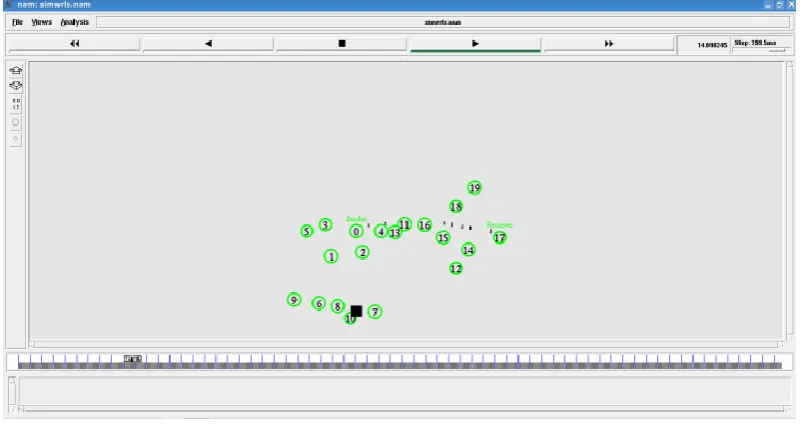
Simulation environment consists of 20 wireless mobile nodes which are placed uniformly and forms a Wi-fi Network, moving about over a 200 x 200 meters area for 100 seconds of simulated time. We have used standard two-ray ground propagation model, the IEEE 802.11 MAC for Wi-Fi, and omnidirectional antenna model of NS2. We have analysed DSDV, DSR and AODV routing protocols. The source node is 0 and the destination node is 17 respectively. Simulation is set up in NS2 with various simulation parameters.
TABLE I SIMULATION PARAMETERS
Method Value
Channel Type Channel/WirelessChannel
Radio Propagation Model Propagation/Two ray ground
Network Interface Type Phy/WirelessPhy
MAC Type Mac/802.11
Interface Queue Type Queue/DropTail
Link Layer Type LL
Antenna Antenna/OmniAntenna
Area(m*m) 200*200
Number of Nodes 20
Simulation Time 100 sec
Routing Protocol AODV/DSDV/DSR
The Wi-Fi channel is modeled in accordance with the parameters of Lucent ORiNOCO wireless card [5]. The following code is used in NS2 to model the Wi-Fi network:
Antenna/OmniAntenna set Gt_ 1 ;#Transmit antenna gain Antenna/OmniAntenna set Gr_ 1 ;#Receive antenna gain Phy/WirelessPhy set L_ 1.0 ;#System Loss Factor
Phy/WirelessPhy set freq_ 2.472e9 ;#channel-13. 2.472GHz Phy/WirelessPhy set bandwidth_ 11Mb ;#Data Rate
Phy/WirelessPhy set CPThresh_ 10.0 ;#Collision Threshold
Phy/WirelessPhy set CSThresh_ 5.011872e-12 ;#Carrier Sense Power Phy/WirelessPhy set RXThresh_ 5.82587e-09 ;# Receive Power Threshold Mac/802_11 set dataRate_ 11Mb ;# Rate for Data Frames
© 2014, IJCSMC All Rights Reserved 413
Fig. 2 NAM Window Snapshot
V. NETWORK PARAMETERS
The Wi-Fi network is analysed for the following parameters:
THROUGHPUT: It is the average rate of successful message delivery over medium. It is expressed in bits per second. Some factors that affect the throughput as; if there are many topology changes in the network, unreliable communication between nodes, limited bandwidth available and limited energy. A high throughput is absolute choice in every network.
Throughput (in bytes) = successful packets delivered/ total packets sent
AVERAGE END-TO-END DELAY: It is the time taken for a packet to be transmitted across a network from source to destination. This delay comprises of transmission, propagation, and processing delays.
© 2014, IJCSMC All Rights Reserved 414
VI.SIMULATION RESULTS AND ANALYSIS
A. THROUGHPUT
Fig. 3 Data Rate Vs Throughput
AODV and DSR perform better than DSDV in low mobility cases as they do not exchange so much routing information. Since DSDV protocol uses a “table driven” approach of maintaining routing information, it is not adaptive to the route changes that occur under high mobility as AODV and DSR protocols are. Packets are sent and lost. Hence its performance is poor in high mobility cases. This is shown in Fig 3.
B. END - END DELAY
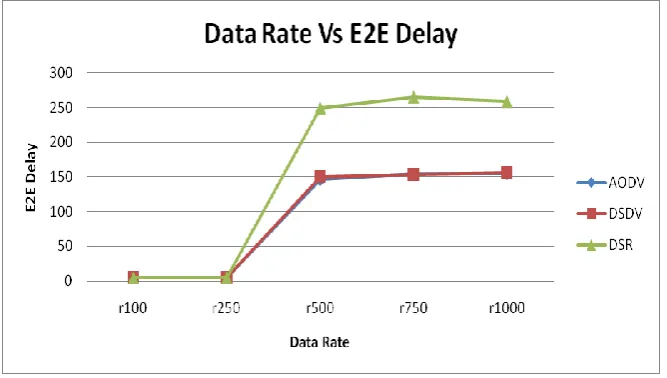
Fig 4 Data Rate Vs End to end delay
© 2014, IJCSMC All Rights Reserved 415
C. PACKET LOSS
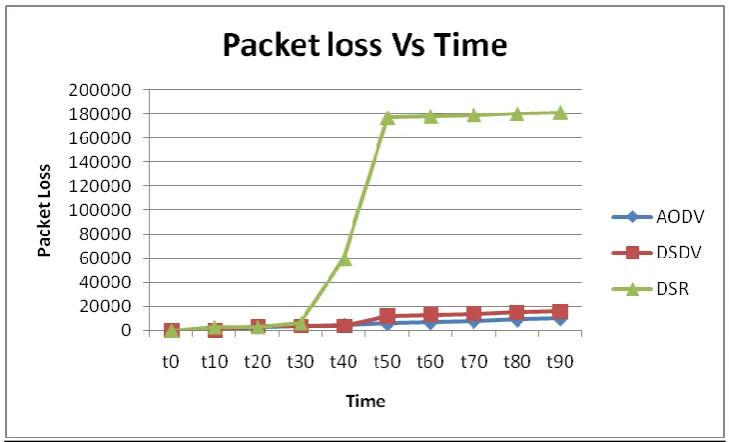
Fig 5 Packet loss Vs Time
As explained previously, due to the use of caching and its inability to expire out of date routes, the performance of DSR becomes poor in highly mobile network. Since the network is dynamically changing, chances are that the routing table doesn’t get updated properly. Hence packets are sent and lost and the Packet loss increases. This is plotted in Fig 5.
VII. CONCLUSIONS
In this work, we have set up a Wi-Fi network in NS2 and have analyzed its performance based on routing protocols for parameters such as throughput, end to end delay and packet loss. The following observations are made:
Performance of DSDV is poor in high mobility cases as, it is not adaptive to the route changes, whereas AODV performs the best
End to end delay of DSR is more because of its inability to expire out of date routes.
Because of the inability to expire out of date routes, DSR packet loss is high.
Having done with the performance analysis of Wi-Fi network, we could extend it to other networks such as WiMAX, Zigbee etc. As a future scope, we will try and suggest/introduce ways by which performance could be improved for some of the parameters.
ACKNOWLEDGMENT
© 2014, IJCSMC All Rights Reserved 416
REFERENCES
[1]. Merin Skariah, Dr. Prof. Suriyakala C D, “An Exploration on Wi-Fi/802.11b and WiMAX/802.16 Networks with Performance Enhancements” IJESRT, December 2013.
[2] M. Rehan Rasheed, M. Kamran Khan, M. Naseem, Aisha Ajmal and Ibrahim M. Hussain “Performance of Routing Protocols in WiMAX Networks” IACSIT International Journal of Engineering and Technology, Vol.2, No.5, October 2010 ISSN: 1793-8236
[3] Ruhani Ab Rahman, Murizah Kassim, Cik Ku Haroswati Che Ku Yahaya, Mariamah Ismail “Performance Analysis of Routing Protocol in WiMAX Network” 2011 IEEE International Conference on System Engineering and Technology (ICSET)
[4]. Sio-long Ao, Xu Huang, and P. Alexander Wai, (editors) “Trends in Communication Technologies and Engineering Science,” 2009, ISSN: 1876-1100, ISBN: 978-1-4020-9492-7, Spinger Dordrecht Heidelberg London New York.
[5] Xiuchao Wu, "Simulate 802.11b Channel within NS2", Tech. Report, NUS, 2004.
Websites:
[6] www.arpapress.com/Volumes/Vol7Issue3/IJRRAS_7_3_15.pdf
[7] http://www.cisco.com/en/US/prod/collateral/wireless/ps5678/ps11983/white_paper_c11-713103.html
[8] http://money.cnn.com/2013/06/19/technology/mobile/wifi-speeds/index.html
BIOGRAPHIES
Merin Skariah did her Bachelor of Technology in Electronics and Communication Engineering from Cochin University of Science and Technology in 2008. She then worked with Infosys as Systems Engineer for 3.5 years. Her industrial experience includes Mobile Application Development for Android and Blackberry. She is currently doing her Masters in Wireless Technology at the Toc H Institute of Science & Technology, Cochin, Kerala.
![Fig. 1 NS2 Simulation Model [6]](https://thumb-us.123doks.com/thumbv2/123dok_us/1987985.1262954/4.595.150.468.124.239/fig-ns-simulation-model.webp)