S
WEDISH
A
CTIVE
L
ABOUR
M
ARKET
P
ROGRAMMES IN THE
1990
S
:
O
VERALL
E
FFECTIVENESS AND
D
IFFERENTIAL
P
ERFORMANCE
Barbara Sianesi
Swedish active labour market programmes in the 1990s:
Overall effectiveness and differential performance
Barbara Sianesi ∗
University College London and Institute for Fiscal Studies [email protected]
February 2002
Keywords: Active labour market programmes, unemployment insurance, evaluation, matching, treatment effects.
JEL classification: C14, J38, J65, J68.
∗ I thank my supervisor Costas Meghir for continuous guidance, Emla Fitzsymons, Anders Harkman,
Summary
The ‘Swedish model’ of active labour market programmes is investigated in relation to some crucial institutional features with two aims: examining how successful it has been in the context of the high unemployment atypically experienced by Sweden in the 1990s and trying to derive some general lessons as to which type of programme works best. The effectiveness of the programmes in improving the labour market prospects of un-employed participants is assessed in terms of their impact on individual employment probability and collection of unemployment benefits over time.
The evidence as to the overall effectiveness of the programmes is rather mixed, with individuals joining a programme subsequently enjoying higher employment rates but also a higher probability of drawing unemployment benefits over time than if they had searched longer in open unemployment.
The renewed eligibility to unemployment compensation following participation in a programme appears to be a most critical driving force behind these results. In fact, when comparing the programme effects for individuals entitled to unemployment benefits to the programme effects for non-entitled individuals, the positive effect on participants’ employment prospects disappears, being instead replaced by a much higher probability of benefit collection.
Still, the various programmes may have differential effects, making it interesting to quantify the relative performance of the six main types of Swedish programmes that were available to adult unemployed workers entitled to unemployment benefits in the 1990s: labour market training, workplace introduction, work experience placement, re-lief work, trainee replacement and employment subsidies.
The low unemployment rates traditionally enjoyed by Sweden have often been related to the country’s extensive system of active labour market programmes (ALMPs)1, which has thus often been viewed as a model for other countries.
In the early 1990s, however, Sweden was hit by its most severe recession since the war: unemployment swiftly reached unprecedented levels, and as a policy response, so too did the offer of labour market programmes (see Figure 1).
Figure 1. Swedish total unemployment, broken into open unemployment and pro-gramme participation rates, 1985-2000 (percentage points)
0 2 4 6 8 10 12 14
198 5
1987 198 9
199 1
199 3
199 5
1997 199 9
Total
Open unemployment Programme rate
Sources: Open unemployment rate is from the Labour Force Survey (LFS). Programme rate is defined as the number of programme participants over the labour force; the former is from the National Labour Market Board (AMS) register, the latter from the LFS.
At over 3 percent of GNP, labour market programmes represented a substantial out-lay for the Swedish economy, prompting research to be increasingly carried out with the aim of evaluating how successful such large-scale measures have actually been.2
A second feature that makes the Swedish case particularly interesting is the wide ar-ray of different programmes among which unemployed individuals can potentially choose. Although all aimed at improving job-seekers’ labour market opportunities, some types of programmes provide direct incentives to move back into employment (e.g. by facilitating individuals’ job search, providing wage subsides or fostering the acquisition of work contacts and references), whilst other measures try to make the working option more attractive by providing incentives to improve individual produc-tivity and skills (e.g. via formal teaching or work experience). In such an institutional context, a natural question concerns the relative effectiveness of the various pro-grammes, ideally with the aim of singling out the best performing ones. Such an exer-cise could prove instructive for other countries as well, in particular those who have
1 E.g. Layard, Nickell and Jackman (1991).
cently been focusing on active labour market policy.3 Although with the obvious care required by cross-country comparisons, general lessons as to which type of programme is more effective could be shared (cf. e.g. Martin and Grubb, 2001).4
Accordingly, this paper relates and discusses the analyses in Sianesi (2001 and 2002) with two specific aims:
1. to investigate whether the ‘Swedish model’ was in fact successful in the context of high unemployment atypically experienced by Sweden, by appraising findings relat-ing to how effective the Swedish ALMPs as a whole have been in improvrelat-ing the la-bour market opportunities of unemployed individuals over the last decade;
2. to identify which type of programme works best, by quantifying the relative effec-tiveness of different types of Swedish programmes.
The outcomes used to assess the performance of the programmes are individual em-ployment prospects as well as unemem-ployment benefit collection over time (five years).
Before turning to the review of these sets of results in Section 3 and their appraisal and discussion in Section 4 it is important to highlight several features of the Swedish institutional background which cannot be overlooked when performing the evaluation or interpreting the results. Section 1 deals with these features, whilst Section 2 sets out the corresponding framework for analysis.
3 Examples include the UK, where the ‘New Deal for the Young Unemployed’, introduced in April 1998
and sharing some of the features of the Swedish set-up, offers five types of programme; France, where a series of measures targeted at unemployed youth were introduced during the late ‘80s; or Switzerland, where an ambitious array of programmes was set up during the ‘90s. In fact, both at the OECD (OECD, 1996) and European Union (European Commission, 1998) levels, labour market programmes are increas-ingly viewed as important measures to reduce long-term unemployment.
4 Microeconometric studies looking at the relative effects of Swedish programmes include among others
Carling and Gustafson (1999) for self-employment subsidies versus subsidised jobs, Melkersson (1999a,
1. Swedish features
1.1 Passive and active components of the Swedish labour
mar-ket policy
The Swedish labour market policy has two components: a benefit system that supports individuals while unemployed and a series of active labour market programmes offered in order to improve the employment opportunities of unemployed workers.
There are two forms of unemployment compensation5, the primary one being the relatively generous (up to 80% of the previous wage) unemployment insurance (UI), while the roughly half as generous cash assistance (KAS) was mainly designed for new entrants into the labour market.6 The duration of compensated unemployment is in prin-ciple capped at 60 weeks for UI- and 30 for KAS-recipients. However, up to February 2001, participation in a programme allowed job-seekers to renew eligibility to unem-ployment compensation, making it in fact possible to indefinitely extend the period dur-ing which unemployed individuals could receive benefits.
A rather distinctive feature of the Swedish labour market policy which requires spe-cial consideration when assessing programme effectiveness during the 1990s is thus the fact that a programme effectively came as a package of two competing components. On the one hand, it was expected to equip job-seekers with marketable skills which should facilitate their re-employability, but at the same time it could be used as a passport to renewed eligibility, thus reinforcing the work disincentive associated with the generous unemployment benefit system.7 In order to display any positive effect, any skill-enhancing component of the programme thus needed to be strong enough to outweigh the reinforced work disincentive associated with the entitlement renewability that par-ticipation allowed.
5 Individuals not entitled to any form of unemployment benefits may receive means-tested social
insur-ance.
6 As to eligibility, a certain degree of previous labour market attachment is required for UI; the ‘work
condition’ of having worked for at least five months in the year preceding the current unemployment spell can however be replaced by an ‘education condition’ for KAS.
7 Incentives to escape unemployment may have been weakened through, for example, higher reservation
1.2 No programme participation in Sweden
When the aim is to evaluate the effect of a programme on some outcome of interest, an essential part of the research question concerns the comparison state. One may for in-stance be interested in the performance of one Swedish programme (e.g. labour market training) compared to another one (e.g. relief work). Still, interest often lies in assessing the effect of participating in a given programme (e.g. training) relative to no programme participation at all. The comparison group (or ‘control group’, to borrow a term from the experimental literature) should in this case be composed of the non-participants, that is those individuals not participating in any programme.
The definition of the ‘no programme participation’ state in Sweden is however not as straightforward.8 The object of the evaluation is a system of ongoing programmes, tak-ing place continuously over time and open to all registered job-seekers. Unemployed individuals in turn can – and in fact often do – register repeatedly, and they can partici-pate in various programmes at different times during their observed unemployment his-tory. More important still is the fact that even when focusing on individuals who have just entered unemployment, it can in general be claimed that they will join a programme at some future point, provided they remain unemployed ‘long enough’; in fact, if unem-ployed individuals in Sweden are not observed to go into any programme, it can be ar-gued that it is because they have already found a job.
Another related feature of the Swedish programme participation process is that once registered, unemployed job-seekers are most likely to take their decisions sequentially over time in unemployment. In particular, at any given moment the relevant choice open to them is not whether to participate now or not to participate at all, but whether to join a programme now or not to participate for now, in the knowledge that they can always join later on. For those who are in fact observed to find a job before going on any pro-gramme, the participation-postponing decision has proven successful. The key choice faced by the unemployed in Sweden is thus a decision between participating in a pro-gramme now or waiting longer in open unemployment in the hope of finding a job. Cor-respondingly, what one can evaluate in the Swedish institutional set-up (in addition to the pair-wise comparisons of the various programmes) is the average effect of joining a given programme at a certain time compared to not joining any programme at least up
to then. Subsequently aggregating all the effects by time of entry would then recover the average effect, for those observed to join a programme, of joining when they did com-pared to waiting longer than they have, where the average is taken with respect to the observed joining distribution of the participants. When interpreting the results it is thus important to keep in mind that the chosen comparison group does not reflect a no-programme state, but rather a possibly postponed participation.9
A final clarification concerns the type of assistance effectively received by those in our chosen comparison group, i.e. by those (waiting longer) in open unemployment. In Sweden, the state to which programme participants can be compared to is in fact not one of being completely left on one’s own to look for a job, but rather the baseline services offered by the employment offices. Simply being registered as openly unemployed gives access to the various employment services offered by the offices, not only in terms of the increasingly computerised job information and matching of vacancies to applicants, but also in terms of the ‘job-seeker activities’, which include search-skill-enhancing activities such as training courses on how to apply for a job and motivation-raising activities. Note that in some countries this kind of assistance is in fact considered a programme in its own right.10
1.3 Richness of the data
Analyses of Swedish labour market programmes can considerably benefit from particu-larly rich data sources by international standards. In particular, the National Labour Market Board (AMS) records the programme and unemployment history (to the day) of
all unemployed individuals registered at public employment offices. This register-based longitudinal event history dataset (Händel), available from 1991, provides each individ-ual’s labour market status information over time (e.g. unemployed, on a given pro-gramme, temporarily employed), together with important personal characteristics of the job-seeker and of the occupation sought. From 1994, the unemployment insurance funds provide additional information for individuals entitled to UI benefits or KAS (in particular, amount and type of compensation received, previous wages and working hours).
9 For more details on the implementation, see Sianesi (2001 and 2002).
The end result is thus a very large, comprehensive and representative11 dataset, which permits both short- and long-term evaluation of the programmes and with respect to a larger number of outcomes than is generally possible.12 The analyses discussed in the following sections make use of extensive information on the labour market history of more than 110,000 individuals who first13 became unemployed in 1994 and were then followed for five to six years until the end of November 1999.
1.4. The ‘lost’ individuals
Despite the richness and thoroughness of the administrative data just described, the un-employment register does however suffer from an attrition problem. This occurs when a registered unemployed individual, having first missed an appointment at his official employment office, subsequently fails to contact the agency within a week, and is con-sequently de-registered with the reason recorded as ‘contact ended’.
Such ‘lost’ individuals are problematic, in the sense that the researcher is prevented from fully observing their true labour market status: which of these spells are in reality an employment spell the former unemployed individual failed to report to the agency, and which are by contrast still part of the preceding unemployment spell? Bring and Carling (2000), who traced a sample of ‘lost’ individuals, found that approximately half of them had in fact found a job. The problem is not just how severely under-reported employment status is in the data, but also the fact that such under-reporting may sys-tematically differ between programme participants and comparison group members. It is thus important that results on programme effects on employment be checked in terms of their robustness to these lost spells.
2. A framework for analysis
The richness of the Swedish data may justify the use of methods of analysis based on ‘selection on observables’, i.e. the key assumption that the evaluator can observe all of
11 Unemployment individuals entitled to compensation are required to be registered at a public
employ-ment office in order to collect their benefits, and only registered individuals have access to the pro-grammes. In fact, over 90% of the unemployed do register at an employment office (from a validation study by Statistics Sweden, quoted in Carling, Edin, Harkman and Holmlund, 1996, Footnote 7), making the employment register-based dataset quite representative of the population of interest.
12
Examples include unemployment – in particular of the benefit-compensated type –, employment, sub-sequent programme participation, out of the labour force – including further regular studies.
13 Strictly speaking, one cannot exclude the possibility that these individuals have had contact with the
the systematic differences (which are believed to affect labour market outcomes) be-tween groups of individuals entering the different programmes or postponing their par-ticipation decision. Before briefly discussing the plausibility of this assumption in rela-tion to the available informarela-tion as well as the selecrela-tion process into the Swedish pro-grammes, the following sub-section first sketches out the evaluation problem of interest and the method of analysis chosen.
2.1 The evaluation problem
Our evaluation problem consists of quantifying the average effect on programme par-ticipants’ subsequent labour market performance from joining a programme when they did compared to waiting longer in open unemployment than they have. Additionally, we are interested in assessing the relative effectiveness of different types of programmes.
More specifically, three evaluation questions will be addressed concerning
(1) the effect of joining any programme compared to waiting longer, for individuals participating in any programme;
(2) the effect of joining a specific programme P compared to waiting longer, for par-ticipants in P; and
(3) the effect of joining a specific programme P compared to joining another pro-gramme P’, for participants in P.
To frame the problem in general terms, let us follow an established terminology in the evaluation literature and define a set of ‘treatments’ whose effectiveness is to be compared in the three evaluation questions:
Question Treatment A Comparison treatment B
(1) Join any programme Wait longer in open unemployment (2) Wait longer in open unemployment (3) Join programme P Join programme P’
Notes: P and P’ are two different programmes, e.g. labour market training versus relief work.
The aim is thus to evaluate the average effect for an individual of receiving treatment
individuals who have participated in A is observed in the data; by contrast, since no in-dividual can be in two different states at the same time, assumptions need to be invoked to identify the counterfactual average outcome participants in A would have experienced had they taken treatment B instead.14
The simple comparison between the observed performance of individuals taking treatment A and individuals receiving treatment B is however likely to reflect the com-position of the unemployed workers taking different treatments: groups of unemployed individuals with quite different characteristics are in fact observed to go into the various programmes or else to find a job before joining any, and their observed differences (e.g. qualifications, previous wage, pre-programme unemployment duration) are quite likely to affect the way they would have performed anyway, even had they chosen another treatment.
One way to adjust for such differences in characteristics between groups A and B is offered by statistical matching, which pairs to each individual in group A an individual from group B with the ‘same’ observable characteristics.15 Under the ‘selection on ob-servables’ assumption that all the outcome-relevant differences between groups A and B
are captured by observable characteristics, the average outcome experienced by the matched pool of B-participants can be used to proxy the counterfactual outcome partici-pants in A would have experienced, on average, had they taken treatment B instead.16
2.2 Selection into the Swedish programmes
As has already been highlighted, the method of matching just outlined requires the re-searcher to observe all those differences between the various treatment groups that are
14 Identification assumptions and estimation of treatment effects in non-experimental studies have been
extensively examined. Standard references in the evaluation literature include the comprehensive survey by Heckman, LaLonde and Smith (1998), as well as Heckman and Robb (1985), Heckman, Ichimura and Todd (1997, 1998), Heckman, Ichimura, Smith and Todd (1998), Rosenbaum and Rubin (1983, 1985) and Rubin (1974).
15 Matching estimators can in practice be implemented by exploiting so called ‘balancing scores’,
vari-ables which provide a parsimonious way to adjust for differences in a (generally large) set of characteris-tics. The determination of such variables for a single treatment versus no-treatment comparison is due to Rosenbaum and Rubin (1983), whilst Imbens (2000) and Lechner (2001) (see also Brodaty, Crépon and Fougère, 2000) have generalised the approach to the case where a whole range of mutually exclusive treatments is available. For the technical details of the present implementation, see Sianesi (2001 and 2002).
16 Note that an additional condition is required, which in particular rules out the possibility of general
likely to affect their outcomes. It thus important to consider what observables are in fact available in relation to the selection process into the Swedish programmes.
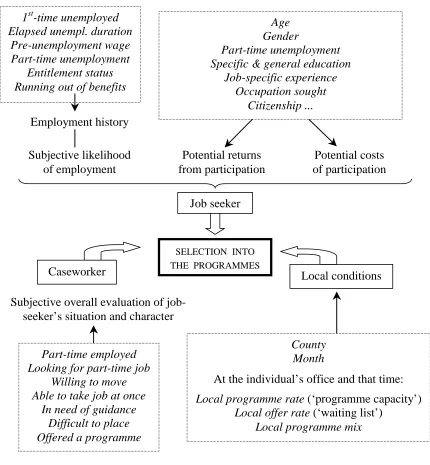
To this end, Figure 2 summarises the extensive discussions in Sianesi (2001 and 2002) by highlighting the agents – the unemployed job-seeker, his caseworker and the local conditions prevailing at his employment office – whose interactions determine the outcome of the selection process (i.e. whether an individual joins a programme and if yes which one), as well as how these respective influences are captured in the available data.
Figure 2. Selection process into the Swedish programmes and key available regressors
Potential costs of participation Potential returns
from participation Subjective likelihood
of employment
SELECTION INTO THE PROGRAMMES
Job seeker
Local conditions Caseworker
Employment history
1st-time unemployed Elapsed unempl. duration
Pre-unemployment wage Part-time unemployment
Entitlement status Running out of benefits
Age Gender
Part-time unemployment Specific & general education
Job-specific experience Occupation sought
Citizenship ...
Part-time employed Looking for part-time job
Willing to move Able to take job at once
In need of guidance Difficult to place Offered a programme
County Month
At the individual’s office and that time:
Local programme rate (‘programme capacity’)
Local offer rate (‘waiting list’)
Local programme mix
The decision between waiting further in open unemployment or joining a (i.e. any) programme appears to be driven by the individual’s subjective likelihood of employ-ment (Harkman, 2000, as reported in Carling and Richardson, 2001), which could in turn be proxied by several pieces of information characterising the recent employment history of the individuals; one can also control for factors relating both to employment prospects and either to potential returns from programme participation or to the oppor-tunity cost or psychological cost of participation. Additional useful information allow-ing us to capture caseworker selection relates to the officials’ own subjective and syn-thetic overall evaluation of the situation and character of their unemployed client, sum-marising individual traits that are potential indicators of unobserved heterogeneity. This latter type of information proves particularly valuable also when considering the deci-sion to choose one specific programme among the available ones, since Harkman (2000) has found the relevant decision-maker to be the caseworker in this case.
Finally, local indicators at the individual’s municipality / employment office level over time should control for the possibility that individual joining decisions and/or of-fice-specific programme selection criteria may be based on local unobserved character-istics which in turn may correlated with individuals’ labour market performance.17
3. Some empirical results for the 1990s
Before moving on to the empirical findings, the main conclusions emerging from Sec-tion 2 are that: benefit entitlement consideraSec-tions should not be overlooked when assessing the past effectiveness of the Swedish programmes; both analyses and interpretation of the results need to take account of the non-standard definition of the ‘comparison group’ in the Swedish context, and some robustness checks should try to take account of the ‘lost’ individuals. This last issue aside, the available data is very representative and includes a wide array of demographic and human capital variables, together with information on unemployment history and unemployment benefit receipt, as well as the caseworker’s appraisal of various factors relating to the overall situation and needs of service of the job-seeker. Such unusual richness of the data has motivated the matching approach from which the following results were obtained.
17 A possible source of violation of the ‘selection on observables’ assumption would be the presence of
3.1 The Swedish ALMP system as a whole
It seems appropriate to begin by focusing on the overall performance of the Swedish system – a system comprising both a collection of programmes and a closely inter-twined unemployment benefit component. Sianesi (2002) has examined the effective-ness of the Swedish unemployment system in improving the opportunities of unem-ployed individuals over the last decade, so that results reviewed here are based on all of the programmes combined into one, and relate to the question of how job-seekers who join a Swedish programme perform, on average, compared to a situation where they would have searched longer as openly unemployed.
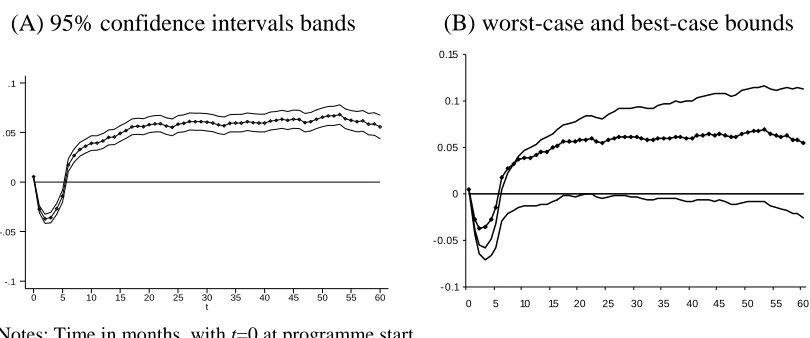
As to the employment prospects of programme participants, although joining a pro-gramme has a negative effect in the very short term, the propro-grammes’ impact on partici-pants’ more long-run employment probability is positive and significant. As shown in Figures 3A, joining a programme is initially expected to reduce the chance of finding employment: compared to open unemployment, job search whilst on a programme is clearly reduced because less time is left due to participation itself (the ‘lock-in effect’).
Figure 3. Average effect for participants of joining a programme (compared to waiting longer in open unemployment) on employment probability over time
(A) 95% confidence intervals bands
t
treatm effect P(empl) upper 95% bound lower 95% bound
0 5 10 15 20 25 30 35 40 45 50 55 60 -.1
-.05 0 .05 .1
(B) worst-case and best-case bounds
- 0.1 -0.05 0 0.05 0.1 0.15
0 5 10 15 20 25 30 35 40 45 50 55 60
Notes: Time in months, with t=0 at programme start.
par-ticular shows the worst- and best-case bounds for the programme effect on employment rates, which were derived exploiting the additional information from the Bring and Car-ling (2000) survey.
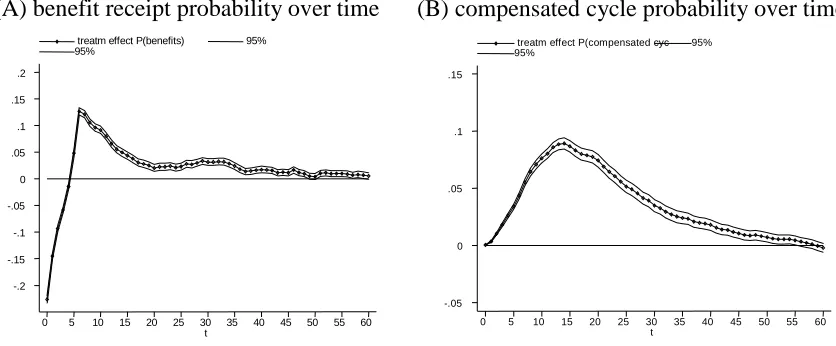
By contrast, the fact that programme participation entitles individuals to renewed un-employment compensation is indeed found to create strong incentives to remain within the official unemployment system, in particular to be drawing unemployment benefits over time and on a ‘cycling’ basis. Figure 4A shows that as soon as the programme typically ends (i.e. after approximately 5-6 months), the negative effect on benefit col-lection probability (by construction, compensation while on programmes is not counted as unemployment benefits) abruptly turns into a large positive one of almost a 15 per-centage point higher probability.
Figure 4. Average effect for participants of joining a programme compared to waiting longer in open unemployment on
(A) benefit receipt probability over time
t treatm effect P(benefits) 95% 95%
0 5 10 15 20 25 30 35 40 45 50 55 60 -.2
-.15 -.1 -.05 0 .05 .1 .15 .2
(B) compensated cycle probability over time
t treatm effect P(compensated cyc 95% 95%
0 5 10 15 20 25 30 35 40 45 50 55 60
-.05 0 .05 .1 .15
Notes: Time in months, with t=0 at programme start. 95% confidence intervals bands.
unemploy-ment or programme spell is part of an uninterrupted chain of alternating unemployunemploy-ment- unemployment-programme spells, where in each of the unemployment spells the individual draws un-employment compensation. As revealed by Figure 4B, there is quite a sizeable positive programme effect on compensated cycle probability, reaching 10 percentage points and persisting for well up to 50 months after entry into the programme. The fact that former programme participants keep going on various programmes without exiting unemployment, is clear evidence of a failure of the programme system itself, while the importance of compensated cycling behaviour points to a likely failure in the way in which incentives are taken into account by the intertwined unemployment benefit-programme institutional system.
Overall, the impact of the programme system is thus found to have been mixed, in line with both programme components being at work: the skill-enhancing component and the work disincentive element. Compared to longer job search in open unemploy-ment, individuals joining a programme are found to be more likely to return to benefit-compensated unemployment, to re-enter more programmes in the future, or to alternate between benefits and program participation over time. At the same time, however, join-ing a programme also considerably reduces the probability of bejoin-ing unemployed outside
the official (and compensated) unemployment system, and to a lesser extent of exiting the labour force. In fact, the net effect is that unemployed individuals who go on a pro-gramme sooner (compared to later or never) have on average a higher probability of be-ing in employment from six months after joinbe-ing the programme for up to at least five years.
espe-cially benefit receipt over time, by far the worst programme effect in terms of compen-sated cycling probability is displayed by those joining a programme at benefit exhaus-tion.18
Figure 5. Marginal effect of UI-status on the probability of joining a programme (percentage points difference in the programme joining probability with respect to non-entitled individuals with the same characteristics of UI individuals), by months in un-employment prior to joining a programme
-5% 0% 5% 10% 15%
1 3 5 7 9 11 13 15 17
Various pieces of evidence thus consistently point to entitlement (renewability) con-siderations as a weighty driving force behind the direction and strength of the observed programme effects.19 When assessing the effectiveness of the Swedish programmes, it is therefore believed that a critical issue concerns the co-ordination and interaction be-tween the programmes and the unemployment insurance system.
The next sub-section presents some further analyses that single out those individuals whose incentives are most likely to be affected: job-seekers entitled to unemployment benefits.
3.2 Programmes for unemployed adults: the role of entitlement
status
To shed more light on the linkages between entitlement to unemployment compensation and programme effects, this sub-section directly contrasts the programme effects for that sub-group of adults who were entitled to unemployment compensation when first
18 The average programme effect for this group is an average 8 percentage points higher probability of
being in the midst of a compensated cycle over time, as opposed to 1.8 percentage points for individuals joining a programme in their first month of unemployment and 3.5 percentage points for the whole group of participants.
19
Previous Swedish evidence on the importance of issues relating to unemployment benefits, work disin-centive effects and cycling behaviour includes Ackum Agell, Björklund and Harkman (1995), Carling, Edin, Harkman and Holmlund (1996), Regnér (1997), Agell and Lundborg (1999), Carling, Holmlund and Vejsin (1999) and Hägglund (2000).
registering as unemployed to the programme effects for unemployed adults who were
not entitled to benefits at the start of their unemployment spell.
Following the previous sub-section, focus of the evaluation is on the overall effec-tiveness of the six main Swedish programmes available to adult individuals at the height of the economic recession in 1994: labour market training, workplace introduction (API), work experience placement (ALU), relief work, trainee replacement and em-ployment subsidies.20
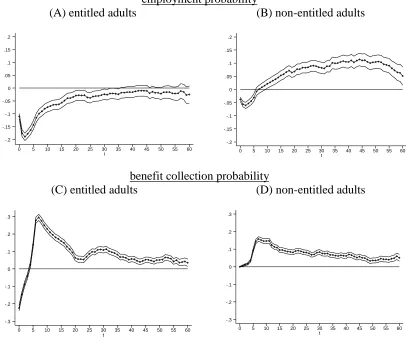
Figure 6A (B) plot the average effect on employment probability for an entitled (re-spectively for a non-entitled) unemployed individual of joining one of the above pro-grammes, rather than searching in open unemployment for at least a while longer. The two figures offer a striking contrast. Although joining a programme initially has a sig-nificantly negative lock-in effect for both sub-samples, programmes appear to reduce their entitled participants’ job search intensity much more severely, with a substantial lock-in effect of almost 20 percentage points compared to 5 for the non-entitled sub-sample.
However even after the typical 4-5 months duration of a programme, entitled partici-pants do not seem to enjoy higher employment rates than if they had postponed their participation decision further. In fact, the negative programme effect persists for up to three years after entry into the programme, after which former participants become just as likely to be in employment as if they had further searched in open unemployment. These results are in sharp contrast to those for the non-entitled sub-sample, for whom a significant and substantial positive effect of the programmes was already visible just after 6 months.
Figure 6C plots the programme effect on the probability of compensated unemploy-ment for the entitled sub-sample. The comparison with the effect for the non-entitled sub-sample (Figure 6D) is again very revealing, with twice as much of a positive effect on benefit receipt probability for entitled individuals (peaking to 30 percentage points) compared to non-entitled individuals (up to 15 percentage points). Finally, results for the entitled sub-group display a pronounced second ‘hump’ starting around the 24th month (=5 months on the programme + 14 months of maximum benefit collection + 5 months on another programme) and lasting for another 14 months – a feature likely to
20 Results for the non-entitled sub-group relate to five programmes, since ALU is reserved to entitled
be linked to cycling incentives, whereby programmes are simply viewed and used as a gateway to renewed benefit eligibility.
Figure 6. Average effect for participants of joining any of the programmesa compared to waiting longer in open unemployment on
employment probability (A) entitled adults
t
0 5 10 15 20 25 30 35 40 45 50 55 60
-.2 -.15 -.1 -.05 0 .05 .1 .15 .2
(B) non-entitled adults
t
0 5 10 15 20 25 30 35 40 45 50 55 60 -.2 -.15 -.1 -.05 0 .05 .1 .15 .2
benefit collection probability (C) entitled adults
t
0 5 10 15 20 25 30 35 40 45 50 55 60
-.3 -.2 -.1 0 .1 .2 .3
(D) non-entitled adults
t
0 5 10 15 20 25 30 35 40 45 50 55 60 -.3 -.2 -.1 0 .1 .2 .3
Notes: a Training, API, ALU, relief, replacement and subsidies for entitled; all but ALU for non-entitled. Time in months, with t=0 at programme start.
95% confidence intervals bands
Still, even when focusing on entitled individuals, the six programmes considered may well have heterogeneous effects: while some of them may simply lock participants in rather useless or low-qualified tasks that will give them no subsequent edge on the labour market, some others may endow participants − and even participants entitled to unemployment benefits − with skills marketable enough to make the working option sufficiently attractive. The following sub-section thus moves a step further and disag-gregates the composite ‘programme’ analysed above into its six distinct components.
3.3 Differential programme performance
In order to focus on that group whose incentives appear to be most affected and for whom the trade-off between skill-enhancing components of the programmes and the reinforced work disincentive associated with the benefit system should be at its sharp-est, this sub-section more closely examines the sub-sample of entitled individuals con-sidered above.21 In particular, it reports and discusses selected results by Sianesi (2001) investigating both the separate and the relative performance of the six main Swedish programmes available to entitled adults in the mid 1990s and considered as a whole in the previous sub-section.
Additional interest in this sub-sample arises from the fact that individuals entitled to unemployment benefits not only have exclusive access to ALU – a measure introduced in 1993 with the explicit aim of preventing entitled individuals from running out of benefits – but also enjoy ‘special’ conditions on programmes of wider access (in par-ticular, they are in principle granted the right to relief work when approaching benefit exhaustion).
Table 1 contrasts the main features of these programmes, which all aim at improving their participants’ re-employment prospects, though by providing them with distinct kinds of skills and in quite diverse ways.
Labour market training is intended to teach participants new vocational skills deemed in demand in a formal (classroom) environment. By contrast, the two ‘work practice schemes’ – API and ALU – offer a workplace traineeship to gain practical on-the-job experience, good working habits and references which should later prove useful on the
21 Almost 31,000 adult individuals who were entitled to either UI or to KAS when first registering as
Table 1. Synoptic table of the main features of the programmes
PROGRAMME AIM ELIGIBLE EMPLOYER TRAINING TASK COMPENSATIONa EMPLOYER INCENTIVES COSTb
EMPLOYMENT SERVICES
fill job openings quickly, job search assistance and training
job seeker activi-ties
UI/KAS if enti-tled
LABOUR MARKET TRAINING (AMU)
equip individuals with skills to find jobs more easily
>20 priv. and publ. providers full-time voca-tional training TA/BA course free 1,753
WORK PRACTICE
Work experience placement (ALU)
prevent exhaustion of benefits while maintaining contact with the regular labour market and enhancing good working habits
entitled
≥20
90% public and non-profit
otherwise not
performed
TA/BA free labour 1,169
Workplace introduction (API)
contact with working life to get work-place training, job-experience and refer-ences
≥20 private and public practical voca-tional training
otherwise not performed
TA/BA pay tuition to government (2,000 SEK/month)
879
TEMPORARY JOB
Relief work specially created temporary jobs to maintain working skills and habits, also to avoid benefit exhaustion
>25 2/3 in public sec-tor (municipalities and state organiza-tions)
otherwise not
performed
according to collective agree-ment
grant 50% of labour cost up to fixed amount (SEK 7,000/month)
1,157
Trainee replacement enhance skills of employee while pro-viding an unemployed individual with work experience in a regular job
≥20 80% in public sector
on-the-job practice replaces regu-lar employee
according to collective agree-ment
grant 50% of labour cost up to fixed amount (SEK
7,000/month); deduction of train-ing costs; educational grant of up to 20,000 SEK per employee
964
EMPLOYMENT
SUBSIDIES
establish permanent employment rela-tion ≥20 ≥6months unem-ployed private sector only; from 97 some industries excluded
on-the-job practice normal according to collective agree-ment
grant 50% of labour cost up to fixed amount (SEK 7,000/month)
751
Notes: Information has been gathered from various sources, in particular, Swedish Institute (1997).
a
regular labour market, while relief work involves specially created temporary jobs, mostly in the public sector. Participants in these latter three types of programme are however prevented – at least formally – from performing tasks that are part of the or-ganiser’s normal activity. Although it is likely for such a rule to be often interpreted more as a recommendation22, to the extent it is adhered to, the type of on-the-job prac-tice acquired may not be expected to be particularly marketable.
Similar to relief work, trainee replacement schemes offer an unemployed individual a temporary job by allowing him to replace a regularly employed worker on leave for education. Finally, employment subsidises not only represent a temporarily subsidised job opportunity to acquire job-specific skills, but in fact aim at initiating a permanent employment relationship, the engagement being implicitly expected to continue on a regular and indefinite basis after the programme. Like the two work practice schemes and relief work, trainee replacement and employment subsidies thus offer the opportu-nity to gain skills and experience on the job; in these latter cases, though, the participant does in fact replace ordinary labour. Finally, while trainee replacement is intrinsically a temporary opportunity to invest in job-specific skills, employment subsidies almost en-tail the ‘promise’ of a permanent job.
Figures 7 looks at the separate effectiveness in terms of participants’ employment rates of each of the six programmes compared to a hypothetical situation where partici-pants would have searched longer in open unemployment. Joining any of the pro-grammes is again confirmed to have a negative lock-in effect on participants’ short-term employment probability, reducing their chances of being in employment by an over 15 percentage points probability in each case. The impact of joining a programme on more medium- and long-term employment prospects is however found to radically vary ac-cording to which programme the individual has joined.
In particular, participants in trainee replacement and in API are just as well off as if they had been searching further as openly unemployed, while the decision to enter a job subsidy programme significantly pays off in terms of persistently higher employment rates (up to 40 percentage points) soon after the programme typically ends. By contrast, for our sample of entitled unemployed adults it seems more worthwhile to intensively search longer in open unemployment rather than joining labour market training, ALU or
relief work. In fact, participants in these programmes subsequently enjoy lower em-ployment rates than if they had postponed their joining decision further, with these negative effects persisting over a long time horizon before turning insignificant.
Figure 7. Unemployed adults entitled to unemployment benefits: Average effect on employment probability over time of joining the specified programme compared to waiting longer in open unemployment for participants in the specified programme
Labour market training Work practice (ALU)
t
0 5 10 15 20 25 30 35 40 45 50 55 60
-.6 -.4 -.2 0 .2 .4 .6 t
0 5 10 15 20 25 30 35 40 45 50 55 60 -.6 -.4 -.2 0 .2 .4 .6
Work practice (API) Relief work
t
0 5 10 15 20 25 30 35 40 45 50 55 60
-.6 -.4 -.2 0 .2 .4 .6 t
0 5 10 15 20 25 30 35 40 45 50 55 60 -.6 -.4 -.2 0 .2 .4 .6
Trainee replacement Employment subsidies
t
0 5 10 15 20 25 30 35 40 45 50 55 60
-.6 -.4 -.2 0 .2 .4 .6 t
0 5 10 15 20 25 30 35 40 45 50 55 60 -.6 -.4 -.2 0 .2 .4 .6
The use of these latter types of programmes simply as a way to re-qualify for unem-ployment benefits is likely to be at the root of these disappointing results. In fact, Sianesi (2001) finds employment subsidies to be the only programme to display a nega-tive effect on compensated unemployment probability compared to postponing the par-ticipation decision, while the trainee replacement programme has a zero effect. By con-trast, participants in labour market training, relief work and either of the two work prac-tice schemes ALU and API are all considerably more likely to be drawing benefits over time than if they had waited longer in open unemployment. Furthermore, for partici-pants in these latter programmes there is clear evidence of unemployment-programme ‘cycling’ effects. It is also quite revealing to compare the potentially different effective-ness of the two work practice measures, ALU and API. As previously mentioned, whilst sharing the basic features of API, ALU is exclusively reserved to entitled individuals and has been explicitly instituted to prevent them from exhausting their benefits. It is thus not too surprising that compared to waiting longer in open unemployment, the per-formance of ALU is slightly worse than that of API in terms of employment probability over time and that ALU participants display an even stronger propensity to be drawing benefits on a visibly ‘cycling’ basis compared to waiting longer than do API partici-pants had they waited longer too. The explicit, close link between entitlement renew-ability and programme (as institutionalised in the case of ALU) would thus seem to se-verely impact on the programme’s effectiveness on the labour market performance of its participants.
Finally, Sianesi (2001) evaluates the relative performance of the six programmes, in-vestigating how participants in programme A would have fared had they joined pro-gramme B instead.23 The main conclusion is that in terms of both employment rates and benefit collection probability, the best performer is undisputedly employment subsidies, followed by trainee replacement.
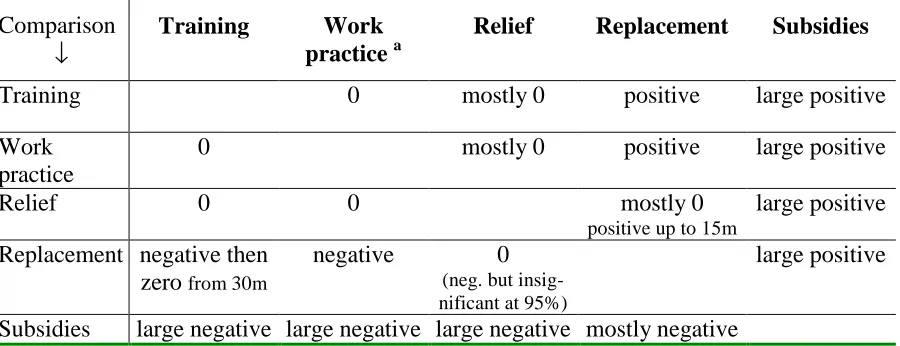
Table 2 summarises the results from the various pair-wise comparisons in terms of employment rates. More specifically, individuals having joined the subsidy programme consistently enjoy a much higher (20 to 50 percentage points) employment probability over time than if they had joined an alternative programme. In addition, participants in any of these other programmes (with the possible exception of trainee replacement
23 Note that all these results are quite robust to the problem of the ‘lost’ individuals; the worst- and
schemes) would have fared considerably better had they gone on job subsidies instead. The second best performing programme is trainee replacement: former deputies have considerably better employment prospects than if they had joined any other of the re-maining programmes (in particular, training or work practice). Conversely, trainees and work practice participants would have improved their labour market performance had they joined a replacement scheme. As to the remaining programmes – labour market training, work practice and relief work – they do not seem to perform in a significantly different way between one another in terms of employment probability over time.
Table 2 Informal summary of the pair-wise conditional average programme effects on employment probability over the 5-year horizon since programme start
Comparison
↓ Training practice Work a
Relief Replacement Subsidies
Training 0 mostly 0 positive large positive
Work practice
0 mostly 0 positive large positive
Relief 0 0 mostly 0
positive up to 15m
large positive
Replacement negative then zero from 30m
negative 0
(neg. but insig-nificant at 95%)
large positive
Subsidies large negative large negative large negative mostly negative
Notes: This summary takes informal account of the statistical significance of the estimated effects; for the complete set of results, see Sianesi (2001).
a API and ALU combined. m = month(s).
4. Summary and discussion
The first research question set out in the introduction concerned the effectiveness of the Swedish unemployment-programme system in improving individual labour market op-portunities during the recession of the 1990s. The evidence considered in the paper has been rather mixed; individuals joining a programme are found to subsequently enjoy higher employment rates but also to be more likely to draw unemployment benefits over time than if they had searched longer in open unemployment.24
24 It may be worthwhile to stress again that these programme effects do not relate to the effect of joining a
programme compared to never joining any, but rather compared to delaying participation at least some
Comparing the main lessons arising from studies performed at different times (in particular the switch from positive effects of Swedish labour market training in the 1980s to negative ones in the 1990s25), it may thus seem that the collection of measures that appeared to be quite effective in a low-unemployment environment may no longer be so successful if applied – and on a massive scale – in periods of severe economic downturns. On the other hand, it may also be argued that it is exactly in such difficult times of high unemployment when effective labour market programmes are be most needed to place participants back into work. Similarly, the large scale at which pro-grammes have been administered may have prevented the efficient management and tailoring of the various measures.
Nevertheless, possibly the most critical factor appears to have been the link between the programme system and the unemployment benefit system, an interaction quite likely to intensify in periods of high unemployment and unstable labour market conditions. Various pieces of evidence concerning this link have been combined and discussed. In particular, the evidence for individuals entitled to unemployment benefits provided a sharp contrast to the findings relating to non-entitled individuals, quite unmistakably pointing to distorted incentives behind programme participation as a most likely force behind the disappointing programme effects.
All of these considerations thus raise the important issues as to whether there may be more efficient means of providing (sustained) unemployment compensation, as well as whether some programme expenditure could be more effectively redirected, for instance towards market-based incentives to stimulate labour demand (e.g. by decreasing payroll taxes).
The second question motivating the paper concerned the possibility of scrutinizing the Swedish experience in order to derive some general lessons as to which type of pro-gramme works best. The answer that has emerged is that those propro-grammes most simi-lar to regusimi-lar employment rank unambiguously highest, an overall conclusion not only in line with other Swedish analyses, but also with studies looking at different countries with varying labour market structures and policies.26
25
For more details, see Calmfors, Forslund and Hemström (2001).
26 For Sweden, cf. in particular the programme ranking obtained by Carling and Richardson (2001). For a
In particular, while on employment subsidies or trainee replacement the participant performs a task that is by construction a useful one, one for which the firm is willing to pay a regular employee. These programmes should thus teach demonstrably market-relevant skills, in contrast to e.g. labour market training with its emphasis on the class-room-based acquisition of new skills which are deemed to be – or soon to become – in demand. A second advantage of these programmes is that they can be used as a cheap screening device of the participant’s initially unknown productivity in a regular task. For employment subsidies – with their informal promise of a job – there is thus a valu-able opportunity for mutually trying out the likely future employment relationship on a low-cost basis. For trainee replacement, a signal is sent out to potential employers that the individual has been gaining (or at least maintaining) relevant skills. Participants in either type of programme are thus likely to become more attractive to potential employ-ers, who value the fact that a job is being performed in the regular competitive market.
By contrast, it appears that the formal vocational skills taught by labour market train-ing, as well as the working skills, additional work experience, improved working habits, fresh contacts and references that relief work and the two work practice schemes are intended to provide may not be relevant – and thus valuable – enough to fetch a return on the labour market, or at least not one high enough to make the working option more attractive, this being particularly the case for individuals entitled to unemployment benefits. These types of programme are then likely to be regarded just as a gateway to renewed benefit eligibility, ending up locking their participants – in particular their enti-tled participants – in the unemployment system.
In the light of these results, it is actually worth pointing out how the ranking of the programmes in terms of their effectiveness is almost perfectly reversed when viewed in terms of their expensiveness (1. training, 2. ALU, 3. relief work, 4. trainee replacement, 5. API and 6. subsidies – cf. Table 1, last column).
It is however important not to jump to hasty conclusions as to which programmes should attract most public funds. As to job subsidies, apart from an increasingly re-stricted legal possibility of extension27, both survey and econometric Swedish studies
and Lechner (2000) for Switzerland, Brodaty, Crépon and Fougère (2000) and Bonnal, Fougère and Sérandon (1997) for France, and Ridder (1986) for the Netherlands.
27 The public sector cannot use such grants, and following EU regulations in 1997 neither do employers in
have found sizeable direct displacement effects (of around 65-70 percent).28 Similarly, broadening such a measure is bound to lead to substantial dead-weight effects (i.e. sub-sidising firm hirings that would have taken place anyway). For trainee replacement too, dead-weight losses have been both suspected in terms of the sponsored training29, as well as documented in terms of the deputies, with a large share of participants found to be alternating between regular short-term jobs and trainee replacement with the same
employer (see Harkman, Johansson and Okeke, 1999). Similarly, survey studies have uncovered displacement effects of the same order as employment subsidies (e.g. AMS, 1998).30
In conclusion, although this paper has presented and discussed results which, per-fectly in line with previous micro evidence, have found that a programme’s benefits to its participants are highest the more it resembles regular employment, several macro-economic studies have documented large and negative displacement and dead-weight effects exactly for this type of programme. As discussed by Calmfors, Forslund and Hemström (2001), labour market policy-makers are confronted with a difficult trade off.
References
Ackum Agell, S. (1995), Swedish labour market programmes: Efficiency and timing,
Swedish Economic Policy Review, 2, 65-98.
Ackum Agell, S., Björklund, A. and Harkman, A. (1995), Unemployment insurance, labour market programmes and repeated unemployment in Sweden”, Swedish Economic Policy Review, 2, 101-128.
Agell, J. and Lundborg, P. (1999), Survey evidence on wage rigidity and unemploy-ment: Sweden in the 1990s, IFAU Working Paper 1999:2, Office of Labour Mar-ket Policy Evaluation, Uppsala.
AMS (1998), Undanträngningseffekter av arbetsmarknadspolitiska åtgärder – enenkätundersökning ur både arbetssökande- och arbetsgivarperspektiv, Ura 1998:8, AMS.
Bonnal, L., Fougère, D. and Sérandon, A. (1997), Evaluating the impact of French em-ployment policies on individual labour market histories, Review of Economic Studies, 67, 683-713.
28 For more details, see Calmfors, Forslund and Hemström (2001).
29 Since 80 to 90 percent of employers taking part in the scheme are within sectors (health care and
re-lated branches in the public sector) with a long-standing system for further training funded by the em-ployer, it seems likely that a good part of the sponsored training would have occurred anyway. (I thank Anders Harkman for this information.)
Bring, J. and Carling, K. (2000), Attrition and misclassification of drop-outs in the analysis of unemployment duration, Journal of Official Statistics, 4.
Brodaty, T., Crépon, B. and Fougère, D. (2000), Using matching estimators to evaluate alternative employment programmes: Evidence from France, 1986-8, Labour Economics Discussion Paper 2604, CEPR, London.
Calmfors, L. Forslund A. and Hemström, M. (2001), Does active labour market policy work? Lessons from the Swedish experiences, Swedish Economic Policy Review, this issue.
Carling, K. and Gustafson, L., (1999), Self-employment grants versus subsidised em-ployment: Is there a difference in the re-unemployment risk?, IFAU Working Pa-per 1999:6, Office of Labour Market Policy Evaluation, Uppsala.
Carling, K. and Larsson, L. (2000a), Utvärdering av arbetsmarknadsprogram i Sverige: Rätt svar är viktigt, men vilken var nu frågan?, Arbetsmarknad&Arbetsliv, 6, 185-192.
Carling, K. and Larsson, L. (2000b), Replik till Lars Behrenz och Anders Harkman, Ar-betsmarknad&Arbetsliv, 6, 278-281.
Carling, K. and Richardson, K. (2001), The relative efficiency of labour market pro-grammes: Swedish experience from the 1990s, IFAU Working Paper 2001: 2, Of-fice of Labour Market Policy Evaluation, Uppsala.
Carling, K., Edin, P.-A., Harkman A. and Holmlund, B. (1996), Unemployment dura-tion, unemployment benefits, and labour market programmes in Sweden, Journal of Public Economics, 59, 313-334.
Carling, K., Holmlund, B. and Vejsiu, A. (2001), “Do benefit cuts boost job findings?”, IFAU Working Paper 1999: 8, Office of Labour Market Policy Evaluation, Upp-sala, to appear in the Economics Journal.
European Commission (1998), From Guidelines to Actions: The National Action Plans for Employment, Directorate-General for Employment, Industrial Relations and Social Affairs, Luxemburg.
Gerfin, M. and Lechner, M. (2000), Microeconometric evaluation of the active labour market policy in Switzerland, Discussion paper 2000-10, Volkswirtschaftliche Abteilung, Universität St. Gallen.
Hägglund, P. (2000), Effects of changes in the unemployment insurance eligibility re-quirements on job duration – Swedish evidence, IFAU Working Paper 2000:4, Office of Labour Market Policy Evaluation, Uppsala.
Hallström, N.-E. (1994), Genomförandet av åtgärden arbetslivsutveckling (alu). En studie i sex kommuner i tre län, Mimeo, Department of culture and Social Sci-ences, Linköping University.
Harkman, A. (2000), Vem placeras i åtgärd?, Mimeo, Office of Labour Market Policy Evaluation, Uppsala.
Heckman, J.J. and Robb, R. (1985), Alternative methods for evaluating the impact of interventions, in Heckman, J.J. and Singer, B. (eds.), Longitudinal Analysis of Labour Market Data, Cambridge University Press, 156-246.
Heckman, J.J., Ichimura, H. and Todd, P.E. (1997), Matching as an econometric evalua-tion estimator: Evidence from evaluating a job training programme, Review of Economic Studies, 64, 605-654.
Heckman, J.J., Ichimura, H. and Todd, P.E. (1998), Matching as an econometric evalua-tion estimator, Review of Economic Studies, 65, 261-294.
Heckman, J.J., Ichimura, H., Smith, J.A. and Todd, P.E. (1998), Characterising selec-tion bias using experimental data, Econometrica, 66, 1017-1098.
Heckman, J.J., LaLonde, R.J. and Smith, J.A. (1998), The economics and econometrics of active labour market programmes, in Ashenfelter, O. and Card, D. (eds.), The Handbook of Labour Economics, 3, Ch.31, North-Holland, Amsterdam.
Frölich, M., Heshmati, A. and Lechner, M. (2000), A microeconometric evaluation of rehabilitation of long-term sickness in Sweden, SSE/EFI Working Paper Series in Economics and Finance, no 373.
Imbens, G. (2000), The role of propensity score in estimating dose-response functions,
Biometrika, 87, 706-710.
Johansson, P. and Martinson, S. (2000), The effect of increased employer contacts within a labour market training programme, IFAU Working Paper 2000:10, Office of Labour Market Policy Evaluation, Uppsala.
Larsson, L. (2000), Evaluation of Swedish youth labour market programmes, IFAU Working Paper 2000:1, Office of Labour Market Policy Evaluation, Uppsala. Layard, R., Nickell, S. and Jackman, R. (1991), Unemployment, Macroeconomic
Per-formance and the Labour Market, Oxford University Press.
Lechner, M. (2001), Identification and estimation of causal effects of multiple treat-ments under the conditional independence assumption, in Lechner, M., Pfeiffer, F. (eds), Econometric Evaluation of Labour Market Policies, Physica/Springer, Heidelberg, 43-58.
Martin, J.P. and Grubb, D. (2001), What works and for whom: A review of OECD countries’ experiences with active labour market policies, Swedish Economic Pol-icy Review, this issue.
Melkersson, M. (1999a), Policy programmes only for a few? Participation in labour market programmes among Swedish disabled workers, IFAU Working Paper 1999:1, Office of Labour Market Policy Evaluation, Uppsala.
Melkersson, M. (1999b), Unemployment duration and heterogeneous search behaviour among swedish disabled workers, IFAU Working Paper 1999:5, Office of Labour Market Policy Evaluation, Uppsala.
Regnér, H. (1997), Training at the job and training for a new job: Two Swedish studies, Dissertation Series 29, Swedish Institute for Social Research, Stockholm Univer-sity.
Ridder, G. (1986), An event history approach to the evaluation of training, recruitment and employment programmes, Journal of Applied Econometrics, 1, 109-126. Rosenbaum, P.R. and Rubin, D.B. (1983), The central role of the propensity score in
observational studies for causal effects, Biometrika, 70, 41-55.
Rosenbaum, P.R. and Rubin, D.B. (1985), Constructing a control group using multi-variate matched sampling methods that incorporate the propensity score, The American Statistician, 39, 33-38.
Rubin, D.B. (1974), Estimating causal effects of treatments in randomised and non-randomised studies, Journal of Educational Psychology, 66, 688-701.
Sianesi, B. (2001), Differential effects of Swedish active labour market programmes for unemployed adults during the 1990s, IFS Working Paper W01/25.
Sianesi, B. (2002), An evaluation of the Swedish system of active labour market pro-grammes in the 1990s, IFS Working Paper W02/01.