Silicon vertex detector for superheavy
elements identification
A. J. Kordyasz1,*, M. Kowalczyk1, M. Kisieli´nski2, A. Bednarek1, M. Hady´nska-Klek1, A. Wieloch3, Z. Sosin3,
D. Atanasov4, J. Sarnecki5, A. Brzozowski5, J. Jagielski5,
M. Teodorczyk5, M. Gajewski5, A. Wi´sniewska5, K. Krzy ˙zak5,
G. Gawlik5, A. Zagojski5
1 Heavy Ion Laboratory, Warsaw University, ul. Pasteura 5a, 02-093
Warszawa, Poland
2 Soltan Institute for Nuclear Studies, ´Swierk, Poland 3 Jagiellonian University, ul. Reymonta 4, 30-059 Krakow, Poland
4 University of Sofia “Sveti Kliment Ohridski”, Bulgaria 5 Institute of Electronic Materials Technology, Warsaw, Poland
Abstract
Silicon vertex detector for superheavy elements (SHE) identifica-tion has been proposed. It will be constructed using very thin silicon detectors about 5μm thickness. Results of test of 7.3μm four inch sili-con strip detector (SSD) with fission fragments andαparticles emitted by252Cf source are presented
1
Introduction
The vertex detector very popular in high energy physics can by used for superheavy elements identification [1]. However, due to very low kinetic energy of SHE elements that are produced close to the interaction barrier, the thickness of SSD detectors should be very small about 5 μm. For a
*E-mail: [email protected]
such thin strip detectors the PPPP (Planar Process Partially Performed on the Thin, Silicon Membrane) process was elaborated [2, 3]. The preliminary tests presented in this work with the 7.3μm thick SSD detectors made from four inch epitaxial structures, show that very thin SSD detectors can be possible to produce.
2
Silicon vertex detector for superheavy elements
identification
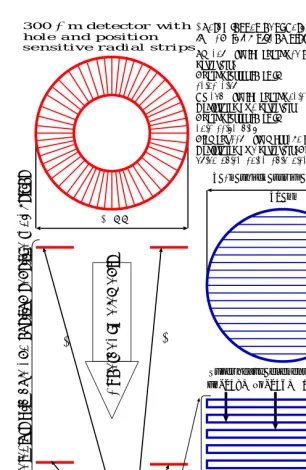
The design of silicon vertex detector for identification of SHE elements is illustrated in Fig. 1. It will consist of 9 SSD detectors of thickness about 5 μm (blue color) and an additional 300 μm thick detector for stopping of α particles emitted in forward directions (blue color) in the process of consecutiveα-radioactive decays of SHE elements. The energy loss of 5 MeV
α particles in 5 μm thick detectors is about 0.5 MeV, which is sufficient to determine their trajectories. Forαparticles, which are emitted in backward directions, a system of 300 μm thick detectors with radial strips and hole for a coming superheavy nuclei is proposed (Fig. 1, red color). Almost all
α particles, except for those emitted parallel to the direction of SHE nuclei, are stopped by this system. The proposed vertex detector measures energies of superheavy elements as well as the products of their decay (α particles and fission fragments) in a solid angle close to 4π. Additionally, it provides trajectories of all registered particles, what should considerably improves the identification of superheavy elements.
3
Test of four inch, 7.3
μ
m thick SSD detector
with
252Cf source
For SHE elements identification by the silicon vertex detector [1] we have elaborated a new technology of large-area, thin SSD detectors. On the Fig. 2 is presented a photo of four inch silicon epitaxial n+ - n structure with thin 7.3μm epitaxial membrane, transparent for visible light with detector strips created.
The uniformity of the thickness of the thin SSD detector was tested using
241Am source. The picture of Fig. 3 shows theαparticle energy distribution
(relative units) measured by PIN diode after crossing of the thin detector by
90 mm
300 μm detector with hole and position sensitive radial strips
α α
α α
α α
Superheavy elements
300
μ
m thick detectors with hole and position sensitive radial strips
5
μ
m thick strip detectors
300 μm thick detector with position sensitive strips
Superheavy element paths: 5 μm thick strip detector Energy losses of superheavy elements in 5 μm thick silicon strip detectors.
Fm-248 with lab energy 15 MeV. Registered by two detectors.
Energy losses [MeV]: 12.41, 2.58
No-256 with lab energy 42.1 MeV. Registered by 3 detectors Energy losses [MeV]: 24.1, 11.72, 6.27
Element 118 with mass 294 and lab energy 129.5 MeV. Registered by 5 detectors. Energy losses [MeV]: 58.54, 36.12, 14.22, 16.5, 4.12
Fm-248, No-256, 118 element
zoom
30 mm
Figure 2: (Colour online) Four inch wafer with 7.3 μm thin silicon membrane supported by thick 400μm silicon n+substrate ring. The detector strips are visible in the transparent light illuminating the wafer from the back side.
0 200 400 600 800
40 60 80 100 120
252 Cf fission fragments
in E detector Det. E
covered by ΔE
Fission fragments measured directly in E detector
E(MeV)
Counts
0 2000 4000
0 20 40 60 80 100 120
ΔE strip detector 7.3 μm thick
α particles 252
Cf fission fragments
E(MeV)
Counts
25 50 75 10030 40 50 60 70 80
E - ΔE plot
E (MeV)
Δ
E (MeV)
Figure 4: (Colour online) Upper figure: Fission fragments directly measured by PIN diode which is the E detector (right spectrum). After covering of PIN diode by 7.3μm SSD detector the fission fragments decreased their energy (left spectrum). Middle figure: Fission fragments (central spectrum) and 6.2 MeVαparticles from
252Cf (left spectrum) measured by 7.3μm strip ΔE detector. The estimated energy
The detector operate with very low bias potential about 1 Volt and cur-rent 780 nA. The low bias potential is probably associated with high internal, build-in field, which allow auto depletion of thin transmission detectors [2]. The ΔE-E telescope was mounted with collimated strip ΔE detector fol-lowed by PIN diode as an E detector. The telescope was illuminated in vacuum by fission fragments and α particles from 252Cf source. Results of measurements are presented in Fig. 4.
In conclusion, results presented in this work (Fig. 3, 4): good uniformity of the SSD and possiblity to measure energy of detected heavy ions, conviced us that one can construct very thin (e.g. 5μm) SSD detectors and they can be very usefull in SHE detection and indentification.
Acknowledgments
We would like to thank very much to Krzysztof Rusek for fruitful discussions and comments.
References
[1] A.J. Kordyasz et al., M. Kowalczyk, A. Bednarek, J. Sarnecki, A. Brzo-zowski, J. Jagielski, G. Gawlik, A. Zagojski, M. Teodorczyk, G. Gajew-ski, Poster presented at SPIRAL2 WEEK 2011, Memorial, GANIL France
[2] A.J. Kordyasz, E. Nossarzewska-Orowska, J. Wojtkowska, M. Kisieliski, E. Kulczycka, L. Reissig, J. Kownacki, A. Wojtasiewicz, J. Sarnecki, J. Iwanicki, Nucl. Instr. and Meth. A 539 (2005) 262