Stiff self-interacting strings at high temperature QCD
A. SBakry1,X.Chen1,M.Deliyergiyev1,A.Galal2,A.Khalaf2, andP. MPengming1, 1Institute of Modern Physics, Chinese Academy of Sciences, Lanzhou 730000, China
2Physics Dept., Faculty of Science, Al Azhar University, Cairo 11651, Egypt.
Abstract.
We investigate the implications of Nambu-Goto (NG), Lüscher Weisz (LW) and Polyakov-Kleinert (PK) effective string actions for the Casimir energy and the width of
the quantum delocalization of the string in 4-dim pure SU(3) Yang-Mills lattice gauge theory. At a temperature closer to the critical point T/Tc=0.9, we found that the next to
leading-order (NLO) contributions from the expansion of the NG string in addition to the boundary terms in LW action to decrease the deviations from the lattice data in the inter-mediate distance scales for both the quark-antiquarkQQ¯potential and broadening of the color tube compared to the free string approximation. We conjecture possible stiffness of
the QCD string through studying the effects of extrinsic curvature term in PK action and
find a good fitting behavior for the lattice Monte-Carlo data at both long and intermediate quark separations regions.
1 Introduction
The formulation of an effective bosonic string description for gluonic degrees of freedom binding
the hadron has been an attractive picture in consistency with with the main infrared (IR) features of quantum chromodynamics (QCD). The most simple choice relevant to the QCD string description is the NG string which is a bosonic string with an action taken proportional to the world-sheet area.
In the leading order approximation of the NG string action, the quantum fluctuations of the string bring forth a universal quantum correction to the linearly rising potential well known as the Lüscher
term [1]in the meson and entail geometrical Lüscher-like terms [2] in the baryonic configuration. The
width due to the quantum delocalizations of the string grows logarithmiclly [3,4] as two color sources
are pulled apart.
Precise lattice measurements of theQQ¯ potential in SU(3) gauge model are in consistency with
the Lüscher subleading term for color source separation distanceR=0.5 fm [1]. Many gauge models
have unambiguously identified the Lüscher correction to the potential with unprecedented accuracy
(for example [5–7]). The string model predicts, in addition, a logarithmic broadening [3] for the width
profile of the string delocalization [8–11]
Speaker, e-mail: [email protected]
Nevertheless, the simplified picture of the free bosonic string derived on the basis of the leading order formulation of NG action does not provide a good description of the numerical data in the
inter-mediate distances and high temperatures. For instance, substantial deviations [12] from the free string
behavior have been found for the lattice data corresponding to temperatures near the deconfinement point.
A comparison with the lattice Monte-Carlo data has shown the validity of the leading-order
ap-proximation at sources separation larger thanR=0.9 fm [12,13] for both the quark–antiquark (QQ¯)
potential and color-tube width profile. The region extends behind distances at which the leading-order
string model predictions is valid [1] at zero temperature. In the baryon [14,15], we found a similar
behavior [16] for the long Y-string among quarks.
In this proceeding, we summarize the results obtained by studying the effects of the extrinsic
curvature of the PK string in addition to the next to leading order expansion of the NG string action with boundary terms and the corresponding match to the lattice data. The numerical data of the potential and width profile of the energy density distribution is compare to the Casimir energy and the mean-square width of the string fluctuations of both PK and NG string action.
2 String Phenomenology
One particular form of string action that is Poincare and parity invariant is the Lüscher and Weisz
string action. This form is introduced [1,17] with additional built-in surface/boundary terms to
account for the interaction of the open string with boundaries. The Lüscher and Weisz [11] (LW)
effective action up to four-derivative term read
SLW[X]=σA+σ
2
dζ1
dζ2[(∂ζα∂X·∂ζα∂X)+σ
dζ1
dζ2[κ2(∂ζα∂X·∂ζα∂X)2+κ3(∂ζα∂X·∂ζβ∂X)2]+Sb (1)
The vectorXµ(ζ
1, ζ2) maps the regionC ⊂ R2 into RD and couplingsκ1, κ2 are effective
low-energy parameters. Invariance under party transform would keep only even number derivative terms.
The boundary termSbis relevant to the interaction of the effective string with the Polyakov loops at
the fixed ends of the string and is given by
Sb=
dζ0[b1∂2Xi.∂2Xi+b2∂2∂1Xi.∂2∂1Xi+...]. (2)
Consistency with the open-closed string duality [11] implies a vanishing value of the first boundary
couplingb1 = 0 in addition to a further constraint on the kinematically-dependent couplings in D
dimension given byκ2+κ3=8−1
σ. This condition implies that all the terms with only first derivatives
in the effective string action Eq. (1) coincide with the corresponding one in Nambu-Goto action to all
orders in the derivative expansion.
The Nambu-Goto action is the most simple form of string actions proportional to area of the world-sheet, the action after gauge fixing reads
SNG[X]=σ
L
0 dζ1
R
0 dζ2
( 1+(∂ζ1X⊥)2+(∂ζ2X⊥)2). (3)
A generalization of the Nambu-Goto string has been proposed by Polyakov [18] and Kleinert [19] to
Nevertheless, the simplified picture of the free bosonic string derived on the basis of the leading order formulation of NG action does not provide a good description of the numerical data in the
inter-mediate distances and high temperatures. For instance, substantial deviations [12] from the free string
behavior have been found for the lattice data corresponding to temperatures near the deconfinement point.
A comparison with the lattice Monte-Carlo data has shown the validity of the leading-order
ap-proximation at sources separation larger thanR=0.9 fm [12,13] for both the quark–antiquark (QQ¯)
potential and color-tube width profile. The region extends behind distances at which the leading-order
string model predictions is valid [1] at zero temperature. In the baryon [14,15], we found a similar
behavior [16] for the long Y-string among quarks.
In this proceeding, we summarize the results obtained by studying the effects of the extrinsic
curvature of the PK string in addition to the next to leading order expansion of the NG string action with boundary terms and the corresponding match to the lattice data. The numerical data of the potential and width profile of the energy density distribution is compare to the Casimir energy and the mean-square width of the string fluctuations of both PK and NG string action.
2 String Phenomenology
One particular form of string action that is Poincare and parity invariant is the Lüscher and Weisz
string action. This form is introduced [1, 17] with additional built-in surface/boundary terms to
account for the interaction of the open string with boundaries. The Lüscher and Weisz [11] (LW)
effective action up to four-derivative term read
SLW[X]=σA+σ
2
dζ1
dζ2[(∂ζα∂X·∂ζα∂X)+σ
dζ1
dζ2[κ2(∂ζα∂X·∂ζα∂X)2+κ3(∂ζα∂X·∂ζβ∂X)2]+Sb (1)
The vector Xµ(ζ
1, ζ2) maps the region C ⊂ R2 into RD and couplingsκ1,κ2 are effective
low-energy parameters. Invariance under party transform would keep only even number derivative terms.
The boundary termSbis relevant to the interaction of the effective string with the Polyakov loops at
the fixed ends of the string and is given by
Sb=
dζ0[b1∂2Xi.∂2Xi+b2∂2∂1Xi.∂2∂1Xi+...]. (2)
Consistency with the open-closed string duality [11] implies a vanishing value of the first boundary
couplingb1 = 0 in addition to a further constraint on the kinematically-dependent couplings in D
dimension given byκ2+κ3= −81
σ. This condition implies that all the terms with only first derivatives
in the effective string action Eq. (1) coincide with the corresponding one in Nambu-Goto action to all
orders in the derivative expansion.
The Nambu-Goto action is the most simple form of string actions proportional to area of the world-sheet, the action after gauge fixing reads
SNG[X]=σ
L
0 dζ1
R
0 dζ2
( 1+(∂ζ1X⊥)2+(∂ζ2X⊥)2). (3)
A generalization of the Nambu-Goto string has been proposed by Polyakov [18] and Kleinert [19] to
stabilize the NG action and was first investigated in the context of fluid membranes. This is a bosonic
string with an extrinsic curvature as a next order operator after NG action. The action of the bosonic (Polyakov) string with the extrinsic curvature term reads
SPK=σ
2
d2ζ√ggαβ∂αX.∂βX+α
r
d2z√g∆X.∆X, (4)
whereis Laplace operator. The extrinsic-curvature term filters out the sharply curved string
config-urations. The rigidity parameter provides the relative weight between the NG and this smoothing term
in the effective string action [20]. Rigid string effects investigated first in Ref. [21] may manifest in
the IR region of SU(N) non-abelian gauge theories [22] and could perhaps account for fine structure
deviations from the simple NG string in quenched QCD.
The Casimir potential inDdimensions is extracted from the string partition function which yields
the first model-independent leading order contribution to the potential
Vo(R,T)=σR+(D−2)T lnη(τ)+µ(T), (5)
µ(T) is a renormalization parameter andηis the Dedekind eta function withτ= iLT
R is the modular
parameter of the cylinder andLT =1/T is the temporal extent governing the inverse temperature.
The mean-square width of the energy profile is defined as
W2(ξ;τ)=
C[D X]X2exp(−SNG[X])
C[D X] exp(−SNG[X])
, (6)
The mean-square width is calculated in Ref. [23] and would read as
W2
o(ξ, τ)= D2πσ−2log
R R0(ξ)
+D−2
2πσ log
θ2(θπ ξ/1(0;Rτ;)τ)
, (7)
whereθare Jacobi elliptic functions with nome given asq1=e−
π
2τ, andR0(ξ) is the UV cutoff.
The next to leading corrections [24] to the Casimir energy from the explicit calculation of the
two-loop approximation usingζregularization scheme are given by
Vno(R,T)=σR+(D−2)T lnη(τ)−Tln
1−(1152D−2)σπ2T oR3
2E4(τ)+(D−4)E22(τ)
+µ(T). (8)
The width of the NG string [25] at the next-to-leading order expansion of the action
W2
NG(ξ)=W2o(ξ)+Wn2o(ξ) (9)
with the leading order termW2
ois in accord to Eq.7and the next to leading term is given by
(10)
W2
no(ξ)= π
12σR2 [E2(τ)−4E2(2τ)]
W2
lo(ξ)−D4πσ−2
+(D−2)π
12σ2R2
τ
q2dqd
2 −
D−2
12 E2(τ)
[E2(2τ)−E2(τ)]−D8−π2E2(τ).
withq2=e−πτ. The form ofW2oin terms of Dedekindηfunction given in Ref. [25] is equivalent
The boundary termSbin Lüscher-Weisz action is of relevance to the interaction of the string with
the boundaries. In Refs. [26,27] the first nonvanishing Lorentz-Invariant boundary term contribution
has been calculated. The modification to the potential for Dirichelet boundary condition is given by
Vb=(d−2)b2−π
3LT
60R4 (11)
b2is a fit parameter.
The fist-loop contribution of the extrinsic-curvature term at finite temperature [28]
Vo
S ti f f(R,T)=σR+4T lnη(τ)−2T
∞
n=0
ln(1−e−2R√(2πnT)2+ω2
0)−πRT
2
6 +
T
4 ln(
1
(2TR))+µ(T),(12)
withω0=ασ20
rig. The potential of the sti
ffstring with the next to leading order NG contribution is
Vno
S ti f f(R,T)=VS ti f fo (R,T)−Tln
1−(1152D−2)σπ2T oR3
2E4(τ)+(D−4)E22(τ)
, (13)
The mean-square width of the corresponding stiffstring has been evaluated in detail in Ref. [29] and
is given by
W2=W2
NG+π(24DR−22)σ2αrE2
iLT
2R
. (14)
3 Numerical Results and Discussion
3.1 Monte-Carlo SimulationsThe Monte Carlo evaluation of the temperature-dependent quark–antiquark (QQ¯) potential at eachR
is calculated through the Polyakov loop correlators
P2Q=
d[U]P(0)P†(R) exp(−S
w),
= exp(−V(R,T)/T). (15)
The two lattices employed in this investigation are of a typical spatial size of 3.63fm3with a lattice
spacinga = 0.1 fm, temporal extents of Nt = 8, and Nt = 10 slices and coupling value of β =
6.00. The two lattices correspond to temperaturesT/Tc = 0.9 just before the deconfinement point,
andT/Tc = 0.8 near the end of QCD plateau. The gauge configurations were generated using the
standard Wilson gauge action employing a pseudo-heatbath algorithm updating the corresponding to
threeS U(2) subgroup elements. The measurements are taken on 500 bins. Each bin consists of 4
measurements separated by 100 sweeps of updates.
A scalar field characterizing the action density in the Polyakov vacuum [30] is defined as
C(ρ;r1,r2)= P2Q(r1,r2)S(ρ)
P2Q(r1,r2) S(ρ), (16)
with the vectorρrefers to the spatial position of the energy probe with respect to some origin, and the
bracket< ... >stands for averaging over gauge configurations and lattice symmetries. We choose a
double Gaussian form [31] to estimate the mean-square width of the gluonic action-density (inlisted
The boundary termSbin Lüscher-Weisz action is of relevance to the interaction of the string with
the boundaries. In Refs. [26,27] the first nonvanishing Lorentz-Invariant boundary term contribution
has been calculated. The modification to the potential for Dirichelet boundary condition is given by
Vb=(d−2)b2−π
3LT
60R4 (11)
b2is a fit parameter.
The fist-loop contribution of the extrinsic-curvature term at finite temperature [28]
Vo
S ti f f(R,T)=σR+4T lnη(τ)−2T
∞
n=0
ln(1−e−2R√(2πnT)2+ω2
0)−πRT
2
6 +
T
4 ln(
1
(2TR))+µ(T),(12)
withω0=ασ20
rig. The potential of the sti
ffstring with the next to leading order NG contribution is
Vno
S ti f f(R,T)=VS ti f fo (R,T)−Tln
1−(1152D−2)σπ2T oR3
2E4(τ)+(D−4)E22(τ)
, (13)
The mean-square width of the corresponding stiffstring has been evaluated in detail in Ref. [29] and
is given by
W2=W2
NG+π(24DR−22)σ2αrE2
iLT
2R
. (14)
3 Numerical Results and Discussion
3.1 Monte-Carlo SimulationsThe Monte Carlo evaluation of the temperature-dependent quark–antiquark (QQ¯) potential at eachR
is calculated through the Polyakov loop correlators
P2Q=
d[U]P(0)P†(R) exp(−S
w),
= exp(−V(R,T)/T). (15)
The two lattices employed in this investigation are of a typical spatial size of 3.63fm3with a lattice
spacinga = 0.1 fm, temporal extents of Nt = 8, and Nt = 10 slices and coupling value of β =
6.00. The two lattices correspond to temperaturesT/Tc = 0.9 just before the deconfinement point,
andT/Tc = 0.8 near the end of QCD plateau. The gauge configurations were generated using the
standard Wilson gauge action employing a pseudo-heatbath algorithm updating the corresponding to
threeS U(2) subgroup elements. The measurements are taken on 500 bins. Each bin consists of 4
measurements separated by 100 sweeps of updates.
A scalar field characterizing the action density in the Polyakov vacuum [30] is defined as
C(ρ;r1,r2)= P2Q(r1,r2)S(ρ)
P2Q(r1,r2) S(ρ), (16)
with the vectorρrefers to the spatial position of the energy probe with respect to some origin, and the
bracket< ... >stands for averaging over gauge configurations and lattice symmetries. We choose a
double Gaussian form [31] to estimate the mean-square width of the gluonic action-density (inlisted
in detail in [31]).
3.2 Fit Analysis of the Potential of Static Meson
To set comparison with the string model predictions, we fit theQQ¯ potential to that of the NG string
Eqs.(5) and (8) for the exact expression of leading and next-to-leading order, separately. Similarly,
we set the string tensionσa2and the renormalization constantµ(T) as free fitting parameters.
At temperatureT/Tc=0.8, We found subtle changes in the fit behaviour of the NG string for both
the free and self-interacting pictures to the latticeQQ¯ potential data with subtel differences inχ2do f at
the intermediate and the asymptotic large distances. We conclude that at zero and low temperatures
up toT/Tc =0.8 the free string picture provides a good match with mesonic potential data in the IR
region of QCD.
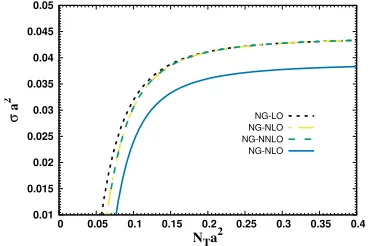
In spite of the improvement recieved by stretching out the fits to the NG string’s self-interactions, the inclusion of the NLO terms does not provide an acceptable optimization for the potential data neither it does for the correct string tension dependency on the temperature near the deconfinement
pointT/Tc=0.9 (See Fig.1). That is, the fit does not return a value for the free-parameterσ0a2same
as the one returned atT/Tc=0.8 or that measured at zero temperature [32].
0.01 0.015 0.02 0.025 0.03 0.035 0.04 0.045 0.05
0 0.05 0.1 0.15 0.2 0.25 0.3 0.35 0.4
σ
a
2
NTa2
NG-LO
NG-NLO
NG-NNLO
NG-NLO
Figure 1.The temperature-dependence of the string
tension for Nambu-Goto string action at LO, NLO and NNLO perturbative expansion. The dashed lines correspond toσ0a2=0.044 and solid line corresponds to
σ0a2=0.039.
Effects such as the interaction of the string with the boundaries may be relevant to the
discrep-ancy in the string description for intermediate distance and the correct string tension dependency on
the temperature. The contribution to the Casimir energy due to the leading nonvanshing termSb in
Lüscher-Weisz action Eq. (1) is given by Eq (11). The fits to Eq. (11) retun large values ofχ2when
considering the fit intervalR∈[0.5,1.2] fm. Even though, nontrivial improvements in the values ofχ2
are retrieved, as shown in Fig.2, compared to that obtained [31] by merely considering the NG action
Eqs. (5) and (8). Despite the reduction in the values ofχ2do f, the consideration of the first boundary
term Eq. (11) does not significantly alter the value of string tension at the minima ofχ2do f. As seen in
Fig.2the fit returns zero temperature string tensionσ0a2=0.0397 with acceptable value ofχ2do f on
the fit interval [0.7,1.2] fm.
Significant improvement in the fit behavior is observed when considering only the leading Eq. (12)
together with stiffness effects. Even with the consideration of the stiffness correction together with
the only leading-order NG potential Eq. (12) does provide a smallerχ2do f compared to the fit to the
LW static potential (NG potential at NLO Eq. (8) in addition to leading nonvanishing boundary term)
Eq. (11) (See the discussion in [22]).
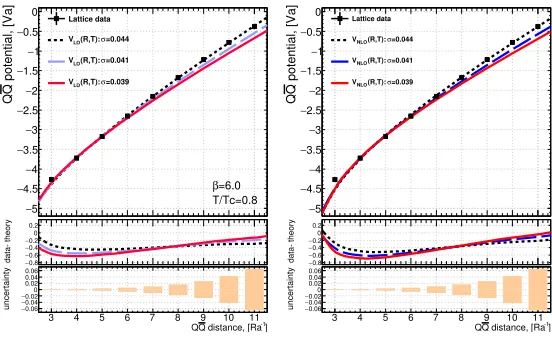
However, a precise match with the lattice data is obtained when taking into account the rigidity of the string together with the next to leading order term of NG string and the boundary terms of LW
string. Figure.3.2depicts a very good agreement for the stiffstring Casimir energy with the lattice
0.1 1 10 100 1000
3.8 3.9 4 4.1 4.2 4.3 4.4 4.5
χ
2 dof
σ a2
Boundary-Fit range[5-12] Boundary-Fit range[7-12]
0.1 1 10
3.7 3.8 3.9 4 4.1 4.2 4.3 4.4 4.5
χ
2 dof
σ a2
StiffLO-Fit range[5-12]
Figure 2. (a)The returnedχ2do fversus the string tensionσa2(scaled) from the fits ofQQ¯potential to NG string
with boundary terms Eqs. (8) and (11) atT/Tc=0.9. (b)The returnedχ2from the fits to Eq. (13) and Eq. (11).
]
-1
distance, [Ra Q
Q
3 4 5 6 7 8 9 10 11
potential, [Va] Q Q 5 − 4.5 − 4 − 3.5 − 3 − 2.5 − 2 − 1.5 − 1 − 0.5 −
0 Lattice data
=0.044 σ (R,T): LO V =0.041 σ (R,T): LO V =0.039 σ (R,T): LO V =6.0 β T/Tc=0.8 ] -1 distance, [Ra Q Q
3 4 5 6 7 8 9 10 11 data- theory −0.8
0.6 − 0.4 − 0.2 − 0 0.2 ] -1 distance, [Ra Q Q
3 4 5 6 7 8 9 10 11
uncertainty −0.06 0.04 −0.02 − 0 0.02 0.04 0.06 ] -1 distance, [Ra Q Q
3 4 5 6 7 8 9 10 11
potential, [Va] Q Q 5 − 4.5 − 4 − 3.5 − 3 − 2.5 − 2 − 1.5 − 1 − 0.5 −
0 Lattice data
=0.044 σ (R,T): NLO V =0.041 σ (R,T): NLO V =0.039 σ (R,T): NLO V ] -1 distance, [Ra Q Q
3 4 5 6 7 8 9 10 11 data- theory −0.8
0.6 − 0.4 − 0.2 − 0 0.2 ] -1 distance, [Ra Q Q
3 4 5 6 7 8 9 10 11
uncertainty −0.06 0.04 −0.02 − 0 0.02 0.04 0.06
Figure 3.TheQQ¯potential at temperatureT/Tc=0.8 and 0.9, the lines correspond to the fits to the stiffstring
model Eq. (13) for the depicted values ofσ0.
plots ofχ2do f in Fig2show a minimal value returned at the same string tension valueσ0measured at
T/TC =0.8.
3.3 Fit Analysis of Energy-Density Width Profile
In this section, the broadening of the width of the action density Eq. (16) at each selected transverse
plane can be compared [31] to that of the corresponding width of the NG string Eqs.(7) and (10) for
the leading and two-loop approximations, respectively. Similar to the numerical analysis of theQQ¯
data we show that the best fits to the energy profile are obtained when taking into account rigidity
0.1 1 10 100 1000
3.8 3.9 4 4.1 4.2 4.3 4.4 4.5
χ
2 dof
σ a2
Boundary-Fit range[5-12] Boundary-Fit range[7-12]
0.1 1 10
3.7 3.8 3.9 4 4.1 4.2 4.3 4.4 4.5
χ
2 dof
σ a2
StiffLO-Fit range[5-12]
Figure 2. (a)The returnedχ2do f versus the string tensionσa2(scaled) from the fits ofQQ¯ potential to NG string
with boundary terms Eqs. (8) and (11) atT/Tc=0.9. (b)The returnedχ2from the fits to Eq. (13) and Eq. (11).
]
-1
distance, [Ra Q
Q
3 4 5 6 7 8 9 10 11
potential, [Va] Q Q 5 − 4.5 − 4 − 3.5 − 3 − 2.5 − 2 − 1.5 − 1 − 0.5 −
0 Lattice data
=0.044 σ (R,T): LO V =0.041 σ (R,T): LO V =0.039 σ (R,T): LO V =6.0 β T/Tc=0.8 ] -1 distance, [Ra Q Q
3 4 5 6 7 8 9 10 11 data- theory −0.8
0.6 − 0.4 − 0.2 − 0 0.2 ] -1 distance, [Ra Q Q
3 4 5 6 7 8 9 10 11
uncertainty −0.06 0.04 −0.02 − 0 0.02 0.04 0.06 ] -1 distance, [Ra Q Q
3 4 5 6 7 8 9 10 11
potential, [Va] Q Q 5 − 4.5 − 4 − 3.5 − 3 − 2.5 − 2 − 1.5 − 1 − 0.5 −
0 Lattice data
=0.044 σ (R,T): NLO V =0.041 σ (R,T): NLO V =0.039 σ (R,T): NLO V ] -1 distance, [Ra Q Q
3 4 5 6 7 8 9 10 11 data- theory −0.8
0.6 − 0.4 − 0.2 − 0 0.2 ] -1 distance, [Ra Q Q
3 4 5 6 7 8 9 10 11
uncertainty −0.06 0.04 −0.02 − 0 0.02 0.04 0.06
Figure 3.TheQQ¯potential at temperatureT/Tc=0.8 and 0.9, the lines correspond to the fits to the stiffstring
model Eq. (13) for the depicted values ofσ0.
plots ofχ2do f in Fig2show a minimal value returned at the same string tension valueσ0measured at
T/TC=0.8.
3.3 Fit Analysis of Energy-Density Width Profile
In this section, the broadening of the width of the action density Eq. (16) at each selected transverse
plane can be compared [31] to that of the corresponding width of the NG string Eqs.(7) and (10) for
the leading and two-loop approximations, respectively. Similar to the numerical analysis of theQQ¯
data we show that the best fits to the energy profile are obtained when taking into account rigidity
effects of the string together with the string self-interactions Eq. (14).
] -1 distance, [Ra Q Q
5 6 7 8 9 10 11 12
]
-2a
2
String width, [w
5 10 15 20 25 Lattice data LO w NLO w Middle plane =6.0 β T/Tc=0.8 ] -1 distance, [Ra Q Q
5 6 7 8 9 10 11 12
]
-2a
2
String width, [w
15 20 25 30 35 Lattice data LO w NLO w Middle plane =6.0 β T/Tc=0.9
Figure 4.The mean-square width of the density distribution in the middle of the tubez=R/2 atT/Tc=0.9 and
T/Tc=0.8. The solid and dashed lines correspond to the free and self-interacting NG string Eq. (7) and Eq. (10), respectively.
Table 1.The returnedχ2from the fits of the action density width profile to Eq. (7), (10) and (14) using an
optimal value of the rigidityαrigreturned from the fit ofQQ¯potential data to Eq. (13).
Fit range R∈[5,12] R∈[6,12] R∈[7,12]
NG String (LO) 82.98 53.30 15.71
NG String (NLO) 82.85 29.24 5.59
StiffString 3.26 1.41 2.4
In Table1the first two entries are the retuned value ofχ2considering fits of the string width profile
in the middle plane to Eq. (7) and Eq. (10). These indicate improvements of the fits of the flux tube
width in the middle plane compared the leading-order approximation of NG action.
] -1 distance, [Ra Q Q
5 6 7 8 9 10 11 12
]
-2
a
2
String width, [w
15 20 25 30 35 Lattice data Stiff string NG string Middle plane =6.0 β T/Tc=0.9
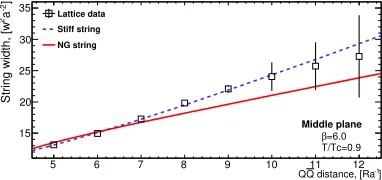
Figure 5.The mean-square width of the density
distribution at the middle of the tubez=R/2 and
T/Tc=0.9. The solid and dashed lines correspond to the width of the Nambu-Goto and stiffstring
Eqs. (10) and (14), respectively.
Figure4compares the profile reproduced by the fits of the lattice data to the two approximation
schemes of NG string at both temperaturesT/Tc=0.8 andT/Tc=0.9. At the temperatureT/Tc =
0.8, the fit [31] of the LO and NLO versions of NG string returns very close parameterization in both
the asymptotic and intermediate distances regions regardless of the selected fit range. Indeed, higher
order effects are almost absent at this temperature scale.
Even though, for short and longQQ¯ separation distances considered (Table (1)), the stiffstring
effects considered together with the next to leading expansion of the NG string provide the minimal
value ofχ2. The improvements in the fits with respect to pure NG string are obviously seen in Fig5.
4 Conclusion
The theoretical predictions laid down by the free and self-interacting picture [31] are set into a
under scrutiny is the intermediate source separation (R = 0.5 toR = 1.2 fm) for two temperatures
scales; near the end of QCD plateauT/Tc=0.8, and just before the critical pointT/Tc=0.9.
We conclude from the fit analysis of theQQ¯ potential and the energy width profile of the static
meson the pure NG string does not provide precise match with lattice numerical data. However, we find a good agreement with the data, together with a subsequent retrieve of the correct string tension
dependency on temperature, provided that the effects of the interaction with the boundaries and the
rigidity of the string are taken into account in the portrayal of QCD string.
References
[1] M. Luscher, P. Weisz, JHEP07, 049 (2002),hep-lat/0207003
[2] O. Jahn, P.D. Forcrand, Nucl. Phys. B - Proc. Suppl.129-130, 700 (2004), lattice 2003
[3] M. Luscher, G. Munster, P. Weisz, Nucl. Phys.B180, 1 (1981)
[4] M. Pfeuffer, G.S. Bali, M. Panero, Phys. Rev. D79, 025022 (2009)
[5] K.J. Juge, J. Kuti, C. Morningstar, Phys. Rev. Lett.90, 161601 (2003),hep-lat/0207004
[6] N.H. Dass, P. Majumdar, Phys. Lett. B658, 273 (2008)
[7] M. Caselle, M. Panero, D. Vadacchino, JHEP02, 180 (2016),1601.07455
[8] M. Caselle, F. Gliozzi, U. Magnea, S. Vinti, Nucl. Phys.B460, 397 (1996),hep-lat/9510019
[9] C. Bonati, Phys.Lett.B703, 376 (2011),1106.5920
[10] M. Caselle, M. Hasenbusch, M. Panero, JHEP03, 084 (2006),hep-lat/0601023
[11] M. Luscher, P. Weisz, JHEP07, 014 (2004),hep-th/0406205
[12] A.S. Bakry et al., Phys. Rev. D82, 094503 (2010,hep-lat/1004.0782)
[13] A.S. Bakry, D.B. Leinweber, A.G. Williams, Phys.Rev.D85, 034504 (2012),1011.1380
[14] A.S. Bakry, X. Chen, P.M. Zhang, Phys. Rev.D91, 114506 (2015),1412.3568
[15] A.S. Bakry, X. Chen, P.M. Zhang, AIP Conf. Proc.1701, 030001 (2016)
[16] Bakry, Ahmed S., Chen, Xurong, Zhang, Peng-Ming, EPJ Web Conf.126, 05001 (2016)
[17] M. Luscher, K. Symanzik, P. Weisz, Nucl. Phys.B173, 365 (1980)
[18] A. Polyakov, Nuclear Physics B268, 406 (1986)
[19] H. Kleinert, Physics Letters B174, 335 (1986)
[20] H. Kleinert, A. Chervyakov (1996),hep-th/9601030
[21] M. Caselle, M. Panero, R. Pellegrini, D. Vadacchino, JHEP01, 105 (2015),1406.5127
[22] B.B. Brandt, JHEP07, 008 (2017),1705.03828
[23] A. Allais, M. Caselle, JHEP01, 073 (2009),0812.0284
[24] K. Dietz, T. Filk, Phys. Rev. D27, 2944 (1983)
[25] F. Gliozzi, M. Pepe, U.J. Wiese, Phys.Rev.Lett.104, 232001 (2010),1002.4888
[26] O. Aharony, M. Field, JHEP01, 065 (2011),1008.2636
[27] M. Billo, M. Caselle, F. Gliozzi, M. Meineri, R. Pellegrini, JHEP05, 130 (2012),1202.1984
[28] V.V. Nesterenko, I.G. Pirozhenko, J. Math. Phys.38, 6265 (1997),hep-th/9703097
[29] A.S. Bakry, X. Chen, M. Deliyergiyev, A. Galal, P.M. Zhang (2017),1709.09446
[30] F. Bissey et al., Phys. Rev. D76, 114512 (2007), hep-lat/0606016
[31] A. Bakry, X. Chen, M. Deliyergiyev, A. Galal, S. Xu, P.M. Zhang (2017),1707.02962