
Review
1
Controlled Surface Wettability by Plasma Polymer
2
Surface Modification
3
I. Muzammil1,*, D.K Dinh1, A. Qasim2, M Imran2, H Sattar2 and A.U Ahmad2
4
1 Plasma Engineering Laboratory, Korea Institute of Machinery and Materials, Daejeon 34103, Republic of
5
Korea
6
7
2 School of Physics, Dalian University of Technology, Dalian 116024, China
8
Abstract:
Various methods of polymer surface tailoring have been studied to control the changes9
in wetting behavior. Polymers having precisely controlled wetting behavior in a specific
10
environment are blessed with a wealth of opportunities and potential applications exploitable in
11
biomaterial engineering. The controlled wetting behavior can be obtained by combining surface
12
chemistry and morphology. Plasma assisted polymer surface modification technique have played a
13
significant part to control surface chemistry and morphology. This review focuses on plasma
14
polymerization and investigations regarding surface chemistry, surface wettability, coating kinetics,
15
as well as coating stability. We begin with brief overview of plasma polymerization; these include
16
growth mechanisms of plasma polymerization and influence of plasma parameters. Next, surface
17
wettability and theoretical background structures and chemistry of superhydrophobic and
18
superhydrophilic surfaces. In this review, overview of recent work on tunable wettability by
19
tailoring surface chemistry and physical appearance (i.e. substrate texture) is also described. The
20
formation of smart polymer coatings, which adjust their surface wettability by according to outside
21
environment, including, pH, light, electric field and temperature. Finally, the applications of tunable
22
wettability and pH responsiveness of polymer coatings in real life are addressed. This review should
23
be of interest to plasma surface science communality specifically focused controlled wettability of
24
smart polymer surfaces.
25
Keywords: Polymer Surfaces; Surface wettability; Plasma Surface Modification; Tunable Surface
26
wettability; pH-responsive
27
28
1. Introduction
29
Plasma Polymerization has been a vibrant area of research as it offers a versatile route to design
30
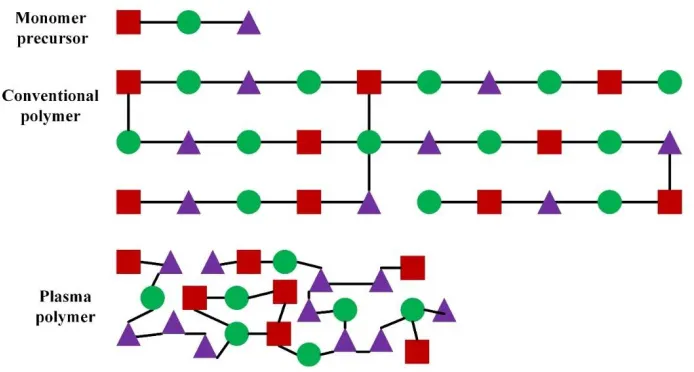
materials rationally with tunable functionalities. The exclusive properties of plasma polymer smart
31
coatings like tunable wettability, self-cleaning and antireflective make them prominent in various
32
applications such as biomaterials, drug delivery, adhesion, protective coatings, microelectronic
33
devices, oil-water separation and thin film technology. These smart polymer coatings have attracted
34
considerable interest owing to these remarkable application oriented surface properties especially
35
surface wettability [1-4]. The smart polymer surfaces with specific wettability are designed by tuning
36
the surface chemistry and the geometric structure [5]. Plasma copolymerization technique of
37
monomers with antagonist physicochemical properties is used to optimize chemical composition
38
because of its versatility to obtain specific chemical functionalities [6,7].
39
In this review, a brief overview of polymers, polymerization techniques, plasma polymerization
40
and surface wettability are discussed. The research background and mechanism of plasma
41
copolymerization and copolymer surface properties mainly tunable surface wettability are presented
42
as well.
43
2. Plasma polymerization
44
Polymerization is a process to form a polymer by the combination of repeating functional units,
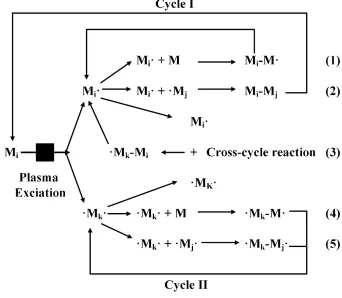
45
called monomers. Wet chemical polymerization techniques such as spin coating and ink-jet printing
46
are widely used due to low-cost process. However, the presence of solvent may have adverse effects
47
on polymer coatings such as non-uniform coatings, the impurities by the solvent produce defective
48
coatings that are not suitable for biomaterials and drying process leads to inhomogeneous polymer
49
deposition [8,9].
50
These issues, caused by wet chemical polymerization techniques can be overcome via chemical
51
vapor deposition (CVD). CVD provides uniform coatings in a single dry chemical deposition step.
52
Plasma-enhanced CVD (PECVD), initiated CVD (iCVD) and photoinitiated CVD (piCVD) follow
53
chain polymerization mechanism while oxidative CVD (oCVD) follow step-growth polymerization
54
[10,11]. All of these CVD techniques for polymerization have a set of advantages and drawbacks that
55
make these techniques suitable for particular polymer coatings.
56
Plasma techniques are employed as plasma etching, plasma grafting, and plasma-enhanced
57
CVD. PECVD is a versatile polymerization method that utilizes precursors in either solid, liquid or
58
gas form for rapid, pinhole free, cross-linked and dry deposition of polymer. Fig. 1 shows the
59
structural difference between conventional polymer and plasma polymer [12].
60
Plasma polymerization occurs at both, low pressure and atmospheric pressure, the purpose of
61
this work is to study low-pressure plasma polymerization. The chain polymerization process occurs
62
with the assistance of plasma energy during plasma polymerization and this plasma energy is used
63
to activate electrons, ions, and radicals [13]. In plasma polymerization process, monomer precursors
64
in vapor form are pumped to the vacuumed plasma reactor. The high-energy excited electrons during
65
glow discharge break molecules into free electrons, ions, radicals and excited molecules. These free
66
radicals and excited molecules condense and polymerize on the substrate, and the ions and electrons
67
crosslink or form chemical bonds with the already deposited polymer, so properties of plasma
68
polymers are not only determined by precursors but also by deposition parameters. The low-pressure
69
glow discharge plasma characterized as cold plasma can be generated by either a continuous current
70
or an alternating current signal to vapors. For continuous ion bombardment, high electron mobility
71
is required that can be achieved by high-frequency current signal typically in the radio frequency
72
(RF) range. The RF plasma is categorized as cold plasma due to electron energy range from 1 to 10
73
eV [14].
74
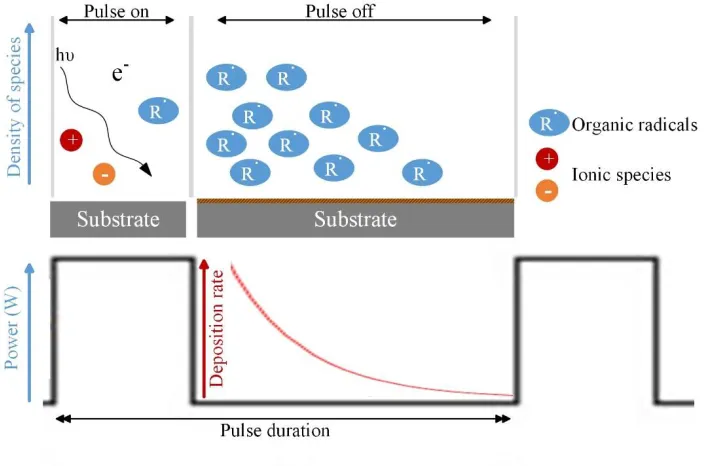
75
Fig. 1 Schematic representations of monomer precursor, conventional polymer and plasma polymer
76
film synthesized from the same monomer precursor.
77
2.1. Radio frequency plasma polymerization
Radio frequency (RF) plasma with capacitively-coupled parallel plate configuration is
79
commonly used to induce radicalization of monomer precursor. The plasma power supply usually
80
consists of RF generator of 13.56 MHz frequency and a matching box to reduce reflected power. The
81
RF power for polymerization process is low ranging from 10 W to 400 W. RF-generated plasmas are
82
more stable and have high-temperature electrons than equivalent AC or DC, and can be used to
83
process insulating materials, so it's a good choice for polymer deposition from organic monomers.
84
The use of 13.56 MHz is recommended by the international authorities to avoid interference with
85
broadcasting frequencies [15,16].
86
2.2. Growth mechanisms of plasma polymerization
87
Yasuda[14] proposed bi-cyclic rapid step-growth polymerization mechanisms schematically
88
illustrated in Fig. 2. The cycle I consist of activation reaction products from single reactive site species,
89
and cycle II propagated by divalent reactive species.
90
91
Fig. 2 Growth and deposition mechanisms of plasma polymerization.
92
The reactive species are characterized as free radicals in Fig. 2. As the same charge ion cannot
93
react each other and an equal number of positive and negative charge ions are needed for growth
94
mechanisms. Therefore, the ions role in growth mechanisms can be excluded.
95
The single reactive species or divalent reactive species can polymerize with monomer by shifting
96
radical center and leaving it open for more polymerization process. Reaction (5) shows divalent
97
reactive species can react with other divalent species to form a new bond while leaving additional
98
reactive sites for further polymerization. Reaction (1), (4) and (5) show the addition of reactive species
99
to the monomer or other reactive species which is same as observed during initiation and propagation
100
reaction in the chain growth free radical polymerization. Reaction (2) shows the formation of the
101
oligomer (combination of few monomer units) by losing its radical center which is same as
102
termination reaction in the chain growth free radical polymerization. Moreover, reaction (3) combines
103
single reactive species with divalent reactive species by the cross-cycle reaction and presence of
radical center shows the continuity of polymerization reaction. While repeating these steps, the size
105
of the gaseous species increase, and the saturation vapor pressure of the species decreases, which
106
forces the species to deposit on the substrate in the form of the polymer.
107
2.3. Influence of plasma parameters
108
The polymer chemistry and morphology during plasma polymerization can be affected by many
109
internal and external factors. The most important external factors are system pressure, monomer flow
110
rate, input power and deposition time [14,17].
111
System pressure is controlled by vacuum pump-out rate from plasma reactor, gas feed rate into
112
the plasma reactor, deposition/fragmentation rate within plasma reactor and the change in
113
temperature during plasma polymerization. The mean free path between active species is significant
114
at low pressure, so uniform deposition throughout the reactor system can be obtained. Low pressure
115
also increases the glow discharge size rising plasma interaction with the substrate [18-20].
116
The monomer flow rate determines whether the plasma polymerization is carried out in energy
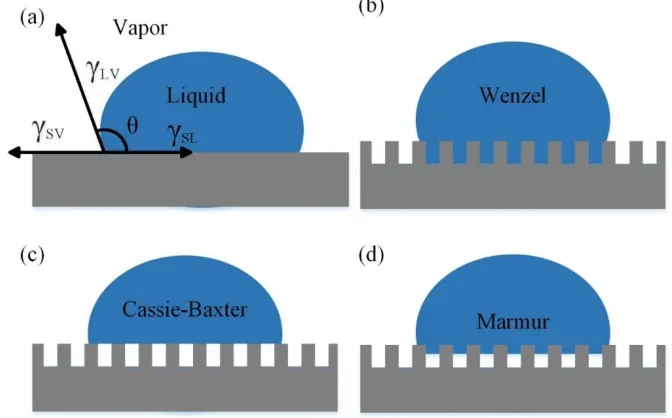
117
deficient region or monomer deficient region. At constant RF power, the deposition rate increases
118
linearly with increasing flow rate as long as the reaction system moves from monomer deficient
119
region (having the much available energy for monomer activation) to energy deficient region. At this
120
point, a balance exists between available energy for reaction and monomer. The further increase in
121
flow rate decreases the resident time of monomer in plasma, consequently the polymer deposition
122
rate decrease (energy deficient region). The rise in flow rate also increases system pressure. So effects
123
associated with high pressure are also dominated by high flow rate as nonuniformity of deposited
124
polymer surface [18-20].
125
The deposition rate of plasma polymer coatings increases linearly with an increase in input
126
power (energy deficient region) as long as energy deficient region changes to monomer deficient
127
region. At this point, the maximum deposition rate is obtained due to balance between available
128
energy for reaction and monomer. The further increases in power results as decrease in deposition
129
rate due to sputtering effect during the polymer film growth in monomer deficient region. The
130
deposition rate of plasma polymer coatings also increases as plasma exposure time increases.
131
Moreover, the chemistry and morphology of deposited polymer may also change due to cross-linking
132
and etching process [18-20].
133
The deposition rate of plasma polymer coatings decreases as substrate temperature increases. A
134
high degree of monomer fragmentation shows the change in deposition mechanism at high
135
temperature. The cross-linking and branching of the deposited polymer increase due to
136
fragmentation process [18-20].
137
2.4. RF pulsed plasma polymerization
138
Plasma polymerization under continuous wave (CW) mode produces complete fragmentation
139
of monomer so random polyrecombination of fragments and atoms leads to irregular polymer
140
structure as previously mentioned in Fig. 1. The primary cause of small retained irregular polymer
141
structure is the monomer exposure to high power plasma. To overcome this general disadvantage,
142
low power plasma is used, termed as ‘mild plasma conditions’ but the power modulation can be done
143
to a certain limit. However, lowering input power by pulsed wave (PW) plasma polymerization is
144
possible [12,21].
146
Fig. 3 Schematics representation of polymer deposition during pulse-on and pulse-off of pulsed mode
147
plasma polymerization.
148
The pulsed plasma polymerization process is used to modulate power from microseconds to
149
milliseconds, in this way overall power density can be controlled. This pulsation consists of two
150
periods. During the pulse on-time (tpulse-on), polymerization by fragmentation and polyrecombination
151
of monomers occur depending on monomer flow, pressure and the plasma power same as in CW
152
mode. Alternatively, during pulse off-time (tpulse-off), the free radicals created during tpulse-on react with
153
monomer and initiate the polymerization process as mention in Fig. 3. These radicals, in the absence
154
of ions bombardment and photo-irradiation initiate a purely radical chain chemical reaction. During
155
this period tpulse-off plasma polymer is chemically very similar to the conventional polymer as shown
156
in Fig. 1. Thus, the initiation step occurs during the tpulse-on and propagation step during tpulse-off[22,23].
157
The CW and PW plasma polymerization mechanism difference is following (Fig. 4):
158
Initiation M + plasma M PW plasma (during tpulse-on)
159
M + plasma A + B + C + D CW plasma (fragmentation)
160
Chain growth M + M P PW plasma (during tpulse-off)
161
A + B + C + D BDCA + E CW plasma (polyrecombination)
162
The chemical structure and composition of PW plasma polymer coatings depend on the tpulse-on
163
and tpulse-off ratio, the so called duty cycle (DC) and power density.
164
DC =
(1.1)
165
The shorter tpulse-on and the longer tpulse-off time favor the conventional structure. In other words,
166
low duty cycle support retention of functional group in PW plasma polymer coatings. The polymer
167
products formed during Tpulse-off should have a more regular structure as compared to those formed
168
during Tpulse-on. Thus, PW plasma polymer product becomes a mixture of regular and cross-linked
169
chemical structures as shown in Fig. 4. The regularity of chemical structure of PW plasma polymer
170
coatings depends on chain growth reaction during Tpulse-off, duty cycle, and pulse frequency. This
171
pulse frequency is different from the RF-frequency [22].
172
2.5. Plasma copolymerization
The plasma polymerization has the unique characteristics of being copolymerized almost all the
174
monomers. The properties of copolymers produced from two or more monomers are nearly
175
proportional to the composition of these monomers feed rate in the reactor. Thus, the plasma
176
copolymerization is a versatile technique to obtain specific chemical functionalities [24].
177
Different copolymerization models are developed to explain radical copolymerization process.
178
If A and B are different monomers, the resulting copolymers can be of random (—AA—B—AB—
179
AAA—B—….), alternating (—A—B—A—B—…), or block (—AA—BBB—AAA—BB—) structure
180
[25,26].
181
182
Fig. 4 Schematics of CW and PW mode plasma polymerization and their products [22].
183
3. Surface wettability
184
The surface wettability of solid by the liquid is the most important and fundamental aspect of
185
surface science due to its various everyday applications including printability, fogging,
anti-186
bacterial, anti-reflection, field-effect transistor, self-cleaning windows, cookware coatings,
187
waterproof textiles, corrosion resistance, oil-water separation, and anti-bioadhesion [27-29]. The
188
surface wettability is usually governed by the chemical composition and morphology of solid surface.
189
When a liquid drop makes a contact with a solid surface, it will either retain its drop like shape or
190
spread out on the solid surface, this property is characterized by using contact angle (CA)
191
measurements. The liquid droplet tends to form an angle with the solid surface when it is placed in
192
contact with the solid surface. This contact angle can be measured between the horizontal line and
193
tangential line of the liquid surface near the liquid-solid-vapour three-phase contact line as shown in
194
Fig. 5. According to water CA (WCA) measurements, the surface wettability can be divided into four
195
categories. The surfaces are hydrophobic and hydrophilic with WCA on solid surfaces in the range
196
90° < θ < 150° and 10° < θ < 90°, respectively. The surfaces with WCA larger than 150° are called
197
superhydrophobic and WCA less than 10° are called superhydrophilic [30,31]. The superhydrophobic
198
surfaces can be found in nature of lotus leaves, ramie leaves, red rose petals, rice leaves, butterfly’s
199
wings, peacock feathers, fish skin and so on [31].
3.1. Static and dynamic wettability
201
The droplet contact angle measurements on the solid surface are performed by both statically
202
and dynamically. The CA measurements of a static liquid droplet on a solid surface are known as
203
static contact angle (SCA). Moreover, for dynamic wettability, the sliding angle (SA) or contact angle
204
hysteresis (CA hysteresis) is measured. High SCA reveals that the solid surface repels liquid droplet,
205
moreover, a low CA hysteresis or small SA indicates a liquid droplet has low adhesion to the solid
206
surface and easily slides on the surface [32-34]. The contact angle is measured during droplet size
207
variation, to change droplet size, the liquid volume is added (advancing CA), or removed (receding
208
CA). The series of advancing CA’s are measured by simply adding more liquid to the droplet, and
209
the receding CAs are measured by withdrawing a specific volume of liquid. The advancing CA shows
210
how much favorable is for a solid surface to wet and receding CA shows how much favorable is for
211
a solid surface to de-wet. The advancing and receding CAs measurements are more reliable as SCA
212
can adopt any value between advancing and receding CAs. The advancing and receding contact
213
angle difference for a contact line moving in an opposite direction at the same velocity is known as
214
CA hysteresis. The larger value of CA hysteresis shows high resistance between wetting and
de-215
wetting states. CA hysteresis is commonly induced by surface effects, such as roughness,
216
heterogeneity, or surface deformation [35].
217
3.2. Theoretical background
218
The wettability of flat surface can be predicted by Young's equation using surface energy [36].
219
cos
=
(1.1)
220
Where γ represents the surface energy between the solid-vapor (SV), solid-liquid (SL), and
221
liquid-vapor (LV) interfaces. The θ in Young's equation is droplet contact angle with the surface. The
222
large contact angle implies high energy ( ) interface (not favorable for the liquid-solid interface),
223
whereas small contact angle implies low energy interface (convenient liquid-solid interface). Young’s
224
contact angle equation is only applicable on physically smooth and chemically homogeneous
225
surfaces.
226
The Wenzel model[37] and Cassie-Boxter model[38] are two renowned theories to explain the
227
wettability behavior of rough surface. In the Wenzel state, the droplet is in contact with the solid
228
surface completely, and liquid penetrates into cavities as shown in Fig. 5b. This model reveals that
229
rough solid has a larger surface area as compared to smooth one, so Young's equation for contact
230
angle is modified by Wenzel.
231
cos
= cos
(1.2)
232
Where θr is the droplet contact angle on a rough surface, θ is Young’s contact angle on a smooth
233
surface with the same material, and r is surface roughness obtained by dividing actual area with the
234
flat projected area. For the flat surface value of r becomes 1, and r > 1 implies surface roughness
235
features. According to Wenzel model both hydrophobicity and hydrophilicity are amplified by
236
surface roughness. Moreover, the CA hysteresis increases for high surface roughness due to
droplet-237
solid contact and pinning of the droplet during de-wetting.
238
However, the Wenzel model state is only applicable to the chemically similar solid surface.
239
According to Cassie-Boxter model liquid, the air is trapped in rough surface cavities so liquid of
240
droplet cannot penetrate into these cavities as shown in Fig. 5c, leading to solid-liquid and liquid-air
241
a composite interface.
242
cos
=
cos
+
cos
(1.3)
243
Where and are the areas fractions of liquid droplet in contact with the solid surface and
244
trapped air in the cavities of the rough surface respectively, θ1 and θ2 are the CA’s of droplet with
245
solid surface and air, respectively. For composite interface, the air part of surface can be considering
246
cos
=
(1 + cos ) − 1
(1.4)
248
Marmur introduced a mixed model, according to this model a liquid droplet partially wets the
249
surface partially and sits on air packets as shown in Fig. 5d [39]. This model modified CA expression:
250
cos
=
cos +
− 1
(1.5)
251
It is possible that Cassie-Baxter state for a given solid surface can transform into Marmur or
252
Wenzel state, surface roughness and surface chemistry plays a significant role in this regard.
253
3.3. Textured surface wettability
254
As mentioned in Wenzel and Cassie-Baxter models, the surface roughness (surface texture) and
255
surface chemistry are the primary factors to determine liquid droplet behavior on a solid surface and
256
texturing a surface with micro or nano-scale architecture is essential to enhance hydrophobicity and
257
hydrophilicity [40-42].
258
For hydrophobic solid surface, solid-vapor surface energy is less than solid-liquid surface
259
energy . Thus according to Young’s equation, the surface energy becomes low due to trapped air
260
below the drop for textured surface of 30 µm roughness order. For hydrophilic solid surface, the
261
solid-liquid surface energy is less than solid-vapor energy . Thus the solid-liquid interface
262
follows the roughness of the textured solid surface, which leads liquid droplet to a Wenzel state [43].
263
264
Fig. 5 Schematic representation of a water droplet on smooth and rough surfaces (a) Young’s
265
equation, (b) Wenzel state, (c) Cassie-Baxter state and (d) Marmur state.
266
267
4. Surface functionalization of plasma polymer coatings
268
Plasma functionalization is the process of surface modification to improve features and
269
properties of polymers by changing the surface chemistry. The plasma functionalization is achieved
270
in a single step without wet chemistry methods, which positively affects its cost, safety and
271
environment impact. The surface properties of many materials including glass, metals, ceramics,
272
textiles and broad range of polymers are improved by plasma functionalization [44].
273
4.1. Surface processes during plasma functionalization
The highly reactive species (free radicals and electrons) in plasma initiates various physical and
275
chemical processes by contacting with surfaces depending on plasma parameters [45]. For example,
276
the highly reactive species remove surface contaminations to make ultra-clean surface [46]. The free
277
radicals help to break bonds and promote cross-linking of molecules [47]. The substrate is etched and
278
formed micro or nanometer scale roughness by highly reactive species [48]. The short-lived free
279
radicals are deposited on the substrate to promote specific properties depending on the functional
280
group and this deposition of functional groups is the most important process in plasma
281
functionalization [45].
282
4.2. Functionalized plasma polymer coatings
283
The functionalization of the polymer by plasma treatment has many advantages over
wet-284
chemical treatment as wet-chemical methods become unacceptable due to environmental and safety
285
consideration. Functional groups like carboxylic acid groups, hydroxyl groups and amine groups
286
produced by plasma treatment are used to chemically functionalized polymer surfaces [49].
287
Numerous authors reported the functionalization of polymer materials by exposure to various
288
gaseous plasma treatment like oxygen plasma, nitrogen plasma, ammonia plasma and fluorine
289
plasma [50-53]. For example, polymer functionalized with oxygen plasma has low surface energy,
290
whereas polymer functionalized with fluorine plasma has low surface energy improving chemical
291
inertness [54,55]. Moreover, argon plasma treatment can increase crosslinking of polymer surfaces
292
[56,57].
293
Functionalization by depositing thin polymer coatings is a unique process due to its various
294
applications like adhesion, surface hardening, surface wettability, tribology, contact lens coating,
295
blood compatibility and diffusion barrier [58]. The functionalization by hydrocarbon polymer
296
deposition is widely used due to its outstanding physical properties such as optical refractive index
297
and microhardness. Methane is used to functionalize contact lens materials like silicone rubber. The
298
5 nm plasma polymer coating on silicone rubber reduces its hydrophobicity and surface tackiness
299
[59]. The C2H6 plasma polymer coatings functionalize the alkali halide (e.g., KBr and NaCl). These
300
coatings show good adherence to substrate and moisture barriers [60]. The hydrophobic materials
301
are obtained by plasma polymerization of fluorine-containing gases. For example, carbon nanotubes
302
are functionalized to make superhydrophobic using tetrafluoroethylene plasma polymer coatings as
303
shown in Fig. 6 [61]. The hydrophobic and oleophobic coatings are obtained by plasma
304
polymerization of perfluoro acrylates [62]. The 1H,1H,2H,2H-perfluorooctyl acrylate precursor is
305
used to get superhydrophobic surface by repetitive bursts of CW plasma polymerization. This small
306
time scale plasma deposition leads to the polymeric nanospheres [63].
307
The organosilicon monomers are used to functionalize various materials due to its excellent
308
optical, electrical, thermal and biomedical properties. For example, hexamethyldisiloxane
309
((CH3)3SiOSi(CH3)3) is used to functionalize charcoal to make blood compatible surface to reduce
310
blood cells loss through blood contact [64,65]. In addition to the applications of plasma functionalized
311
organosilicon polymers in biomedical, they have been used in other applications like protective,
312
conductive and moisture sensitive coatings [66,67]. The functionalization by incorporating cyano
313
groups in a polymer made it an attractive material in thermal resistance, electrical properties and gas
314
permeation properties due to its high polarity [68,69]. The amino groups are used to the
315
functionalized membrane that can bind toxic components found in patient’s blood during blood
316
dialysis [70-72].
318
Fig. 6 SEM images of carbon nanotube forests. (a) As-grown forest prepared by PECVD, (b)
PTFE-319
coated forest and (c) a spherical droplet suspended on the PTFE-coated forest [61].
320
4.3. Functionalized plasma copolymer coatings
321
Plasma copolymerization is considered as a promising and versatile technique due to its
322
advantage of the tunable functionality over plasma homopolymerization by adjusting the monomer
323
feed ratio. The combining properties of each monomer that participate in copolymerization opened
324
new doors to tailor a surface [73]. Golub et al.[74] reported one of the early work on RF plasma
325
copolymerization of ethylene (ET) and tetrafluoroethylene (TFE). The rate of ET-co-TFE polymer
326
deposition is exceeded as compared to the calculated deposition rate of homopolymers. The C1s XPS
327
spectra showed that up to 70 mol % TFE, the relative amount of carbon to fluorine bonding is of the
328
order CF > CF2 > CF3. However, this order changed to CF2 > CF3 > CF for higher TFE concentration as
329
shown in Fig. 7. The F1s binding energies for the ET-co-TFE polymer coatings linearly increased with
330
the increase of TFE flow rate. Leezenberg et al.[75] deposited plasma copolymer coatings of
331
hexafluoropropylene (C3F6) and octafluoropropane (C3F8). They showed the addition of C3F8 in
332
plasma polymer coatings increased CF3 groups which reduced surface energy. The SWCA increased
333
with thickness and addition of C3F8 due to the lower surface energy of CF3. Jiang et al.[76] utilized
334
plasma copolymerization technique to fabricate hexamethyldisiloxane (HMDSO, C6H18Si2O) and
335
octafluorocyclobutane (C4F8) coatings. They found that with the increases of HMDSO precursor flow
336
the fluorine content decreases and oxygen contents rise.
337
Beck et al.[77,78] studied plasma copolymerization of acrylic acid with hexane and allylamine.
338
They showed coatings with specific chemical functionality can be produced by controlling the
339
concentration of monomer feed. The higher concentration of carboxylic functional group is achieved
340
by simply increasing the acrylic acid feed rate.
341
Hirotsu et al.[79] reported pulsed and continuous wave plasma copolymerization of acrylic acid
342
(AA) with hezamethyldisilazne (HMSZ). They found duty cycle and power have great influence on
343
deposition rate, as deposition rate was greater for pulsed plasma. The deposition rate of the
344
copolymer was higher as compared to HMSZ and AA polymers alone, suggesting copolymerization
345
of AA with HMSZ. The high plasma power with continuous wave favored Si-O functional groups,
346
and low power favored carboxylic functional groups, so they tuned water contact angle from
hydrophilic to hydrophobic by regulating power. Fahmy et al.[80,81] studied the effect of duty cycle
348
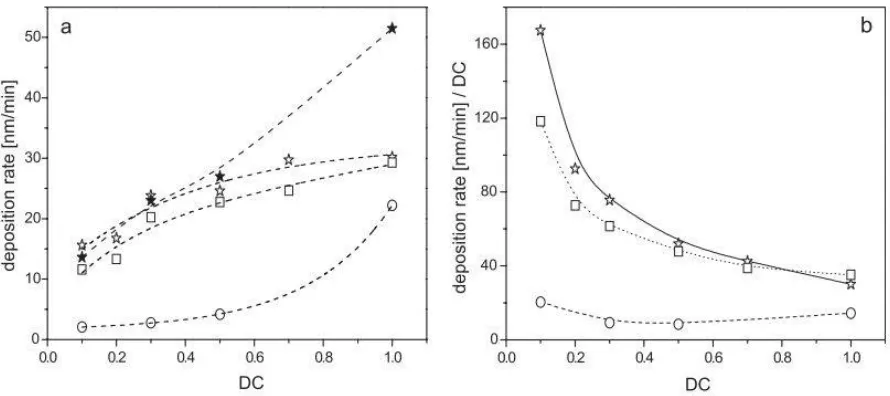
and monomer feed rate of plasma copolymers of acrylic acid and styrene (AA-co-S). They found high
349
deposition rate at the high duty cycle and high chain growth polymerization at a low duty cycle of
350
pulsed plasma AA-co-S polymer coatings as shown in Fig. 8. Moreover, high retention of carboxylic
351
group is found at a low duty cycle in both AA and AA-co-S polymer coatings. They also reported the
352
concentration of carboxylic groups increases with the fraction of AA monomer feed rate in copolymer
353
mixture. The deposition rate also increased monastically as AA feed rate rise. deposition rate as a
354
function of duty cycle (DC): square, PAA; circle, PS homopolymers; and star, AA/S copolymer [80].
355
Chahine et al.[82] investigated the chemical structure and growth kinetics of pulsed plasma
356
copolymer coatings elaborated from 2-(dimethylamino) ethyl methacrylate (DMAEMA) and
357
1H,1H,2H-perfluoro-1-decene (HDFD). They found deposition rate per pulse increases up to 30 W
358
power and then decreases due to the transfer of polymerization from energy deficient region to
359
monomer deficient region. Moreover, the increase of CFx and decrease in carboxylic groups are
360
observed from FTIR as HDFD feed rate rise in the mixture of monomers. The reduction in the ratio
361
of the FTIR absorbance bands AC=O/AOH and CF2/CF are observed for an increase in plasma discharge
362
power but these absorbance ratios rise for high pulse off time showing high retention of functional
363
groups at low power.
364
365
Fig. 7 XPS C1S spectra of three ET/TFE plasma copolymers, obtained from 26,55, and 80 mol % TFE in
366
the feeds, and of PPTFE [74].
368
Fig. 8 (a) Deposition rates as a function of duty cycle (DC): PAA (square), PS (circle), AA-co-PS
369
polymer calculated (solid star); and AA-co-PS polymer (star). (b) Normalized deposition rate as a
370
function of DC [80].
371
5. Surface wettability of functionalized polymer coatings
372
As mentioned earlier, the surface wettability is governed by surface chemistry and enhanced by
373
surface roughness, so rough and smooth solid surfaces are designed with different hydrophobic and
374
hydrophilic coatings to exhibit specific surface wettability.
375
5.1. Hydrophobic polymer coatings
376
The hydrophobicity of a flat surface can be increased either by low surface energy coating
377
(changing surface chemistry) or by adding roughness. The maximum SCA that can be achieved for
378
flat surface by using low surface energy coating is 120° and SCA higher than 120° can only be
379
obtained by the roughness of the hydrophobic surface [83].
380
The fluorocarbon polymer coatings are of particular interest for hydrophobic surfaces due to the
381
extremely low surface energy of fluorine containing (CF2 and CF3) functional groups [84]. The most
382
of the fluorocarbon polymer coatings are deposited by RF plasma polymerization process using
383
either CW or PW mode [85]. CH2F2, CHF3, C3F6O CF4, C2F6, C3F8, C4F10 and C4F8 are commonly used
384
precursors for fluorocarbon coating. The hydrophobicity of fluorocarbon coatings depends on surface
385
chemistry of deposited polymer controlled by precursor feed rate and plasma parameters such as
386
input power, reactor pressure, reactor geometry and plasma operational mode (CW or PW) [23,86].
387
The fluorocarbons precursors are commonly classified into polymer forming and non-polymer
388
forming by their F/C ratios. The fluorocarbon with lower F/C ratios is called polymer forming such
389
as C4F8 and C4F10. The fluorocarbon with high F/C ratios are not polymerized such as CF4, and C2F6
390
because F atoms act as etching agents for hydrocarbon polymer and silicon. Therefore, the F/C ratios
391
play a critical role to determines either process leading to etching or polymer deposition and C3F8
392
stands between these two classes. Yasuda et al. [86] considered fluorocarbon plasma polymerization
393
is more complicated as compared to hydrocarbons, due to competition between plasma
394
polymerization and etching. They also suggested that only unsaturated and cyclic fluorocarbon
395
precursors could be used for polymerization. Jihye et al.[87] deposited fluorocarbon polymer coatings
396
using different precursors like C2F6, C3F8, and C4F8 on Si substrate by plasma polymerization process
397
in both CW and PW mode. They observed static water contact angle (SWCA) is higher for C2F6 and
398
C3F8 polymer coatings by PW plasma polymerization, but SWCA of C4F8 plasma polymer coating is
399
higher for CW plasma polymerization as shown in Tab. 1.
Octafluorocyclobutane (C4F8) gas belongs to cycloalkanes family and frequently used as
401
hydrophobic coating and etching agent, its chemical structure is shown in Fig. 9. The higher SWCA
402
of C4F8 for CW plasma polymerization shows CW plasma mode favors formation of CF3 and CF2
403
functional groups and inverse for C2F6 and C3F8. The C4F8 plasma polymer coatings on different
404
smooth substrates exhibit hydrophobic character with small variation depending on the substrate
405
due to highly cross linked CF3 and CF2 groups, and this hydrophobicity is enhanced to
406
superhydrophobicity with SWCA > 160° and CA hysteresis < 5° by rough or nanotextured surfaces
407
[88-92]. Labelle et al. [93,94] explained thickness variations of C4F8 polymer coatings using PW and
408
CW plasma. They found that deposition rate is a weak function of input power in CW plasma and
409
for PW plasma thickness rate is significantly low as compared to CW. The deposition rate for PW
410
plasma is attributed almost to tpulse-on, and there is slight dependence on tpulse-off. Furuya et al.[88]
411
observed the chemical structure and chemical bonding of C4F8 plasma polymer coating significantly
412
depend on the type of substrate used.
413
Table 1. Static water contact angle of fluorocarbon plasma polymer on Si substrate [87].
414
Static water contact angle (SWCA) C2F6 C3F8 C4F8
PW (1kHz) 103.8 ± 0.2° 104.4 ± 0.5° 98.8 ± 0.3° PW (500 Hz) 106.0 ± 1.0° 101.5 ± 0.5° 96.0 ± 0.1° PW (200 Hz) 74.5 ± 1.5° 78.5 ± 0.5° 81.5 ± 0.5° CW 102.0 ± 0.2° 101.0 ± 0.5° 112.0 ± 0.5°
415
Fig. 9 The chemical structure of (a) octafluorocyclobutane and (b) acrylic acid.
416
5.2. Hydrophilic polymer coatings
417
The polymers having a polar functional group that make them soluble in the polar solvent
418
(water) are known as hydrophilic polymers [95]. The water solubility of the hydrophilic polymer
419
varies with molecular chain length, molecular crosslinking, and polarity of side chain as shown in
420
Tab. 2. Various methods have been established to produce hydrophilic polymer surface, but all these
421
methods used a standard approach to introducing new polar functional groups, such as hydroxyl
422
(OH), carboxyl (COOH) and amino group (NH2) to improve surface hydrophilicity [96-98].
423
The most recent scientific study of the hydrophilic polymers is devoted to the acrylic acid (AA)
424
and its copolymer derivatives [99]. The chemical structure of AA is shown in Fig. 9. Allméa et al.[100]
425
observed the hydrophilic behavior of acrylic acid polymer coatings grafted on low and high-density
426
polyethylene, these polymer coatings showed 56° SWCA on low density polyethylene and 60° SWCA
427
on high-density polyethylene at room temperature. These polymer coatings show stable wettability
428
at room temperature even after a month of storage. However, when these coated samples were heated
429
to 80 °C they lost their wettability in 1 hour, and SWCA increased from 56° to 87° for low density
430
polyethylene and from 60° to 82° for high-density polyethylene. Moreover, crosslinked polyethylene
431
sample grafted with acrylic acid did not lose its polarity and wettability when heated. Gupta et
432
al.[101] observed the 72.9° SWCA of polyethylene terephthalate (PET) decrease up to 26° after
433
plasma-induced graft polymerization of acrylic acid depending on the graft density. Sciarratta et
434
al.[102] observed the change in SWCA of polypropylene (PP) from 90° to 19° after acrylic acid plasma
435
polymer coatings. Jafari et al.[103] checked surface wettability and water stability of low frequency
plasma-deposited acrylic acid on polyethylene. They observed 90° SWCA of polyethylene varied to
437
10° after acrylic acid plasma polymerization and after water washed SWCA increases to 60°. The rise
438
in SWCA is due to sharp declines of carboxylic (COOH) functional group from 28% to 7% after water
439
washed. Voronin et al.[104] checked retention of carboxylic (COOH) functional group of acrylic acid
440
pulsed plasma polymer coatings as a function of duty cycle. They found the carboxylic group
441
functionality increases for lower duty cycle. The retention reached to 66% for tpusle-off exceeding 5 ms.
442
Moreover, the deposition rate is a strong function of monomer flow rate. Fahmy et al.[105] studied
443
surface and chemical properties of pulsed plasma polymer coating of acrylic acid on glass and
444
aluminum as a function of the duty cycle. They found the deposition rate is nonlinear when it is
445
plotted against duty cycle. Moreover, the carboxylic functional group concentration increases with a
446
lower duty cycle as it favors chain polymerization and high duty cycle support fragmentation.
447
Tab. 1 Polymer structure and water solubility [99].
448
Polymer structural feature Water solubility Chain length increased Decreases Polar groups ratio increased Increases Polarity of polar group increased Increases Cross-linking increased Decreases
5.3. Tunable and pH-responsive surface wettability
449
The surface wettability can be tuned by varying the ratio of hydrophobic/hydrophilic monomers
450
during the preparation of copolymers [99]. The degree of surface wettability also depends on relative
451
cross-linking and polymer functionality as described in Tab. 2. Peter et al.[106] reported the tunable
452
wetting behavior of micro/nanotextured poly dimethyl siloxane (PDMS). The PDMS substrate is
453
plasma coated with sulfur hexafluoride, fluoroform, and octafluorocyclobutane successively. These
454
coatings showed stable superhydrophobicity and superhydrophilicity. Yilgor et al.[107] developed
455
polymeric surface with tunable wettability based on hydrophilic/hydrophobic silica mixture
456
prepared by spin-coating. They have showed gradually changing surface wettability from
457
superhydrophilic to superhydrophobic by tuning hydrophobic silica content in coatings as shown in
458
Fig. 10. Chahine et al.[82] studied plasma copolymer having hydrophobic and hydrophilic
459
components. They studied growth kinetics and chemical structure of plasma copolymer elaborated
460
from 2-dimethylamino ethyl methacrylate (DMAEMA) and 1H,1H,2H-perfluoro-1-decene (HDFD)
461
monomers. They observed low peak power and Tpulse-on lead to better retention of the functional group
462
both in plasma homo and copolymers and for high peak power and Tpulse-on fluorinated unit retained
463
better than acrylate in both homopolymer and copolymers. They also found that the presence of
464
HDFD amount give rise to the copolymer growth rate and this growth principally occurs during T
pulse-465
467
Fig. 10 The static water contact angles on silica-coated polystyrene surfaces as a function of the
468
hydrophobic silica content of the coating mixture [107].
469
Stimuli-responsive polymers undergo a reversible phase transition in response to the external
470
stimuli such as pH, redox, temperature, ultrasound, light, electromagnetic radiation, and
471
biomolecules. Different type of stimuli-responsive surfaces are fabricated that reversibly switch to
472
different wetting states [108]. pH-responsive superwettability is of great importance because of its
473
interesting applications, such as biosensors and drug delivery. Weak polymer bases and acids are
474
commonly used to get a pH-responsive surface with switchable wetting properties.[108] The polymer
475
acids have pH-responsive carboxylic (COOH) group, this carboxylic group at low pH can be
476
protonated so hydrophobic interaction become dominant, While at high pH carboxylic group
477
dissociate into carboxylate anions (COO-) and become hydrophilic. By the combination of
pH-478
responsive polymer with the rough surface substrate, the switchable wettability can be enhanced
479
[109].
480
Polyacrylic acid (PAA) is one of the most frequently reported pH-responsive polymer with
481
pKa=4.7 [108]. The PAA chain conformation can change from collapsed state at pH< pKa to the
482
stretched state at pH > pKa via protonation and deprotonation of carboxylic functional groups. The
483
copolymer coatings containing PAA monomer owing to pH-responsive feature are used to tune
484
responsive surface with switchable wettability. Xu et al.[110] prepared poly styrene-co-acrylic acid
485
(PS-co-PAA) polymer. They showed SWCA of PS-co-PAA polymer coatings after dipped in low pH
486
solution is 73° and this SWCA value decreases abruptly to a constant value 43° as pH value change
487
to 4. Zhou et al.[111] fabricated poly 2,2,3,4,4,4-hexafluorobutyl methacrylate-co-polyacrylic acid
488
(PHFBMA-co-PAA)] copolymers with three different segment length on silicon wafers using spin
489
coating technique. They found that PAA ratio in copolymer significantly influences pH-responsive
490
surface wettability, but all these copolymers show evolutions of SWCA at a similar pH inflection
491
point at pH 5.25 regardless of PAA concentration. Xia et al.[112] fabricated N-isopropyl
acrylamide-492
co-acrylic acid (NIPAAm-co-PAA) polymer on smooth and rough silicon. They observed reversibly
493
switchable wettability from superhydrophilic to superhydrophobic in response to both narrow
494
temperatures range of about 10 °C and relatively wide range of pH about 10 due to combining effect
of the chemical structure variation and the surface roughness. For a flat surface, this dual response
496
switching of NIPAAm-co-PAA polymer is only from hydrophobic to hydrophilic, but for a rough
497
surface, the extreme change of 150° in SWCA is observed.
498
Muzammil et al. fabricated novel and intelligent C4F8-co-AA polymers with tunable wettability
499
and pH-responsiveness are demonstrated. A series of plasma C4F8-co-AA polymer coatings based on
500
various hydrophilic/hydrophobic monomer feed ratio on the flat and nanotextured low-density
501
polyethylene (LDPE) surfaces are deposited via capacitively coupled RF plasma (CCP). The static
502
water contact angles (SWCA) of C4F8-co-AA polymer coatings on flat LDPE surfaces tuned from 119°
503
to 11°, while this surface wetting tunability dramatically enhanced from superhydrophobicity
504
(SWCA=163°) to superhydrophilicity (SWCA=4°) for nanotextured LDPE surfaces (Fig. 11). The C4F8
-505
co-AA polymer coatings also showed pH-responsive wetting behavior caused by the combined effect
506
of the pH-responsive component (carboxylic acid functional group) and nanotextured surface. The
507
increase of carboxylic acid functional groups in C4F8-co-AA polymers shifted the switchable
pH-508
responsive wetting behavior towards low SWCA range. The magnifying effect of the nanotextured
509
surface on pH-responsiveness is also observed [113,114].
510
511
Figure 11. Tunable Wettability and pH-Responsiveness of Plasma Copolymers of Acrylic Acid and
512
Octafluorocyclobutane.
513
The influence of duty cycle in pulsed plasma process with the monomer feed rate on the surface
514
chemistry and wettability of C4F8-co-AA polymer coatings is studied. The concentration of the
515
carboxylic acid (hydrophilic) groups increase, and that of fluorocarbon (hydrophobic) groups
516
decrease by lowering the duty cycle. The combined effect of surface chemistry and surface
517
morphology of the RF pulsed plasma copolymer coatings causes tunable surface wettability and
518
surface adhesion. The gradual emergence of hydrophilic contents leads to surface heterogeneity by
519
lowering duty cycle causing an increased surface adhesion in hydrophobic coatings. The C4F8-co-AA
520
plasma polymer coatings on the nanotextured surfaces are tuned from repulsive
superhydrophobicity to adhesive superhydrophobicity, and further to superhydrophilicity by
522
adjusting the duty cycles with the monomer feed rates [115].
523
6. Prominent applications of tunable wettability and pH-responsiveness
524
As discussed above, tunable wettability and pH-responsiveness have variety of applications but
525
in this section an overview of some applications is presented.
526
6.1. Oil-water separation
527
Removing oil from water is an essential industrial process and due to different affinities of water
528
and oil, it is done by tuning surface wettability. This wettability based oil-water separation technique
529
is highly effective and energy efficient as compared to conventional methods [116].
530
In this technique, a filter with selective wettability is used as a porous barrier that allows some
531
components of permeation of selective wettability and rejects others. By polymer modification many
532
of these selective wettability filters with a pore size in micrometers range are fabricated. The function
533
of these selective wettability filters is based on controlled wettability rather than size barrier. Mostly
534
these selective wettability filters are superhydrophilic but oleophobic and vice versa [117,118]. The
535
microfiltration polymer membranes with fixed wettability have also been used for a stabilized
oil-536
water emulsion of micrometer oil droplet. These polymer membranes can efficiently separate both
537
oil-in-water emulsions as well as immiscible oil-water mixtures, with high efficiency (rejection rate)
538
above 99% [119,120]. The polymers with stimuli-responsive wettability have also been used in
539
selective wettability filters and membranes for oil-water separation as shown in Fig. 12 [121].
540
541
Fig. 11 (a) Hydrophobic and oleophilic polymer filter for oil-water separation, (b) hydrophobic and
542
oleophilic polymer sponge for oil absorbance from oil-in-water emulsion. (c) Hydrophilic and
543
oleophobic polymer filter for oil-water separation, (d) hydrophilic and oleophobic polymer sponge
544
for oil-in-water emulsion, (e) hydrophobic-oleophilic stimuli-responsive filter for oil-water separation
545
[1].
546
6.2. pH-responsive tumor targeted drug delivery
547
The pH-responsive biomaterials for tumor-targeted drug delivery have attracted much interest
548
as pH in tumor tissue may be exploitable for selective targeting of tumors relative to normal tissues.
549
The acidic pH (low pH) induced protonation causes the hydrophilic-hydrophobic transition. The
550
carboxylic component is pH-sensitive part of polymer deprotonated at physiological pH and shows
551
hydrophilic state, while an acidic environment due to protonation polymer become hydrophobic
552
leading to drug release. These pH-responsive biomaterials in acidic environment accept protons and
change their structure in three different ways to attained targeted drug release destabilization,
554
precipitation or dissociation depending on the pKa value of a pH-sensitive component of the polymer
555
[122]. Polymers with carboxylic groups are commonly used for targeting the tumor tissue in the acidic
556
environment [123]. At 7.4 pH, the carboxylic component is deprotonated and remains in the
557
hydrophilic state. In an acidic environment, it is protonated and surface wettability changed to a
558
hydrophobic state. The change in surface wettability leads to the deformation in the polymer, causing
559
drug release [124].
560
7. Conclusions
561
The surfaces with tunable and stimuli-responsive switchable wettability are of great interest due
562
to its promising applications as mentioned above. The copolymer having hydrophobic and
563
hydrophilic component can be tuned to specific wettability by controlling monomer ratio, surface
564
morphology, and other deposition parameters. Moreover, many groups are claiming successful
565
fabrication of copolymer surfaces with switchable wettability in response to external stimuli, such as
566
pH, light irradiation, temperature, chiral, and counter ion. The most of the stimuli-responsive
567
surfaces with switchable wettability typically show intrinsic responsive wettability due to the fixed
568
functional responsive building block of copolymers. It is challenging to tune the chemical structures
569
of responsive copolymers with controlled wetting/dewetting components due to the complicated
570
procedures. This review has demonstrated recent work to fabricate surfaces with tailored wettability
571
by merely controlling plasma polymerization parameters. The controlled wettability can be used to
572
design filters with selective wettability for oil-water separation industry. Moreover, this technique
573
will be helpful to design the pH-responsive biomaterials for tumor-targeted drug delivery. This rich
574
knowedge on surface wettability plasma polimirzed coatings will be benificial biomadical
575
applications.
576
References:
577
1. Wang, Z.X.; Elimelech, M.; Lin, S.H. Environmental Applications of Interfacial Materials with Special
578
Wettability. Environ. Sci. Technol. 2016, 50, 2132-2150, doi:10.1021/acs.est.5b04351.
579
2. Falde, E.J.; Yohe, S.T.; Colson, Y.L.; Grinstaff, M.W. Superhydrophobic materials for biomedical
580
applications. Biomaterials 2016, 104, 87-103, doi:10.1016/j.biomaterials.2016.06.050.
581
3. Siow, K.S.; Kumar, S.; Griesser, H.J. Low-Pressure Plasma Methods for Generating Non-Reactive
582
Hydrophilic and Hydrogel-Like Bio-Interface Coatings - A Review. Plasma Processes and Polymers 2015, 12,
583
8-24, doi:10.1002/ppap.201400116.
584
4. Yao, X.; Song, Y.; Jiang, L. Applications of bio-inspired special wettable surfaces. Adv. Mater. 2011, 23,
719-585
734, doi:10.1002/adma.201002689.
586
5. Feng, L.; Li, S.; Li, Y.; Li, H.; Zhang, L.; Zhai, J.; Song, Y.; Liu, B.; Jiang, L.; Zhu, D. Super-hydrophobic
587
surfaces: from natural to artificial. Adv. Mater. 2002, 14, 1857-1860.
588
6. Khelifa, F.; Ershov, S.; Habibi, Y.; Snyders, R.; Dubois, P. Free-Radical-Induced Grafting from Plasma
589
Polymer Surfaces. Chemical reviews 2016, 116, 3975-4005, doi:10.1021/acs.chemrev.5b00634.
590
7. Denes, F. Macromolecular plasma-chemistry: an emerging field of polymer science. Progress in Polymer
591
Science 2004, 29, 815-885, doi:10.1016/j.progpolymsci.2004.05.001.
592
8. Odian, G. Principles of polymerization; John Wiley & Sons: 2004.
593
9. Flory, P.J. Principles of polymer chemistry; Cornell University Press: 1953.
594
10. Ozaydin-Ince, G.; Coclite, A.M.; Gleason, K.K. CVD of polymeric thin films: applications in sensors,
595
biotechnology, microelectronics/organic electronics, microfluidics, MEMS, composites and membranes.
596
Reports on progress in physics. Physical Society 2012, 75, 016501, doi:10.1088/0034-4885/75/1/016501.
597
11. Sreenivasan, R.; Gleason, K.K. Overview of Strategies for the CVD of Organic Films and Functional Polymer
598
Layers. Chemical Vapor Deposition 2009, 15, 77-90, doi:10.1002/cvde.200800040.
599
12. Friedrich, J. Mechanisms of Plasma Polymerization - Reviewed from a Chemical Point of View. Plasma
600
Processes and Polymers 2011, 8, 783-802, doi:10.1002/ppap.201100038.
![Fig. 4 Schematics of CW and PW mode plasma polymerization and their products [22].](https://thumb-us.123doks.com/thumbv2/123dok_us/8006269.1330377/6.595.105.486.195.445/fig-schematics-cw-pw-mode-plasma-polymerization-products.webp)
![Fig. 6 SEM images of carbon nanotube forests. (a) As-grown forest prepared by PECVD, (b) PTFE-coated forest and (c) a spherical droplet suspended on the PTFE-coated forest [61]](https://thumb-us.123doks.com/thumbv2/123dok_us/8006269.1330377/10.595.177.419.79.326/carbon-nanotube-forests-forest-prepared-spherical-droplet-suspended.webp)
![Fig. 7 XPS C1S spectra of three ET/TFE plasma copolymers, obtained from 26,55, and 80 mol % TFE in the feeds, and of PPTFE [74]](https://thumb-us.123doks.com/thumbv2/123dok_us/8006269.1330377/11.595.63.528.313.606/fig-xps-spectra-plasma-copolymers-obtained-feeds-pptfe.webp)
![Table 1. Static water contact angle of fluorocarbon plasma polymer on Si substrate [87]](https://thumb-us.123doks.com/thumbv2/123dok_us/8006269.1330377/13.595.174.420.282.442/table-static-water-contact-fluorocarbon-plasma-polymer-substrate.webp)
![Fig. 10. Chahine et al.[82] studied plasma copolymer having hydrophobic and hydrophilic](https://thumb-us.123doks.com/thumbv2/123dok_us/8006269.1330377/14.595.177.418.254.325/fig-chahine-studied-plasma-copolymer-having-hydrophobic-hydrophilic.webp)
