
Journal of Fluid Mechanics
http://journals.cambridge.org/FLMAdditional services for
Journal of Fluid Mechanics:
Email alerts: Click here
Subscriptions: Click here
Commercial reprints: Click here
Terms of use : Click here
Trapped vortices in rotating flow
E. R. Johnson
Journal of Fluid Mechanics / Volume 86 / Issue 02 / May 1978, pp 209 224 DOI: 10.1017/S0022112078001093, Published online: 12 April 2006
Link to this article: http://journals.cambridge.org/abstract_S0022112078001093
How to cite this article:
E. R. Johnson (1978). Trapped vortices in rotating flow. Journal of Fluid Mechanics, 86, pp 209224 doi:10.1017/S0022112078001093
Request Permissions : Click here
J . Fluid Mech. (1978), vol. 86, part 2, pp. 209-224
Printed in areat Britain
209
Trapped vortices in rotating
flow
By
E.
R.
JOHNSON
Department of Applied Mathematics and Theoretical Physics, University of Cambridgef
(Received 7 December 1976 and in revised form 21 November 1977)
A variational principle is presented which characterizes steady motions, at finite Rossby number, of rotating inviscid homogeneous fluids in which horizontal velocities are independent of depth. This is used to construct nonlinear solutions corresponding to stationary patches of distributed vorticity above topography of finite height in a uniform stream. Numerical results are presented for the specific case of a right circular cylinder and are interpreted using a series expansion, derived by analogy with a deformable self-gravitating body. The results show that below a critical free-stream velocity a trapped circular vortex is present above the cylinder and a smaller patch of more concentrated vorticity, of the opposite sign, maintains a position to the right (looking downstream) of t,he cylinder. An extension to finite Rossby number and finite obstacle height of Huppert's (1975) criterion for the formation of a Taylor column is presented in an appendix.
1.
Introduction
Proudman (1916) and Taylor (1917) demonstrated that slow steady motion of an inviscid, homogeneous, incompressible, rotating fluid must be independent of the co-ordinate parallel to the axis of rotation: the Taylor-Proudman theorem. The peculiarity of this result prompted Taylor (1923) to perform an experiment in which a short cylinder was moved slowly across the floor of a tank rotating about a vertical axis. He found that the vertical cylindrical surface circumscribing the body separated regions with dissimilar velocity distributions: inside the fluid was at rest with respect to the obstacle, whereas outside it flowed asymmetrically in a two-dimensional pattern. The stagnant fluid region has come to be called a Taylor column (Hide 1961). Various theoretical models have been advanced to explain these observations, each retaining a different term in the equations of motion to remove the inherent degeneracy caused by the balance between the Coriolis force and the pressure gradient in the geostrophic limit. Grace (1927) and Stewartson (1952, 1953, 1967) considered the linearized inviscid initial-value problem and Jacobs (1 964) the linearized viscous steady problem.
These solutions, however, do not possess the asymmetry which has been consistently observed (Taylor 1923; Hide & Ibbetson 1968, 1968). From a consideration of inertial effects, Hide (1961) predicted that a Taylor column first forms over an obstacle of height h,, in a tank of depth
H,,
when a = 8-'Ro decreases to some critical valuet
Present address: Department of Mathematics, University of British Columbia, Vancouver, Canada.210
E .
R.
Johnson
ac(S), say, of order unity. Here
6
=ho/Ho
is the non-dimensional obstacle height, so that 6 < 1, andRo
= U/fL is the Rossby number for the flow, whereU
andL
are horizontal velocity and length scales respectively and 4 f is the basic rotation rate. Ingersoll(l969) presented the first nonlinear calculations, based on the conservation of potential vorticity in steady quasi-geostrophic flow, i.e. the limitS
--f 0,Ro
+-
0 such that a remains finite. This work was extended by Huppert (1975), who gave an expression for a,(O) and flow patterns when a2
a,(O) for axisymmetric obstacles in the quasi-geostrophic limit.For
a 2 ac(0) the flows obtained by Ingersoll and Huppert possess no closed stream- lines and so the potential-vorticity distribution is completely determined by the upstream conditions. However for a < aJ0) closed streamlines are present and further conditions are required to make the steady-state problem well posed. Ingersoll obtained these by demonstrating that the long-term effect of vanishingly small viscosity on fluid in any closed-streamline region is to spin that region down until it is stagnant with respect to the bottom topography. This gives the additional condition that any closed streamline region must be stagnant, and is sufficient to give a well- posed steady problem.He
obtained solutions corresponding to a stagnant vortex trapped above the topography and asymmetric flow outside it.We present here an alternative, time-dependent, nonlinear approach for the regime
a < ac(6), where the potential-vorticity distribution cannot be deduced solely from upstream conditions. By taking account of the constraints imposed on the motion by the requirement that potential vorticity must be conserved, we obtain steady solu- tions which may occur after the flow has started from rest. The complete equations of motion for starting flow over isolated topography have been integrated numerically by Huppert & Bryan (1 976). Although their results are for a stratified fluid, a description of the flow development based on conservation of volume and absolute vorticity is equally relevant for homogeneous starting flow.
As the flow starts from rest, those vertical filaments of fluid initially above an obstacle move off downstream and, in the absence of vertical shear, remain vertical.
As
each filament stretches, conservation of volume requires the horizontal cross- section of the filament to decrease. The relative vorticity of the narrowing filament must thus increase to conserve angular momentum. Hence, on the downstream side of the obstacle, a cyclonic vortex of area smaller than that of the obstacle is formed. Simultaneously, the contraction of filaments moving over the obstacle means that a second, less intense, ant,icyclonic vortex is formed above the obstacle. Whena exceeds a certain critical value, less than the relevant ac(6), Huppert & Bryan find that the cyclonic vortex eventually moves off downstream with a velocity which approaches asymptotically that of the free stream. However, for a less than this critical value, the interaction of the two vortices is strong enough to counteract the tendency of the free stream to sweep this vortex away. The cyclonic vortex slowly moves to take up a position to the right (looking downstream) of the obstacle.
The aim of the present work is to show that there exists a steady solution to the finite Rossby number equations of motion corresponding to the latter situation. We obtain the shape and position of such a trapped cyclonic vortex both by use of a variational principle and through a gravitational analogy.
Trapped
vortices
inrotating
$ow 21 1equations of motion for such an axisymmetric flow show that the quantity w / r (where
o is the component of vorticity in the azimuthal direction and r is the radial co-ordinate) is conserved by individual fluid parcels. Thus, in a steady flow, w / r at any point must be solely a function g (say) of the value at that point of the stream function. The existence of such a function g was f i s t proved by Fraenkel & Berger (1974). Benjamin simplified this proof and obviated the necessity to consider the flow outside a region containing the support of w / r by observing that the stream function can be obtained from w / r
through a bounded linear operator. He also pointed out that the time-dependent dynamic equation for the conservation of w / r is equivalent to requiring that w/r
remains a rearrangement of some initial vorticity distribution.
A
vortex propagating with uniform velocity in otherwise quiescent fluid may thus be characterized as that rearrangement of the initial vorticity which possesses the maximum kinetic energy for a given linear momentum in the direction of propagation. Benjamin proved that such a maximum exists and hence was able to show that the motion is stable. These ideas may be applied to the present problem.For sufficiently thin and rapidly rotating flows, horizontal velocities are independent of depth (Greenspan 1968, chap. 5). This is a valid approximation for flows where
~ R o ( H , / L ) ~
=a(h,/L)2
Q 1 and includes not only the ‘fat’ layers of rapidly rotating fluid (where (H,/L)2-
1, Ro<
1) dealt with in the laboratory, but also the thin rotating layers of fluid (where(H,/L)2
Q I,R,
5
1) considered in ocean modelling. I n these flows potential vorticity is conserved and there exists a bulk stream function which can be obtained from the potential vorticity through a linear operator. In contrast, however, to the quasi-geostrophic limit, the horizontal velocity field is not solenoidal and equal horizontal areas are associated with different fluid volumes owing to varying fluid depth. Thus a co-ordinate transformation is introduced before applying rearrangement ideas to obtain our main result. The steady-state potential- vorticity distribution above arbitrary topography in a uniform stream is characterized as that rearrangement, in a specified co-ordinate system, of the original potential- vorticity distribution which maximizes a functional related to the total energy of the motion.The advantage of the present principle over those previously discussed in geophysical situations (Stern 1975; Bretherton & Haidvogell976) lies in the concept of rearrange- ments. Bretherton & Haidvogel discussed quasi-geostrophic motion with no upstream flow. However, as they themselves noted, the nature of the variational principle they introduced specifies
a
priori that the potential vorticity is simply linearly related to the stream function, The specification of a finite number of power integrals by Stern is also equivalent to specifying the relationshipa
priori. Use of the rearrangement constraint eliminates these restrictions on the form of the function relating the potential vorticity and the stream function. The difficulty noted by Bretherton & Haidvogel, of determination of the correct function of potential vorticity to be minimized, disappears when their problem is posed as obtaining an extremum of the energy subject to the constraint that the vorticity remains a rearrangement of the original random field.The considerable simplification which occurs when attention is restricted to flat- topped obstacles is discussed in $4. Numerical results obtained from the variational principle applied to a right circular cylinder are presented in $ 5 and discussed with the aid of an expansion of the solution as a power series in a, found by analogy with a
212
E .
R.
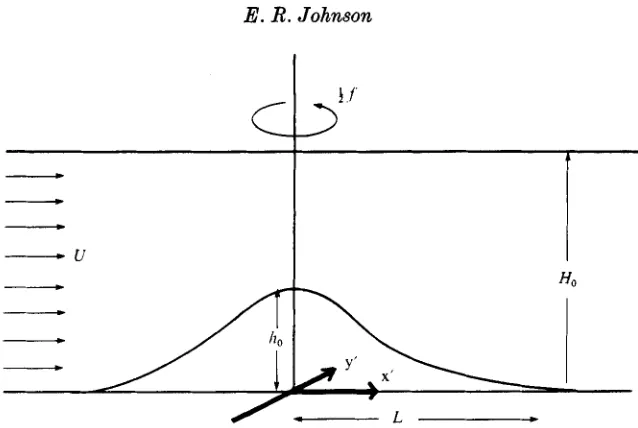
JohnsonFIGURE 1. The co-ordinate system and scales of the motion.
gravitational problem. From numerical work it appears that there exists a second critical value for a, a* say, less than the critical value ac below which stagnation points exist. Above this value of a* no solutions can be found corresponding to trapped cyclonic vortices. The three possible regimes a > ac, a, > a > a* and a* > a are discussed in
5
6. We conclude with an appendix in which expressions are given for the stream function and blocking height for axisymmetric obstacles of arbitrary height. These reduce to those given by Huppert (1975) in the quasi-geostrophic limit.2.
The time-dependent equations
Although the actual analysis will be restricted to steady flows, it will help to motiv- ate the procedure if we begin by writing down the time-dependent equations. We consider the motion of a layer of depth
H,
of homogeneous, incompressible, inviscid fluid confined between two horizontal planes and initially in a state of solid-body rotation with angular velocity4
f about a vertical axis. We take horizontal co-ordinates(2’) 9’) as in figure 1, with corresponding velocity components (u’, v’), and time t’. We are concerned with the effect of an obstacle fixed to the lower boundary on the evolu- tion of this system when an applied pressure gradient accelerates the fluid a t infinity from rest to uniform motion in the
+x’
direction with velocityU.
We assume that horizontal velocities are independent of depth. The vertically integrated continuity equation is thuswhere H(x’, y’) = 1
-
Sh(x’, y’) is the non-dimensional local fluid depth. Combining this with the vertical vorticity equation gives the conservation relationwhere
n‘
=(5‘
+
f
)/H,H -f/H,
=(5‘
+
Sfh)/H,H
is the potential vorticity and6’
is the vertical component of the relative vorticity. Since we consider the fluid to be initially at rest relative to the rotating frame, we have(U’H),
+
(V’H),. = 0,7T;+u’7T;*+v’7Ty, = 0, (2.2)
(2.1)
Trapped vortices in rotating flow 213 The initial distribution of potential vorticity is non-zero only on that k i t e area where the local depth differs from the basic depth H,. We introduce non-dimensional variables defined by
(x',
y') =L(x,
y), (u',v')
= SfL(u, v), t' = t/&f,g'
=Sfc,
n' =Sfn/Ho.
In the light of (2.1), we may also introduce a bulk stream function Y defined by
WX,
Y,) = ( V H ,-
UH),
n,
=-H-l8(Y,n)/8(x,y),
and write (2.2) and (2.3) asn =
h/H =
ni (say) at t = 0, (2.5) where 8(Y, n)/a(z, y) = Yxn, -'Funx is the Jacobian and Y and n are related through the relative vorticity :6
= H ( n - n i ) = vx-u, =(H-lY,JX+
(H-Tu),
=
9 Y (say). (2.6) The conservation relation (2.4) has a simple geometric meaning. This may be demon- strated by introducing any continuous bijection from(x,
y) to new (non-orthogonal) co-ordinates(E,
7) which satisfies(Along with (2.7) it may also be required that the origin is invariant under the bijection and that the new co-ordinates differ from the old by an amount which decreases with increasing distance from the origin.) The volume element
dP
=W x ,
y)dxdy,
which was previously a function of position, is independent of co-ordinate values in this new system: d,u = d t d y . For any function G we introduce G*(<,r) =- G(x,y). The relation (2.4) becomes
This states that the potential-vorticity distributions which evolve during any time interval are rearrangements in
5 , ~
space of some initial distribution, which, from (2.5), we take to be n:. This is the sole information from the time-dependent problem that we shall use in finding steady solutions. The steady problem may then be posed as finding a potential-vorticity distribution no (say) and corresponding stream function Yo such that no* is a rearrangement of n:, and no and Yo satisfynt* =
-
a(Y*,..*)/a(<,
7). (2.8)aw,,
n,)/8(z,Y)
= 0, (2.91(aY,/az, 8Yo/8y) -+ (0, -a) as x2+y2
-+
co.
(2.10)3.
The steady solution
For a wide range of bottom topography the operator
9
in (2.6) may be inverted to obtain from a vorticity distribution with bounded support a stream function whose corresponding velocity components vanish at infinity. There exists a Green's functionk(x,
y,6,
Q),
say, for (2.6) subject to the boundary condition(kx,
k,)
-+
(0,O) as214
E.
R.
Johnson
is non-zero instead of the whole fluid field.
To
solve the steady problem we split Yointo irrotational and rotational parts. Let Yo =
Yl
+
Y,, where Y, is given byY, = -ay +aK[(H-l),] (3.1)
and the linear operator
K
is defined byIt
may be verified that Y, satisfies9 Y l
= 0 and the boundary condition (2.10). The rotational component Y, satisfieswhere
We are now in a position to characterize n,* as that rearrangement of n: which maximizes the functional
F(n*)
=-/
=
-/
(n*
-
n,*){Y?
+
&K*(n*-
7$)} dpaupp ( A * - A ; )
aupp (A' - ?If, (n*
-
n:) Y: dp-
5
(n*-
n,*)K*(n*
-mi*) dp.'1
supp (n*-nt)The first integral in the latter expression may be identified with the impulse, or linear momentum, of the vorticity distribution in the 2 direction and the second with its
kinetic energy. Benjamin's result may be obtained as a special case of the result that it is the ratio of absolute vorticity to depth which is conserved when the depth varies linearly in the cross-stream direction. I n his case both the integral for impulse and that for kinetic energy are independent of time. However, with more general depth varia- tion, drag from bottom topography means that neither integral is conserved individually although substitution in (2.8) shows the combination
F
to be a constant of the motion.By establishing a priori certain properties of the maximizing function for his case, Benjamin was able to produce an elegant proof of existence.
It
is not obvious how similar properties might be demonstrated for the function no*. We prove solely that if n,* is a local maximum ofF ( n )
then it is a solution of the time-independent equation of motion (3.3).We assume that no* is maximal for perturbations with parameter s that are deter-
(3.5)
is a maximum of F, the first variation of
F
about T: vanishes. Ordering inmined by P,+a(g,P)/i?(&q) = 0 for all s 0,
PI,=,
= no,*
where g = g(E,q, s) is chosen arbitrarily.
powers of Since s, the first variation complying with (3.5) is
Trapped vortices in rotating
$ow 215Thus
P
=s
{P[YT
+
iK*(n:
-
n:)]+
i(n,*-
7 ~ : )K*P}
dp= /(Y:+Y:)Pdp, where Yg =
K*(n,*-n:),
Since F vanishes for arbitrary g ,
w:
+
yt,
n,*)P(<,
7) = 0.This is precisely the dynamic condition (3.3) for steady motion in the present co- ordinate system. The stationary-vortex problem is thus reduced to finding the local maxima (if any) of
P
corresponding to a given a,& andh
subject to the constraint thatno* be a rearrangement of n:.
4.
Flat-topped obstacles
An appreciable simplification occurs when attention is restricted to obstacles which are of uniform, non-zero height within some given region and of zero height elsewhere, For such obstacles the requirement that n* remains a rearrangement of n: becomes a simple weighted area constraint. This greatly reduces the difficulty of numerical calculations.
Consider the obstacle given by
h
=xd,
wherexd
is the characteristic function for some bounded, simply connected region d (i.e.xd
takes the value unity inside &' and the value zero elsewhere). The initial potential vorticity is thus ni = (1 - 6)-1xd, from(2.5). Since n is conserved the subsequent value of n at any point is either (1 -&)-I
or zero, i.e. the determination of the motion is reduced to obtaining, at any time t , the support a(t) (say) of n, since we then have n(z,y,t) = (1 -&)-lxtar. Calculating the
relative vorticity shows that
6
is non-zero in two compact regions:(;= -xy+(1-&)-1x.q. (4.1)
The potential vortex
9
consists of those filaments which have moved off the obstacle after initially occupying a position above it while the topographic vortex .F consists of those filaments now above the obstacle which were not there initially. The require- ment that n* remains a rearrangement of n: in a space defined by (2.7) becomes simply thatJtarn*dp = ldn:dp. ( 4 4
Relative t o z,
y
co-ordinates, this states thatarea
(9)
= (1 -6) area (F).216
E .
R.
JohnsonI n terms of a co-ordinate system satisfying (2.7),
F
may be written aswhere
(Y:
+
@*+
#K*n*)
n*dp+
(YT+
#@*) T: dp, (4.3)c
Here
a*
is the contribution to the stream function from the topographic vortex and YT is the irrotational part of the stream function, given by (3.1). Since the final term in (4.3) is independent of &I* we takep*(a*)
=-
(1-
8)-lS I* (YT+
@*+
+( 1-
8)-lJI* k* d i ] dp.The condition that &I* is a stationary point of
F*,
subject to the constraint (4.2), i.e. thata*
has the same measure asd*
under measure p, requires thatc
'rT
+
a*
+
(1 -&)-I) k* d,G I*be constant on the boundary of
9P.
This is simply the condition that the boundary ofa*
must be a streamline for the flow to be steady. For those steady solutions in which dn
93' is empty (which is always the case for sufficiently small a), the problem becomes that of maximizingwhere
Y, is given by (3.1) and &I is constrained so that
area (9) = (1
-8)
area ( d ) . (4.5) I n this case, the combination of the irrotational and topographic parts of the stream function, i.e. @+
Y,, is the finite-8, non-axisymmetric form of the zero-potential- vorticity stream function given by Huppert (1975) for axisymmetric obstacles in homogeneous flows in the limitS
+
0. The general form of0
+
Y, for arbitrary axisymmetric obstacles and the effect of finite6
on Huppert's criterion for blocking are presented in the appendix.5.
Right circular cylinder
A right circular cylinder is perhaps the simplest example we may consider as it is both axisymmetric and flat-topped. We thus take a height function
xd,
where x? is a disk of radius one centred about the origin. For the evaluation ofF(@
we require the Green's functionk
and the zero-potential-vorticity stream function @+Yl.
I n the appendix it is shown that- a ( l - , 8 ) y - ~ ( l - S ) ( r 2 - 1 ) if r
<
1,-
a( 1 -,8/+) y-
# In
r if r > l ,Trapped vortices in rotating $ow 217 The equation satisfied by the where (2, y) = (r cos
8,
r sin 8) andP
=+S(
1-
Green’s function follows from (2.6) as
subject to
(kz, ky)
-+
(0,O) as x2+ y2+-
00. This may be solved by expandingIC
in a sumof terms of the form
A,(r,p)cos[n(8-$)], n = 0, 1,2..., where
(a,$)
= (pcos$,psin$). ThenWs,
Y,
=I
G(rY OIP, $) -BG(r, 01 l/py
9)
+
(27rr)-lBlnr if r > 1, p > 1,( 1 - 6 ) G ( r , B l p , ~ ) + P ( 1 - 6 ) G ( r , 8 1 l / p , 9 ) + ( 2 7 r ) - l P ( l - S ) h p if r < 1, p < 1, (1 -P)G(r, q p , $)
+
(24-1Plnp if r < 1 < p , (1 -P)G(r, q p ,$1
+
(24-lPlnr if p < 1 < r ,( 5 4
G ( r , B ( p , $ )
= (4n)-11n[r2-2rpcos(O-$)+p2]. whereAs 6 -f 0,
k
+- G , the fundamental solution of Laplace’s equation in two dimensions. the area constraint (4.5), which becomes[
Expressions (5.1) and (5.2) form the basis for the maximization of (4.4) subject to
area
(a)
= ( 1-
S) n.Expressions (4.4) and (4.5) are based on the assumption that d
n
9’ is empty, which is always true for sufficiently small a. As a increases it is possible for this condition to be violated and then the previously noted stretched co-ordinates must be introduced. Numerical calculations have, to date, been carried out for solely the simpler quasi- geostrophic limit 6 -+ 0, so that the transformed and original co-ordinates coincide and (4.4) and (4.5) are valid even whend
n
is not empty. The integral in (4.4) was replaced by a sum over 650 vortex points from 2500 fixed grid points. The value ofF
calculated for a given configuration was tested against all other values ofF
for con- figurations which could be obtained by exchanging a vortex point for a point next to the vortex. IfP
could be increased the points were exchanged and the process con- tinued until the test was successful. Streamline patterns of the flow for a = 0.18, 0.25 and 0.259 are presented in figure 2. The dotted region is that covered by the potential vortex, i.e. 23’.It
may be noted that the region of fluid isolated from the upstream flow by the splitting streamline is not stagnant and is of more than twice the area of the obstacle, decreasing in area with increasing upstream velocity. The streamline pattern is very much like that of a line-vortex pair.The extension of these calculations to finite
S
and the interpretation of the present solutions are aided by an expansion of the solution as a power series in a, obtained by analogy with the effect of gravity on a deformable body. The condition that the boundary of be a streamline in steady flow is analogous to the condition that the boundary of any deformable body should be a gravitational equipotential.218
E .
R.
Johnson
( b ( c )
FIQURE 2. Streamlines for steady flow over an infinitesimal cylinder with a trapped potential vortex. The dashed circle indicates the edge of the cylinder, at r = 1, and the area of non-zero potential vorticity is dotted. The splitting zero streamline is thickened. (a) a = 0.18, ( b ) a = 0.25, ( c ) a = 0.259. The scale is the same in each diagmm and
the streamline interval is 0.2.
field centred on the origin; and the region
43
corresponds to a deformable self- gravitating body of area (1-
6)
n and density (1-
S)-l with gravitational potential given by(l-&)--l/ kd2dfJ.
This configuration is depicted in figure 3.
For slow flow, a
<
1, i.e. a weak background field in the analogy, equilibrium can occur only at large distances from the repulsive body. The repulsive field has an equal and opposite strength to the background field at (2, y) = (0,-
d), whereTrapped vortices in rotating flow
Y
219
f
+
r t
t
IT
FIGURE 3. Field lines for the model considered in the gravitational analogy. The circular region d is of density 1, area 7r and exerts a force directed away from the origin. Region
a
is self-gravitating, of density (1-
8)-1 and of area (1 - 8) 7r. The background field is ofapproximately uniform strength a.
Both fields will be uniform to zeroth order in a and so its own gravitational field will cause the deformable body to be circular to zeroth order.
To
satisfy the area constraint,9
will thus be a disk of radius y = ( 1-&)a
and centre (0, -d). The steady-state system, viewed on a length scale a-lL %L,
has the appearance of a line-vortex pair in an almost uniform stream, the negative vortex being at the origin, the positive vortex at (0, -d).Higher approximations to the shape of
a
may be obtained by expanding in terms of a. We take the boundary of -9? to be given by (z,y) = (R(O)cos8, - d +R(O)sin O), where~ ( 6 ) = y
+
a”fi (8)-F
ay2(o)
+
o(a4).The potential a t the boundary of 33 due to the background and repulsive fields is then, from (5.1) and to within a constant,
220
E .
R. JohnsonThe potential at the boundary of
93
due to self-gravitation is2 K R(6)
cV(8) = y - 2 I 0
jo
k(R(O)cos8, -d+R(O)sinO,pcos$, -d+psin$)pdpd+.This integral can be evaluated to order a4 without excessive manipulation by noting, from ( 5 . 2 ) , that the potential a t any point (r, 8) due to a point mass at (p,
9)
is, forp > 1 and r > 1, the sum of three potentials which depend solely on the logarithm of a distance. These are the distances from (p,q5)
to (i) ( r , O), (ii) ( l / r , 6) and (iii) (0,O). The last two reflect the presence of an obstacle of finite height and vanish as 6 --f 0.Thus the simple logarithmic potential due to the body B' is found for an arbitrary point (r, O), r > 1, and is used to calculate the three contributions to the potential for an obstacle of finite height. This gives, to within a constant,
a2 2n a2
@@(6) =
- ( f l ~ ~ ) + ~ f z ( ~ ) ) + z , r ~ o
Cfl(4)+~f2($)lln{2[1-
c o s ( ~ - $ ) l ) ~ d $+
4a3yP sin 8+
O(a4). (5.4) For the boundary of Pi? t o be an equipotential, the two expressions (5.3) and (5.4) can differ by the most a constant, independent of a. Thus, equating coefficients of a,2Y
fl(6)+1 ~2'fl(q5)h{2[1
-
cos(8-q5)]}idq5 = 2y3cos28,n o
f2($)
In {2[1- COB (8-
$)]}* d$ = #y4 sin 38-
8y2Psin 8.Expanding the logarithmic kernel in sine and cosine series gives the exact solutions fl(8) = 4y3cos26,
fz(8)
= Zy4sin38-4y2Psin8.Hence, to order a4, d and R are given by
d = $a -as( 1
-
+S)-l- 2a3S2( I-
R(8) = ( 1-
S)i+
4( 1-
S)#
a2 cos 26+
2a3( 1-
6)
[( 1 -6) sin 38-
S(
1-
gS)-l sin81.
(5.5)Trapped vortices in rotating flow 221
6. Discussion
It has been shown that if a rearrangement, relative to a particular co-ordinate system, of the initial potential-vorticity distribution above topography of finite height maximizes a functional related to the total energy of the motion, then this rearrange- ment is a soIution of the time-independent equations of motion. We have, however, not shown, as Benjamin was able to, that such a maximum must exist in a suitably defined function space.
It
appears, in fact, that there exists a critical value of a above which no such maximum may be found. This corresponds in the gravitational analogy to noting that, for sufficiently strong background fields, the repulsion between the two bodies will not be great enough to oppose the background field and no equilibrium configuration will exist. For a cylinder with 6 = 0 no maximum of the functional has been found for a > a* = 0.259. The results for flow with zero potential vorticity, derived for arbitrary6
in the appendix, show that closed streamlines first occur for 6 = 0 when a decreases past ac(0) = 0.5. Thus we may divide the flow into three regimes.(i) a > ac. While the flow is set up those fluid elements initially above the topography, with non-zero potential vorticity, drift off downstream, so that within any fixed finite area the potential vorticity will be zero at sufficiently large times. The flow will then be given by the zero-potential-vorticity solution
(A
6).(ii) a, > a > a*. The present method will not give an unambiguous form for the solution in this regime. We expect that, for flow velocities first increasing to above a, before approaching the final a value, the potential vortex would be lost downstream and the solution would be the zero-potential-vorticity solution
(A
6), containing closed streamlines. However, for monotonically increasing flows, some potential vorticity may remain in the vicinity of the origin.(iii) a < a*. Provided that the basic flow reaches its final velocity monotonically, we expect trapped vortices to be present, containing all the original potential vorticity. Only in the last two cases is the mode of initiation critical, since it is always possible to sweep away the potential vortex by starting with a sufficiently large and sustained a before decreasing it to its final value.
The analysis presented above has been for obstacles whose height is everywhere positive. For obstacles of negative height analogous results may be derived. There will, however, be qualitative differences. Since flow moving over a depression is stretched, the topographic vortex will be cyclonic and the potential vortex anticyclonic. The equilibrium point will thus be to the left (looking downstream) of the depression. In the quasi-geostraphic limit the motion for 6 < 0 will be simply the reflexion about the
x
axis of that for6
> 0 if the obstacle is symmetric about thex
axis. However, for finite 6, volume and vorticity conservation require that the potential vortex is less intense but occupies a larger area than the topographic vortex. As there is no bound on obstacle depth (in contrast to bump height, which has a maximum of6
= I), there is no bound on how large and weak a potential vortex due to a depression may be, provided, of course, that a solution is possible for 6 large and negative.222
E . R.
Johnson(Greenspan & Howard 1963) is far longer than the advection time scale for setting up the flows discussed here.
The initial-value numerical solutions of Huppert & Bryan (1976) appear to approach the present solutions at large times for sufficiently low basic velocities, and photo- graphs obtained by Huppert & McEwan (private communication) in laboratory experiments show what could well be trapped potential vortices described by the previous analysis. Oceanographic evidence for the occurrence of these trapped vortices is less clear. The present analysis points to the possibility of finding not only trapped anticyclonic vortices above seamounts but also cyclonic vortices trapped by weak streams to the right (looking downstream) of mountains. Measurements of spatial and temporal variability (Stommel 1955; Swallow & Hamon 1960; MODE, Mid Ocean Dynamics Experiment) have yet to give unequivocal evidence of trapped vortices.
I
wish to thank Dr Ronald Smith for his many helpful suggestions andDr
Herbert Huppert for his constructive comments on previous drafts of this paper. The interest they have shown in this work is greatly appreciated. This work was financed by a Commonwealth Scholarship.Appendix. Stream functions and blocking for finite axisymmetric obstacles
The results in
$3
4 and 5 require knowledge of the zero-potential-vorticity flow field due to obstacles of b i t e height. I n this section we obtain a general expression for this field for arbitrary axisymmetric obstacles and the particular form for the specific case of a right circular cylinder. This also enables us to extend Huppert's (1975) blocking criterion to axisymmetric obstacles of finite height.Let the axisymmetric obstacle be H ( s ,
y)
= 1-
6h(r), where (2, y) = (r cos 8,r
sin 8)and h has a maximum value of 1. Then from (2.6), the vorticity operator, in polar
co-ordinates, is 1
1
-
ah)The irrotational component Y, of the stream function has been defined to satisfy 9Y, = 0 subject to
We may thus put Y, = -a sin O(r
+
6R(r)}, whereR
is a function ofr
alone, vanishing at the origin and at infinity, which satisfies, from(A
1) and (A2),(aY?,/ax,
8TJay)+
(0, -ct) asr
-+
co.
(A
2)-(l--~?h)(&~R,.) 1 --R 1 = - ( 1 - ~ 9 h ) - ~ h , .
r r r2
For arbitrary 6 and h this ordinary differential equation would have to be integrated numerically to obtain the behaviour of
R.
The exact solution of(A
3) for a cylinder is given later in this appendix.We are concerned with the case of zero potential vorticity so the vorticity of the flow is given by LJx, y) = -h(r). Thus the stream function Q due to the topographical vortex satisfies 9Q =
-
h, i.e.-(--)
1 rQr = - h ,
Trapped vortices in rotating $ow 223
subject to the boundary conditions that @,. is bounded at r = 0 and vanishes as
r
+
m. The required solution of(A
4) isThus the zero-potential-vorticity stream function is
where
R
satisfies(A
3). This finite4 result reduces to that given by Huppert in the limit of quasi-geostrophic flow.For sufficiently large upstream velocities, Y, will dominate @ and no stagnation points will be present. For a given 6, as a decreases it will reach a critical value ac(6) at which a stagnation point first appears and below which the flow field represented by
(A
6) contains closed streamlines. Decreasing 01 a t constant6
is equivalent to decreasingthe Rossby number. As
Ro
decreases, rotation effects become more important than inertia and eventually blocking occurs.At
a stagnation point(QrJ = ('9
'1'
(A
7)Hence as Ro decreases from infinity, a stagnation point occurs first at 8 =
-
for some finite r, when,
Let the maximum value of F o v e r all r occur at
~~(6).
ThenRoc
=F(r,(&),&).
ForRo
> Roc,(A
8) and hence(A
7) possess no solution, there are no closed streamlines in the flow field and the zero-potential-vorticity flow is unambiguously determined. ForRo = Roc there exists precisely one stagnation point, a t (rc(6),
-
an), and for Ro < Roc the flow contains closed streamlines about the point (rc(6), -in).ExampZe. Consider the cylinder
1 if r < 1,
0 otherwise.
h(r) =
Then
and
Thus
-(Z-S)-lr if r < 1,
-(2-6)--lr-l if r > 1,
R(r) =
- a r s i n 8 ( l - p ) - ~ ( l - S ) ( r 2 - 1 ) if r < 1,
-
ar
sin 8( 1 -b/r2)-
4
Inr if r > 1,Q@,@
={
whereAs
Ro
decreases from infinity, a stagnation point first occurs at (re, 8,) = (1,-
an) whenp
=&S(
1-
iS)-1.224
E .
R.
JohnsonThe critical value of a is given by ac(S) = 6 l R 0 , . In the limit
S
+
0 this gives a,(O) =4
as in Huppert (1975). Equation (A 9) states that stagnation occurs solely for Rossby numbers less than 0.25 and for obstacles of height greater than8,
= 1-
(1-
4Ro)i = 2Ro+
2R02+
O(Ro3) as Ro+
0.(A
10) Expression(A
lo) shows that the critical blocking height calculated for quasi- geostrophio flow over a cylinder underestimates the height required to cause stagna- tion a t non-zero Rossby number. This result is closely analogous to that obtained by Huppert & Stern (1974) for rotating-channel flow.R E F E R E N C E S
BENJAMIN, T. B. 1975 The alliance of practical and analytical insights into the nonlinear problems of fluid mechanics. In Lecture Notes in Mathematics, vol. 503. pp. 8-29. Springer.
BRETHERTON, F. P. & HAIDVOGEL, D. B. 1976 Two-dimensional turbulence above topography. J. Fluid Mech. 78, 129-154.
FRAENKEL, L. E. & BEROER, M. S. 1974 A global theory of steady vortex rings in an ideal fluid. Acta Mathematica 132, 13-51.
GRACE, S. F. 1927 On the motion of a sphere in a rotating liquid. Proc. Roy. Soc. A 113, 46-77. GREENSPAN, H. P. 1968 The Theory of Rotating Fluids. Cambridge University Press.
GREENSPAN, H. P. & HOWARD, L. N. 1963 On non-linear spin-up of a rotating fluid. J . Math. HIDE, R. 1961 Origin of Jupiter’s Great Red Spat. Nature 190, 895-896.
HIDE, R. & IBBETSON, A. 1966 An experimental study of ‘Taylor Columns’. Icarus 5, 279-290. HIDE, R. & IBBETSON, A. 1968 On slow transverse flow past obstacles in a rapidly rotating fluid.
J . Fluid Mech. 32, 251-272.
HUPPERT, H. E. 1975 Some remarks on the initiation of inertial Taylor columns. J . FZuid Mech. 67, 397-412.
HUPPERT, H. E. & BRYAN, K. 1976 Topographically generated eddies. Deep-Sea Res. 23, HUPPERT, H. E. & STERN, M. E. 1974 Ageostrophic effects in rotating stratified flow. J . Fluid
Mech. 62, 369-385.
INGERSOLL, A. P. 1969 Inertial Taylor columns and Jupiter’s Great Red Spot. J . Atmos. Sci. 26, 744-752.
JACOBS, S . J. 1964 The Taylor column problem. J . Fluid Mech. 20, 581-91.
PROUDMAN, J. 1916 On the motion of solids in a liquid possessing vorticity. Proc. Roy. Soc.
STERN, M. E. 1975 Minimal properties of planetary eddies. J . Mar. Res. 33, 1-13.
STEWARTSON, K. 1952 On the slow motion of a sphere along the axis of a rotating fluid. Proc.
Camb. Phil. SOC. 48, 168-177.
STEWARTSON, K. 1953 On the slow motion of an ellipsoid in a rotating fluid. Quart. J . Mech. Appl. Math. 6, 141-162.
STEWARTSON, K. 1967 On slow transverse motion of a sphere through rotating fluid. J . Fluid Mech. 30, 357-370.
STOMMEL, H . 1955 Direct measurements of sub-surface currents. Deep-sea Res. 2, 284-5 SWALLOW, J. C. & HAMON, B. V. 1960 Some measurements of deep currents in the eastern
TAYLOR, G. I. 1917 Motion of solids in fluids when the flow is not irrotational. Proc. Roy. SOC.
TAYLOR, G. I. 1923 Experiments on the motion of solid bodies in rotating fluids. Proc. Roy. SOC. Phy8. 44, 66-85.
655- 679.
A 92, 408-424.
North-Atlantic. Deep-sea Res. 6 , 155-68.
A 93, 99-113.

![catena Poly[[[(dihydrogenphosphato)silver(I)] μ 4,4′ bipyridine] dihydrate]](data:image/gif;base64,R0lGODlhAQABAIAAAP///wAAACH5BAEAAAAALAAAAAABAAEAAAICRAEAOw==)