University of South Carolina
Scholar Commons
Theses and Dissertations
1-1-2013
An Institutional History of the Higgins Armory
Museum and Its Relationship with Worcester,
Massachusetts
Kary Ashley Pardy
University of South Carolina - Columbia
Follow this and additional works at:https://scholarcommons.sc.edu/etd Part of theHistory Commons
This Open Access Dissertation is brought to you by Scholar Commons. It has been accepted for inclusion in Theses and Dissertations by an authorized administrator of Scholar Commons. For more information, please [email protected].
Recommended Citation
An Institutional History of the Higgins Armory Museum and
Its Relationship with Worcester, Massachusetts
by
Kary A. Pardy
Bachelor of Arts Hamilton College, 2008
Submitted in Partial Fulfillment of the Requirements
For the Degree of Master of Arts in
Public History
College of Arts and Sciences
University of South Carolina
2013
Accepted by:
Allison C. Marsh, Director of Thesis
Lana A. Burgess, Reader
Abstract
This thesis examines the institutional history of the Higgins Armory Museum through
its connection with the industrial city of Worcester, Massachusetts. It documents the
museum’s beginning as a commercial museum connected with the Worcester Pressed
Steel Company and analyzes both Worcester and the Armory’s survival methods when
their affiliated industries folded under economic pressures following World War II. The
thesis follows the Higgins’ attempted transformation to a nationally-recognized museum
of arms and armor, and concludes with the Armory’s identity struggles and eventual
Table of Contents
Abstract……….………..………iii
List of Figures.………iv
Chapter 1: Introduction….………..……….…1
Chapter 2: Successes in Steel………...………2
Chapter 3: The Higgins Armory as a Commercial Museum……….12
Chapter 4: The Decline of American Steel……..………..17
Chapter 5: 1960’s Transitions………..………..19
Chapter 6: Struggles for Survival………..………....22
Chapter 7: Reinvention for Worcester and the Higgins Armory………..………….26
Chapter 8: After PRESTEEL- Planning for a Sustainable Future………...29
Chapter 9: The Worcester Art Museum Debates………..….32
Chapter 10: Moving Forward Independently……….………37
Chapter 11: The Present and Future Armory……….38
Chapter 12: Update- The 2014 Merger with the Worcester Art Museum……….42
List of Figures
Figure 2.1Leland’s steel and glass creation, looking much the same in 2013 as in it did when first built……….6
Figure 2.2The Ancient and Modern Wings (respectively) of the Higgins Armory
Museum………...……….7
Figure 2.3The Piper Cub Airplane in the Higgins Armory Museum’s Modern Wing….10
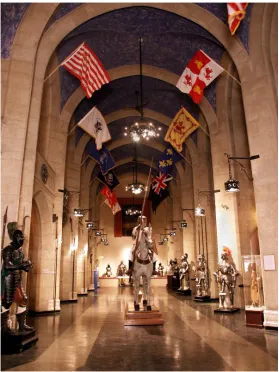
Figure 6.1 Since 1971 half of the Great Hall has been devoted to additional armor
displays………..22
Chapter 1: Introduction
Located at 100 Barber Street in Worcester, Massachusetts, the Higgins Armory
Museum is the largest arms and armor museum in the United States. Its collection
contains pieces that have monetary and cultural values rivaling arms and armor within the
Metropolitan Museum of Art, the Art Institute of Chicago, or the Philadelphia Museum
of Art. Despite its internationally important collection, few outside the city of Worcester
or the arms and armor community have ever heard of the Higgins Armory Museum.
The Armory’s relative anonymity is a result of years spent as a local Worcester
museum, intricately connected with the community from its inception. Industrialist John
Woodman Higgins started the Worcester Pressed Steel Company (WPS, or PRESTEEL)
in the early 1900’s. An avid collector of armor, Higgins saw the artistic side of steel and
commissioned a museum in 1929 to house his growing collection and inspire his workers.
He designed the armory to showcase craftsmanship in steel, both ancient and modern,
evident as visitors moved from galleries of medieval armor to ones exhibiting products of
WPS employees. As a company museum, the Armory’s fortunes were bound to
Worcester Pressed Steel as well as to the economic fluctuations of the steel industry. The
museum’s tumultuous history reflects the struggles of its community, as does it rebirth
and redirection. This thesis will examine the success and decline of the industrial city of
Worcester through the lens of the Higgins Armory Museum and discuss the actions both
Chapter 2: Successes in Steel
John Woodman Higgins graduated from Worcester Polytechnic Institute in 1896
and entered Worcester’s thriving workforce through his family’s Worcester Plunger
Elevator Company. His father, Milton Higgins, sold the company in 1902 to Otis
Elevator Company, but John stayed on and used the elevator industry as a testing ground
for experiments in steel. Higgins favored rolled, pressed steel over castings as it proved
to be stronger and more economical to produce. He and his father purchased the
Worcester Ferrule and Manufacturing Company, which they renamed Worcester Pressed
Steel. 1
A heavily industrial city with a strong workforce, Worcester offered the ideal
environment for the new steel company. American steel was highly profitable through
connections with railroads and expanding automobile industries. Additionally, rapid
economic growth in the early 1900’s encouraged increased steel consumption, resulting
in decentralization and allowing smaller steel companies to succeed alongside larger,
fully integrated steel corporations.2 Worcester Pressed Steel initially specialized in
bicycle and automobile parts, but during World War I, British contracts for bronze
Howitzer castings and the American need for helmets, bayonet scabbards, anti-shrapnel
1 Carter C. Higgins and Bradley Higgins, “Craftsmanship in Steel,” The John Woodman Higgins Armory,
Worcester, MA, (USA: The Newcomen Society in North America, 1956); John Woodman Higgins and the Higgins Armory Museum (Worcester, MA: Higgins Armory Museum, 2010).
2 Hans D. Rosebrock., “Dynamic Changes and Locational Shifts in the U.S. Steel Industry,” Economic
goggles and cartridge cases quickly pulled the company into the upper tier of successful
Worcester industries.3
Early 20th century historian Charles Nutt claimed that Worcester’s prosperity
came from its variety of manufactured goods. He asked, “Why do we hear the sound of a
thousand factory whistles every morning? Why do new factories creep outward from the
old city and spread clustering dwellings about them? Why are Worcester banks teeming
with the savings of an army of skilled mechanics?” He answers that it is because of
Worcester’s industrious population. More telling, however, is Nutt’s description of the
city in 1918. He presents a city supported by factories and teeming with industrial
workers.
To give a list of even the most important products of the factories would be to catalogue almost everything that human ingenuity can produce. Perhaps wire and wire goods come first on the list. Looms, lathes, all kinds of machine tools, agricultural machinery, shoes, card machinery and cards for textile manufacturing, carpets and rugs, envelopes and envelope machinery, razors, wrenches, fire-arms, forgings, rail road cars, elevators, are made in great variety. In grinding machinery, polishing machinery, corsets, cotton and woolen goods, pressed steel devices, wall paper,
valentines, leather goods, the city ranks high.4
Worcester’s diverse industries helped drive the American Industrial Revolution and
shaped the city’s identity. Higgins’ steel company grew up alongside the American Steel
and Wire Company, a leading producer of barbed-wire, piano-wire and hoop skirt wires
that supported 6,000 employees.5
3 Carter Higgins and Bradley Higgins, “Craftsmanship in Steel.”
4 Charles Nutt, History of Worcester and its People, (New York City: Lewis Historical Publishing
Company, 1919).
5Dan Ricciardi and Kathryn Mahoney, “Washburn and Moen: Worcester's Worldwide Wire Manufacturer,” Worcester and Its People, College of the Holy Cross Northworks Project,
In 1908, the Royal Worcester Corset Company reported 1,200 female employees, making
it the United State’s leading employer of women.6
The American Steel Industry, Worcester, Massachusetts, and Higgins’ Worcester
Pressed Steel Company thrived in the period following World War I. European nobility
did not. Political, social and economic upheavals forced them to open their homes to
ambitious buyers and allowed John Woodman Higgins to indulge in his hobby of armor
collecting.7 Fascinated with metal-working from a young age, Higgins appreciated
craftsmanship in ancient and modern steel, and filled his home and PRESTEEL offices
with his armor acquisitions. The Metropolitan Museum of Art’s Arms and Armor
Curator, Bashford Dean, guided him to purchase seven valuable suits of armor from art
dealer Joseph Duveen in 1928, and a growing lack of space initiated plans for the
collection’s public display.8
A 1927 family trip to Europe introduced Higgins to a type of museum that did not
yet have a strong presence in the United States, a museum of practical products. Seeing
the merit of exhibiting both ancient and modern examples of steel workmanship, Higgins
devised a museum to display both his arms and armor collection and the products of
PRESTEEL. Higgins’ creation began as an industrial museum showcasing the evolution
of metalwork.9
American steel in the early 20th century conjured ideas of prosperity, success and
innovation, and John Woodman Higgins succumb to its allure. He collected arms and
6 Melvin G. Overlock, “Driving Tuberculosis out of the Industry,” The World’s Work 23, (November
1911-April, 1912): 295.
7 Walter Karcheski, Arms and Armor at the Art Institute of Chicago (Chicago: The Art Institute of Chicago,
1995), 9.
armor as examples of functional art and saw the modern steelworker as the creator of a
similarly artistic product. By showcasing the loveliness of ancient and modern steel,
Higgins planned to inspire steelworkers and the Worcester community with his fledgling
museum. However, Higgins’ ideas met with initial trepidation. PRESTEEL management
worried that a museum exhibiting their products would reveal trade secrets to competing
steel companies. In a speech about his father John, Cater Higgins would later argue that
“If industry does not let the public into its plants and its thinking, how can we hope for
sympathetic understanding? John Higgins was a pioneer for public relations.”10
Higgins’ Steel Museum was incorporated in 1928, with the goal that through its
ancient and modern pieces, it would instill in visitors an appreciation for metalwork and
reveal the beauty in functional items. Higgins believed so strongly in his model that he
encouraged every industry to establish its own technical museum. Such institutions
would ignite community pride, inspire workers, and allow perspective clients to view a
company’s products. They would teach trade history, showcase products and encourage
further industrial research.11 Higgins hired Boston architect Joseph Leland to design his
museum in 1929. Leland’s two-story, “L” shaped building was a work of steel
innovation. It was the first multi-story building in the United States with an exterior
made entirely of steel and glass.12 The Steel Museum occupied the upper two floors,
while the lower half served as PRESTEEL offices.
10 Carter C. Higgins and Bradley Higgins, “Craftsmanship in Steel,” 20. 11 Carter C. Higgins and Bradley Higgins, “Craftsmanship in Steel,” 25.
12 Higgins Armory Museum, National Register of Historic Places, National Park Service, accessed
Figure 2.1: Leland’s steel and glass creation, looking much the same in 2013 as in it did when first built.13
The new building was built directly in front of Worcester Pressed Steel, linked to
its parent company by a passageway and catwalk that allowed visitors to tour the museum
and then view the factory itself. The upper museum floors were “arched and plastered to
form a two-winged hall” that Higgins and Leland designed to resemble the Great Hall of
Prince Eugene’s castle in Hohenwerfen, Austria, a sight that had greatly impressed
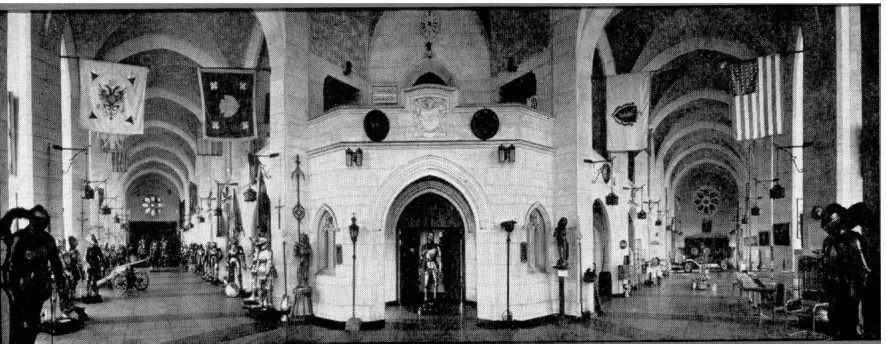
Higgins on his European travels.14 The two wings of the museum’s Great Hall featured
“ancient” and “modern” subject matter; the former showcasing chronologically exhibited
suits of armor and ancient weaponry while the later displayed pieces of modern
metalwork that included automobile parts and other “crowning examples of mass
production,” such as airplane parts and utensils.15
13 Bill Greene photographer, “Higgins Armory Museum to Close,” The Boston Globe, March 8, 2013,
http://www.bostonglobe.com/arts/2013/03/08/higgins-armory-museum-close-arms-and-armor-worcester-art-museum/3Y4p45OpkfMrQxSGmlP3NP/story.html.
14 Carter C. Higgins and Bradley Higgins, “Craftsmanship in Steel,”21.
15 Libbie Armstrong, Public Relations and Membership Coordinator at the Higgins Armory, telephone
Figure 2.2: The Ancient and Modern Wings (left and right) of the Higgins Armory Museum.16
Visitors could also follow a silver line that led through the exhibits to the gallery
of the plant and observe PRESTEEL workers in action. Guides and labels within the
gallery explained the machinations of steel working, including comparative strength,
weight, and costs as well as the processes of rolling, drawing, stamping welding and
tempering metals.17 John Woodman Higgins hoped that by allowing visitors to
experience steel workmanship firsthand, he could inspire them to see modern industry
workers as creators of functional art, similar to armorers. He lamented, “Early Gothic
armor was rightly classed with the fine arts, but modern supersonic aircraft, submarines,
missiles and rockets are just machines.”18 Higgins hoped that a visit to his museum
would cause people to think differently.
The Steel Museum officially opened to the public on January 12, 1931. Over 600
people attended its opening ceremony that included a performance by the Boston
Symphony Orchestra. The new museum was a shining example of the success of
16John Woodman Higgins and the Higgins Armory Museum, 14.
17 John Woodman Higgins, “The Steel Museum,” Invitation Circular for the John Woodman Higgins
Armory, undated, Higgins Armory Museum Archive, Worcester, MA, accessed 2012, 3.
18 Steven V. Grancsay, The John Woodman Higgins Armory Catalog of Armor (Worcester, MA: The David
Worcester industry. In an invitation circular for the Steel Museum, John Woodman
Higgins wrote,
We metalworkers, here in this creative, altruistic research laboratory and library of historical information, compare our modern products with masterpieces of the past-our tools, machines, wages, living standards, ambitions and fun, with the romance of traditions and visions of future opportunities…19
Higgins could afford such romantic language; the new museum brought in two to four
thousand visitors a month and Higgins spoke of adding an armorer’s shop, a village
smithy and a “picnic grove near our two hundred year old iron ‘Silver Mine.’”20
The Steel Museum appeared at a time when Americans found glory in industry
and was a direct reflection of the success of American steel. Joseph Leland’s innovative
steel and glass museum building certainly took architectural inspiration from Higgins’
desire to promote the beauty of steel, but also had roots in early 1930s construction
trends. A 1931 edition of Worcester’s Evening Gazette lauded the new all-steel building
as indicative of an increasingly popular construction style that minimized masonry in
favor of lighter steel materials. The Department of Commerce stated that chrome nickel
steel and other alloys were in high demand because they put less weight on foundations
and steel frames than masonry, ultimately reducing construction costs. New steel alloys
resisted rusting and were slowly replacing masonry even on building exteriors, a trend
that the Steel Museum building took to an extreme. The Gazette reported that chrome
nickel steel ingredients cost twenty five to fifty percent more than ordinary steel, but
19 Higgins, “The Steel Museum,” 27.
Federal officials correctly predicted that prices would drop as demand increased, and this
would further promote the all-steel trend.21
Worcester had another innovation in its American Steel and Wire Company. A
center for industrial research in the 1930’s, the company designed a process called
austempering that allowed for continuous production of springs and other small,
carbon-steel products.22 Thomas Misa’s A Nation of Steel cited the American Steel and Wire
Company as an example to support his argument about the existence of American steel
innovation, though this evidence is only a small counterpoint to Misa’s more significant
observations about strong foreign competition within the industry. With American
success, foreign competitors saw the value of steel and the possible profits that lay in
increased efficiency. Worldwide steel innovations that outmatched American
technologies threatened in the early 1940s, but were postponed by World War II’s sharp
increase in production demand.
The onset of World War II and defense contracts brought the next wave of
success to steel companies and Worcester’s industries. The Worcester Pressed Steel
Company received nearly a million dollars in contracts to produce aircraft motor parts
and shell casings for the United States, as well as machine gun parts for the British
military. The Steel Museum, also called the Higgins Armory, displayed PRESTEEL’s
wartime prosperity by exhibiting the products of its workers, including a full-sized, Piper
Cub Airplane replica. Parts manufactured by the Worcester Pressed Steel Company were
used in constructing the plane, which was suspended from the ceiling of the museum’s
Modern Wing in 1941.
21 J.C. Royle, “City Building Gains Notice,” The Evening Gazette, January 17, 1931.
Figure 2.3: The Piper Cub Airplane in the Higgins Armory Museum’s Modern Wing.23
The tremendous influx of business during World War II nearly doubled the
production of American Steel. According to the American Iron and Steel Institute,
production increased from 85 million tons to 141 million between 1947 and 1969,
peaking in 1958. At its height, the industry employed 650,000 workers, and the increased
demand for smaller, specialized “mini mills” allowed for industry growth outside of
major business centers.24 Because they focused on the production of specific objects, the
steel companies of Worcester benefited from the decentralizing trend. Local journalist
Adrian Hayward wrote that 1958 was an expected production peak, and claimed that in
the midst of such achievement, Worcester stood out for its progressivity. Front-runners
23John Woodman Higgins and the Higgins Armory Museum, 17.
for their early innovations, Worcester steel companies continued to aspire to greatness.
They had something more inspiring and constructive than most steel cities- Higgins’
museum, an innovative combination of art and vocational education.25 Hayward
predicted that with such advantages, Worcester steel was poised for continued success.
With the benefit of hindsight, Hayward’s article seems like foreshadowing. The
year 1958 was a peak, after which American Steel slumped and allowed foreign
competitors room to compete, spelling disaster for Worcester and steel companies across
the country. The article was also correct in its assertion of Higgins’ innovation. His
museum was a leader in the commercial museum trend, a concept Higgins actively
worked to further. He published numerous articles on the importance of craftsmanship in
industry, and argued that productivity would increase if workers understood the history of
their craft. Additionally, Higgins saw his museum as a tool to inspire public support, one
so valuable that he advocated for every industry to establish its own technical museum.26
25 Adrian Hayward, 1956 newspaper article in the Higgins Armory Museum Archive, Worcester, MA,
accessed 2012.
Chapter 3: The Higgins Armory as a Commercial Museum
With a large portion of its economy due to technical industry, Worcester was an
ideal location for a technical or commercial museum. Higgins saw his Armory as a tool
to teach steel history and inspire both workers and the public, a valuable concept that was
slowly beginning to catch on with other American companies. Even if they did not have
a technical or industrial background, companies saw the merit of having their own
museums, particularly as a method of public outreach. Such museums also served as
outlets for design, research, legal and patent studies, sales training, tours, and institutional
advertising.27 Company museums provided education, advertising, and economic
innovation, all wrapped up in a culturally-relevant package and marketed as a leisure
activity. American businesses would soon catch on to the trend. In 1944 there were only
eighty museums connected to specific companies, by 1956 there were several hundred.
Of those, the John Woodman Higgins Armory stood out as one of the best known
examples of a company museum, grouped with the Corning Museum of Glass, the Chase
Manhattan Museum of Moneys of the World and the Home Insurance Company of New
York’s collection of firefighting pieces. Companies reported that the benefits derived
from running a museum far outweighed the expense, saying that it was a painless and
effective way of acquainting new employees and the public with the company and its
products.28
27 Carl Spielvogel, “Gratifying Public Reception Encourages the Establishment of Company Museum,” New York Times, Sunday, April 1, 1956, 1.
The concept of museums supporting industry has roots in the philosophy of
museum theorist John Cotton Dana and the innovation of the Philadelphia Commercial
Museum. Founded in 1893, the Commercial Museum was the only institution of its type.
It offered Americans a glimpse of a commercial empire in material form and was inspired
by Chicago’s 1893 Columbian Exposition. The goal behind the museum’s creation was
to take the temporary aspects of the exposition and turn them into a permanent
installation. There was a great deal to be learned from the exposition, and the museum’s
founders wanted to make those economic lessons available. Once established, the
museum aimed to foster American economic expansion in overseas markets by
displaying commerce through spectacular exhibits and publications.29 It existed to assist
and promote American business, and to reassure leery Americans that imperialistic
negatives did not always accompany commercial expansion. The museum taught that
objects of commerce had inherent meanings, and when exhibited, understanding those
objects could substitute for direct economic experience. Since objects could be
substituted for experience, Americans could learn without the direct hardship of colonial
responsibilities. The Commercial Museum exhibited utilitarian objects, commodities
with real economic value, and offered practical, useful advice to aid in commercial
expansion.30 It was to international commerce what a natural history museum is to
science. It also popularized the connection of economics and museums, and hinted at
exciting new possibilities.
The Director of the Newark Museum from 1909 to 1929, John Cotton Dana saw
such possibilities, and wrote of them in a strikingly similar manner to John Woodman
29 Steven Conn, Museums and American Intellectual Life, 1876-1926 (Chicago, IL: The University of
Chicago Press, 1998), 115.
Higgins. Dana’s philosophies were heavily rooted in the idea that a museum should
serve its community and should exhibit objects of everyday utility as an extension of that
community’s experience. He argued that museums should prepare local industry
exhibits, featuring a group of completed objects interesting for their “beauty or
complexity, or for the high technical skill of the craftsman who made them.”31 By
showing the products of local labor, a museum would celebrate the workings of its
community. These ideas were part of Dana’s plan for a “New Museum,” a different, more
usefully-minded, accessible institution than the traditionally imposing, old-style art
museums. He argued that oil paintings and other examples of high art were important,
but should not trump objects that had a direct bearing on the lives of the museum’s
supporters. Dana cites the Buffalo Art Gallery and its exhibit, “Art in Everyday Life,” to
explain that museums should not think of commerce and everyday, useful items as
tainted. As Buffalo illustrated, the “useful arts” should be esteemed for their
craftsmanship and their importance to the communities that produced them.32
Dana’s New Museum would showcase industry’s historic and cultural
development through a chronological progression of objects. Here, artistic quality would
be judged by genius, and not material. Museums cannot teach the entire industrial
process, but can enlighten visitors through displays of machines, images of the process,
and examples of resulting handiwork. Europeans had already caught on to the idea; the
British Institute of Industrial Art inspired Dana because it was formed to raise standards
of design and workmanship.33 Austria and Germany supported industrial museums as a
31 John Cotton Dana, The New Museum: Selected Writings by John Cotton Dana, ed. by William A
Peniston, (Newark, NJ.: The Newark Museum Association, 1999) 16, 28.
means to take pride in production. Dana believed that if American adults were more
pleased with and proud of their industrial achievements, it would inspire children to take
an interest in practical trades, to respect manual labor, and to ultimately gain an increased
understanding of their community. For American museums, however, the industrial was
still generally anathema. A German traveling exhibit featuring fine industrial art applied
to the Metropolitan Museum of Art and was rejected because the Met did not want to
associate with anything commercial.34
Dana fought for his New Museum idea despite overwhelming resistance from
traditional museums. His writings drew upon the Philadelphia Commercial Museum for
support, as well as the Cleveland Art Museum’s attempts to collect and display objects
relating to Cleveland industry. In 1903 he tried to establish a “Museum of Local
Industries” but was unable to secure funding.35 He was ahead of his time, and struggled
to convince the museum community that objects of utility had value. Though there is no
evidence that John Woodman Higgins read Dana’s work, his museum featuring the
chronological progression of steel craftsmanship, complete with the products of WPS and
a factory tour, echoed Dana’s sentiments.
Higgins conceived of his Armory as an industrial museum that could depict the
evolution of metalworking. It was designed to be a hands-on experience involving steel
objects of all types and time periods. The museum encompassed both Higgins’ firm
belief in the importance of industry and his passion for craftsmanship, creating an
institution where understanding the steel industry’s past was integral to its future success.
As with Dana’s concept, the Armory was closely linked to the Worcester community.
Higgins practiced extreme openness and encouraged visitors to handle or touch any
object for the ultimate experience of public engagement. Shortly after the museum
opened, Higgins began planning for a blacksmith’s workshop in the garage next to the
museum, complete with tools young visitors would require to create their own suits of
armor out of tin cans. He strongly believed in the relevance and artistic beauty of
practical craftsmanship and wanted his museum to be an inspiration for steel workers, the
Worcester community and the industrial world. 36
The innovative attitude of the Higgins Armory Museum and its benefits to the city
of Worcester were not enough to hold off the effects of the Steel Industry’s changing
economics. Foreign companies had been poised for their opportunity to compete in
American markets, and after 1958 they got their chance. In the years from 1950 to 1958,
steel imports were at an all-time low of less than 1.5 million tons. Only a year later, they
jumped to 4.4 million, and would continue to rise.37
36John Woodman Higgins and the Higgins Armory Museum, 16.
37 Robert W. Crandall, The U.S. Steel Industry in Recurrent Crisis, (Washington, DC.: The Brookings
Chapter 4: The Decline of American Steel
The three main reasons for the decline of the United State’s position in steel
markets were raw material prices, shipping costs and new technologies. Japanese
companies adopted new steel making technologies including the basic oxygen furnace,
the furthered blast furnace, and continuous casting methods that increased labor
productivity in a location with relatively low wage-rates. They also pioneered computer-
controlled steel pouring, forming, and rolling, increasing the possible yield of finished
products from raw steel. The international market also offered access to cheaper raw
materials, and this, combined with rising costs of shipping, hurt the U.S. industry by
limiting exports of materials and finished products, subsequently driving down profits at
the same time that foreign companies were increasing economic efficiency. 38
Steel profits plummeted in the 1960’s; American steel companies’ rate of return was
twenty five percent below the average U.S. manufacturing industry.39
This dramatic shift hit Worcester’s steel companies hard. The loss of war-time
demand combined with international competition caused the Royal Worcester Corset
Company to close in 1950, the innovative American Steel and Wire to close its doors in
1958, and Pullman Standard to follow in 1960. Thousands of local workers lost their
38In the 1950’s, U.S. steel pricing was not related to demand conditions, a factor that changed dramatically
in response to international competition. Instead of calculating prices by demand, American Steel started with a target-return pricing policy, meaning that prices were calculated so that companies received a decided-upon amount of return profits, a system more based on production costs than competition. Price markups rose slowly, despite the industry’s booming business. With the influx of imports after 1958, steel companies needed to adjust profit margins, changing prices to reflect demand conditions and compete within the newly challenging steel market. For more information about the economics behind the Steel Industry’s decline, see Robert A. Blecker, “Markup Pricing, Import Competition, and the Decline of the America Steel Industry,” Journal of Post Keynesian Economics 12, no. 1 (1989): 70-87.
jobs. 40 Worcester Pressed Steel and its affiliated museum strongly felt the effects of
industrial decline. The 1960’s brought economic turmoil to the Higgins Armory,
PRESTEEL, and the city of Worcester, and forced all three to either evolve or succumb
to de-industrializing trends.
40 Chaim M. Rosenberg, Goods for Sale: Products and Advertising in the Massachusetts Industrial Age
Chapter 5: 1960’s Transitions
John Woodman Higgins died in 1961, and with him went the energetic force that
had created the museum and sustained it through trying times. Without the surety of
Higgins’ vision, the museum spent the 1960’s grappling for a direction. Despite its
founder’s passing, the Armory’s attendance increased by thousands of visitors each year,
inspiring growth in its staff and operating costs. Costs, the slow decline of PRESTEEL
and the necessities of object conservation forced the modernization of museum policies
and the Armory’s first steps towards creating an identity as an independent institution.
The Board of Directors, comprised of Higgins’ family and original supporters, began the
modernizing process by creating a formal collecting and deaccessioning policy, limiting
the connection to PRESTEEL, and charging for admission.
John Woodman Higgins created the museum from his extensive private collection
of arms and armor and personally handled new acquisitions. This arrangement stalled the
creation of any official guidelines for the collection or deacessioning of objects. Prior to
John Woodman Higgins’ death, deaccessioning records listed all items removed from the
collection as “discarded.” Museum executives set groundwork for dealing with objects
apart from Higgins’ private collecting by creating an Acquisition Fund, and requested
support the fund. In 1963, board members also revoked Higgins’ public hands-on policy
to preserve the armor.41
After Higgins’ death, the museum continued to support its connection to
PRESTEEL, though public tours and entrance through the museum stopped in 1962 due
to “stones being thrown into the machines and the stealing of WPS ideas.”42 The Armory
was still a company museum, and announced its connection to PRESTEEL in its
entryway, but growth made Higgins’ original vision unwieldy. To pay operating costs
and taxes, the museum charged an admissions fee for the first time in its history, fifty
cents for adults and ten for children.
Such changes indicated a shift in executive focus. By charging admission,
shutting down factory tours and restricting public access to objects, the museum signaled
its new direction as a collecting institution with a purpose apart from WPS’s showroom.
Executives asserted that the Armory’s main strength lay in its objects rather than its
community and industry connections, and were willing to restrict community access to
further their new direction: the success of the Higgins Armory Museum as a repository
for Higgins’ collection.
Though the museum shifted away from direct community interaction, Worcester
Pressed Steel maintained an active presence in the museum until the 1970’s. Executive
Committee members considered the inclusion of a PRESTEEL display area adjoining the
Modern Wing and discussed using the museum to promote PRESTEEL products. The
41 Higgins Armory Museum Deacessioning Log, 1961, Higgins Armory Museum Archive, Worcester, MA,
accessed 2012; Higgins Armory Museum Trustees’ Meeting Minutes, 1969, Higgins Armory Museum Archive, Worcester, MA, accessed 2012; Important Yearly Events Outlined, 1963, compiled by Mary Louise Wilding-White, Higgins Armory Museum Archive. Worcester, MA, accessed 2012.
42John Woodman Higgins and the Higgins Armory Museum; 21; Important Yearly Events Outlined, Mary
Modern Wing’s renovation was a top priority in committee meetings; members wanted to
further Higgins’ idea of steel craftsmanship and advocated for the accession of items of
contemporary interest. Committee members proposed exhibits on missiles or jets,
EBCOR boiler technologies, and military items such as bulletproof vests used in
Vietnam. In 1967 and 1968 museum leaders saw the Armory as a presenter of new
technologies, and wanted to renovate the Modern Wing to be an outlet for forward
thinking.43 Higgins’ company museum had been innovative, and through presenting new
technologies the museum could continue the tradition and keep itself at the forefront of
American industry.44
43 Higgins Armory Museum Executive Committee Meeting Minutes, June 6, 1967, Higgins Armory
Museum Archive, Worcester, MA, accessed 2012; Higgins Armory Museum Executive Committee Meeting Minutes, October 8, 1968.
44 When considering the renovation of the Modern Wing, Executive Committee Members in 1968 cited the
Chapter 6: Struggles for Survival
Despite support from the Higgins Armory Museum, Worcester Pressed Steel
struggled financially in 1970. It had outlasted the American Steel and Wire Company,
Pullman Standard, and the Royal Worcester Corset Company, but was not strong enough
to counter the city’s gradual deindustrialization following World War II. The Armory’s
financial records indicate that PRESTEEL was delinquent on rent payments for its office
space within the museum.45 The museum had its own financial problems that year
resulting from low attendance numbers. In a meeting to evaluate the situation, a trustee
attributed the serious drop in numbers to the “economic change in the country.” He noted
that many museums with admissions fees had experienced a similar crunch.46
Lack of incoming funds forced the museum to postpone its plans for the Modern
Wing and reevaluate their resources. In 1970, the collection’s worth was estimated at
$841, 756. Armor and medieval weaponry formed the bulk of the collection; modern
pieces only generated $43, 280.47
Given the strength of the museum’s collection and its tenuous relationship with
Worcester Pressed Steel, in September of 1970 executives discussed replacing the WPS
display with “more appropriate displays,” including more Crusader history and
educational interactives.48 Director George Gage’s Report proposed the question “What
45 John Woodman Higgins Armory Inventory Report, March 17, 1970, Higgins Armory Museum Archive,
Worcester, MA, accessed 2012.
46John Woodman Higgins Armory Annual Attendance Report, 1969-1971, Higgins Armory Museum
Archive, Worcester, MA, accessed 2012.
kind of museum are we?” and his response showed a distinct directional shift away from
the Armory’s founding status as the Steel Museum.
We are known throughout the museum world as a museum of arms and armor. Most literature concerning this
museum, written by freelance writers, refers to the Armory as a museum of arms and armor. Such descriptive phrases resolve the question in anyone’s mind as to the museum’s content. Therefore, any connotation that we are an armory of modern day weapons is dispelled.49
Gage used the collection as a focal point around which he hoped to refocus the museum’s
primary purpose. His statement also hinted at a lack of public interest in the museum’s
industrial side. The rest of the Executive Committee supported his ideas, and by the end
of the year all items of modern workmanship disappeared from the East Wing to be
replaced with an exhibit of chain mail, a horse mounted crusader, an improved display of
some armor that was already on exhibit, and a larger collection of 19th century
weaponry.50
All items not in keeping with the Higgins Armory’s new philosophy were
deaccessioned, returned to their former owners, or placed in basement storage. Trustees
approved the sale of all modern items in storage, forbidding only the sale of armor
because of its possible future uses. The large-scale removal of modern items expressed
the sincerity and longevity of the Armory’s new direction. Moving forward, there would
be no need for WPS products, a replica Piper Cub airplane, or modern military
hardware.51
48Tentative Plan for Conversion of the Modern Wing of the Museum, Rough Draft, September 27, 1970.,
Higgins Armory Museum Archive, Worcester, MA, accessed 2012.
49Higgins Armory Museum Director’s Report, November 17, 1970, Higgins Armory Museum Archive,
Worcester, MA, accessed 2012.
50 Higgins Armory Museum Annual Report, 1970, Higgins Armory Museum Archive, Worcester, MA,
accessed 2012; John Woodman Higgins and the Higgins Armory Museum, 22.
Figure 6.1: Since 1971 half of the Great Hall has been devoted to additional armor displays.52
John Woodman Higgins’ daughter Mary Louise Wilding-White served as
President of the museum’s Executive Committee, and was one of the only opponents to
the drastic changes. She stressed Higgins’ desire to showcase the art of metal working
through time, a founding purpose that 1970s executives abandoned by removing
examples of modern industry.53 By breaking its connection with PRESTEEL and
deacessioning its industrial objects, the museum no longer displayed Worcester’s past
52 “Higgins Armory Museum,” Mojo Pages.com, copyright 2006-2013,
http://www.mojopages.com/biz/indian-lake-east-ma-higgins-armory-museum-3984810.
53 Mary Louise Wilding-White, Higgins Armory Museum President’s Annual Report, April 25, 1972,
and present. It asserted itself as an arms and armor museum whose objects were for the
benefit of Worcester’s population, but not derived from it. Two years after the
directional switch, Roe Corporation purchased Worcester Pressed Steel from the Higgins
family at a drastically reduced rate. The newly empowered Armory also solidified its
new relationship with its former partner by drafting a tenant’s agreement. It asserted the
museum’s ownership of the building and established WPS as a tenant on the two lower
floors. PRESTEEL was responsible for rent and continued maintenance costs.54
Chapter 7: Reinvention for Worcester and the Higgins Armory
The Higgins Armory Museum and Worcester Pressed Steel continued their
tenuous relationship until 1974, when the severity of PRESTEEL’s financial situation
became apparent. President Mary Louis Wilding-White wrote that she regretted selling
Worcester Pressed Steel in 1972, but government pressure restricted her from running a
charity and a paying company together. She noted that her father would have wanted the
two institutions to remain together to showcase modern steel alongside old steel
craftsmanship, but WPS had fallen on severely hard times. The company owed the
museum $10, 500, and would continue to strain Higgins’ other beloved creation. The
museum needed its independence to survive.55 Executives requested WPS’s official
departure in 1974, and granted their employees only temporary access to the museum’s
bathrooms until December of that year.56 Upon PRESTEEL’s departure, the Higgins
Armory sued for and won $10,000 from the struggling steel company to pay for damages
to the museum building during its tenancy. Shortly after, Worcester Pressed Steel
officially closed. An involuntary bankruptcy petition was filed against the company in
August of 1975, followed by an auction of its equipment and machinery. Maine’s
Pressed Steel of Portland closed that same year.57
The Canal National Bank from Portland, ME purchased the remainder of WPS for
$20,000 at a public auction. Rumors circulated that the Armory would be closing as well,
55 Wilding-White, Higgins Armory Museum President’s Annual Report, May 3, 1977.
56 Higgins Armory Museum Executive Committee Meeting Minutes, October 15, 1974; Executive
Committee Meeting Minutes, November 19, 1974.
57 Higgins Armory Museum Executive Committee Meeting Minutes, July 22, 1975; “Pressed Steel Co.
but Director George Gage reported to local media outlets that the closing and sale of their
industrial arm would have absolutely no effect on the museum. Although the properties
share the same industrial complex, Gage asserted that the museum owned its own
building and was a fully-functioning institution in its own right. That same year, the
Higgins Armory began a membership drive to promote its position as a publicly-funded
institution.58
The museum executives’ decisions to separate it from WPS, remove the Modern
Wing, and prioritize arms and armor laid the foundation for a new identity. The museum
could be marketed as an institution of national or even worldwide importance rather than
one that succeeded through local connections. In keeping with this identity, the Armory
applied for and received accreditation in 1972 from the American Association of
Museums, now the American Alliance of Museums. President Wilding-White also
worked to forge connections with major arms and armor exhibitors. She wanted the
museum to create a new identity alongside the collections of the Metropolitan Museum of
Art, the Philadelphia Museum of Art, the Art Institute of Chicago, and the Cleveland
Museum of Art. Such powerful arms and armor collections could offer advice and guide
the Higgins to its desired place as an internationally-recognized arms and armor
museum.59 In the 1976 President’s Report, Wilding-White wrote that staff kept busy
searching for new ways to maintain public interest and generate revenue, including
testing out innovative exhibition strategies. She discussed their success exhibiting active
conservation, and mentioned her desire to better understand visitor motivations. Staff
efforts seemed to be paying off; attendance number rose modestly and Wilding –White
58 “Pressed Steel Co. Building is Sold,” The Worcester Evening Gazette; John Woodman Higgins and the Higgins Armory Museum, 22.
wrote that the museum was “becoming better and better known. More people are
realizing our worth!” Marketing adjustments and fundraising plans occupied the majority
of staff time during this post-WPS period.60
The city of Worcester was also in need of a reinvention. Its high unemployment rates,
skilled workforce, and vacated industrial spaces provided an ideal atmosphere for the
technology market. Government contractors, university-associated research firms, and
venture capitalists purchased the cheap remains of Worcester industry in the name of
high-technology. Such an industry required significant human effort and few raw
materials, an ideal arrangement for a city that had lost steel and textile businesses due to
raw material competition. The low cost of labor in Massachusetts was additionally
appealing. Massachusetts industrial cities contained more workers in electronics than in
textiles for the first time in 1977, and between 1979 and 1983, high-tech and service
industries accounted for 97.6 of all jobs created. Research and development firms needed
large amounts of inexpensive space in close proximity to research universities, and
Worcester had an abundance of empty industrial property. In their book, Massachusetts:
a Concise History, Richard D. Brown and Jack Tager noted that the transition to
high-technology industries was only possible because of Massachusetts’ industrial past.
Worcester machinists and metal workers had been developing technical skills and
innovating since the 19th century; John Woodman Higgins was a prime example.
Technological companies had talented pool of available workers to draw from and
space to develop in Worcester, allowing the city to successfully trade one technical
identity for another.61
Chapter 8: After PRESTEEL- Planning for a Sustainable Future
The Armory Museum’s identity shift and divorce from Worcester industry did not
bring the success that museum executives had hoped for. After an initial influx of
visitors to see the museum’s changes, attendance and available funds dropped. John
Woodman Higgins had provided for the museum to receive funding from his estate for
years following his death, but that money was not enough to sustain it. His children,
Mary Louis Wilding-White and Bradley Higgins, remained involved with the museum
and assisted with funding issues, but could not support the struggling museum forever.
Without the connected income source of PRESTEEL, the museum needed an endowment
and increased attendance, and both posed problems.
In 1978, the museum’s Incorporators met to brainstorm funding possibilities.
Their meeting, “John Woodman Higgins Armory Alternatives,” illustrated the severity of
the museum’s situation. Some proposed “weeding-out” surplus objects or low-quality
reproductions and selling them at public auction. Another idea came from Ronald Lauder,
the philanthropist son of Estee’ Lauder. Lauder offered to purchase the very best of the
Armory’s collection, and when trustees refused, amended his offer to include the entire
collection, all for the purpose of obtaining the rarest pieces. Trustees approached the
offers as complimentary, but both received no serious consideration.62 The following
year, Trustees discussed what their goals for the museum would be if given large
amounts of money. Would they be willing to add another person’s name to the museum?
61Richard D. Brown and Jack Tager, Massachusetts: A Concise History (USA: University of Massachusetts
Press, 2000), 275-286.
Would they be willing to part with two important suits to raise the money? Another offer
of $10 million from Ronald Lauder prompted these questions. He followed it up with a
different offer of $100,000 to purchase two suits of armor of his choosing. Again, the
Board of Trustees unanimously voted not to sell, because “the board is not in a position
to act at the present time.”63 Their consideration of Lauder’s second round of requests,
however, illustrates the museum’s desperate situation.
With no other offers for major funding, the museum was forced to address its low
attendance problem. Worcester Pressed Steel’s closing surrounded the museum with
vacated industrial buildings. What had once been a productive and frequented corner of
the city had turned empty, and apart from the museum itself, there was nothing bringing
traffic into the vicinity. Executives also noted the lack of a parking lot and the
specialized nature of the exhibits as possible visitor detriments.64 By choosing to focus
only on the strength of their collection, museum leaders had limited their mass appeal.
This selectivity could be turned into a strength if the museum became nationally
recognized for its arms and armor, but that had yet to fully develop.
The same issues that kept attendance levels low also hindered
endowment-strengthening donations, which were necessary to support the museum into the future and
to take care of pressing maintenance issues such as a damaged roof and high heating
costs. Bradley Higgins proposed restructuring the area around the museum to mimic
Connecticut’s Mystic Seaport Museum. A museum village with shops, trade
63 Higgins Armory Museum Trustees’ Meeting Minutes, January 16, 1979; Trustees’ Meeting Minutes,
June 19th, 1979.
demonstrations, and tours might entice tourists to travel to its increasingly-remote section
of Worcester. Another option was a merger with a more heavily-trafficked,
better-endowed institution, the Worcester Art Museum.65
Chapter 9: The Worcester Art Museum Debates
The Worcester Art Museum opened in 1898 and maintained a considerable
endowment due to a bequest from its founder, Stephen Salisbury III. It operated on an
international scale from its inception, and was one of the first American museums to
purchase works from artists Claude Monet and Paul Gauguin. It was also the first to
transport a medieval building from Europe and successfully reinstall it. The Worcester
Art Museum had forged a close relationship with other renowned art museums, and
worked with them in the early 1930’s to discover and extricate intricate floor mosaics at
the Antioch archeological site in Turkey. Such acquisitions and public achievements
helped the Worcester Art Museum (WAM) to become the second largest museum of fine
art in the New England area, and possibly a powerful ally for the Higgins Armory
Museum.66
Armory Museum trustees held a special meeting on March 13, 1979 to discuss a
merger with the Worcester Art Museum. Due to increasing costs and to avoid consuming
the rest of its endowment, the museum “must either close, severely cut costs back, or
merge.” Higgins’ children were adamant about their father’s collection remaining whole
and preferably in its original location, so all discussions of the merger progressed
tentatively to avoid conflict.67 In the event of a merger, the Armory could not afford the
66 “Massachusetts Museums Offer Art, Science,” Daily Gazette, Friday, June 13, 2003, pg 50; “Salisbury’s
Bequests,” New York Times, November 21, 1905, http://query.nytimes.com/mem/archive-free/pdf?res=FB0617FF3F5911738DDDA80A94D9415B858CF1D3; “Worcester Art Museum,” Traditional Fine Arts Organization, Inc., 2009, http://tfaoi.org/newsmu/nmus52.htm.
cost of a new building, nor did staff want their collection to disappear seamlessly into
WAM’s existing exhibits. Trustees saw the benefit of the Art Museum’s financial
stability and the potential for its popularity to draw more visitors to experience the armor,
but wanted to move forward only if WAM agreed to assist with the cost of a new,
specialized space for the Higgins collection. Bradley Higgins expressed his lack of
support even at this early juncture, arguing that future exhibit space and the collections’
growth and continued representation would not be guaranteed if control transferred to the
art museum. Those with the Armory’s best interests in mind would no longer control its
future, a frightening idea for the Higgins heirs, who argued for full autonomy to ensure
the collection’s future dynamism. 68
Despite Higgins’ protests, trustees consulted architect Jean Paul Carlhian about
the possibilities for a future building. He expressed initial trepidation. Carlhian came
from a historic preservation background, and noted the unique qualities of the original
building: it bore the imprint of the institution’s founder and his goals. Carlhian argued
that when one entered the space, one immediately felt transported; the building was as
much a part of the collection as the objects. It created an atmosphere that should not be
overlooked if trustees moved forward with a new space. Carlhian compared the Higgins’
display techniques with the armor exhibited at the Metropolitan Museum of Art, noting
the differences in the two museum’s interpretive strategies. The Met presented its objects
from an artistic perspective, and its building inspired feelings similar to an art gallery or
an antique shop. The Armory attempted to create a more immersive, interactive
experience, and through that, teach about historic progression. Such ideas would be
integral to the design of a new space, and Carlhian suggested that a new location should
include arches and vaulted ceilings and attempt to keep the collection together in a single
space. If a similar space could be created, the museum would also benefit from a shared
gift shop, a common registrar for shipping and receiving, and shared security.69
Discussions also included questions about how much of the collection could
transfer, if any needed to be sold, and if it could remain in chronological order in the new
location. A representative from WAM argued for the unlimited flexibility of the merger,
but suggested that paintings and similar non-armor objects could be integrated into the
museum’s existing collection, while the best armor would have its own exhibition space
and rotate. Trustees attending voted six to two in favor of approving the merger; two
votes abstained until the WAM could guarantee of a satisfactory new space with room to
exhibit all armor that was currently on display.70
Despite the approved vote, Mary Louis Wilding-White wrote to Harry B. Dewey,
president of the Worcester Art Museum, to stall the merger. She asked for a temporary
agreement or a limited commitment, to which Dewey wrote,
How can the Worcester Art Museum bear the responsibility for creating a building at a cost in excess of $1 million to house the Higgins Armory, a building which would of necessity conform to the special requirements for the display of armor, with the possibility that after ten years the Armory would abandon the WAM and leave us with the very expensive and not easily adaptable building? It would seem to me that we would be constructing a castle on a very sandy foundation and I don’t see how this would be of benefit to either institution.71
They continued their correspondence as Wilding-White looked for ways to insure the
safety of her father’s collection and Dewey attempted to negotiate for the heirs’ support.
69 Trustees’ Meeting Minutes, April 17, 1979. 70 Trustees’ Meeting Minutes, April 17, 1979.
71 Harry B. Dewey. letter to Mary Louis Wilding-White, May 11, 1979, Higgins Armory Museum
It was not forthcoming. Mary Louis Wilding-White stepped down from the Board of
Trustees in June of 1979. She would continue her annual donations to the museum,
which would be maintained for ten years following her death. Her resignation letter,
though politely worded, contained slightly veiled anger about the Trustees lack of trust in
the collection and in Higgins’ original vision. She wrote, “This museum can and will last
as an individual entity. Will the trustees accept this? My children do.”72
The conflict over the WAM merger did not stop with Higgins’ daughter. Bradley
Higgins expressed his extreme disappointment about the plan, one that he felt
demonstrated a lack of gratitude for the Higgins heirs’ efforts to keep their museum
afloat. He cited his time as an incorporator, as Chairman, his donations, his purchase of a
parking lot, and his work to help the museum go public so that it could qualify for grant
funding. “There is and never was any intent to lessen my financial support,” he wrote,
“In fact, last April I offered a substantial pledge to cover the ten-year strain on the
endowment.” Both he and Wilding-White felt the museum could move forward without
a merger, and stressed their willingness and commitment to help it do so. However,
when the merger seemed inevitable, Bradley Higgins resigned as Chairman, claiming the
strain was too difficult. He also threatened the withdrawal of his financial support should
the merger come to pass. Wilding- White stressed her independence in her own
retirement letter, writing that though she felt a similar disappointment, she was separate
from her brother, and would continue her financial support.73
72 Mary Louis Wilding-White, letter to the Higgins Armory Museum Board of Trustees, June 19, 1979,
Higgins Armory Museum Archive, Worcester, MA, accessed 2012.
73 Bradley Higgins, letter to the Higgins Armory Museum Board of Trustees, June 19, 1979, Higgins