International Medical Case Reports Journal 2017:10 81–85
International Medical Case Reports Journal
Dove
press
submit your manuscript | www.dovepress.com 81
C A S E R E P O RT
open access to scientific and medical research
Open Access Full Text Article
Decrease of the foveal avascular zone area
after internal limiting membrane peeling:
single case study
Kazuyuki Kumagai1
Akinori Uemura2
Mariko Furukawa1
Tetsuyuki Suetsugu1
Nobuchika Ogino3
1Department of Ophthalmology,
Kami-iida Daiichi General Hospital, Aichi, 2Department of Ophthalmology,
Kagoshima City Hospital, Kagoshima,
3Department of Ophthalmology,
Nishigaki Eye Clinic, Aichi, Japan
Purpose: To report a patient whose foveal avascular zone (FAZ) decreased after vitrectomy with internal limiting membrane (ILM) peeling.
Methods: A 58-year-old woman underwent successful phacovitrectomy with ILM peeling for a thin epiretinal membrane in an eye with a normal foveal contour. Optical coherence tomography angiographic en face images of the 3 mm×3 mm superficial and deep inner retinal vascular plexuses were examined preoperatively, and on days 1, 2, 9, and 37 postoperatively. The changes in the FAZ areas and the thicknesses of the parafoveal retinal layers at 500 μm from the foveal center were assessed in the vertical and horizontal B-scan images.
Results: The areas of the superficial and deep FAZ decreased after the surgery. The course of the postoperative decrease of the FAZ area in the superficial plexus can be fit by a hyperbolic curve (R2=0.993). An increase in the thicknesses of the retinal nerve fiber layer, ganglion cell–inner plexiform layer, and inner nuclear layer was observed at all times postoperatively.
Conclusions: We observed one case that the FAZ area decreased and the parafoveal inner retinal thickness increased after the vitrectomy with ILM peeling. The decrease in the FAZ area sug-gests that a centripetal movement of the inner retinal layer is probably due to the ILM peeling.
Keywords: internal limiting membrane, optical coherence tomography angiography, foveal
avascular zone
Introduction
The foveal avascular zone (FAZ) is a capillary-free area bordered by the foveal capil-laries running in the inner retinal layers. Optical coherence tomography angiography (OCTA) was recently introduced as a noninvasive method that can obtain en face images of both the superficial and deep capillary plexuses.1
The size of the FAZ area is correlated with the sex,2 age,2–6 and foveal thickness.5–6,7–11
However, the effect of internal limiting membrane (ILM) peeling on the FAZ area has not been well determined. Thus, the purpose of this study was to determine the effect of vitrectomy with ILM peeling on the size of the FAZ. To accomplish this, we performed vitrectomy with ILM peeling on an eye with a thin epiretinal membrane (ERM) and a normal foveal contour. The OCTA en face images of the superficial and deep retinal vascular plexuses were examined preoperatively, and at days 1, 2, 9, and 37 postoperatively.
Case report
A 58-year-old woman presented with a slight decrease in vision in her right eye (20/25) of 1 year duration. Ophthalmoscopy showed that she had a thin ERM over the fovea. Correspondence:Kazuyuki Kumagai
Department of Ophthalmology, Kami-iida Daiichi General Hospital, 2-70 Kamiiida Kita-machi, Aichi 462-0802, Japan Tel +81 52 991 3111
Fax +81 52 991 3220 Email [email protected]
Journal name: International Medical Case Reports Journal Article Designation: CASE REPORT
Year: 2017 Volume: 10
Running head verso: Kumagai et al
Running head recto: Decrease of FAZ area after ILM peeling DOI: http://dx.doi.org/10.2147/IMCRJ.S129174
International Medical Case Reports Journal downloaded from https://www.dovepress.com/ by 118.70.13.36 on 24-Aug-2020
For personal use only.
This article was published in the following Dove Press journal: International Medical Case Reports Journal
8 March 2017
Dovepress
Kumagai et al
The patient underwent phacoemulsification, intraocular lens implantation followed by vitrectomy, ERM peeling, and bril-liant blue G-assisted ILM peeling within the vascular arcade. After the surgery, her visual acuity improved to 20/20 at day 37 postoperatively. The patient did not have systemic risk factors such as diabetes mellitus or uncontrolled hyperten-sion that could affect the retinal morphology. Also, she did not have ocular diseases such as myopia, glaucoma, and age-related macular degeneration that could affect retinal morphology except for a thin ERM.
The patient has signed a written informed consent for the case report and any accompanying images to be published.
The sequential changes of the foveal morphology were determined by swept-source optical coherence tomography (SS-OCT) with the DRI OCT-1 instrument (Topcon, Atlantis, Tokyo, Japan). The scans were performed with the angioretina mode to obtain 3 mm×3 mm en face images of the super-ficial and deep vascular plexuses. The retinal surface maps were reconstructed from the three-dimensional cube scans. The FAZ area was measured by manual delineation with the ImageJ software (National Institutes of Health, ImageJ, Bethesda, MD, USA).
The vertical and horizontal B-scan images through the foveal center were analyzed to determine the thicknesses of the retinal nerve fiber layer (RNFL), ganglion cell-inner plexiform layer (GCIPL), inner nuclear layer (INL), outer
plexiform layer, and outer nuclear layer. Manual measure-ments were made of the horizontal and vertical lines at 500 μm from the foveal center.
The sequential retinal surface maps and the OCTA images showing the FAZ in the superficial and deep plex-uses at each time are shown in Figure 1. The surface maps showed an increase of the parafoveal thickness up to day 9 postoperatively, and then only a slight decrease in the thick-ness at day 37.
Analyses of the changes in the superficial plexuses showed that the postoperative decrease of the FAZ area can be fit by a hyperbolic curve (Figure 2; R2=0.993). The area
of the FAZ of the superficial plexus was 0.336 mm2
preopera-tively, and 0.285 mm2 on day 1, 0.262 mm2 on day 2, 0.212
mm2 on day 9, and 0.209 mm2 on day 37. The area of the
FAZ in the normal fellow eye was 0.378 mm2. The OCTA
images of the superficial and deep plexuses and the horizontal cross-sectional SS-OCT image of the normal fellow eye are shown in Figure 3.
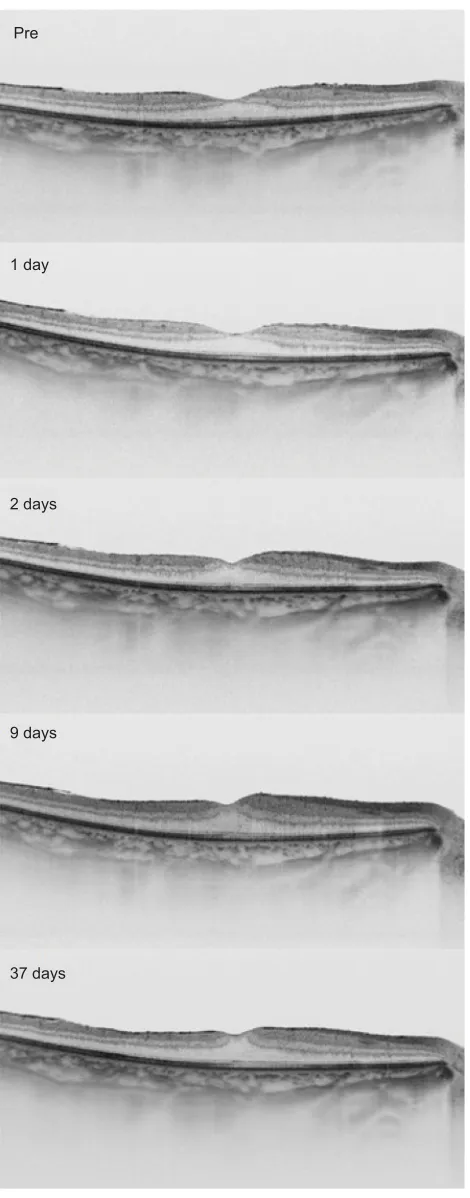
The sequential horizontal cross-sectional SS-OCT images during the follow-up period are shown in Figure 4. The preoperative OCT image showed that the foveal contour was normal. After the surgery, the parafoveal thickness was increased, and the foveal contour became steeper.
Figure 1 Sequential retinal surface maps (left) and the optical coherence tomography angiography images showing the foveal avascular zone in the superficial (center) and
Pre
1 day
2 days
9 days
37 days
Figure 3 The retinal surface map (top left), optical coherence tomography angiography images showing foveal avascular zone in the superficial and deep plexuses (top right), and horizontal cross-sectional swept-source optical coherence
0.4
0.3
0.2
0.1
0
0 5 10 15
Follow-up (day)
Superficial
FA
Z area (mm
2)
20 25 30 35 40
Figure 2 Postoperative decrease of the FAZ area in the superficial plexus can be fit
by a hyperbolic function of y=0.336−0.138*x/(1.634+x).
Note:R2=0.993.
Abbreviation: FAZ, foveal avascular zone.
International Medical Case Reports Journal downloaded from https://www.dovepress.com/ by 118.70.13.36 on 24-Aug-2020
Dovepress Decrease of FAZ area after ILM peeling
Figure 4 The horizontal cross-sectional swept-source optical coherence tomography images at each visit.
Note: Preoperative image with a thin epiretinal membrane is shown at the top, then the images 1 day, 2 days, 9 days, and 37 days after the surgery are shown sequentially to the bottom.
Pre
1 day
2 days
9 days
37 days
The thicknesses of the different retinal layers preop-eratively and at day 37 postoppreop-eratively determined by the horizontal (top) and vertical lines (bottom) at 500 μm from the foveal center are shown in Figure 5. The thicknesses of the RNFL, GCIPL, and INL were increased postoperatively.
Discussion
We presented a case in which the FAZ area decreased and the parafoveal inner retina thickness increased after the vit-rectomy with ILM peeling on an eye with a thin ERM and a normal foveal contour. There are three possible causes for the decrease of the FAZ area.
First, the release of the traction by the ERM may have caused the decrease. The preoperative surface maps showed that the parafoveal region was thicker in the affected eye than in the normal fellow eye although the foveal contour was normal. In addition, the FAZ area of the affected eye was similar in size with that of the normal fellow eye. It is possible that the thin ERM had influenced the parafoveal thickness, but the FAZ size and the foveal center thickness were unaffected. Thus, it seems unlikely that the release of the traction caused the decrease in the FAZ size.
Second, a growth of the capillaries toward the foveal center may have occurred after the ILM peeling. During the development of the human retina, the area of the FAZ is demarcated before the foveal pit forms. The FAZ is first observed at 26 weeks of gestation, and no vessel overgrowth is observed until birth. The FAZ area expands to the adult size of 500–700 μm at 15 months after birth as the foveal pit widens by remodeling.12 No vessel overgrowth is observed
during this process. It is less likely that an extension of the capillaries inside the FAZ occurs postnatally even after sur-gical procedures.
Third, the surgical procedures, ie, the vitrectomy and the ILM peeling, may have caused the FAZ area to decrease in size. Although it is difficult to distinguish the effects of each procedure, the surgical procedures may be partly responsible for the FAZ area decrease. The increase in the parafoveal inner retinal thicknesses may be due to a transient subclinical macular edema resulting from the ILM peeling.
The ILM peeling may cause a centripetal movement of the parafoveal inner retinal layer. The foveal capillaries run in the inner retinal layers, and the capillary network at the foveal margin forms the FAZ border. The capillary network delineating the FAZ border may have moved centripetally along with the inner retinal layers. This suggestion may also help explain the postoperative increase in the parafoveal thickness.
International Medical Case Reports Journal downloaded from https://www.dovepress.com/ by 118.70.13.36 on 24-Aug-2020
Dovepress
Kumagai et al
An inner retinal movement toward the foveal center would lead to a reduction in the FAZ area and cause more retinal cells to be packed in the parafoveal regions leading to an increase of the retinal thickness. In fact, the smaller FAZ area has been reported in other studies to be associated with an increase in the foveal thickness.5–6,7–11 Also, an increase
in the central macular thicknesses has been reported after ILM peeling in eyes treated for several macular diseases.13–18
One question raised from this possibility is why there is a centripetal retinal movement after ILM peeling. The ILM may have some intrinsic forces stretching the retina centrifugally, and the removal of ILM may eliminate such forces leading to a centripetal movement. Additional studies need to be performed to determine why this occurs.
The structural changes to the Mueller cells may be a key factor influencing the inner retinal movement. The Mueller cells extend vertically for the full thickness of the retina, except for the foveal center, and they stretch eccentrically from the foveal center to the parafoveal region.19 The
foot-plates of the Mueller cells form the ILM. Thus, the struc-tural changes in the Mueller cells after ILM peeling may be involved in the retinal movement.
The study has several limitations. First, the findings were made on only one eye. Thus, the examinations of a larger
number of patients are needed. Second, longer follow-up periods and further studies are needed to determine the effects on the functional outcomes.
In conclusion, we observed a single case where FAZ area decreased after vitrectomy with ILM peeling. It may indicate that surgery can affect the morphology of the inner retina. However, the exact mechanisms causing these changes were not determined from the results of this single case. Our findings demonstrate the ability of OCTA in providing en face images that can be used to analyze the changes in the inner retinal area including the FAZ. Further studies are needed to determine the underlying mechanisms for the retinal movements.
Acknowledgment
We thank Professor Emeritus Duco Hamasaki of the Bascom Palmer Eye Institute of the University of Miami, FL, for discussions and editing of this manuscript.
Disclosure
The authors report no conflicts of interest in this work.
References
1. Spaide RF, Klancnik JM Jr, Cooney MJ. Retinal vascular layers imaged by fluorescein angiography and optical coherence tomography angiog-raphy. JAMA Ophthalmol. 2015;133(1):45–50.
400 450
400 350 300 250 200 150 100 50 0 350
300
Horizontal temporal
(
µ
m)
Horizontal nasal
(
µ
m)
250 200 150 100 50 0
400 350 300
Ve
rtical superior
(
µ
m)
250 200 150 100 50 0
400 350 300
Ve
rtical inferior
(
µ
m)
250 200 150 100 50 0 Total RNFL GCIPL INL OPL ONL
Total RNFL GCIPL INL OPL ONL Total RNFL GCIPL INL OPL ONL
Total RNFL
Pre Post
Pre Post
GCIPL INL OPL ONL
Figure 5 The preoperative and the day 37 postoperative layer-by-layer retinal thicknesses in the horizontal (top) and vertical lines (bottom) at 500 μm from the foveal center.
Notes: The measurements on temporal, nasal, superior, and inferior points are shown.
Abbreviations: GCIPL, ganglion cell–inner plexiform layer; INL, inner nuclear layer; ONL, outer nuclear layer; OPL, outer plexiform layer; RNFL, retinal nerve fiber layer.
International Medical Case Reports Journal downloaded from https://www.dovepress.com/ by 118.70.13.36 on 24-Aug-2020
Dovepress
International Medical Case Reports Journal
Publish your work in this journal
Submit your manuscript here: https://www.dovepress.com/international-medical-case-reports-journal-journal
The International Medical Case Reports Journal is an international, peer-reviewed open-access journal publishing original case reports from all medical specialties. Previously unpublished medical post-ers are also accepted relating to any area of clinical or preclinical science. Submissions should not normally exceed 2,000 words or
4 published pages including figures, diagrams and references. The manuscript management system is completely online and includes a very quick and fair peer-review system, which is all easy to use. Visit http://www.dovepress.com/testimonials.php to read real quotes from published authors.
Dove
press
Decrease of FAZ area after ILM peeling
2. Yu J, Jiang C, Wang X, et al. Macular perfusion in healthy Chinese: an optical coherence tomography angiogram study. Invest Ophthalmol Vis Sci. 2015;56(5):3212–3217.
3. Laatikainen L, Larinkari J. Capillary-free area of the fovea with advanc-ing age. Invest Ophthalmol Vis Sci. 1977;16(12):1154–1157. 4. Grunwald JE, Piltz J, Patel N, Bose S, Riva CE. Effect of aging on
retinal macular microcirculation: a blue field simulation study. Invest Ophthalmol Vis Sci.1993;34(13):3609–3613.
5. Gong D, Zou X, Zhang X, Yu W, Qu Y, Dong F. The influence of age and central foveal thickness on foveal zone size in healthy people. Ophthalmic Surg Lasers Imaging Retina.2016;47(2):142–148. 6. Samara WA, Say EA, Khoo CT, et al. Correlation of foveal avascular
zone size with foveal morphology in normal eyes using optical coher-ence tomography angiography. Retina. 2015;35(11):2188–2195. 7. Tick S, Rossant F, Ghorbel I, et al. Foveal shape and structure in a
normal population. Invest Ophthalmol Vis Sci. 2011;52(8):5105–5110. 8. Dubis AM, Hansen BR, Cooper RF, Beringer J, Dubra A, Carroll J.
Relationship between the foveal avascular zone and foveal pit morphol-ogy. Invest Ophthalmol Vis Sci. 2012;53(3):1628–1636.
9. Chui TY, Zhong Z, Song H, Burns SA. Foveal avascular zone and its relationship to foveal pit shape. Optom Vis Sci. 2012;89(5):602–610. 10. Chui TY, VanNasdale DA, Elsner AE, Burns SA. The association
between the foveal avascular zone and retinal thickness. Invest Oph-thalmol Vis Sci.2014;55(10):6870–6877.
11. Balaratnasingam C, Chae B, Remmer MH, et al. The spatial profile of macular pigments is related to the topological characteristics of the foveal avascular zone. Invest Ophthalmol Vis Sci. 2015;56(13):7859–7865.
12. Provis JM, Hendrickson AE. The foveal avascular region of developing human retina. Arch Ophthalmol. 2008;126(4):507–511.
13. Christensen UC, Krøyer K, Sander B, Jorgensen TM, Larsen M, la Cour M. Macular morphology and visual acuity after macular hole surgery with or without internal limiting membrane peeling. Br J Ophthalmol. 2010;94(1):41–47.
14. Lee JW, Kim IT. Outcomes of idiopathic macular epiretinal membrane removal with and without internal limiting membrane peeling: a com-parative study. Jpn J Ophthalmol. 2010;54(2):129–134.
15. Kumagai K, Furukawa M, Ogino N, Larson E. Possible effects of internal limiting membrane peeling in vitrectomy for macular vein occlusion. Jpn J Ophthalmol. 2010;54(1):61–65.
16. Kumagai K, Ogino N, Furukawa M, et al. Retinal thickness after vit-rectomy and internal limiting membrane peeling for macular hole and epiretinal membrane. Clin Ophthalmol. 2012;6:679–688.
17. Chang S. Controversies regarding internal limiting membrane peeling in idiopathic epiretinal membrane and macular hole. Retina.2012;32 Suppl 2:S200–S203; discussion S203–S204.
18. Purtskhvanidze K, Treumer F, Junge O, Hedderich J, Roider J Hil-lenkamp J. The long-term course of functional and anatomical recovery after macular hole surgery. InvestOphthalmol Vis Sci. 2013;54(7):4882–4891.
19. Spaide RF. Closure of an outer lamellar macular hole by vitrectomy: hypothesis for one mechanism of macular hole formation. Retina. 2000;20(6):587–590.
International Medical Case Reports Journal downloaded from https://www.dovepress.com/ by 118.70.13.36 on 24-Aug-2020