Article
Serrated flow behavior of hot-rolled Fe-6.5wt.%Si
sheet with layered structure
Xiangju Shi 1, Yongfeng Liang 1, Binbin Liu 1, Zhiyi Ding 2, Bao Zhang 1, and Feng Ye 1,*
1 State Key Laboratory for Advanced Metals and Materials, University of Science and Technology Beijing,
Beijing, China; [email protected] (X.S.); [email protected] (Y.L.); [email protected] (B.L.); [email protected] (B.Z.)
2 Department of Mechanical Engineering, The Hong Kong Polytechnic University, Hong Kong, China;
[email protected] (Z.D.)
* Correspondence: [email protected]; Tel.: +86-10-6233-3899 (F.Y.)
Abstract: The microstructures and mechanical properties of the hot-rolled Fe-6.5wt.%Si sheet are analyzed. The microstructure of the hot-rolled sheet is layered along the thickness direction. The surface exhibits fine and equiaxed grains, whereas the center part shows coarse and elongated grains with a <101> fiber texture along the rolling direction. Serrated flow behavior is observed during tensile deformation of both the hot-rolled sheet and its center samples at 350 °C; thus, the serrated flow of the hot-rolled sheet is mainly attributed to the serration of the center part. The analyses of dislocation configurations, ordered structures, and crystal orientation show that the serrated flow behavior results from the interaction of solutes with mobile dislocations. Mobile dislocations are pinned by combining parallel forest dislocations with the pipe diffusion of solution atoms. This study provides a new perspective for the deformation mechanism of the Fe-6.5wt.%Si alloy.
Keywords: Fe-6.5wt.%Si alloy; serrated flow; forest dislocation; pipe diffusion; mobile dislocation; layered microstructure
1. Introduction
Fe-6.5wt.%Si alloy exhibits excellent soft magnetic properties, such as high permeability, low coercivity, and near-zero magnetostriction, which result in favorable application of this alloy in high-frequency transformers [1,2]. However, its intrinsic brittleness and poor formability resulting from the ordered phases (B2 and D03 ordered structures) limit the fabrication of Fe-6.5wt.%Si alloy sheets by the conventional casting-rolling process, which hinders the development and application of the alloy [3–5].
The formability of the hot-rolled sheet can be enhanced by warm deformation [6,7]. Recently, Li et al. [7] found that the warm deformation may induce work softening by the deformation-induced disordering and dynamic recovery. Liang et al. [6] fabricated the alloy sheet by hot–warm–cold rolling. Accordingly, warm deformation is significant for deformation mechanism research and preparation of the alloy.
During warm deformation, serrated flow behavior is usually accompanied by repetitive yielding and plastic instability in the stress–strain curves [8]. Some special deformation mechanisms and the structural evolution during deformation can be reflected by the serration characteristics. Therefore, the serrated flow behavior is of great theoretical value for plastic deformation, which has attracted wide attention and interest. The serrated flow behavior has been found in materials such as aluminum alloys, magnesium alloys, bulk metallic glass, TRIP-assisted steel, and China low-activation martensitic steel [8–13].
The Fe-6.5wt.%Si alloy is a body centered cubic (BCC) alloy together with B2 (FeSi) or D03 (Fe3Si) ordered structures[14]. Recently, Honjo et al. [15–17] studied the serrated plastic flow of L12-type ordered intermetallics, including Ni3(Si, Ti), Ni3Al, and Co3Ti alloys, at intermediate
temperature. The activation energy of pipe diffusion in the dislocation core is very close to the activation energy of the serrated plastic flow. However, the serrated flow behavior in the Fe-6.5wt.%Si alloy has not been widely investigated. Fu et al. [18,19] observed serrated plastic flow during warm deformation in the elongated-grained Fe-6.5wt.%Si alloy obtained by directional solidification. They revealed that the deformation twinning is responsible for the serrated flow behavior. However, it is not clear whether the serrated flow behavior in the elongated-grained Fe-6.5wt.%Si alloy fabricated by rolling occurs. The mechanisms of serrated flow in Fe-6.5wt.%Si alloy need to be further discussed and analyzed.
In this study, the microstructures and tensile deformation behavior of hot-rolled Fe-6.5wt.%Si alloy were investigated. Serrated flow behavior during tensile deformation was observed. The layered structure of the hot-rolled Fe-6.5wt.%Si alloy provided sound evidence that the grain morphology, degree of order, and orientation can result in varied deformation behavior. The results are expected to provide a theoretical supplement for the serrated flow behavior and deformation mechanism of the Fe-6.5wt.%Si alloy.
2. Materials and Methods
A flat ingot of Fe-6.5wt.%Si alloy with a thickness of 90 mm was fabricated by melting pure iron (99.5 wt.%) and metallic silicon (99 wt.%) in a vacuum induction furnace. The chemical composition is listed in Table 1. After homogenization at 1100 °C for 5 h, the flat ingot was directly hot rolled into sheets with a thickness of 2.5 mm in the temperature range of 900–1100 °C (rolling reduction 97%).
Table 1. Chemical composition of Fe-6.5wt.%Si alloy (wt.%).
Si C Mn P S Fe
6.47 0.0052 0.019 0.005 0.0019 Bal
The microstructures and crystallographic orientation were detected by an electron backscattered diffraction (EBSD) detector in scanning electron microscopy (SEM, ZEISS SUPRA 55). High-temperature tensile samples with a thickness of 0.5 mm were cut from the surface and center of the hot-rolled sheet. The sampling position corresponds to the rectangular region in Fig. 1. The tensile axis of the samples was parallel to the rolling direction. Tensile properties were tested by DDL-50 electronic universal testing machine at 350 and 450 °C with a strain rate of 5×10⁻⁴ s−1. The fracture surface was observed by SEM (ZEISS SUPRA 55).
3. Results
3.1. Grain morphology and orientation of the hot-rolled sheet
Figure 1 shows grain morphology and orientation of the hot-rolled sheet. A significant difference in orientations and grain morphology is visible along the thickness direction, namely, the normal direction (ND). The surface part was composed of equiaxed grains with random
orientations, and the size of the equiaxed grains was approximately 30 μm. For the center, the elongated grains with a strong <101> fiber texture along the rolling direction were obtained, and the
width of the elongated grains was approximately 110 μm. A transition region between the surface
and center part consisted of elongated grains with a <001> fiber texture.
Figure 1. Orientation imaging of the hot-rolled sheet. A color coded map referred to the rolling direction is shown on the lower right side. (RD: rolling direction; ND: normal direction of the rolled plane).
3.2. Tensile properties and fracture morphology
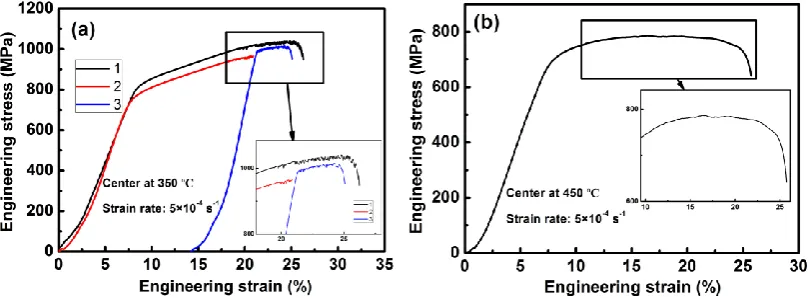
Figure 2 shows the tensile curves of the hot-rolled sheet with a thickness of 2.5 mm at 350 °C and 450 °C. Serrations appeared in the tensile curve at 350 °C after the ultimate tensile strength, as shown in Fig. 2a, whereas no serrations occurred at 450 °C (Fig. 2b). The serrated stress amplitude was approximately 30 MPa in the tensile curve at 350 °C, and the critical strain corresponding to the transition from stable to unstable flow is approximately 18.2%.
Figure 2. Tensile curve of the whole sample and partial enlarged detail at (a) 350°C and (b) 450°C.
Because the microstructure of the hot-rolled sheet was not homogenous, as shown in Fig. 1, tensile properties of the surface and center part were tested to analyze the origin of the serrated plastic flow. For the surface and center tensile samples, the sampling position corresponds to the rectangular region in Fig. 1.
flow behavior still occurred in the re-loading process, as shown in the curve 3 in Fig. 3a. At 450 °C, nearly no serration appeared in the tensile curve, as shown in Fig. 3b. For the surface sample, the tensile curve was smooth during deformation at 350 °C, and no serrated flow appeared, as shown in Fig. 4.
Figure 3. Tensile curves of the center sample at (a) 350 °C (Curve 1: tensile curve, Curve 2: loaded curve before the critical strain of the serrated flow, Curve 3: reloaded curve) and (b) 450 °C.
Figure 4. The tensile curve of the surface at 350 °C.
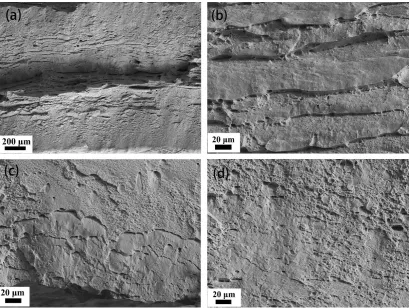
Figure 5. Tensile fracture morphologies of the Fe-6.5wt.%Si alloy at 350 and 450 °C. (a) Whole sample at 350 °C; (b) Center sample at 350 °C; (c) Center sample at 450 °C; (d) Surface sample at 350 °C.
3.3. Orientation variation during warm deformation
The crystallographic orientation of the loaded center samples at the critical strain and after tensile fracture (corresponding to Curve 2 and Curve 1 in Fig. 3a) was observed by EBSD, as shown in Fig. 6 and 7. Some new orientations emerged during serrated flow deformation (Fig. 7), and a slight turn in the grain orientation existed during deformation (Fig. 6 and 7). The elongated grains with a strong <101> fiber texture along the rolling direction were observed (Fig. 6b and 7b). The average misorientation angle between adjacent grains was approximately 8°, and the grain boundaries were straight.
Figure 7. Microstructures of tensile-finished center samples. (a) EBSD orientation map at 350 °C; (b) Inverse pole figure.
3.4. Variation of dislocation configurations during warm deformation
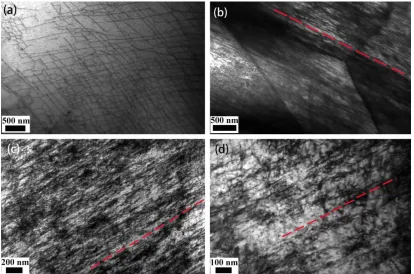
The center samples of the hot-rolled sheet before the tensile test were analyzed by TEM, as shown in Fig. 8a. The dislocation density was relatively low, and the dislocation configuration basically exhibited the shape of the network before tensile tests.
Figure 8b shows the dislocation configuration of loaded center sample (corresponded to Curve 2 in Fig. 3a) before the critical strain at 350 °C. The density of dislocations increased compared with that observed in Fig. 8a. Dislocations were mostly parallel to each other. Dislocations were not markedly piled up, and some dislocations passed through subgrain boundaries. Figures 8c, d show the dislocation configurations of the center samples after tensile tests at 350 °C. A large number of dislocations accumulated, forming approximately parallel forest dislocations.
During the tensile deformation, the dislocation density gradually increased and dislocations gradually piled up, forming areas of forest dislocations parallel to each other.
4. Discussion
4.1. Cause of the serrated flow
During the tensile tests at 350 °C, serrated flow did not appear in the surface sample (Fig. 4), whereas serrated flow was observed in the center sample (Fig. 3a). Therefore, the serrated flow of the hot-rolled sheet in Fig. 2 is attributed to the serration in the center part.
The serrated flow was considered to be related to the flow units in crystal materials, which are dislocations, plastic-deformation twins, adiabatic shear-softening bands, and even phase-transformation regions [20,21]. Adiabatic shear failure is one of the most important failure modes in metallic materials under impact loading. In terms of force and loading, tensile deformation is different from impact loading. Therefore, the possibility for adiabatic shear can be ruled out. According to the Fe–Si phase diagram [22], below 500 °C, there is no rapid phase transformation in Fe-6.5wt.%Si alloy. At a low temperature, the critical stress of twins is usually reached first, whereas at an intermediate temperature, dislocations are the flow units [20]. Therefore, the serrated flow behavior can be mainly related to deformation twinning or the interaction of solutes with dislocations.
According to the study of deformation twins of Fe-6.5wt.%Si alloy by Fu et al. [18,19], deformation twins tended to occur in grains with a tensile orientation near the <001> corner [18,19]. However, in this work, the orientation of the center samples was near a <101> orientation (Fig. 1, 6, and 7), which is far from a <100> orientation; thus, deformation twins do not easily occur.
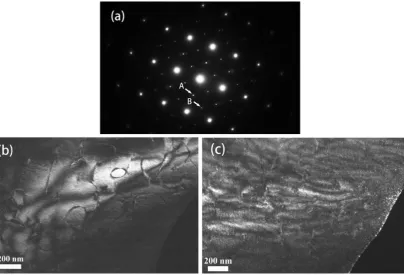
In addition, B2 and D03 ordered phases were observed in the center samples before deformation, as shown in Fig. 9. The B2 ordered domains are visible in the dark-field image by using the (200) superlattice reflection (Arrow A), and D03 ordered domains are visible by using the (111) superlattice reflection (Arrow B) [22]. The diffraction patterns in Fig. 9a indicate that there exist B2 and D03 ordered phases. It can be seen from Fig. 9b that the size range of B2 ordered domain is 200–400 nm. A smoothly curved anti-phase boundary (APB) can be clearly observed. Figure 9c is the dark-field image taken from the (111) diffraction spot. It is found that the D03 ordered domain is granular.
Figure 9. TEM micrographs before deformation. Arrow A designates g = 200 reflection, and arrow B designates g = 111 reflection. (a) SAED patterns along the [011] zone axis; (b) Dark-field image by using (200) diffraction spot; (c) Dark-field image by using (111) diffraction spot.
Furthermore, the results of the EBSD and TEM show that the deformation twins were not found in the center samples after tensile test at 350 °C, and thus the interaction of solutes and dislocations is probably the reason.
4.2. Mechanism and evolution of the serrated flow
The serrated plastic flow associated with dislocations is expected to take place, when the velocity of solute diffusion is identical to the velocity of mobile dislocations [17,24]. Before the critical strain, dislocations are not piled up. The average speed of dislocation may be higher than the diffusion velocity of solutes atoms. With the increase in strain, on the one hand, the dislocation density increases and dislocations are piled up highly, so that the velocity of mobile dislocations decreases. On the other hand, the increase in dislocation density leads to a large number of vacancies and diffusion channels [25], which further promotes the pipe diffusion and segregation of solute atoms near parallel forest dislocations (Fig. 8c and d). At the critical strain in the tensile curve at 350 °C (Fig. 3a), the velocity of solute diffusion is identical to the velocity of mobile dislocations.
According to observation of the dislocation configurations during tensile deformation, forest dislocations parallel to each other are formed in the center samples with the low-angle grain boundary (Fig. 7 and Fig. 8). The dislocation configurations are similar to those (thick dislocation walls or nearly parallel vein structures indicating localized slip) in single crystals of Al0.3CoCrFeNi high-entropy alloy [26] and NiAl alloy [27] in the study of the serrated flow. The dislocation slip distance of coarse elongated grains with low angle or single crystals in the center is longer than that of fine equiaxed grains in the surface. The dislocations in the elongated grains tend to be uniform and nearly parallel in slip plane. As a result, serrations take place as a mobile dislocation interacts with these parallel dislocations during deformation.
motion in the distortion field causes some strengthening in the intersection points between mobile and forest dislocations (Fig. 10a, b). As the deformation continues, the stress increases. Finally, the mobile dislocations are free from pinning due to the increasing stress, and there is an instantaneous increase in the mobile dislocation density (Fig. 10c). The stress begins to relax [25]. As the mobile dislocations continue to move forward, they are hindered by the next forest dislocation (Fig. 10c).
Figure 10. The evolution of the serrated flow. (a) Mobile dislocations are hindered by forest dislocations; (b) Solute atoms (red dots) move along the dislocation line toward the mobile dislocation; (c) Mobile dislocations are free from pinning.
5. Conclusions
The microstructures and tensile deformation behavior of hot-rolled Fe-6.5wt.%Si alloy were investigated.
(1) The hot-rolled Fe-6.5%Si sheet exhibits a layered structure along the thickness direction. The surface part is composed of equiaxed grains, whereas the center part shows elongated grains with a <101> fiber texture parallel to the rolling direction.
(2) Serrated flow behavior occurs in both the hot-rolled sheet and its center region sample at 350 °C, whereas serrated flow does not appear in the surface sample. Therefore, the serrated flow of the hot-rolled sheet is attributed to the serration in the center sample. Based on analyses of the microstructures, it can be deduced that the serrated flow behavior may be caused by the interaction of solutes and mobile dislocations.
Author Contributions: Xiangju Shi conceived, designed and performed the experiments; Bao zhang contributed to the EBSD work; Binbin Liu contributed to ideas and intensive discussions. Xiangju Shi wrote the manuscript; Feng Ye, Yongfeng Liang, and Zhiyi Ding supervised the work.
Acknowledgments: Financial supports from the National Natural Science Foundation of China (51471031, U1660115), the State Key Laboratory for Advanced Metals and Materials (2016Z-17), and the Program of Introducing Talents of Discipline to Universities (No. B07003) are gratefully acknowledged.
References
1. Ouyang, G.; Chen, X.; Liang, Y.; Macziewski, C.; Cui, J. Review of Fe-6.5 wt% Si high silicon steel—A promising soft magnetic material for sub-kHz application. J. Magn. Magn. Mater.2019, 481, 234-250. 2. Phway, T.P.P.; Moses, A.J. Magnetostriction trend of non-oriented 6.5% Si–Fe. J. Magn. Magn. Mater.2008,
320, e611-e613.
3. Raviprasad, K.; Tenwick, M.; Davies, H.A.; Chattopadhyay, K. The nature of ordered structures in melt spun iron-silicon alloys. Scripta Metall. Mater.1986,20, 1265-1270.
4. Matsumura, S.; Oyama, H.; Oki, K. Dynamical behavior of ordering with phase separation in off-stoichiometric Fe3Si alloys. Mater. T. JIM 1989,30, 695-706.
5. Matsumura, S.; Tanaka, Y.; Koga, Y.; Oki, K. Concurrent ordering and phase separation in the vicinity of the metastable critical point of order–disorder transition in Fe–Si alloys. Mater. Sci. Eng. A 2001, 312, 284-292.
6. Liang, Y.F.; Ye, F.; Lin, J.P.; Wang, Y. L.; Chen, G.L. Effect of annealing temperature on magnetic properties of cold rolled high silicon steel thin sheet. J. Alloy. Compd.2010, 491, 268-270.
7. Li, H.; Liang, Y.F.; Yang, W.; Ye, F.; Lin, J.P.; Xie, J.X. Disordering induced work softening of Fe–6.5 wt% Si alloy during warm deformation. Mater. Sci. Eng. A2015, 628, 262-268.
8. Fu, S.; Cheng, T.; Zhang, Q.; Hu, Q.; Cao, P. Two mechanisms for the normal and inverse behaviors of the critical strain for the Portevin–Le Chatelier effect. Acta Mater.2012, 60, 6650-6656.
9. Cai, Y.L.; Yang, S.L.; Wang, Y.H.; Fu, S.H.; Zhang, Q.C. Characterization of the deformation behaviors associated with the serrated flow of a 5456 Al-based alloy using two orthogonal digital image correlation systems. Mater. Sci. Eng. A2016, 664, 155-164.
10. Min, J.; Hector Jr, L.G.; Zhang, L.; Sun, L.; Carsley, J.E.; Lin, J. Plastic instability at elevated temperatures in a TRIP-assisted steel. Mater. Design2016, 95, 370-386.
11. Sun, B.A.; Liu, C.T.; Yang, Y. Rate dependence of serrated flow and its effect on shear stability of bulk metallic glasses. J. Iron Steel Res. Int.2016, 23, 24-30.
12. Wang, W.H.; Wu, D.; Shah, S.S.A.; Chen, R.S.; Lou, C.S. The mechanism of critical strain and serration type of the serrated flow in Mg–Nd–Zn alloy. Mater. Sci. Eng. A2016, 649, 214-221.
13. Xu, Z.; Shen, Y. Serrated flow and work-hardening behavior of China low activation martensitic steel (CLAM). Metals2018, 8, 413.
14. Wen, S.; Xue, S.; Han, C.; Liu, B.; Liang, Y.; Ye, F. Fabrication technology and material characterization of hot rolled cylindrical Fe-6.5 wt.% Si bars. Metals2018, 8, 371.
15. Honjo, H.; Kaneno, Y.; Inoue, H.; Takasugi, T. Plastic flow instabilities of L1 2 Ni 3 Al alloys at intermediate temperatures. J. Mater. Sci.2004, 39, 3677-3681.
16. Honjo, H.; Kaneno, Y.; Inoue, H.; Takasugi, T. Plastic Flow Instabilities of L1 2 Ni 3 (Si, Ti) Alloys at Intermediate Temperature. J. Mater. Res.2002, 17, 705-711.
17. Takasugi, T.; Honjo, H.; Kaneno, Y.; Inoue, H. Plastic flow instabilities of L12 Co3Ti alloys at intermediate temperatures. Acta Mater. 2002,50, 847-855.
18. Fu, H.; Zhang, Z.; Jiang, Y.; Xie, J. Applying the grain orientation dependence of deformation twinning to improve the deformation properties of an Fe-6.5 wt% Si alloy. J. Alloy. Compd.2016, 689, 307-312.
19. Xie, J.; Fu, H.; Zhang, Z.; Jiang, Y. Deformation twinning feature and its effects on significant enhancement of tensile ductility in columnar-grained Fe–6.5 wt.% Si alloy at intermediate temperatures. Intermetallics 2012, 23, 20-26.
20. Zhang, Y.; Qiao, J.W.; Liaw, P.K. A brief review of high entropy alloys and serration behavior and flow units. J. Iron Steel Res. Int.2016, 23, 2-6.
21. Zhang, Y.; Liu, J.P.; Chen, S.Y.; Xie, X.; Liaw, P.K.; Dahmen, K.A.; Wang, Y.L. Serration and noise behaviors in materials. Prog. Mater. Sci.2017, 90, 358-460.
22. Li, H.; Liang, Y.F.; Ye. F. Effect of heat treatment on ordered structures and mechanical properties of Fe-6.5 mass% Si Alloy. Mater. Trans.2015, 56, 759-765.
23. Cahn, R.W. Twinning in iron-aluminium alloys. Acta Metall.1961, 9 138-148.
24. Klose, F.B.; Ziegenbein, A.; Weidenmüller, J.; Neuhäuser, H.; Hähner, P. Portevin–LeChatelier effect in strain and stress controlled tensile tests. Comp. Mater. Sci.2003, 26, 80-86.
25. Rodriguez, P. Serrated plastic flow. B. Mater. Sci. 1984, 6, 653-663.
27. Weaver, M.L.; Kaufman, M.J.; Noebe, R.D. Manifestations of dynamic strain aging in soft-oriented NiAl single crystals. Metall. Mater. Trans. A1996, 27, 3542-3557.