Comparison of deterministic and stochastic approaches for
iso-topic concentration and decay heat uncertainty quantification on
elementary fission pulse
S. Lahaye1,a, T. D. Huynh1, and A. Tsilanizara1
1CEA Saclay, DEN, DM2S, SERMA, LLPR F-91191 Gif-sur-Yvette, France
Abstract.Uncertainty quantification of interest outputs in nuclear fuel cycle is an im-portant issue for nuclear safety, from nuclear facilities to long term deposits. Most of those outputs are functions of the isotopic vector density which is estimated by fuel cycle codes, such as DARWIN/PEPIN2, MENDEL, ORIGEN or FISPACT. CEA code systems DARWIN/PEPIN2 and MENDEL propagate by two different methods the uncertainty from nuclear data inputs to isotopic concentrations and decay heat. This paper shows comparisons between those two codes on a Uranium-235 thermal fission pulse. Effects of nuclear data evaluation’s choice (ENDF/B-VII.1, JEFF-3.1.1 and JENDL-2011) is in-spected in this paper. All results show good agreement between both codes and methods, ensuring the reliability of both approaches for a given evaluation.
1 Introduction
These last years, most of depletion code systems have introduced uncertainty propagation function-alities. CEA fuel cycle code systems used in this study have implemented two different methods. DARWIN/PEPIN2 [1] propagates uncertainties using deterministic first order forward perturbations through the INCERD supervisor while MENDEL [2, 3] uses Monte Carlo sampling with samples
created by CEA/DEN uncertainty platform URANIE [4].
Three nuclear data evaluations were used: ENDF/B-VII.1, JEFF-3.1.1 and JENDL-2011.
2 Depletion calculations
2.1 Concentrations and decay heat expressions
After an elementary fission pulse, the atom densityNi(t) of the different fission productsiis solution of the generalized Bateman equation when all neutronic reactions have been taken out:
dNi
dt (t) = −λiNi(t)+
N
j=1bj,iλjNj(t) ; Ni(0) = γi (1)
whereλi is the radioactive decay constant of fission producti,bj,i the radioactive decay branching ratio from jtoiandγithe independent fission yield generating fission producti. Independent fission yields correspond to initial concentration of fission products after the elementary fission pulse.
ae-mail: [email protected]
For any cooling timet, total decay heat DH is computed as displayed in equation (2), whereEiis the total radioactive decay energy released by nuclideidisintegration (sum ofα,βandγcomponents):
DH(t)=
i
EiλiNi(t) (2)
2.2 Uncertainty data
In this paper, we consider for radioactive decay constants, radioactive decay energies, radioactive decay branching ratios and independent fission yields all the uncertainty data available in each eval-uations (ENDF/B-VII.1, JEFF-3.1.1 and JENDL-2011). If physical parameters are not associated to nuclear data uncertainties in the considered evaluation, its value is considered known without uncer-tainty. Table 1 summarizes the available uncertainty data in different data sets and evaluations.
Table 1.Number of physical parameters which uncertainty is not equal to 0, in different data sets.
Decay Total Decay Ind. Fission Nb of isotopes
constant decay energy branching ratio yield (U235T) in decay chain
JEFF-3.1.1 3204 1554 505 918 3849
ENDF/B-VII.1 2233 1285 866 998 3820
JENDL-2011 867 653 590 1067 1142
3 Propagation of uncertainty data
3.1 Correlations between parameters
Two uncertain nuclear data from different parameters types are always considered uncorrelated, as well as two radioactive decay constants or radioactive decay energies or independent fission yields, as no physical correlation are given in evaluation files. For independent fission yields, this assumption will stop as soon as independent fission yields covariance matrices will be available.
Radioactive decay branching ratios corresponding to the different decay processes from the same father are correlated to assure a sum equal to 1, as described in section 3.2.
3.2 Deterministic method
The deterministic method used in DARWIN/PEPIN2 to calculate the propagation of uncertainty is
based on the first order Taylor series (linearity hypothesis). In the matrix form, the uncertainty of a variable Y due to the effect of uncertainties on variable X is given by the following formula (3):
Cov(Y)=SY/XCov(X)SYT/X (3)
where Cov(Y) (resp. Cov(X)) is the variance-covariance matrix of variableY(resp.X).SY/XandSTY/X are respectively the sensitivity matrix and its transposed matrix.
To take into account the correlation rj,k between radioactive decay ratio branches bi,j and bi,k from a given radioactive nuclidei, we introduce a unique correlation coefficientri between all ra-dioactive decay branching ratio from the same father isotopei, with respect of the physical constraint
N
j=1bi,j=1. It is deduced from equation (4):
Var ⎛ ⎜⎜⎜⎜⎜ ⎜⎝
N
j=1 bi,j
⎞ ⎟⎟⎟⎟⎟
Which leads to:
rjk=const=
−N
j=1Var(bi,j)
21≤j<k≤N
Var(bi,j)Var(bi,k)
(5)
The uncertainty propagation in DARWIN/PEPIN2 involves the supervisor module INCERD.
INCERD gathers all user’s data and uncertainties data of physical parameters and launches deple-tion calculating in parallel mode (using MPICH2/OPENMPI) to determine the sensitivity coefficient values (SY/X). Then, INCERD performs the uncertainty propagation as described by equation (3).
3.3 Stochastic method
The stochastic method implemented in MENDEL propagates the uncertainty on output data using sampled input data. For each uncertain nuclear data parameter, sampling is done using the CEA/DEN uncertainty platform URANIE.
Decay branching ratios cannot be sampled using the correlation factor from equation (5), as in-coherence in the evaluation data creates for ENDF/B-VII.1 and JENDL-2011 correlation coefficients outside [−1,1]. MENDEL assumes all standard deviations are equal for a given father isotope, which leads tori=−1/(N−1). All other parameters are sampled independently.
Radioactive decay energies, radioactive decay periods and radioactive decay branching ratios are considered to have positive Gaussian distribution (truncated) if their relative standard deviation is less than 50%, lognormal distribution if it is bigger. Due to large number of high relative standard deviation for fission yields, they are sampled by a lognormal distribution. Those assumptions enable to assure the positivity of the distributions and a good estimation of mean value and standard deviation.
All results shown in this paper result from a use of 2000 realisations.
4 Results and Discussion
4.1 Uncertainty quantification for decay heat
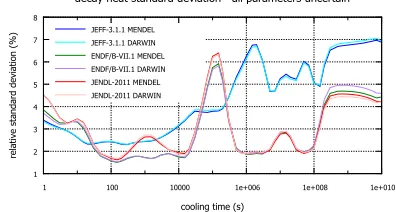
When propagating uncertainty data to total decay heat for the three nuclear evaluations,
DARWIN/PEPIN2 and MENDEL results both show a very good agreement, but also huge differences
between evaluations, as shown in figure 1.
Figure 1.Uncertainty quantification of decay heat due to all parameters.
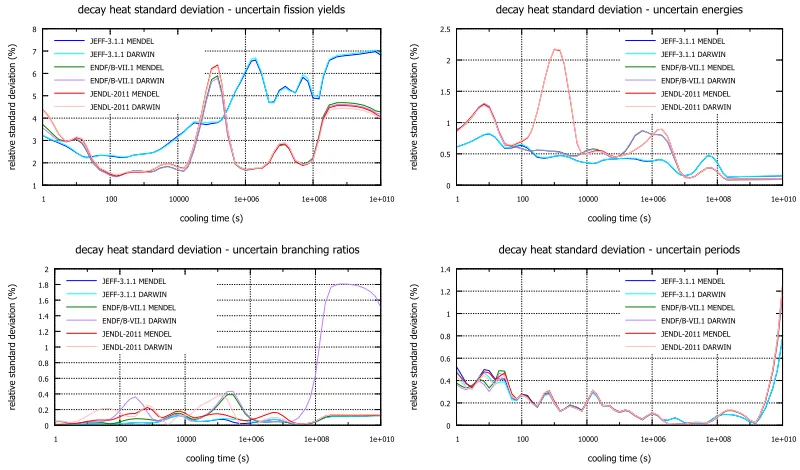
energies. Discrepancies are observed only for decay branching ratios, due to the differences in adopted correlations. This discrepancy can be important, as shown in the botom left of Figure 2.
Figure 2.Uncertainty quantification of decay heat due to each parameter parameters.
4.2 Uncertainty quantification for nuclide density
DARWIN/PEPIN2 and MENDEL were used in this study to propagate uncertainty data to isotopic
concentration of various fission products. Results are presented in this paper for Iodine-131 only but are representative of results for other nuclei. Uncertainty on Iodine-131 is due on independent fission yields (initial concentration), radioactive decay branching ratios and radioactive decay periods.
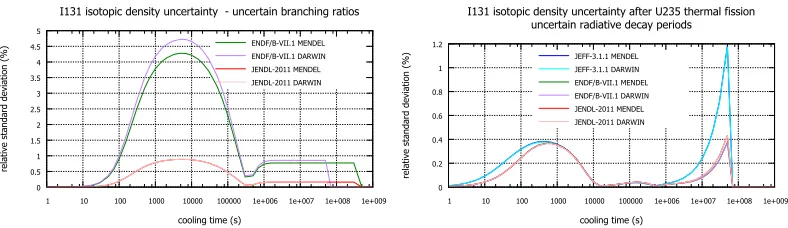
This work has been done assuming that uncertainty data not present in the evaluation corresponds to physical data known without uncertainty. This leads to no uncertainty of Iodine-131 concentration due to radioactive decay branching ratios for JEFF-3.1.1 in the bottom left of Figure 4.
Numerical precision effects can appear for when concentrations tends to 0 as MENDEL works in
double precision and DARWIN/PEPIN2 in simple precision. MENDEL results where truncated to
match DARWIN/PEPIN2 accuracy, but differences can still be seen for radioactive decay branching
ratios around 108s, when DARWIN/PEPIN2 goes down to zero before MENDEL.
5 Conclusion
This work validates DARWIN/PEPIN2 and MENDEL uncertainty quantification of isotopic
concen-trations for a Uranium-235 elementary thermal fission pulse.
The importance of differences between evaluations on uncertainty data leads several new needs
Figure 3. Uncertainty quantification of Iodine-131 concentration due to all parameters (left) and independent fission yields (left).
Figure 4.Uncertainty quantification of decay heat due to branching ratios (left) and periods (right).
JENDL-2011 radioactive decay branching ratios is needed to be able to use completely the data. Availability of covariances data on fission yields is expected, as well as the completion of uncertain data not present in the current evaluations.
Acknowledgement
The authors thank EDF and AREVA for their financial support to DARWIN/PEPIN2 and MENDEL
codes development.
References
[1] A. Tsilanizara et al., Nuclear Science Technology Supplement1, 845 (2000)
[2] S. Lahaye et al.,First Verification and Validation Steps of MENDEL Release V1.0 Cycle Code
System, inPHYSOR 2014(2014)
[3] A. Tsilanizara et al.,Probabilistic approach for decay heat uncertainty estimation using URANIE platform and MENDEL depletion code, inSNA+MC 2013(EDP Sciences, 2014)