ABSTRACT
PHILAR, GAUTAM R. Improving Memory Reclamation Techniques in Hypervisors using Persistent Memory. (Under the direction of Dr. Vincent W. Freeh.)
Virtualization is a core technology that enables cloud computing. Hypervisors enable virtual-ization by providing an abstraction layer for physical compute, storage and network resources. In
a virtual environment, physical memory of a system is also shared between the guest operating
systems. Hypervisor allows users to power on virtual machines with a total configured memory that exceeds the memory available on the physical machine. This is called memory overcommitment.
While this increases the consolidation ratio(VMs per machine) it can result in severe performance
degradation during low memory conditions. Currently used memory reclamation techniques like Ballooning and Transparent page sharing are limited and slow. They tend to degrade performance
of other VMs that are hosted on the same hypervisor.
Persistent Memories(PM) refer to a new class of hardware devices that promise to bridge the
gap between low-latency volatile DRAM and high-latency persistent HDDs/SSDs. They are
byte-addressable and can be directly connected to the memory bus of a processor. This enables the processor to access these devices through load/store operations just like physical memory. With
their near-memory like latency characteristics, PM devices can be used effectively as an intermediate
caching layer between fast main memory and slow hard disk drives.
In this dissertation, we propose the use of Persistent memory to alleviate performance issues in
hypervisors during low memory conditions. The main contributions of this work are (a)Persistent memory simulator using RAM (b)KVM-extension that migrates pages to and from the PM Zone
intelligently. To evaluate our proposal, we ran several micro and macro benchmarks and observed a
© Copyright 2015 by Gautam R. Philar
Improving Memory Reclamation Techniques in Hypervisors using Persistent Memory
by
Gautam R. Philar
A thesis submitted to the Graduate Faculty of North Carolina State University
in partial fulfillment of the requirements for the Degree of
Master of Science
Computer Science
Raleigh, North Carolina
2015
APPROVED BY:
Dr. Edward Gehringer Dr. Xipeng Shen
DEDICATION
BIOGRAPHY
Gautam R. Philar is a systems software engineer with background and interests in Virtualization and Cloud computing. Before enrolling as a full-time graduate student at North Carolina State
University, he worked in the Storage Area Network development team at NetApp in RTP. Prior to that,
he completed a graduate program in Information Systems from Carnegie Mellon University. After graduation, he intends to pursue an opportunity with Avere Systems, a Pittsburgh based startup
ACKNOWLEDGEMENTS
I would like to thank my advisor Dr. Vincent W. Freeh for his incisive guidance in the overall direction of this thesis. I would also like to thank Dr. Edward Gehringer and Dr. Xipeng Shen for taking time
TABLE OF CONTENTS
LIST OF TABLES . . . vii
LIST OF FIGURES. . . .viii
Chapter 1 Introduction. . . 1
Chapter 2 Motivation, Hypothesis and Contribution. . . 5
2.1 Motivation . . . 5
2.2 Hypothesis . . . 8
2.3 Contribution . . . 9
Chapter 3 Qemu-KVM Architecture . . . 10
3.1 Qemu Architecture . . . 12
3.1.1 Threading model . . . 12
3.1.2 libvirt layer . . . 14
3.1.3 virtio layer . . . 14
3.2 Kernel based virtual machine (KVM) . . . 15
3.2.1 Intel hardware assisted virtualization . . . 15
3.3 Interaction with underlying kernel . . . 18
Chapter 4 Design and Implementation . . . 19
4.1 Persistent Memory Simulator . . . 20
4.1.1 Memory Zones . . . 20
4.1.2 Modified Memory map . . . 21
4.1.3 Micro-benchmarks for PM simulator . . . 22
4.2 Qemu-Kvm extension . . . 24
4.2.1 Page fault handling . . . 24
4.2.2 Migrating pages from low priority queues . . . 25
4.2.3 Migrating entire low priority queues . . . 26
Chapter 5 Evaluation and Results . . . 28
5.1 Experimental Setup . . . 28
5.2 Performance tests . . . 29
5.2.1 Baseline ballooning - S0 . . . 29
5.2.2 Baseline hypervisor swap to disk - S1 . . . 29
5.2.3 Baseline hypervisor swap to PM - S2 . . . 30
5.2.4 Hypervisor swap of low priority pages to PM - S3 . . . 30
5.2.5 Hypervisor swap of low priority queues to PM - S4 . . . 30
5.2.6 Hypervisor swap of high priority queues to PM - S5 . . . 31
5.3 Results and Explanation . . . 31
5.3.1 Baseline Results . . . 31
5.3.2 Hypervisor swap to PM Vs Disk . . . 33
Chapter 6 Related Work . . . 36
6.1 PM aware filesystems . . . 36
6.2 PM programming . . . 37
Chapter 7 Conclusion and Future Work . . . 38
LIST OF TABLES
Table 4.1 Baseline system configuration . . . 22
Table 4.2 DRAM/PM Performance test configuration . . . 22
Table 4.3 Performance comparison DRAM and PM . . . 23
Table 5.1 Hardware Configuration . . . 28
Table 5.2 Test scenarios . . . 29
Table 5.3 Test scenarios Performance Results . . . 33
Table 5.4 Kernbench Configuration . . . 35
LIST OF FIGURES
Figure 1.1 Virtual memory mapping in a hypervisor . . . 2
Figure 1.2 Shadow Page table . . . 2
Figure 1.3 Hypervisor Memory Overcommitment . . . 4
Figure 2.1 Memory Ballooning . . . 6
Figure 3.1 Qemu processes . . . 11
Figure 3.2 Qemu Internals . . . 12
Figure 3.3 Intel VMX operations . . . 16
Figure 3.4 VMM Handling . . . 17
Figure 3.5 GVA to HPA conversion . . . 18
Figure 4.1 Modified Memory Map . . . 21
Figure 4.2 DRAM/PM Baseline . . . 23
Figure 4.3 Low priority Qemu queues . . . 27
Figure 5.1 Ballooning and HV-swap baseline . . . 31
Figure 5.2 Comparing run-times for different scenarios . . . 33
Figure 5.3 Qos control . . . 35
CHAPTER
1
INTRODUCTION
Server virtualization sofware enables several operating systems to run on a single physical server orhost as self-contained virtual machines(VMs) isolated from each other yet sharing thehost’s
physical resources. This server virtualization software that runs directly on the physical hardware is
called aHypervisororVirtual machine monitor(VMM).
The hypervisor intelligently manages physical resources like CPU, Memory, Network and Storage
among guest operating systems. In this thesis, we are primarily interested in memory virtualization. It involves sharing system memory and dynamically allocating it to virtual machines. Virtual machine
memory virtualization is similar to virtual memory support provided by modern operating systems.
Processes see a contiguous address space that is not necessarily tied to the underlying physical memory of the system. The operating system maintains mappings of virtual page numbers to
physical page frames in page tables. All modern CPUs include a memory management unit(MMU)
CHAPTER 1. INTRODUCTION
Figure 1.1: Virtual memory mapping in a hypervisor
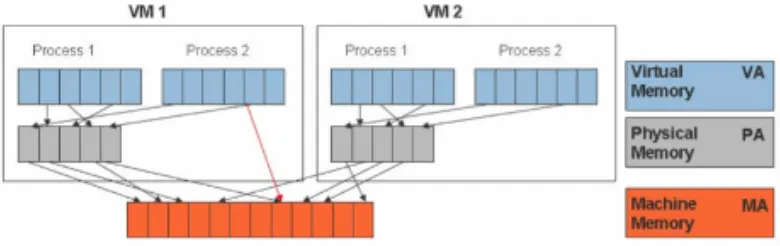
As shown in Figure 1.1[VMWare (2011)], to run multiple virtual machines on a single system, another level of memory virtualization is required. The MMU has to be virtualized in order to sup-port multiple guest OSes. Each guest OS continues to control the mapping of guest virtual memory
addresses to the guest physical memory addresses, but the guest OS cannot have direct access to
the actual machine memory also called the host physical memory. The hypervisor is responsible for mapping guest physical memory to the actual machine memory in a structure called shadow page
table. The hypervisor uses TLB hardware to accelerate guest virtual memory to host physical memory
translation and avoid the tedious two level translation -guest virtual address→guest physical address
→host physical addresson every memory access. When the guest OS changes its virtual memory to physical memory mapping, the hypervisor updates the shadow page tables to enable a direct lookup.
The following terminology is used throughout this thesis with their relationships illustrated.
CHAPTER 1. INTRODUCTION
1. Guest virtual memoryrefers to the continuous virtual address space presented by the guest OS to applications running inside the virtual machine.
2. Guest physical memoryrefers to the memory visible to the guest OS running in the virtual machine.
3. Guest physical memory is backed byHost physical memory, which means the hypervisor provides a mapping from the guest to the host memory.
4. Guest level pagingrefers to memory transfer between the guest physical memory and the guest swap device and is driven by the guest OS. The memory transfer between host physical memory and the host swap device is referred to asHypervisor swappingand is driven by the hypervisor.
As shown in Figure 1.2[VMWare (2011)], address translation between guest physical memory and host physical memory is maintained by the hypervisor using a per VM data structure called
pmap. The hypervisor intercepts all virtual machine instructions that manipulate the hardware TLB contents or guest OS page tables. The actual TLB state is updated based on a separate shadow page
table, which contains the guest virtual to host physical address mapping. The shadow page tables
maintain consistency with the guest OS page tables and thepmapdata structure. This reduces the two-level translation overhead because the hardware TLB will cache direct guest virtual address to
host physical address translations read from the shadow page tables. The extra level of indirection
of guest physical memory to host physical memory enables the hypervisor to easily remap a virtual machine’s host physical memory to other devices in a manner that is completely transparent to the
VM.
Hypervisors support overcommitment of physical resources thus enabling higher consolidation
ratios. A hypervisor is said to be memory-overcommitted when the total configured guest memory
size of all powered-on VMs exceeds the physical memory on the hypervisor. When a hypervisor is memory-overcommitted, it distributes physical memory fairly and efficiently among the powered-on
CHAPTER 1. INTRODUCTION
Figure 1.3: Hypervisor Memory Overcommitment
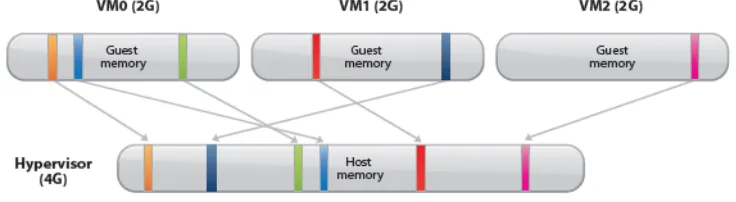
For instance in Figure 1.3[VMWare (2011)], hypervisor has only 4GB physical memory but is configured to support three virtual machines with 2GB guest physical memory each. Without mem-ory overcommitment, only one VM can be run considering that each guest VM has some memmem-ory
overhead. In order to effectively support memory overcommitment, the hypervisor must provide
efficient host memory reclamation techniques. In this thesis, we propose the use of emerging Non-volatile persistent memory to alleviate some of the performance issues observed during memory
CHAPTER
2
MOTIVATION, HYPOTHESIS AND
CONTRIBUTION
2.1
Motivation
Memory overcommitment is an extremely important feature of a hypervisor. If it is not supported,
the hypervisor needs to reserve enough host physical memory upfront to back all VMs’ guest physi-cal memory. This reduces the consolidation ratio which is a measure of the number of VMs that can
be configured on a physical server. A lower consolidation ratio means lower memory utilization.
Hence, memory overcommitment and efficient reclamation techniques form an important feature set of a commercially viable hypervisor.
Currently, most hypervisors support the following memory reclamation techniques.
1. Transparent Page Sharing: When multiple VMs are running, some of them may have identical sets of memory content. For example, several virtual machines may be running the same
guest operating system, have the same applications or contain the same user data. With TPS,
2.1. MOTIVATION CHAPTER 2. MOTIVATION, HYPOTHESIS AND CONTRIBUTION
is reduced and a higher degree of memory overcommitment is possible.
2. Ballooning: This is a technique where the hypervisor makes a guest operating system aware of the low memory status of the host. Due to the VM’s isolation, a guest OS is not aware
that it is running inside a VM. It is certainly not aware of the states of other VMs running on
the same host. When the amount of free host physical memory becomes low, none of the VMs will free guest physical memory because they cannot detect the host’s physical memory
shortage. A balloon driver loaded into the guest OS polls the hypervisor to obtain a target
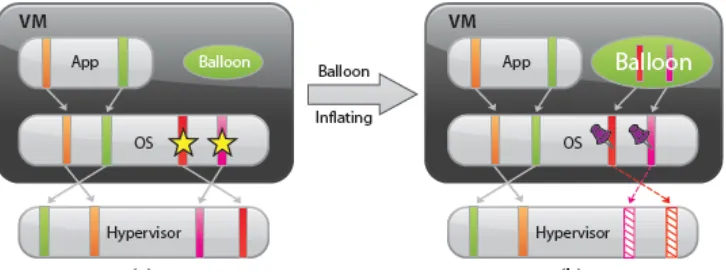
balloon size. If the hypervisor needs to reclaim guest physical memory, it sets the proper target balloon size for the balloon driver, making itinflateby allocating guest physical pages within the virtual machine. In Figure 2.1[VMWare Academic Program(2013)], four guest physical
Figure 2.1: Memory Ballooning
pages are mapped in the host physical memory. Two of the pages are being used by the guest application and the other two pages are in the guest OS’ free list. The hypervisor does not
have access to the guest OS’ free lists, so it cannot identify the pages that are in the free list. So
it cannot reclaim the host physical pages that are backing them. Consider that the hypervisor is running low of free physical pages and needs to reclaim 2 physical pages. It informs the
balloon driver that is polling constantly with the hypervisor. After obtaining the target balloon
size, the balloon driver allocates two guest physical pages inside the virtual machine and
pinsthem.Pinningis achieved through the guest OS which ensures that the pinned pages cannot be paged out to disk under any circumstances. Once the memory is allocated, the
2.1. MOTIVATION CHAPTER 2. MOTIVATION, HYPOTHESIS AND CONTRIBUTION
them because no further memory accesses to those pages will be generated by the guest OS.
3. Hypervisor swapping:At VM startup, the hypervisor creates a separate swap file for each VM. If necessary, the hypervisor directly swaps out guest physical memory to the swap file to
reclaim host memory. This technique is used as the last resort because it can severely degrade
performance of all VMs hosted on a hypervisor.
All the techniques discussed upto this point suffer from the following limitations.
1. Limits on the reclaimed memory size.
2. Slowness in reclaiming memory.
2.2. HYPOTHESIS CHAPTER 2. MOTIVATION, HYPOTHESIS AND CONTRIBUTION
2.2
Hypothesis
We hypothesize that Hypervisor swapping used in conjunction with emerging Non-volatile persistent
2.3. CONTRIBUTION CHAPTER 2. MOTIVATION, HYPOTHESIS AND CONTRIBUTION
2.3
Contribution
1. RAM backed Persistent Memory Simulator.
2. KVM-extension that migrates pages between PM Zone and DRAM intelligently.
CHAPTER
3
QEMU-KVM ARCHITECTURE
Qemu stands for quick emulation. It is an open source machine emulator and virtualizer. Qemu has two operating modes:
(1) Full system emulation : This mode provides full platform virtualization. In this mode, Qemu
emulates processor and various peripheral devices. This is the mode used throughout this project. (2) User mode emulation : This mode provides application level virtualization using dynamic
transla-tion. In this mode, programs made for one type of CPU (eg: ARM) can be run on a different machine
(x86) but the operating systems should be the same. We do not use this mode in this project.
When operated in full system emulation mode (virtualizer), Qemu can achieve near native
performance by executing guest operating system code directly on the host CPU using an in-kernel accelerator called Kernel based virtual machine(KVM). KVM executes some of the guest code
na-tively, while continuing to emulate the rest of the machine. Additionally, Qemu uses a full software
Memory Management Unit (MMU) to handle virtual to physical address translation at every memory access. A soft MMU is used to improve portability.
Mul-CHAPTER 3. QEMU-KVM ARCHITECTURE
tiple guests run alongside without knowledge of each other. Other user applications like browsers, email clients etc also compete for the same host resources as Qemu, although resource controls
can be used to prioritize qemu processes. When a guest operating system shuts down, the Qemu
process exits.
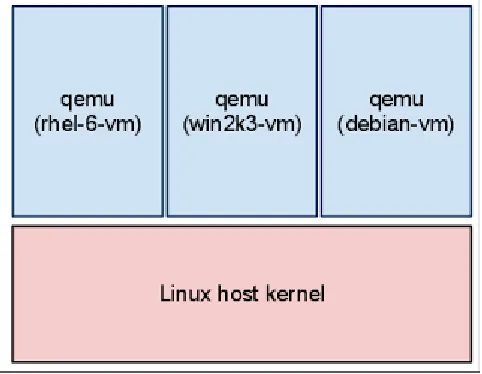
Figure 3.1[KVM Architecture Overview (2015)]shows 3 different guest OSes running in a Qemu environment.
Figure 3.1: Qemu processes
Since Qemu system emulation provides a full virtual machine inside the Qemu userspace process, the details of processes running inside the guest operating systems are not visible to the host. So in
Figure 3.1, details of processes running within the guest OSes are not available to the underlying
Linux kernel (also referred to as the host). In a nutshell, Qemu allocates a slab of guest RAM at startup, the ability to execute code and emulated hardware devices, so that any operating system
3.1. QEMU ARCHITECTURE CHAPTER 3. QEMU-KVM ARCHITECTURE
3.1
Qemu Architecture
3.1.1 Threading model
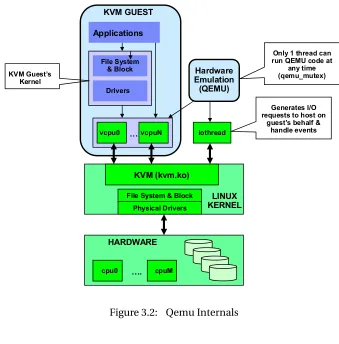
Qemu uses a hybrid model that combines event-driven programming with threads. Since an event loop alone is single threaded, it will not be able to utilize multiple cores. So it is used in conjunction
with threading that provides dedicated threads to perform certain functions. During configuration,
the number of virtual CPUs available to a guest OS can be specified. Each virtual CPU is emulated as a vCPU thread within the Qemu process. These vCPU threads execute simultaneously and have
to be synchronized with a global mutex lock. A separate ioThread runs an event loop to process asynchronous events like network packets and disk I/O and dispatches it to worker threads.
Figure 3.2[KVM Architecture Overview (2015)]shows the internal threading model of Qemu.
3.1. QEMU ARCHITECTURE CHAPTER 3. QEMU-KVM ARCHITECTURE
3.1.1.1 Event-driven Qemu core
Running a guest involves executing guest code, handling timers, processing I/O and responding to monitor commands. These are mostly asynchronous events that are handled by the Qemu core
thread. The Qemu core thread runs an event loop that listens for these events and dispatches to
event handlers. The event handlers can be dedicated worker threads that run independently on separate cores thus providing parallelism.
The Qemu core thread uses thepoll() system callto track actionable events. During initializa-tion, a set offile descriptorswith bitmaps indicatingeventsof interest is set. Thepoll() system call
examines these file descriptors for specifiedeventsand returns when those events have occurred. File descriptors play an important role because files, sockets, pipes and various other resources are
all file descriptors. Timers can also be tracked usingpoll().
When a file descriptor becomes ready or a timer expires, the event loop invokes acallbackthat responds to theevent. No blocking system calls or long-running computations are performed in the callbacksince this will impact the main event loop. If blocking system calls are required, they are dispatched as a work item to worker threads that execute them asynchronously.
3.1.1.2 Worker threads
Blocking system calls and long-running computations are not handled as callbacks. They are handled
by dedicatedworked threadsthat operate independent of core Qemu thread. The core Qemu thread places these type of requests on a queue.Worker threadstake requests off the queue and execute them outside of core Qemu. They may perform blocking operations or long-running computations
since they execute in their own threads and do not block core Qemu. Communication between worker threadsandcore Qemuhappens through file descriptors. A file descriptor is added to the event loop. When the worker thread writes to the file descriptor, core Qemu thread detects it and
invokes a callback that was registered earlier.
3.1.1.3 Guest code execution
Qemu leverages the KVM module to execute guest code natively. KVM takes advantage of hardware
virtualization extensions present in modern Intel and AMD CPUs for safely executing guest code
directly on the host CPU. vCPU threads start executing guest code and take away control from core Qemu thread. Any asynchronous event like READ or WRITE to emulated device registers causes
3.1. QEMU ARCHITECTURE CHAPTER 3. QEMU-KVM ARCHITECTURE
control to core Qemu from a thread executing guest code. Core Qemu then runs its event loop and processes any pending events.
3.1.1.4 IOthreads
IOthreads are specialized threads that do not execute guest code or core Qemu event-loop. They are
meant to wait for long-running work items that can be executed independently from core Qemu or guest code. These threads are meant to take advantage of multi-cores in an SMP environment.
3.1.2 libvirt layer
Libvirt is a framework that all commercial hypervisors implement so that any popular virtual
management tool like virsh or virt-manager can be used to manage virtual machines deployed on those hypervisors. It provides major functionalities like VM Management, Remote machine support,
Storage Management and Network interface management. KVM-Qemu uses the libvirt framework
so that any admin using the above mentioned tools will easily be able to deploy VMs.
3.1.3 virtio layer
Just like the libvirt layer, the virtio layer provides a standard way to access devices found in virtual
3.2. KERNEL BASED VIRTUAL MACHINE (KVM) CHAPTER 3. QEMU-KVM ARCHITECTURE
3.2
Kernel based virtual machine (KVM)
KVM is a linux kernel module that allows a user space program like Qemu to utilize the hardware
virtualization features of processors. In our test setup, KVM uses Intel’s virtualization technology(VT-x). While Qemu acts as theVMM, the kvm module needs to be loaded in-order to leverage hardware enabled acceleration. Qemu communicates with kvm as follows:
open ( "/dev/kvm" ) i o c t l (KVM_CREATE_VM)
i o c t l (KVM_CREATE_VCPU)
f o r ( ; ; ) {
i o c t l (KVM_RUN)
switch ( e x i t _ r e a s o n ) { case KVM_EXIT_IO :
case KVM_EXIT_HLT : }
}
As stated earlier, KVM is aninterfaceto the actual hardware support. In the next section, we explore Intel’s VT-x features.
3.2.1 Intel hardware assisted virtualization
Soft-MMU provides portability but has performance problems. Maintaining consistency between
guest page tables and host page tables through software on every memory access is a very CPU
intensive operation. Any memory access in a guest OS that changes its page table entries will need to be reflected in theshadow page tablesmaintained by the host kernel. This consistency is required in order to maintain a coherent view of the hardware TLB that is utilized by the processor for fast virtual address to physical address translations.
Processor support for virtualization is provided by a form of processor operation called VMX opera-tion. There are two types of VMX operations:
1. VMX root operation : A VMM will run in VMX root operation.
2. VMX non-root operation : A guest OS will run in VMX non-root operation. Processor behavior is restricted and modified to facilitate virtualization. Certain instructions and events cause VM
3.2. KERNEL BASED VIRTUAL MACHINE (KVM) CHAPTER 3. QEMU-KVM ARCHITECTURE
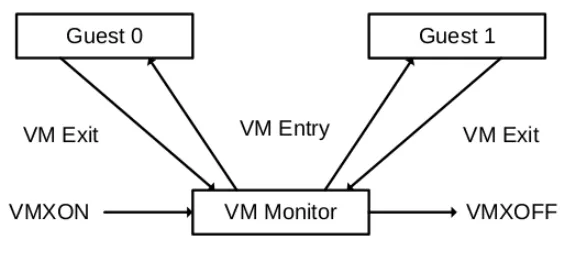
Transitions between these two operations are called VMX transitions. Transitions into VMX non-root operation are called VM entries and transitions from VMX non-root to VMX root are called VM exits.
Figure 3.3: Intel VMX operations
1. VMM discovers support for VMX operations during bootup and enters VMX root operation by
executing the VMXON instruction.
2. VMM then launches guest VMs using VMLAUNCH and VMRESUME instructions which causes
the VM entry transition. At this point guest OS starts executing natively on the processor.
3. A VM exit transition transfers control back to the VMM. The VMM can take appropriate action
to the cause of the VM exit and then return to the VM using a VM entry.
3.2. KERNEL BASED VIRTUAL MACHINE (KVM) CHAPTER 3. QEMU-KVM ARCHITECTURE
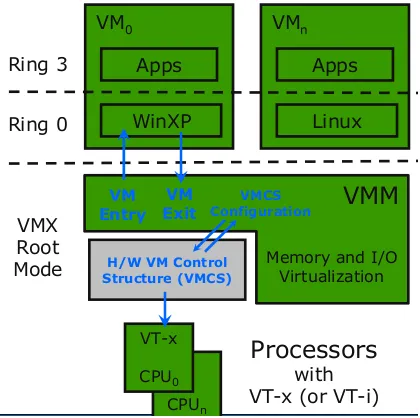
Figure 3.4: VMM Handling
VMM configures a data structure called virtual-machine control structure(VMCS) for each logical
processor(vCPU) per VM that it supports. This data structure is used to track VMX transitions. At
any given time, at most one of the active VMCSs is the current VMCS. The VMCS data structure is used to maintain context data likeguest-stateandhost-statewhich is used to load the processor state during VMX transitions.
VMX operations enable guest OSes to run directly on the hardware but that may still create excessive VMX transitions that impact performance. A way to reduce these transitions especially
during paging is through Extended page tables(EPT). Using EPT allows guest OS to maintain control
over legacy guest page tables and while VMM controls the EPT. The processor uses both these tables almost concurrently as follows:
3.3. INTERACTION WITH UNDERLYING KERNEL CHAPTER 3. QEMU-KVM ARCHITECTURE
Figure 3.5: GVA to HPA conversion
3.3
Interaction with underlying kernel
KVM leverages the standard linux operating system as a base. It runs as a kernel extension, so it can
CHAPTER
4
DESIGN AND IMPLEMENTATION
The central idea of this thesis is to demonstrate the use emerging byte-addressable persistent mem-ory(PM) to address performance issues encountered during memory reclamation in virtualized
environments. In chapters 1 and 2 we discussed some of the existing memory reclamation
tech-niques and their major drawbacks. In this chapter, we propose a solution that leverages persistent memory(PM) to alleviate performance bottlenecks during low memory conditions in hypervisors.
New device technologies like phase-change-memory(PCM), spin-transfer-torque RAM and memristors provide persistent storage at near DRAM latencies. These technologies are collectively
4.1. PERSISTENT MEMORY SIMULATOR CHAPTER 4. DESIGN AND IMPLEMENTATION
4.1
Persistent Memory Simulator
In designing a PM simulator, we had two design options.
1. Build the simulator as a loadable kernel module that created a RAM-backed/dev/pcm0 when
it was loaded. This involved using IOCTLS in Qemu to initialize and communicate with it.
2. Build the simulator as a KVM-extension. This meant no changes to Qemu code and limited changes to the memory management code in the base kernel.
We chose the second option since it provides a clean way to isolate and easily integrate oursimulator
code with the proposedmemory reclamationalgorithm. 4.1.1 Memory Zones
TheBIOSconveys the system memory map to the linux kernel through anE820 table. Each physical address range is associated with an address type that indicates how the physical address range is
supposed to be used by the OS. We added a new address range type calledAddressRangePM. This
address range will be used to create a ZONE_PM as described in the next section. This modification enables the OS to distinguish between system RAM and part of RAM that is used to simulate
persis-tent memory.
In aNon Uniform Memory Access(NUMA)architecture, memory is arranged into banks that incur a different cost to access depending on their distance from the processor. Each bank is referred to
as anodeand is is tracked by struct pg_data_t in the linux kernel code. In our case, the test setup isSymmetric Multi-processor(SMP)environment. Eachnodeis divided into a number of blocks calledzones, which represent ranges within memory. With x86 architecture, the followingzonesare available:
1. ZONE_DMA - First 16MiB of memory
2. ZONE_NORMAL - 16MiB to 896MiB (Kernel memory)
3. ZONE_HIGHMEM - 896MiB to end (User memory)
Eachzoneis represented by struct zone_t. The system’s memory is divided into fixed-size chunks calledpage framesthat are 4096 bytes in size. Each physical page frame is represented by struct page and stored in global array called mem_map at the beginning on ZONE_NORMAL i.e start of kernel
4.1. PERSISTENT MEMORY SIMULATOR CHAPTER 4. DESIGN AND IMPLEMENTATION
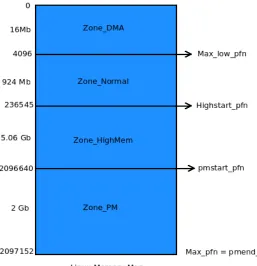
We introduce two global variables that are initialized along with the boot memory allocator. pmstart_pfnandpmend_pfnare initialized to create a new zone within ZONE_HIGHMEM. The entire address rangeAddressRangePMis in ZONE_PM.
4.1.2 Modified Memory map
Our test setup has 8GB physical memory. After creating ZONE_PM, the final memory map looks as follows:
Figure 4.1: Modified Memory Map
1. ZONE_DMA - First 16MiB of memory
2. ZONE_NORMAL - 16MiB to 896MiB (Kernel memory)
3. ZONE_HIGHMEM - 896MiB to 5956MiB (User memory)
4.1. PERSISTENT MEMORY SIMULATOR CHAPTER 4. DESIGN AND IMPLEMENTATION
Table 4.1: Baseline system configuration
System Quad core, 3.00 GHz
DRAM/PM 8GiB
Base OS type 64-bit Linux
Guest OS type 64-bit Ubuntu 14.04 LTS, 2 vCPUs Guest DRAM/PM 4 GiB
READ Latency 200ns
WRITE Latency 250ns
Table 4.2: DRAM/PM Performance test configuration
Name Workload Footprint Baseline VM Guest OS BS Bubble sort 1024 MB 4096 MB 64-bit Ubuntu QS Quick sort 1024 MB 4096 MB 64-bit Ubuntu
In our current setup,Page framesfrom2096640to2097152are used to simulate PM that is 2 GB in size.
4.1.3 Micro-benchmarks for PM simulator
For micro-benchmark performance testing, we compare performance of two popular sorting
algo-rithms with large datasets in DRAM and simulated Persistent Memory. For PM tests, we simulate asymmetric READ and WRITE latencies by adding an artificial delay of 200ns for READs and 250ns
for WRITEs. Our baseline system configuration is as shown in Table 4.1
4.1.3.1 Experimental setup
In our experiments, we compare performance of modified in-memory Quicksort and Binarysort, running in virtualized environment with the data being in DRAM and simulated Persistent Memory.
Each workload is executed with a 1GiB data set that is initially read into memory.
Table 4.2 shows our test configuration. The data is initially read from HDD into DRAM and simulated PM. Run-times are measured starting from after the data has been read into memory. All
subsequent READs and WRITEs are to the in-memory data structure used for sorting. All access to disk is ignored.qsortandbsortare executables running in the guest VM which is configured with enough memory. We try to limit the maximum memory footprint of both applications to 1024MB.
4.1. PERSISTENT MEMORY SIMULATOR CHAPTER 4. DESIGN AND IMPLEMENTATION
Table 4.3: Performance comparison DRAM and PM
Name DRAM Persistent Memory BS 2773 secs 3091 secs QS 2606 secs 2828 secs
4.1.3.2 Results
In-memory binary sort and quick sort can be considered to be CPU-intensive as well as
memory-intensive. Initially building up the data set in memory ensures that all further activity is limited to memory and there is no I/O activity. Our goal is to prevent any unwanted disk-latencies to creep into our analysis. After the initial burst of paging activity that is common to both scenarios, all
further processing is limited to the processors and memory. Persistent memory will be attached to
the memory bus and can be accessed by the processor just like a DIMM module. So simulating PM with RAM-backed pages is an ideal substitute.
Figure 4.2: DRAM/PM Baseline
The near-DRAM latencies provided by PM make it ideal for use as an alternative tier in the
4.2. QEMU-KVM EXTENSION CHAPTER 4. DESIGN AND IMPLEMENTATION
4.2
Qemu-Kvm extension
In this section, we discuss the design and implementation details of a KVM-extension that is used
to swap pages to and from the ZONE_PM. When there is memory pressure, pages are swapped into the ZONE_PM. Under normal load, pages backed by DRAM are used.
4.2.1 Page fault handling
Qemu enables the guest OS to execute natively on the CPU using KVM and VMX extensions. When Qemu is initially launched with a guest OS, it callsmalloc()and allocates memory for the VM. But
malloc()does a lazy allocation. It does not reserve physical backing store for themalloc’dmemory. So as the guest OS begins executing, it causes a page fault which causes a VM exit operation back to the VMM. Qemu leverages the underlying kernel’s page fault handler to allocate a physical page and
update the page tables. The code flow is as follows:
d o _ p a g e _ f a u l t ( ) ; handle_mm_fault ( ) ;
pmd_alloc ( ) ;
p t e _ a l l o c ( ) ;
h a n d l e _ p t e _ f a u l t ( ) ;
do_no_page ( ) ;
a l l o c _ p a g e ( ) {
s t r u c t page_t page ; page = p a g e _ a l l o c a t o r ( ) ;
i f( Qemu_low_pri_process ) {
enqueue ( low_pri_queue , page ) ; }
}
Initialize a global queue to track the physical frames being allocated to low priority Qemu
processes. These frames will not be added to LRU lists. When a page is not present in the EPT, there is a page fault and the page fault handler is invoked. As part of allocating a new page to this process,
insert this page in the global queue if this is a low pri Qemu process. Since at boot time, we have
4.2. QEMU-KVM EXTENSION CHAPTER 4. DESIGN AND IMPLEMENTATION
4.2.2 Migrating pages from low priority queues
Memory pressure builds up as processes use up available free page frames. This section focusses
on a new way to select old pages that can be freed and invalidated for new uses before physical
memory is completely exhausted. Currently, page replacement policy does not distinguish between processes. Any pages belonging to any process can be reclaimed. We modify this by introducing a
low priority queuethat tracks pages allocated to low priority Qemu processes. LRU-like algorithm is then run on this queue to reclaim pages.
During system startup, a kernel thread calledkswapdis started fromkswapd_init(), which continuously executes the functionkswapd(). We modify this function as follows:
s t a t i c i n t kswapd (void p ) { i f ( ! zone−>balanced ) {
move_inactive_pages_to_pm (&zone ) ; }
}
void move_inactive_pages_to_pm (s t r u c t zone_t zone ) { s t r u c t page_t page ;
s p i n _ l o c k _ i r q ( zone−>l p r i _ l o c k ) ;
while( s i z e ( low_pri_queue ) > 0 && p ag es _f r e ed ) { page = dequeue ( low_pri_queue ) ;
i f( page−>i s _ l o c k e d ( ) && page−>PG_launder ) { wait_on_page ( page−>page_id ) ;
continue; }
i f( page−>PG_dirty ) {
page−>PG_launder = 1 ;
page_PG_dirty = 0 ;
writepage ( page−>page_id ) ; }
copy_to_pm ( page ) ;
mmu_notifier_modify_pte ( ) ; s p i n _ l o c k _ i r q ( zone−>l r u _ l o c k ) ;
r e f i l l _ i n a c t i v e _ z o n e ( page ) ; s p i n _ u n l o c k _ i r q ( zone−>l r u _ l o c k ) ;
4.2. QEMU-KVM EXTENSION CHAPTER 4. DESIGN AND IMPLEMENTATION
}
s p i n _ u n l o c k _ i r q ( zone−>l p r i _ l o c k ) ; }
kswapdis woken by the physical page allocator whenpages_lownumber of free pages in a zone is reached. It frees up a certain number of pages and reschedules itself until it is woken up again.
This process continuous until the number of free pages reachespages_highfor that zone. Under extreme memory pressure, processes will do the work ofkswapdsynchronously.kswapdtraverses through thelow_pri_queueglobal structure and performs the following actions:
1. If the page is locked and PG_launder bit is set, it means this page is currently locked by the process for I/O, so it is skipped. It is put on the wait_queue of this zone and will be moved to ZONE_PM in the next iteration.
2. If the page is dirty and the PG_dirty bit is set, the contents are immediately flushed to the
backing store by calling writepage().
3. Finally, if it is not a dirty page or has no process referencing it, the page is migrated to ZONE_PM. It is then moved to theInactive LRU list, forkswapdto find it there and move it to the free list. The corresponding pte is updated to reflect the new mapping.
4.2.3 Migrating entire low priority queues
Instead of migrating a set number of pages in each iteration, we migrate all pages of low priority
Qemu processes to ZONE_PM and release those pages in DRAM for consumption by higher priority Qemu processes. In order to do this, we maintain a list of low_pri_queues for all the low priority
Qemu processes in the system.
Everytimekswapdruns, it traverses through this list migrating all the pages belonging to a particular low priority process to ZONE_PM. This proceeds until the list is empty which indicates
that all low priority processes have been migrated. Consider Figure 4.3, there are four low priority
Qemu processes running alongside higher priority Qemu processes. The first timekswapdruns in a low memory situation, it moves pages 232 and 123 to ZONE_PM. In the second run, it moves pages
98, 34 and 12, thus freeing these frames for use by higher priority Qemu processes. The difference
between this and the previous approach is that here we are moving all the frames being used by a particular process during a single run instead of the piece-meal approach in the previous section.
4.2. QEMU-KVM EXTENSION CHAPTER 4. DESIGN AND IMPLEMENTATION
Figure 4.3: Low priority Qemu queues
CHAPTER
5
EVALUATION AND RESULTS
5.1
Experimental Setup
We integrate the PM simulator with our KVM extension and test it on Linux base kernel 3.7.1. The hardware configuration is shown in Table 5.1:
We configure guest operating systems using KVM control groups(cgroups) in order to limit physical resources allocated to a particular guest OS and maintain a priority order among the guest
OSes. Usingcgroupsprovides us an ability to space reserve physical memory upfront in some of Table 5.1: Hardware Configuration
System Intel Quad-core, 3.00 GHz
DRAM 6GiB
PM 2GiB
Base OS type 64-bit Linux 3.13
Guest OS type 64-bit Ubuntu 14.04 LTS, 1-2 vCPUs Qemu-KVM version 2.3.50
READ Latency 200ns
5.2. PERFORMANCE TESTS CHAPTER 5. EVALUATION AND RESULTS
Table 5.2: Test scenarios
Config Name Test details
S0 Baseline ballooning S1 Baseline Hypervisor swap to disk S2 Baseline Hypervisor swap to PM S3 Hypervisor swap of low priority pages to PM S4 Hypervisor swap of low priority queues to PM S5 Hypervisor swap of high priority queues to PM
our tests. We run each test 5 times and present average values. In some cases where there are no values, it means the test did not end or there was a crash. We test both static and dynamic memory
assignments by varying the number of active guest OSes from one to eight. We evaluate six different configurations shown in Table 5.2.
5.2
Performance tests
In this section, we explain the nature of each configuration and tests conducted in that setting. For dynamic memory tests, we configure multiple guest operating systems and run tests from
within those guest environments. We use Linux kernel compile(LKC) and Parallel bzip2(Pbzip2) as
macro-benchmarks. In all of these tests, we measure the total run-times for 5 different tests and then present the average. To measure Quality of service, we focus onS4and run another benchmark calledKernbenchthat runs kernel compile in a number of different ways by initially caching all the kernel source in RAM.
5.2.1 Baseline ballooning - S0
The purpose of this configuration is to establish a baseline with a currently used memory reclamation
technique called ballooning. As explained in a previous section, ballooning is a popular memory reclamation technique used by Qemu-KVM, VmWare-ESX and Xen. We configure both static and
dynamic memory configurations and enable the balloon driver in every guest operating system. We
measure the runtimes for LKC and Pbzip2 and use the average values in our analysis.
5.2.2 Baseline hypervisor swap to disk - S1
The purpose of this configuration is to establish a baseline with a currently used memory reclamation
last-5.2. PERFORMANCE TESTS CHAPTER 5. EVALUATION AND RESULTS
resort memory reclamation technique used by Qemu-KVM, VmWare-ESX and Xen. We configure both static and dynamic memory configurations and disable the balloon driver in every guest
operating system. During low memory conditions, the hypervisor resorts to uncooperative swapping
of pages to HDD. We measure the runtimes for LKC and Pbzip2 and use the average values in our analysis.
5.2.3 Baseline hypervisor swap to PM - S2
The purpose of this configuration is to establish a baseline with a currently used memory reclamation technique called hypervisor swapping. As explained in a previous section, HV-swapping is a
last-resort memory reclamation technique used by Qemu-KVM, VmWare-ESX and Xen. We configure
both static and dynamic memory configurations and disable the balloon driver in every guest operating system. During low memory conditions, the hypervisor resorts to uncooperative swapping
of pages to Persistent-Memory(PM) Zone. We measure the runtimes for LKC and Pbzip2 and use
the average values in our analysis.
5.2.4 Hypervisor swap of low priority pages to PM - S3
The purpose of this configuration is to test Hypervisor swapping of low priority pages to ZONE_PM.
As explained in a previous section, HV-swapping is a last-resort memory reclamation technique
used by Qemu-KVM, VmWare-ESX and Xen. We configure both static and dynamic memory config-urations and disable the balloon driver in every guest operating system. We usecroupsto configure priorities for each guest OS. Guest OSes are configured as eitherHighorlowpriority. During low memory conditions, the hypervisor initially swaps pages belonging to low priority guest OSes to PM. We measure the runtimes for LKC and Pbzip2 in High priority guest OSes and use the average
values in our analysis.
5.2.5 Hypervisor swap of low priority queues to PM - S4
The purpose of this configuration is to test Hypervisor swapping of low priority queues to ZONE_PM.
We configure both static and dynamic memory configurations and disable the balloon driver in
every guest operating system. We usecroupsto configure priorities for each guest OS. Guest OSes are configured as eitherHighorlowpriority. During low memory conditions, the hypervisor initially swaps entire low priority queues belonging to low priority guest OSes to PM. We measure the
5.3. RESULTS AND EXPLANATION CHAPTER 5. EVALUATION AND RESULTS
Figure 5.1: Ballooning and HV-swap baseline
5.2.6 Hypervisor swap of high priority queues to PM - S5
The purpose of this configuration is to test Hypervisor swapping of high priority queues to ZONE_PM.
We configure both static and dynamic memory configurations and disable the balloon driver in every guest operating system. We usecroupsto configure priorities for each guest OS. Guest OSes are configured as eitherHighorlowpriority. During low memory conditions, the hypervisor initially swaps entire high priority queues belonging to high priority guest OSes to PM. We measure the runtimes for LKC and Pbzip2 in High priority guest OSes and use the average values in our analysis.
5.3
Results and Explanation
In the first part of our analysis, we establish a baseline to get a sense of current reclamation
tech-niques. We then run the same tests with our KVM-extension and compare run-times to the baseline.
5.3.1 Baseline Results
To establish a baseline we ran static and dynamic tests and measured the run-times for LKC and
Bzip2. In the static environment, we configured 2 cgroups with 4Gb memory capacity and 1 Active
Linux guest operating system. For dynamic environment, we configured 2 cgroups with 4Gb each and 3 Active Linux guests. LKC and Bzip2 were executed in the active guest OSes. The first set of tests
were conducted with Ballooning enabled on all guest OSes. The second set of tests were conducted
with ballooning disabled, so that hypervisor swapping to disk would be used. From the results, it is apparent that Ballooning performs better than hypervisor swapping to disk. This is reasonable
because the hypervisor resorts to un-cooperative swapping of guest OS pages. Since the hypervisor
5.3. RESULTS AND EXPLANATION CHAPTER 5. EVALUATION AND RESULTS
5.3. RESULTS AND EXPLANATION CHAPTER 5. EVALUATION AND RESULTS
Table 5.3: Test scenarios Performance Results
Config Name Linux Kernel Compile Pbzip2
Baseline ballooning(S0) 72m 53.83s 15m 46.8s Baseline Hypervisor swap to disk(S1) 100m 56.22s 22m 1s
Baseline Hypervisor swap to PM(S2) 63m 41.09s 12m 23s Hypervisor swap of low priority pages to PM(S3) 52m 48s 11m 18s Hypervisor swap of low priority queues to PM(S4) 48m 11.4s 9m 41s Hypervisor swap of high priority queues to PM(S5) 55m 36s 12m 42s
5.3.2 Hypervisor swap to PM Vs Disk
In this set of tests, VMs were prioritized intoHigh priorityandLow priorityusing thecgroupsfeature of Qemu-KVM. Four high pri VMs were configured alongside four low priority VMs.
In static setup, one active Linux guest is configured to run while space reserving the other guest
OSes usingcgroups. This forces the guest OS to encounter low memory condition from the outset. In dynamic setup, multiple guest OSes run simultaneously and can encounter low memory condition at different points in time. Dynamic setup is akin to real-world mode where multiple applications
running in different guest OSes can impact each other’s performance if low-memory condition is
encountered on the hypervisor. Each test was executed 5 times and average was used in the analysis.
(a) LKC and Pbzip2 run-times comparison (b) LKC and Pbzip2 run-times comparison
5.3. RESULTS AND EXPLANATION CHAPTER 5. EVALUATION AND RESULTS
5.3.2.1 Linux kernel compile
LKC compiles and builds a linux kernel from source by reading the entire source directory into memory. Analysing the run-times, we see that Hypervisor swapping to disk has the worst
perfor-mance. This is reasonable because un-cooperative paging at the hypervisor layer impacts guest VM
performance. When swapping to ZONE_PM is enabled, we notice a performance improvement of 34% over Ballooning and close to 45% over Hypervisor based swapping to disk. The best
improve-ment is seen with hypervisor swapping of low priority queues to ZONE_PM. By swapping out low
priority process’ pages, we enable high priority processes to run faster as is confirmed by their lower run-times.
5.3.2.2 Pbzip2
Pbzip2 is a parallel implementation of bzip2. It performs compression on an entire Linux source
tree using multiple threads. The execution times for both static and dynamic environments are as shown in the figures. They follow a similar pattern to LKC. Hypervisor swapping of low priority
queues to ZONE_PM performs better than all other configurations with performance gains of 38%
over ballooning and 56% over Hypervisor swapping to disk.
5.3.3 Qos control
Directly attached Persistent-memory devices can be used to provide quality of service guarantees
to high priority guest operating systems. Providing Qos guarantees during memory reclamation
is a way to ensure predictable performance for workloads that are deemed important. Currently, usingcgroups, admins can prioritize a set of tasks i.e VMs running on a hypervisor. However, as the system reaches low memory condition, the performance of all the VMs becomes unpredictable. Even the high priority VMs are impacted by intensive memory reclamation techniques running in
the background. Using PM that can be dynamically sized during such a situation provides us with
an option to guarantee a certain level of quality.
For these tests, we usekernbench.Kernbenchruns the kernel compile in a number of different ways. It cleans and primes a kernel tree with a make defconfig. Then it reads all the kernel source
to cache it in RAM. Then it performs a number of different kernel compiles by varying the loads across the cores. This benchmark can be both CPU and memory intensive. The S4 configuration is
setup for this test. Ballooning and HV-swap to disk are disabled. The hypervisor swaps low priority
5.3. RESULTS AND EXPLANATION CHAPTER 5. EVALUATION AND RESULTS
Table 5.4: Kernbench Configuration
Config Name Test setup
C1 2 High Priority, 4 Low priority VMs C2 3 High Priority, 3 Low priority VMs C3 4 High Priority, 2 Low priority VMs C4 5 High Priority, 1 Low priority VMs
Table 5.5: QoS performance comparisons
Tests C1 C2 C3 C4
Run-times in secs with PM 1084.2 1120.6 1316.5 1628.4 Run-times in secs with Balloon driver 1412.6 1562.6 1633.8 1714.8 Run-times in secs with HDD 1620.3 1739.6 1862.6 1914.3
Using the KVM-extension which swaps out low priority queues to ZONE_PM, we notice pre-dictable performance with all configurations. With Balloon driver and swapping to HDD, as the
number of high priority VMs increases, there can be more contention for memory. Since the number
of physical pages allocated to low priority VMs that are swappable is less than pages allocated to high priority VMs, with low memory situations we observe significant performance degradation. On
the other hand, with PM, even when there is memory contention, performance degrades slightly
but with predictability.
CHAPTER
6
RELATED WORK
6.1
PM aware filesystems
6.2. PM PROGRAMMING CHAPTER 6. RELATED WORK
This area of research explores the impact of load/store accessible Persistent Memory on system software design. It proposes a new filesystem design that exploits the PM’s byte-addressability
by avoiding overheads of block drivers by enabling direct PM access by applications. SSDs are
low latency block devices that are accessed through block drivers. Since they do not have a byte-addressable interface, this is probably the best way to access these types of devices. But in case of
PM, block drivers pose an additional layer of abstraction that is an overhead. PM aware filesystem avoids these block layers and enable direct PM access by applications with memory mapped I/O. By mapping PM pages directly into an application’s address space, the overhead of copying into kernel
memory and then to the process’s address space is avoided.
6.2
PM programming
Legacy applications are used to depending on filesystems to provide consistency in the event of any
kind of failure. But in the case of a PM-aware filesystem, applications flush data directly to PM and will need to have access to libraries that effectively provides open/close/read and write semantics
that filesystems provide. So these libraries provide a way to expose PM devices to applications
circumventing the existing path through block device interfaces. This happens in conjunction with a PM aware filesystem. The application memory-maps PM pages through a PM-aware filesystem and
directly does loads/stores to the PM region. But the application developer will then have to directly
manage how data structures are laid out on the PM device and will also have to do failure handling. That’s where these PM libraries provide an interface to handle memory allocation or transactional
CHAPTER
7
CONCLUSION AND FUTURE WORK
Hypervisor memory reclamation is an overlooked area in virtualization. Ballooning, Transparent Page Sharing and Hypervisor based swapping to disk are limited and slow. As consolidation ratio
increases in data centers, hypervisors need to have robust memory reclamation techniques that
perform well and provide quality of service. Newly introduced Persistent Memory devices provide the ideal caching layer to accomplish this goal. They provide persistence at memory-like latencies.
As these new types of persistent memory devices become more mainstream, it becomes necessary
to think about their effects on existing system software. Completely overhauling legacy software stack by introducing new PM aware filesystem or enabling applications to access PM devices directly
may seem like feasible ideas in the long run. But in the near future, the best way to leverage these
new devices is in the form of a hierarchical caching layer positioned in between main memory and the hard disk drive. To exploit this new layer, we propose some tweaks to the memory management
in the form of a KVM-extension. We observe noticeable performance gains of 34% over Ballooning
and 45% over hypervisor based swapping. Our proposal also provides a way to ensure quality of service to other higher priority VMs in case of memory pressure.
A future area of research will be to explore if this persistent memory area can be leveraged for
CHAPTER 7. CONCLUSION AND FUTURE WORK
provides advantages to other memory intensive subsystems in the kernel. The filesystem meta-data can be stored in the PM zone and this region can be expanded and contracted by migrating pages
to and from the disk. Another useful application can be as a hierarchical page cache. Currently
pages in the page cache or buffer cache do not have priorities. Based on existing page replacement techniques, any page can be swapped out. By using a multi-tiered page cache pages can be migrated
BIBLIOGRAPHY
[1] Condit, Jeremy and Nightingale, Edmund B and Frost, Christopher and Lee, Benjamin and Burger, Doug and Coetzee, Derrick (2009) Better I/O Through Byte-Addressable , Persistent Memory
[2] Hajnoczi, Stefan (2015)KVM Architecture Overview 2015 Edition.
[3] Muir, Steve and Tavilla, Rita (2013)VMware Academic Program ( VMAP ).
[4] Dulloor, Subramanya R and Kumar, Sanjay and Keshavamurthy, Anil and Sankaran, Rajesh and Jackson, Jeff and Lantz, Philip (2014) System Software for Persistent Memory.
[5] Huynh, Khoa and Hajnoczi, Stefan (2010)KVM/QEMU Storage Stack Performance Discussion Speakers.
[6] VMware (2011)Understanding Memory Resource Management in VMware vSphere 5.0.
[7] Bhaskaran, Meenakshi Sundaram and Swanson, Steven (2013)Bankshot : Caching Slow Storage in Fast Non-Volatile Memory.
[8] Coburn, Joel and Caulfield, Adrian M and Grupp, Laura M and Gupta, Rajesh K and Swanson, Steven (2011) NV-Heaps : Making Persistent Objects Fast and Safe with Next-Generation , Non-Volatile Memories.
[9] Freitas, R F and Wilcke, W W (2008)Storage-class memory : The next storage system technology.
[10] Bailey, Katelin A and Levy, Henry M and Gribble, Steven D (2013) Exploring Storage Class Memory with Key Value Stores.
[11] Kang, Yangwook and Miller, Ethan L (2013)Object-based SCM : An Efficient Interface for Storage Class Memories.
[12] Volos, Haris and Tack, Andres Jaan and Swift, Michael M (2011) Mnemosyne : Lightweight Persistent Memory.