ABSTRACT
XIAO, WEI. Flexible Methods and Computation for Model Selection and Optimal Treatment Learning. (Under the direction of Wenbin Lu and Hao H. Zhang.)
This dissertation studies the methods and computational algorithm for model selection,
and develops robust estimation method for optimal individualized treatment rules. It contains
four parts. Chapter 1 gives an overall introduction of the thesis. In Chapter 2, we develop a
penalization approach to conduct structure selection for time-varying coefficient Cox models.
Specifically, we propose a method which can simultaneously identify the structure of covariate
effects in a time-varying coefficient Cox model, i.e., covariates with null effect, constant effect and
truly time-varying effect, and estimate the corresponding regression coefficients. Our method
is able to identify the underlying true model structure with probability tending to one and
estimate the time-varying coefficients consistently. The asymptotic normalities of the resulting
estimators for both the constant coefficients and truly time-varying coefficient functions are
also established. We demonstrate the performance of our method using simulations and an
application to the primary biliary cirrhosis data.
In Chapter 3, we further study and develop the computational algorithm for model/variable
selection. We show that the least angle regression (LAR) originally proposed by Efron, Hastie,
Johnstone and Tibshirani (2004) for continuous model selection in linear regression can be
extended in a fruitful way. In particular, we propose a ConvexLAR algorithm that works for
any convex loss function and naturally extends to group selection and data adaptive variable
selection. After simple modification it also yields new exact path algorithms for certain penalty
methods such as a convex loss function with lasso or group lasso penalty. Variable selection
in recurrent event and panel count data analysis, Ada-Boost, and Gaussian graphical model is
reconsidered from the ConvexLAR angle.
In Chapter 4, we develop and study new methodologies to personalized medicine. Because
increas-ing interest in developincreas-ing individualized treatment. In particular, people are eager to find the
optimal individualized treatment rule, which is a decision rule that if followed by the whole
pa-tient population would lead to the “best” outcome. In this chapter, we propose new estimators
based on robust regression with general loss functions to estimate the optimal individualized
treatment rules. The new estimators possess the following nice properties: first, they are robust
against skewed, heterogeneous, heavy-tailed errors or outliers; second, they are robust against
misspecification of the baseline function; third, under certain situations, the new estimator
cou-pled with pinball loss approximately maximizes the outcomes conditional quantile instead of
conditional mean, which leads to a different optimal individualized treatment rule from the
tra-ditional Q- and A-learning. Consistency and asymptotic normality of the proposed estimators
are established. Their empirical performance is demonstrated via extensive simulation studies
©Copyright 2014 by Wei Xiao
Flexible Methods and Computation for Model Selection and Optimal Treatment Learning
by Wei Xiao
A dissertation submitted to the Graduate Faculty of North Carolina State University
in partial fulfillment of the requirements for the Degree of
Doctor of Philosophy
Statistics
Raleigh, North Carolina
2014
APPROVED BY:
Leonard A. Stefanski Arnab Maity
DEDICATION
BIOGRAPHY
Wei Xiao was born in Chengdu, Sichuan, China in April 1986. He graduated from Shude High
school in 2004 and attended Fudan University afterwards. He received a Bachelor degree in
statistics in 2008 from Fudan University. In 2009, he was granted a full scholarship in North
Carolina State University to pursue a PhD in statistics. His doctoral dissertation research at
North Carolina State University is under the direction of Dr. Wenbin Lu and Dr. Hao Helen
Zhang. His dissertation focuses on developing flexible methods and computation for model
ACKNOWLEDGEMENTS
I would like to express my deepest gratitude to my advisors Dr. Wenbin Lu and Dr. Hao
H. Zhang for their enormous support though my graduate study. Their patience, inspiration,
encouragement, enthusiasm, and immense knowledge help me in every step of my dissertation
research. From them, I learned not only statistical knowledge but also the way to conduct a
research. I could not have finished this work without their guidance.
I would also like to extend my appreciation to my committee members, Dr. Leonard A.
Stefanski and Dr. Arnab Maity for their advices, and for the wonderful courses they have
taught me. I owe special thanks to Dr. Yichao Wu and Dr. Hua Zhou. Specifically, Chapter 3
is based on a joint work with them. Their insight and knowledge are invaluable to me, which
bring me to the world of computational statistics. I want also thank Dr. Seth Sullivant, who
agrees to serve as my graduate school representative in both my Ph.D. oral preliminary and
defense out of his busy schedule.
Thanks to Dr. Lexin Li, Dr. Jason A. Osborne, Dr. Daowen Zhang, Dr. David A. Dickey,
Dr. John F. Monahan, Dr. Brian J. Reich, Dr. Min Kang, Dr. Subhashis Ghosal, Dr. Sujit K.
Ghosh, Dr. Anastasios Tsiatis, Dr. Eric Laber, Dr. Ana-Maria Staicu and Dr. Dennis Boos
for teaching me so many useful courses and giving me advices in my research. Thanks to
all my friends at NCSU. The joy we have throughout various parties, sports and travels are
unforgettable.
I would also like to thank Quintiles and SAS Institute Inc. for offering me Graduate
In-dustrial Traineeship (GIT) opportunities. Special thanks to Dr. Russell Reeve and Dr. Alex
Chien, who are my wonderful supervisors in Quintiles and SAS, respectively. Their support and
guidence help me accomplish an excellent work. Their passion about utilizing statistics to solve
real world problem always encourages me. I would also like to thank all my former colleagues
in Quintiles and SAS. They have made the life of internship so much more colorful.
parents, for their tremendous love and support. Without their encouragement, I would not be
able to achieve everything I have today. They are and always will be my source of strength and
TABLE OF CONTENTS
LIST OF TABLES . . . .viii
LIST OF FIGURES . . . ix
Chapter 1 Introduction . . . 1
1.1 Variable/Model selection . . . 1
1.2 Computational Issues for High Dimensional Data . . . 3
1.3 Optimal Treatment Learning . . . 5
Chapter 2 Joint Structure Selection and Estimation in the Time-varying Co-efficient Cox Model . . . 7
2.1 Introduction . . . 7
2.2 Structure Selection with Kernel Group Nonnegative Garrote . . . 10
2.2.1 Methods . . . 10
2.2.2 Computational Aspects . . . 12
2.2.3 Tuning Procedure . . . 13
2.3 Theoretical properties . . . 14
2.3.1 Asymptotic Properties of Initial Estimators . . . 14
2.3.2 Asymptotic Properties of KGNG Estimators . . . 16
2.3.3 Asymptotic Properties of KGNG2 Estimator . . . 18
2.4 Numerical studies . . . 19
2.4.1 Simulation studies . . . 19
2.4.2 Analysis of primary biliary cirrhosis (PBC) data . . . 24
2.5 Discussion . . . 29
2.6 Supplement . . . 30
2.6.1 Proof of Lemma 2.2 . . . 32
2.6.2 Proof of Theorem 2.1 . . . 33
2.6.3 Proof of Theorem 2.2 . . . 38
2.6.4 Proof of Theorem 2.3 . . . 40
Chapter 3 ConvexLAR: An Extension of Least Angle Regression . . . 45
3.1 Introduction . . . 45
3.2 ConvexLAR Algorithm and ConvexLASSO Modification . . . 47
3.2.1 ConvexLAR Algorithm . . . 49
3.2.2 ConvexLASSO Modification . . . 51
3.3 Generalizations . . . 53
3.3.1 Weighted/Adaptive ConvexLAR . . . 53
3.3.2 Group ConvexLAR . . . 55
3.3.3 Group ConvexLASSO Modification . . . 59
3.4 Examples . . . 59
3.4.1 Recurrent event data . . . 60
3.4.3 Ada-Boost . . . 64
3.4.4 Gaussian graphical model . . . 67
3.5 Discussion . . . 70
3.6 Supplement . . . 72
3.6.1 Proof of Theorem 3.1 . . . 72
3.6.2 Derivation of GroupConvexLAR directions (3.8), (3.9) and (3.10) . . . 72
Chapter 4 Robust Regression for Optimal Individualized Treatment Rules . . 76
4.1 Introduction and Motivation . . . 76
4.2 New Optimal Treatment Estimation Framework: Robust Regression . . . 80
4.2.1 Overview . . . 80
4.2.2 New Proposal: Robust Regression . . . 84
4.3 Asymptotic Properties . . . 85
4.3.1 Consistency of Robust Regression: Pinball Loss . . . 85
4.3.2 Consistency of Robust Regression: Other Losses . . . 88
4.3.3 Asymptotic Normality: Pinball Loss . . . 89
4.4 Numerical Results: Simulation Studies . . . 91
4.4.1 Simulation Study I: error terms independent with treatment . . . 91
4.4.2 Simulation Study II: error terms interactive with treatment . . . 95
4.5 Application to AIDS study . . . 97
4.6 Discussion . . . 101
4.7 Supplement . . . 102
4.7.1 Proof of Asymptotic Properties of Robust Regression . . . 102
4.7.2 Additional Simulation Result . . . 108
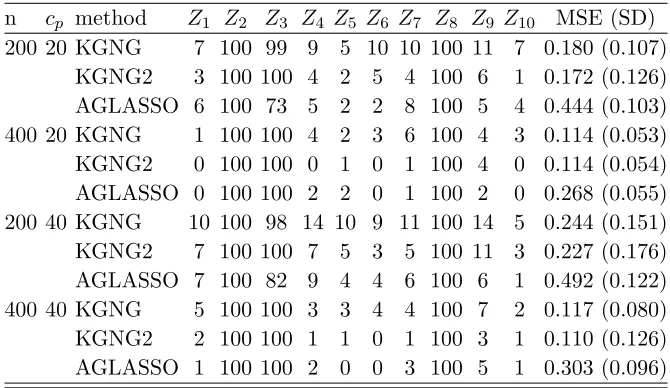
LIST OF TABLES
Table 2.1 Variable selection and estimation results for p = 10. MSE stands for mean-squared error. Standard deviations of the Monte Carlo estimates are given in parentheses. . . 21 Table 2.2 Variable selection and estimation results for p = 50. MSE stands for
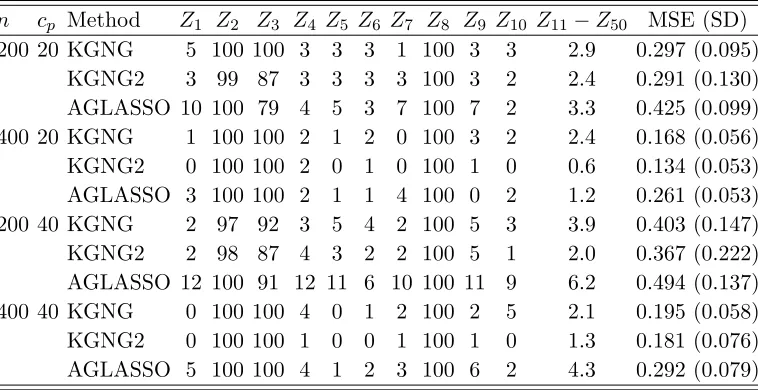
mean-squared error. Standard deviations of the Monte Carlo estimates are given in parentheses. . . 24 Table 2.3 Structure selection results for covariates 2, 3 and 8. Here O is for null effect,
C for constant effect, and NC for time-varying effect. . . 25 Table 2.4 Analysis results for PBC data. TV stands for time-varying coefficients. . . 26
Table 4.1 Summary result of Model I with constant propensity scores. LS stands for lsA-learning. P(0.5) and P(0.25) stand for robust regression with pinball loss and parameter τ = 0.5 and 0.25, respectively. Huber stands for robust regression with Huber loss, where parameter α is tuned automatically with R function rlm. δ0.5 is multiplied by 10. . . 92
Table 4.2 Summary result of Model II with constant propensity scores. LS stands for lsA-learning. P(0.5) and P(0.25) stand for robust regression with pinball loss and parameter τ = 0.5 and 0.25, respectively. Huber stands for robust regression with Huber loss, where parameter α is tuned automatically with R function rlm. δ0.5 is multiplied by 10. . . 93
Table 4.3 Summary results with constant propensity scores when errors interacted with treatment. Least square stands for lsA-learning. Pinball(0.5) stands for robust regression with pinball loss and parameter τ = 0.5. Pinball(0.25) stands for robust regression with pinball loss and parameter τ = 0.25. . . 96 Table 4.4 Analysis results for AIDS data. Est. stands for estimate; SE stands for
stan-dard error; PV stands for p-value. All p-values which are significant at level 0.05 are highlighted. . . 99 Table 4.5 Result of hypothesis test for conditional independence assumption ⊥A|X. . 101 Table 4.6 Summary result of Model I with non-constant propensity scores. δ0.5 is
mul-tiplied by 10. . . 109 Table 4.7 Summary result of Model II with non-constant propensity scores.δ0.5 is
mul-tiplied by 10. . . 110 Table 4.8 Summary results with non-constant propensity scores when errors interacted
LIST OF FIGURES
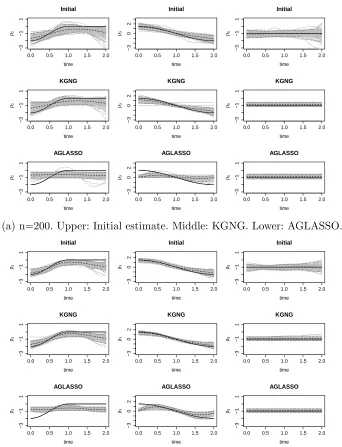
Figure 2.1 Estimated curves (gray) of the three nonzero coefficients from 100 replicates when cp = 20% and p= 10. The dark lines are the true curves. The dashed lines are the average of 100 estimates. The dotted lines are the simulation-based pointwise 95% confidence intervals. . . 22 Figure 2.2 Estimated curves (gray) of the three nonzero coefficients from 100 replicates
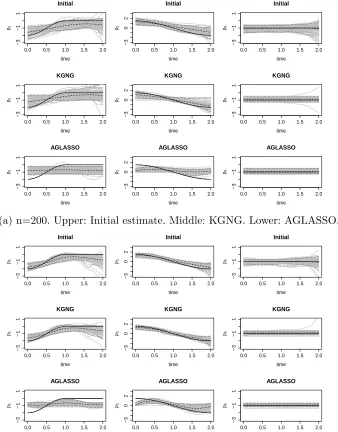
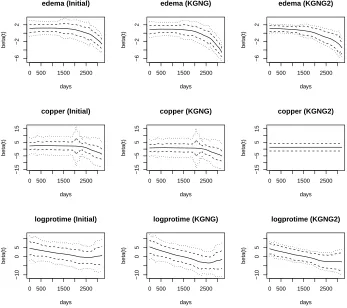
when cp = 40% and p= 10. The dark lines are the true curves. The dashed lines are the average of 100 estimates. The dotted lines are the simulation-based pointwise 95% confidence intervals. . . 23 Figure 2.3 Estimated coefficients for covariates: edema, copper, and logprotime. Left
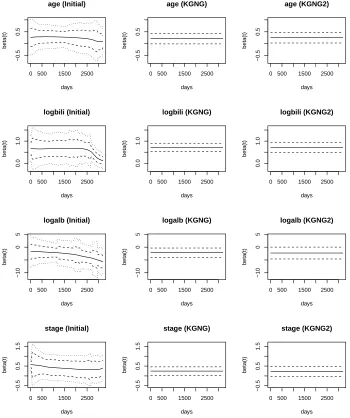
panel: initial estimator in KGNG; Middle panel: KGNG; Right panel: KGNG2. Solid lines: estimated curves; Dashed lines: 95% pointwise confidence inter-vals; Dotted lines: 95% simultaneous confidence bands. . . 27 Figure 2.4 Estimated coefficients for covariates: age, logbili, logalb and stage. Left panel:
initial estimator in KGNG; Middle panel: KGNG; Right panel: KGNG2. Solid lines: estimated curves; Dashed lines: 95% pointwise confidence intervals; Dotted lines: 95% simultaneous confidence bands. . . 28
Figure 3.1 Recurrent event example (CGD data). Top left: ConvexLAR; Top right: vexLASSO; Bottom left: weighted ConvexLAR; Bottom right: weighted Con-vexLASSO. . . 62 Figure 3.2 ConvexLAR and ConvexLASSO solution paths for the panel count data
(bladder) example. . . 64 Figure 3.3 Group LARs solution paths for the Ada-Boost data (WDBC) example. Top
left: GroupConvexLAR-L2; Top right: GroupConvexLAR-L1; Bottom left: GroupConvexLAR; Bottom right: Group ConvexLASSO. . . 67 Figure 3.4 ConvexLAR and ConvexLASSO solution paths for the graphical model (math
score) example. . . 70 Figure 3.5 ConvexLAR and ConvexLASSO solution paths for the graphical model
ex-ample with the simulated data. . . 71
Figure 4.1 The distribution functions of the response Y, in a randomized clinical trial with two treatments,A and B, for male (two panels on the left) and female (two panels on the right). The solid lines with triangle symbol, dashed line, and dotted lines are the conditional mean, 50% quantile, and 25% quantile functions ofY given the gender and the treatment, respectively. . . 79 Figure 4.2 Various loss functions: squared error loss, pinball loss withτ = 0.25, Huber
loss withα= 1 and -insensitive loss with= 1. . . 86 Figure 4.3 Scatterplot and box plots of response Y (CD4 count (cells/mm3) at 20±5
Chapter 1
Introduction
As technology advances, massive data sets are collected by human beings in all fields, which
leads to both promises and challenges for researchers. One important issue in analyzing big
volume of data is to find real relationships between the response variable and input covariates
in the data, while getting rid of noisy inputs. Variable/model selection as an useful tool to solve
this problem has received increasing attention in the past few decades. Another interesting topic
is personalized medicine. It is well-known that patients may have heterogeneous responses to
the same treatment or drug. Therefore it would optimize the treatment outcome to develop
individualized treatment for patients. An individualized treatment rule is a rule that assigns a
treatment, from a set of candidate treatments, to a patient according to his/her characteristics,
including genetic, physiological, demographic, environmental, and other clinical information,
and the optimal individualized treatment rule is one such rule which if assigned to the whole
population would lead to the overall “best” outcome. Our main research topic is to find an
efficient and robust way to estimate the optimal individualized treatment rule from the data.
1.1
Variable/Model selection
elimina-theoretical justification and computational efficiency. In recent years, various modern
vari-able/model selection techniques have been proposed, including but not limited to nonnegative
garrote (Breiman, 1995; Yuan and Lin, 2007), LASSO (Tibshirani, 1996, 1997), SCAD (Fan
and Li, 2001, 2002), adaptive LASSO (Zou, 2006; Zhang and Lu, 2007), group Lasso (Yuan
and Lin, 2006), elastic net (Zou and Hastie, 2005) and MCP (Zhang, 2010). All these methods
can be naturally included in the framework of regularization. Most existing methods focus on
variable selection in the linear model, and less have been studied for nonparametric models or
model structure selection. For example, the identification of linear/nonlinear structure in
par-tially linear regression models or time-invariant/time-varying coefficients in regression models
with time varying coefficients.
In Chapter 2, we explore along this line and study the structure selection problem of
time-varying coefficient Cox models. The time-time-varying coefficient Cox model as a natural extension
of the standard Cox model is widely used to study the temporal effects of covariates. It relaxes
the proportional hazard assumption and can be fitted using either basis expansions (Zucker
and Karr, 1990; Yan and Huang, 2012) or local kernel methods (Cai and Sun, 2003; Tian et al.,
2005). In a time-varying coefficient Cox model, a critical issue is to correctly identify the
mod-el structure, i.e., covariates with null effect, constant effect and truly time-varying effect. By
distinguishing covariates with null effect and non-zero effect, we can build a parsimonious
mod-el with improved risk prediction. By distinguishing covariates with constant effect and truly
time-varying effect, we can build a more interpretable semiparametric model with improved
efficiency over a pure nonparametric model. In this chapter, we will develop a double
penal-ization approach to solve this problem, which also simultaneously estimate the corresponding
regression coefficients.
The majority of existing work conduct model structure selection for the varying coefficient
models by doing hypothesis tests, such as Cai et al. (2000), Huang et al. (2002), Fan and Huang
(2005), Kim (2007), Li and Liang (2008) and Wang et al. (2009), etc. Compared with our
theoretical justification and computational efficiency. In addition, it is also extremely difficult
to construct a hypothesis test with high power on a large number of covariates simultaneously.
Our proposed methods, KGNG and its variant KGNG2, conduct structure selection and
coefficient estimation simultaneously by coupling the kernel-weighted partial likelihood
esti-mation (Cai and Sun, 2003; Tian et al., 2005) with the group nonnegative garrote penalty.
The performance of our methods is illustrated using simulations and an application to the
primary biliary cirrhosis (PBC) data. Important theoretical properties of the final estimators
are established, including selection consistency, estimation consistency and asymptotic
nor-malities of both the constant coefficients and truly time-varying coefficient functions. Based
on numerical studies, our method can easily handle high dimensional cases with dimension
p over 50. We have developed R code for the proposed methods and make it available at
http://www4.ncsu.edu/~wxiao.
1.2
Computational Issues for High Dimensional Data
Penalized regression is frequently used in high dimensional data analysis. In penalized regression
framework, we usually need to minimize the penalized loss function
M(θ) =L(θ|x) +λP(θ) (1.1)
with respect toθ, whereLis the loss function,P is the penalty andλis the tuning parameter. The tuning parameterλcontrols the magnitude of the penalty, and hence regulates the tradeoffs
between goodness of fit and model sparsity. The performance of penalization methods largely
depends on the choice of the tuning parameter, and careful selection of the tuning parameter is
computation. First, we can construct a grid points of tuning parameter λand then calculate ˆ
θ(λ) with one value of tuning parameter at a time, using an algorithm such as quadratic programming (QP), the local quadratic approximation (LQA) algorithm (Fan and Li, 2001)
or the local linear approximation (LLA) algorithm (Zou and Li, 2008). To improve the tuning
result, it is essential to make the grid points of tuning parameters finer and finer, which will on
the other hand increase the computation time. This is the main criticism on this type of method.
The second way is to apply a solution path algorithm, which can calculate the minimizer ˆθ(λ) over all values of λ in one shot. Here, we can apply either the approximate path algorithm or the exact path algorithm. One important work in this area is the Least Angle Regression (Efron et al., 2004), which is an extremely efficient exact path algorithm for linear regression.
The Least Angle Regression (LARS) algorithm results in a piecewise solution path, and is
computationally as efficient as Ordinary Least Squares. Rosset and Zhu (2007) derived the
sufficient conditions on the loss and penalty functions, which leads to piecewise linear solution
paths. They have shown that generalized linear models (GLMs) usually do not have piecewise
linear solution paths. Park and Hastie (2006) proposed an approximate path algorithm for
GLMs based on the predictor-corrector method of convex optimization. The algorithm’s overall
accuracy is controlled by a step length parameter. Another approximate path algorithm was
proposed in Friedman (2008) for any convex loss with a separable penalty. Wu (2011) proposed
an ordinary differential equation based exact path algorithm for GLMs, and extended the
algorithm for Cox model considered in Wu (2012). In Chapter 3, we explore along this line and
propose a ConvexLAR algorithm that works for any convex loss function and naturally extends
to group selection and data adaptive variable selection. The algorithm also leads to a new exact
path algorithm for certain penalty methods such as a convex loss function with lasso or group
lasso penalty by a simple modification. We apply the algorithm to various contexts including
recurrent event and panel count data analysis, Ada-Boost, and Gaussian graphical model. The
algorithms are implemented in Matlab and the corresponding code can be downloaded from
1.3
Optimal Treatment Learning
There is increasing interest to discover individual treatment rules to patients due to their
heterogenous responses to treatment. Here, an individualized treatment rule is a function that
assign a treatment to a patient based on his/her specific characteristics. In particular, we would
like to find an optimal individualized treatment rule, which if applied to the whole population
would lead to the “best” outcome. For complex diseases such as cancer and AIDS, the optimal
individualized treatment rule is usually a dynamic treatment process, which involves a sequence
decisions over the time. In this case, we also name it dynamic treatment regimes.
Q-learning (Watkins and Dayan, 1992; Murphy, 2005) and A-learning (Murphy, 2003;
Robin-s, 2004) are two main approaches for estimating optimal dynamic treatment regimes. Q-learning
is based on posing a regression model to estimate the conditional expectation of the outcome
at each time point, and then applying a backward recursive procedure to fit the model.
A-learning, on the other hand, only requires modeling the contrast function of the treatments
at each time point, and it is therefore more flexible and robust to a model misspecification.
Alternative methods include regret regression (Henderson et al., 2010) and direct value
max-imization (Zhao et al., 2012; Zhang et al., 2013). Specifically, Zhao et al. (2012) proposed an
outcome weighted learning approach using a surrogate loss to approximate a 0-1 loss, and the
approach is based on support vector machine framework. Zhang et al. (2013) estimates the
dy-namic treatment regime by maximizing a doubly robust augmented inverse probability weighted
estimator for mean outcome over a restricted class of regimes. The method proposed in Zhang
et al. (2013) is robust against model misspecification, but computational intractable when the
restricted class of regimes are in high dimension setting.
Variable selection is important to estimate optimal individualized treatment rule in high
dimensional data analysis. Related work includes Qian and Murphy (2011) and Lu et al. (2013).
The former one employs a flexible model estimation framework to approximate the conditional
In Chapter 4, we will develop new estimators for optimal individualized treatment rules
via robust regression. Compared with standard Q- and A-learning, which both mimic a least
squares regression, our new estimators are robust against the skewed, heterogeneous,
heavy-tailed errors or outliers. Furthermore, the new estimators are robust against misspecification of
the baseline function, which is a nice property shared by A-learning. Last but not least, under
certain situations, i.e. when the error term is interacted with the treatment, the new estimator
coupled with pinball loss approximately maximizes the outcomes conditional quantile instead
of conditional mean, which leads to a different optimal individualized treatment rule from
the traditional Q- and A-learning. We demonstrate the performance of the new estimators by
Chapter 2
Joint Structure Selection and
Estimation in the Time-varying
Coefficient Cox Model
2.1
Introduction
Cox proportional hazards model (Cox, 1972) has become the most popularly used
semiparamet-ric model in survival analysis due to its nice hazard interpretation and easy estimation based on
partial likelihood principle with elegant counting process-based martingale theory (Andersen
and Gill, 1982). However, one main limitation of the standard Cox model is to assume that the
hazard ratios stay constant over time, i.e. covariate effects are time-invariant, which may be
unrealistic in practical applications. Many alternatives have been proposed to relax the
propor-tional hazards assumption. Among them, the time-varying coefficient Cox model is a natural
extension of the standard Cox model by allowing temporal effects of covariates, and has been
widely studied in the literature (e.g. Zucker and Karr, 1990; Cai and Sun, 2003; Tian et al.,
model structure, i.e. to distinguish covariates with null effect, constant effect or truly
time-varying effect. There are at least two benefits. On one hand, by identifying covariates with null
effect and excluding them from the model, we can build a parsimonious model with better risk
prediction. On the other hand, by distinguishing covariates with constant effect and truly-time
varying effects, we can build a simpler and easier-interpretable semiparametric model comparing
with a pure nonparametric model with time-varying coefficients, which will be highly
appre-ciated by empirical investigators since they generally prefer a flexible but easy-interpretable
model for data analysis. See Zhang et al. (2002); Fan and Huang (2005); Ahmad et al. (2005);
Wang et al. (2009) for more demonstration of the benefits of semiparametric varying-coefficient
models comparing with nonparametric varying-coefficient models.
Model selection has been extensively studied in the past few decades. Traditional model
se-lection techniques, such as best-subset sese-lection, coupled withCp (Mallows, 1973), AIC (Akaike, 1973) and BIC (Schwarz, 1978), separate model selection and model estimation steps and are
generally unstable due to the their inherent discreteness (Breiman, 1995) and stochastic errors
(Fan and Li, 2001). They also lack of asymptotic selection consistency, which is a desirable
asymptotic property to possess. More importantly, they are not computational feasible for data
set with moderate to large dimensions as their computation times increase exponentially with
the dimension. To overcome these difficulties, various penalization methods have been
intro-duced, for example, nonnegative garrote (Breiman, 1995), LASSO (Tibshirani, 1996, 1997),
SCAD (Fan and Li, 2001, 2002) and adaptive LASSO (Zou, 2006; Zhang and Lu, 2007). These
methods provide competing performance for simultaneously selecting important variables and
estimating their effects. However, most existing penalization methods focus on variable
selec-tion for simple linear regression models. Less has been studied for model structure selecselec-tion,
for example, the identification of linear/nonlinear structure in partially linear regression models
or time-invariant/time-varying coefficients in regression models with time-varying coefficients.
Recently, Zhang et al. (2011) proposed a novel penalization approach in the frame of
nonlinear effect in a partially linear model. For censored data, Yan and Huang (2012) proposed
an adaptive group LASSO (AGLASSO) method based on a penalized B-spline approach for
model structure selection in a time-varying coefficient Cox model. Specifically, time-varying
coefficients are expanded with a set of B-spline basis functions and an adaptive group lasso
penalty is used to select between time-independent and time-dependent covariate effects.
In this chapter, we propose an alternative method for automatic model structure
selec-tion and coefficient estimaselec-tion in a time-varying coefficient Cox model by coupling the
kernel-weighted partial likelihood estimation (Cai and Sun, 2003; Tian et al., 2005) with the group
nonnegative garrote penalty. There are three major motivations for developing this new
ap-proach based on local kernel methods. First, in contrast with the spline method proposed in
Yan and Huang (2012), our method is able to better capture some local features of time-varying
coefficient functions, which are otherwise hard to be captured by the spline method. Second, by
using the local kernel estimation, it enables us to rigorously study the asymptotic properties of
the proposed estimators for both constant and time-varying coefficients, such as model
selec-tion consistency and asymptotic normality, and hence justify the validity of the methods from
theoretical perspectives. None of these properties have been established for existing approaches
like Yan and Huang (2012). Third, the proposed method provides an automatic and effective
way to conduct structure selection for time-varying coefficient Cox model, which can deal with
relative large dimension in contrast with all existing methods based on hypothesis testing, such
as those studied in Tian et al. (2005) and Liu et al. (2013). The remainder of the chapter is
organized as follows. Our proposed kernel group nonnegative garrote (KGNG) method and its
variant (KGNG2) are introduced in Section 2.2. Asymptotic properties of KGNG and KGNG2
estimators are presented in Section 2.3. Section 2.4 is devoted to numerical studies, including
simulations and an application to the primary biliary cirrhosis data. All the technical proofs
2.2
Structure Selection with Kernel Group Nonnegative
Gar-rote
2.2.1 Methods
Consider a random sample of n individuals. Let Ti be the failure time, Ci be the censoring time, andZi be ap-vector of covariates for subjecti. Conditional onZi,Ti andCi are assumed independent. Define Tei = min(Ti, Ci) and ∆i = 1(Ti ≤ Ci). The data consist of the triplets (Tei,Zi,∆i),i= 1, . . . , n. The time-varying coefficient Cox model assumes the following form
α(t|Zi) =α0(t)eβ
T
0(t)Zi, (2.1)
where α(·|Zi) is the conditional hazard function given covariates, α0(·) is a completely un-specified baseline hazard function, andβ0(t) = (β01(t), . . . , β0p(t))T is a p-dimensional smooth function of t.
Without loss of generality, we assumeβ0(t) = (βT
O(t),β
T
C(t),β
T
N C(t))T, whereβO(t)∈IRp1, βC(t) ∈IRp2 and β
N C(t) ∈IRp3 correspond to covariates with null effect, constant effect and truly time-varying effect, respectively, and p = p1 +p2+p3. Denote the corresponding index
sets of the above three classes by IO, IC and IN C, and let I = {1, . . . , p} = {IO S
IC S
IN C}. Our method consists of two steps. In Step 1, for any fixed t, we obtain the initial estimator
e
β(t) = (β1e(t), . . . ,βep(t))T ∈ IRp using the kernel-weighted partial likelihood estimation (Cai and Sun, 2003; Tian et al., 2005), i.e., by maximizing the local partial likelihood
L1n(β, t) = 1
n
n X
i=1
Z τ
0
Kh(s−t)
β
TZ
i−log
n X
j=1
Yj(s)eβ
T Zj
dNi(s), (2.2)
into the mean partfm= (m1, . . . ,e mep)
Tand the deviation part
e
β∗(t) = (βe1∗(t), . . . ,βep∗(t))T, where
e
mk =τ−1 Rτ
0 βek(u)duand βe∗k(t) =βek(t)−mek for k= 1, . . . , p. Practically, we could chooseM grid points TM = {t1, . . . , tM}, equally spaced between 0 and τ, where M is a large positive integer. We then let mek =PMi=1βek(ti)/M and βek∗(t) =βek(tj)−mek, wherej = argmink|tk−t| and t∈[0, τ]. In our numerical studies, we setM to be 100, which based on our experiment is large enough to make good approximation of both mek and βek∗(t).
In Step 2, we adapt group nonnegative garrote penalties for structure selection. Denote
λ1 = (λ11, . . . , λ1p)T,λ2 = (λ21, . . . , λ2p)T as two p-dimensional vectors. We obtain λb1 and λb2 by minimizing
Q2n(λ1,λ2) =−
n X
i=1
Z τ
0
"
f
m◦λ1+βe
∗
(s)◦λ2
T
Zi
−log
n X
j=1 Yj(s)e
f m◦λ1+βe
∗
(s)◦λ2 T
Zj
#
dNi(s)
+θ1
p X
j=1
λ1j+θ2
p X
j=1
λ2j (2.3)
subject toλ1j ≥0 andλ2j ≥0,j= 1,· · · , p, whereθ= (θ1,θ2) are two-dimensional nonnegative
tuning parameters, anda◦b denotes the Hadamard (element-wise) product of vectorsaandb. Then, the proposed KGNG estimator ofβ0k(t) is given by
b
βk(t) =bλ1kmek+bλ2kβek∗(t), k= 1, . . . , p, t∈[0, τ]. (2.4)
It is interesting to note that the automatic structure selection is achieved by shrinking some
components of λb1 and λb2 to zero. Specifically, we definebIO = {k ∈ I : λb1k = 0,bλ2k = 0},
bIC ={k∈I :bλ1k6= 0,λb2k = 0}andbIN C ={k∈I :λb2k6= 0} as estimated index sets for IO, IC and IN C, respectively.
variant of KGNG estimator. Specifically, we add a preliminary step (Step 0) before Steps 1 and
2 to exclude all noise variables prior to structure selection. To do this, we conduct a standard
group nonnegative garrote estimation by minimizing
Q0n(λ∗) =− n X i=1 Z τ 0 e
β(s)◦λ∗ T
Zi−log
n X
j=1 Yj(s)e
e
β(s)◦λ∗ T
Zj
dNi(s)
+θ∗
p X
j=1
λ∗j (2.5)
with respect to λ∗ = (λ∗1, . . . , λ∗p)T, whereλ∗
j ≥0,j = 1, . . . , p, and θ∗ is a nonnegative tuning parameter. Letλb
∗
= (bλ∗1, . . . ,bλ∗p)Tdenote the resulting minimizer. We exclude thekth covariate if bλ∗k = 0. Let Zi denote the remaining sub-vector of Zi by keeping all important covariates. We then implement Steps 1 and 2 withZi replaced by Zi for further structure selection. The resulting estimator is denoted as KGNG2.
2.2.2 Computational Aspects
We implemented the proposed method in R, and the corresponding code can be
download-ed from the author’s web page (http://www4.ncsu.edu/sim/wxiao/). In Step 1, L1n(β, t) is strictly concave with probability one and thus has a unique solution. The maximization can be
realized based on a regular Newton-Raphson iteration or an efficient iterative algorithm
pro-posed in Cai et al. (2000). In Step 2, after proper transformations, the minimization problem of
(2.3) is equivalent to finding the lasso solution for a Cox model with time-dependent covariates
e
Zi(s) under the nonnegative constraint of regression parameters, where
e Zi(s) =
f m◦Zi
e
β∗(s)◦Zi
.
We used R package “penalized” (Goeman, 2010) for this optimization step. The algorithm is
can also incorporate nonnegative constraints on the parameters (Goeman, 2010). Moreover, the
minimization in the preliminary Step 0 is also equivalent to finding a lasso solution for a Cox
model with time-dependent covariates βe(s)◦Zi. Therefore it can be computed similarly with existing R packages.
2.2.3 Tuning Procedure
For computing KGNG, two sets of tuning parameters need to be chosen properly, i.e., the
bandwidth h at the maximum local partial likelihood estimation step (2.2) and (θ1, θ2) at the
group nonnegative garrote estimation step (2.3). To chooseh, we use a K-fold cross-validation
method as suggested in Tian et al. (2005). First, we randomly split the data set intoK roughly equal-sized parts. Then, for each k= 1, . . . , K, we delete the kth part and fit the time-varying
coefficient Cox model with the otherK−1 parts. Next, we compute the prediction errorP Ek(h), which measures how well the fitted model predicts the kth part of the data. Here,
P Ek(h) =− X
i∈Ik
Z τ
0
bβ
(−k)
(s)T
Zi−log
X
j∈Ik
Yj(s)e
b
β(−k)(s)TZ j
dNi(s),
where Ikis the index set for the kth part of the data andβb
(−k)
(t) is the maximum local partial
likelihood estimator calculated with the kth part of the data deleted. Last, the optimal h is
obtained by minimizing the total prediction errorP E(h) =PK
k=1P Ek(h).
For (θ1, θ2), we consider a set of bivariate grid values, and choose the optimal (θ1, θ2) by minimizing the following BIC criterion
BIC=−2 log(partial likelihood)/n+ logn/n×df1+ log(nh∗)/(nh∗)×df2,
where df1 and df2 are the number of nonzero components in λb1 and λb2, respectively, and
h∗ =h/τ is the effective bandwidth when we scale τ to 1. Note that the effective sample size
fact thatβ∗i(t) is estimated locally. Similar strategy is adopted in Wang and Xia (2009) and Hu and Xia (2012).
Similarly, θ∗ in the preliminary Step 0 can be chosen by minimizing the BIC criterion
BIC=−2 log(partial likelihood)/n+ log(nh∗)/(nh∗)×df3,
wheredf3 is the number of covariates with nonzero effect.
2.3
Theoretical properties
In this section, we establish the asymptotic properties of the initial estimators, and our proposed
KGNG and KGNG2 estimators.
2.3.1 Asymptotic Properties of Initial Estimators
Denote the true mean and deviation part of β0(t) as m0 = (m01, . . . , m0p)T and β∗0(t) =
(β∗01(t), . . . , β0∗p(t))T, respectively, where
m0k=τ−1 Z τ
0
β0k(u)du, β0∗k(t) =β0k(t)−m0k,
fork= 1, . . . , p. LetI(β, t) =−∂2L1n(β, t)/∂β2 =n−1 Pn
i=1
Rτ
0 V(β, s)Khn(s−t)dNi(s), where
V(β, t) =S
(2)(β, t) S(0)(β, t) −
S(1)(β, t) S(0)(β, t)
!⊗2
,
S(r)(β, t) =n−1
n X
i=1
Yi(t)Zi⊗reβ
0
Zi, r= 0,1,2,
with⊗ denoting the outer product. LetE(β, t) =S(1)(β, t)/S(0)(β, t),P(t|z) = P(
e
T ≥t|Z= z), Q0(t) = E[P(t|Z)α(t|Z)], Q1(t) = E[P(t|Z)α(t|Z)Z] and Q2(t) = E[P(t|Z)α(t|Z)Z⊗2].
Define Σ(t) =Q2(t)−Q1(t)Q1(t)T/Q0(t). Lets(r)(β, t) denote the limits ofS(r)(β, t),r= 0,1,2,
set of IRp that includes a neighborhood of β0(t) for t ∈ [0, τ]. Under the following regularity conditions,
(A.1) The kernel functionK(·) is a bounded and symmetric density with a bounded support [-1,1];
(A.2) Fort∈[0, τ]
E "
exp (
2 sup
u∈N(t,)
|β0(u)|+β00(t) + 3 !
|Z| )#
<∞;
(A.3) Q0(u)>0,Q1(u) andQ2(u) are continuous fort∈[0, τ];
(A.4) Assume that α0(t) is positive and continuous, P(t|z) > 0 and coefficient functions {β0j(t)} have a continuous second derivative fort∈[0, τ];
(A.5) Assume that the matrix Σ(t) is positive definite fort∈[0, τ];
(A.6) s(r)(β, t) is uniformly continuous with respect to (βT, t)T∈ B ×[0, τ] fort∈[0, τ];
we have
Lemma 2.1. Suppose hn=O(n−ν) with ν ∈[1/5,1).
(a) βe(t) p
→β0(t), 0≤t≤τ.
(b) If 1/5< ν <1, we have, for fixedt∈(0, τ),
(nhn)1/2
e
β(t)−β0(t) d
→N
0, Σ−1(t) Z 1
−1
K2(s)ds
.
where Σ(t) can be consistently estimated byI(eβ(t), t).
where Σm = Rτ
0 Σ
−1(u)du/τ2 and can be consistently estimated by
b Σm=
Z τ−h h
I−1(βe(u), u)du/(τ−2h)2.
The proof of Lemma 2.1 follows Cai and Sun (2003) which is omitted. The proof of
Lem-ma 2.2 follows similar steps given in Section 5 of Tian et al. (2005) and is relegated to the
Supplement.
2.3.2 Asymptotic Properties of KGNG Estimators
Letλ01andλ02denote the true values ofλ1 andλ2, respectively, and partition them into three
parts: λ01= (λO01
T
,λC01T,λN C01 T)T and (λO
02
T
,λC02T,λN C02 T)T, according to the true index sets I
O, IC and IN C, respectively. Then
λO01=0p1, λ
C
01=1p2, λ
O
02=0p1, λ
C
02=0p2, λ
N C
02 =1p3
andλN C01,j = 0 or 1 forj∈IN C, whereλN C01,j is thejth component ofλN C01 and corresponds to the
mean part of thejth covariate with time-varying effect. IfλN C01,j = 0, thejth time-varying effect has zero mean effect; otherwise, it has nonzero mean effect. As we do not distinguish between
the above two types of time-varying effects, without loss of generality, we assumeλN C01 =1p3 in
our theoretical derivations. Let λ0 = (λT01,λ02T )T. We further partition λ0 asλ(1)0 representing
all the ones and λ(0)0 representing all the zeros, where λ(1)0 = (λC01T,λN C01 T,λN C02 T)T = 1
p2+2p3
and λ(0)0 = (λO01T,λO02T,λC02T)T = 0
2p1+p2. In a similar manner we define λ, λ
(1),λ(0),
b λ, λb
(1)
and λb
(0)
, which accord to the true index sets IO, IC and IN C.
Note that the KGNG estimator defined in (2.4) takes the form βb(t) =λb1◦fm+λb2◦βe
∗
(t).
To derive its asymptotic properties, we need to study the asymptotic properties of fm, βe
∗
(t)
and λb. In Lemmas 2.1 and 2.2, we have established the asymptotic properties ofmf andβe
∗
(t). In the following, we derive the asymptotic properties of λb, which consists ofλb
(1)
and λb
(0)
. In
particular, we establish the root-n consistency ofλb
(1)
of λb
(0)
in Theorem 2.2.
Theorem 2.1. Assume hn = O(n−ν) with 1/4 < ν < 1/2. Under the regularity conditions
assumed in Lemmas 2.1 and 2.2, ifmax(θ1, θ2)/√nis bounded, thenkλb
(1)
−λ(1)0 k=Op(n−1/2). Theorem 2.2. Assume hn = O(n−ν) with 1/4 < ν < 1/2. Under the regularity conditions
assumed in Lemmas 2.1 and 2.2, if kλb
(1)
−λ(1)0 k=Op(n−1/2) andh1n/2min (θ1, θ2)→ ∞, then P(λb
(0)
=0)→1.
Combining Theorems 2.1 and 2.2, we can then prove the selection consistency of the KGNG
estimator, which is summarized in part (a) of Theorem 2.3. We further establish the
asymp-totic normality of the KGNG estimators for both nonzero constant and time-varying regression
coefficients in Theorem 2.3. Recall that β0(t) = (βT
O,β
T
C,β
T
N C(t))T ∈ IRp, where βO ∈ IRp1, βC ∈IRp2 and β
N C(t)∈IRp3 are subvector ofβ0(t) corresponding to the true underline index
sets IO, IC and IN C, respectively. In a similar manner, we write m0 = (mTO,m
T
C,m
T
N C)
T and
β∗0(t) = (β∗OT
,β∗CT
,β∗N CT
(t))T. We further partition
b
β(t), βe(t), f mand βe
∗
(t) accordingly.
Theorem 2.3. Assume hn = O(n−ν) with 1/4 < ν < 1/2. Under the regularity conditions
assumed in Lemmas 1 and 2, if max(θ1, θ2)/√n is bounded and hn1/2min (θ1, θ2)→ ∞, then
(a) (Selection consistency) with probability tending to one,bIO = IO,bIC = IC andbIN C =
IN C.
(b) (Root-n consistency of βbC) βbC is a root-n consistent estimator for βC.
(c) (Asymptotic normality of βbC) if we further assume max(θ1, θ2)/
√
n→0,
(n)1/2βbC−βC d
→N
0, ΣFm ,
where
ΣFm = Z τ
0
D(u) +1
τB10Σ
−1(u)
Σ(u)
D(u) +1
τB10Σ
−1(u)
T
(d) (Asymptotic normality of βbN C(t))
(nhn)1/2
b
βN C(t)−βN C(t) d
→N
0, {Σ−1(t)}N C,N C Z 1
−1
K2(s)ds
,
where {Σ−1(t)}N C,N C is the submatrix of Σ−1(t) corresponding to IN C.
The proofs of Theorem 2.1, 2.2 and 2.3 are relegated to the Supplement. The asymptotic
variance-covariance matrices given in parts (c) and (d) can be consistently estimated by the
usu-al plug-in method. It is interesting to note that the limiting distribution of the KGNG estimator
for the time-varying coefficients given in part (d) is the same as that of the corresponding initial
estimator. Actually in the proof of part (d), we have shown that the difference betweenβbN C(t) and βeN C(t) are uniformly asymptotically negligible in t. Thus we could construct confidence bands ofβbN C(t) using the resampling technique as proposed in Tian et al. (2005).
2.3.3 Asymptotic Properties of KGNG2 Estimator Let Z = (ZT
O,ZCT,ZN CT )T and Z = (ZCT,ZN CT )T as the subvector of Z with only important covariates kept. Letβ
0(t) = (β
T
C(t),βTN C(t))T,α(t|Z) =α0(t)eβ0(t) TZ
,P(t|Z) =P(Y ≥t|Z= z), Q0(t) = E[P(t|Z)α(t|Z)], Q1(t) = E[P(t|Z)α(t|Z)Z] and Q2(t) = E[P(t|Z)α(t|Z)Z⊗2]. Define Σ(t) = Q2(t)−Q1(t)Q1(t)T/Q
0(t). We add “*” to distinguish the KGNG2 estimator
from the KGNG estimator. We summarize the asymptotic properties of KGNG2 estimator in
Theorem 2.4.
Theorem 2.4. Assume hn = O(n−ν) with 1/4 < ν < 1/2. Under the regularity conditions
assumed in Lemmas 1 and 2, if (1)θ∗/√n is bounded andhn1/2θ∗→ ∞; (2)max(θ1, θ2)/ √
nis bounded and h1n/2min (θ1, θ2)→ ∞, then
(a) (Selection consistency of preliminary Step 0)with probability tending to one,bλ∗k = 0,
for k∈IO and bλ∗k6= 0, for k∈IC S
IN C.
(b) (Selection consistency) with probability tending to one,bI∗O = IO,bI∗C = IC andbI∗N C =
(c) (Root-n consistency of βb
∗
C) βb
∗
C(t) is a root-n consistent estimator for βC.
(d) (Asymptotic normality of βb
∗
C) if we further assume max(θ1, θ2)/ √
n→0,
(n)1/2βb
∗
C−βC d
→N
0, ΣFm ,
where ΣFm can be computed following (2.6)with some obvious changes.
(e) (Asymptotic normality of βb
∗
N C(t))
(nhn)1/2
b
β∗N C(t)−βN C(t) d
→N
0, {Σ−1(t)}N C,N C Z 1
−1
K2(s)ds
,
where {Σ−1(t)}N C,N C is the submatrix of Σ−1(t) corresponding to IN C.
The proof of Theorem 2.4 is similar to that of Theorem 2.3 and hence is omitted here.
Based on Theorem 2.3 and 2.4,βb
∗
N C(t) is strictly more efficient thanβbN C(t) if IOis not empty. However, there is no clear order between the efficiencies of βb
∗
C and βbC.
2.4
Numerical studies
2.4.1 Simulation studies
We generate failure times from the varying-coefficient Cox model (2.1). Here, covariate vectorZ is generated from a multivariate normal distribution with mean 0, variance 0.5 and correlation
coefficient 0.5|j−k|for any pair (j, k). We consider both the low dimensional case and the high dimensional case, where the dimension p = 10 and 50 respectively. There are three nonzero
coefficients in β0(t), i.e., β02(t) = −{1 + cos(πt)}1(0 < t < 1), β03(t) = 1.5{cos(πt/2)} and
β08(t) =−1. So, there are two covariates with time-varying effects, one with constant effect and
all the remains with null effect. The baseline hazard function α0(t) = exp{−cos(πt/2)}. We
ith subject is a mixture ofW and a point mass at 2, whereW = min(exp(Zi2−Zi5), Unif(0,2)).
When p = 50, we generate censoring times from a mixture of Unif(0,2)) and a point mass at
2. For both cases, the mixing probability is chosen to have the desired censoring proportion,
i.e. cp = 20% or 40%. For each scenario, we conduct 100 simulation runs with sample size
n= 200 and 400. We compare the proposed KGNG and KGNG2 with the AGLASSO of Yan
and Huang (2012). For our estimators, we use the Epanechnikov kernel K(x) = 3(1−x2)/4, −1 ≤ x ≤ 1. The bandwidth h is chosen using 5-fold cross validation as discussed in Section 2.2.3. For KGNG2, the same bandwidth is used for Step 1 as for Step 0. We use the proposed
BIC criterion in Section 2.2.3 to tune (θ1, θ2) and θ∗.
Tables 2.1 and 2.2 summarize the mean squared errors and variable selection results for
p= 10 and 50, respectively. The selection frequency of each variable over 100 runs is reported,
where the important covariates areZ2,Z3 andZ8. The mean squared error (MSE) is calculated
as
1 100
100
X
i=1
n b
β(ti)−β0(ti) oT
V
n b
β(ti)−β0(ti) o
,
where {t1, . . . , t100} are 100 equally-spaced grid points in the time interval (0,2) andV is the
population covariance matrix of covariates.
From Tables 2.1 and 2.2, we make the following observations. First, KGNG2 shows the
best performance in terms of variable selection and MSE in almost all scenarios, especially for
large dimension case (p= 50). This is expected since KGNG2 is a two-stage approach, by first
excluding the noise variables. Second, both KGNG and KGNG2 outperform AGLASSO with
deduction in MSE as large as 60%. Third, KGNG and KGNG2 selectZ2,Z3andZ8as important
covariates nearly all the times, while the AGLASSO missesZ3occasionally, especially when the sample size is small.
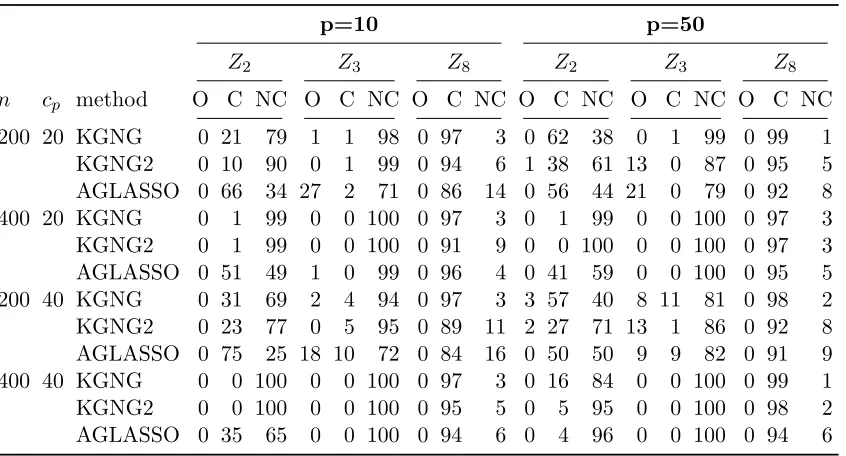
Table 2.3 summarizes the structure selection result of the three covariates with nonzero
Table 2.1: Variable selection and estimation results forp= 10. MSE stands for mean-squared error. Standard deviations of the Monte Carlo estimates are given in parentheses.
n cp method Z1 Z2 Z3 Z4 Z5 Z6 Z7 Z8 Z9 Z10 MSE (SD)
200 20 KGNG 7 100 99 9 5 10 10 100 11 7 0.180 (0.107) KGNG2 3 100 100 4 2 5 4 100 6 1 0.172 (0.126) AGLASSO 6 100 73 5 2 2 8 100 5 4 0.444 (0.103) 400 20 KGNG 1 100 100 4 2 3 6 100 4 3 0.114 (0.053) KGNG2 0 100 100 0 1 0 1 100 4 0 0.114 (0.054) AGLASSO 0 100 100 2 2 0 1 100 2 0 0.268 (0.055) 200 40 KGNG 10 100 98 14 10 9 11 100 14 5 0.244 (0.151) KGNG2 7 100 100 7 5 3 5 100 11 3 0.227 (0.176) AGLASSO 7 100 82 9 4 4 6 100 6 1 0.492 (0.122) 400 40 KGNG 5 100 100 3 3 4 4 100 7 2 0.117 (0.080) KGNG2 2 100 100 1 1 0 1 100 3 1 0.110 (0.126) AGLASSO 1 100 100 2 0 0 3 100 5 1 0.303 (0.096)
select the time-varying-effect Z2 as a constant-effect covariate. For example, when p = 10,
n= 200 and cp = 20%, AGLASSO correctly classifies Z2 only 34 times out of 100, while both
KGNG and KGNG2 classify Z2 correctly for more than 70 times.
Finally, we plot the initial estimator, KGNG and AGLASSO for three nonzero coefficients
and their pointwise 95% confidence intervals based on 100 simulations for p = 10. The plots
forcp = 20% andcp = 40% are given in Figures 2.1 and 2.2, respectively. We make the follow-ing observations. First, the performance of both KGNG and AGLASSO improves substantially
when sample size increases. Second, KGNG has smaller biases in the estimation of time-varying
coefficients compared with AGLASSO in all the cases, while KGNG and AGLASSO give
com-parable estimates for the constant coefficient. Third, the improvement of KGNG over the initial
estimator for time-varying coefficients is not obvious, however, the improvement for the constant
0.0 0.5 1.0 1.5 2.0 −3 −1 1 Initial time β2
0.0 0.5 1.0 1.5 2.0
−3 0 2 Initial time β3
0.0 0.5 1.0 1.5 2.0
−3 −1 1 Initial time β8
0.0 0.5 1.0 1.5 2.0
−3 −1 1 KGNG time β2
0.0 0.5 1.0 1.5 2.0
−3 0 2 KGNG time β3
0.0 0.5 1.0 1.5 2.0
−3 −1 1 KGNG time β8
0.0 0.5 1.0 1.5 2.0
−3 −1 1 AGLASSO time β2
0.0 0.5 1.0 1.5 2.0
−3 0 2 AGLASSO time β3
0.0 0.5 1.0 1.5 2.0
−3 −1 1 AGLASSO time β8
(a) n=200. Upper: Initial estimate. Middle: KGNG. Lower: AGLASSO.
0.0 0.5 1.0 1.5 2.0
−3 −1 1 Initial time β2
0.0 0.5 1.0 1.5 2.0
−3 0 2 Initial time β3
0.0 0.5 1.0 1.5 2.0
−3 −1 1 Initial time β8
0.0 0.5 1.0 1.5 2.0
−3 −1 1 KGNG time β2
0.0 0.5 1.0 1.5 2.0
−3 0 2 KGNG time β3
0.0 0.5 1.0 1.5 2.0
−3 −1 1 KGNG time β8
0.0 0.5 1.0 1.5 2.0
−3 −1 1 AGLASSO time β2
0.0 0.5 1.0 1.5 2.0
−3 0 2 AGLASSO time β3
0.0 0.5 1.0 1.5 2.0
−3 −1 1 AGLASSO time β8
(b) n=400. Upper: Initial estimate. Middle: KGNG. Lower: AGLASSO.
Figure 2.1: Estimated curves (gray) of the three nonzero coefficients from 100 replicates when
0.0 0.5 1.0 1.5 2.0 −3 −1 1 Initial time β2
0.0 0.5 1.0 1.5 2.0
−3 0 2 Initial time β3
0.0 0.5 1.0 1.5 2.0
−3 −1 1 Initial time β8
0.0 0.5 1.0 1.5 2.0
−3 −1 1 KGNG time β2
0.0 0.5 1.0 1.5 2.0
−3 0 2 KGNG time β3
0.0 0.5 1.0 1.5 2.0
−3 −1 1 KGNG time β8
0.0 0.5 1.0 1.5 2.0
−3 −1 1 AGLASSO time β2
0.0 0.5 1.0 1.5 2.0
−3 0 2 AGLASSO time β3
0.0 0.5 1.0 1.5 2.0
−3 −1 1 AGLASSO time β8
(a) n=200. Upper: Initial estimate. Middle: KGNG. Lower: AGLASSO.
0.0 0.5 1.0 1.5 2.0
−3 −1 1 Initial time β2
0.0 0.5 1.0 1.5 2.0
−3 0 2 Initial time β3
0.0 0.5 1.0 1.5 2.0
−3 −1 1 Initial time β8
0.0 0.5 1.0 1.5 2.0
−3 −1 1 KGNG time β2
0.0 0.5 1.0 1.5 2.0
−3 0 2 KGNG time β3
0.0 0.5 1.0 1.5 2.0
−3 −1 1 KGNG time β8
0.0 0.5 1.0 1.5 2.0
−3 −1 1 AGLASSO time β2
0.0 0.5 1.0 1.5 2.0
−3 0 2 AGLASSO time β3
0.0 0.5 1.0 1.5 2.0
−3 −1 1 AGLASSO time β8
(b) n=400. Upper: Initial estimate. Middle: KGNG. Lower: AGLASSO.
Figure 2.2: Estimated curves (gray) of the three nonzero coefficients from 100 replicates when
Table 2.2: Variable selection and estimation results forp= 50. MSE stands for mean-squared error. Standard deviations of the Monte Carlo estimates are given in parentheses.
n cp Method Z1 Z2 Z3 Z4 Z5 Z6 Z7 Z8 Z9 Z10 Z11−Z50 MSE (SD)
200 20 KGNG 5 100 100 3 3 3 1 100 3 3 2.9 0.297 (0.095) KGNG2 3 99 87 3 3 3 3 100 3 2 2.4 0.291 (0.130) AGLASSO 10 100 79 4 5 3 7 100 7 2 3.3 0.425 (0.099) 400 20 KGNG 1 100 100 2 1 2 0 100 3 2 2.4 0.168 (0.056) KGNG2 0 100 100 2 0 1 0 100 1 0 0.6 0.134 (0.053) AGLASSO 3 100 100 2 1 1 4 100 0 2 1.2 0.261 (0.053) 200 40 KGNG 2 97 92 3 5 4 2 100 5 3 3.9 0.403 (0.147) KGNG2 2 98 87 4 3 2 2 100 5 1 2.0 0.367 (0.222) AGLASSO 12 100 91 12 11 6 10 100 11 9 6.2 0.494 (0.137) 400 40 KGNG 0 100 100 4 0 1 2 100 2 5 2.1 0.195 (0.058) KGNG2 0 100 100 1 0 0 1 100 1 0 1.3 0.181 (0.076) AGLASSO 5 100 100 4 1 2 3 100 6 2 4.3 0.292 (0.079)
2.4.2 Analysis of primary biliary cirrhosis (PBC) data
As an illustration, we apply our KGNG and KGNG2 methods to analyze the PBC data
(Flem-ing and Harr(Flem-ington, 1991). The data is from the Mayo Clinic trial in primary biliary cirrhosis
(PBC) of the liver conducted between 1974 and 1984. The primary biliary cirrhosis is a chronic
disease in which the bile ducts in one’s liver are slowly destroyed. In the study, 312 out of 424
patients who participate in the randomized trial are eligible for the analysis. There are 17
co-variates: trtmt=treatment (Yes/No), age (in 10 years), gender=female/male, ascites=presence
of ascites (Yes/No), hypato=presence of hepatomegaly (Yes/No), spiders=presence of
spider-s, edema=severity of oedema (0 denotes no oedema, 0.5 denotes untreated or successfully
treated oedema and 1 denotes unsuccessfully treated oedema), logbili=logarithm of serum
bilirubin (mg/dl), chol=serum cholesterol (mg/dl), logalb=logarithm of albumin (gm/dl),
cop-per=urine copper (mg/day), alk=alkaline phosphatase (U/liter), sgot=liver enzyme (U/ml),
trig=triglicerides (mg/dl), platelet=platelets per 10−3ml3, logprotime=logarithm of
prothrom-bin time (seconds), stage=histologic stage of disease (category: 1, 2, 3 or 4).
Table 2.3: Structure selection results for covariates 2, 3 and 8. Here O is for null effect, C for constant effect, and NC for time-varying effect.
p=10 p=50
Z2 Z3 Z8 Z2 Z3 Z8
n cp method O C NC O C NC O C NC O C NC O C NC O C NC
200 20 KGNG 0 21 79 1 1 98 0 97 3 0 62 38 0 1 99 0 99 1
KGNG2 0 10 90 0 1 99 0 94 6 1 38 61 13 0 87 0 95 5
AGLASSO 0 66 34 27 2 71 0 86 14 0 56 44 21 0 79 0 92 8
400 20 KGNG 0 1 99 0 0 100 0 97 3 0 1 99 0 0 100 0 97 3
KGNG2 0 1 99 0 0 100 0 91 9 0 0 100 0 0 100 0 97 3
AGLASSO 0 51 49 1 0 99 0 96 4 0 41 59 0 0 100 0 95 5
200 40 KGNG 0 31 69 2 4 94 0 97 3 3 57 40 8 11 81 0 98 2
KGNG2 0 23 77 0 5 95 0 89 11 2 27 71 13 1 86 0 92 8
AGLASSO 0 75 25 18 10 72 0 84 16 0 50 50 9 9 82 0 91 9 400 40 KGNG 0 0 100 0 0 100 0 97 3 0 16 84 0 0 100 0 99 1
KGNG2 0 0 100 0 0 100 0 95 5 0 5 95 0 0 100 0 98 2
AGLASSO 0 35 65 0 0 100 0 94 6 0 4 96 0 0 100 0 94 6
Cox model with time-independent coefficients (Tibshirani, 1997; Zhang and Lu, 2007) and Cox
model with time-varying coefficients (Tian et al., 2005; Yan and Huang, 2012). To ease the
comparison, we analyzed the data of 276 patients with no missingness in covariates and took
log transformation of serum bilirubin, albumin and prothrombin time as in Yan and Huang
(2012). For our methods, we used the 10-fold cross validation to find the optimal bandwidth
in the initial estimator, which is 2000 (days). We chose τ = 3200, which covers around 90%
of observed survival times. Table 2.4 gives the estimates of coefficients by five methods: the
maximum partial likelihood estimator (MPLE), the adaptive LASSO (ALASSO) estimator
of Zhang and Lu (2007) based on a standard Cox model, the AGLASSO, and KGNG and
KGNG2 based on a time-varying coefficient Cox model. The numbers given in parenthesis are
the estimated standard errors for important constant coefficients selected by each method. The
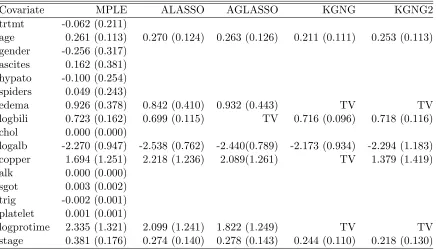
results for ALASSO and AGLASSO are copied directly from Yan and Huang (2012). We make
identifies three covariates with time-varying coefficients and KGNG2 identifies two, in which
edema and logprotime are the common covariates identified by both KGNG and KGNG2. On
the other hand, AGLASSO only selects logbilli as the covariate with time-varying coefficient.
These results partly agree with the findings of Tian et al. (2005), where only 5 covariates:
age, edema, logbili, logalb and logprotime, are considered in their time-varying coefficient Cox
model, and three covariates: edema, logprotime and logbili, are identified as having time-varying
coefficients. Finally, in Figures 2.3 and 2.4, we plotted the estimated coefficients by the initial
step (maximum local partial likelihood estimator), KGNG and KGNG2 for the 7 important
covariates and their associated 95% pointwise confidence intervals and simultaneous confidence
bands.
Table 2.4: Analysis results for PBC data. TV stands for time-varying coefficients.
Covariate MPLE ALASSO AGLASSO KGNG KGNG2
trtmt -0.062 (0.211)
age 0.261 (0.113) 0.270 (0.124) 0.263 (0.126) 0.211 (0.111) 0.253 (0.113) gender -0.256 (0.317)
ascites 0.162 (0.381) hypato -0.100 (0.254) spiders 0.049 (0.243)
edema 0.926 (0.378) 0.842 (0.410) 0.932 (0.443) TV TV
logbili 0.723 (0.162) 0.699 (0.115) TV 0.716 (0.096) 0.718 (0.116) chol 0.000 (0.000)
logalb -2.270 (0.947) -2.538 (0.762) -2.440(0.789) -2.173 (0.934) -2.294 (1.183) copper 1.694 (1.251) 2.218 (1.236) 2.089(1.261) TV 1.379 (1.419)
alk 0.000 (0.000)
sgot 0.003 (0.002) trig -0.002 (0.001) platelet 0.001 (0.001)
logprotime 2.335 (1.321) 2.099 (1.241) 1.822 (1.249) TV TV
0 500 1500 2500 −6 −2 2 edema (Initial) days beta(t)
0 500 1500 2500
−6 −2 2 edema (KGNG) days beta(t)
0 500 1500 2500
−6 −2 2 edema (KGNG2) days beta(t)
0 500 1500 2500
−15 −5 5 15 copper (Initial) days beta(t)
0 500 1500 2500
−15 −5 5 15 copper (KGNG) days beta(t)
0 500 1500 2500
−15 −5 5 15 copper (KGNG2) days beta(t)
0 500 1500 2500
−10 0 5 logprotime (Initial) days beta(t)
0 500 1500 2500
−10 0 5 logprotime (KGNG) days beta(t)
0 500 1500 2500
−10 0 5 logprotime (KGNG2) days beta(t)
0 500 1500 2500 −0.5 0.5 age (Initial) days beta(t)
0 500 1500 2500
−0.5
0.5
age (KGNG)
days
beta(t)
0 500 1500 2500
−0.5
0.5
age (KGNG2)
days
beta(t)
0 500 1500 2500
0.0
1.0
logbili (Initial)
days
beta(t)
0 500 1500 2500
0.0
1.0
logbili (KGNG)
days
beta(t)
0 500 1500 2500
0.0
1.0
logbili (KGNG2)
days
beta(t)
0 500 1500 2500
−10 0 5 logalb (Initial) days beta(t)
0 500 1500 2500
−10 0 5 logalb (KGNG) days beta(t)
0 500 1500 2500
−10 0 5 logalb (KGNG2) days beta(t)
0 500 1500 2500
−0.5 0.5 1.5 stage (Initial) days beta(t)
0 500 1500 2500
−0.5 0.5 1.5 stage (KGNG) days beta(t)
0 500 1500 2500
−0.5 0.5 1.5 stage (KGNG2) days beta(t)
2.5
Discussion
We propose a kernel group nonnegative garrote (KGNG) estimation method and its variant
(KGNG2) for automatic structure selection and coefficient estimation in a time-varying
coef-ficient Cox model. We establish the asymptotic properties, including structure selection
con-sistency and asymptotic distributions, of our estimators for both constant and time-varying
coefficients. Numerical studies have shown the competitive performance of the proposed
meth-ods compared with existing approaches.
In this chapter, we only focus on the case with fixed dimensionp, and pis smaller than the
sample sizen. Forp > ncase, a penalty term needs to be added to (2.2) to get reasonable initial
estimates of the coefficient functions. Then Step 2 and 3 can follow similarly as proposed in this
chapter. For an ultra-high dimension case, say,pn, a screening procedure can be utilized to remove the noisy covariates beforehand. Then the dimension of the model can be decreased to a
value that can be handled directly. However, a screening procedure for time-varying coefficient
Cox model has not yet been developed in the literature, and it needs further investigation.
Since the proposed procedure depends on a large number of tuning parameters, it may be
useful to develop a statistical test to check the goodness-of-fit of the final estimated model. We
think that a cumulative sums of martingale residuals-based goodness-of-fit test can be derived
for the final estimated model, following the techniques of Lin, Wei and Ying (1993). A similar
goodness-of-fit test procedure was developed for the Dantzig selector in Cox’s proportional
hazards model (Antoniadis, Fryzlewicz and Letue, 2010). This is an interesting topic that needs
further investigation.
Another interesting problem, as suggested by a referee, is to extend the proposed methods to
domain selection, i.e., to develop a procedure which estimates the coefficients as exactly zero on
parts of the time domain, and as nonzero (and time-varying) on the remaining parts. One simple
solution would be to chop the coefficient functions evenly into small pieces on the study time
challenging. The proposed KGNG/KGNG2 methods for structure selection can be regarded
as a preliminary step for domain selection since they can help to remove all the covariates
with null or constant effects and thus achieve effective dimension reduction. Then, the domain
selection can only focus on the selected covariates with truly time-varying coefficients. This is
an interesting extension that warrants our future research.
2.6
Supplement
This supplementary section contains the proofs of Lemma 2.2, and Theorem 2.1, 2.2 and 2.3.
Before we give the details of proofs, we first introduce some additional notation. With simple
matrix multiplication, we have λ(1)0 =P1λ0 and λ(0)0 =P2λ0, where
P1 =
0p2×p1 Ip2 0p2×p3 0p2×p1 0p2×p2 0p2×p3
0p3×p1 0p3×p2 Ip3 0p3×p1 0p3×p2 0p3×p3
0p3×p1 0p3×p2 0p3×p3 0p3×p1 0p3×p2 Ip3
(p2+2p3)×2p
; (2.7)
P2 =
Ip1 0p1×p2 0p1×p3 0p1×p1 0p1×p2 0p1×p3
0p1×p1 0p1×p2 0p1×p3 Ip1 0p1×p2 0p1×p3
0p2×p1 0p2×p2 0p2×p3 0p2×p1 Ip2 0p2×p3
(2p1+p2)×2p
. (2.8)
Let λ0 = (λ(1)0
T
,λ(0)0 T)T. We also have λ
P41λ(1)+P42λ(0), where
P3 = (P31|P32) =
0p1×p2 0p1×p3 0p1×p3 Ip1 0p1×p1 0p1×p2
Ip2 0p2×p3 0p2×p3 0p2×p1 0p2×p1 0p2×p2
0p3×p3 Ip3 0p3×p3 0p3×p1 0p3×p1 0p3×p2
p×2p
; (2.9)
P4 = (P41|P42) =
0p1×p2 0p1×p3 0p1×p3 0p1×p1 Ip1 0p1×p2
0p2×p2 0p2×p3 0p2×p3 0p2×p1 0p2×p1 Ip2
0p3×p2 0p3×p3 Ip3 0p3×p1 0p3×p1 0p3×p2
p×2p
. (2.10)
LetL2n(λ1,λ2;fm,βe
∗
(·)) andQ2n(λ1,λ2;fm,βe
∗
(·)) denote the partial likelihood and penal-ized partial likelihood in equation (2.3) respectively. We then have
L2n(λ1,λ2;m,β(·)) =
n X i=1 Z τ 0
a(s)
TZ
i−log
n X
j=1
Yj(s)ea(s)
TZ j
dNi(s);
Q2n(λ1,λ2;m,β(·)) =−L2n(λ1,λ2;m,β(·)) +θ1kλ1k1+θ2kλ2k1,
where
a(s)≡a(s,λ(1),λ(0);m,β∗(·))≡a(s,λ1,λ2;m,β∗(·)) =λ1◦m+λ2◦β∗(s). (2.11)
Let U(λ1,λ2;m,β∗(·)) and H(λ1,λ2;m,β∗(·)) denote the vector and matrix of the first and
second order partial derivatives of L2n(λ1,λ2;m,β(·)) with respect toλ= (λT1,λT2)T. Thus
U(λ1,λ2;m,β(·)) =
n X i=1 τ Z 0
A(s) (Zi−E(a(s), s))dNi(s),
H(λ1,λ2;m,β(·)) =−
n X i=1 τ Z 0 A(s)
S(2)(a(s), s)
S(0)(a(s), s) −
S(1)(a(s), s)
S(0)(a(s), s)
!⊗2 A(s)
TdN