ABSTRACT
VIVEK. LocalMine - Probabilistic Keyword Model for Software Text Mining. (Under the direction of Dr. Timothy Menzies.)
Traditionally software change messages are classified as "bug-fixing commits" or "not" using a
keyword-based model. This classification is very useful in defect prediction, automatic program
repair and fault localization. However, these keywords are usually generic like "bug", "fix" or "patch".
These special words do not characterize all variants of bug-fixing change messages. In some cases
the keywords are very specific to a software project. And, developing a keyword model for another
project requires manually discovering keywords specific to that project. Recently, it has been seen
that automated machine learning approaches for change message classification using probabilistic
models have been successful. However, these studies are still based on generic "special" keywords.
To address these problems we propose LocalMine which is based on probabilistic approaches for
keyword modeling. LocalMine does not rely on earlier generic keywords for classification, rather
it creates features based on the probabilistic model that discovers the keywords for a particular
project. Then it uses these features to train a machine learning binary classifier. The results are
promising for change message classification. For commit messages dataset, LocalMine achieves
82% recall (median over 3 projects) with a 61% F1 score. This is significantly better than results from
state of the art models that use keyword methods (76% recall and 26% F1 score). One interesting
feature of LocalMine is that it generalizes to different kinds of natural-language software texts. For
example, on tech debt dataset it has 76% recall and 64% F1 score, compared to 72% and 59% for
the baseline model, respectively. LocalMine can be very successful in software text mining. These
© Copyright 2019 by Vivek
LocalMine - Probabilistic Keyword Model for Software Text Mining
by Vivek
A dissertation submitted to the Graduate Faculty of North Carolina State University
in partial fulfillment of the requirements for the Degree of
Master of Science
Computer Science
Raleigh, North Carolina
2019
APPROVED BY:
Dr. Min Chi Dr. Kathryn Stolee
DEDICATION
BIOGRAPHY
The author was born in small town of Danapur in the state of Bihar in India. He obtained his Bachelor
of Technology degree in Electrical Engineering (Power) in 2015 from Indian Institute of Technology
Delhi in New Delhi, Delhi, India. He worked as software engineer for 2 successful startups in India
before starting his Master of Science degree in Computer Science in Fall of 2018 from North Carolina
State University, Raleigh, NC, USA. With a massive interest in machine learning and text mining,
the author undertook this thesis work under Dr. Tim Menzies following interesting coursework
of Foundations of Software Science in Fall 2018. The author also underwent summer internship
at LexisNexis, Raleigh, NC, USA working on natural language processing and machine learning
ACKNOWLEDGEMENTS
I would like to thank my advisor, Dr. Timothy Menzies and RAISE lab for their help and guidance.
In particular, I would like to thank Dr. Menzies for believing in my approach and encouraging me
to explore software text mining. For different queries and datasets I often sought help from Rahul
Krishna, Amritanshu Agrawal, Fahmid Fahid and Huy (Ken) Tu. I am grateful for their constant help
TABLE OF CONTENTS
LIST OF TABLES . . . vi
LIST OF FIGURES. . . vii
Chapter 1 INTRODUCTION . . . 1
Chapter 2 RELATED WORK. . . 5
Chapter 3 RESEARCH METHODOLOGY . . . 8
3.1 Datasets . . . 8
3.2 Latent Dirichlet Allocation . . . 10
3.3 Text Processing . . . 11
3.4 Random Forest Classifier . . . 12
Chapter 4 EVALUATION STRATEGY. . . 13
4.1 Classification metrics . . . 13
4.2 Statistical test . . . 14
Chapter 5 EVALUATION OF BASELINE MODELS . . . 15
5.1 Baseline Models . . . 15
5.1.1 Fixed Dictionary . . . 16
5.1.2 Generalized Evolving Dictionary . . . 17
5.1.3 Latent Dirichlet Allocation with Manual Annotation of Topics . . . 17
5.1.4 Semi-supervised Latent Dirichlet Allocation . . . 18
5.2 Comparing Baseline Models . . . 18
Chapter 6 LOCALMINE ALGORITHM AND EVALUATION. . . 21
6.1 Algorithm . . . 21
6.2 Evaluation Metrics . . . 22
Chapter 7 GENERALITY OF LOCALMINE . . . 25
7.1 Datasets . . . 26
7.1.1 Stack Overflow dataset . . . 26
7.1.2 Technical Debt Dataset . . . 26
7.2 Evaluation . . . 27
7.2.1 StackOverflow . . . 27
7.2.2 Technical Debt . . . 29
Chapter 8 SUMMARY . . . 33
Chapter 9 THREATS TO VALIDITY AND FUTURE WORK . . . 36
9.1 Threats To Validity . . . 36
9.2 Future Work . . . 38
Chapter 10 CONCLUSIONS. . . 39
LIST OF TABLES
Table 3.1 Commits dataset . . . 9
Table 5.1 Mockus et al.[1]dictionary . . . 16
Table 5.2 Mauczka et al.[6]dictionary . . . 16
Table 5.3 Evaluation metrics of baseline models . . . 19
Table 6.1 Evaluation metrics of LocalMine (** indicates Cohen’s small effect size) . . . 23
Table 6.2 LocalMine Topics - Top 10 keywords per topic . . . 23
Table 6.3 LocalMine Vocabulary . . . 24
Table 7.1 StackOverflow.com dataset . . . 26
Table 7.2 Technical Debt Dataset . . . 27
Table 7.3 StackOverflow Dataset Metrics . . . 28
Table 7.4 StackOverflow Topics - Top 10 keywords per topic . . . 30
Table 7.5 Technical Debt Dataset Metrics . . . 31
LIST OF FIGURES
Figure 3.1 LocalMine Core Flow . . . 9
Figure 5.1 Evaluation of the baseline models on different data-sets . . . 16
Figure 6.1 Evaluation of LocalMine with baseline . . . 23
Figure 7.1 Performance on Stack Overflow dataset . . . 29
CHAPTER
1
INTRODUCTION
Software projects have become pervasive in industry. With increase in the number of projects,
in-creases the number of software related texts. For instance, most of the software projects uses version
control system. Github is a popular version control system. Github reports (octoverse.github.com)
31 million developers, 96 million repositories and 200 million pull requests in 2018. Another source
of software texts is Stack Overflow (a question answering platform) originally created for
profes-sional and enthusiast programmers. According to insights.stackoverflow.com, there are 100 million
users, 18 million questions and 28 million answers. This is humongous volume of texts. To extract
knowledge from these texts we need to have automated text mining models. Therefore, it is very
important to study software text mining.
To limit the scope for the purpose of this thesis, we focus on a specific type of software text
mining. We will study change messages. Change messages are very crucial to version control system.
It is, generally, a small size text that captures information on the purpose of commit. In this way not
only does version control system maintain the software, it also helps maintain history of a particular
purpose, at what time, what files that change corresponds to and why that change.Why that change
is very important as this natural language message can give a wealth of information on the nature of
the change introduced.
Classifying a change message as a bug-fixing commit or not requires understanding of the
natural-language texts in the commit message. It is a challenge to understand natural-language
software texts because they do not follow the natural convention of natural language, particularly
related to grammar. Traditionally change message classification has been done using a generic
key-word dictionary[1] [2]. We have also seen that probabilistic methods have shown some success too,
particularly, Latent Dirichlet Allocation (LDA)[3] [4]and probabilistic Latent Semantic Analysis[5].
Taking inspiration from success of dictionary models that rely on "special" words, our motivation
is to create a keyword model that is automated and can be applied to any version control project. An
automated model can be built on top of probabilistic approaches to capture keyword. In this project,
we explore automated machine learning methods to predict if a change message corresponds to
a bug-fix. Most of the git projects are managed by only a certain group of individuals, hence, they
tend to have a characterizing way of expressing commit messages. However, as all of them are
software projects, certain software engineering domain specific words are frequently used. These
general keywords are more prominent to identify a bug-fixing commit, but not exhaustive. Due to
this localized nature of software management, we need to explore a model that learns these words
specific to a project. In a nutshell, we will explore an automated generic model that learns "local"
keyword features for discovering bug-fixing messages.
Mauckza et al.[6]proposed a variation of keyword based approach to automate classification of
change messages. This work has been based on Mockus et al.[1]natural language "modification
request" words. Keyword based models have been a benchmark for change message classification.
In this project, we aim to question if a generic keyword dictionary is suitable for all projects. Or if
there exists some localized natural language reference of equal importance with respect to global
software engineering specific keywords. This leads to our first research question
• RQ1:Does an automated probabilistic model perform better than generic dictionary based classifiers?
keywords specified by[1]. In Zhong et al[7]if words "bug" or "fix" appeared in the commit message,
it has been classified as bug-fixing commit. Similarly, Martinez et al[8]we see that words that match
"bug", "fix" or "patch" are called as bug-fix patterns. We see a similar way of labeling or classification
in Kim et al[9]and Osman et al[10]approaches for text classification of bug-fixing patterns. We
have seen that probabilistic approaches have been used earlier for change message classification.
In particular, we will take inspiration from[11]approach of using Latent Dirichlet Allocation, which
is very effectively used to identify keywords for a particular topic. Because of the nature of these
topics being a latent feature of the corpus of text, it is difficult to attribute the latent topic to a class.
Comprehensibility of the topics is a major concern. We aim to build features for the classifier that
has comprehensible features. One interesting approach Ying et al.[4]takes is that of keeping number
of topics equal to number of labels. This approach helps in comprehensibility.
• RQ2:How many topics should be specified for LDA?
Our motivation is to build a generic model that can do change message classification specific to
a project. One interesting feature of building this automated keyword model for change message
classification is that it can be generalized to other types of software text mining problems. So, we
aim to verify generality of LocalMine on stackoverflow questions and technical debt datasets. These
datasets comprise of natural language texts in software engineering domain as described in Chapter
7.
• RQ3:How does LocalMine generalize to different natural-language software texts, specifically stackoverflow and technical debt dataset?
Although, we focus mostly on change message classification but our core aim is to build a
proba-bilistic keyword model that can be used for any type of natural-language software text mining. We
establish that by answering this research question.
The paper proceeds as follows. In Chapter 2, earlier works in the space of change message
classi-fication are detailed. The paper proceeds with explaining the research methodology for LocalMine
in Chapter 3. The metrics used for evaluating LocalMine and the baseline models are explained
in Chapter 4. Chapter 5 deals with evaluation of the baseline models and corresponding useful
LocalMine with different natural language texts pertaining to software engineering domain. Chapter
8 delves into answers for research questions framed above. Chapter 9 discusses threats to validity
and future work that can be extended from this keyword model. And Chapter 10 concludes on the
CHAPTER
2
RELATED WORK
In Chapter 1 we gave an introduction to what we are trying to achieve with LocalMine. In this chapter,
we discuss earlier works in the same domain.
The research field of change classification has been evolving over many decades. The first
classification system of software changes was put forward by Swanson in 1976[12]. Swanson defined
that a change can be classified in one of the following 3 categories:
• Corrective: Changes that are fix for prior failures.
• Adaptive: Changes in environment.
• Perfective: Changes to improve efficiency.
Based on this foundation, corrective software changes have been studied for the purpose of software
maintenance[1]and defect prediction[9]. Mockus and Votta[1]established that to understand
the motive of introducing a change in the software can be estimated from the associated message.
Kim et al[9]mentions that abug-introducingchange can be identified through the analysis of a
bug-fix. These bug fix changes are in turn identified by mining change messages. They propose that
change message classification can be done through two ways:
• Keyword search model aimed at searching for well identified keywords such as "Fixed" or
"Bug". This is a reasonable assumption and is also seen from Hindle et al. to be successful[3].
This sort of injection of domain knowledge into the classification of change message does
prove helpful. Therefore, we use a similar model as our baseline.
• Searching for references for bug reports such as their IDs. It is very difficult to track as Issue
tracking system is often used for Feature tracking too. These two data, generally, reside in
two different systems i.e. version control and feature tracking. It seems that injecting more
domain knowledge may help us identify bug-fixing commits more precisely.
These methods of identifying bug-fixing commits are costly. It is not easy to get version control
data and tracking data together, as they are generally two separate systems. Moreover, using issue
tracking system IDs does not resonate well with our main idea of simple automation of text mining
model. A generic keyword based model does well for identifying the bug-fix commits, but it is not
local to the project. Tracking issue IDs is local to a project but is not a scalable. We learn from this
limitation and try to come up with an algorithms that is both automate, and can identify both
general and local keywords corresponding to a bug-fix commit message.
Initial models were built on keyword basis[1] [2] [13]and Naive Bayes classifiers[14]. In a way, it
can be said that these classifiers were either look up or needed help from experts for understanding
classification. Antonio et al[14]proposed a method based on decision trees, naive bayes and logistic
regression models that does change message classification based on external features, and not
just commit messages. However, Support Vector Machine (SVM) remains a popular choice for this
classification[11] [9]. Hindle et al.[3]employed the Weka Machine learning version of SVM. Random
Forest have also been shown to be used successfully for classification task in software text mining
[15]. We find Random Forest to be most robust to any type of data because of its ensemble nature.
Hence, we use Random Forest in our experiments.
Mauczka et al.[6]proposed a variation of keyword based approach to automate classification of
evolves as more and more commits messages are studied. However, a stopping criteria needs to
established. This is very specific to a project and has good performance, however the model is
still rule based and manual intervention is required. Hindle et al.[11]discusses Latent Dirichlet
Allocation (LDA), which is a more automated way of discovering keywords. Use of probabilistic
model helps discovering more features and properties of natural-language text. In this particular
case, it helps discover keywords. A dictionary model is not scalable as it always needs manual
intervention, even when the keyword is developed specific to the project as modeled by Mauczka
et al.[6]. Hindle et al[11]used LDA based method to analyze this kind of unstructured data i.e.
raw texts, and then assign meaning to group of topics discovered. This is an attempt to provide
comprehension to latent topics of LDA. LDA based text mining proves to be useful in increasing
comprehension of the model as opposed to only TF (term frequency) and TFIDF (term frequency
inverse document frequency) models[16]. However, assigning meaning to topics is still a manual
process. LocalMine overcome this by taking inspiration from Ying et al[4]choice of keeping number
of topics only corresponding to number of classes. In this way, the topics become comprehensible.
However, to further utilise the topic for classification we require a classifier. Hence, Ying et al.[4]
uses "signifier" documents to ascertain that documents generated from specific seed values. They
try to take benefit of property of LDA to have an order bias. However, we do see that taking LDA to
be the sole classifier does not yield us results significant enough compared to dictionary models.
Therefore, we will see that in LocalMine, we resort to LDA to generate comprehensible features only
and rely on Random Forest as a classifier for further classification utilising these features.
Another tool that has been studied and shown to have success is pLSA (probabilistic Latent
Sematic Analysis)[5]. As established by Blei et al[17]LDA is an improvement upon pLSA, we use
LDA for our study. Studies have shown the success of LDA models for defect prediction[18] [19]
[16] [4]. Defect prediction, fault localization and automated program repair are few areas where
understanding of bugs and bug-fixes can tremendously help improve efficiency of their applications.
Success of these related works and applications of change message classification have motivated
us to explore keyword modeling using probabilistic approaches, specifically LDA, for our study.
CHAPTER
3
RESEARCH METHODOLOGY
LocalMine is based on raw textual data. To employ methods of LDA and Random Forest, we require
to convert text to vectors. LocalMine makes use of a vectorization technique. In the next few sections
of this chapter we will see how datasets and methods of this research have been set up. As you can
see from Fig 3.1, first LocalMine processes raw textual data. After processing of the texts to convert
them to Tf-idf vectors to feed to LDA. We extract top N (=25) words based on words in each topic
and get K(=2) probabilities of topics for each commit message. These 2*N+K features are fed to a
Random Forest classifier for binary classification.
3.1
Datasets
The data under study here is collected through mining of open source software projects from
github.com. Three projects were selected for this study. These are popular github projects in the
field of computation. They have a large number of commits, as will be explained later. The commit
messages were labelled during a mechanical turks study. The mechanical turks were graduate
Figure 3.1LocalMine Core Flow
Table 3.1Commits dataset
Project 0: Not bug-fix 1: bug-fix % of 1s avg # tokens vocab len
abinit 4024 572 12 5 3629
libmesh 6462 651 9 7 2798
mdanalysis 2802 379 12 7 2889
USA. The details of the project is shown in Table 3.1.
Each of the commit messages has been labelled as 0 or 1. Here, label 1 corresponds to a message
being tagged as bug-fixing commit. We see that on average each project has approximately 90%
non-buggy commits. This is expected. Otherwise, a software project is poorly managed if there
are a lot of bug-fix commits. Also, we can see from Table-3.1, that on an average, we have buggy
commits to be approximately 10 percent of the total commits. LocalMine first processes the commit
message text by tokenizing and removing unnecessary tokens like stopwords and symbols like ’/’,
’#’, ’-’, etc. The number of tokens in each project is mentioned in ’avg # tokens’ column in Table-3.1
and standard deviation of 4 tokens on average across project. This mean length is almost equally
divided among both the classes. Maximum length of tokens in processed messages of a project goes
high as 132. And minimum length is 1. We discard those message tokens that may not contain any
terms after text processing. We also find that unique number of words in each project is as shown in
3.2
Latent Dirichlet Allocation
Topic modeling algorithms are statistical methods that analyze the words of the original texts
to discover the themes that run through them[17]. Topic modeling enables us to organize and
summarize electronic archives at a scale that would be impossible by human annotation[17]. Specific
to text based corpus, we can say that Latent Dirichlet Allocation (LDA) is an unsupervised clustering
algorithm aimed at clustering the words in the corpus to specifictopics. Since, it is probabilistic in
nature, it means that certain words can reside in different topics. According to Blei et al.[17]the
joint distribution of LDA can be described as
P(w,z|α,β) =P(w|z,β)∗P(z|α)
Here,zis the topic andwis the word. And,αandβare model parameters. P(z|α)is the probability
of topiczappearing in the documentd. P(w|z,β)describes the probability of wordwappearing
in a particular topicz. We will make use of both P(z|α)and P(w|z,β). We use python scikit-learn
implementation of LDA. There are certain hyper parameters to that model.Number of topicsis
the first and foremost hyper parameter. We need to decide how many topics prior to the training
process. In our work, we classify change messages in two distinct values 0 or 1 indicating non-buggy
or buggy commit message. Hence, our natural option for selecting’k’i.e. number of topics is 2. This
ensures that the topic could correspond to these labels. This decision greatly enhances our ability
to interpret these topics. This is great addition to comprehensibility of our model. This decision is
inspired by a similar work of Ying et al on change message classification where they choose number
of topics corresponding to number of classes[4]. Another hyper parameter is total number of words
to consider before sending to LDA for training. This is calledmaximum number of features, i.e.
the number of dimensions. This sets the maximum number of words to be fed to LDA. We see
that lower number of maximum features is much better[20]. For this experiment we default to
the value of 100 for this purpose. Another hyper parameter that we change in our experiment is
number of iterationsfor LDA. We set it to 20. Essentially, LDA is a generative probabilistic model.
LDA has two matrices. First, describes the probability of selecting a particular word when sampling
Now to build word versus topic matrix, a sample is drawn from dirichlet distribution for each topic
usingβas input. For second a composite is defined as a document and a sample is drawn from
dirichlet distribution usingαas input. Then the actual composites are defined basis these two
matrix for each document. LDA does expectation maximization in each iteration. We setmaximum
number of featuresas 100 for our study. The LDA iteration method is Gibbs sampling. The other
hyper parameters namelyβ, and that we choose are taken from literature study[4]or set to default.
LDA is a common technique in text mining used for dimensionality reduction[21]. TF and
TF-IDF are common feature generation methods applied to text mining. The order of number of
features is 1000s or more. However, with LDA we get very small number of dimensions. As we keep
only 2 topics, we have 2 features corresponding to that, then we choose top words from these topics,
25 for LocalMine. So, this is a reduced dimension from 25+25+2 as opposed to 100s or 1000s in
TF-IDF vectorization. The output of LDA is very comprehensible[21] [16]. We agree with their work
and validate LDA and comprehensibility it offers in this paper.
3.3
Text Processing
Even before we feed data to LDA, we need to process the natural language expressed in change
messages. Some examples of change messages are as follows:
• Quickfix: paral_kgb=1 shoulkd be ignored for DFPT (was OK in previous versions)
• Fix bug that was preventing the kxc to be stored.
• multibinit: add initialization for the fit and add restartxf -3,0.0.
• Fixup receive_packed_range call.
These messages are expressed in a natural language, not necessarily following the English
grammar well. Most of the the times it contains only few words. We want to vectorize these words
to feed into LocalMine’s LDA. First of all we extract important words from this message. Using the
python NLTK module, the words are first tokenized using RegExp Tokenizer. Then all the tokens
which are either numerical values of symbols or punctuations are removed. To remove redundant
taken that even if there remains any token of length 2 character or less it is removed. In addition, all
tokens are stripped of white spaces and symbols like "-" and "_". Finally, the tokens are lemmatized.
Lemmatization brings the natural language English word to its root form. For instance, "fixes" is
reduced to "fix".
Above processing of words to a list of tokens gives us the corpus that we want the vectorizer to
fit on. We use TF-IDF vectorizer. TF-IDF puts higher weight on word which are very frequent in a
document and rarer across documents. This is to ensure that the words selected for training LDA
are discriminatory of the documents. Maximum number of features is defined here as the length of
our feature space for our experiments. We define it as 100.
3.4
Random Forest Classifier
Random forest (RF) is an ensemble approach that is specifically designed for decision tree classifier.
Simply defined as collection of decision trees that are used for consensus on the decision. Each
decision tree in RF is built on randomly selected subset of features. We control the depth and number
of trees in the forest. For our case, we use python scikit-learn implementation of RF and we have
set number of estimators to be 100 and max_depth of 100. Since, we have top 25 words and 2 topic
probabilities, summing to 52 features, we believe this is a reasonable choice of hyperparameter.
Moreover, we find that these parameters are values found by grid search over discrete values. The
main benefits of RF are: 1) Feature importance is defined automatically, it removes the bias of
pre-defined keywords and onus of curating important keywords for our case; 2) As RF is an ensemble of
CHAPTER
4
EVALUATION STRATEGY
In this chapter, we talk about the different metrics that are used to evaluate performance of
Lo-calMine.
4.1
Classification metrics
Since this is a binary classifier, evaluating our results on the basis of confusion matrix seems apt.
We will evaluate the performance of the model by precision, recall and F1 score. The definitions of
these metrics are below:
• Precision: Defined as number of true labels as a fraction of total truly predicted labels, it
says, number of true positives of all the positive predicted labels. Basically it indicates, of all
positives that was predicted how many of them were actually positive. For precision score, the
higher the better.
Precision= True Positive
True Positive+False Positive
number of true positives of all the positive labels. Basically it means, of all the true labels how
many did the model correctly recall. For recall score, the higher the better.
Recall= True Positive
True Positive+False Negative
• F1-measure: F1 measure is the harmonic mean of precision and recall. For both precision and
recall to be high, we need to have high F1 score.
F1=2∗Precision∗Precision Precision+Recall
Since, F1 is harmonic mean of precision and recall, we need not mention precision explicitly as it is
implied. So, in some cases we have mentioned recall and F1 score only. We also report F2 score in
some cases. F2 score is derived from general form of F1 score. F2 score puts higher weight on recall,
i.e. cost of making False Negative is higher.
4.2
Statistical test
Effect size is necessary to be ascertained in any phenomenon. As popularly said, don’t sweat small
stuff. If the effect size is small, then the success of the experiment holds little value. For testing
success of LocalMine, we will use Cohen’s delta test. Cohen’s d is defined as follows:
d =x¯1−x¯2 s =
µ1−µ2 s
Here, ¯x1and ¯x1refer to mean of LocalMine and baseline, respectively. And,sis the standard deviation
of LocalMine. We will look at the precision, recall and f1 and test with respect to Cohen’s delta. We
define small effect corresponding to Cohen’s convention i.e. 0.2 as small effect size. If any result
corresponds to small effect size, it will be mentioned with a (*) star in the tables. Cohen’s conventional
criteria that defines an effect size i.e. measure of magnitude of phenomenon, assmall),mediumor
big, is acceptable in most studies. However, these are only rule of thumb and should be used for
CHAPTER
5
EVALUATION OF BASELINE MODELS
In this chapter, we will discuss about the baseline models. We have chosen two models that are
dictionary models and two models that can be automated and are probabilistic models. One
inter-esting thing to note is that we have implemented the model in python by carefully understanding
the algorithm and parameters provided in respective papers. Then we evaluate the models on the
commit messages dataset to understand their true baseline metrics in regards to our experiment of
LocalMine on commit messages dataset.
5.1
Baseline Models
As discussed in earlier chapters we have some keyword dictionary lookup models and some
proba-bilistic models that have shown to perform well for change message classification. We discuss four
models proposed in literature. We argue for two of them to be contestants for baseline against which
Figure 5.1Evaluation of the baseline models on different data-sets
Table 5.1Mockus et al.[1]dictionary Category Associated words
Corrective fix, bug, problem, incorrect, correct, error, fixup, fail Adaptive new, change, patch, add, modify, update
Perfective style, move, removal, cleanup, unneeded, rework
Table 5.2Mauczka et al.[6]dictionary Category Associated words
Corrective wrong, except, cause, null, warn, correct, valid, fail, bug, dump, opps, error, invalid, failure, incorrect, bugfix, fix, problem, bad, miss
Adaptive context, introduce, future, appropriate, information, add, compatibility, sim-ple, structure, configuration, available, require, init, function, internal, security, current, config, provide, easier, switch, default, faster, text, release, install, user, feature, old, useful, method, change, trunk, protocol, patch, version, replace, necessary, new, create
Perfective clean, include, whitespace, dead, consistent, prototype, static, style, remove, definition, header, documentation, variable, inefficient, useless, cleanup, move, unused, declaration
Blacklist cvs2svn, cvs, svn
5.1.1 Fixed Dictionary
Mockus et al.[1]studied and created classification based on word frequency analysis and keyword
clustering. Mockus et al. derives inspiration from Swanson’s classifications[12]. They have created a
generic keyword based dictionary that corresponds to Swanson’s classes[12]. It has been envisioned
that there are 3 primary types of maintenance: fault fixes for keywords such asfix, problem, incorrect,
correct, new code development for keywordsadd, new, modify, updateand code improvement
for keywordscleanup, unneeded, remove, rework. These keywords help in clustering of similar
words based on some heuristics, followed by a simple classification algorithm. The keywords used
as validation method in the study. Kappa coefficient is 0.5 indicating moderate agreement. A log
linear model was employed to further this validation that indicated strong agreement between
automatic classification and developer’s classification. A claim is made that this method can be used
for different projects as only basic information from version control system is used. This is a very
simple algorithm and very comprehensible. It can be easily reproduced. So, it is a good candidate as
baseline for our project.
5.1.2 Generalized Evolving Dictionary
Mauczka et al.[6]proposed a variation of dictionary based approach to automate classification of
change messages. This work has been based on Mockus et al.[1]natural language "modification
request" words. Weights for certain keywords were also defined. Since, the weight was subject to
researchers tuning of their algorithms, it may have suffered a bias. A first set of 3 keywords is for
each category is selected based on prior work[13] [1]. This keyword dictionary is extended by new
words basis a frequency analysis algorithm until 80% of the project is classified. This dictionary
was localized to a project starting from an initial globally accepted seed. A modified version of the
original dictionary is shown in Table-5.2. However, they go on to do validation over cross-projects to
establish a general keyword dictionary. Mauczka et al.[6]made an extension of Swanson’s original
classification by adding aBlacklistcategory. This dictionary can be seen as an extension of exemplary
work of Mockus et al.[1]. Moreover, it has been validated across different projects. Hence, this model
can also be a viable candidate for baseline.
5.1.3 Latent Dirichlet Allocation with Manual Annotation of Topics
Hindle et al.[11]discusses Latent Dirichlet Allocation (LDA). The proposal says discovering change
message classification topics over a window of time. LDA is a mixture model based method used to
analyze unstructured data. Hindle et al.[11]used certain parameters to conclude topic meaning.
Top 10 words were seen among all 20 topics. Then they were manually assigned a topic name. If
some topic did not give proper meaning it was discarded. The main objective is to create a trend in
topics for a software project. For this purpose, similarity between two topics needs to be computed.
A simple algorithm of 8 matches among top 10 words implied similar topic. There are many "magic"
automated process. The final classification of a topic is based on human intervention. Hence, it is
kind of semi-supervised classification based on LDA with software domain knowledge injection.
Such a model is viable candidate for our baseline.
5.1.4 Semi-supervised Latent Dirichlet Allocation
Ying et al.[4]proposes an automated discovery of change message features using LDA. The
al-gorithm includes a semi-supervised LDA method for change message classification. It is called
semi-supervised as topic generation and data transformation through LDA is largely depended on
signifier documents. A set of documents is built as signifier documents corresponding to Mauczka
et al.[6]extended dictionary that is validated across project. The exact dictionary used is shown in
Table-5.2. In a way, Ying et al. method is initialized using Mockus et al.[1]"keywords" and is based
on Swanson’s original change message classification[12]. Key difference of this algorithm is two
folds:
• Injection of software engineering domain knowledge to generate topics and words
distribu-tion.
• Classification algorithm is similarity between topic distribution of signifier documents and
target documents.
Validation is done through developer survey and accuracy is reported. Approximately, 85% of the
messages were classified with approximately 70% accuracy. The algorithm is claimed to work on
cross project analysis of software change message classification because of developer agreement.
It’s dependence on both software domain knowledge and automated change message classification
with features specific to a project makes it a good candidate for baseline.
5.2
Comparing Baseline Models
For the purpose of establishing a baseline, a version of each of the above is implemented by us. We
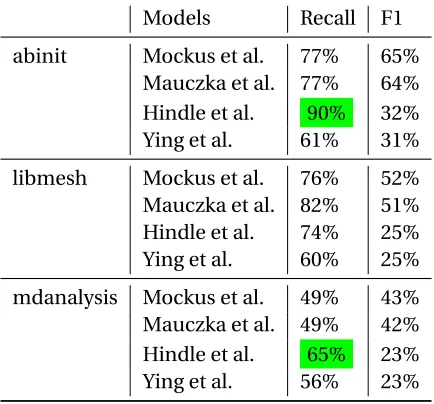
sample the data with 20 times and report the mean results as shown in Figure-5.1 and in Table 5.3.
The model for Mockus et al.[1]is implemented as a look-up dictionary as in Table-5.1. If any
Table 5.3Evaluation metrics of baseline models
Models Recall F1
abinit Mockus et al. 77% 65% Mauczka et al. 77% 64% Hindle et al. 90% 32% Ying et al. 61% 31%
libmesh Mockus et al. 76% 52% Mauczka et al. 82% 51% Hindle et al. 74% 25% Ying et al. 60% 25%
mdanalysis Mockus et al. 49% 43% Mauczka et al. 49% 42% Hindle et al. 65% 23% Ying et al. 56% 23%
implementation is for Mauczka et al.[6]. The dictionary look-up is mentioned in Table-5.2. This is
close to actual algorithm implemented in the paper and not exactly same, as in the paper there is
reliance on manual intervention for establishing classification. Our implementation of the models
has no human intervention. However, this is based on the final dictionary proposed for cross
project change message analysis by Mauczka et al[6]. The algorithm proposed by Ying et al.[4]
is implemented exactly as mentioned. The signifier documents used are as in Table-5.2. Ying et
al.[4]model is semi-supervised and is classified basis similarity to topic distributions in signifier
documents using cosine similarity. Also, we take inspiration of using LDA as language model as
mentioned in Hindle et al.[11]. A similar model is implemented. Instead of manual annotation of
a topic classification, we generated only 2 topics and useCorrectivekeywords from Table-5.1 to
annotate one of the topics as "corrective" topic. After a topic is annotated as buggy based on analysis
of top 10 words with the dictionary, we classify the change message according to the probability of
that topic.
We compare all the three software projects under study on the implementation of the baseline
models as described above. Although, Mockus et al.[1]and Mauczka et al.[6]are not automated
models but are dictionary lookup, they still tend to perform equally good as the other models for
the given dataset. One other thing to note is that all the models based on "corrective keywords" is
bug-fix indicating words. If we say that we require an automated language model rather a dictionary
based model, Hindle et al.[11]model is the most acceptable baseline. Otherwise, our baseline is
Mauczka et al.[6]keyword based model. So, we will evaluate our model, LocalMine, against both
CHAPTER
6
LOCALMINE ALGORITHM AND
EVALUATION
In this chapter, we talk about the main innovation of this thesis, the probabilistic keyword model i.e.
LocalMine. The algorithm of LocalMine is novel and inspired by the work of Ying et al[4]. LocalMine
uses LDA for feature generation, essentially keyword generation. These features are fed into a
binary classifier, Random Forest, for final prediction. We explain the algorithm for LocalMine model
building and evaluation on commits messages dataset in this chapter.
6.1
Algorithm
The text processed data is split into 80% training and 20% testing. From the training data create
a random dataset of 2:1 label counts i.e. one-third of data should be 1s and two-thirds as 0s and
drop other data points. Shuffle the training data. Using the TfidfVectorizer of python’s scikit-learn,
distributions. LDA is used to select features (words) that matter the most in this classification. We
select top 25 words from each LDA topics. We also take the topic probabilities of each commit
message.
First, after text processing and train/test split, we go through LDA transformation to get both
probabilities of topics and probabilities of feature words. Let’s call the two topic probabilities as
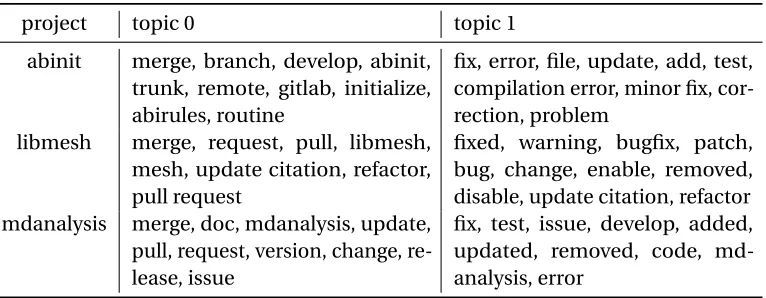
Topic_0andTopic_1. Table-6.2 describes the top 10 words found in each topic according to the
probabilities of occurrence in the topic. It is quite evident thatTopic_1corresponds to a topic that
describes bug fix words.
After LDA transformation, we go through the following algorithm:
1. Compute the probability of each word in the topic and store in a
word_topic_map
2. Go through each document.
• Iterate over all the initial tokens present.
• If a token matches the featured words, add the probability (from
word_topic_map
) ofit being in a topic.
• If the word is in both topics, use the maximum probability.
• Along with these 50 features, either 0 or otherwise computed in previous step, append
the topic probabilities for the document as last two features i.e. total 52 features.
3. Split train data into 80% and 20% for training and validation.
4. Feed these 52 columns to Random Forest(max_depth=100, n_estimators=100) for training.
5. Test on testing set.
6. Repeat the entire training process 20 times
7. Run Cohen’s delta test to assess for small effect size.
6.2
Evaluation Metrics
All the above steps including initial train/test split, training LDA and training RF is done 20 times
Figure 6.1Evaluation of LocalMine with baseline
Table 6.1Evaluation metrics of LocalMine (** indicates Cohen’s small effect size) project precision recall f1 f2
abinit 54% 80% 65% 73%
libmesh 47%** 86% 61% 74%
mdanalysis 43%** 81% 57% 69%
Table 6.2LocalMine Topics - Top 10 keywords per topic
project topic 0 topic 1
abinit merge, branch, develop, abinit, trunk, remote, gitlab, initialize, abirules, routine
fix, error, file, update, add, test, compilation error, minor fix, cor-rection, problem
libmesh merge, request, pull, libmesh, mesh, update citation, refactor, pull request
fixed, warning, bugfix, patch, bug, change, enable, removed, disable, update citation, refactor mdanalysis merge, doc, mdanalysis, update,
pull, request, version, change, re-lease, issue
fix, test, issue, develop, added, updated, removed, code, md-analysis, error
Performance of LocalMine model with corresponding baseline model i.e. Hindle et al and Mauckza
et al is show in Fig. 6.1. Table 6.2 shows the top words corresponding to the topics generated by LDA.
Looking at Table 6.2 we can easily point the topic corresponding to bug-fix, which Topic 1 in our
case. This comprehensibility is at par with comprehensibility offered by dictionary based models.
Moreover, the metrics of LocalMine, in terms of recall and F scores, outperform the baseline models.
It is also worth noting that LocalMine used the vocabulary mentioned in 6.3 for generating above
topic word distribution. The vocabulary is based on TF-IDF vectorization of the text corpus under
study i.e. commit messages. To come up with the final model we also do hyper-parameter
opti-mization over discrete values of various "magic" parameters involved in our study. The parameters
Table 6.3LocalMine Vocabulary project vocabulary
abinit abilint, abinit, abinit develop, abinit org, abirules, add, also, beauty, branch, branch develop, branch trunk, bug, bug fix, buildsys, case, change, compilation, compilation error, correct, correction, create, define, develop, develop gitlab, dfpt, doc, error, file, fix, fix bug, fix compilation, fix compilation error, fix minor, fix problem, fix typo, fixed, gitlab, gitlab abinit, gitlab abinit org, gitlab trunk, gitlab trunk abinit, gmatteo, gnu, hotfix, html, improve, input, input variable, input web, intel, issue, lesson, libxc, link, make, merge, merge branch, merge branch develop, merge remote, merge remote tracking, minor, minor fix, missing, modified, multibinit, new, new file, nonlinear, one, org, output, paw, problem, ref, ref file, reference, release, remote, remote tracking, remote tracking branch, remove, small, suppress, test, tolerance, topic, tracking, tracking branch, tracking branch trunk, trunk, trunk abinit, trunk develop, tutorial, typo, update, update ref, use, variable, version, web
libmesh add, added, adding, also, amr, assert, boundary, branch, bug, bugfix, build, case, change, changed, citation, class, code, comment, complex, constraint, data, default, dependency, disable, dof, elem, element, enable, enable complex, error, example, file, fix, fix disable, fix enable, fixed, fixing, function, get, header, include, libmesh, make, map, merge, merge branch, merge pull, merge pull request, mesh, method, mode, mpi, need, neighbor, new, node, non, one, option, order, output, parallel, parallelmesh, patch, petsc, point, pull, pull request, read, refactor, remove, removed, request, return, rule, run, set, side, solution, std, still, support, system, test, time, type, unused, unused variable, update, update citation, updated, use, user, variable, variable warning, vector, warning, work, write, wshadow
CHAPTER
7
GENERALITY OF LOCALMINE
To establish generality and robustness of our model we evaluate the performance of LocalMine
model on two different datasets. These datasets are natural-language software texts. The datasets
have been generously provided by Real-world Artifical Intelligence for Software Engineering research
lab in Department of Computer Science at NC State. In this chapter, we will experiment LocalMine
with different types on natural language texts. The first dataset is Stack Overflow dataset. This dataset
primarily has questions. The content is mostly natural language and is specific to a domain. Most
of the questions can be categorised by a few or more tags. The second dataset is Technical Debt
dataset. Technical debts mostly comprise of self admitted errors that were introduced because of a
reason to implement quick or temporary fix. These natural language comments are more technical
Table 7.1StackOverflow.com dataset
project Counts
academia 8081
cs 9270
diy 15287
expressionengine 9469
judaism 14393
photo 12733
rpg 11208
scifi 19546
ux 13424
webmasters 17911
total 131322
7.1
Datasets
7.1.1 Stack Overflow dataset
Stack overflow dataset is collected from stackoverflow.com. The data contains questions and tags
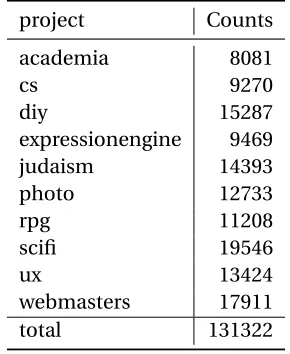
associated with them. We specifically focus on 10 classes as shown in Table 7.1 created by analyzing
associated tags. This table shows the amount of data (number of stack overflow questions) we have
in each category. While using this data we will mark one class as 1 and rest as 0 and sample desired
amount of rows from this modified dataset. An example of such a data is as follows:engineering: "i
was just wondering how a diesel engine starts given that there are no spark plugs how does it build
up momentum for that first explosion in the cylinder does it have something to do with the starter
motor".
7.1.2 Technical Debt Dataset
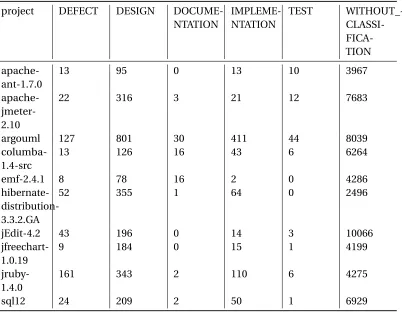
Technical Debt dataset is extracted from comments in the code of 10 open source projects as shown
in Table 7.2. Each of the comments have been associated with one of the classes namely: defect,
design, documentation, implementation, test or without any classification. For the purposes of
testing the generality of our model, we classify each of the technical details as 1 and the rows without
classification as 0. An example of such a data is as follows:apache-ant-1.7.0 : DEFECT://FIXME
Table 7.2Technical Debt Dataset project DEFECT DESIGN
DOCUME-NTATION IMPLEME-NTATION TEST WITHOUT_- CLASSI- FICA-TION apache-ant-1.7.0
13 95 0 13 10 3967
apache- jmeter-2.10
22 316 3 21 12 7683
argouml 127 801 30 411 44 8039
columba-1.4-src
13 126 16 43 6 6264
emf-2.4.1 8 78 16 2 0 4286
hibernate- distribution-3.3.2.GA
52 355 1 64 0 2496
jEdit-4.2 43 196 0 14 3 10066
jfreechart-1.0.19
9 184 0 15 1 4199
jruby-1.4.0
161 343 2 110 6 4275
sql12 24 209 2 50 1 6929
7.2
Evaluation
LocalMine has claims to create a generic language model that learns specific local features of a
specific project. This translated into the fact that LocalMine when modeled as a binary classifier
should efficiently capture the features of the natural language. We used the same metrics we have
used to evaluate this language model on github commits dataset i.e F1 and Recall. However, we also
report precision and F2 score here. These are only for references and verifying correctness of the
model.
7.2.1 StackOverflow
We have 10 classes in this dataset as shown in Table 7.1. We will do all vs one classification here. For
creating the dataset we follow following steps for one class at a time:
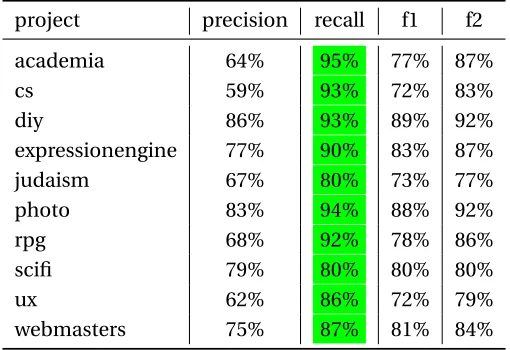
Table 7.3StackOverflow Dataset Metrics project precision recall f1 f2
academia 64% 95% 77% 87%
cs 59% 93% 72% 83%
diy 86% 93% 89% 92%
expressionengine 77% 90% 83% 87%
judaism 67% 80% 73% 77%
photo 83% 94% 88% 92%
rpg 68% 92% 78% 86%
scifi 79% 80% 80% 80%
ux 62% 86% 72% 79%
webmasters 75% 87% 81% 84%
• Split the data randomly in 80:20 for train and test, respectively.
• From the training data create a random dataset of 2:1 label counts i.e. one-third of data should
be 1s and two-thirds as 0s and drop other data points. Shuffle the training data.
• Split training data in training and validation 80:20.
• Train on training data, validate on validation.
• Test on testing data and record metrics
• Repeat above steps 20 times and report average metrics.
Recall and F1 for StackOverflow dataset is as shown in Fig. 7.1. We see that on average we have
approximately 89% recall and 80% F1 score. We find that average precision is less that brings down
the F1 score. Depending on the use case we can assign relative importance to recall or not. Therefore,
we have included precision and F2 score in Table 7.1. In particular, it can be seen that this model
consistently has better recall than precision which was evident from github commits dataset too.
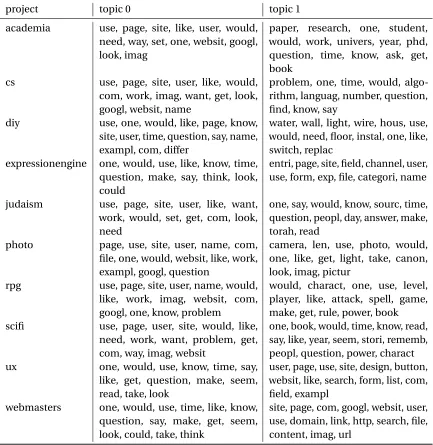
We can see from the Table 7.4 that the classes with high recall and F1 produce much coherent topics
(Topic 1 corresponds to topic related to the category). Hence, we establish that LocalMine is generic
enough to learn features of natural language in texts like stackoverflow, which is loosely SE based
Figure 7.1Performance on Stack Overflow dataset
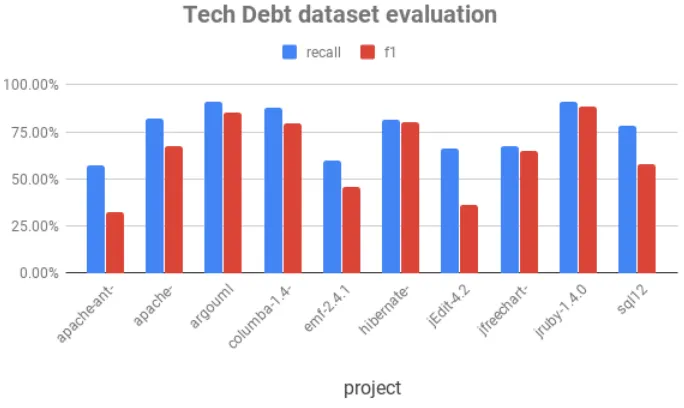
Figure 7.2Performance on Technical Debt datasets 7.2.2 Technical Debt
Technical Debt data is merely comments from the code-base of the project. These comments are self
admitted error, introduced due to rushed temporary code introductions. We use the same metrics
as above i.e. F1 and recall to gauge the performance of LocalMine. The evaluation graph is as shown
Table 7.4StackOverflow Topics - Top 10 keywords per topic
project topic 0 topic 1
academia use, page, site, like, user, would, need, way, set, one, websit, googl, look, imag
paper, research, one, student, would, work, univers, year, phd, question, time, know, ask, get, book
cs use, page, site, user, like, would, com, work, imag, want, get, look, googl, websit, name
problem, one, time, would, algo-rithm, languag, number, question, find, know, say
diy use, one, would, like, page, know, site, user, time, question, say, name, exampl, com, differ
water, wall, light, wire, hous, use, would, need, floor, instal, one, like, switch, replac
expressionengine one, would, use, like, know, time, question, make, say, think, look, could
entri, page, site, field, channel, user, use, form, exp, file, categori, name
judaism use, page, site, user, like, want, work, would, set, get, com, look, need
one, say, would, know, sourc, time, question, peopl, day, answer, make, torah, read
photo page, use, site, user, name, com, file, one, would, websit, like, work, exampl, googl, question
camera, len, use, photo, would, one, like, get, light, take, canon, look, imag, pictur
rpg use, page, site, user, name, would, like, work, imag, websit, com, googl, one, know, problem
would, charact, one, use, level, player, like, attack, spell, game, make, get, rule, power, book scifi use, page, user, site, would, like,
need, work, want, problem, get, com, way, imag, websit
one, book, would, time, know, read, say, like, year, seem, stori, rememb, peopl, question, power, charact ux one, would, use, know, time, say,
like, get, question, make, seem, read, take, look
user, page, use, site, design, button, websit, like, search, form, list, com, field, exampl
webmasters one, would, use, time, like, know, question, say, make, get, seem, look, could, take, think
site, page, com, googl, websit, user, use, domain, link, http, search, file, content, imag, url
shows the words associated each of the topic. In ’jEdit-4.2’ project we see a lot of overlap between
these words i.e. technical terms. We can attribute this fact for this project to have one of the lower
recall and F1 scores. This fact is also evident from the ’emf-2.4.1’ and ’apache-ant-1.7.0’ project.
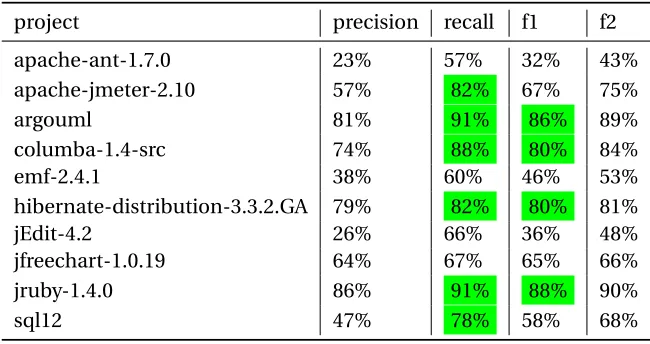
Also, it is worthy to note that the average recall is 76% and F1 is 66%. Average recall as established
in the baseline model Huang et al[22]is 72% and average F1 is 59%. Although, both our approach
and Huang et al.[22]approach is an approach that generalizes to any project. Huang et al.[22]used
Table 7.5Technical Debt Dataset Metrics
project precision recall f1 f2
apache-ant-1.7.0 23% 57% 32% 43%
apache-jmeter-2.10 57% 82% 67% 75%
argouml 81% 91% 86% 89%
columba-1.4-src 74% 88% 80% 84%
emf-2.4.1 38% 60% 46% 53%
hibernate-distribution-3.3.2.GA 79% 82% 80% 81%
jEdit-4.2 26% 66% 36% 48%
jfreechart-1.0.19 64% 67% 65% 66%
jruby-1.4.0 86% 91% 88% 90%
sql12 47% 78% 58% 68%
probabilistic framework by using LDA built on top of TF-IDF vector and the features from LDA are
Table 7.6Technical Debt Topics - Top 10 keywords per topic
project topic 0 topic 1
apache-ant-1.7.0
file, ignore, attribute, prop-erty, set, directory, specified, create, need, name
checkstyle, ignore, visibil-itymodifier, class, default, method, end, get, test
apache-jmeter-2.10
todo, used, set, test, file, check, default, use, name
nls, non nls, noop, panel, main, org, apache, see, apache jmeter, main panel argouml todo, class, end, set, needed,
name, element, model, add, nothing
see, org, argouml, uml, object, java, lang, lang object,
columba-1.4-src
nls, non nls, message, folder, add, todo, create, get, new, au-thor
columba, text, org, non javadoc, javadoc see, event, update, tooltip,
emf-2.4.1 value, byte, fill, object, non nls, nls, copied, non, interface, javadoc copied, javadoc
ignore, create, feature, noth-ing, command, class, add, file, new, content
hibernate- distribution-3.3.2.GA
todo, cache, check, add, col-umn, alias, new, sql, object, use, one, node, key, note, method
collection, type, return, null, element, name, join, support, property, table, first, handle, select, array
jEdit-4.2 constructor, variable, type, line, case, instance, value, buffer, need, check, object, note, instance variable
method, class, member, pri-vate, private member, create, init, init method, find, pack-age, workaround, inner class, inner
jfreechart-1.0.19
draw, argument, defer, de-fer argument, checking, argu-ment checking, test, nothing, todo, paint
check, series, add, item, data, point, value, case, try, plot, independence, set, null, axis, fixme, check independence jruby-1.4.0 line, fixme, switch, set, thread,
constant, new, add, receiver, module, ignore, true, create, error, node, exception
method, value, args, class, block, scope, ruby, string, mri, array, name, variable, case, java, call
sql12 sql, error, todo, see, null, session, non, class, row, user, squirrel, oracle, nothing, javadoc, test, non javadoc
CHAPTER
8
SUMMARY
The research questions that we formulated in the introduction are answered in this chapter.
RQ1: Does an automated probabilistic model perform better than generic dictionary based classifiers?
Yes. As it is evident from Fig. 6.1, LocalMine outperforms Mauckza et al.[6]keywords based
model in all projects. Moreover, LocalMine has the best F1-score and recall score on averag across all
projects. LocalMine does this well because it captures local features of a project that are characteristic
of the project. Only, in one project, ’abinit’, Hindle et al. probabilistic and general model has better
recall than LocalMine. However, in reaching such high recall this model has lots of false positive.
Both Hindle et al model and LocalMine does better than keyword based model in terms of recall.
LocalMine has smart feature generation, therefore goes on to have better F1 score too. It can be also
seen from Fig. 5.1 that keyword based models perform better than Hindle et al model in ’libmesh’ and
’mdanalysis’ project. These models do have a better F1 score than all other models. It is interesting
to note that project specific evolving dictionary Mauczka et al. model performs better than generic
Hindle et al model is automated and can be project specific. Both these conclusions points to the fact
being project specific reduces a lot of false negatives. However, it also leads to a rise in false positive
in case of Hindle. We tackle this problem by doing project level feature engineering by choosing LDA
transformed features. We see that from Fig. 6.1 that LocalMine outperform Hindle et al. F1 score is
also higher indicating that false positive has also decreased. We can also see from Table 6.2 that it is
not necessary that only those words have higher weight that are mention in dictionary models like
in Table 5.1 or Table 5.2. For instance, ’compilation error’ is a two word phrase that is characteristic
of a bug-fixing commit message. The dictionary based model do not account for phrases. Even
if they do, it will become unfeasible to determine common phrases for different projects. Hence,
we should not specify keywords that do not localize to a project as they do not capture important
information that is a characteristic of the project for change message classification.
RQ2: How many topics should be specified for LDA?
Inspired by Ying et al[4]we decided to keep number of topics to be equal to number of classes
(=2 for the case of LocalMine). From Table-6.2, we can observe that topic 1 actually capture the words
corresponding bug fixes. The keywords discovered by LocalMine are also mentioned in Mockus
et al[1]dictionary. Therefore, keeping 2 topics, fetches keywords that are comparable to special
keywords that are prevalent in the literature, along with many keywords that are unique to commit
messages of bug fixes for that project. Moreover, we note that apart fromKeyword searchmodel, no
other model offers this comprehensibility other than LocalMine. In fact, LocalMine offers a better
comprehensibility thanKeyword searchmodel. It is such because, LocalMine identifies keywords
that are local to the software project. Not only does LocalMine capture localized keywords, but it also
captures keywords that are similar to corrective category keywords used inKeyword searchmodel. It
can be seen in Table 6.2. Hindle et al.[11]used LDA but number of topics was arbitrary. Nonsensical
topics were later weeded out by human intervention. However, LocalMine sets number of topics
equal to number of classes. The objective that LocalMine has that each topic should provide with
enough corresponding features in order to distinguish the two classes. When we look at Table 6.2,
we can find that the two topics are distinctly different. Moreover, many of the top words match to
the generic keywords given by Mauckza et al.[6]and Mockus et al.[1]. So, we can conclude keeping
topics corresponding to classes helps in comprehensibility.
We verified the generality of LocalMine by testing on two different software texts. On the
stack-overflow set we find that average recall across projects is 89% and F1 as 80%. It is very comparable to
baseline proposed in Majumder et al[23]implementation of baseline K-Nearest Neighbour model.
Based on this comparison it can be claimed that LocalMine generalizes to stackoverflow dataset.
However, LocalMine does require various hyper-parameter tuning. Comparing against the baseline
on the tech debt dataset, LocalMine has outperformed the baseline in terms of recall and F1 score.
We see from the table 7.6 that the projects with lower F1 score have higher correlated top words in
the topics. In other words, those projects have correlated topics. Other projects where LocalMine
generated distinct top words, i.e. LDA based feature generation is in tandem with the features
required for classification, we have high recall and F1, and higher than the baseline Huang et al.[22]
CHAPTER
9
THREATS TO VALIDITY AND FUTURE
WORK
In this chapter we discuss some of the limitations for LocalMine. Also, we discuss how these
limita-tions may be reduced and some enhancements that LocalMine can incorporate as part of future
work.
9.1
Threats To Validity
It is quite evident from this study that LDA helps in comprehensibility of the model. However, the
complexity of the model increases much more than simple dictionary models. This raises doubt if
model is within reasonable limits. However, we see that the model is fairly robust across the projects
and software texts. We can, thus, say construction of LocalMine increases complexity and increases
the cost of other resources like time to train the model and computing requirements grow as the size
to one of the classes and able to justify the performance of LocalMine by understanding keywords
like in dictionary models.
The results reported are generated over 20 sample runs. This is done to reduce the order bias.
As data sets distributed in training and testing is completely random, that could have incurred
order bias. Agrawal et al.[21]discussed that LDA, inherently, has an order bias. The algorithm
automatically discovers words that are characteristic to a topic. These words could differ in different
samples of data. However, keeping low number of maximum features for LDA training and running
this experiment multiple times helps reduce that bias.
LocalMine decides 100 words from TF-IDF vectorized model to feed to LDA. This also means
that a large portions of words in initial commit messages are dropped. As we can see from
Table-3.1, approximately 3000 words are present in the vocabulary (after text processing) of commits
message dataset per project. That means approximately 97% of words are not considered for final
classification. There could possibly be some information loss here. However, through grid search
over discrete values of 100, 500 and 1000 and LocalMine found 100 to be most optimal value with
regards to the evaluation metrics.
Instead of relying on special words provided by Mockus et al[1], LocalMine discovers keywords
that may better characterize changes messages of the project. After LDA, LocalMine fetches top
N discovered keywords for each topic (N=25, found after hyper-parameter optimization). The
probability values of these words corresponding a topic are used to generate features when a word
in the tokens of a commit message matches it exactly. This exact match could be misleading as a
typographical error would not account for it or even a synonym. The match here could have been
in terms of natural language, slopped to adjust for spelling variation and synonyms could be used
keeping software engineering domain knowledge. Accommodating this domain knowledge may
have an effect on LocalMine’s keyword model.
LocalMine hyper-parameter optimization has been done over discrete finite space. Number
of features for TF-IDF vectorizer was varied over the set of (100, 500, 1000). Number of words
extracted as features per topic was varied over the set (10, 25, 50, 100). Random forest parameter
for n_estimators and max_depth were varied over (50, 100, 200) and (10, 50, 100), respectively. A
differential evolution technique may prove more useful here where the variation can be over larger
9.2
Future Work
Injecting Software Engineering domain knowledge into LDA and feature generation may perform
better. As described in limitations section, feature generation using matching words can make use
of SE domain knowledge.
The hyper-parameters of LocalMine were optimized with Grid Search. However, Agrawal et al.
[16]shows that using differential evolution techniques, LDA has much better performance. We can
also optimize various parameters in LocalMine apart from LDA, namely number of words to be
used as features, number of estimators in Random Forest, maximum depth of Random Forest, etc.
There are other word embeddings models that can be employed. As commit messages are
based on semantic natural language sentences, it might help to use word2vec or GloVe embedding
instead of TF-IDF vectorization. Word2vec is known to capture semantic and syntactic relationships
at low computational cost[24]. GloVe is unsupervised learning algorithm to obtain word vector
representations[25]. However, this may lead to increased complexity in comprehensibility of the
model. If these models improve our evaluation metrics, further questions can be raised on the
comprehensibility and reason-ability of these models.
LocalMine is localized to a software project, and is yet a general model. It is a common practice
in software engineering data mining that the model is trained on earlier releases of the software
project and tested on more recent version. Can we train a model on older versions of project
and predict for current version? However, a big task in change message classification is labeling
of messages. Kim et al[9]suggests understanding bug tracking system and use keyword search
heuristic to classify. However, recommendation is still made to get these change classifications
manually verified. Software engineering domain knowledge is essential, but sample change message
classification for each project is costly. Can we omit human in the loop and understand from earlier
release notes for keyword labeling in a semi-supervised fashion? Or can a fully automated change
CHAPTER
10
CONCLUSIONS
In previous chapters, we have seen that LocalMine outperforms baseline models, both dictionary
based models and probabilistic models. LocalMine is, also, suitable to be used for different software
text mining task. In this chapter, we talk about the conclusions that can be drawn from experiments
that we did for LocalMine and the results obtained. LocalMine is an automated model that
general-izes on a variety of datasets. We see that LocalMine which is an LDA-based classifier works with
github commit messages for change message classification, also with stack overflow dataset for
topic classification and tech debt for comments classification. Though, we should note to achieve
this performance on stack overflow and tech debt dataset, we had to tune some hyper-parameters
associated with the components of LocalMine. We have kept number of features for TF-IDF as 1000
and top N words from topics to be 100. In change message classification model, these values were
100 and 25 respectively. We find that a small amount of tuning is required to create project specific
model.
Since, the performance in each of these datasets LocalMine performs well within the range of