Survey on Flooding Detection System Using
Internet of Things
Anusha.A1, Bharani.I2, Bharathi.J3, Hemavathi.V4 and Venkatesan.M5
UG Scholar, Department of ECE, Adhiyamaan College of Engineering, Hosur, TN, India1,2,3,4
Assistant Professor, Department of ECE, Adhiyamaan College of Engineering, Hosur, TN, India5
ABSTRACT:To decrease the challenges that the cities face such as scarcity of energy sources, flooding prevention, healthcare, housing water and deteriorating infrastructure, making a city ’smart’ is emerging. The internet of things or IOT provides the ability for human and machines to interact from billions of things that include sensors, services or other internet connected things. This paper aims to realize the security requirement and security architecture of internet of things technology for urban flooding prevention management system and discussed the demand and overall design of urban flooding prevention management system. Finally, the application process of the internet of things technology in flooding prevention management system is summarized. For emergency command and dispatch there is visual management, and at the same time, network assessment management for the drainage pipe can be conducted correctly.
KEYWORDS: Flooding prevention, Internet of things, Drainage pipe,catastrophic situation, Flooding condition, Flow rate, water level.
I. INTRODUCTION
The terms IOT, is the inter-networking of physical devices such as vehicles, buildings or embedded items such as software, sensors, actuators, and to enable these objects to collect and exchange data network connectivity is needed. The concept internet of things describes a future where every day physical objects can be connected to the internet and also is able to identify themselves to other devices. IOT is closely identified with sensor technologies, RFID, wireless technologies. Internet is a medium that connect people across the world for e-mailing, gaming, conferencing etc.
Internet of things allows sensing the term IOT is the inter-networking of physical devices such as vehicles, buildings, or embedded of objects and controlling objects remotely across existing network infrastructure. Floods, extreme weather events, have occurred with frequent regularity over last two decades causing severe urban flood related inundations. India is primarily an agricultural country and rural infrastructure was adequate to sustain country population. Expansion of urban sector increased due to migration of population towards mega cities. Such migrations are due to industrial growth. Every year floods affect nearly 400 million hectares of land in India. Now a day’s weather information is used for monitoring and warning on urban flooding.
TABLE 1 NUMBER OF DEATHS/INJURED IN FOUR MEGA CITIES
The flooding Prevention Management System work in three dimension, calculation of drainage flow, rainfall, and water level, second sending collected flooding information to data center for analysis and monitoring and alerting mechanism. Use the data reasonably on the management and control platform, while constructing the system and apply the data fusion technology and wireless remote intelligent monitoring technology as well.
II. RELATED WORKS
Application of Internet of Things in Urban Flooding Prevention Management System
The Survey has analyzed the security architecture and security requirement of IOT technology. The paper describes thedemand of urban waterlogging prevention management system with the help of IOT. The basic model urban waterlogging prevention has described in this article [1].
Urban flooding in recent decades in four mega cities of India
People are migrating from rural to urban area due to unemployment and other reasons. The population count is increasing day by day and due to that cities are facing many new challenges. Flooding condition is one of the big challenges increased due to uncontrolled growth of mega cities. The article describes the population count and death rate due to flooding in four mega cities in India [2].
III. SYSTEM FUNCTION DESIGN
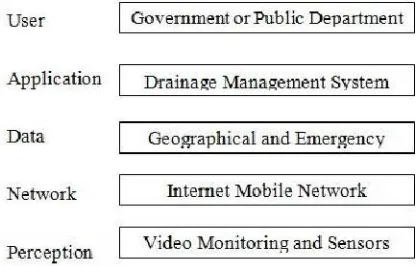
There are five layers for the system, as shown in Figure 1. Good design management of user layer and application layer should be made. To determine the system design of perception layer, data layer and network layer shall also be conducted.
FIGURE 1 FLOODING DETECTION SYSTEM REQUIREMENT
Year
Deaths
Delhi Kolkata Mumbai Chennai
1990 3 1 79 15
1995 2 6 7 12
2000 - - 87 -
Drainage management
An important analysis is needed based on the design of systematic drainage management system. The flow-meter calculates the rate of flow of water; simultaneously Water Level Indicator calculates the rising water level and rain sensor calculate the rainfall rate. The collected data is sent to data centre for analysis to determine flood condition. The analysis can also used to maintenance of drainage pipe.
Data Centre
The data centre performs statistical analysis on data collected from various sources. The analysis is used for evaluation of flood condition and by Early Warning Subsystem.
Emergency command and dispatch
It is mainly designed in combination with the online flood situation; conduct well the analysis and management of operational data. The system should provide feedback and release flood information timely, and analyze the operation and dispatching situation of drainage facilities.
FIGURE2FLOODINGDETECTIONSYSTEMUSINGINTERNETOFTHINGS
IV. COMPONENTS
Ultrasonic Flow-meter
Water Level Indicator
Water Level Indicator detects the water level from ground or surface to determine flood condition.
Rain sensor
A rain sensor is a switching device that gets activated by rainfall. The rain sensor detects water that completes the circuits on its sensor boards' printed leads. The sensor board acts as a variable resistor that will change from 100k ohms when wet to 2M ohms when dry. In short, the wetter the board, more current will be conducted. The rain sensor detects the velocity of rainfall.
VI. CONCLUSION
The application of urban flood control management system which is based on Internet of things technology provides comprehensive monitoring and pays more attention to the management of urban drainage and flooding prevention. It also provides operational services, conducts the monitoring and realizes the comprehensive supervision management, early warning management, and investigation management, which has not only improved the flood control decision making and drainage, but the city’s flood control capacity is significantly improved. It will contribute to the security of society and harmonious development and construction.
REFERENCES
[1] Qinggong Ma, Bo Yang, Jipeng Wang, "Application of Internet of Things in Urban Flooding Prevention Management System", Scientific Research Publishing, Advances in Internet of Things, 2017, 7, 1-9, ISSN Print: 2161-6817.
[2] U.S. De, G. P. Singh and D. M. Rase, Urban flooding in recent decades in four mega cities of India, J. Ind. Geophys. Union, April 2013,Vol.17, No.2, pp. 153-165.
[3] Xue, X.G., Jiang, S.F., Li, M., et al.(2016) Application Trend of GIS in Urban Drai-nage and Flooding Prevention. Science & Technology Vision, No. 1, 71-72.
[4] Tong, L.G. (2015) Urban Drainage and Flooding Prevention Intelligent Controlling Platform Based on Internet of Things and GIS. Science & Technology Information,13, 10-12.