University of Windsor University of Windsor
Scholarship at UWindsor
Scholarship at UWindsor
Electronic Theses and Dissertations Theses, Dissertations, and Major Papers
2005
A framework for IPSec functional architecture.
A framework for IPSec functional architecture.
Mehdi. Fahandezh University of Windsor
Follow this and additional works at: https://scholar.uwindsor.ca/etd
Recommended Citation Recommended Citation
Fahandezh, Mehdi., "A framework for IPSec functional architecture." (2005). Electronic Theses and Dissertations. 622.
https://scholar.uwindsor.ca/etd/622
A Framework for IPSec Functional Architecture
by
Mehdi Fahandezh
A Thesis
Submitted to the Faculty of Graduate Studies and Research through the Department o f Electrical and Computer Engineering
in Partial Fulfillment of the Requirements for the Degree of Master of Science
at the University of Windsor Windsor, Ontario, Canada
1*1
Library and Archives CanadaPublished Heritage Branch
Bibliotheque et Archives Canada
Direction du
Patrimoine de I'edition 395 W ellington Street
Ottawa ON K1A 0N4 Canada
395, rue W ellington Ottawa ON K1A 0N4 Canada
Your file Votre reference ISBN: 0-494-09865-1 Our file Notre reference ISBN: 0-494-09865-1
NOTICE:
The author has granted a non exclusive license allowing Library and Archives Canada to reproduce, publish, archive, preserve, conserve, communicate to the public by
telecommunication or on the Internet, loan, distribute and sell theses
worldwide, for commercial or non commercial purposes, in microform, paper, electronic and/or any other formats.
AVIS:
L'auteur a accorde une licence non exclusive permettant a la Bibliotheque et Archives Canada de reproduire, publier, archiver,
sauvegarder, conserver, transmettre au public par telecommunication ou par I'lnternet, preter, distribuer et vendre des theses partout dans le monde, a des fins commerciales ou autres, sur support microforme, papier, electronique et/ou autres formats.
The author retains copyright ownership and moral rights in this thesis. Neither the thesis
nor substantial extracts from it may be printed or otherwise reproduced without the author's permission.
L'auteur conserve la propriete du droit d'auteur et des droits moraux qui protege cette these. Ni la these ni des extraits substantiels de celle-ci ne doivent etre imprimes ou autrement reproduits sans son autorisation.
In compliance with the Canadian Privacy Act some supporting forms may have been removed from this thesis.
While these forms may be included in the document page count,
their removal does not represent any loss of content from the
Conformement a la loi canadienne sur la protection de la vie privee, quelques formulaires secondaires ont ete enleves de cette these.
ABSTRACT
In today’s network, various stand-alone security services and/or proxies are used to provide
different security services. These individual security systems implementing one single security
function cannot address security needs o f evolving networks that require secure protocol such
as IPSec.
In this paper, we provide a framework for implementing IPSec security functions in a well
structured functional architecture. The proposed architecture is modular and allows for
composing software applications from products commercially available and developed by
different suppliers to implement the entire security requirements o f IPSec protocol.
In addition the proposed architecture is robust in the sense that it supports open standards and
interfaces, and implements security functions o f IPSec as an integrated solution under a unified
DEDICATION
I dedicate this work to my wife, Rose (Zohreh Heshmatzadeh), who supported me all the
way and stands beside me. Her enthusiasms for my future have always kept me going and her
prayers are always with me. Her patient is most recognized and appreciated.
I also dedicate my work to my family, who always give me boundless supports, especially
to my sons, Arash and Arman, to encourage them to reach for higher education and for better life.
Finally, I would dedicate not only this work but also my entire success, to my beloved
ACKNOWLEDGEMENT
I would like to thank my academic advisor, Prof. Shervin Erfani, for his guidance and
support, especially for letting me to use his patent on “5-Layer Security Architecture”, and lead me
all the way through to achieve the novelty o f “A Framework for IPSec Functional Architecture”.
A special thanks to Mr. Karim Zarafshan for his active support. His encouragements were
always my guiding light during the time o f my M aster’s Degree studies at the University o f
TABLE OF CONTENTS
ABSTRACT...I
DEDICATION... II
ACKNOW LEDGEM ENTS... I ll
LIST OF FIGURES... VII
LIST OF TABLES... X
LIST OF ACRONYM S... XI
CHAPTER I INTRODUCTION...1
1.1 Introduction... 1
1.2 Network S ecu rity ... 5
1.1.1 Introduction to Network S ecurity ... 6
1.1.2 Introduction to Security T h re a ts ... 7
1.1.3 Common type o f network A tta c k s... 10
1.2 TCP / IP O v erv iew ... 16
1.2.1 Introduction...16
1.2.2 TCP/IP Protocol A rchitecture... 16
1.3 Cryptography Tools and Techniques...22
1.3.1 Introduction... 22
1.3.2 Cryptographic... 22
1.3.3 Encryption Concepts and Algorithm...23
1.3.4 Hashing Concepts and Algorithms... 29
1.3.5 Authentication M echanisms... 34
CHAPTER II INTERNET PROTOCOL SECURITY (IPSEC) ARCHITECTURE..38
2.1 Introduction... 38
2.2 IPSec Implementation in TCP/IP S ta c k ... 40
2.3 The IPSec R o ad m ap ... 41
2.4 How IPSec W orks... 42
2.5 IPSec M odes...44
2.6 Security A ssociations...45
2.6.1 Security Associations (SA) C o n cep t...45
2.6.2 Security Associations D atab ases... 47
CHAPTER III IPSec PROTOCOLS:... 53
3.1 Introduction...53
3.2 The Authentication Header ( AH) Protocol... 53
3.2.1 The Authentication Header ( AH) P ro to co l... 53
3.2.2 AH Protocol F o rm a t... 54
3.2.3 AH M o d e s ... 57
3.2.3.1 AH Transport M ode...57
3.2.3.2 AH Tunnel M ode... 58
3.2.4 AH P ro cessin g... 60
3.2.4.1 Outbound Processing...60
3.2.4.2 Inbound Processing... 61
3.3 The Encapsulating Security Payload (ESP) Protocol... 62
3.3.1 ESP Protocol Concept...62
3.3.2 ESP Protocol F o rm a t...64
3.3.3 ESP M o d e s ... 66
3.3.3.1 ESP Transport M ode... 67
3.3.3.2 ESP Tunnel M ode...68
3.3.4 ESP Processing... 70
3.3.4.1 Outbound Processing... 70
3.3.4.2 Inbound Processing...72
3.4 The Internet Key Exchange (IKE) Protocol... 74
3.4.1- IKE Protocol Concept... 74
3 .4 .2 -ISAKM P ... 76
3.4.3- Exchanges and Phases... 78
3.4.3.1 Exchange Phases... 78
3.4.3.2 Exchange M odes... 79
3.4.4- Oakley Groups... 81
CHAPTER IV A FRAM EW ORK FOR IPSec FUNCTIONAL ARCHITECTURE.82 4.1 Introduction... 82
4.2 IPSec Functional Architecture... 84
4.2.1- IPSec Policy & Business Management Function layer... 85
4.2.1.1 IPSec policy Concepts... 85
4.2.1.2 IPSec Policy Management Function layer... 88
4.2.2- IPSec Management Function Layer... 89
4.2.3- IPSec Security Service Function Layer...90
4.2.4- IPSec security Mechanism Layer... 91
4.2.5- IPSec Primitive Function Layer...93
4.3 IPSec Protocol Handling Function...95
4.4 IPSec Security Management Information Base (IPSec SM IB)...96
4.5 IPSec Functional Layers Summary... 97
C H A P T E R V I P S e c S C E N A R I O S ...100
5.1 IPSec Scenario...100
5.1.1 IPSec Scenario 1... 100
5.1.2 IPSec Scenario 2 ... 105
5.1.3 IPSec Scenario 3...106
5.2 IPSec Deployment... 107
5.2.1- Virtual Private Network (VPN)...108
C H A P T E R V I C O N C L U SIO N ... 110
6.1 Conclusion...110
6.2 Concluding Rem arks... I l l 6.3 Future W ork... I l l R E F E R E N C E S ... 112
A P P E N D IC E S ... 116
A ppendix A1 o IPv4 Datagram Form at... 116
o IPv6 Datagram Form at... 122
A ppendix A2 - Fields for the SA ...123
A ppendix A3 The objects stored in Security Database...125
A ppendix A4 - ISAKMP Header Form at... 128
A ppendix B o Preshared Keys Overview and Types... 140
LIST OF FIGURES
1.1 Protocols at the four layers o f the TCP/IP protocol s u ite ... 17
1.2 Encapsulation and de-capsulation o f data as it goes down and up the protocol stack, respectively... 18
1.3 Schematic Example for Symmetric Cryptography... 24
1.4 Schematic Example for Asymmetric Cryptography... 28
1.5 A keyed hashing function (M A C )... 31
1.6 Digital signature generation...36
2.1 IPSec Encryption not evident in application... 40
2.2 IPSec Roadmap (this figure has been reproduced from the draft with permission of the au th o rs)... 41
2.3 IPSec in Transport M o d e ...44
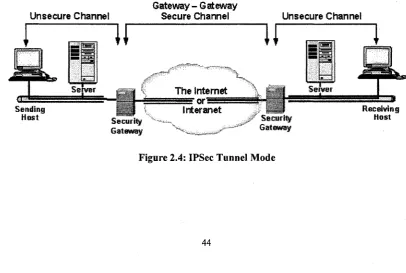
2.4 IPSec Tunnel M o d e ...44
2.5 Outbound IPSec P rocessing...49
2.6 packet fo r m a t...50
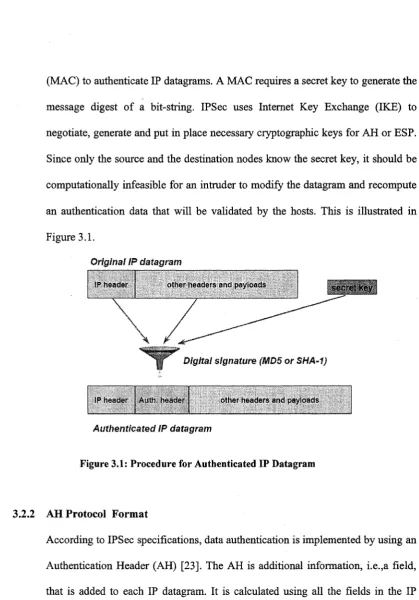
3.1 Procedure for Authenticated IP Datagram ... 54
3.2 IPSec AH Protocol F o r m a t... 55
3.3 Authentication Header Form at...55
3.4 AH relative to other IPv4 header fields, in transport mode... 57
3.5 AH relative to other IPv6 extension headers, in transport m ode... 58
3.6 AH relative to other IPv4 header fields, in tunnel m o d e ... 59
3.7 AH relative to other IPv6 extension headers, in tunnel m ode... 59
3.8 IPSec ESP Protocol F o r m a t... 64
3.9 ESP Packet Form at...65
3.10 IP Datagram with Transport ESP M ode... 67
3.11 ESP relative to other IPv4 header fields, in transport mode...68
3.12 ESP relative to other IPv6 extension headers, in transport m ode...68
3.13 ESP relative to other IPv4 header fields, in tunnel m ode... 69
3.14 ESP relative to other IPv6 extension headers, in tunnel m ode... 69
3.15 IKE param eters... 76
3 .1 7 Example o f a Main Mode Exchange... 80
3.18 Example o f an Aggressive Mode Exchange...80
3.19 Example o f a Quick Mode exchange...81
4.1 IPSec functional five logical layers...84
4.2 Policy deployment architecture... 87
4.3 IPSec Policy and Business Management function Layer... 88
4.4 IPSec management function layer...90
4.5 IPSec Security services Function Layer... 90
4.6 IPSec Security Mechanism Function Layer... 93
4.7 IPSec Primitive Modules Layer... 94
4.8 IPSec Protocol Handling Function... 96
4.9 Location o f IPSec Architecture... 99
5.1 SA Negotiation...100
5.2 Third Message o f the ISAKMP Base Exchange...101
5.3 Fourth Message o f the ISAKMP Base Exchange... 103
5.4 IPSec Exam ple...104
5.5 Flow of specific IPSec SM IB... 106
5.6 Example of IPSec outbound processing...107
5.7 Schematic o f A security Gateway...107
5.8 Schematic o f IPSec VPN Configuration...108
A.1.1 IPv4 datagram ... 116
A.1.2 IPv6 Header Form at... 121
A.4.1 The ISKAMP Header Format... 128
A.4.2 Generic Payload Header Form at...131
A.4.3 Security Association Payload Form at...132
A.4.4 Proposal Payload Format...133
A.4.5 Transform Payload Form at... 135
A.4.6 Key Exchange Payload Form at...136
A.4.7 Identification Payload Form at...137
A.4.10 Signature Payload Form at... 139
LIST OF TABLES
1.1 Security Services to Counter Security Threats... 8
1.2 Typical Threats in Particular Application Environments... 9
4.1 Security Services Provided by AH and ESP... 91
A2.1 Example o f S A ... 124
A.4.1 Assigned Values for ISAKMP Payloads... 129
LIST OF ACRONYMS
3DES Triple DES
ABR Area Border Router
ACK Acknowledgment
ACL Access Control List
AD Adminstrative Distance
AH Authentication Header
ARP Advance Research Project Agency
ARPA Address Resolution Protocol
AS Autonomous System Border Router
ASCII American Standard Code For Information Interchange
A SN .l Autonomous System Number
ASBR Abstract Syntax Notation
ATM Asynchronous Transfer Mode
ATT Attached
BGP Border Gateway Protocol
C Customer
CA Certificate Authority
CBC Cipher Block Chaining
CE Cisco Express Forwarding
CEF Cipher Feedback
CFB Customer Edge
CIDR Classless Inter-Domain Routing
CLNS Connectionless Network Service
CONFED Confederation
CoS Class o f Service
CPE Customer Premises Equipment
CPU Central Processing Unit
CRL Constraint-Based Label Distribution Protocol
CR-LDP Certificate Revocation List
CUG Closed User Group
DER Distinguished Encoding Rules
DES Data Encryption Standard
DF Don't Fragment
D-H Diffie-Hellman
DN Distinguished Name
DoD Domain o f Interpretation
DOI Department o f Defense
DoS Denial o f Service
DS Digital Signal
DSL Digital Subscriber Line
EBGP External BGP
ECB Electmic Code Book
EGP Exterior Gateway Protocol
ES End System
ESP Encapsulating Security Payload
FEC Forwarding Equivalence Class
FIB Forwarding Information Base
FQDN Fully Qualified Domain Name
GRE Generic Routing Encapsulation
HDLC High-Level Data Link Control
HMAC Hashed Message Authentication Code
HSRP Hot Standby Router Protocol
HTTP Hypertext Transfer Protocol
IANA Internet Assigned Number Authority
IBGP Internal BGP
ICMP Internet Control Message Protocol
ID Identifier
IEEE Institute o f Electrical And Electronics Engineers
IETF Internet Engineering Task Force
IG Inside Global
IGP Interior Gateway Protocol
IKE Internet Key Exchange
IL Inside Local
IMP Interface Message Processors
IOS Internetwork Operating System
IP Internet Protocol
IPSec IP Security
IPv4 Internet Protocol Version 4
IPv6 Internet Protocol Version 6
IPX Internetwork Packet Exchange
IS Intermediate System
ISAKMP Internet Security Association And Key Mangement Protocol
ISDN Intergrated Services Digital Network
IS-IS Intermediate System To Intermediate System
ISO International Organization For Standardization
ISP Internet Service Provider
IV Initialization Vector
KE Key Exchange
LI Level 1
L2 Level 2
LAN Local Area Network
LDAP Lightweight Directory Access Protocol
LDP Label Distribution Protocol
LFIB Label Forwarding Information Base
LLC Logical Link Control
LSA Link-State Advertisement
LSDB Link-State Database
MAC Message Authentication Code
MD5 Message Digest 5
MED Multi-Exit Discriminator
MIM Man-In-Middle
MM Main Mode
MOD Modulus
MP-BGP Multiprotocol BGP
MP-IBGP Multiprotocol Internal BGP
MPLS Multiprotocol Label Switching
MSS Maximum Segment Size
MTU M aximum Transfer Unit
NAT Network Address Translation
NBMA Nonbroadcast Multiaccess
NET Network Entiry Title
NH Next Hop
NLRI Network Layer Reachability Information
NSA National Security Agency
NSAP Network Service Access Point
NSSA Not-So-Stubby Area
NTP Network Time Protocol
NVRAM Nonvolatile Random Access Memory
OFB Output Feedback
OG Outside Global
OL Outside Local
OSI Open System Interconnect
OSPF Open Shortest Path First
P Provider
PAT Port Address Translation
PC Portable Computer
PE Provider Edge
PEM Privacy Enhanced Mail
PFS Perfect Forward Secrecy
PHP Penultimate Hop Popping
PKCS Public-Key Cryptography Standard
PKI Public Key Infrastructure
PMTU Path M aximum Transfer Unit Discovery
PoS Packet over Sonet
PPP Point-To-Point Protocol
PRC Partial Route Calculation
PREF Preference
QM Quick Mode
QoS Quality o f Service
RA Registration Authority
RD Route Distinguisher
RFC Reequest For Comment
RIPv2 Routing Information Protocol version 2
RR Route Reflector
RSA Rivest- Shamir-Adleman
RSVP Resource Reservation Protocol
RT Route-Target
SA Security Association
SADB SA Database
SCEP Simple Certificate Enrollment Protocol
SDH Synchronous Digital Hierarchy
SHA Secure Hash Algorithm
SLA Service-Level Algorithm
SLA Service-Level Agreement
SONET Synchronous Optical Network
SOO Site-of-Orgin
SP Service Provider
SPD Selective Packet Discard
SPF Shortest Path First
SPI Security Parameter Index
TCP Transmission Control Protocol
TDM Time Division M ultiplexing
TE Traffic Engineering
TED Tunnel Endpoint Discovery
TLV Type, Length, And Value
ToS Type o f Service
TTL Time-to-Live
UDP U ser Datagram Protocol
VC Virtual Circuit
VPDN Virtual Private Dialup Network
VPN Virtual Private Network
VPNv4 VPN-Ipv4
VRF Virtual Routing And Network
WAN Wide Areas Network
W WW W orld Wide Web
CHAPTER I:
1.1 Introduction
In the mid 1960’s [1] in the height of the cold war, the Department o f Defense (DoD) in
the USA wanted a command and control network that could survive a nuclear war. The
DoD consequently commissioned its research arm- ARPA (Advance Research Project
Agency)- to invent the technology that could get data to its destination reliably even if
arbitrary part o f the network disappeared without warning as a result of a nuclear attack.
Traditional telephone technology called circuit switching would not work because it had
serious drawbacks. In circuit switching, a route for data to get from one place to another
is set up by using relays to make physical connections among pieces o f cable. Therefore,
if a part of the circuit fails, a new circuit must be set up, which could be quite difficult
and time consuming depending on the severity of the damage [2].
ARPA used a different kind of technology called packet switching. The idea of
packet switching network was proposed by Paul Baran [3]. In packet switching, data to
be sent over the network is divided up into discrete parts called packets. Each packet is
routed independently from one computer to the next over the network until it reaches its
final destination.
The first experimental network- called the ARPANET - went into operation in
December 1969. It consisted of subnets and host computers. The subnets consisted of
minicomputers called IMPs (Interface Message Processors) connected by transmission
lines. This network contained four nodes, one each at UCLA (University of California at
Los Angeles), UCSB (University of California at Santa Barbara), SRI(Stanford Research
host in the same room, connected by wires. These four sites were chosen because all had
large ARPA contract; additionally, all four sites had different and completely
incompatible computers. This experimental network grew rapidly: in July 1970 it grew to
eight nodes, by March 1971 it expanded to sixteen nodes, in April 1972 it grew to twenty
three nodes and by September 1972 it consisted of thirty four nodes [1].
In the 1983 TCP/IP protocols were adopted as the only official protocol of the
ARPANET. During the same year the term Internet came into common usage. The old
ARPANET was divided into MILNET, the unclassified part of the Defense Data
Network (DDN), and a new smaller ARPANET. The “Internet” was used to refer to the
entire network: the MILNET plus the ARPANET [1]. Many regional networks in the
USA joined up to the Internet. In the mid 1980’s trans-Atlantic fiber optic cables were
laid and consequently, networks in Europe, the Pacific region and Canada were
connected to the Internet. Growth o f the Internet continued exponentially, and by 1995
there were multiple backbones, hundreds of regional networks, tens of thousands o f Local
Area Networks (LAN’s), millions of hosts, and tens of millions of users. At the close of
the twentieth century almost every nation was connected to the Internet.
The nature of the Internet has raised many security concerns. The principal
concern over the years is the fact that Internet Protocol (IP) packets are inherently
insecure. It is relative easy to forge IP addresses, modify the contents of IP packets,
replay old content and inspect the content o f packets in transit. Therefore, there is no
guarantee that the IP datagrams originated from the source it claims to originate from, or
that they will get to the intended destination, or that the contents have not been modified
These security problems have caused many companies to stop using the Internet to
transmit electronic data. These companies turned to leased lines and private networks.
The Internet Protocol Security protocol developed by Internet Engineering Task
Force (IETF) in the late 1990 has addressed most of the IP datagram. The Internet
Architecture Board (LAB) in 1994 issued a report identifying issues concerning
security needs of the network infrastructure [4], In response to these issues IPSec has
been developed.
The purpose of this thesis is to implement the IPSec by using Functional Architecture
Layers. First, however, it is important to have a clear understanding o f the related
algorithms, technologies, and operational processes. The following chapters will
cover the concept of security systems, and the operations of IP Security Protocol
(IPSec) and Internet key exchange (IKE), as well as their associated technologies, in
depth. These associated technologies should be thoroughly understood in order to
deploy a robust IPSec security policy and to implement fully operational IPSec
functions.
IPSec is implemented at the network layer. It protects and authenticates IP packets
between participating IPSec devices (peers) such as firewalls, routers, clients, and
other IPSec-compliant products. IPSec is a framework of open standards, which is not
formally limited to any specific set of algorithms. As such, IPSec allows for newer
and better algorithms to be implemented without patching the existing standards, and
participating peers at the IP layer. In the following sections, we will look at the
definitions o f these security services and describe the technologies associated with
them.
IPSec provides the capability to secure communications across a LAN, across private
and public WANs, and across the Internet. In addition, IPSec can play a vital role in
the routing architecture required for internetworking [5]. For example, routing
protocols such as OSPF (Open Shortest Path First) should be run on top o f any
security association (SA) between routers that are defined by IPSec. It is seen that the
IPSec specification has become quite complex. The numerous documents defining
IPSec do not provide a framework for its implementation. The various vendors of
traditional security systems are implementing some o f the IPSec functionality and
security services relying on their own mostly nonstructured functional architecture.
This nonstructured implementation can only provide some sort o f piecemeal
implementation, and cannot address security demanded by efficient implementation
o f IPSec. The key to successful IPSec functional architecture is to consider the
security management as an evolving integrated part o f the architecture.
This thesis is organized into five chapters.
First three chapters provide necessary background information for this topic stating
the problem and thesis contribution. They also provide basic concepts o f network
security threats, TCP/IP overview, and cryptography tools and techniques.
Chapter IV, which is the body o f the thesis, provides the design o f the functional
Chapter Y provides some security session scenarios which will demonstrate the
execution o f the designed IPSec syste in an IPSec environment.
Finally, we conclude this work by summarizing the results, and making suggestions
1-2 Network Security
1-1.1 Introduction to Network Security:
The Internet is changing the way we work, live, play, and learn. These changes are
occurring both in the ways that we currently experience (e-commerce, real-time
information access, e-leaming, expanded communication options, and so forth), and
in ways we have yet to experience. Imagine a day when your enterprise can make all
its telephone calls over the Internet for free. Or perhaps on a more personal note,
consider logging on to a daycare provider’s website to check how your child is doing
throughout the day. As a society, we are just beginning to unlock the potential of the
Internet. But with the Internet’s unparalleled growth comes unprecedented exposure
of personal data, critical enterprise resources, government secrets, and so forth. Every
day hackers pose an increasing threat to these entities with several different types of
attacks. These attacks, outlined in the next section, have become both more prolific
and easier to implement.
There are two primary reasons for this problem. First is the ubiquity of the
Internet. With millions of devices currently connected to the Internet, and millions
more on the way, a hacker’s access to vulnerable devices will continue to increase.
The ubiquity of the Internet has also allowed hackers to share knowledge on a global
scale. A simple Internet search on the words “hack,” “crack,” or “phreak” yields
thousands of sites, many of which contain malicious code, or the means with which to
use that code.
Second is the pervasiveness of easy-to-use operating systems and development
by hackers. A truly remarkable hacker can develop easy-to-use applications that can
be distributed to the masses. Several hacker tools that are available in the public
domain merely require an IP address or host name and a click of a mouse button to
execute an attack [6].
1-1.2 Introduction to Security Threats
A threat or security attack is a potential violation of security or an intrusion for
unauthorized, illegitimate, malicious or fraudulent purposes. These attacks are aimed to
compromise security. The points o f attack (or attacking points) can occur at various
weakness points within a security perimeter, and can be at any level or layer of
realization, e.g., at the physical system realization level, at the system or network level, at
the communication protocol level, and so on.
Table 1.1 lists some known attacks and their brief descriptions. These are examples of
specific threats that a security management system may need to counter. The nature of
the attacks varies with the circumstances and according to the defined perimeter for the
security. Threats may be classified by their type (e.g., accidental or intentional, passive
or active), by their consequences, or by their sources (e.g., users or programs) and objects
of threats. Our purpose is not to categorize various known (or unknown) threats. This is
beyond the scope of this study. However, we need to be aware of all potential threats (at
all conceivable levels of all natures) in order to come up with security services to counter
them. Typical intentional known threats and the corresponding security services to
that counters the intentional threats by implementing appropriate service(s) for the given
security domain.
THREAT OR VIOLATION (SECURITY ATTACK) DESCRIPTION CONSEQUENSES DEFENSE (REQUIRED SECURITY SERVICE) Eavesdropping
A passive attack for disclosure of information
Interception; leak o f information; loss of confidentiality; loss o f anonymity; traffic analysis deduction
Confidentiality
Masquerade
Spoofing, a bogus party aims to dupe legitimate parties into giving up sensitive information
Misuse o f credentials or security parameters; incorrectly executed sign-on procedure; false claim of origin o f parameters
Authentication
Repudiation
An authorized involved party subsequently denies the transaction
Denial of origin; denial o f delivery; denial of submission, denial o f a specific action
Non-repudiation
Forgery or fraud
A party fabricates information and claims it came from another party
Fabrication; insertion o f spurious information in a network or to a file
Data Integrity, Access Control, Authentication
Non-authorized access
Attempts to conform to the rules o f authentication and access control to gain information in violation to the security policy in force
Modifying the files; performing actions outside o f the security profile;
illegal associations
Authentication, Access Control
Denial o f Service & Interruption
Legitimate access to secured entities is deliberately impeded
A party prevents others from performing their functions; flooding the network with faked error messages; denial o f access, denial o f communication; deliberate suppression of a particular party
Availability, Authentication, Access C o n tro l, Integrity
Trapdoor
A built-in feature that allows security policy to be violated
Intentional or unintentional violation o f security services
Firewalling, anti virus,
authentication access control Modification of
Programs
(Trojan horse, viruses, and worms)
Software with an invisible malicious part, when executed, compromises the security o f the user party
Destruction of the operating systems, communication software, or user application software
Firewalling, anti virus program, data integrity, authentication
Message modification, data loss & corruption
Integrity compromised by unauthorized deletion, insertion, modification, replay or delay
Modification or deletion o f
Not given in Table 1.1, are famous security products/solutions, which are designed for
a particular environment or for a special application. They are considered as
custom-designed combinations of the above services. Examples of these are:
1. PGP (Pretty Good Privacy) - a widely used authentication and confidentiality service.
2. Kerberos - an authentication protocol based on conventional encryption to authenticate clients to servers, and vice versa. The Version 5 Kerberos was
developed within the Internet community.
3. PEM (Privacy Enhancement Mail)- developed specifically as an Internet
Standard for electronic mail.
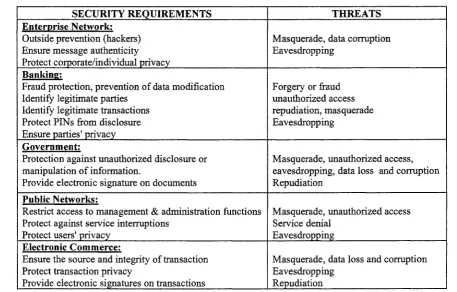
For illustration purposes, some typical threats associated with various business
environment are shown in Table 1.2.
SECURITY REQUIREMENTS THREATS
Enterprise Network: Outside prevention (hackers) Ensure message authenticity Protect corporate/individual privacy
Masquerade, data corruption Eavesdropping
Banking:
Fraud protection, prevention o f data modification Identify legitimate parties
Identify legitimate transactions Protect PINs from disclosure Ensure parties' privacy
Forgery or fraud unauthorized access repudiation, masquerade Eavesdropping
Government:
Protection against unauthorized disclosure or manipulation o f information.
Provide electronic signature on documents
Masquerade, unauthorized access, eavesdropping, data loss and corruption Repudiation
Public Networks:
Restrict access to management & administration functions Protect against service interruptions
Protect users' privacy
Masquerade, unauthorized access Service denial
Eavesdropping Electronic Commerce:
Ensure the source and integrity of transaction Protect transaction privacy
Provide electronic signatures on transactions
Masquerade, data loss and corruption Eavesdropping
Repudiation
1.1.3 Common type of network Attacks
Without security, both public and private networks are susceptible to unauthorized
monitoring and access. Internal attacks might be a result of minimal or nonexistent
intranet security; while risks from outside the private network stem from connections to
the Internet and extranets. Password-based user access controls alone do not protect data
transmitted across a network.
Without security measures and controls in place, the data might be subjected to an attack.
• Passive attacks, meaning information is monitored,
• Active attacks, meaning the information is altered with intent to corrupt or
destroy the data or the network itself.
The networks and data are vulnerable to any type of attacks listed in Table 1.1, as
described in the following bullet items:
• Eavesdropping
In general, the majority of network communications occur in an unsecured or
“cleartext” format which allows an attacker who has gained access to data paths
in your network to “listen in” or interpret (read) the traffic. When an attacker is
eavesdropping on your communications, it is referred to as sniffing or snooping.
The ability of an eavesdropper to monitor the network is generally the biggest
security problem that administrators face in an enterprise. Without strong
encryption services that are based on cryptography, the data can be read by others
• Data Modification
After an attacker has read the data, the next logical step is to alter it. An attacker
can modify the data in the packet without the knowledge o f the sender or receiver.
Even if the network does not require confidentiality for all communications, you
do not want any of messages to be modified in transit. For example, if we are
exchanging purchase requisitions, we do not want the items, amounts, or billing
information to be modified.
• Identity Spoofing (IP Address Spoofing)
Most networks and operating systems use the IP address of a computer to identify
a valid entity. In certain cases, it is possible for an IP address to be falsely
assumed— identity spoofing. An attacker might also use special programs to
construct IP packets that appear to originate from valid addresses inside the
corporate intranet. After gaining access to the network with a valid IP address, the
attacker can modify, reroute, or delete the data. The attacker can also conduct
other types of attacks, as described in the following bullet item.
• Password-Based Attacks
A common denominator of most operating system and network security plans is
password-based access control. This means access rights to a computer and
Older applications do not always protect identity information as it is passed
through the network for validation. This might allow an eavesdropper to gain
access to the network by posing as a valid user. When an attacker finds a valid
user account, the attacker has the same rights as the real user. Therefore, if the
user has administrator-level rights, the attacker also can create accounts for
subsequent access at a later time. After gaining access to the network with a valid
account, an attacker can do any of the following:
■ Obtain lists of valid user and computer names and network
information.
* Modify server and network configurations, including access
controls and routing tables.
■ Modify, reroute, or delete any data.
• Denial-of-Service Attack
Unlike a password-based attack, the denial-of-service attack prevents normal use
of a computer or network by its valid users. After gaining access to the network,
the attacker can do any of the following:
■ Randomize the attention of the internal IS staff so that they do not
see the intrusion immediately, which allows the attacker to make
more attacks during the diversion.
■ Send invalid data to applications or network services, which causes
* Flood a computer or the entire network with traffic until a
shutdown occurs because o f the overload.
■ Block traffic, which results in a loss of access to network resources
by authorized users.
• Man-in-the-Middle Attack
As the name indicates, a man-in-the-middle attack occurs when someone between
a legitimate user and the person with whom this user is communicating is actively
monitoring, capturing, and controlling the communication transparently.
For example, the attacker can re-route a data exchange. When computers are
communicating at low levels o f the network layer, the computers might not be
able to determine with whom they are exchanging data.
Man-in-the-middle attacks are like someone assuming your identity in order to
read your message. The person on the other end might believe it is you because
the attacker might be actively replying as you to keep the exchange going and
gain more information. This attack is capable of the same damage as an
application-layer attack, described later in this section.
• Com promised-Key Attack
A key is a secret code or number necessary to interpret secured information.
Although obtaining a key is a difficult and resource-intensive process for an
attacker, it is possible. After an attacker obtains a key, that key is referred to as a
secured communication without the sender or receiver being aware of the attack.
With the compromised key, the attacker can decrypt or modify data, and try to use
the compromised key to compute additional keys, which might allow the attacker
access to other secured communications.
• Sniffer Attack
A sniffer is an application or device that can read, monitor, and capture network
data exchanges and read network packets. If the packets are not encrypted, a
sniffer provides a full view of the data inside the packet. Even encapsulated
(tunneled) packets can be broken open and read unless they are encrypted and the
attacker does not have access to the key. Using a sniffer, an attacker can do any of
the following:
■ Analyze the network and gain information to eventually cause the
network to crash or to become corrupted.
■ Read the communications.
• Application-Layer Attack
An application-layer attack targets application servers by deliberately causing a
fault in a server’s operating system or applications. This results in the attacker
gaining the ability to bypass normal access controls. The attacker takes advantage
of this situation, gaining control of the application, system, or network, and can
do any of the following:
■ Introduce a virus program that uses computers and software
applications to copy viruses throughout your network.
■ Introduce a sniffer program to analyze the network and gain
information that can eventually be used, to crash or to corrupt
systems and the network.
■ Abnormally terminate the data applications or operating systems.
1.2 TCP / IP Overview
1.2.1 Introduction
The Transport Control Protocol/ Internet Protocol (TCP/IP) suite proved to be quite
robust and was very adaptable to the different networks. This along with the fact that it
was an open protocol, it was freely available, it was developed independently of any
specific computer hardware or operating system, and it was simple and easy to implement
made it very popular. By 1983, TCP/IP was integrated into release 4.2 o f Berkeley
Software Distribution (BSD) UNIX, and the same year, the DoD adopted this protocol
suite as Military Standard (MIL STD) and it became the standard of the Internet.
Today, TCP/IP continues to be the standard for the Internet.
The fact that this protocol was designed to be independent of any specific physical
network hardware has allowed it to be integrated into many different kinds of networks.
TCP/IP is currently integrated into Ethernets, token ring, dialup networks and just about
every other type of physical transmission medium, and virtually all modem operating
systems.
1.2.2 TCP/ IP Protocol architecture
Networking protocols are normally developed in layers, with each layer responsible for a
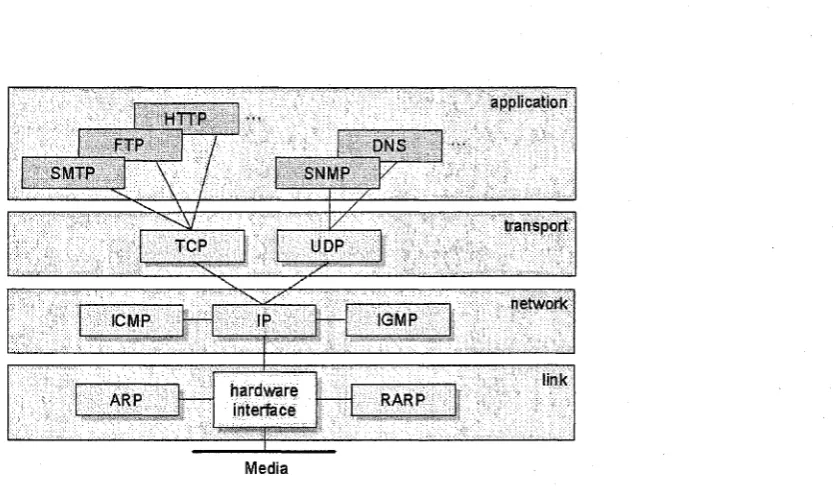
different facet of the communication [7]. The TCP/IP protocol suite consists of four
layers. Each layer has distinct functions and consists of a consists of a combination of
different protocols as shown in Figure 1.1. The functionalities of the layers are discussed
application HTTP
DNS
SNMP 1 7 "
SM TP
tran sp o rt
T C P UDP
netw ork IGMP
ICMP
link h a rd w are
interface RARP
ARP
Media
Figure 1.1: Protocols at the four layers of the TCP/IP protocol suite.
• Data-link Layer
The data-link layer is also called the data link or network access layer. It is the lowest
layer of the TCP/IP protocol stack. Example of data-link layers are Ethernet, Token Ring
and ATM (Asynchronous Transfer Mode). For information on Ethernet refer to [8], for
information on Token Ring see[9], and for further detail on ATM see [10], [11] and [12].
The protocols in data-link layer provide means for the system to deliver data to other
devices on the network. These protocols are concerned with details such as the packet
structure and addressing scheme of the underlining network. Two of the protocols in this
layer are ARP (Address Resolution Protocol), which maps IP addresses to Ethernet
addresses; and RARP (Reverse Address Resolution Protocol), which maps Ethernet
address to IP address. See [13] and [14] for further information on these protocols.
When the data-link layer receives a packet from the network layer the layer, above
network to the specified device. The reverse occurs when a packet arrives from the
physical network to the data link layer: the layer removes the data-link header then sends
the packet up to the network layer for processing. This is illustrated in Figure 1.2.
user data
HTTP h d r
HTTP client
“ T ~
TCP
mmi)
TC P hdr \
IP j IP h d r
V
Ethernet driver
Eth. hdr tr.
Ethernet
Figure 1.2: Encapsulation and de-capsulation of data as it goes down and up the protocol stack,
respectively.
• Network Layer
The network layer is also called the internet layer. This layer is responsible for the
routing of packets from the source host to the destination host. The network layer consists
of three protocols: Internet Control Protocol (ICMP), Internet Group Management
Protocol (IGMP) and Internet Protocol (IP).
The official specification of ICMP is outlined in [15]. ICMP is the protocol that is
used to communicate error conditions that occurred during the transmission of IP packets.
ICMP is the debug of network connectivity problems. The popular debugging tools are
ping and traceroute using this protocol.
IGMP is the protocol that is used by hosts and routers to ascertain information about
the hosts in multicast groups; i.e., groups o f hosts to which IP datagrams are to be sent
simultaneously. As is the case with ICMP, IGMP messages are encapsulated in IP
datagrams. For further detail on IGMP refer to [16] which contains the original
specification of IGMP.
IP is the protocol that holds the whole TCP/IP protocol suite architecture together.
The data of the protocols in all of the layers of the TCP/IP protocol stack, except the data-
link layer, are transmitted as IP datagrams. IP allows hosts to inject packets into the data-
link layer, which eventually puts them on the physical network and has them travel on
potentially different networks to their final destination. IP offers a connectionless service.
In connectionless services, each message or datagram carries the full destination address,
and is routed independently of the other datagrams. With connectionless services, it is
possible for the datagrams to arrive at their destination in different order that they were
sent. This is not possible with connection-oriented services, since the latter is like a
telephone system which establishes a connection or a path from the host to the destination
uses the path to send data, and then releases the connection after the data transmission is
completed.
There are two versions of IP that are available for use with the TCP/IP protocol, IPv4 and
• Transport Layer
The layer above the network layer in the TCP/IP protocol stack is the transport layer.
This layer provides a flow of data between two hosts, for the application layer above.
Two protocols are implemented at the transport layer, 1) TCP (Transport Control
Protocol) and 2) UDP (User Datagram Protocol). TCP is a reliable connection-oriented
protocol that allows byte streams from a host to be delivered without error to any other
hosts on networks that are reachable. The TCP protocol also breaks up received packets,
re-assembles packet fragments it received from the network layer, and perform flow
control to ensure that a fast hosts does not overwhelm a slower host with more packets
that it can handle. See [17] for further detail On this protocol.
The UDP, unlike TCP, offers an unreliable and connectionless service. It does not
perform any error checking or flow control; it simply sends datagrams from one host to
another and does not provide any guarantee that a datagram will get to its destination.
There is much less overhead involved in processing UDP datagrams compared to TCP
packets. Consequently, the throughput of UDP datagrams is usually greater than that of
TCP. UDP protocol is usually use by applications for which prompt delivery is more
important than accurate delivery; such as in the transmission of speech or video. See [18]
• Application Layer
The top of the TCP/IP protocol stack is the application layer. This layer includes all
processes that use the transport layer protocols to deliver data. Application layer
protocols usually provide services to the users o f the system. There are many application
protocols. The ones that just about all TCP/IP implementation provides include:
-Telnet: The Network Terminal Protocol, which provides remote login.
-FTP: File Transfer Protocol, which is used for file transfer to or from remote hosts.
- SMTP: Simple Mail Transfer Protocol, which delivers electronic mail.
- SNMP: Simple Network Management Protocol, which is used for monitoring network
segments.
- DNS: Domain Name Service, which is used for mapping host names onto their IP
addresses.
- HTTP: Hypertext Transfer Protocol, which is used for fetching web pages on the World
1.3 Cryptographic tools and Techniques
1.3.1 Introduction
There is no single cryptographic tool. There are various techniques for encrypting
messages, for securely exchanging keys, for maintaining the integrity of messages, and
for guaranteeing authenticity of a message. All o f these techniques combined to provide
the services necessary to keep secrets in an increasingly public world.
There is really no such thing as absolute security, but for every secret there is a threat,
and analysis must be made to determine the viability of that threat and the damage that
can be done if they are acted upon. Generally, the strength of a cryptosystem is measured
by its complexity. If the complexity of a particular crypto-system is 232 then it is assumed
that 232 separate operations are required to break it. That is a considerable number o f
operations, but if each operation can be performed by a modem computer in hundredths
or thousandths of a second, the system might not be secure enough for the secret it is
protecting. Because of this the term computationally secure is used to express the security
of a modem cryptosystem.
1.3.2 Cryptographic Building Blocks
A good portion of public key cryptography relies upon a foundation of one-way
functions and trapdoors. A one-way function is something that is easy to compute in one
direction but difficult, bordering on impossible, to compute in the other direction. A
trapdoor is a way to sneak back, in effect a way to cheat and return using a secret
For a one-way function to be useful in cryptography it must exhibit its one way-
ness with any input. For example, in a finite field it is easy to compute the product of
numbers but difficult to factor that product. Another number example is the Discrete
Logarithm Problem: with a larger prime, p, and a base generator, g, for a particular value
y, find x where
g x = y mod p
Modular exponentiation is easy, but doing a discrete logarithm to recover the exponent is
hard. For any class of numbers: odd numbers, palindromic numbers, numbers divisible by
47 - the problem of solving the discrete logarithm is still very hard; see [19].
1.3.3 Encryption Concepts and Algorithms
1) Encryption Concepts
Unencrypted message is referred to as “plaintext”. The process of camouflaging a
message in such a way as to conceal its content is known as encryption. An encrypted
message is referred to as “ciphertext”. The process of converting ciphertext back into
plaintext is known as decryption.
2) Cryptographic algorithm
A cryptographic algorithm, also called a cipher, is the mathematical function used for
encryption and decryption. For better security, quality control and standardization,
modem cryptography incorporates the concept of a key. This key can take many values
(usually denoted in binary bits), and is analogous to the combination of a lock. Although
the concept of a combination lock is well known, it is often difficult to open a
given combination, the more time consuming it will be to guess the combination. The
same is true for cryptographic keys; hence the more bits in a key the less susceptible a
key is to being compromised. Therefore, the security robustness in modem day ciphers is
based on the key rather than the details of the cipher known as encryption algorithm. This
doesn’t matter if an eavesdropper knows the algorithm; if the particular key is not
revealed, the message cannot be read by anyone.
3) Confidentiality
Confidentiality is the security service that protects data and the external characteristics of
communication from unauthorized disclosure by concealing source and destination
addresses, message length or frequency of communication. With confidentiality, the
intended recipients know what was being sent but unintended parties cannot determine
what was sent. Encryption algorithms can be used to provide confidentiality.
There are two general types of key-based algorithms: symmetric and asymmetric,
o Symmetric Algorithms
In symmetric algorithms, the encryption key can be calculated from the
decryption key and vice versa. In this case, encryption and decryption use the
same mathematical functions, and the encryption key and the decryption key are
identical. Symmetric algorithms, also known as secret-key algorithms, require that
the sender and receiver agree on a key before they can transmit and receive
Cewlfeferrtiality
Figure 1.3: Schematic Example for Symmetric Cryptography
The security of a symmetric algorithm lies in the key; disclosing the key implies
that anyone could encrypt and decrypt the messages. Therefore, it is mandatory
that the key remain secret.
Symmetric algorithms are further categorized into stream and block ciphers.
Block ciphers operate on one block of data (usually in 64-bit block size) at a time.
Stream ciphers conversely operate on data one bit (or one byte) at a time. In either
case, they are ideal for bulk encryption. As block ciphers are used only in IPSec,
stream ciphers are beyond the scope of this study.
Cipher mode refers to a set of techniques used to apply a block cipher to a data
stream. Four basic modes are used:
- Electronic code book (ECB)
- Cipher block chaining (CBC)
- Cipher feedback (CFB)
- Output feedback (OFB)
An example of a symmetric block in CBC mode is the Data Encryption Standard
(DES). DES encrypts data in 64-bit blocks and the same algorithm and key are
any 56-bit number and can be altered any time. DES breaks a massage into 64-bit
blocks, XORs the first block with the Initialization Vector (IV), and encrypts it
with the 56-bit key. The result is a 64-bit block of cipher text that is further
XORed with the next 64-bit block. This process is repeated until the entire
message has been encrypted.
There is a more secure variant of DES. called “3DES”. In 3DES, pronounced
“Triple-DES” the DES algorithm is applied 3 times to each 64-bit plaintext block,
using a different 56-bit key each time. A typical approach uses two different 56-
bit keys, K1 and K2, yielding a length of 112 bits, with K1 being reused for the
final (third) encrypt. Other applications use three different 56-bit keys, K l, K2,
and K3, and K3, yielding a total key length of 168 bits. Using the same key in all
three steps will yield the same result as encrypting with conventional DES. Due to
the second step being a decryption operation [20],
Over the years, a number of symmetric cryptosystems have been proposed as
possible replacement for DES. Some of these cryptosystems will be introduced
below.
• Blowfish: Blowfish was developed by Bruce Schneier [21]. It uses a key
of variable length: from 32 to 448 bits to encrypt blocks o f 64-bit plaintext
into blocks of 64-bit ciphertext. Blowfish has a simple structure which
makes it easy to implement. Currently, Blowfish is one of the fastest
security. It is believed that Blowfish is very secure, particularly when
longer keys are used.
• CAST-128: CAST was developed by Carlisle Adams and Stafford
Tavares [22]. It uses a key that varies between 40 to 128 bits in length, in
8-bits increments; and produces 64-bit blocks ciphertext from blocks of
64-bit plaintext. The CAST algorithm involves 16 rounds of computations
which are quite complex. This algorithm has received widespread review
and it is believed to be quite safe.
• International Data Encryption Algorithm (IDEA): IDEA was
developed by Xuejia Lai and James Massey at the Swiss Institute of
Technology (ETH in Zurich). The original specification and later
modifications are outlined in [23] and [24] respectively. IDEA uses a 128-
bit key and encrypts plaintext in blocks o f 64 bits and output 64-bits
blocks ciphertext. IDEA enciphering algorithm has received a fair bit of
attention and it is believed that to be quite secure for a number of years.
• RC2: RC2 was developed by Ronald Rivest [25]. It is designed to be
easily implemented on 16-bit microprocessors. The algorithm uses a key
of variable length: from 8 bytes to 128 bytes and enciphers block of 64-bit
plaintext to output blocks of ciphertext o f 64 bits, inlength.
• RC5: RC5 was developed by Ronald Rivest [26]; a later description is
given in [27], RC5, like DES, is suitable for both hardware and software
implementation. It is adaptable to processor of different word length. The
algorithm. RC5 algorithm also has variable number of rounds, which
allows tradeoff between higher speed and higher security. The algorithm
uses a variable length key to encrypt plaintext blocks of 32, 64 or 128 bits
and output blocks o f ciphertext o f corresponding length. RC5 has a low
memory requirement which therefore, makes it suitable to be used in
applications such as smart cards that have limited memory,
o Asymmetric Algorithms
Asymmetric algorithms are designed so that the key used for encryption is
different from the key used for decryption as it is shown schematically in
Figurel.4.
In addition, the decryption key cannot be derived from the encryption key. These
algorithms are referred to as public-key algorithms, because the encryption key is
made public. In other words, anyone can use the encryption key (public key) to
encrypt a message, but only a specific recipient with the corresponding decryption
key (private key) can decrypt the message. In other instances the message can be o
'L
K#y CortfletettfMiy
Public Privet*
K*y K*y
encrypted with private key and decrypted with the public key. This is typically
used in digital signatures.
An example of a public key cipher is the RSA algorithm developed by Ron
Rivest, Adi Shamir, and Leonard Adleman. The public and private keys are
functions of a pair of large prime numbers. The security o f this approach is based
on the fact that it can be relatively easy to multiply these large prime numbers
together but extremely difficult to factor the resulting product. In other words,
anyone attempting to recover the text plain from the cipher text and the public key
will have to go through the knotty task of guessing Hie decryption (private) key by
factoring the resulting product of two large prime numbers. RSA uses a key
length of 512 bits, 768 bits, 1024 bits, or longer. A longer key length offers
stronger security, but also uses up more CPU processing cycles. This is due to the
fact that the mathematical computations in the RSA algorithm are much more
complicated than the DES algorithm [28]. As a result, in hardware, RSA is about
1000 times slower than DES, and in software, DES is up to 100 times faster than
RSA. These numbers may change slightly as technology advances, however, RSA
will never approach the speed of symmetric algorithms, which makes it an
unlikely candidate for bulk data encryption [29].
Public-key algorithms such as RSA are rarely used for data confidentiality
(encryption) because of the performance constraints mentioned earlier. Instead,
they are most often used in applications involving authentication via digital
surrogates for symmetric algorithms. They are typically used to encrypt keys
instead of messages.
1.3.4 Hashing Concepts and Algorithms
1) Hashing Concepts
A one-way hash function is a mathematical function that is easy to compute in the
forward direction, but computationally infeasible to reverse. An input message runs
through the mathematical function (the hash function) and results in a string of output bits
called a hash (or a message digest). The process is irreversible, that is, the input cannot be
derived from the output. It is analogous to a coffee grinder. Imagine the message is the
coffee beans and the output hash is the resulting ground coffee. It is quite impossible to
take the ground coffee and recreate the original coffee beans. In addition, a hash function
takes a message of arbitrary length and produces a fixed-length output [30],
It is important to implement keyed hashing because only performing a one way hash on
some data does not provide any authentication. A hash function alone is like a checksum.
Anybody can modify the data and just run the hash algorithm over the modified data. A
keyed hash function is a message authentication code (MAC), which, in other words, is a
one-way hash function encrypted using private key. A MAC is generated through hashing
a shared privet key along with message.
The concept is the same as hash functions, except now only the holder of the secret key
Privet key
{ ] £
\ ---7
\ Hash /
V F u n c t i c n /
1 HasTT
Figure 1.5: A keyed hashing function (MAC)
Keyed hashing can be used to generate a hash (MAC) on each IP packet in an IP
data stream. These hashes then become part of the IP packet and are used to verify the
integrity of the IP packet when it is received. The recipient runs the same hash (plus
shared secret key) on each received IP packet and compares it with the inserted hash
value. If nothing in the packet has been modified in transit the results are the same and
the integrity of the IP packet remains intact. Common keyed hash functions include:
- Message Digest 5 (MD5) is a one-way hash that combines a shared secret and
the message, to produce a hash. MD5 processes the input text in 512-bit blocks,
divided into 16 x 32-bit subblocks. The output is a set of 4 x 32-bit blocks,
concatenated to form a single 128-bit hash value.
- Secure Hash Algorithm (SHA) is similar to MD5 but the algorithm output is a
set of 5x 32-bit blocks, concatenated to form a single 160-bit hash value.
Note that all message authentications in IPSec use hashed MAC (HMAC) described in
variant that provides an additional level of hashing making it cryptographically stronger
than principal hashing function.
2) Integrity Service
Integrity is a security service that ensures that any modifications to data are detectable.
There are two types of integrity in a TCP/IP environment: connectionless and partial
sequence integrity. Connectionless integrity is a service that detects the modification o f
individual IP packets without regard to the ordering of the packet in a traffic stream.
Partial sequence integrity is referred to as antireplay integrity, and it detects arrival of
duplicate IP packets. With integrity, data is transmitted from source to destination
without undetected change. Hashing algorithms can be used to provide integrity.
Although authentication and integrity services are often mentioned separately, in practice
they are closely related, and almost always offered together.
3) Key Exchanges
Symmetric algorithms and keyed hashing both require a shared key. The security of the
encryption and authentication techniques can be completely undermined by an insecure
key exchange. With symmetric encryption, the data encryption key is always present and
remains fixed. Any intruder who compromises the encryption key can decrypt messages
encrypted with it. A common cryptographic technique is to encrypt each individual
conversation with a separate key. This is referred to as a session key since it is used for
only one particular communication and destroyed when it is no longer needed. As such,
the risk of compromising the session (encryption) key is reduced significantly. In the
following section, we look at how the Diffie- Heilman key exchange algorithm can be