Cloud Security Ecosystem for Data Security
and Privacy
Durgesh Sharma1, Subhas Sharma2, Rajesh V3
U.G Student, Department of Computer Science and Engineering, Sri Krishna Institute of Technology,
Bengaluru, India1.,
U.G Student, Department of Computer Science and Engineering, Sri Krishna Institute of Technology,
Bengaluru, India2
Assistant Professor, Department of Computer Science and Engineering, Sri Krishna Institute of Technology, Bengaluru,
Karnataka, India3
ABSTRACT:In the past couple of years Cloud Computing has become an eminent part of the IT industry. Because of its economic benefits more and more people are heading towards Cloud adoption. In present times there are numerous Cloud Service providers (CSP) allowing customers to host their applications and data onto Cloud. However, Cloud Security continues to be the biggest obstacle in Cloud adoption and thereby prevents customers from accessing its services. Various techniques have been implemented by provides to mitigate risks pertaining to Cloud security. In this paper, we present a Hybrid Cryptographic System (HCS) that combines the benefits of both symmetric and asymmetric encryption thus resulting in a secure Cloud environment. The paper focuses on creating a secure Cloud ecosystem wherein we make use of multifactor authentication along with multiple levels of hashing and encryption. The proposed system along with the algorithm are simulated using the CloudSim simulator. To this end, we illustrate the working of our proposed system along with the simulated results.
KEYWORDS:Cloud Security; Data Security; Data Privacy; CloudSimulator
I.INTRODUCTION
In today’s times Cloud computing has a significant impact on the IT industry. With growing popularity more and more organizations are making use of cloud services [1]. Although cloud services have a widespread acceptance but the fear pertaining to security and privacy of these services continue to be an open challenge. With rapid technological advancements these services could be easily accessed through smart phones thus allowing users to share pictures, video, documents and other important data across various platforms on a real time basis [2]. However, a security breach in their cloud account could lead to stolen data which would indeed result in huge losses.
Security has always been a concern in the domain of information technology. With Cloud services handling critical data which can be accessed from anywhere through the internet makes security a prominent concern [3]. The pervasive nature of Cloud and its disbursal of data across various geographical locations amounts to high security risks. While talking of Cloud Security there are many aspects which one needs to consider such as, trusted authentication, appropriate authorization, data security and privacy. These are some of the basic security goals which are extremely essential for every cloud provider to incorporate [4]. Since security has been seen as an attribute for information technology, data encryption has been one of its key measures in ensuring data security protection. Many algorithms in the past have been proposed for conducting efficient data encryption. These algorithms range from Diffie-Hellman, RSA, DES to AES, RC4 and 3DES. Each of these algorithms have their own advantages along with their demerits. These algorithms are broadly classified as being symmetric or asymmetric in nature.
The rest of the paper is categorized as follows: Section II talks about security concerns pertaining to Cloud Computing.
Section III elucidates the proposed work wherein the proposed system and its working are explained. Section IV discusses the algorithm that depicts the workflow of the entire system, whereas its successful simulation and its results are discussed in Section V. Finally, Section VI concludes the paper.
II.SECURITYCONCERNSINCLOUD
Security in cloud plays an important role in creating a sense of belief and confidence between the customer and Cloud Service Provider (CSP). Since, all the user data is stored, managed and processed at the cloud end thus it is the duty of the CSP to mitigate any kind of risk pertaining data security and privacy. Following are certain Cloud security which a CSP needs to keep in mind while dealing with user data.
1. Data Protection: Cloud computing poses several data protection risks for cloud users, providers and brokers. There are different kinds of SLAs involved between the cloud user, provider and broker leading to certain kinds of data leaks. Many of times it is seen that it becomes difficult for the cloud user to have a check on the data handling practices of the cloud provider [5]. Further there can be challenges due to the complex network topology between cloud and the end user that gives scope to many network related attacks.
2. Loss of Data: Mission critical applications involving the use of crucial data are not preferred to be offloaded to cloud. Due to the presence of common resource pools, applications run on the same platform that could lead to disclosure of user’s information through its application. In many cases proper encryption schemes for secure processing are not adopted for data transfer and its storage by the cloud vendor.
3. Traffic hijacking: is also one of the prominent threats that end users face while leveraging form cloud computing. In 2013 Cloud Security Alliance ranked it as the third most extreme threat to cloud security. In such kind of an attack, hackers tend to obtain a user’s security credentials and proclaim unauthorized access to its data. After which all the activities of a user including its confidential transactions happening on the cloud are now open to a hacker [6]. The hacker can easily tamer the users data along with have access to its applications running on cloud. A similar kind of an attack was faced by Amazon in 2010 when the hackers had stolen the session IDs and had access to client’s credentials.
4. Isolation of Resources: In present times the two main characteristics of cloud computing are multi-tenancy and shared resources. This risk category caters to processes that work and manage resources like storage, memory, bandwidth and even reputation between different tenants. Cloud provides a shared platform for different kind of applications from different users. This common resource pool adds problems relating to security thus making the user data more vulnerable to data breaches.
5. Malicious Insider: Usually, the damage which may be caused by malicious insiders is often far greater than expected. Such type of attackers uses their own device as a medium to inject the unsecure code to the cloud. This code behaves maliciously when properly injected and the control of which lies in hands of the user operating it [7]. This code can provide access of information to the malicious user, criticality of which depends on the capability of the designed code and the level of security measures taken by the cloud.
III.PROPOSEDWORK
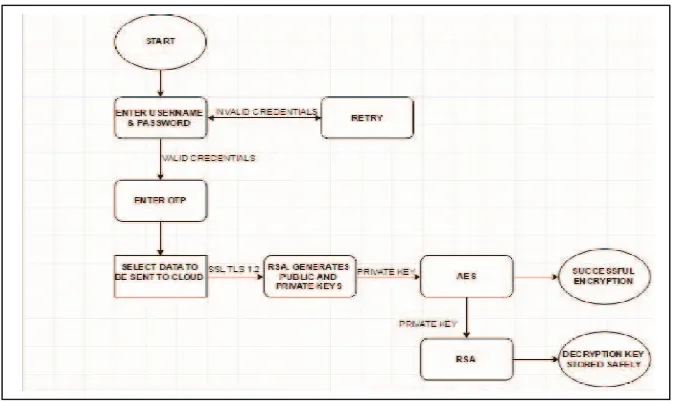
Fig 1 Encryption Process Flowchart
As it can be seen in the figure, no unauthorized user will have access to and kind of user data. This is ensured by making use of multifactor authentication in form of One Time Password (OTP). Once a legitimate user enters its login credentials an OTP is sent to its registered mail which one needs to enter to make certain successful login. Upon successful login the user can anytime send or retrieve data from Cloud. If a user wishes to store its data onto the Cloud, in this case the data can pass through a secure network channel to protect it from any kind of hackers residing over the network. Once the data reaches the Cloud end it undergoes encryption through our Hybrid Cryptographic System. At first the RSA generates Public and Private Keys which are later used by the AES to commence data encryption. The Private key of the AES again undergoes encryption through RSA and is saved in the data base after adding salt to it. In this way the user data is stored in an encrypted form at the Cloud end and whenever the user wishes to access it will be available after successful decryption.
System Architecture
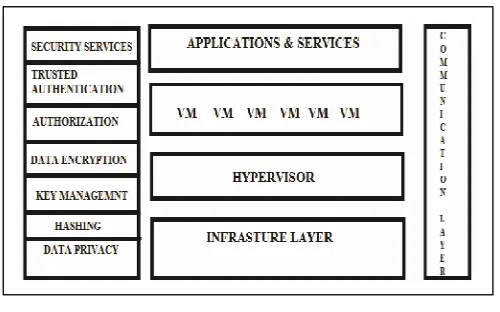
Fig. 2.System Architecture
The list of security services which our Secure Cloud Ecosystem ensure are:
1. Trusted Authentication: Only a legitimate user will be allowed to access services and data being hosted on
Cloud.
2. Authorization: The system ensures proper authorization by only allowing system admin to have access to decryption keys. It is only the Cloud admin who is aware of the salted value added to every user password and Decryption Key before being saved in the database.
3. Data Encryption: The system makes use of Hybrid Encryption by allowing RSA and AES algorithms to
encrypt user data. The proposed system leverages the benefits of both symmetric and asymmetric data encryption. We make use of RSA2048 and AES256 for our encryption process.
4. Hashing: SHA512 and bcrypt functions are used for securing user password.
5. Key Management: The Private Key of AES is encrypted and salted and safely stored into the database. The
decryption keys are also saved soon after the encryption gets over. The SHA512 key is protected using keyed-hash message authentication code (HMAC).
IV.ALGORITHM
The working of our proposed system is explained through the illustration of the algorithm that forms the core for it. The algorithm depicts the functioning of the system by representing the entire process from user authentication to storage and retrieval of user data from Cloud.
STEP 1: Create Username and Password STEP 2: Password creation using CSPRNG
STEP 12: User request to access data STEP 13: RSA generates Decryption Keys STEP 14: Decryption process takes place
STEP 1 to STEP 6 depict the authentication process wherein trusted authentication takes place through the use of original user credentials. Multifactor authentication has also been performed by making use of One Time Password (OTP), which is sent to the registered email-id of the user. In STEP 2, we make use of CSPRNG (Cryptographically Secure PseudoRandom Number Generator) which is a salting technique used for protecting passwords in case there is an attack on credential database. In STEP 3, hashing functions such as SHA512 and bcrypt have been used for ensuring password protection. STEP 9 to STEP 11 illustrate the process of data encryption that happens at the Cloud end. STEP 12 to STEP 14 demonstrate the decryption process in case the user needs to access its data.
V. CONCLUSION
In this paper, we present a Hybrid Cryptographic System (HCS) that combines the benefits of both symmetric and asymmetric encryption. The Secure Cloud Ecosystem which we propose ensures data security and privacy by implementing different encryption techniques at various levels. The system also makes use of certain hashing and salting techniques which even strengthens the entire encryption process. During the design of our system we also made sure of trusted authentication thereby allowing the feature of One Time Password (OTP). In future we wish to incorporate definite steps that would enhance the efficiency and generality of our system. This could be in form of extending our system to work for a multi cloud environment and add certain backup and recovery features which would prevent data loss in case of an attack.
REFERENCES
[1] Subashini, Subashini, and VeerarunaKavitha. "A survey on security issues in service delivery models of cloud computing." Journal of network and computer applications 34.1 (2011): 1-11.
[2] Pawar, Pramod S., et al. "Security-as-a-service in multi-cloud and federated cloud environments." IFIP International Conference on Trust Management. Springer International Publishing, 2015.
[3] Nair, Nikhitha K., K. S. Navin, and Soya Chandra. "Digital Signature and Advanced Encryption Standard for Enhancing Data Security and Authentication in Cloud Computing." (2015).
[4] Wang, Cong, et al. "Privacy-preserving public auditing for data storage security in cloud computing." INFOCOM, 2010 Proceedings IEEE. Ieee, 2010.
[5] Hendre, Amit, and KarunaPande Joshi. "A semantic approach to cloud security and compliance." 2015 IEEE 8th International Conference on Cloud Computing. IEEE, 2015.
[6] Khanna, Abhirup, Sarishma. (2015). Mobile Cloud Computing: Principles and Paradigms. IK International.
[7] Khanna, Abhirup. "RAS: A novel approach for dynamic resource allocation." Next Generation Computing Technologies (NGCT), 2015 1st International Conference on. IEEE, 2015.
[8] Calheiros, Rodrigo N., et al. "CloudSim: a toolkit for modeling and simulation of cloud computing environments and evaluation of resource provisioning algorithms." Software: Practice and Experience 41.1 (2011): 23-50.
[9] Huang, Wei, et al. "The State of Public Infrastructure-as-a-Service Cloud Security." ACM Computing Surveys (CSUR) 47.4 (2015): 68. [10] Aich, Asish, AloSen, and SatyaRanjan Dash. "A Survey on Cloud Environment Security Risk and Remedy." Computational Intelligence and
Networks (CINE), 2015 International Conference on. IEEE, 2015.