Hands Free Authentication
G. Michael, Sundararajan.M, Arulselvi S
Dept. of CSE, Bharath University, Chennai, Tamil Nadu, India
Director, Research Center for Computing and Communication, Bharath University, Chennai, Tamil Nadu, India
Co-Director, Research Center for Computing and Communication, Bharath University, Tamil Nadu, India
ABSTRACT: we present a hands free interface between the computer and human to control the mouse cursor by our eyes and we replace the usage of laser mouse by, Input are taken through the webcam and processed to find the position of the cursor on the screen and moved across the screen according to the eye movements. We apply this concept in banking domain particularly in ATM card authorization method thereby replacing conventional typing of the password by looking the buttons for a particular session of time and those keys are taken as input for PIN. This technique would diminish shoulder surfing at authentication level thereby increasing the privacy of the individual.
KEYWORDS: face detection, SSR, SVM.
I. INTRODUCTION
The personal identification number (PIN) is a common user authentication method used in various situations, such as in withdrawing cash from an automatic teller machine (ATM), approving an electronic transaction, unlocking a mobile device, and even opening a door. However, a critical issue with PINs is that they are vulnerable to shoulder-surfing attacks (SSAs) [2]. In other words, anyone who observes the logon procedure by looking over a user’s shoulder can easily memorize his/her PIN. This kind of attack is an actual threat to the use of PINs because there are many cases in which PINs are used in public places and for financial transactions. For example, a combination of an SSA and stolen or skimmed material such as a magnetic card or a mobile device enables an attacker to obtain a victim’s private information and to withdraw money from that victim’s account.
This technology is intended to be used by disabled people who face a lot of problems in communicating with fellow human beings. It will help them use their voluntary movements, like eyes and nose movements: to control computers and communicate through customized, educational software or expression building programs. People with severe disabilities can also benefit from computer access and take part in recreational activities, use internet or play games. This system uses a usb or inbuilt camera to capture and detect the user’s face movement. The proposed algorithm tracks the motion accurately to control the cursor, thus providing an alternative to computer mouse or keyboard.
Primarily approaches to camera-based computer interfaces have been developed. However, they were computationally expensive, inaccurate or suffered from occlusion. For example, the head movement tracking system is the device that transmits a signal from top of computer monitor and tracks a reflector spot placed on user forehead. This technique is not completely practical as some disabled cannot move their head and it becomes in accurate when someone rotates its head. Electrooculography (EOG) is a technology where a electrode around user eye record the movement. The problems with this technique is that for using this the disabled person needs someone help to put it and also the system is quite expensive. so the usage of webcam reduces the cost and makes everyone to use it easily.
II. FLOW OF USING THE APPLICATION
2.1 Face Detection
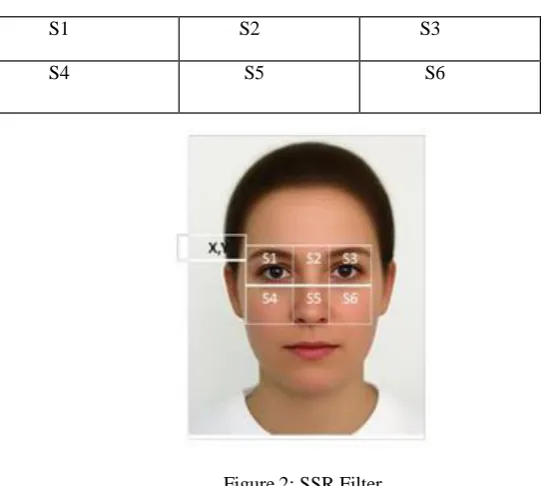
S1 S2 S3
S4 S5 S6
over viewing the face detection algorithm we applied in this work here is an explanation of some of the idioms that are related to it.
2.2 SIX SEGMENTED RECTANGULAR FILTER [SSR] At the beginning, a rectangle is scanned throughout the input image. This rectangle is segmented into six Segments as shown in Fig. (1).The template is used to format your paper and style the text. All margins, column widths, line spaces, and text fonts are prescribed; please do not alter them. You may note peculiarities. For example, the head margin in this template measures proportionately more than is customary. This measurement and others are deliberate, using specifications that anticipate your paper as one part of the entire proceedings, and not as an independent document.
Please do not revise any of the current designations.
Fig (1) Segments of rectangle
Figure 2: SSR Filter
We denote the total sum of pixel value of each segment (S1-S6). The proposed SSR filter is used to detect the Between-the-Eyes [BTE] based on two characteristics of face geometry. (1) The nose area (Sn) is brighter than the right and left eye area (eye right (Ser) and eye left (Sel), respectively) as shown in Fig. (2), where
Sn = S2 + S5 Ser = S1 + S4 Sel = S3 + S6 Then, S > Ser (1) Sn > Sel (2)
(2) The eye area (both eyes and eyebrows) (Se) is relatively darker than the cheekbone area (including nose) ( Sc ) as shown in Fig. (2), where
Se= S1 + S2 + S3 Sc= S4 + S5 + S6 Then,
Se < Sc (3)
2.3 INTEGRAL IMAGE
In order to assist the use of Six-Segmented Rectangular
filter an immediate image representation called “Integral Image” has been used. Here the integral image at location x, y contains the sum of pixels which are above and to the left of the pixel x, y [10] (Fig. 3).
Fig 3: Integral Image; i: Pixel value; ii: Integral Image So, the integral image is defined as:
ii (χ, y) = Σ і(χ′‚ y′) (1)
χ′ ≤ χ‚ y′ ≤ y
With the above representation the calculation of the SSR filter becomes fast and easy. No matter how big he sector is, with 3 arithmetic operations we can calculate the pixels that belong to sectors
The Integral Image can be computed in one pass over the original image (video image) by: s(χ,y) = s(χ,y-1)+i(χ,y) (2)
ii (χ,y)=ii(χ -1,y)+s(χ,y) (3)
Where s(χ ‚ y) is the cumulative row sum, s(χ, -1) = 0, and ii(- 1‚ y) = 0. Using the integral image, any rectangular sum of pixels can be calculated in four arrays.
2.4 SUPPORT VECTOR MACHINES [SVM]
SVM are a new type of maximum margin classifiers: In
“learning theory‟ there is a theorem stating that in order to achieve minimal classification error the hyper plane which separates positive samples from negative ones should be with the maximal margin of the training sample and this is what the SVM is all about. The data samples that are closest to the hyper plane are called support vectors. The hyper plane is defined by balancing its distance between positive and negative support vectors in order to get the maximal margin of the training data set.
III. FACE DETECTION ALGORITHM
3.1 Face Tracking
Now that we originate the facial features that we need, using the SSR and SVM, Integral Image method we will be tracking them in the video stream. The nose tip is tracked to use its association and coordinates as them association and coordinates of the mouse pointer. The eyes are tracked to detect their blinks, where the blink becomes the mouse click. The tracking process is based on predict the place of the feature in thecurrent frame based on its location in previous ones; templatesimilar and some heuristics are applied to locate the feature’snew coordinates..
3.2 Motion Detection
To detect motion in a certain region we subtract the pixels
in that region from the same pixels of the previous frame, and at a given location (x,y); if the absolute value of the subtraction was larger than a certain threshold, we consider a motion at that pixel.
3.4 Eyes Tracking
If a left/right blink was detected, the tracking process of the left/right eye will be skipped and its location will be considered
as the same one from the previous frame (because blink detection is applied only when the eye is still). Eyes are tracked in a bit different way from tracking the nose tip and the BTE, because these features have a steady state while the eyes are not (e.g. opening, closing, and blinking) To achieve better eyes
positions of the eyes to the BTE; in the next frame after locating the BTE we assume that the eyes have kept their relative locations to it, so we place the eyes
IV. NEW PIN-ENTRY METHOD
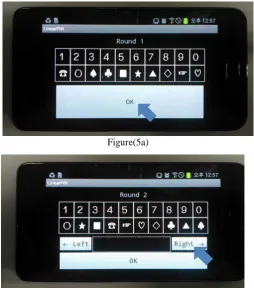
On the basis of the above guidelines, we present a new PIN-entry method. The basic layout of our method comprises a horizontal array of digits from 0 to 9, juxtaposed with another array of ten familiar objects such as and , as shown in Fig.5. For simplicity, we assume that the number of digits in a PIN is four, although the proposed method may be applied to any case with N ≥ 2 digits. We present two versions of the new method, called LIN4 and
LIN5.
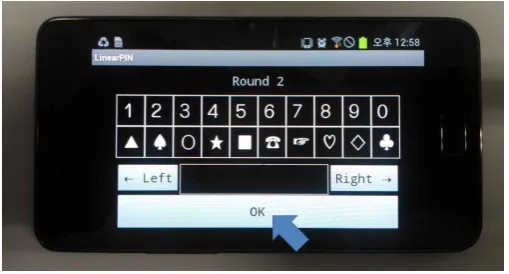
For LIN4, we need a total of four rounds. The first round is the session key decision round, and the remaining three rounds are PIN-entry rounds. In the session key decision round, ten randomly arranged objects are displayed to the user, as depicted in Fig. 5(a). The user recognizes the symbol immediately below the first digit of his/her PIN as the temporary session key and presses “OK.” In the example shown in Fig. 2(a), where the PIN is 2371, the user recognizes as the session key because it is collocated with the first digit of the PIN, 2. The remaining rounds are PIN-entry rounds, in which the i th digit of the PIN is entered in the i th round for i = 2, 3, 4. In each of these rounds, the user is again given a random array of ten objects as in Fig. 5(b), and s/he enters a
PIN digit by rotating the object array and aligning the session key with the current PIN digit, as in Fig. 2(c). For this task,
the user can use two additional buttons (“Left” and “Right”). In the example round shown in Fig. 2(b) and (c), the user presses the “Right” button twice so that moves to the position immediately below 3, and then presses “OK.” For faster input, the user may use the sliding
Figure(5a)
Figure 5c
Fig. 5 Example of a session key decision procedure and a PIN-entry procedure for PIN 2371, in which the session key is given as . (a) Session key decision round. (b) Challenge in a PIN-entry round. (c) User’s response. touchpad between the “Left” and “Right” buttons. This input mechanism can be implemented using various devices, such as keypads, touch screens, keyboards, and mouse wheels. We named our method LIN4 after its linear layout. For LIN5, we perform another round. In the fifth round, the user is asked to enter the first PIN digit, e.g., 2 in PIN 2317. That is, the first digit is used for session key decision as well as PIN entry. The challenge in the final round of LIN5 is generated so that when the user correctly performs the alignment, no number other than the correct PIN digit may be aligned with the same symbol with that of the session key decision round. For example, if the session key decision round was that shown in Fig. 2(a), 8 should not be aligned at the moment 2 is aligned in the final round. Let us now verify the trade-off between the recording attack and the guessing attack. First, it is easy to see that P1 RA(LIN4) = 1/10 because an attacker can build a
candidate set with 10 elements by linking the digits matched to the same symbol across consecutive rounds. Further,
PGA(LIN4) = 1/1000 because there are only three PIN-entry rounds. On the other hand, P1 RA(LIN5) = 1 and
PGA(LIN5) = 1/10000.
Note that P1 RA(LIN4) × PGA(LIN4) = P1RA(LIN5) ×
PGA(LIN5) =1/10000. This is the best possible value for a method with 10000 possible PINs according to Theorem 1.
Next, let us analyze the HSSA resistance. We start with LIN4.
An interesting property of LIN4 is that all rounds are connected by a session key. Therefore, an attacker with an curate view can link the four consecutive digits matched to a ecific symbol. Even when the attacker’s short-term memory pacity is limited to only five, s/he will be able to achieve P1
BA,5(LIN4) = 1/10 if s/he pre-selects a symbol and succeeds observing all numbers matched to that symbol. However, as will be shown in the following experiments,
dinary human attackers frequently fail to do this because the jects array moves very rapidly. Moreover, in some cases the ser presses “OK” after few (or no) rotations. In addition, en if the attacker has more than five memory slots, the ccess probability cannot be greater than P1 RA(LIN4) = 1/10.
n the other hand, the security of LIN5 depends on the memory capacity as follows If the attacker can track a candidate among number equations consecutively. the ten possibilities, s/he can check if this candidate is the correct PIN or not by comparing the digit selected in the session key decision round and the digit selected in the last PIN-entry round. If they are the same, the candidate is the correct PIN, and the attacker will succeed in the next logon with this PIN. If the attacker’s memory capacity is five, the probability for this event is 1/10. On the other hand, if the two observed digits are different, this candidate PIN can never be the correct one. The attacker can then remove every digit of this candidate from the combinations of possible PINs. As a result, the cardinality of the candidate PIN set is reduced to 94. If the attacker’s memory capacity is five, the probability that the attacker succeeds in the next logon by the latter case is 9/10 × 1/94 ≈
(LIN5)=k/10+(10−k)/ 10 ×
1/(10k)4 for k = 1, 2, . . . , 10. For a small k, P1 MBA,5k (LIN5) ≈ k/10.
To verify the security of LIN4, we conducted experiments similar to those conducted for IOC. We randomly generated nine PINs and recorded the PIN-entry session for each PIN. Let T1, . . . , T9 be these recorded sessions. All five subjects from the previous experiments also participated in the new experiments. As in our experiments for IOC, we considered three different speeds. We scored each participant according to the number of correct candidate PINs s/he submitted. Because there were ten candidates, the maximum possible score was 10.The measured attack performance.
According to our experimental results, there was no attacker who successfully observed more than one candidate at a normal speed. As explained above, if the attacker successfully observes at least one candidate, P1 HSSA will be 1/10. On the other hand, there are two cases of failure. The first one is the case in which the attacker fails to keep track of the symbol. That is, the attacker knows that s/he failed. In this case, the attacker will try a pure guessing attack for logon, whose success probability is 1/1000. The second case is where the attacker believes that s/he successfully observed a candidate but there has been a mistake. Thus, the probability of a successful logon with this incorrect candidate is zero. The slight difference in P1 HSSA between S3 and S5 at normal speed.
V. CONCLUSION
In this paper, we introduced quantitative security notions for PIN-entry methods, and presented novel theoretical and experimental techniques to analyze security. By analyzing the existing PIN-entry methods under the new framework, we devised meaningful guidelines for the design of a PIN-entry method. On the basis of these guidelines, we developed a PIN entry method that has advanced security against human shoulder-surfing attacks. This was possible by effectively increasing the amount of memory required by a shoulder surfer. We verified the security and usability of the new method via our quantitative security model and usability tests, correspondingly.
We remark that when the question was asked as to whether they would use the proposed method in daily life, a majority of the participants replied affirmatively (three chose “strongly agree,” and ten chose “agree” among 5-level Liker items.). Three participants were neutral, six disagreed, and two strongly disagreed. An encouraging result is that some of the reasons for the negative answers did not arise from any essential feature of the method. For example, a participant who strongly disagreed commented that the symbols are crude and suggested the use of other symbols, which we may consider in future research. Further, two participants who disagreed replied that using the input order 2, 3, 4, and 1 in LIN5 is not intuitive and that the order 1, 2, 3, and 4 would be preferable.
Thus, it would be interesting to analyze the effect of the order of digits in data were obtained from five human attackers. Therefore, the results only give a very rough preliminary indication that the proposed method is promising compared to the previous ones, but a rigorous study should be designed to draw more significant conclusions. In addition, an attack may involve multiple human attackers as mentioned in . For example, more than one attacker may set an attack strategy such as who would track which inputs, and coordinate their results after observing the same authentication session in parallel. It would be fascinating to validate how effectual this strategy is for attacking various methods including LIN variants. Finally, it should be noted that even though the proposed method is an effective countermeasure against human shoulder surfing attacks, it cannot prevent a recording attack. Therefore, it may be desirable to warn users not to use this method in places where recording can be done without raising suspicion, e.g., a store with a surveillance camera. In addition, another important research direction would be to improve the usability of secondary channels because they guarantee a higher level of security than the visual channel
REFERENCES
[1] Security Notions and Advanced Method for Human Shoulder- Surfing Resistant PIN-Entry Mun-Kyu Lee,
IEEE Transactions on Neural Systems And Rehabilitation Engineering. VOL. 10. NO 1. March 2002.
[4] Rekha C.V., Aranganna P., Shahed H., "Oral health status of children with autistic disorder in Chennai", European Archives of Paediatric Dentistry, ISSN : 1818-6300, 13(3) (2012) pp.126-131.
[5]Abdul Wahid Mohamed, “Control of Mouse Movement Using Human Facial Expressions” 57, Ramakrishna Road, Colombo 06, Sri Lanka. [6] Shirley Gloria D.K., Immanuel B., Rangarajan K., "Parallel context-free string-token petri nets", International Journal of Pure and Applied Mathematics, ISSN : 1311-8080, 59(3) (2010) pp.275-289.
[7] Eye Movement-Based Human-Computer Interaction Techniques: Toward Non-Command Interfaces Robert J.K. Jacob
[8] Ramakrishnan V., Srivatsa S.K., "Pitch control of wind turbine generator by using new mechanism", Journal of Electrical Syste ms, ISSN : 1112-5209, 6(1) (2010) pp.1-15.
[9]CONTROLLING MOUSE CURSOR USING EYE MOVEMENT Shrunkhala Satish Wankhede, Ms.S.A.Chhabria, Dr.R.V.Dharaskar
[10] Karthikeyan T., Subramaniam R.K., Johnson W.M.S., Prabhu K., 'Placental thickness & its correlation to gestational age & foetal growth parameters- a cross sectional ultrasonographic study", Journal of Clinical and Diagnostic Research, ISSN : 0973 - 709X, 6(10) (2012) pp.1732-1735. [11] Sangeetha Rajagurusamy, Analysis of Work study in An Automobile Company ,International Journal of Innovative Research in Science, Engineering and Technology, ISSN: 2319-8753 , pp 5622-5631,Vol. 2, Issue 10, October 2013.
[12] V.G.Vijaya,Analysis of Rigid Flange Couplings ,International Journal of Innovative Research in Science, Engineering and Technology ,ISSN: 2319-8753 , pp 7118-7126,Vol. 2, Issue 12, December 2013.
[13] V.G.Vijaya ,DESIGN OF HUMAN ASSIST SYSTEM FOR COMMUNICATION ,International Journal of P2P Network Trends and Technology(IJPTT),ISSN: 2319-8753 ,pp 3687-3693,Vol. 2, Issue 8, August 2013.
[14] V.G.Vijaya, V.Prabhakaran ,Design of Human Assist System for Communication ,International Journal of Innovative Research in Science, Engineering and Technology ,ISSN: 2249-2651,pp 30-35, Volume1 Issue3 Number1–Nov2011.
[15] V.Krishnasamy, R.Kalpana devi ,Isomorphous Salts with Abnormal Water Of Hydration ,International Journal of Innovative Research in Science, Engineering and Technology,ISSN: 2319-8753 , pp 3500-3509,Vol. 2, Issue 8, August 2013.